
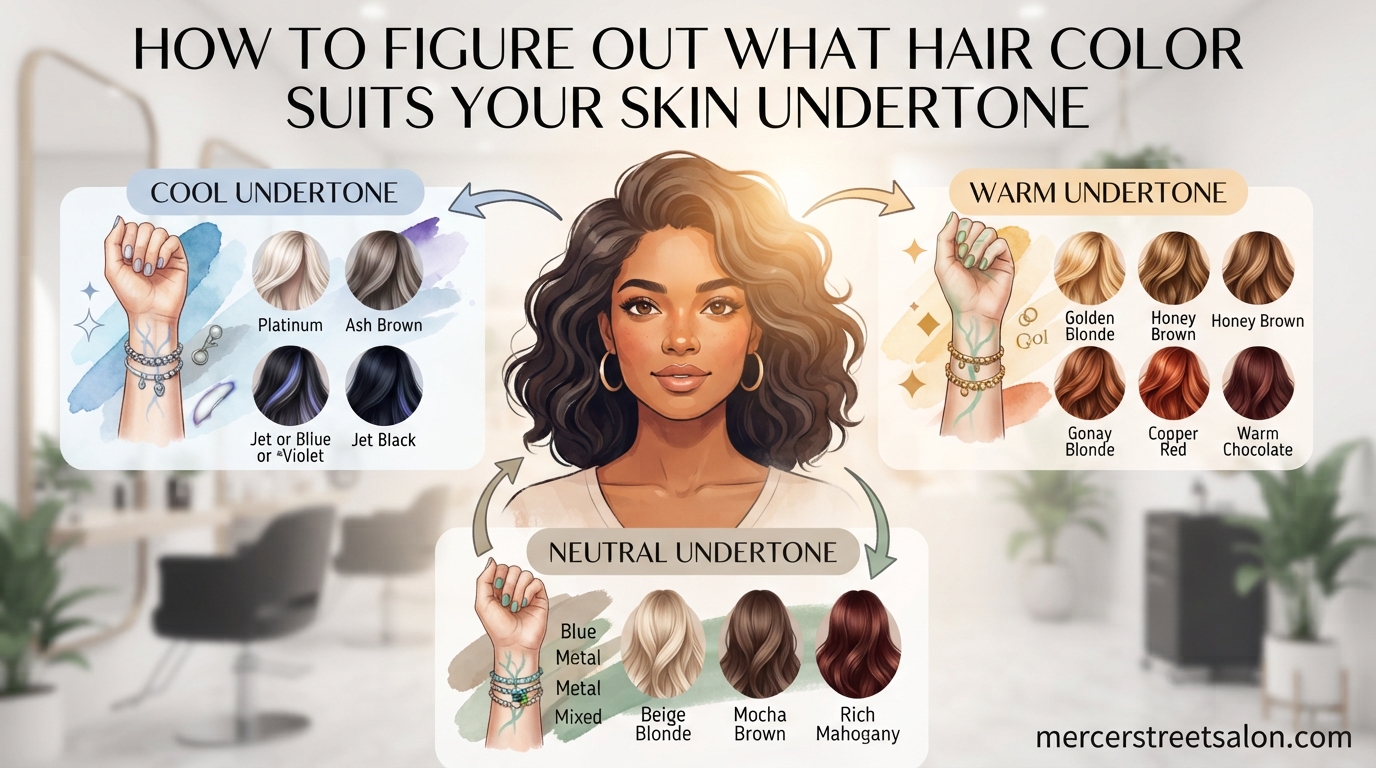
Choosing a hair color that actually flatters you starts with understanding what is happening beneath the surface of your skin. Your surface tone can change with the seasons, but your undertone stays the same year-round. That undertone is the single most important factor in finding the right hair color for your skin undertone.
I have spent years in salons consulting with clients who felt stuck choosing between blonde, brunette, or red because they did not know what suited them. The process becomes much simpler once you can identify whether you have cool, warm, or neutral undertones. You stop guessing and start matching.
At Mercer Street Salon, our team walks through this exact framework with every color consultation. This guide covers five at-home tests you can do in minutes, specific shade recommendations for every undertone, and guidance for olive and deeper skin tones that often get overlooked.
Table of Contents
Skin Tone vs Skin Undertone: What Is the Difference?
Your skin tone is the color you see on the surface, and it can shift based on sun exposure, season, or lighting. You might describe it as fair, light, medium, tan, or deep. This is what most people focus on, but it is only half the picture.
Your skin undertone is the subtle hue that sits beneath the surface. It remains consistent regardless of whether you are pale in winter or tanned in summer. Undertones fall into three categories: cool, warm, and neutral. There is also olive, which functions as a unique variation that can overlap with the other three.
Understanding this distinction matters because two people with the same fair skin tone can have completely different undertones. One might look radiant in golden copper hair while the other looks washed out. The right hair color for skin undertone depends on what is underneath, not what you see on top.
How to Figure Out What Hair Color Suits Your Skin Undertone: 5 Tests You Can Do Right Now
You do not need a salon appointment to identify your undertone. Here are five reliable tests you can do at home in under ten minutes. Try at least three of them and look for a consensus in your results.
Test 1: The Vein Test
This is the fastest and most popular method for finding your undertone. Turn your wrist over in natural daylight and look at the visible veins on the inside of your forearm. The color of those veins reveals your underlying pigment.
If your veins appear blue or purple, you likely have cool undertones. If they look green, you probably have warm undertones. If you cannot tell whether they are blue or green, or they seem to be a mix of both, you likely have neutral undertones.
One important note: the vein test can be tricky on deeper skin tones where veins are less visible. If you cannot clearly see vein color, move on to the other tests below for a more reliable read.
Test 2: The Jewelry Test (Gold vs Silver)
Hold a piece of silver jewelry against one hand and a piece of gold jewelry against the other. Alternatively, drape each metal across your wrist or collarbone and observe which one makes your skin look brighter and more even. The metal that flatters you corresponds to your undertone.
Silver, platinum, and white gold tend to flatter cool undertones. Gold, rose gold, and copper bring out the best in warm undertones. If both metals look equally good on you, you are likely in the neutral zone.
I have seen clients who swore they could only wear gold discover that silver actually brightens their complexion once they test it side by side. The difference can be subtle, so take a photo in natural light and compare if you are unsure.
Test 3: The Sun Exposure Test
Think about how your skin typically reacts to sun exposure. Does your skin burn easily and struggle to tan, or do you tan quickly and rarely burn? Your sun behavior is closely linked to your undertone.
Skin that burns before it tans usually signals cool undertones. Skin that tans easily and quickly tends to have warm undertones. If you burn initially but then develop a tan, you may fall into the neutral category.
This test is not about how dark or light your skin is. It is about how your skin responds to melanin production when exposed to UV rays. Even very fair skin can tan easily if warm undertones are present.
Test 4: The White Cloth Test
Stand in front of a mirror in natural daylight holding a pure white piece of fabric or paper next to your face. A white towel or pillowcase works well for this. The contrast between the white and your skin will reveal your undertone.
If your skin looks slightly pink, rosy, or bluish against the white, you have cool undertones. If your skin appears yellow, peachy, or golden by comparison, you have warm undertones. If your skin looks greyish or you cannot identify a clear hue, you likely have neutral undertones.
For best results, remove all makeup and do this test before applying any skincare products that might leave a cast on your skin. Natural daylight near a window gives the most accurate reading.
Test 5: The Eye Color Test
While eye color does not determine your undertone on its own, it provides a helpful clue when combined with the other tests. Certain eye colors correlate statistically with specific undertones.
Blue, gray, and deep brown eyes often accompany cool undertones. Amber, hazel, and green eyes frequently pair with warm undertones. People with neutral undertones can have any eye color, which is why this test works best as a confirmation rather than a standalone method.
If you have already noticed from the vein or jewelry test that you lean cool or warm, check whether your eye color supports that finding. When multiple tests point in the same direction, you can feel confident in your result.
Best Hair Colors for Cool Undertones
If your tests pointed to cool undertones, look for hair colors with ashy, icy, or violet bases. These shades complement the pink or bluish hints in your skin and keep your complexion from looking ruddy or flushed.
The general rule is that cool skin pairs best with cool hair colors. You want shades that have names containing words like ash, icy, platinum, champagne, or mocha. These tones create harmony with your skin rather than fighting against it.
Top hair color picks for cool undertones include ash blonde, platinum blonde, icy champagne blonde, mushroom brown, espresso brown, cool-toned burgundy, and blue-black. If you want red, go for mahogany or violet-based reds rather than orange or copper reds.
Ash blonde is one of the most flattering choices for cool-toned fair to medium skin. It neutralizes warmth and gives a clean, bright finish. For deeper cool skin, espresso and blue-black create striking contrast without pulling red or brassy.
If you prefer dimension over a single solid color, ask for cool-toned balayage or babylights. Stick to lowlights and highlights in the same cool family rather than mixing warm and cool pieces, which can create a muddy result.
Best Hair Colors for Warm Undertones
Warm undertones call for hair colors with golden, copper, amber, and honey bases. These shades bring out the natural glow in your skin and enhance the golden or peachy qualities that make warm undertones so radiant.
The matching principle applies here too: warm skin pairs best with warm hair colors. Look for shade names that include words like golden, honey, caramel, copper, chestnut, or auburn. These will flatter your complexion and bring warmth to your overall look.
Top hair color picks for warm undertones include golden blonde, honey blonde, strawberry blonde, copper, caramel brown, chestnut, warm auburn, and chocolate brown with golden highlights. If you want a bold statement color, copper red is one of the most striking choices for warm skin.
Golden blonde is a standout for warm-toned fair to medium skin. It catches light beautifully and makes the skin look sun-kissed even in winter. For deeper warm skin, rich chocolate brown and warm chestnut provide depth without looking flat.
Avoid ash-based shades if you have warm undertones. Ash tones can make warm skin look dull or greenish. If you have previously colored your hair with an ash shade and felt something looked off, this is likely why.
Best Hair Colors for Neutral Undertones
Neutral undertones give you the most flexibility because your skin has a balance of both warm and cool tones. You can pull off shades from either family, which makes experimenting a lot more fun.
Neutral undertone skin looks great with shades that are balanced themselves. Think beige blonde, sandy blonde, natural brown, soft caramel, and warm-tipped brown. These colors are not too ashy and not too golden, which mirrors your skin’s natural equilibrium.
If you want to push in one direction, both cool and warm shades can work. Just avoid extremes at either end. A very ash platinum might look harsh, while a very orange copper might overwhelm. Stick to shades that sit somewhere in the middle of the spectrum.
For dimensional color, neutral undertones can handle mixed tones beautifully. A caramel balayage over a natural brown base works well because your skin can support both the warm pieces and the cooler base.
Best Hair Colors for Olive Skin Tones
Olive skin is the undertone that most people get wrong, and it is severely underrepresented in most guides. Olive skin has a subtle green or greyish cast beneath the surface, and it can appear in any skin depth from fair to deep. It often overlaps with neutral undertones but requires specific color choices.
If you have olive skin, your biggest challenge is avoiding hair colors that bring out unwanted green or sallow tones. Ashy shades can make olive skin look grey or ill. Very warm golden shades can exaggerate the green in your complexion.
The best hair colors for olive skin sit in the rich, warm-but-not-too-warm zone. Think chocolate brown, espresso, warm chestnut, deep mahogany, and caramel highlights. If you want blonde, go for a golden beige or honey rather than ash or platinum.
For red tones, avoid bright copper and opt instead for deep auburn or burgundy. These colors add richness and warmth without clashing with the green undertones in your skin. Many people with South Asian, Mediterranean, or Latin American backgrounds have olive undertones, and these recommendations tend to work especially well for those skin depths.
Skin Depth and Undertone: Matching Your Full Profile
Your undertone is only one piece of the puzzle. To find your ideal hair color, you also need to factor in your skin depth, which is how light or deep your skin is. The combination of depth and undertone determines your full profile.
Fair Skin With Cool Undertones
Fair cool skin looks striking with high-contrast shades. Platinum blonde, icy champagne, and cool espresso all create a dramatic and polished look. Avoid anything too warm or brassy, which can clash with the pink in your skin.
Fair Skin With Warm Undertones
Fair warm skin glows with golden blonde, strawberry blonde, and soft copper. These shades enhance the natural peachiness in your complexion. Avoid stark platinum or blue-black, which can look harsh against fair warm skin.
Medium Skin With Cool Undertones
Medium cool skin shines with mushroom brown, cool mocha, and ash-toned balayage. These colors add dimension while keeping the overall finish cool and polished. Caramel can work if it leans beige rather than golden.
Medium Skin With Warm Undertones
Medium warm skin looks rich with caramel brown, honey blonde, and warm chestnut. These shades pick up the golden qualities in your skin and create a sun-kissed effect. Copper highlights add a beautiful pop of warmth.
Deep Skin With Cool Undertones
Deep cool skin is stunning with blue-black, espresso, and cool burgundy. These shades create deep contrast and intensity without pulling red or orange. Violet-based burgundy is especially flattering and makes the skin look luminous.
Deep Skin With Warm Undertones
Deep warm skin glows with chocolate brown, warm mahogany, and golden copper highlights. These shades bring out the richness and warmth in deep skin. Warm auburn is also a beautiful choice that adds dimension and vibrancy.
Common Mistakes to Avoid When Choosing Hair Color
After working with countless clients, I see the same mistakes repeated. Avoiding these common pitfalls will save you time, money, and the frustration of a color that does not feel right.
Do not skip the undertone test and choose based on trends alone. What looks incredible on your favorite celebrity might not work for your undertone. Always start with your undertone and then narrow down within that category.
Do not ignore how lighting affects your color. Salon lighting can make a shade look completely different from your bathroom or office light. Always check your color reference photos in natural daylight before committing.
Do not assume that because you liked a color five years ago, the same shade will work today. Hair changes with age, and so does skin. Graying hair can affect how color deposits, and skin can shift in depth over time.
Do not be afraid to consult a professional. Even with all the at-home tests, a trained colorist can identify nuances you might miss. At our salon, we regularly help clients who felt stuck between two undertones find clarity through a consultation.
How Aging Affects Your Undertone and Color Choices
This is a topic almost no competitor covers, and it is one of the most common questions we hear from clients over 40. As we age, our skin loses some of its pigment and can become slightly cooler or lighter. Hair also grays, which changes how dye deposits and develops.
If your skin has shifted cooler with age, you might find that shades which once flattered you now look off. A golden blonde that looked radiant at 30 might start to look brassy at 50. Consider moving half a shade cooler or softer as your skin evolves.
Gray hair tends to be more resistant to color, which means warm shades can fade faster and leave behind unwanted brassiness. Using a purple shampoo and scheduling regular gloss treatments helps maintain your chosen tone between appointments.
FAQs
How to figure out what hair color goes with your skin tone?
Start by identifying your skin undertone using the vein test, jewelry test, and sun exposure test. Cool undertones pair with ash, platinum, and espresso shades. Warm undertones pair with golden, copper, and caramel shades. Neutral undertones can wear both warm and cool colors.
How do I know if I have warm or cool undertones?
Look at the veins on the inside of your wrist in natural light. Blue or purple veins indicate cool undertones, while green veins indicate warm undertones. You can also test whether gold or silver jewelry flatters your skin more. Silver suits cool tones and gold suits warm tones.
What hair color suits olive skin tone?
Olive skin looks best with rich, balanced shades like chocolate brown, espresso, warm chestnut, and deep mahogany. Avoid ashy shades which can make olive skin look grey, and very warm golden shades which can exaggerate green tones. Deep auburn and burgundy also work beautifully for olive complexions.
Can neutral undertones wear any hair color?
Neutral undertones have the most flexibility and can wear both warm and cool hair colors. The best approach is to choose balanced shades like beige blonde, sandy blonde, or natural brown. Avoid extreme ends of the spectrum like stark platinum or bright copper, which can overwhelm neutral skin.
Does eye color affect which hair color suits me?
Eye color provides a helpful clue but is not the primary factor. Blue, gray, and deep brown eyes often accompany cool undertones, while amber, hazel, and green eyes frequently pair with warm undertones. Use eye color as a confirmation alongside the vein and jewelry tests rather than on its own.
Conclusion
Finding the right hair color for your skin undertone does not have to be overwhelming. Run the five at-home tests, identify whether you lean cool, warm, neutral, or olive, and then match your hair color within that family. The results speak for themselves.
Remember that your skin depth and undertone work together to create your full color profile. A shade that flatters fair cool skin will be different from one that flatters deep cool skin. Factor in both elements for the most accurate recommendation.
If you are still unsure after testing, book a color consultation with a professional stylist. Bring reference photos of shades you love, and let an experienced eye help you translate your undertone into the perfect color. The right shade is out there waiting for you.