
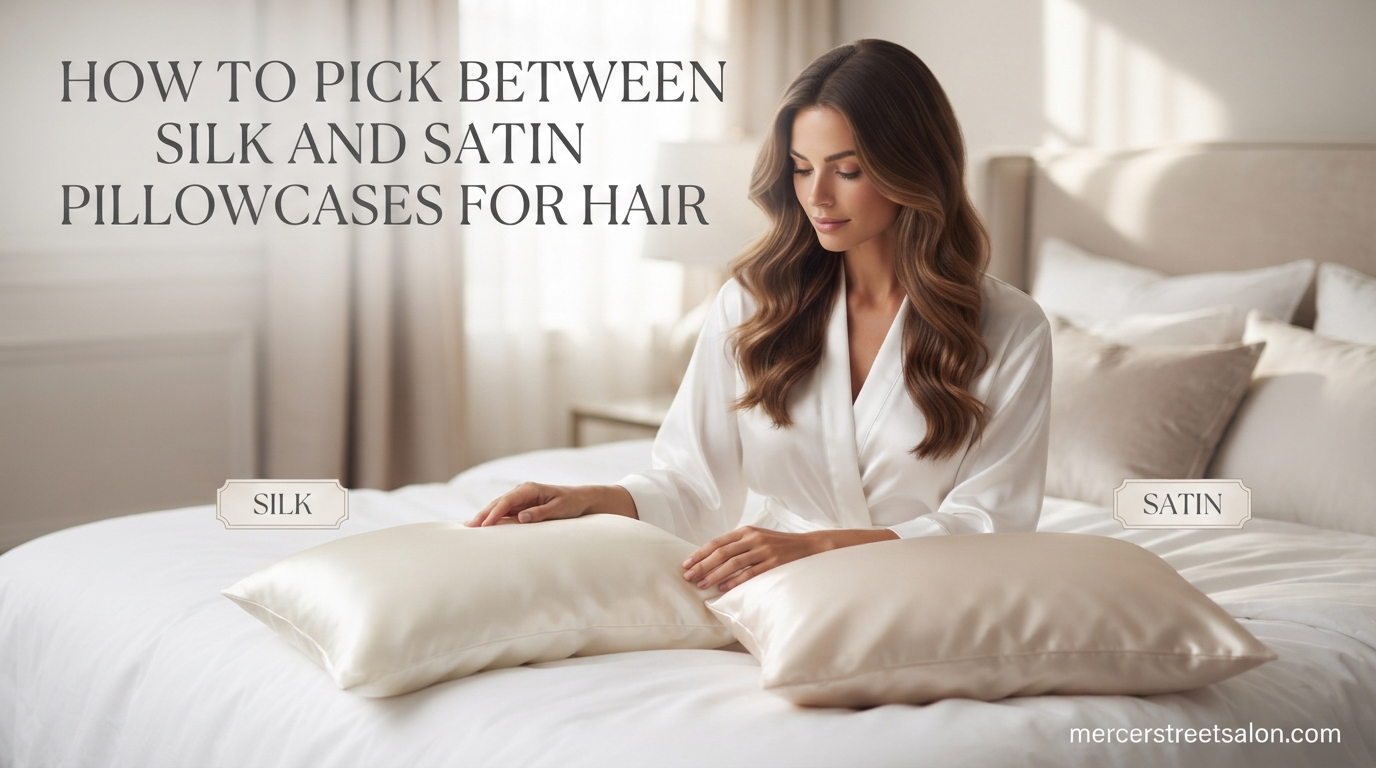
You spend roughly a third of your life with your face and hair pressed against a pillowcase. That is a lot of hours for the wrong fabric to create friction, pull at your hair cuticle, and undo the good work you put into your hair care routine during the day. Learning how to pick between a silk and satin pillowcase for your hair can change that equation overnight.
Our team has spent years in the salon industry watching clients struggle with frizz, breakage, and bedhead that traces back to their bedding choices. The pillowcase you sleep on matters more than most people realize, and the material you choose directly affects how your hair looks each morning.
The two options that dominate the conversation are silk and satin. Both reduce friction compared to cotton, but they are fundamentally different materials with different properties, price points, and care requirements. Understanding those differences is the key to making the right call for your hair type, budget, and lifestyle.
In this guide, we break down exactly what silk and satin are, how they compare across every meaningful category, and which one makes the most sense for your specific hair needs. We also address the durability concerns, marketing tricks, and hair type guidance that most competitors gloss over.
Table of Contents
Quick Answer: Which Is Better for Your Hair?
Silk is the better choice for your hair if budget is not a primary concern. Real silk, particularly mulberry silk with a momme weight of 19 or higher, provides superior moisture retention, natural temperature regulation, and a friction-free surface that minimizes frizz and breakage. Its natural protein fibers are structurally similar to human hair, which makes it uniquely gentle.
Satin is the smarter pick if you want most of the benefits at a fraction of the cost. A quality satin pillowcase (typically made from polyester) delivers a smooth, low-friction surface that reduces tangles and bedhead. It is more durable, machine washable, and stays smooth longer than silk over repeated washes.
Both materials outperform cotton by a wide margin. The real question is whether the premium for silk is worth it for your hair type and budget. The sections below will help you decide.
What Is Silk?
Silk is a natural protein fiber produced by silkworms, primarily the Bombyx mori species. The silkworms spin cocoons from a continuous thread of silk protein, which is then harvested, unwound, and woven into fabric. This process has remained largely unchanged for over 5,000 years since it was first developed in ancient China.
What makes silk special for hair is its structure. Silk fibers are composed of fibroin, a protein that contains 18 amino acids. These amino acids are remarkably similar to the keratin that makes up human hair. When your hair rests against silk, it encounters a surface that is biologically compatible rather than foreign and abrasive.
Mulberry Silk: The Gold Standard
The vast majority of quality silk pillowcases are made from mulberry silk. This is silk produced by silkworms that are fed exclusively on mulberry leaves, resulting in a consistent, smooth, and strong fiber. Mulberry silk accounts for roughly 90% of all silk produced worldwide and is considered the highest grade available for textiles.
When you see a silk pillowcase marketed without specifying the type, it is almost certainly mulberry silk. The quality can vary significantly, however, based on the grade of the silk and how it is woven.
Understanding Momme Weight
Momme weight (pronounced “mummy”) is the measurement used to describe the density and quality of silk fabric. It refers to the weight in pounds of a piece of silk that is 45 inches wide by 100 yards long. A higher momme weight means denser, more durable, and higher-quality silk.
For pillowcases, here is what the momme numbers tell you:
12 to 16 momme: Lightweight and lower quality. These are often marketed as silk but feel thin and wear out quickly. Not recommended for pillowcases.
17 to 18 momme: Acceptable quality for a budget silk option. You will get some hair benefits, but durability is limited.
19 to 22 momme: This is the sweet spot for quality silk pillowcases. Dense enough to be durable, smooth enough to deliver full hair benefits. Most reputable brands operate in this range.
23 to 25+ momme: Premium luxury silk. Exceptionally smooth and long-lasting, but the price jumps considerably. Worth it if you plan to use the pillowcase for years and can justify the investment.
If a silk pillowcase does not list its momme weight, treat that as a red flag. Quality manufacturers are proud to display this number.
Ahimsa Silk (Peace Silk)
Traditional silk production involves boiling the cocoon while the silkworm is still inside, which kills the worm. Ahimsa silk, also called Peace silk, is produced by allowing the silkworm to complete its lifecycle and emerge from the cocoon as a moth before the silk is harvested. This creates an ethical, cruelty-free alternative.
Ahimsa silk has a slightly different texture than traditional mulberry silk because the broken cocoon results in shorter fibers. It is less smooth and slightly more textured, which some people find less ideal for hair benefits. However, for those who prioritize animal welfare, it remains a viable option.
Grade 6A Silk Explained
Silk quality is also graded on a scale from A to C, with 6A being the highest possible grade within the A category. Grade 6A silk represents the longest, strongest, and most uniform fibers available. It produces the smoothest, most lustrous fabric.
When you see “Grade 6A mulberry silk” on a pillowcase label, it means the manufacturer is using top-tier raw materials. Combined with a momme weight of 19 or above, Grade 6A silk gives you the best possible surface for your hair.
What Is Satin?
Here is the most important thing to understand about satin: it is not a material. Satin is a weave. This distinction trips up most shoppers and is the source of endless confusion in the pillowcase market.
A weave refers to how threads are interlaced during the weaving process. The satin weave is characterized by a specific pattern where four or more weft (horizontal) threads float over a single warp (vertical) thread. This creates long floating threads on the surface that produce the glossy, smooth feel we associate with satin.
Because satin is a weave rather than a fiber, a satin pillowcase can be made from almost any material. The most common materials used for satin pillowcases are polyester, nylon, rayon, and acetate. It is also possible to make satin from silk, which is where the confusion between “silk satin” and “polyester satin” begins.
Polyester Satin: What Most People Buy
When you purchase an inexpensive satin pillowcase, you are almost certainly buying polyester satin. Polyester is a synthetic fiber made from plastic polymers. When woven in a satin pattern, it produces a very smooth, slippery surface that mimics the feel of silk at a fraction of the cost.
Polyester satin has real advantages for hair care. It is exceptionally smooth, creates very little friction, and is highly durable. It does not absorb moisture from your hair the way cotton does, which helps your hair retain its natural oils overnight.
The main drawbacks of polyester satin are breathability and temperature. Polyester does not breathe well, which means it can trap heat. Hot sleepers often find satin pillowcases warmer than silk. Polyester satin can also generate static electricity in dry climates, which is a problem for fine or flyaway-prone hair.
Silk Satin vs Polyester Satin
It is possible to weave silk threads in a satin pattern, creating what is called silk satin. This combines the natural benefits of silk fiber with the glossy surface of a satin weave. However, silk satin pillowcases are rare and expensive because they use silk fibers (which are costly) in a specific weave pattern.
In practice, when a product is labeled simply “satin pillowcase” without specifying the fiber content, it is almost always polyester. Products labeled “silk satin” should explicitly state the fiber content and momme weight. This is a common area where marketing gets deceptive.
Sateen: Not the Same as Satin
Sateen is another term that adds confusion. Sateen is a satin weave applied to cotton or rayon fibers. The result is a fabric that has some sheen and smoothness but retains the absorbent properties of cotton. Sateen pillowcases are softer than regular cotton but do not offer the same hair benefits as true satin or silk because cotton fibers still absorb moisture and create more friction.
If your goal is hair protection, sateen is a marginal upgrade over standard cotton but not comparable to silk or satin polyester. Always check the fiber content before purchasing.
Why Satin Costs Less
The price difference between silk and satin comes down to production. Silk requires raising silkworms, harvesting cocoons, unwinding continuous silk threads, and weaving them into fabric. It is labor-intensive, time-consuming, and limited by the biological output of silkworms.
Polyester satin, by contrast, is produced in factories from petroleum-based polymers. The fibers are extruded in continuous lengths, woven in a satin pattern, and finished at scale. There is no biological limit on production, no agricultural dependency, and minimal labor per unit. This is why you can find polyester satin pillowcases for a tenth of what a quality silk pillowcase costs.
Silk vs Satin: Side-by-Side Comparison
None of the top-ranking articles for this topic use a proper comparison table. That is a gap we want to fill because a side-by-side view makes the decision much clearer. Here is how silk and satin compare across every category that matters for your hair.
Side-by-Side Comparison Table
| Category | Silk (Mulberry) | Satin (Polyester) |
|---|---|---|
| Material | Natural protein fiber from silkworms | Synthetic fiber (usually polyester) |
| What It Is | A fiber type | A weave type |
| Smoothness | Exceptionally smooth, naturally glossy | Very smooth and slippery |
| Breathability | Highly breathable, temperature-regulating | Low breathability, traps heat |
| Moisture Absorption | Very low (does not strip hair oils) | Very low (does not strip hair oils) |
| Hypoallergenic | Naturally hypoallergenic, resists dust mites | Hypoallergenic but synthetic |
| Durability Over Time | Can roughen with repeated washing | Stays smooth longer with regular washing |
| Static | Naturally anti-static | Can create static in dry climates |
| Temperature for Sleep | Cool to the touch, good for hot sleepers | Can feel warm, less ideal for hot sleepers |
| Care Requirements | Hand wash or delicate cycle, air dry | Machine washable and dryable |
| Price Range | $40 to $210+ per pillowcase | $8 to $30 per pillowcase |
| Environmental Impact | Natural, biodegradable, but animal-derived | Synthetic, petroleum-based, not biodegradable |
| Best For Hair Types | Fine, fragile, color-treated, sensitive scalp | Thick, curly, protective styles, budget-conscious |
When to Choose Silk
You should choose a silk pillowcase if you have fine or fragile hair that breaks easily. The natural protein fibers are gentler than synthetic alternatives, and the anti-static properties matter more when your hair is lightweight and prone to flyaways.
Silk is also the better choice if you are a hot sleeper. The natural breathability and temperature-regulating properties of silk fibers keep the surface cool throughout the night. Polyester satin traps heat and can make night sweats worse.
Choose silk if you have sensitive skin, scalp conditions, or allergies. Silk is naturally resistant to dust mites, mold, and mildew. The protein structure is compatible with human skin and hair in a way that synthetic fibers cannot match.
Finally, choose silk if you can afford the upfront investment and are willing to follow proper care instructions. A high-quality silk pillowcase maintained carefully can last 12 to 18 months of nightly use before showing significant wear.
When to Choose Satin
You should choose a satin pillowcase if budget is a primary concern. A quality polyester satin pillowcase delivers 80% of the hair benefits of silk at 10% of the cost. For most people, that value proposition is hard to argue against.
Satin is also the better choice if you want something durable and low-maintenance. You can throw a satin pillowcase in the washing machine and dryer without worrying about ruining it. This matters if you do not have time for hand-washing or if you use your pillowcase every night and need to wash it frequently.
Choose satin if you have thick, curly, or coily hair. These hair types benefit from the extreme slip that polyester satin provides, which helps prevent tangles and preserves curl definition. The slightly higher friction compared to silk is less noticeable on thicker hair textures.
Choose satin if you rotate pillowcases frequently or need multiple sets. At $10 to $30 each, you can own several satin pillowcases for the price of one silk pillowcase.
The Durability Question Nobody Addresses
Here is something that no ranking competitor talks about but Reddit users mention constantly. Silk pillowcases tend to get rougher over time, even with proper care. We have seen this pattern repeatedly in long-term user reports.
One Reddit user in r/HaircareScience noted: “I have a silk pillowcase and two satin pillowcases and I actually prefer the satin. The silk has gotten rougher over time but the satin is still soft.” Another user echoed this: “I like my satin pillowcase more than my silk one. It’s much more durable and stayed soft whereas the silk got rougher over time and washes.”
This happens because silk fibers, while strong, are delicate when wet. Each wash cycle, even a gentle hand wash, gradually degrades the smooth surface of the silk. The protein fibers can roughen, pill, or lose their luster after 20 to 30 washes.
Polyester satin, by contrast, is made from plastic fibers that do not degrade the same way. A satin pillowcase washed weekly in a machine will typically maintain its smoothness for a year or more. This is an important factor when weighing the value proposition.
If you choose silk, be prepared for the surface quality to decline over time. Buying a higher momme weight (22+) extends the usable lifespan, but no silk pillowcase stays as smooth as day one indefinitely.
Silk vs Satin: Hair Benefits Compared
Both silk and satin deliver meaningful hair benefits compared to cotton. The question is how they compare to each other across specific hair concerns. Here is a detailed breakdown.
Frizz Reduction
Silk wins on frizz reduction, but not by a massive margin. Both materials create a low-friction surface that prevents the hair cuticle from being roughened during sleep. Cotton, by comparison, grips the hair and creates friction that lifts the cuticle, leading to frizz.
The advantage silk holds comes from its natural anti-static properties. Static electricity contributes to flyaway frizz, especially in dry winter months. Silk dissipates static naturally, while polyester satin can actually generate static in low-humidity environments. If frizz is your primary concern and you live in a dry climate, silk has a clear edge.
Breakage Prevention
Both materials help prevent breakage by reducing friction, but silk has a slight advantage for fragile hair. The protein structure of silk is gentler on delicate hair strands than the plastic surface of polyester satin. If your hair is already damaged from chemical treatments, heat styling, or is naturally fine, silk provides a more forgiving surface.
That said, the difference is not dramatic. Both silk and satin reduce breakage significantly compared to cotton. If your hair is healthy and resilient, you may not notice a meaningful difference between the two.
Moisture Retention
This is one area where both materials perform similarly and both significantly outperform cotton. Cotton is highly absorbent, which means it pulls moisture from your hair overnight. This is why people wake up with dry, frizzy hair after sleeping on cotton.
Silk and satin are both minimally absorbent. They do not strip your hair of its natural oils, and they help any leave-in products you applied before bed stay in place. This is particularly important for curly and coily hair types, which are naturally drier and benefit from overnight moisture retention.
Silk has a very slight edge here because its protein fibers can hold a small amount of moisture without absorbing it from your hair. Polyester satin is completely non-absorbent. In practice, the difference is negligible for most users.
Static and Flyaways
This is where silk and satin diverge noticeably. Silk is naturally anti-static due to the moisture content in its protein fibers. Polyester satin, being a synthetic material, can generate static electricity, especially in dry climates or during winter months.
If you have fine hair and struggle with flyaways, this is a meaningful difference. Silk will help tame static, while satin may make it worse. Some satin users report that using a leave-in conditioner or light oil helps mitigate the static issue.
Hairstyle Longevity
If you are trying to preserve a blowout, curls, or braids overnight, both silk and satin help extend the life of your style. The low-friction surface prevents your hair from being disturbed as you move during sleep.
For blowouts and straightened styles, both materials work well. For curly hair and protective styles, satin is often preferred because its extreme slip prevents curls from being compressed or reshaped overnight. Some people with curly hair actually prefer the slightly grippier texture of silk, which helps maintain curl pattern without flattening.
Hair Type Specific Guidance
Curly and Coily Hair: Both silk and satin are excellent. Satin is the more popular choice in the curly hair community because it provides extreme slip at an affordable price, allowing you to own multiple pillowcases for frequent washing. Silk is preferred by those who also want skin benefits and temperature regulation. If budget allows, silk is slightly better; if budget is tight, satin is more than adequate.
Fine and Thin Hair: Silk is the clear winner here. Fine hair is more susceptible to static, and silk’s natural anti-static properties make a real difference. Fine hair is also more fragile, so the gentler protein fibers of silk provide better protection. The lightweight nature of fine hair means it benefits from the reduced friction and temperature regulation of silk.
Thick and Coarse Hair: Satin is often the better practical choice. Thick hair benefits from the extreme slip of polyester satin, and the higher friction compared to silk is barely noticeable on coarse textures. Satin is also more durable under the weight and movement of thick hair. However, silk remains superior if you also want skin and temperature benefits.
Color-Treated Hair: Both materials help preserve color by reducing moisture loss and friction. Silk has a slight edge because its natural properties are gentler on chemically processed hair, which is more fragile. However, the difference is small enough that satin is a perfectly acceptable choice, especially given that color-treated hair requires frequent washing and you may need multiple pillowcases.
Protective Styles (Braids, Twists, Extensions): Satin is typically preferred for protective styles. The smooth surface prevents friction that can cause frizz at the base of braids or twists. Satin is also more practical because you can wash it frequently as protective styles can cause product buildup on your pillowcase.
Silk vs Satin: Skin Benefits Compared
The hair benefits get most of the attention, but the skin benefits of your pillowcase choice are equally important. You spend hours each night with your face pressed against this fabric, so it matters.
Sleep Wrinkle Prevention
Both silk and satin help reduce sleep wrinkles compared to cotton. The smooth surface prevents the fabric from creasing against your skin, which is what creates those morning lines that can become permanent over time.
Silk has a slight edge here because it is softer and more pliable against the skin. The protein fibers are gentler on delicate facial skin than the firmer surface of polyester satin. However, both materials are a significant improvement over cotton.
Hypoallergenic Properties
Silk is naturally hypoallergenic. It resists dust mites, mold, and mildew without any chemical treatment. The protein structure of silk contains sericin, a natural substance that repels bacteria and allergens. This makes silk an excellent choice for people with allergies, asthma, or sensitive skin.
Polyester satin is also considered hypoallergenic in the sense that it does not harbor dust mites the way cotton does. However, some people with sensitive skin find that synthetic fibers cause irritation. If you have reactive skin or contact dermatitis, silk’s natural properties are preferable.
Acne Prevention
Neither silk nor satin will cure acne, but both can help. The key is that both materials are less absorbent than cotton, so they do not soak up your skincare products overnight. Your serums and moisturizers stay on your face where they belong.
For acne-prone skin, silk is marginally better because of its natural antibacterial properties. Polyester satin is a clean, non-absorbent surface but does not have the same bacterial resistance. Regardless of material, you should wash your pillowcase at least weekly if you are acne-prone.
Rosacea and Sensitive Skin
For rosacea and reactive skin conditions, silk is the recommended choice. Dermatologists often suggest silk pillowcases for patients with rosacea because the natural temperature regulation prevents overheating (a common rosacea trigger) and the soft surface reduces irritation.
The breathability of silk helps keep the skin cool, which minimizes the flushing and redness associated with rosacea. Polyester satin traps heat, which can trigger flare-ups for some rosacea patients.
Folliculitis and Scalp Conditions
Folliculitis, an inflammation of hair follicles, can be aggravated by friction and bacteria on your pillowcase. Both silk and satin help by reducing friction, but silk has the advantage of natural antibacterial properties from sericin.
If you have folliculitis or scalp sensitivity, silk is the better choice. The reduced friction combined with natural bacterial resistance creates a healthier sleeping environment for inflamed follicles.
Chemotherapy and Hair Loss
For chemotherapy patients experiencing hair thinning or loss, both silk and satin are gentle on sensitive scalps. Silk is often recommended by cancer care organizations because it is soft, breathable, and naturally soothing to irritated skin.
During chemotherapy, the scalp can become extremely tender. Silk’s smooth, cool surface is more comfortable against sensitive skin than polyester satin. Silk also helps regulate temperature, which is important since many chemo patients experience temperature fluctuations.
Price and Value: Is Silk Worth the Premium?
The price gap between silk and satin pillowcases is significant. Quality polyester satin pillowcases typically cost between $8 and $30. Quality mulberry silk pillowcases range from $40 for entry-level options to $210 or more for premium grades.
That is a 5x to 25x price difference, which naturally raises the question of whether silk is worth it. The answer depends on how you calculate value.
Cost Per Night Analysis
Let us break down the real cost over time. A quality silk pillowcase in the $60 to $80 range, with a 19-22 momme weight, typically lasts about 12 to 18 months with proper care before the surface quality noticeably degrades. That works out to roughly $0.11 to $0.18 per night of use.
A polyester satin pillowcase at $15 typically lasts about 12 months before showing wear or losing color. That works out to approximately $0.04 per night. Satin is clearly cheaper per night of use.
However, the calculation shifts if you value the additional benefits silk provides. If the temperature regulation prevents night sweats, the anti-static properties tame flyaways, and the natural protein fibers soothe sensitive skin, those benefits may justify the premium for you personally.
The Marketing Deception Warning
This is something that only one major competitor mentions, and it is critically important. Many products marketed as “silk” pillowcases are actually satin. This is one of the most common deceptions in the bedding market.
Here is how to spot fake silk being sold as genuine:
Burn test: Real silk burns slowly and smells like burning hair (because it is a protein fiber). It leaves a brittle, crushable ash. Polyester melts and smells like burning plastic, leaving a hard bead.
Price check: If a pillowcase claims to be 100% mulberry silk and costs under $20, be suspicious. Quality silk production is expensive, and legitimate brands cannot sell real silk at that price point profitably.
Momme weight listing: Real silk pillowcases should list the momme weight. If the product does not specify momme weight, it may not be genuine silk or may be very low quality.
Fiber content label: Check the care label. Real silk will be labeled as “100% silk” or “100% mulberry silk.” If the label says “100% polyester” but the product is marketed as silk, you have a clear case of deceptive marketing.
Touch and feel: Real silk is warm to the touch initially and has a soft, slightly grippy texture. Polyester satin feels cool and slippery with no grip. Silk has a natural luster, while polyester has an artificial shine.
How to Care for Your Pillowcase
Proper care extends the life of your pillowcase and preserves its hair benefits. Silk and satin require different approaches, and getting this wrong is the fastest way to ruin an expensive silk pillowcase.
Caring for Silk Pillowcases
Step 1: Hand washing (recommended). Fill a basin with cool water and add a few drops of gentle, pH-neutral detergent or baby shampoo. Submerge the pillowcase and gently agitate. Let it soak for 3 to 5 minutes. Do not wring or twist.
Step 2: Rinsing. Drain the soapy water and refill with cool, clean water. Gently press the pillowcase to remove soap. Repeat until no detergent remains. Add a teaspoon of white vinegar to the final rinse to restore natural luster.
Step 3: Drying. Lay the pillowcase flat on a clean, dry towel. Roll the towel with the pillowcase inside and press gently to remove excess water. Unroll and lay the pillowcase flat to air dry away from direct sunlight or heat.
Machine washing (if you must): Some silk pillowcases are labeled machine washable. Use a mesh laundry bag, select the delicate cycle, use cold water only, and add a gentle detergent. Never use hot water, bleach, or fabric softener on silk.
What to avoid: Never tumble dry silk. Never use bleach or enzyme-based detergents. Never dry silk in direct sunlight, which causes yellowing and fiber damage. Avoid wringing or twisting silk fabric.
Caring for Satin Pillowcases
Satin pillowcases are much easier to maintain, which is one of their biggest advantages.
Machine washing: Wash polyester satin in warm or cool water on a gentle cycle. Use a mild detergent. Avoid bleach and fabric softeners, which can coat the fibers and reduce the smooth surface.
Machine drying: Tumble dry on low heat or air dry. Remove promptly to prevent wrinkling. Polyester satin dries quickly and does not shrink.
What to avoid: Avoid high heat, which can melt or warp polyester fibers. Avoid ironing directly on satin, as the heat can damage the surface. If you must remove wrinkles, use a low-heat iron on the reverse side or use a garment steamer.
Color fading: One common complaint about satin pillowcases is color fading after repeated washes. To minimize this, wash in cold water, turn the pillowcase inside out before washing, and avoid over-drying. Dark colors like black and navy are most prone to visible fading.
How Often to Wash Either Type
Regardless of material, you should wash your pillowcase every 5 to 7 days. Your pillowcase collects sweat, body oils, dead skin cells, hair products, and bacteria. Sleeping on a dirty pillowcase undermines the hair and skin benefits you are trying to achieve.
If you have acne-prone skin or scalp conditions, consider changing your pillowcase every 2 to 3 days. Owning multiple pillowcases makes this practical, and this is where satin’s lower cost gives it an advantage.
FAQs
Should I get a satin or silk pillowcase for hair?
Choose silk if budget allows and you have fine, fragile, or color-treated hair. Choose satin if you want similar hair benefits at a fraction of the cost, especially for thick or curly hair types. Both significantly reduce frizz and breakage compared to cotton.
Do satin pillowcases work as well as silk for hair?
Satin delivers roughly 80% of the hair benefits of silk at 10% of the cost. Both reduce friction, prevent frizz, and help retain moisture. Silk has advantages in temperature regulation, static reduction, and skin compatibility, but satin is highly effective for most hair types and more durable over time.
What is the downside of a silk pillowcase?
The main downsides of silk are cost ($40-$210+), high maintenance (hand washing recommended), and the tendency to get rougher over time with repeated washing. Silk is also less durable than polyester satin and requires more careful handling.
Do dermatologists recommend satin pillowcases?
Dermatologists more commonly recommend silk pillowcases for skin conditions because silk is naturally hypoallergenic, breathable, and temperature-regulating. Polyester satin can trap heat and irritate sensitive skin. For patients with rosacea or reactive skin, silk is typically preferred.
Are silk pillowcases good for chemo patients?
Yes, silk pillowcases are excellent for chemotherapy patients. The soft, breathable surface is gentle on sensitive scalps, and the natural temperature regulation helps with chemo-related temperature fluctuations. Silk is often recommended by cancer care organizations for patients experiencing hair thinning or scalp tenderness.
What pillowcases are best for folliculitis?
Silk pillowcases are best for folliculitis because they reduce friction on inflamed follicles and have natural antibacterial properties from sericin protein. Satin also helps by reducing friction but lacks the antibacterial benefits. Wash your pillowcase every 2-3 days if you have folliculitis.
What kind of pillowcase is best for rosacea?
Silk pillowcases are best for rosacea because they are breathable and temperature-regulating, which helps prevent the overheating that triggers rosacea flare-ups. The soft surface also reduces skin irritation. Avoid polyester satin, which traps heat and can worsen redness.
How can I tell if my pillowcase is real silk or satin?
Check the care label for fiber content (real silk says 100% silk). Real silk feels warm and slightly grippy with a natural luster, while polyester satin feels cool and very slippery. A burn test confirms it: silk smells like burning hair and leaves a crushable ash; polyester melts and smells like plastic.
Making Your Final Decision
Learning how to pick between a silk and satin pillowcase for your hair comes down to three factors: your budget, your hair type, and your willingness to maintain the pillowcase.
If you have fine or fragile hair, sensitive skin, or sleep hot, invest in a quality silk pillowcase with a momme weight of 19 or higher. The natural protein fibers, temperature regulation, and anti-static properties justify the premium for these specific situations.
If you have thick or curly hair, want a low-maintenance option, or need multiple pillowcases for frequent rotation, a quality polyester satin pillowcase is the practical choice. You get most of the hair benefits at a price that makes sense for everyday use.
Either way, switching from cotton to silk or satin is one of the simplest changes you can make for healthier hair and skin. The pillowcase you sleep on each night has a bigger impact than most people realize. Choose the option that fits your needs, and your hair will thank you for it.