
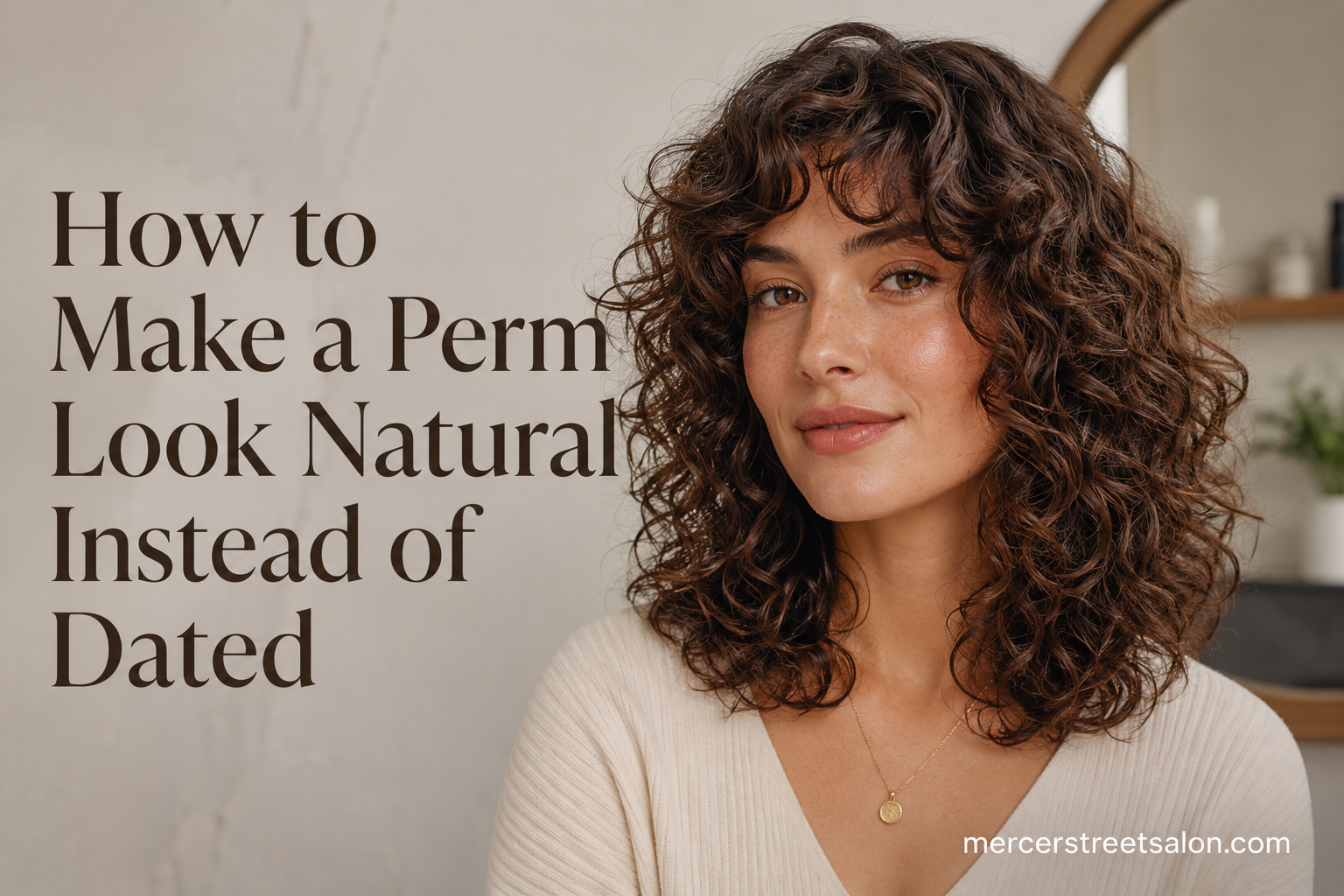
When I got my first perm, I walked out of the salon looking like I had stepped straight out of a 1985 yearbook. Tight, uniform ringlets that bounced with every step. My stylist called it volume. My friends called it poodle hair. The truth was, I had no idea how to make a perm look natural instead of dated, and honestly, I did not even know that was possible.
If you are reading this, you probably already know the feeling. You either have a perm that looks too tight and crispy, or you are considering one but terrified of ending up with that unmistakable 80s perm look. I have been there, and after years of trial and error, plus conversations with stylists who specialize in modern texture, I can tell you this: a perm absolutely can look natural, soft, and modern. The secret is not in luck or genetics. It is in technique, communication, and daily care.
This guide covers everything from choosing the right perm type to styling techniques that soften even the tightest curls. Whether you are prepping for your first salon appointment or trying to rescue a perm that went wrong, you will find specific, actionable steps here. We will also cover what to tell your stylist, because as I learned the hard way, saying “I want it to look natural” is not enough.
The goal is touchable, effortless curls that blend with your hair’s natural movement. Not helmet hair. Not crunchy spirals. Just soft, modern texture that looks like you woke up with it. Let’s get into exactly how to make a perm look natural instead of dated.
Table of Contents
Quick Answer: Can You Make a Perm Look Natural?
Yes, you can absolutely make a perm look natural. The key is choosing a modern perm technique like a digital perm or body wave perm, requesting varied rod sizes for multi-textured curl patterns, and following a sulfate-free care routine with regular deep conditioning. Natural-looking perms use larger rods, gentler solutions, and heat styling techniques that produce loose, touchable waves rather than tight uniform ringlets.
Here are the fastest ways to get natural-looking perm results:
- Ask for a digital perm or body wave perm instead of a traditional cold perm
- Request multiple rod sizes to create curl variation like natural hair
- Use larger rods for loose waves rather than tight spirals
- Bring reference photos to your consultation instead of relying on verbal descriptions
- Wash with sulfate-free shampoo and deep condition weekly
- Style with a diffuser and curl cream instead of air drying
- Never brush permed hair when dry, which separates curls and creates frizz
What Makes a Perm Look Dated vs Natural
Understanding the difference between a dated perm and a modern one starts with recognizing what went wrong in the 80s and 90s. Old-school perms used small uniform rods, strong alkaline solutions, and a one-size-fits-all approach. Every strand of hair wrapped around the same size rod produced identical tight ringlets. That uniformity is exactly what screams “perm” to everyone who sees it.
A dated perm has three hallmarks. First, the curls are uniformly tight from root to tip with no variation. Second, the texture feels crispy or crunchy rather than soft and touchable. Third, the overall shape is voluminous and round, almost helmet-like, because every section curls at the same intensity.
A natural-looking perm does the opposite. Modern perms use varied rod sizes so curls have different diameters, just like natural curl patterns. The texture is soft and movable. The shape falls naturally around the face rather than puffing outward. Most importantly, a modern perm blends with your existing hair texture instead of fighting against it.
I think of it this way: natural curls are never perfectly uniform. Even someone with naturally curly hair has looser waves at the crown and tighter curls underneath. A good perm mimics that organic variation. The goal is for someone to look at your hair and wonder if those curls are natural, not immediately know they came from a chemical treatment.
Choose the Right Perm Type for a Natural Look
The single biggest factor in how to make a perm look natural instead of dated is the type of perm you get. Not all perms are created equal, and the traditional cold perm that dominated the 80s is the one most likely to give you that dated look. Here are the perm types that produce the most natural results.
Digital Perm
The digital perm is the gold standard for natural-looking results, and it is the type most recommended by stylists who specialize in modern texture. Unlike a cold perm, a digital perm uses heat and a milder acidic solution to reshape the hair. The stylist wraps sections around rods and applies controlled heat through digital temperature regulation, which creates softer looser curls that fall more naturally.
What makes digital perms look so natural is the curl pattern itself. The curls are tighter at the mid-shaft and ends but looser near the root, which is exactly how natural wavy hair behaves. This gives you volume without the helmet effect. Users on Reddit consistently cite digital perms as the closest thing to natural curls, and the consensus is that the results are worth the higher cost.
Body Wave Perm
If you want the most subtle and natural enhancement possible, the body wave perm is your best option. This perm uses the largest rods available, creating loose soft waves rather than defined curls. It is perfect for people with straight or slightly wavy hair who just want more movement and touchable volume without obvious curl definition.
Body wave perms are especially popular for fine or thin hair because they add texture and body without overwhelming the hair’s natural character. The result looks like you spent the day at the beach rather than sitting in a salon chair. For anyone nervous about perms looking dated, this is the safest starting point.
Multi-Textured Perm
A multi-textured perm is the secret weapon for mimicking natural curl patterns. Instead of using one rod size for the entire head, the stylist uses a combination of different rod sizes placed strategically throughout the hair. Smaller rods go underneath and at the nape, while larger rods go around the face and crown.
This variation is what makes multi-textured perms look so realistic. Natural curls are never uniform, so why should a perm be? Forum users praise this technique as the best way to avoid the dated perm look. When different curl sizes blend together, the result is organic texture that moves and falls like real curls.
Root Perm
For anyone who just wants volume without curl, the root perm is worth considering. This technique perms only the root area, lifting flat hair and adding body at the crown while leaving the lengths and ends straight or naturally textured. It is ideal for people whose hair falls flat by midday but who do not want full curls.
Root perms are popular among people with fine hair who want lift and dimension without committing to an all-over curl pattern. Because the permed section is hidden underneath the top layer, the results look completely natural. No one will know you had a chemical treatment.
Rod Size Matters: Getting Natural Curl Variation
If there is one technical detail that separates a natural perm from a dated one, it is rod size. The rods your stylist uses determine the diameter of your curls, and using the same size rod across your entire head is the fastest path to that uniform 80s look.
Traditional perms often used small rods, sometimes as narrow as a quarter inch, which created tight corkscrew curls. That level of curl definition on every strand is what makes a perm instantly recognizable as a perm. Natural hair does not curl uniformly, so neither should your perm.
For natural-looking results, ask your stylist to use medium to large rods. Larger rods create wider softer waves that fall loosely. Many modern stylists recommend mixing two or three rod sizes throughout the hair to create dimension. For example, they might use larger rods around the face and hairline for a softer frame, medium rods through the body for definition, and smaller rods only at the underneath layers for hidden volume.
When you book your consultation, ask specifically about rod size strategy. A stylist experienced with modern perms will welcome this question. If they seem confused or dismissive, that is a red flag that they may default to the old-school uniform approach.
What to Tell Your Stylist for a Natural-Looking Perm
One of the biggest pain points I found in forum discussions was that no one explains how to communicate with your stylist. People show up, say “I want it natural,” and walk out with tight curls anyway. Verbal descriptions simply do not work for perm expectations. You need a different approach.
Bring at least three reference photos. Find images of the curl pattern, wave intensity, and overall shape you want. Screenshots from Instagram, Pinterest, or even celebrity photos work well. Show your stylist what “natural” means to you visually, because the word natural means different things to different people.
Use specific language during your consultation. Here are phrases that experienced stylists recommend:
- “I want loose beachy waves, not defined curls”
- “Can we use multiple rod sizes for variation?”
- “I prefer larger rods for a softer look”
- “I want it to look like I was born with this texture”
- “Can we avoid curling the roots too tightly?”
- “I want movement, not uniform ringlets”
Ask questions before committing. Find out what perm technique they plan to use and why. Ask to see before and after photos of their previous perm clients, specifically ones who wanted a natural look. A stylist who specializes in modern texture will have a portfolio ready. If they only have tight spiral perm photos to show you, consider finding a different stylist.
I cannot stress this enough: the consultation matters more than the appointment itself. Spending 15 extra minutes aligning with your stylist saves you months of living with a perm you hate.
Modern Perm Styling Techniques for Natural Results
How you style your perm daily is just as important as the perm itself. Even the most natural-looking perm can appear dated if you style it wrong. The right techniques enhance softness, reduce frizz, and bring out the natural movement in your curls.
The Diffuser Method
A diffuser attachment on your hair dryer is your best friend after a perm. Unlike direct airflow, which separates curl clumps and creates frizz, a diffuser distributes air gently and encourages curls to form in defined but soft groupings.
Start with wet hair after washing. Apply a curl cream or leave-in conditioner from mid-length to ends. Flip your head upside down and gently place sections of hair into the diffuser bowl. Use low heat and low speed. Hold each section for 30 to 60 seconds before moving on. Do not touch the hair while it dries, which causes frizz. Once hair is about 80 percent dry, stop and let it air dry the rest of the way.
Scrunching with Curl Cream
Scrunching is a technique that encourages curl formation without heat. After washing, while hair is still very wet, apply a quarter-sized amount of curl cream to your palms. Gently cup sections of hair from the bottom and squeeze upward toward the scalp. This motion helps curls form their natural pattern.
The key is to scrunch while hair is soaking wet. Once hair starts drying, scrunching creates frizz. After applying product, let hair air dry or use a diffuser. Once fully dry, you can gently scrunch again to break up any crunchiness from the product and reveal soft touchable curls.
Plopping and Air Drying
Plopping is a technique borrowed from the Curly Girl Method that works beautifully for permed hair. After applying your styling products to wet hair, lay a cotton t-shirt or microfiber towel flat on a surface. Flip your head forward and lower your hair onto the center of the fabric. Wrap the fabric around your hair and secure it at the back of your head.
Leave the wrap on for 15 to 20 minutes. This absorbs excess water without roughing up the cuticle, which prevents frizz. Remove the wrap and let your hair finish air drying. Plopping encourages curl formation and reduces drying time, making it ideal for lazy styling days when you want natural results with minimal effort.
Post-Perm Care Routine to Keep Curls Soft
The products and routine you use after a perm make the difference between soft touchable curls and a crunchy dated mess. Permed hair is chemically processed, so it needs more moisture and gentler handling than virgin hair.
First, follow the 48-hour rule. Do not wash your hair for at least 48 hours after getting a perm. The chemical process needs time to fully neutralize and set. Washing too soon can loosen or distort the curl pattern before it has fully formed. Many stylists recommend waiting a full 72 hours for best results.
Switch to sulfate-free shampoo and conditioner immediately. Sulfates are harsh detergents that strip moisture from chemically treated hair, leaving it dry and crispy. Look for products formulated for curly or color-treated hair, which tend to be gentler. Silicone-free formulas are also recommended because silicones build up on permed hair and weigh down the curl pattern.
Deep condition once a week. Permed hair craves moisture, and regular conditioner alone is not enough. Use a deep conditioning mask or treatment once weekly, leaving it on for 15 to 30 minutes. You can also pre-poo with natural oils like argan or coconut oil before washing, which helps protect the hair shaft from moisture loss.
Never brush permed hair when it is dry. Brushing separates the curl clumps and turns defined curls into a frizzy mess. Instead, detangle gently with a wide-tooth comb or your fingers while the hair is wet and coated with conditioner. This preserves the curl pattern and prevents breakage.
Common Mistakes That Make Your Perm Look Dated
Even with the right perm type, certain mistakes can push your look straight back into dated territory. Here are the most common errors I see and how to avoid them.
Using small uniform rods is the number one culprit. If every curl is the same size, your hair looks like a wig. Always ask for varied rod sizes unless your stylist specifically recommends otherwise based on your hair type.
Air drying without product leaves curls undefined and frizzy. Many people think letting hair dry naturally is the gentlest option, but without styling product to hold the curl pattern, the result is poufy and shapeless. Always apply curl cream or mousse to wet hair before drying.
Washing too frequently strips the curl pattern. Permed hair should be washed two to three times per week at most. Between washes, refresh curls with a spray bottle of water and a small amount of leave-in conditioner.
Using heat styling tools regularly will damage permed hair and destroy the curl pattern over time. Flat irons and curling wands are especially destructive because they restructure the hair shaft that the perm already restructured. If you must use heat, always apply a heat protectant first.
Skipping deep conditioning leads to dry, brittle curls that look and feel damaged. Permed hair needs more moisture than untreated hair. If you treat it like normal hair, it will look like straw within a month.
How to Soften an Existing Perm That Looks Too Tight
If you already have a perm that looks too tight or dated, do not panic. There are ways to soften the curl pattern and modernize your look without waiting months for it to grow out.
Start with deep conditioning treatments applied twice a week instead of once. Moisture naturally relaxes the curl pattern, so flooding your hair with hydration will gradually loosen tight curls. Leave the treatment on for 30 minutes under a shower cap for maximum absorption.
Wash with warm water and use a moisturizing shampoo. Hot water opens the cuticle and can help relax the curl slightly. Avoid cold water rinses, which seal the cuticle tight and lock in the curl pattern.
Use a round brush and blow dryer on low heat to stretch the curls. After washing, apply a heat protectant and gently pull sections of hair downward with a round brush while drying. This stretches the curl pattern into looser waves without permanently altering it.
Avoid getting another perm to fix the first one. Layering chemical treatments causes severe damage. Instead, work with what you have using styling techniques and patience. If the perm is truly unmanageable, consult a professional stylist about gentle loosening options rather than attempting any at-home chemical fixes.
Flexi-rods and twist-outs can help blend tight perm curls into a more natural pattern while you wait. These styling methods redefine the curl on your terms, giving you control over the shape and tightness without additional chemicals.
Transitioning from a Dated Perm to Natural Hair
If you decide to grow out your perm and return to your natural texture, the transition period can feel awkward. The line between permed and natural hair is visible and the two textures behave differently. Here is how to manage the process gracefully.
Get regular trims every 6 to 8 weeks to gradually remove the permed ends. This is the healthiest way to transition because it removes damaged hair over time without the shock of a big chop. Each trim brings you closer to fully natural hair.
Blend the two textures with styling techniques that work for both. Twist-outs, braid-outs, and flexi-rod sets create a uniform curl pattern across permed and natural sections. These styles camouflage the texture difference so the growing-out phase is less noticeable.
Deep condition religiously during the transition. The line where permed hair meets natural growth is a weak point prone to breakage. Weekly deep conditioning keeps both textures hydrated and flexible, reducing breakage at the demarcation line.
Be patient. Most perms last 3 to 6 months, and full transition to natural hair can take 8 to 12 months depending on your hair length. The awkward phase is temporary, and the reward of healthy natural texture is worth the wait.
FAQs
Can you make a perm look natural?
Yes, you can make a perm look natural by choosing a modern perm technique like a digital perm or body wave perm, requesting varied rod sizes for multi-textured curl patterns, and following a sulfate-free care routine with regular deep conditioning. Natural-looking perms use larger rods and gentler solutions that produce loose, touchable waves rather than tight uniform ringlets.
Can I perm my hair if I have seborrheic dermatitis?
You should consult a dermatologist before getting a perm if you have seborrheic dermatitis. The chemicals used in perming solutions can irritate an already sensitive scalp and may trigger flare-ups. If your dermatologist approves, wait until your condition is well-managed and inform your stylist so they can use the gentlest possible formula and protect your scalp during the process.
How do I transition from a perm to natural hair?
To transition from a perm to natural hair, get regular trims every 6 to 8 weeks to gradually remove permed ends, use twist-outs and flexi-rod sets to blend the two textures, deep condition weekly to prevent breakage at the demarcation line, and be patient as full transition can take 8 to 12 months depending on hair length.
Can I get a perm while using minoxidil?
You should not get a perm while actively using minoxidil without consulting a doctor first. Minoxidil can make the scalp more sensitive, and the chemicals in perm solutions may cause irritation or reduce the effectiveness of the medication. Wait until you have discussed the risks with your healthcare provider before scheduling a perm appointment.
Conclusion
Learning how to make a perm look natural instead of dated comes down to three things: the right perm type, clear communication with your stylist, and a consistent care routine. A digital perm or body wave perm with varied rod sizes gives you that effortless modern texture. Sulfate-free products and weekly deep conditioning keep curls soft and touchable. And styling with a diffuser or scrunching technique brings out the natural movement that separates a modern perm from an 80s relic.
Your next step is simple. If you are booking a perm, gather reference photos and schedule a consultation. If you already have a perm you want to improve, start with the softening and care techniques in this guide. Either way, you now have everything you need to get curls that look like you were born with them.