
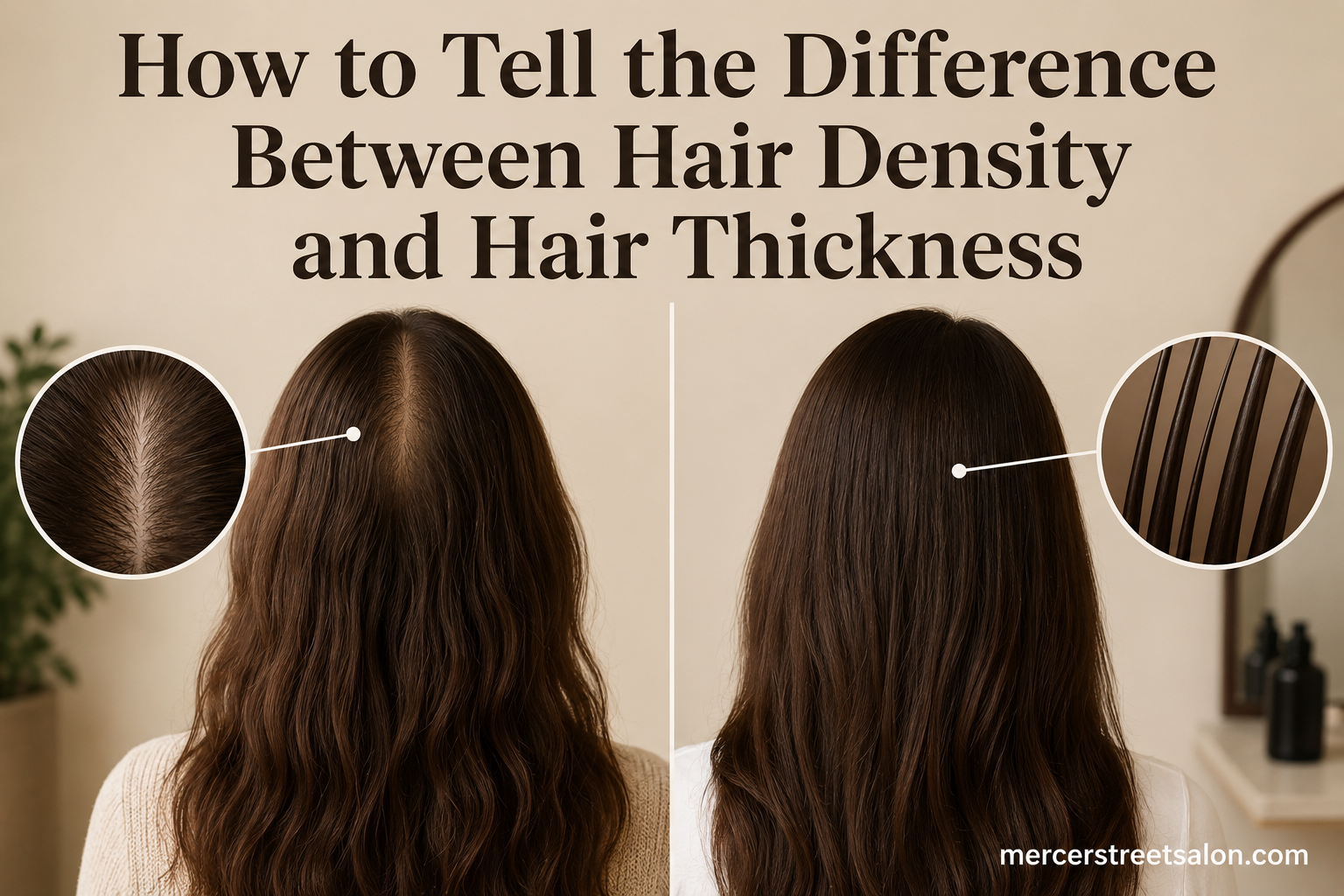
People use the terms “thick hair” and “dense hair” interchangeably all the time. But if you want to understand why certain products fall flat on your strands or why a haircut your friend loves does nothing for you, learning how to tell the difference between hair density and hair thickness is the first step.
Hair density refers to how many individual strands grow on your scalp, while hair thickness describes how wide each individual strand is. One measures quantity; the other measures size. They are completely independent characteristics.
You can have fine hair that is very dense. You can also have coarse strands with low density. Once you understand which combination describes your hair, everything from product selection to styling choices becomes much easier.
In this guide, our team walks you through what each term means, how to test both at home using simple methods, and why knowing your hair profile matters for your daily routine.
Table of Contents
What Is Hair Density?
Hair density is the number of individual hair strands growing per square inch on your scalp. It measures quantity, not quality or width of the strands themselves.
The average human head has somewhere between 80,000 and 120,000 hairs total. This number varies based on genetics, age, and natural hair color. Blondes tend to have more strands on average, while redheads typically have fewer but thicker individual hairs.
Each hair follicle on your scalp produces one strand of hair. More follicles per square inch means higher density. Fewer follicles means lower density. This follicle count is determined before birth and stays relatively constant throughout your life.
When you look at someone and their hair looks full and abundant, you are likely seeing high density. When you can see a lot of scalp through the hair, that person likely has lower density.
It is worth noting that density can change over time due to factors like aging, hormonal shifts, stress, and certain medical conditions. But the baseline number of follicles you are born with sets your genetic starting point.
What Is Hair Thickness?
Hair thickness (also called strand diameter or hair caliber) refers to the width of each individual hair strand. It measures how wide a single strand is, not how many strands you have.
Strands are typically classified into three categories: fine, medium, and coarse. Fine hair has the smallest diameter, while coarse hair has the largest.
To put this in perspective, fine hair measures roughly 50 microns in diameter. Medium hair falls between 60 and 80 microns. Coarse hair can measure 100 microns or more. A micron is one-thousandth of a millimeter, so we are talking about very small differences that still have a big impact on how hair looks and behaves.
Thicker strands feel more substantial between your fingers. They tend to hold styles longer and appear more voluminous. Fine strands feel barely noticeable and can look limp or flat more easily.
The thickness of your individual strands is genetically determined, just like density. However, strand diameter can also change with age, with many people noticing their hair becoming finer over time.
Hair Density vs Hair Thickness: The Key Difference
The simplest way to understand the difference: hair density is about how many strands you have, while hair thickness is about how wide each strand is. Density is quantity; thickness is individual strand size.
These two characteristics are completely independent of each other. This means there are four possible combinations:
High density with fine strands: You have a lot of hair, but each strand is thin. Your hair may look very full overall but feel soft and delicate. People with this combination often struggle with frizz and tangles.
High density with coarse strands: You have many strands and each one is wide. This combination produces very voluminous, thick-feeling hair that can be difficult to manage and style.
Low density with fine strands: You have fewer strands and each one is thin. Hair may appear flat, limp, or sparse. This combination benefits from volumizing products and layering techniques.
Low density with coarse strands: You have fewer strands, but each one is wide. Each strand takes up more space, which can make hair look fuller than the actual strand count would suggest.
Understanding which category you fall into helps explain why a product your friend raves about does nothing for you. Someone with fine, low-density hair needs very different products than someone with coarse, high-density hair.
How to Tell the Difference Between Hair Density and Hair Thickness at Home
You do not need any special equipment or a salon visit to figure out your hair profile. Two simple tests can tell you both your density level and your strand thickness in under five minutes.
How to Test Hair Density
There are two reliable methods to check your hair density at home. Both take less than two minutes.
Method 1: The Scalp Visibility Test
Stand in front of a mirror in bright lighting. Part your hair down the middle and pull it apart gently.
If you can see a lot of scalp between the sections of hair, you likely have low density. If you can see some scalp but the hair still looks fairly full, you probably have medium density. If your scalp is barely visible through the hair, you most likely have high density.
This test works best on clean, dry hair. Wet hair clumps together and can give misleading results.
Method 2: The Ponytail Circumference Test
This method works for people with longer hair. Pull all your hair into a single ponytail at the back of your head.
Wrap a soft measuring tape around the ponytail at the thickest point, just above the hair tie. Measure the circumference.
If your ponytail measures less than 2 inches around, you likely have low density hair. A circumference between 2 and 3 inches suggests medium density. Measurements over 3 inches generally indicate high density hair.
For shorter hair where a ponytail is not possible, the scalp visibility test is your best option. You can also ask a friend or hairstylist to photograph the top of your head from above.
How to Test Hair Thickness
Checking your individual strand thickness is just as straightforward. Here are two methods you can try right now.
Method 1: The Single Strand Finger Test
Pluck a single strand of hair from your head. Place it between your thumb and index finger and roll it back and forth.
If you can barely feel the strand, you likely have fine hair. If you can feel it but it is not prominent, you probably have medium thickness. If the strand feels distinctly thick and wiry, you most likely have coarse hair.
This test is subjective, so it helps to test a few strands from different parts of your head. Hair thickness can vary slightly between areas.
Method 2: The Thread Comparison Test
Pluck a single strand of hair and place it next to a piece of standard sewing thread on a white sheet of paper. Compare the width of your hair strand to the thread.
If your strand is noticeably thinner than the thread, you have fine hair. If it is about the same width as the thread, your hair is medium thickness. If your strand is wider than the thread, you have coarse hair.
This visual comparison takes the guesswork out of the finger test. Many users on hair care forums cite the thread method as the most reliable at-home option.
What Affects Hair Density and Hair Thickness
Both density and thickness are primarily determined by genetics. But several other factors influence how your hair looks and feels over time.
Genetics
Your genes set the baseline for both how many follicles you have and how wide each strand grows. If your parents have dense, coarse hair, you are more likely to as well. Genetic hair characteristics are established before birth.
Age-Related Changes
Hair density typically peaks in your late teens and early twenties. After that, a gradual decline is normal. Research suggests that hair diameter also tends to decrease with age, meaning strands become finer over time for many people.
By age 50, a significant percentage of both men and women experience noticeable thinning. Some of this is hormonal, particularly the drop in estrogen during menopause for women.
Ethnicity and Hair Characteristics
Hair characteristics vary across ethnic groups, which is an angle most hair guides overlook. Studies have shown that people of East Asian descent tend to have the thickest individual strands, with the largest average strand diameter. The trade-off is that East Asian hair often has lower density, meaning fewer strands per square inch.
Caucasian hair typically falls in the middle for both density and strand thickness. It shows the widest range of natural variation in texture and color.
Afro-textured hair tends to have lower density in terms of strands per square inch but can have a wide range of strand thicknesses. The elliptical shape of the strands gives it unique properties that differ from straight hair types.
These are averages, not rules. Individual variation within any ethnic group is significant, and many people have mixed heritage that creates unique combinations.
Health Indicators
Sudden changes in hair density can signal underlying health issues. Stress, thyroid problems, iron deficiency, and autoimmune conditions can all cause hair shedding or thinning.
If you notice rapid hair loss or a significant drop in density over a short period, consult a dermatologist or trichologist. They can run tests to determine whether the cause is genetic, hormonal, or health-related.
Styling Tips Based on Your Density and Thickness
Once you know your hair profile, you can make smarter choices about cuts, products, and styling techniques. Here are our recommendations for each combination.
Low Density, Fine Hair
This combination benefits from products that add volume without weighing strands down. Look for lightweight mousses and volumizing sprays applied at the roots.
Avoid heavy oils and thick creams, which will make fine, sparse hair look greasy and even thinner. Blunt cuts create the illusion of fullness, while too much layering can remove the little volume you have.
Low Density, Coarse Hair
Each strand is wide, which helps hair look fuller than the actual density suggests. Embrace this natural advantage with styles that maximize body.
Lightweight leave-in conditioners work well here. Avoid heavy products that build up on coarse strands and make them look dirty.
High Density, Fine Hair
You have plenty of strands, but each one is delicate. Detangle gently to avoid breakage, and consider finger-detangling before using a wide-tooth comb.
Layered cuts help manage the volume while showcasing the natural fullness. Be careful with heat styling, as fine strands damage more easily than coarse ones.
High Density, Coarse Hair
This combination produces the most voluminous hair of all. The challenge here is manageability rather than volume.
Rich moisturizing products, deep conditioning treatments, and smoothing serums help control frizz and keep coarse strands manageable. Thinning shears and strategic layering can reduce bulk without sacrificing length.
Why This Knowledge Matters for Your Haircare Routine
Knowing how to tell the difference between hair density and hair thickness is not just trivia. It changes the way you approach every aspect of hair care.
Product labels often say “for thick hair” or “for fine hair” without clarifying whether they mean density or strand thickness. Once you understand the distinction, you can decode these labels and choose products that actually match your needs.
Someone with fine strands needs gentle, lightweight formulas regardless of their density. Someone with low density needs volumizing products regardless of their strand width. When you know both characteristics, you can shop with confidence instead of guessing.
This knowledge also helps you communicate better with your hairstylist. Instead of saying “my hair is thick,” you can specify whether you mean many strands or wide strands. Your stylist will have a much clearer picture of how to cut and style your hair.
FAQs
Is hair density the same as hair thickness?
No, hair density and hair thickness are not the same thing. Hair density measures how many individual strands grow per square inch on your scalp, while hair thickness measures the width of each individual strand. Density is about quantity; thickness is about strand size.
How to tell if you have thick or dense hair?
To check hair density, part your hair and look at how much scalp is visible. Lots of visible scalp means low density; barely visible scalp means high density. To check hair thickness, pull a single strand and compare it to a piece of sewing thread. If the strand is wider than the thread, your hair is thick or coarse.
How do I tell what hair density I have?
Measure your ponytail circumference for the most accurate at-home test. Less than 2 inches indicates low density, 2 to 3 inches suggests medium density, and over 3 inches indicates high density. For shorter hair, part your dry hair and check scalp visibility in a mirror.
At what age is hair the thickest?
Hair density and strand thickness typically peak in your late teens to early twenties. After that, a gradual decline in both density and strand diameter is normal. Hormonal changes, particularly during menopause, can accelerate this process.
Which ethnicity has the thickest hair?
Studies show that people of East Asian descent tend to have the thickest individual hair strands, with the largest average strand diameter. However, East Asian hair often has lower overall density. Caucasian and Afro-textured hair show different patterns of density and thickness, with significant individual variation within every group.
Putting It All Together
Learning how to tell the difference between hair density and hair thickness gives you a powerful framework for understanding your hair. Density is the number of strands per square inch. Thickness is the width of each individual strand. Two simple tests, one for each characteristic, take less than five minutes.
Once you know your combination, you can choose products that actually work, pick hairstyles that flatter your natural texture, and communicate clearly with your stylist. Your hair is unique, and understanding it is the foundation of any good haircare routine.