
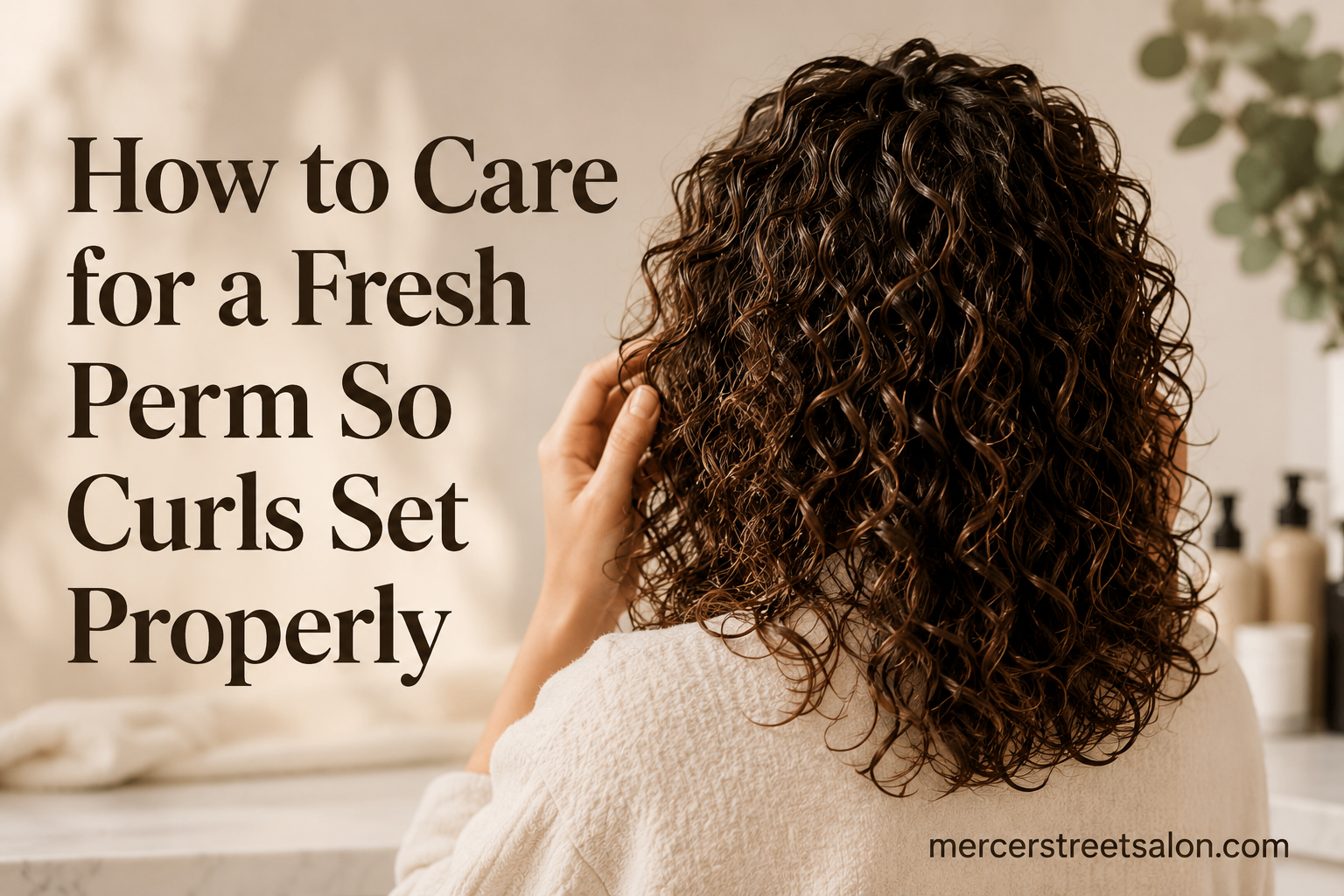
You just left the salon with bouncy, beautiful curls and you want them to last. Knowing how to care for a fresh perm so the curls set properly makes the difference between curls that last six months and ones that fall flat in a week. The first 48 hours are the most critical window of your entire perm journey.
At Mercer Street Salon, we have seen every perm mistake in the book. Clients who follow the right aftercare routine keep their curls looking salon-fresh for months. Those who skip the rules end up back in our chair wondering why their perm disappeared.
This guide walks you through every stage of fresh perm care, from the moment you leave the salon to long-term maintenance that keeps your curls defined. We cover the science behind perm setting, washing rules, drying techniques, product recommendations, sleeping tips, and the swimming advice no other guide mentions.
Quick reference – the golden rules of fresh perm care:
- Do not wash your hair for at least 48 hours after a perm
- Use sulfate-free shampoo and alcohol-free products only
- Avoid heat styling tools for at least one week
- Never brush wet permed hair; use a wide-tooth comb or your fingers
- Sleep on a silk pillowcase with your hair loosely gathered
- Stay out of chlorinated pools and salt water for at least one week
Table of Contents
How a Perm Actually Works (and Why Aftercare Matters)
A perm, short for permanent wave, is a chemical treatment that reshapes your hair bonds to create lasting curls or waves. Understanding what happens inside your hair strand during a perm helps explain why the first 48 hours matter so much.
The process starts with a chemical solution that breaks the disulfide bonds in your hair’s keratin structure. These bonds are what give your hair its natural shape. Once broken, your stylist wraps your hair around perm rods or curlers in the desired pattern.
A neutralizer solution is then applied to reform those bonds in their new curly position. This reforming process continues even after you leave the salon chair. The bonds need approximately 48 hours to fully lock into their new pattern.
If water, heat, or friction disrupts the hair before those bonds set, the curl pattern weakens. That is why washing too early, sleeping on wet hair, or using heat tools right away can cause curls to loosen, frizz, or fall out entirely. Proper perm aftercare protects the chemical process that is still happening inside each strand.
Think of it like baking a cake. You would not open the oven door every five minutes to check on it. The same principle applies here. Let the bonds set undisturbed for the best possible curl definition.
How to Care for a Fresh Perm So the Curls Set Properly: The 48-Hour Setting Window
To care for a fresh perm so the curls set properly, you must avoid washing, soaking, or heavily manipulating your hair for at least 48 hours after the treatment. The chemical bonds that create your new curl pattern need this full two-day window to lock into place. During this period, keep your hair completely dry, avoid heat styling, skip tight hairstyles, and minimize touching your curls with your hands. Water and friction are the two biggest threats during this setting phase, so let your hair rest undisturbed.
Those 48 hours are not just a stylist recommendation. They are the scientifically necessary timeframe for the neutralizer to finish reforming the keratin bonds around your new curl shape. Rush the process and you risk loose, uneven, or completely lost curls.
The Do’s During the First 48 Hours
- Keep your hair completely dry at all times
- Use a spray bottle with plain water only if you need to refresh the curl shape
- Let your hair air dry naturally if it gets slightly damp from humidity
- Wear loose-fitting clothing that does not require pulling over your head
- Use a silk or satin scarf to protect your hair while relaxing at home
- Trust the process and let your curls settle on their own
The Don’ts During the First 48 Hours
- Do not wash, rinse, or soak your hair under any circumstances
- Do not use dry shampoo, which can leave residue on freshly treated hair
- Do not pull hair into ponytails, buns, or clips that could leave dents
- Do not use curling irons, flat irons, or blow dryers
- Do not brush or comb your hair during this period
- Do not wear pullover hoodies, tight collars, or anything that rubs against your hair
- Do not go swimming or expose your hair to rain, steam, or heavy sweat
One Reddit user shared a story about accidentally washing their hair 24 hours after a perm. The result was uneven curls that looked limp on one side and tighter on the other. Once the bonds are disrupted during the setting phase, there is no way to reverse the damage at home.
Your First Week: A Day-by-Day Perm Care Timeline
No competitor in the search results breaks down the first week day by day. We created this timeline because many of our salon clients ask exactly what to do and when. Here is your roadmap for the first seven days after getting a perm.
Day 1 (Treatment Day)
Leave the salon and keep your hands off your hair entirely. Do not touch, scrunch, or adjust your curls. Avoid pulling clothing over your head; button-up shirts are ideal. Sleep on a silk pillowcase tonight and every night going forward.
Day 2 (Still Setting)
Continue the hands-off approach. Your curls may feel tight or look tighter than you expected. This is completely normal. The curl will relax and soften over the coming days. If your scalp feels slightly irritated, this is also normal and should subside by day three.
Day 3 (First Wash)
You have reached the 48-hour mark and can now wash your hair for the first time. Use lukewarm water and a sulfate-free shampoo designed for curly or chemically treated hair. Gently massage the scalp without scrubbing the lengths of your hair. Apply a moisturizing conditioner from mid-shaft to ends.
Days 4 and 5 (Adjustment Period)
Your curls will start to settle into their natural pattern. You may notice some frizz as your hair adjusts. This is the time to introduce a curl cream or lightweight mousse. Avoid heavy products that weigh down your curl pattern. Use a spray bottle with water to refresh curls between washes.
Days 6 and 7 (Styling Introduction)
You can now begin gentle styling. A diffuser attachment on your blow dryer is safe to use on low heat and low speed settings. If you want to use heat styling tools like a curling iron, wait until at least day seven to ten. Always apply a heat protectant spray first.
Washing and Cleansing Your Permed Hair
The way you wash permed hair is different from how you washed your hair before. The right technique preserves curl definition and prevents premature fading of your perm.
When to Wash
Wait a minimum of 48 hours before your first wash. Some stylists recommend waiting 72 hours for extra insurance, especially for resistant hair types. After the first wash, aim to shampoo every two to three days. Washing daily strips natural oils that your permed hair needs to stay moisturized and defined.
Water Temperature
Lukewarm water is your best friend. Hot water opens the hair cuticle, which can cause frizz and fade your curl pattern faster. Cool water at the end of your wash helps seal the cuticle and lock in moisture. Avoid extreme temperature changes while your perm is still fresh.
How to Wash: Step by Step
- Wet your hair thoroughly with lukewarm water
- Apply a quarter-sized amount of sulfate-free shampoo to your palms
- Gently massage your scalp using fingertips, not nails
- Let the suds run down the lengths of your hair; do not scrub or pile hair on top of your head
- Rinse completely with lukewarm water
- Apply conditioner from mid-shaft to ends, avoiding the scalp
- Leave conditioner in for two to three minutes, then rinse with cool water
- Gently blot your hair with a microfiber towel; never rub or wring
Choosing the Right Shampoo
Sulfate-free shampoo is non-negotiable for permed hair. Sulfates are harsh detergents that strip moisture and accelerate curl loss. Look for shampoos labeled as gentle, moisturizing, or formulated for chemically treated hair. Many curly hair brands offer specific perm-safe formulas.
Reddit users in the curly hair community frequently recommend DevaCurl and Mizani product lines for perm aftercare. These brands focus on moisture retention and curl definition without harsh additives. Your stylist can recommend the best product for your specific hair type and curl pattern.
Drying and Styling Techniques for Fresh Perms
How you dry and style your perm affects how long it lasts. The wrong technique can undo months of chemical work in a single session.
Air Drying: The Gold Standard
Air drying is the safest method for permed hair. After washing, gently blot excess water with a microfiber towel. Apply your leave-in conditioner or curl cream to damp hair, scrunching upward to encourage curl formation. Then simply let your hair dry naturally without touching it.
Resist the urge to touch your curls while they air dry. Every time you handle wet curls, you disrupt the curl pattern and invite frizz. Once your hair is completely dry, you can gently scrunch to break any crunchiness from styling products.
Using a Diffuser Correctly
A diffuser attachment disperses air over a wider area, making it safer for curls than a concentrated nozzle. If you need to use a blow dryer, a diffuser on low heat and low speed is the way to go. Tilt your head to one side, place sections of hair into the diffuser bowl, and hold for a few seconds before moving on.
Never use the blow dryer on high heat. High heat can damage the perm bonds and cause frizz. Keep the dryer moving and maintain at least six inches of distance from your hair. A diffuser typically adds five to ten minutes to your routine compared to air drying.
The Microfiber Towel Difference
Regular cotton bath towels create friction that roughs up the hair cuticle and causes frizz. A microfiber towel absorbs water faster and gentler. Instead of rubbing your hair, press and squeeze sections of your hair with the microfiber towel to remove excess water without disturbing the curl shape.
An old cotton t-shirt works in a pinch if you do not have a microfiber towel. The smooth surface glides over curls without snagging. This simple swap makes a noticeable difference in frizz reduction for many of our clients.
Detangling Permed Hair
Never brush wet permed hair. A brush disrupts the curl pattern and can cause breakage in chemically treated strands. Instead, detangle in the shower while conditioner is still in your hair. Use a wide-tooth comb or your fingers, starting from the ends and working slowly up toward the roots.
Between washes, you generally should not need to detangle at all. If tangles develop, apply a small amount of leave-in conditioner to the area and gently separate with your fingers. Some people with looser curl patterns prefer to detangle dry with their fingers, which can work well for wavy perm styles.
Heat Styling Rules
Heat styling tools like curling irons, flat irons, and hot rollers should be avoided for at least the first week after a perm. Your hair is still recovering from the chemical process. Adding heat stress on top of chemical stress leads to damage, breakage, and faded curls.
After the first week, if you choose to use heat tools, always apply a heat protectant product first. Keep temperatures below 350 degrees Fahrenheit. Limit heat styling to once or twice a week at most. The less heat you apply, the longer your perm will last.
Products to Use and Products to Avoid
Using the right products extends your perm. Using the wrong ones can destroy it within weeks. Here is a clear breakdown of what belongs in your shower and what belongs in the trash.
Products Your Perm Will Love
- Sulfate-free shampoo: Cleanses without stripping moisture or curl definition
- Moisturizing conditioner: Restores hydration to chemically treated strands
- Deep conditioning mask: Use weekly to replenish moisture lost during the perm process
- Leave-in conditioner: Provides all-day hydration and helps define curls between washes
- Curl cream: Enhances curl formation and reduces frizz without stiffness
- Lightweight mousse: Adds volume and hold, especially good for fine hair that gets weighed down
- Argan oil or hair serum: A few drops smooth flyaways and add shine without heaviness
- Heat protectant spray: Mandatory before any heat styling to shield bonds from damage
Products That Will Ruin Your Perm
- Sulfate shampoos: Sodium lauryl sulfate and sodium laureth sulfate strip the hair and fade curls
- Alcohol-based products: Many hairsprays and gels contain drying alcohols that make permed hair brittle
- Clarifying shampoos: Designed to remove buildup but also strip perm solution residue that protects curls
- Heavy waxes and pomades: Weigh down curls and leave a greasy residue that is hard to remove
- Volumizing powders: Dry out the hair shaft and make permed strands prone to breakage
- Anti-frizz serums with silicones: Build up over time and block moisture from penetrating the hair
When in doubt, read the ingredient label. If you see sodium lauryl sulfate, alcohol denat, or high concentrations of drying alcohols, put it back on the shelf. Your perm will thank you.
How to Sleep With a Fresh Perm
Sleeping is when most perm damage happens without you even knowing it. Cotton pillowcases create friction that pulls on curls, flattens them on one side, and causes tangles. A few simple adjustments to your nighttime routine can dramatically extend your perm’s life.
Switch to a Silk or Satin Pillowcase
This is the single most impactful change you can make for overnight curl protection. Silk and satin pillowcases allow your hair to glide across the surface instead of catching and snagging. Cotton acts like a sponge, absorbing moisture from your hair while creating friction that roughs up the cuticle.
Many of our clients notice a visible difference in curl definition within a week of switching to silk. The pillowcase does not need to be expensive. Even affordable satin options from a drugstore provide significant improvement over cotton.
The Pineapple Method
The pineapple method involves loosely gathering your hair at the very top of your head before bed. Use a soft scrunchie or silk hair tie, never a tight elastic band. The goal is to keep your curls piled up so they do not get crushed between your head and the pillow.
In the morning, remove the scrunchie and gently shake your curls loose. Use a spray bottle with water to refresh any sections that flattened overnight. The pineapple method works best for medium to long hair lengths.
Additional Overnight Tips
If your hair is too short for a pineapple, wrap it loosely in a silk scarf. Apply a small amount of leave-in conditioner before bed to keep curls moisturized overnight. Never sleep with wet permed hair; this is a guaranteed way to wake up with a tangled, misshapen mess.
Swimming and Water Exposure After a Perm
No competitor in the search results covers swimming after a perm. This is one of the most common questions we get at Mercer Street Salon, so we are filling that gap.
Chlorine and Pool Water
Chlorine is a harsh chemical that strips moisture from permed hair and can alter your curl pattern. Wait at least one week after your perm before entering a chlorinated pool. Even then, always wet your hair with clean water first and apply a leave-in conditioner. Hair that is already saturated with clean water absorbs less chlorine.
A swim cap provides the best protection. If you do not have one, coat your hair in conditioner before swimming to create a barrier. After swimming, rinse your hair immediately with clean water and follow with a moisturizing shampoo and deep conditioning treatment.
Salt Water and the Ocean
Salt water is extremely drying to chemically treated hair. The salt draws moisture out of your strands, which can leave permed hair brittle and prone to breakage. Wait at least two weeks after a perm before swimming in the ocean.
If you live near the coast or vacation at the beach, treat salt water exposure the same as chlorine. Pre-wet your hair, apply a protective leave-in conditioner, and rinse immediately afterward. Deep condition within 24 hours of any salt water exposure.
Rain and Humidity
Getting caught in light rain during the first 48 hours is not ideal but is not catastrophic. Gently blot your hair dry with a microfiber towel as soon as possible. Heavy rain or steam exposure during the setting phase is more concerning and can affect curl formation.
Humidity is a long-term challenge for permed hair. Humid air adds moisture to the hair shaft, which can cause curls to expand and frizz. Anti-humidity hair products, applied after the first week, create a barrier that helps lock out excess moisture. Living in a humid climate like Florida or along the Gulf Coast requires extra attention to anti-frizz products and regular deep conditioning.
Long-Term Perm Maintenance
A perm typically lasts three to six months depending on your hair type, how fast your hair grows, and how well you care for it. These long-term habits keep your curls looking fresh for the entire lifespan of your perm.
Trimming Schedule
Get a trim every six to eight weeks to remove split ends and damaged tips. Permed hair is more prone to dryness and breakage at the ends. Regular trims prevent split ends from traveling up the hair shaft and ruining the curl pattern. Your stylist can trim permed hair dry to see the natural curl pattern and avoid cutting too much length.
Deep Conditioning Routine
Apply a deep conditioning mask once a week. Leave it on for 15 to 20 minutes under a shower cap or warm towel. This replenishes the moisture that daily wear, sun exposure, and environmental factors strip away. Deep conditioning is the number one thing you can do at home to extend your perm’s life.
Workout and Sweat Management
Sweating during the first 48 hours can affect the setting process just like washing can. If you exercise regularly, schedule your perm at a time when you can take two rest days. After the setting phase, sweat does not damage the perm but it can cause frizz and require more frequent washing.
To manage workouts, use a sweatband or silk scarf to absorb sweat along your hairline. After exercise, let your hair air dry and refresh curls with a spray bottle of water and a small amount of leave-in conditioner. Avoid pulling your hair into a tight ponytail while sweating, as this can leave permanent dents in the curl pattern.
When to Refresh Your Perm
Most perms need a refresh every three to six months. You will know it is time when your roots start growing in straight, your curls lose their definition, or your hair becomes difficult to style. A root perm touches up only the new growth, which is more affordable and less damaging than a full perm.
Do not wait until your perm has completely grown out to schedule a refresh. Overlapping perm solution on previously treated hair causes damage and breakage. A skilled stylist can blend new and old curls seamlessly if you come in before the perm has fully grown out.
Perm Care for Different Hair Types
Perm aftercare is not one-size-fits-all. Your hair type affects which products and techniques work best for keeping curls defined.
Fine Hair
Fine hair tends to lose perm volume faster than thicker hair. Use lightweight products only; heavy creams and oils will weigh your curls down. A volumizing mousse applied to damp hair helps maintain body and lift. Wash less frequently to avoid stripping natural oils that fine hair desperately needs.
Coily and Textured Hair
Textured hair needs intense moisture to maintain perm definition. Use rich, butter-based creams and deep conditioning masks regularly. Protective styles like loose braids or twists can help preserve curl definition between washes. Avoid products with drying alcohols that compound the drying effects of the perm chemicals.
Men’s Perm Care
Men’s perm aftercare follows the same core rules but with some simplifications. Shorter hair means curls are less prone to tangling and easier to manage. A lightweight mousse applied to damp hair and air dried works well for most men. The biggest challenge for men is gym sweat; rinse with water only on non-wash days and apply a small amount of leave-in conditioner to refresh curls.
FAQs
How long does it take for perm curls to settle?
Perm curls take about 48 hours to fully settle and set into their permanent pattern. During this window, the chemical bonds are still reforming around your new curl shape. Avoid washing, soaking, or heavy manipulation during this time. Curls will continue to soften and relax over the first one to two weeks, reaching their final look after approximately two weeks.
What not to do with a fresh perm?
Do not wash your hair for at least 48 hours. Do not use sulfates, alcohol-based products, or clarifying shampoos. Do not brush wet permed hair. Do not use heat styling tools for the first week. Do not pull hair into tight ponytails or clips. Do not wear pullover hoodies or tight collars. Do not go swimming in chlorine or salt water.
How to maintain curls after a perm?
Maintain perm curls by washing every two to three days with a sulfate-free shampoo, applying a leave-in conditioner and curl cream after each wash, deep conditioning weekly, sleeping on a silk pillowcase, avoiding heat styling, and getting a trim every six to eight weeks. Consistent moisture is the key to long-lasting curl definition.
Can I wash my hair 24 hours after a perm?
No, you should not wash your hair 24 hours after a perm. The chemical bonds need a full 48 hours to set into their new curl pattern. Washing at 24 hours can cause curls to loosen, become uneven, or fall out entirely. Wait the full 48 hours to ensure your perm sets properly.
Can I go swimming after a perm?
Wait at least one week before swimming in a chlorinated pool and two weeks before swimming in salt water. Always wet your hair with clean water and apply a leave-in conditioner before entering the water. Rinse immediately after swimming and follow with a moisturizing shampoo and deep conditioning treatment to protect your perm.
What happens if you wash a perm too early?
Washing a perm too early disrupts the chemical bonds before they have fully set, which can cause curls to loosen, become uneven, or fall out entirely. If you have already washed too early, avoid further manipulation, use a curl-enhancing product, and contact your stylist. Some curl loss may be permanent and require a re-perm.
Can I use a hair dryer after a perm?
Avoid using a hair dryer for at least the first week after a perm. After the first week, only use a diffuser attachment on low heat and low speed settings. Never use a blow dryer on high heat, as this can damage the perm bonds and cause frizz. Air drying remains the safest option for permed hair.
Can I use minoxidil after a perm?
Consult your dermatologist or stylist before using minoxidil after a perm. Minoxidil is a separate chemical treatment that may interact with permed hair. Most stylists recommend waiting at least one week after a perm before starting minoxidil, and applying it to the scalp only, avoiding the lengths of your permed hair.
Wrapping It Up: Your Perm Care Cheat Sheet
Knowing how to care for a fresh perm so the curls set properly comes down to patience and consistency. The first 48 hours require a strict hands-off approach. After that, gentle washing with sulfate-free products, proper drying techniques, weekly deep conditioning, and silk pillowcase sleeping habits will keep your curls defined for months.
Remember the core rules: wait 48 hours before washing, avoid heat styling for a week, skip chlorinated pools and salt water, and invest in products formulated for curly or chemically treated hair. Treat your perm gently and it will reward you with beautiful, bouncy curls that last three to six months.
If you have questions about your specific hair type or are ready for a perm touch-up, book a consultation with your stylist. Professional guidance tailored to your hair texture and curl pattern makes all the difference in achieving the results you want.