
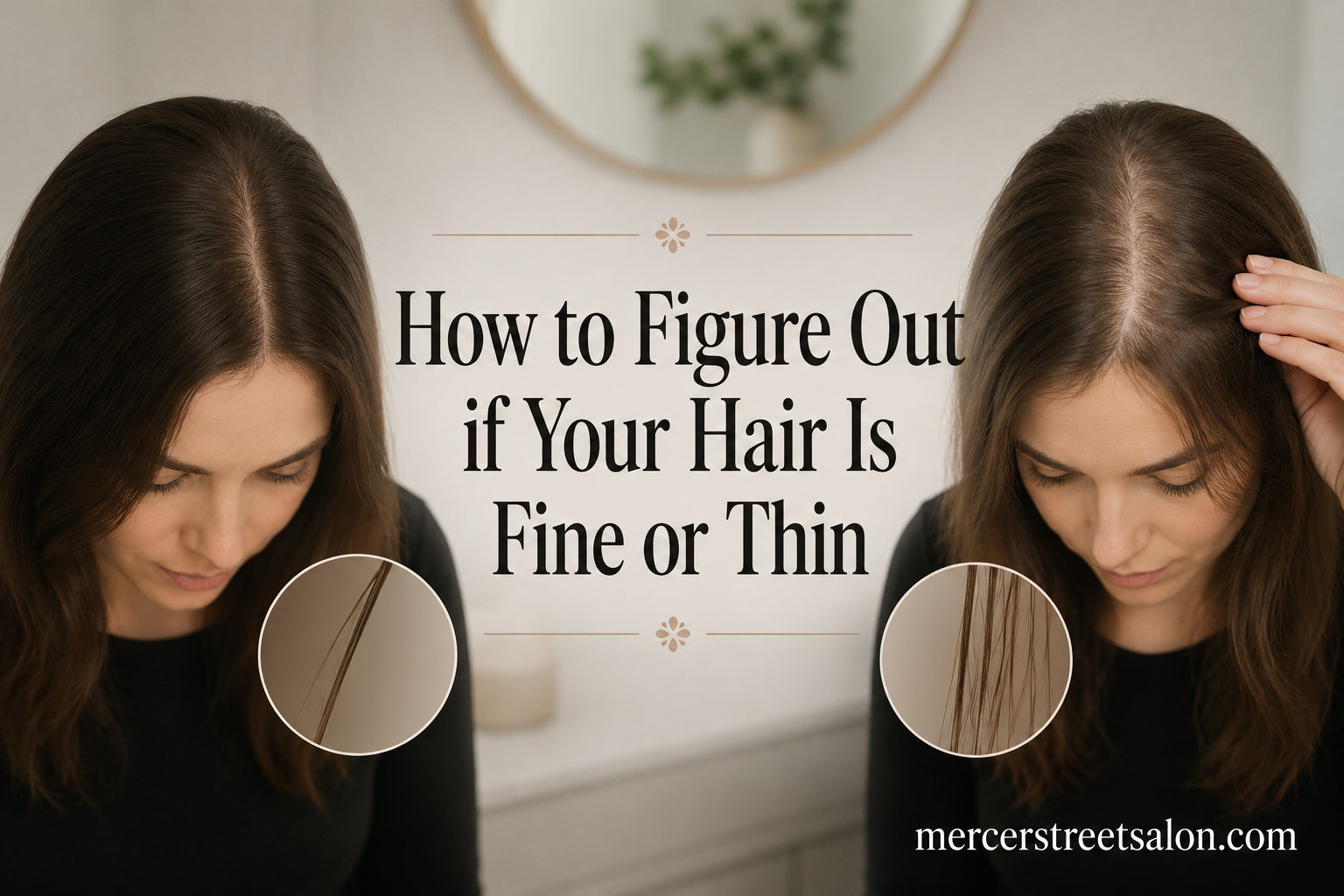
If you have ever stood in the haircare aisle staring at a wall of shampoos labeled for “thick” or “volumizing” hair, wondering which one actually matches your hair, you are not alone. The confusion between fine hair and thin hair is one of the most common sources of frustration our stylists hear at Mercer Street Salon. These two terms describe completely different characteristics of your hair, and mixing them up leads to products that either weigh your hair down or fail to deliver the results you expect.
I have had clients spend hundreds of dollars on volumizing shampoos and thickening treatments that did nothing for them, simply because they had misidentified their own hair type. One woman in her thirties came in convinced her ponytail was shrinking and she was experiencing hair loss, only to discover after running a few simple tests that her strand diameter was extremely fine and her density was actually normal. She had been using products designed for thinning hair that were too heavy for her fine strands, making her hair look flatter and more lifeless than ever.
Fine hair refers to the diameter of each individual strand — the width of a single hair fiber. Thin hair refers to density — how many hairs grow per square centimeter on your scalp. They are independent traits, which means you can have fine hair with normal density, thin hair with thick strands, or both at the same time. Knowing which one describes your hair changes everything about how you care for it, from the products you choose to the way you style it.
In this guide, I will walk you through five simple diagnostic tests you can perform at home right now. You will learn how to read your results, understand the four possible hair type combinations, and recognize when your hair changes may be something a dermatologist should evaluate. We will also cover the gender differences that matter and explain why so many people misdiagnose their own hair type. Let’s start with the foundational distinction.
Before we move into the tests, it is worth noting that the hair industry itself makes this distinction harder than it needs to be. Product labels use terms like “thickening,” “volumizing,” and “thinning hair” interchangeably, even though these words point to different problems. A shampoo that targets “thinning hair” may contain ingredients designed to support follicle health and reduce shedding, while a shampoo for “fine hair” focuses on adding lightweight volume at the roots. Using the wrong one is like trying to fill a leaky bucket with a bucket that has a bigger hole. The diagnostic tests below will tell you which bucket you actually have.
Table of Contents
Fine Hair vs Thin Hair: The Core Distinction
The most important thing to understand before you run any test is that fine hair and thin hair are not two words for the same thing. Fine hair describes the thickness of each individual strand, measured in micrometers. Hair strand diameter typically ranges from around 40 micrometers for very fine hair up to 120 micrometers for coarse hair, according to research published in Dermatologic Surgery. If your individual strands are narrow, almost see-through when held up to a light, you have fine hair. You might also notice that fine hair has a softer, silkier feel compared to coarser hair types.
Thin hair, on the other hand, describes the density of hair on your scalp — essentially, how many hairs are growing in a given area. The average human scalp carries between 100,000 and 150,000 hairs, with roughly 90,000 to 120,000 hairs on a typical scalp per European Journal of Dermatology findings. If you have fewer hairs per square centimeter than average, your hair is thin regardless of how thick each individual strand feels. This means someone with coarse, thick individual strands can still have thin hair if their follicles are spaced farther apart than average.
These two traits operate independently. A person can have fine strands with a high number of follicles growing on their scalp, resulting in hair that feels abundant but lies flat and lacks body. Another person can have thick, coarse strands but a low number of follicles, giving them a sparse ponytail even though each strand feels substantial when rubbed between the fingers. The third possibility is having both fine strands and low density, which creates the most challenging hair type because you have very little volume to work with at both the strand level and the scalp level.
Understanding this distinction matters because the solutions for each problem are different. If your strands are fine but your density is normal, lightweight volumizing products that add body without adding weight are the right choice. If your density is low but your strands are thick, products that support scalp health and follicle function become more relevant than volumizing shampoos. Treating the wrong problem wastes money and often makes the real issue more noticeable. I have seen too many clients with fine hair and normal density purchase “thinning hair” treatments that contained heavy, follicle-targeting ingredients and ended up with weighed-down, greasy hair because the products were never designed for their actual hair type.
How to Figure Out if Your Hair Is Fine or Just Thin or Both: Five Diagnostic Tests
The good news is that you do not need a laboratory or special equipment to determine your hair type. Five simple tests using things you already have at home can give you a clear answer. I recommend doing all five on the same day when your hair is clean and completely dry. Wet hair stretches and behaves differently, so your results will be more accurate on dry hair. Write down your observations for each test so you can compare them side by side.
Test 1: The Finger Test
The Finger Test is the quickest way to assess strand diameter. Take a single clean, dry strand of hair between your thumb and your pointer finger. Gently run it back and forth between them and pay close attention to the sensation. This test works best when your hands are clean and free of lotions or oils that might change how the hair feels.
If you can barely feel the strand at all — it slips through your fingers almost like a thread of silk — you have fine hair. If the strand has a clear, noticeable thickness to it and you can feel it distinctly against your fingertips, you have thick or coarse hair. If the strand is somewhere in between, you have medium-width hair. The boundary between fine and medium is somewhere around 70 micrometers, which most people perceive as a faint but noticeable ridge between the fingers.
Do this test with several strands from different parts of your head. Hair near the crown can sometimes be slightly different in diameter than hair at the nape, and temple hair may be finer than hair at the back. The more consistent your results are across different areas, the more confident you can be in your assessment. Many of our salon clients discover that their strands are finer than they expected, especially if they have been using heavy conditioners or oils that coat the strands and create the illusion of thickness. After a clarifying wash, the true feel of the hair becomes much more apparent.
This test tells you about strand diameter only. It says nothing about how many hairs are on your scalp, so you will need to combine it with the tests below to get the full picture. A person can pass the Finger Test with fine results but still have perfectly normal density, and that is an important distinction to make.
Test 2: The Thread Test
The Thread Test is another way to measure strand diameter, and it works well as a confirmation of your Finger Test results. Take a single strand of your hair and lay it flat next to a standard sewing thread on a piece of white paper so you can see the comparison clearly.
If your hair strand is noticeably thinner than the thread, your hair is fine. If your strand is about the same width as the thread or wider, your hair is medium to coarse. A standard cotton sewing thread is roughly 100 to 120 micrometers in diameter, which sits right at the boundary between fine-medium and medium-coarse. This gives you a concrete reference point that is easier to remember than a subjective finger feel.
The Thread Test is especially helpful for people who find the Finger Test ambiguous. If you are not sure whether you can feel your strand or not, laying it next to a thread removes the guesswork. If you want to be more precise, you can also compare your strand against a piece of dental floss, which is finer than thread and gives you a better sense of whether your hair falls into the very fine range below 60 micrometers.
Test 3: The Ponytail Test
While the Finger Test and Thread Test measure strand diameter, the Ponytail Test measures density. This is the test that tells you whether your hair is thin. Gather all of your hair into a ponytail at the back of your head, as if you were tying it up for the day. Do not pull it tight — let it rest naturally so the measurement reflects your actual density rather than how much you can stretch it.
Now, take a flexible measuring tape or even a piece of string and wrap it around the ponytail just above the elastic. Note the circumference in inches or centimeters. For accuracy, measure at the thickest part of the gathered hair, not at the very end where it might be thinned by the elastic. You can also compare your ponytail to everyday objects: wrap it around a standard pencil or pen and see how many times the hair circles around it.
If your ponytail circumference measures under 2 inches (about 5 centimeters), you have low density hair, which means your hair is thin. A circumference between 2 and 3 inches suggests normal density, and anything over 3 inches indicates high density or thick hair. Many of our clients are surprised to learn that their ponytail measures closer to 2 inches than they expected, especially if they have fine strands that make their hair look fuller than it actually is from a distance.
Our team at Mercer Street Salon uses this test regularly during consultations because it gives an honest, objective measurement that is hard to argue with. When you hold your hair in a ponytail and see how little or how much there is, there is no styling trick or product creating an illusion — you are seeing your true density. You can also try the wrist test at home: if your ponytail is so thin that you can wrap the hair around your wrist multiple times with plenty of room left over, your density is likely low. If it fits snugly or barely fits once, your density is normal or high.
Test 4: The Scalp Visibility Test
The Scalp Visibility Test is another density check, and it works best when you have good lighting conditions. Stand in front of a mirror in a bright, well-lit room or step outside on a sunny day. Part your hair in the middle and pull it back gently on both sides so you can expose your scalp directly.
If you can see your scalp clearly between the strands — if it looks like there is visible skin showing through the hair — your density is low and your hair is thin. If your scalp is barely visible and the hair looks solid and impenetrable from a distance, your density is normal or high. This test is somewhat subjective and influenced by hair color and contrast. Dark hair on a light scalp makes scalp visibility more obvious, while lighter hair colors can make the scalp harder to see even when density is low. Use this test as a supporting clue rather than a definitive measurement.
One thing to watch for specifically is whether your part appears wider than it used to be. A widening part line is one of the earliest signs of actual hair loss rather than just naturally low density. If your part has noticeably widened over the past several months — say, from a half-inch wide to an inch wide — that is a different issue from having thin hair that you have always had. Keep this distinction in mind as we discuss hair loss versus natural density later in this guide.
Test 5: The Hair Loss vs. Density Test
This test helps you distinguish between hair that is naturally thin and hair that is thinning due to loss or a medical condition. On the day you wash your hair, before you step into the shower, collect the hairs that come out in the drain or on your brush. Count them carefully.
Losing between 50 and 100 hairs per day is normal and part of the natural hair growth cycle. Your scalp is constantly cycling hairs through growth, rest, and shedding phases, and some daily shedding is expected and healthy. If you consistently find more than 100 hairs on your brush or in the drain, or if you notice clumps of hair coming out when you run your hand through it or brush it lightly, you may be experiencing hair loss rather than simply having low density.
Other warning signs of hair loss include sudden changes in your ponytail circumference over the course of a few months, significant widening of your part, circular or patchy bald spots, or hair that comes out very easily when you gently pull on it. These signs suggest you should speak with a dermatologist. Natural density, by contrast, remains consistent over time. If your ponytail has always been on the thinner side and your part has not changed since you were younger, you most likely just have naturally low density rather than a hair loss condition.
Fine Hair vs Thin Hair: A Side-by-Side Comparison
To make the distinction as clear as possible, here is a side-by-side comparison of the key characteristics that separate fine hair, thin hair, and the combination of both. Use this as a quick reference after you have completed the diagnostic tests above. The table summarizes everything we have discussed about strand diameter, density, product needs, and styling approaches so you can see the differences at a glance.
When reading this table, keep in mind that fine hair and thin hair are not mutually exclusive. The “Both Fine and Thin” column represents the scenario where both strand diameter and density are below average, which is the most difficult combination to manage because it limits your options at every level. The other columns represent scenarios where only one trait is affected, which means you have more specific solutions available. The key takeaway from this table is that the same visual result — hair that looks like it lacks volume — can have completely different underlying causes, and each cause demands a different approach.
| Characteristic | Fine Hair | Thin Hair | Both Fine and Thin |
|---|---|---|---|
| What it measures | Strand diameter (width of each hair fiber) | Density (number of hairs per square centimeter) | Both narrow strand width AND low follicle count |
| Finger Test result | Barely perceptible between fingers | Can feel fine, medium, or coarse | Barely perceptible between fingers |
| Ponytail circumference | Normal (2 inches or more) | Under 2 inches | Under 2 inches |
| Scalp visibility | Low to moderate (strands are close together) | High (scalp visible between strands) | High and often noticeable from a distance |
| Hair feel | Soft, silky, light | Depends on strand thickness | Soft, light, and sparse |
| Oiliness tendency | Gets greasy faster (less surface area per strand) | Normal unless strand width is also fine | Gets greasy faster with visible scalp |
| Product priority | Lightweight volumizing at the roots | Scalp-supporting and density-focused care | Root volume + scalp care + weightless formulas |
| Styling approach | Root lift, texturizing sprays, blow-dry techniques | Layering, strategic cuts, concealing techniques | Root lift + layering + scalp-concealing products |
| Common concern | Flatness, lack of body, greasiness | Visible scalp, widening part, sparse ponytail | All of the above simultaneously |
| Common misdiagnosis | Thinking fine hair is thin because it looks flat | Thinking thin hair is fine because strands feel soft | Thinking the problem is unsolvable |
The Four Hair Type Combinations and What Each Means
Once you have completed the tests above, you can place yourself into one of four possible combinations. Each combination behaves differently and responds to different care approaches. Understanding which one you fall into is the key to choosing products and styles that actually work. Rather than thinking of fine and thin as a binary either-or, it is more useful to think of them as two separate axes that create a grid of possible outcomes.
Fine Hair with Normal Density
If your Finger Test and Thread Test showed fine strands, but your Ponytail Test measured 2 inches or more in circumference, you have fine hair with normal density. This is a very common hair type, though many people with this combination do not realize their density is actually normal because their fine strands make their hair look thinner than it is.
Your hair may feel soft and silky to the touch, and it often has a natural sheen that people with coarser hair types rarely experience. But it also lacks volume and can lie flat against the scalp, especially as the day goes on and natural oils accumulate. Fine hair with normal density tends to show grease faster than coarser hair types because there is less surface area on each strand to absorb sebum from the scalp. You may also notice that your hair tangles more easily and breaks more readily, which means more frequent trims are a good idea.
The right approach is lightweight volumizing products that coat the strands without weighing them down. Look for shampoos and conditioners labeled “for fine hair” rather than “for thinning hair” — the two categories serve different needs. Volumizing mousses applied at the roots before blow-drying can help create lift that lasts through the day. Avoid heavy oils, butters, and silicone-based products that sit on the strands and make fine hair look greasy within hours. A good haircut with texturizing layers also helps, because shorter layers create the illusion of more strands at the surface.
Humidity and moisture can be particularly challenging for fine hair with normal density. Fine strands tend to absorb moisture from the air, which can make them swell slightly and appear even flatter against the scalp. A lightweight leave-in conditioner used sparingly on the mid-lengths and ends can help protect the hair without adding weight at the roots where volume is needed. Blow-drying with a round brush lifted at the roots is one of the most effective styling techniques for this hair type, as it physically lifts each strand away from the scalp and creates lasting volume.
Fine Hair with Low Density (Both Fine and Thin)
This is the combination the title of this guide asks about specifically. If both your strand diameter tests and your density tests indicate low values — fine strands AND a ponytail under 2 inches — you have both fine and thin hair. This is the most challenging combination because you have limited volume at both the strand level and the scalp level, and there is very little natural fullness to work with.
Clients at our salon with this combination often describe their hair as see-through, even when it is freshly washed and styled. Their ponytails can measure 1.5 inches or less in circumference, and they frequently report being able to see their scalp when they look at their hair from certain angles or in bright lighting. They also commonly report that volumizing products designed for “fine hair” alone do not help much, because those products typically target strand thickness rather than density. The real issue is that there are simply not enough hairs to create fullness, and no product can create new hairs.
The styling strategies that work best for fine and thin hair are honest about this limitation. Root-lifting techniques that create volume at the base of each strand help maximize the impact of every hair you have. Strategic layering in haircuts removes weight from the ends and keeps volume concentrated near the roots where it is most visible. Scalp-concealing products like tinted dry shampoo or fiber powders make the scalp appear fuller by adding color and texture to the areas where scalp is showing. Gentle scalp massages to support circulation can also be beneficial as part of a broader hair health routine. Being honest with yourself about this combination is important because it opens the door to strategies that genuinely help rather than chasing products that will not deliver.
Many people with this combination tell us they feel frustrated because nothing seems to make a noticeable difference. It is important to acknowledge that feeling. Having both fine and thin hair is genuinely harder to manage than having just one or the other, and the haircare industry does not always acknowledge that reality. The goal is not to create hair that looks like a different type entirely, but to work with what you have in ways that make it look as healthy and full as possible. A good haircut and the right lightweight products can make a meaningful difference even if they cannot completely change the underlying characteristics of your hair.
Thick Hair with Normal Density
If your strand tests came back showing thick or coarse strands and your ponytail circumference is over 2 inches, you have the most abundant hair type. Your individual strands have significant diameter, and your scalp supports a high number of follicles growing per square centimeter. This hair type is generally strong, resistant to damage, and holds styles well because there is plenty of material to work with.
The main challenge with thick hair and normal density is managing volume. This hair type can feel heavy, especially when it is long, and it may resist certain styles that require the hair to lay flat or hold a sleek shape. Products designed for thick hair focus on moisture, manageability, and controlling bulk rather than adding volume. Deep conditioning treatments work well here because there is more surface area on each strand for product absorption. Layered cuts help reduce weight and make the hair more manageable without sacrificing its natural abundance.
Thick Hair with Low Density
This combination is less commonly discussed but it definitely exists. If your strands feel thick and coarse but your ponytail measures under 2 inches, you have thick hair with low density. This pattern is often associated with hair loss conditions where follicles become sparse over time but the remaining hairs grow in with normal or above-normal thickness.
With this combination, your hair may still feel substantial and healthy to the touch, but you notice fewer hairs overall. The ponytail feels thinner than it used to, and you may see more scalp than before even though each individual strand feels wide. The focus here is on supporting the follicles and addressing the cause of the density loss rather than simply styling around it. Scalp treatments, professional evaluation, and conversations about hair regrowth options become more relevant for this combination than for the others.
Why People Get This Wrong: The Misdiagnosis Problem
The reason so many people confuse fine hair with thin hair is that both conditions produce a similar visual result: hair that looks like it lacks volume. Fine hair lies flat against the scalp because each strand is too narrow to stand on its own. Thin hair looks sparse because there are fewer strands to create fullness and body. Both can make a ponytail feel smaller than expected and make it harder to achieve certain styles. Without running the diagnostic tests, it is easy to assume the wrong cause and reach for the wrong products.
One common misconception is that fine hair grows more slowly than coarse hair. This is not true. Hair grows at roughly the same rate regardless of strand thickness — about half an inch per month on average for most people. Fine hair may appear to grow more slowly because it breaks more easily, and breakage at the ends creates the impression that length is not being retained. Over time, the constant breakage cycle means fine hair never seems to get longer, even though new growth from the follicle is proceeding at a normal rate. Regular trims to remove split ends and gentle handling during detangling and styling help fine hair maintain its length over time.
Another frequent source of confusion is the transition from chemically relaxed or heavily processed hair to natural hair. If you have spent years using relaxers, flat irons, or strong chemical treatments, your hair’s natural texture may be difficult or impossible to determine accurately. Chemical processing can permanently alter the structure of the hair shaft, changing the way it feels, looks, and behaves. Naturally fine hair that has been relaxed for years may feel coarser at the surface because of damage, while naturally coarse hair that has been regularly flat-ironed may feel smoother and finer. If you are in the process of transitioning from relaxed hair to natural texture, give yourself at least three to six months of growth without processing before running the diagnostic tests. The results will be much more accurate once your natural hair has grown in past the previously damaged sections.
Age also plays a role that most articles about fine and thin hair completely overlook. Hair density naturally decreases with age for everyone, regardless of genetics. A person who had thick, abundant hair in their twenties may notice their ponytail circumference shrinking in their forties or fifties simply due to the normal aging process. This gradual reduction in follicle count is not necessarily a sign of pathological hair loss. The key difference is whether the density loss is gradual and consistent with your age, or sudden and accelerating. Gradual thinning over decades is normal aging. Sudden shedding, patchy bald spots, or a widening part that changes dramatically over weeks or months warrants a medical evaluation.
Forum discussions on Reddit and haircare communities reveal that many people in their twenties and thirties worry their hair is thinning when it is actually just fine, or vice versa. The anxiety around hair loss is real and understandable, but it often leads people to self-diagnose incorrectly. The diagnostic tests described in this guide remove the guesswork and give you concrete data about your hair rather than relying on how your hair looks on a given day under certain lighting conditions.
Fine vs Thin Hair: How It Differs Between Men and Women
Men and women experience fine and thin hair differently, both in terms of presentation and in the social and emotional context around hair loss. Understanding these differences can help you interpret your own test results more accurately and choose the right course of action.
For women, hair thinning typically follows a diffuse pattern across the entire scalp. Rather than a receding hairline or distinct bald spots, women usually notice an overall reduction in density, with the part often widening gradually and hair feeling less abundant in general. Female pattern hair loss, the most common type of hair loss in women, affects roughly 40 percent of women by age 2026 according to the American Academy of Dermatology. Because the pattern is diffuse rather than localized, women may not notice it until their ponytail circumference has already shrunk or their part has widened significantly. The emotional impact of hair thinning on women is often profound, as societal standards place considerable emphasis on hair as a marker of femininity and self-expression.
Men, by contrast, are more likely to experience patterned hair loss that follows the Hamilton-Norwood classification scale. Male pattern baldness typically begins with a receding hairline at the temples and thinning at the crown. Men may notice their hair is thinning before their ponytail circumference changes dramatically, because the pattern starts at specific points rather than spreading evenly across the whole scalp. Men also tend to have coarser facial hair and body hair, which can make their scalp hair feel finer by comparison and lead to misdiagnosis of their actual scalp hair type.
Both men and women can have fine strands, thin density, or both. The diagnostic tests described earlier work exactly the same way regardless of gender. The difference is mainly in what to watch for when monitoring changes over time. Women should pay close attention to widening parts, overall volume reduction, and changes in how their hair sits in a ponytail. Men should watch for a receding hairline at the temples, crown thinning visible from above, and changes in how their hair parts or styles. Both men and women benefit from the same diagnostic clarity, but the patterns they are watching for and the areas of concern differ.
Societal perceptions around hair also differ by gender in ways that affect how people experience and respond to fine or thin hair. Women are often more likely to seek help early because thinning is more socially noticeable for women in many cultures. Men may delay seeking help due to stigma around male pattern baldness, even when early intervention could make a meaningful difference. Regardless of gender, getting clear answers about your hair type through the diagnostic tests is the most productive first step, because it replaces anxiety with specific knowledge you can act on.
When to See a Dermatologist or Hair Stylist
Most of the time, knowing whether your hair is fine, thin, or both is enough to help you choose better products and styling techniques. But there are specific signs that indicate a conversation with a professional is the right next step, and knowing when to make that call can save you time, money, and unnecessary worry.
See a dermatologist if you notice sudden or patchy hair loss, hair that comes out in clumps when you brush or wash it, a widening part that is accelerating over weeks or months, circular bald spots, or hair loss accompanied by itching, pain, redness, or scaling on the scalp. These can be signs of conditions like alopecia areata, telogen effluvium, scarring alopecia, or scalp infections that require medical treatment. Dermatologists can also run blood tests to check for hormonal imbalances, thyroid issues, iron deficiency, or nutritional deficiencies that contribute to hair thinning. At Mercer Street Salon, we regularly refer clients to dermatologists we trust when we notice signs that go beyond normal hair type variation.
See a professional hair stylist if you want help interpreting your diagnostic test results in person, if you are considering a haircut or style that can create the illusion of more volume, or if you want personalized product recommendations based on your specific hair type. Stylists see hundreds of hair types every month and can often identify subtle characteristics that are easy to miss when you are looking at your own hair in the mirror every day. A consultation is also a good opportunity to ask about gentle scalp treatments that support healthy hair growth, and to discuss cut and color techniques that can make fine or thin hair look fuller and more vibrant.
If you decide to see a dermatologist, prepare for your appointment by documenting your diagnostic test results. Bring your notes from the Finger Test, Thread Test, Ponytail Test, and Scalp Visibility Test. Take photos of your hair from different angles in good lighting so the dermatologist can see your scalp and part line clearly. Mention any recent changes in medication, diet, stress levels, or health conditions that could be contributing to changes in your hair. The more information you bring, the faster the dermatologist can narrow down the possible causes and recommend the right course of action.
Frequently Asked Questions
Can you have fine and thin hair at the same time?
Yes. Fine hair and thin hair describe two separate traits u002du002d strand diameter and density u002du002d and they can occur together. If your individual strands feel narrow between your fingers AND your ponytail circumference measures under 2 inches, you have both fine and thin hair. This combination is sometimes called ‘fine thin hair’ and requires products and styles that address both low volume at the strand level and low density at the scalp level.
What are the first signs of thinning hair?
The earliest signs of thinning hair include a widening part line that is noticeably wider than it was six months to a year ago, a ponytail circumference that has shrunk over time, increased scalp visibility when you look at your hair from above, more hair on your brush or in the shower drain than usual, and circular or patchy bald spots. Normal density loss from aging happens gradually and symmetrically. Sudden, patchy, or clumpy shedding warrants a visit to a dermatologist.
Can thin hair get thick again?
Whether thin hair can become thicker depends on the cause. If your low density is simply genetic and has been consistent your whole life, it will not become thicker on its own. But if thinning is caused by a temporary condition like stress, hormonal changes, a nutritional deficiency, or a medical issue, hair can regrow and density can improve once the underlying cause is treated. Treatments like minoxidil, platelet-rich plasma therapy, and certain prescription medications have been shown to help some people regrow hair. A dermatologist can help you determine which options are appropriate for your situation.
Is thin hair the same as fine hair?
No. Thin hair and fine hair are not the same thing. Thin hair refers to low density u002du002d having fewer hairs on your scalp than average. Fine hair refers to narrow strand diameter u002du002d each individual hair fiber is thinner than average. You can have one without the other, or you can have both simultaneously. The confusion arises because both conditions can make hair look like it lacks volume, and the solutions for each are different.
Do people with Ehlers Danlos have thin hair?
Ehlers-Danlos syndrome (EDS) is a group of genetic connective tissue disorders that can affect hair in some individuals, but thin hair is not a defining or universal feature of the condition. Some people with certain types of EDS report that their hair is fine, fragile, or slow-growing, but this varies significantly depending on the specific subtype of EDS and the individual. If you have EDS and are concerned about your hair, a consultation with both a dermatologist and a geneticist can help you understand what to expect and which hair care approaches are safest for your hair type.
Does high cortisol cause hair loss?
Yes, chronically elevated cortisol levels can cause hair loss. Cortisol is the body’s primary stress hormone, and when it stays elevated for extended periods, it can push hair follicles into a resting phase called telogen effluvium. This causes more hairs than usual to shed at once, typically two to three months after a stressful event or period of chronic stress. The hair loss from high cortisol is usually diffuse across the entire scalp rather than patchy. Managing stress levels, getting adequate sleep, and working with a healthcare provider to address the root cause of elevated cortisol can help hair regrow over time.
If you are still unsure after reading this guide, I encourage you to book a consultation at Mercer Street Salon. Our stylists can run through these tests with you in person, help you interpret your results, and recommend specific cuts, products, and styling techniques that work for your exact hair type. Knowing whether your hair is fine, thin, or both is the first step toward hair that looks and feels the way you want it to.
Learning how to figure out if your hair is fine or just thin or both is not about categorizing yourself into a box. It is about understanding your hair well enough to give it what it actually needs instead of guessing and hoping for the best. The five tests in this guide take less than fifteen minutes, require no special equipment, and can save you from wasting money on products that were never designed for your hair type. Once you know your type, you can make informed decisions about cuts, styles, and products that work with your hair rather than against it. That is the real goal here, and it is one that every client who walks through our doors deserves to achieve.