
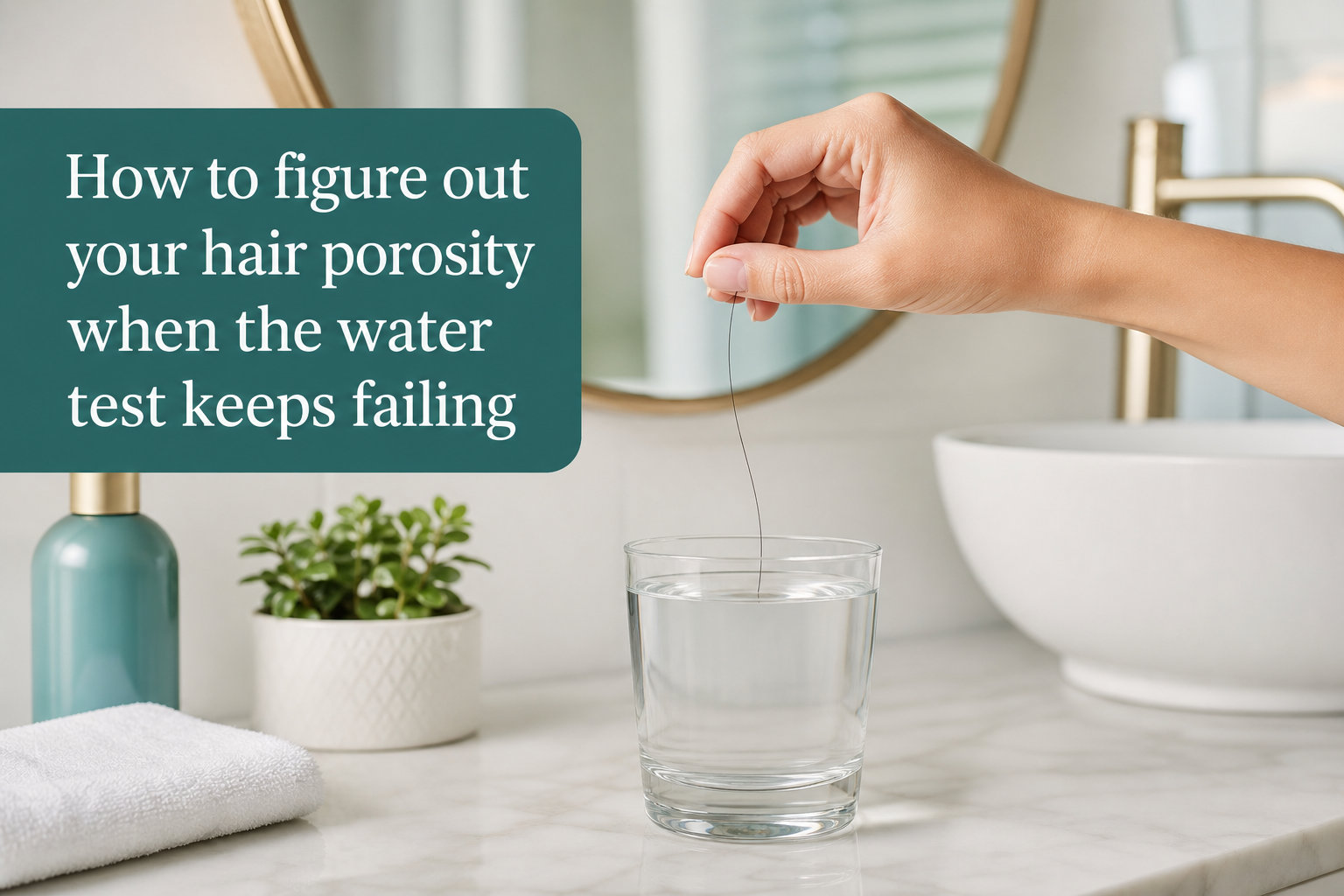
If you have dropped a strand of hair into a glass of water, watched it float, and then thought “there is no way my hair is low porosity” — you are not alone. Learning how to figure out your hair porosity when the water test keeps failing is one of the most common frustrations we hear from clients at Mercer Street Salon. The float test is everywhere online, but it gives contradictory, confusing results for a huge percentage of people, especially those with curly, textured, or chemically treated hair.
The good news is that the water test is far from the only way to diagnose your hair porosity. In fact, most experienced stylists rely on observational cues — how your hair absorbs products, how fast it dries, and how it behaves in humidity — rather than a glass of water. Once you understand why the float test fails and what to look for instead, you can pin down your porosity with surprising accuracy.
In this guide, we walk through exactly why the water test keeps misleading you, four alternative methods that actually work, and a simple decision tree for reconciling conflicting results. Whether your hair floats when it should sink or sinks when it should float, you will leave with a clear answer.
Table of Contents
Quick Answer: How to Figure Out Your Hair Porosity When the Water Test Keeps Failing
When the water test keeps failing, stop relying on it and switch to observational diagnosis instead. Watch how your hair behaves in real life: how quickly water absorbs when you spray it, how fast your hair air-dries, whether products sit on top or soak in, and how your hair reacts to humidity. Cross-reference three or four of these observations and the pattern will reveal your true porosity more reliably than any float test ever could.
The four most reliable alternatives are the spray bottle test, the strand slide test, the drying time observation, and the product absorption method. We break down each one step by step below, then show you how to reconcile them when they disagree.
What Hair Porosity Actually Means
Hair porosity is your hair’s ability to absorb and retain moisture, and it is determined by the condition of the cuticle layer — the overlapping scales that cover each hair shaft. When those scales lay flat and tight, moisture struggles to get in. When they are raised, lifted, or damaged, moisture enters easily but also escapes just as fast.
There are three general categories. Low porosity hair has tightly closed cuticles that resist moisture absorption but hold onto it once it gets in. Medium (or normal) porosity hair has slightly relaxed cuticles that allow balanced moisture flow. High porosity hair has raised, gaps, or holes in the cuticle — usually from chemical processing, heat damage, or environmental wear — that let moisture rush in and escape rapidly.
The rarest hair porosity is extremely low porosity, typically seen only in virgin hair that has never been touched by chemicals, heat, or harsh treatment. Most people sit somewhere on a spectrum rather than fitting neatly into one box, and your porosity can shift over time as your hair is damaged or repaired.
Knowing your porosity matters because it dictates which products, ingredients, and techniques will actually work for your hair. Low porosity hair needs heat and lightweight humectants to open the cuticle. High porosity hair needs rich butters, heavy oils, and protein to fill gaps and lock in moisture. Get the diagnosis wrong and you will keep buying products that sit on your hair doing nothing — or weigh it down into a greasy mess.
Why the Water Test Keeps Failing You
The float test — dropping a clean hair strand into a glass of room-temperature water and watching whether it floats, sinks slowly, or drops fast — sounds simple and scientific. In reality, it is one of the least reliable at-home hair tests out there. Here is exactly why it keeps giving you results that contradict how your hair actually behaves.
1. Surface Tension Skews Everything
Water has surface tension, and a single strand of hair is light enough to rest on top of that tension rather than reflect its true density. This is why so many people with high porosity hair still see it float — the strand never actually breaks the surface. Unless you stir the water or push the strand under manually, you are testing surface tension, not porosity.
2. Product Residue Coats the Strand
If your hair has any leave-in conditioner, oil, gel, or silicone buildup on it, that coating makes the strand hydrophobic. The water repels it, the strand floats, and you walk away thinking you have low porosity hair when you actually have product-coated hair. Most guides say to use “clean hair” but never explain how clean it needs to be — we are talking clarified, stripped, no-residue clean.
3. You Are Only Testing a Few Strands
The float test uses one or two strands from your head. But porosity varies dramatically across your scalp — the hair at your nape behaves differently from the hair at your crown, and your ends are almost always more porous than your roots. Two strands cannot represent an entire head of hair, and this is a major reason the test feels wrong.
4. Water Temperature Changes Cuticle Behavior
Hot water opens the cuticle and cold water closes it. If your glass of water is warmer or colder than room temperature, you are altering the very thing you are trying to measure. Most people fill a glass from the tap without checking, then wonder why the same hair gives different results on different days.
5. Medium Porosity Is Nearly Impossible to Detect
For the float test to register medium porosity, your hair strand would need to suspend perfectly mid-water — meaning its density exactly matches the density of water. That almost never happens. Strands either float or sink, which is why so many people get pushed into either the low or high category when they are actually sitting right in the middle.
6. Hair Is Naturally Hydrophobic
Healthy human hair is naturally water-repellent to a degree. The sebum your scalp produces coats each strand and adds another layer of water resistance. This is why even high porosity hair can float initially — you are fighting the hair’s natural chemistry before porosity even enters the equation.
Is the Water Test Accurate for Hair Porosity?
No, the water test is not a fully accurate way to determine hair porosity. It measures only a few strands, is heavily influenced by surface tension and product residue, and ignores the fact that porosity varies across your head. Use it as a rough data point at best, never as your sole diagnostic tool.
At Mercer Street Salon, we have seen countless clients come in convinced they were low porosity because their hair floated — only for us to observe product-saturated, fast-absorbing, high porosity hair in the chair. The observational method we describe next is what professional stylists actually use, and it works.
How to Know Hair Porosity Without a Water Test: 4 Alternative Methods
If you are done with the float test, here are four methods that rely on observing how your hair actually behaves in real conditions. Run all four and compare the results — when three of them agree, you have your answer.
Method 1: The Spray Bottle Test
This is the closest alternative to the water test, but it works under real-world conditions instead of in a glass.
Step 1: Start with clean, dry, product-free hair. Clarify if you have been using heavy products.
Step 2: Fill a spray bottle with room-temperature water.
Step 3: Mist a small section of hair from about six inches away. Use two or three sprays — do not soak it.
Step 4: Watch what happens over the next 30 seconds.
If the water beads up and sits on top of your hair like dew on a windshield, you likely have low porosity hair. The cuticle is closed and repelling moisture.
If the water absorbs within a few seconds and your hair feels damp quickly, you likely have high porosity hair. The cuticle is open and drinking moisture fast.
If the water sits for a moment, then slowly absorbs over 10 to 15 seconds, you are likely in the medium porosity range.
Method 2: The Strand Slide Test
This test tells you about the physical condition of your cuticle layer.
Step 1: Take a single shed strand of hair from your brush. Do not pull one from your head.
Step 2: Hold it at the root end between your thumb and index finger.
Step 3: Slowly slide your fingers up the strand, from tip toward root, going against the direction the cuticle scales lay.
If the strand feels smooth and slippery the entire way, your cuticles are tightly closed — low porosity. If you feel slight, even resistance, that is normal cuticle texture — medium porosity. If the strand feels bumpy, rough, or catches at certain points, those are raised or damaged cuticle areas — high porosity.
Method 3: The Drying Time Observation
This method takes a bit longer but it reveals how your hair handles moisture in real time.
After your next wash, gently squeeze excess water out with a microfiber towel or cotton t-shirt. Do not blow dry. Note the time, then let your hair air-dry completely and time how long it takes.
Low porosity hair takes a long time to dry — often four to six hours or more for thicker textures. The closed cuticle holds water inside the strand stubbornly.
High porosity hair dries fast — sometimes within an hour or two. The open cuticle lets water evaporate quickly because it entered quickly in the first place.
Medium porosity hair falls somewhere in the middle, typically two to four hours depending on density and length.
Run this test two or three times across different wash days to confirm the pattern. Drying time is one of the most reliable indicators because it reflects how your hair behaves day to day, not in a one-off experiment.
Method 4: The Product Absorption Method
This method uses products you already own to read how your hair handles moisture and oils.
On wash day, apply a water-based leave-in conditioner to damp hair and observe. Low porosity hair will resist absorption — the product sits on top, feels sticky, and may cause white flakes or buildup quickly. High porosity hair drinks it up immediately and may still feel dry minutes later, asking for more. Medium porosity hair absorbs it smoothly without residue.
Next, apply a heavier product like a butter or oil-based cream. Low porosity hair will feel weighed down, greasy, or waxy. High porosity hair will soak it up and feel softer, more manageable. This contrast — water-based products struggling but rich products working — is one of the clearest high porosity signals.
Track this across a full wash cycle, not just one application. Patterns matter more than single observations.
Test Method Comparison: Which One Should You Trust?
Here is how the five main test methods stack up against each other so you know which to prioritize.
Float test: Easy to do at home, but low accuracy. Heavily affected by surface tension, product residue, and strand selection. Use only as a rough starting point.
Spray bottle test: Quick, easy, and more accurate than the float test because it tests how your hair absorbs water under normal conditions. Reliable for most hair types.
Strand slide test: Fast and directly tests cuticle condition. Less useful for hair that has been coated with silicones, which can mask the true texture.
Drying time observation: The most reliable single indicator because it reflects real-world behavior. Takes patience but worth the wait.
Product absorption method: Highly practical because it doubles as a routine-building exercise. You learn your porosity and your ideal product types at the same time.
Our recommendation: skip the float test entirely and run the spray bottle, drying time, and product absorption methods together. When those three agree, you have a confident diagnosis.
How to Reconcile Conflicting Test Results
This is the part no other guide covers, and it is the exact problem the float test creates. You ran three tests and got three different answers — now what?
Start by weighting the tests by reliability. The drying time observation and product absorption method reflect how your hair actually behaves in daily life, so they carry the most weight. The spray bottle test comes next. The float test carries the least weight — if it disagrees with everything else, ignore it.
If your drying time says high porosity (fast dry) but your spray bottle test says low porosity (water beads up), the most likely explanation is product buildup. Clarify your hair with a chelating or clarifying shampoo, wait a week without adding heavy products, then retest. Buildup is the number one cause of contradictory results.
If your strand slide test says low porosity (smooth strand) but your product absorption says high porosity (drinks everything), you may have hair that is naturally low porosity but has been damaged at the ends. This is extremely common for people who heat style or color their hair. Test the slide method using a strand from your roots and another from your ends — you will often get different answers.
If everything points in the same direction except the float test, throw out the float test result. This is the single most common scenario we see, and it is not a contradiction — the float test is simply wrong for your hair type.
When you genuinely cannot get a clear read after running all methods, default to medium porosity and adjust based on how your hair responds to products over the next month. Your hair will tell you the truth through its behavior, even when the tests do not.
Mixed Porosity: When Your Roots and Ends Disagree
One of the biggest reasons every test feels inconsistent is that you may have mixed porosity — different porosity levels on different parts of your head. This is incredibly common and almost no guide talks about it.
Your roots, especially if they are newly grown and undamaged, tend to be lower porosity than your ends. The ends of your hair are the oldest, most weathered sections — they have absorbed years of sun, friction, heat, washing, and manipulation. Even if you have never chemically treated your hair, your ends are likely more porous than your roots.
If you color, bleach, relax, or heat style regularly, the difference is even sharper. You might have low porosity roots and high porosity ends on the exact same strand of hair.
To test for this, run the strand slide test and spray bottle test separately on hair from your scalp area and hair from your ends. Compare the results. If they differ significantly, you have mixed porosity and your care routine needs to address both — heavier moisture and protein for the ends, lighter humectants and heat-assisted conditioning for the roots.
This is also why the float test feels so random — the strand you pluck might be from your roots (low porosity) one day and from your ends (high porosity) the next, giving you completely different readings.
Factors That Can Skew Any Porosity Test
Beyond the float test’s specific flaws, several factors can throw off any porosity diagnostic. Watch for these before you trust your results.
Recent product application: If you applied oils, leave-ins, or styling products within the last 48 hours, your hair is coated. Clarify before testing.
Recent chemical processing: Bleach, dye, relaxer, or perm changes your cuticle structure. Wait at least two weeks after any chemical service before testing — your porosity will read artificially high immediately after processing.
Seasonal humidity: High porosity hair absorbs ambient moisture in humid weather and behaves differently than in dry winter air. Test in your typical climate, not on an extreme weather day.
Hair density and thickness: Fine hair dries faster than coarse hair regardless of porosity. If you have very fine strands, your drying time will be shorter across the board — adjust your expectations.
Hard water: Mineral buildup from hard water coats the cuticle and mimics low porosity behavior. If you live in a hard water area, clarify with a chelating shampoo before running any test.
Care Tips Once You Know Your Porosity
Once you have a confident diagnosis through the observational methods above, here is how to adjust your routine.
Low Porosity Hair Care
Use heat to help moisture enter the cuticle — deep condition under a warm cap or steamer. Stick to lightweight, water-based products and avoid heavy butters that will sit on top. Use humectants like glycerin and honey in moderate-humidity weather. Avoid protein-heavy treatments since low porosity hair already holds onto protein well and can become stiff.
Medium Porosity Hair Care
You have the most flexibility. Maintain your routine with balanced moisture and protein, use a mix of light and medium-weight products, and deep condition regularly without needing heat assistance. Focus on consistency rather than correction.
High Porosity Hair Care
Layer moisture in stages using the LOC method (leave-in, oil, cream) to trap hydration inside the strand. Use rich butters, heavy oils like castor or jojoba, and protein treatments every two to four weeks to help fill cuticle gaps. Apply anti-humectant products in humid weather to prevent excess moisture from causing frizz. Avoid hot water rinses that open the cuticle further — finish every wash with a cool rinse to seal it back down.
Mixed Porosity Hair Care
Treat your ends like high porosity hair and your roots like low porosity hair. Apply heavier products from the mid-shaft down and keep the roots lighter. Use heat-assisted deep conditioning to help the root area absorb, then seal the ends with oil or butter. This layered approach addresses both without weighing your roots down.
When to See a Professional Stylist
If you have run every test and still feel stuck, book a consultation with a stylist who specializes in textured or curly hair. A trained professional can assess your cuticle condition by touch and sight in minutes — they feel for roughness, watch how your hair responds to water and product during the service, and factor in your hair history in a way no at-home test can replicate.
Bring your test results and observations with you. The more data your stylist has, the better they can confirm or correct your diagnosis and build a routine that actually works.
Frequently Asked Questions
Is the water test accurate for hair porosity?
No, the water test (float test) is not fully accurate for determining hair porosity. It only tests a few strands and is heavily affected by product residue, water temperature, and surface tension. Many people get results that contradict how their hair actually behaves, so it should be used as a rough guide rather than a definitive diagnosis.
How to know hair porosity without a water test?
You can determine hair porosity without a water test using the spray bottle test (watch how quickly water absorbs), the strand slide test (feel for bumps along the cuticle), the drying time observation (note how fast your hair air-dries), and the product absorption method (watch how your hair handles leave-ins and oils). Cross-reference three or four of these methods for the most reliable result.
Why does my hair float but not act like low porosity?
Your hair likely floats due to surface tension or product buildup rather than true low porosity. A single strand is light enough to sit on top of the water without reflecting its actual density. Clarify your hair and switch to the spray bottle and drying time methods for a more accurate read.
Can hair porosity be different at the roots versus the ends?
Yes, mixed porosity is very common. Your roots are newer and typically less damaged, while your ends are older and more weathered. Test strands from both areas separately using the slide and spray bottle methods to confirm whether you need a section-specific care routine.
Final Thoughts on Diagnosing Your Hair Porosity
Learning how to figure out your hair porosity when the water test keeps failing comes down to one principle: trust what your hair does, not what a glass of water tells you. The float test is popular because it is easy, but easy does not mean accurate.
Run the spray bottle test, the strand slide test, the drying time observation, and the product absorption method. Weight the drying time and product absorption results heaviest because they reflect real-world behavior. When three of them agree, you have your answer — and if the float test disagrees, throw it out.
Remember that porosity can vary from root to tip, shift with damage and recovery, and change with your routine over time. Reassess every few months, especially after any chemical service or major product change. Your hair is always telling you what it needs — the observational methods simply teach you how to listen.