
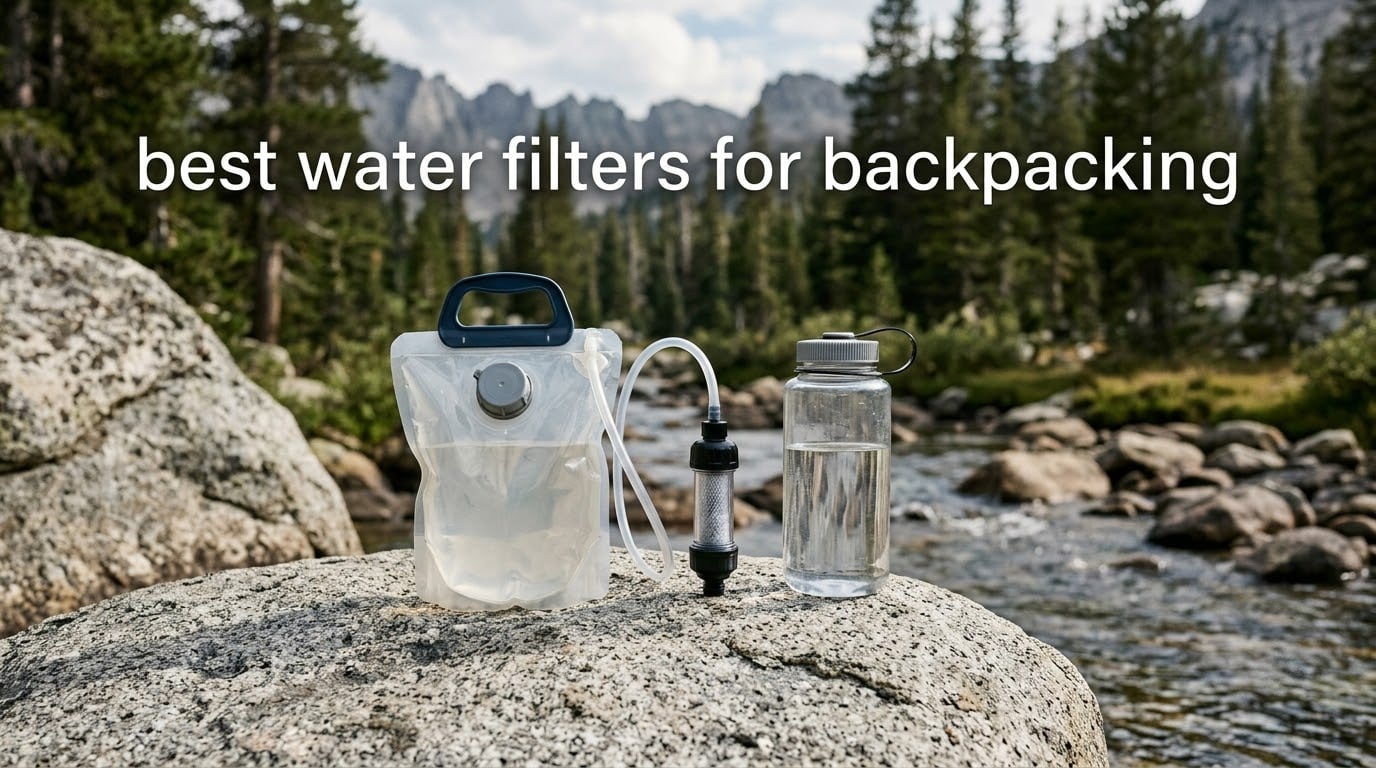
Choosing the best water filters for backpacking comes down to one question most hikers never ask out loud: how dirty is the water where you are going to drink? A hollow-fiber filter strains out bacteria and protozoa such as Giardia and Cryptosporidium, which covers nearly every stream, lake and puddle in North America and Western Europe. It does not touch viruses, and it does not make silty desert water taste better. That distinction is the whole buying decision, and everything below is built around it.
We spent weeks reading specifications, warranty terms and thousands of buyer reviews across twelve filters to put this list together. This is a research-based guide rather than a field test log, and we say so up front because a safety-adjacent category deserves honesty. What we did do was rank the products on the criteria that actually decide whether a filter works on a trail: real flow rate, how it behaves in cold water, how easy it is to backflush, how much space it takes in a pack, and what a replacement element costs over its life.
One quick note for anyone who landed here from a different kind of search. If you are filtering tap water at home, RV plumbing or a city supply, the failure modes and the pore-size maths are different, and we cover those separately in our guides to RV water filters for drinking water and whole house water filters for city water. Everything from here on is about water you carry in your pack and drink the same day.
Table of Contents
Filter vs Purifier: What You Actually Need
A filter removes protozoa and bacteria. A purifier does that and removes viruses as well. That is the entire technical difference, and every other distinction is packaging.
The pore-size thresholds behind it are simple. A 1 micron absolute rating is enough to trap Giardia and Cryptosporidium, which are the organisms that actually make people sick on North American trails. Bacteria need finer pores, and manufacturers use hollow-fiber membranes rated at 0.1 or 0.2 microns to catch them. Viruses are roughly 0.02 microns, so no hollow-fiber filter on this list can touch them; only a purification membrane, an adsorbing cartridge or a chemical treatment does that work.
So: in North America, Western Europe and Australia, on wilderness water that has no human or livestock waste upstream, a filter is enough. Carry a purifier if you are travelling outside those regions, camping near farms, settlements, mines, cesspits or high-traffic campsites, or filtering water anywhere people are washing. A second safety net costs almost nothing: a couple of chlorine dioxide tablets in the first-aid kit handle the case where your filter freezes or cracks and you have no time.
One more thing filters do not do: improve taste or clarity. Membranes strain organisms and microplastics, not dissolved organic material, tannins or silt. If your water is brown, a carbon stage helps the flavour, but it will not make the water clearer, and no filter in this roundup treats farm runoff or fuel spill.
Top 3 Picks for Best Backpacking Water Filters (October 2026)

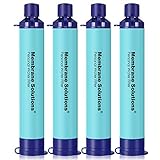
LifeStraw Personal Water Filter
- 4000 liter rated capacity
- 0.09 lb body
- drink straight from the source
All 12 Water Filters for Backpacking Compared in 2026
Every filter below removes bacteria and protozoa. Only the GRAYL GeoPress removes viruses, and only the Survivor Filter PRO pairs a carbon stage with a 0.01 micron element. The weight figures below are the stated body weight, not the weight of the kit around it, and you should add a dirty bag, a clean bottle and a syringe to your own pack total.
| Product | Specifications | Action |
|---|---|---|
| LifeStraw Personal Water Filter |
|
Check Latest Price |
 Sawyer Squeeze SP129 Sawyer Squeeze SP129 |
|
Check Latest Price |
| Membrane Solutions S1 |
|
Check Latest Price |
 LifeStraw Peak Series Personal Filter LifeStraw Peak Series Personal Filter |
|
Check Latest Price |
 GRAYL GeoPress GRAYL GeoPress |
|
Check Latest Price |
 Survivor Filter PRO Survivor Filter PRO |
|
Check Latest Price |
 Katadyn BeFree 1L Katadyn BeFree 1L |
|
Check Latest Price |
 Waterdrop Gravity Straw Kit Waterdrop Gravity Straw Kit |
|
Check Latest Price |
 Sawyer Micro Squeeze SP2129 Sawyer Micro Squeeze SP2129 |
|
Check Latest Price |
 Katadyn Hiker Pro Katadyn Hiker Pro |
|
Check Latest Price |
 MSR TrailShot MSR TrailShot |
|
Check Latest Price |
 LifeStraw Peak Squeeze 650 ml LifeStraw Peak Squeeze 650 ml |
|
Check Latest Price |
1. LifeStraw Personal Water Filter: Best Overall for Backpacking Water Filters
LifeStraw Personal Water Filter for Hiking, Travel and Emergency, Blue, 1PK
0.09 lb body
4000 liter capacity
Removes bacteria, parasites and microplastics
Pros
- Pocket-sized at 0.09 lb
- Drinks directly from the source with no setup
- 4.8 rating across 125713 reviews
- 4000 liter rated lifespan
Cons
- Slow sip-style flow
- Stops at 1 micron for microplastics
- No virus or chemical removal
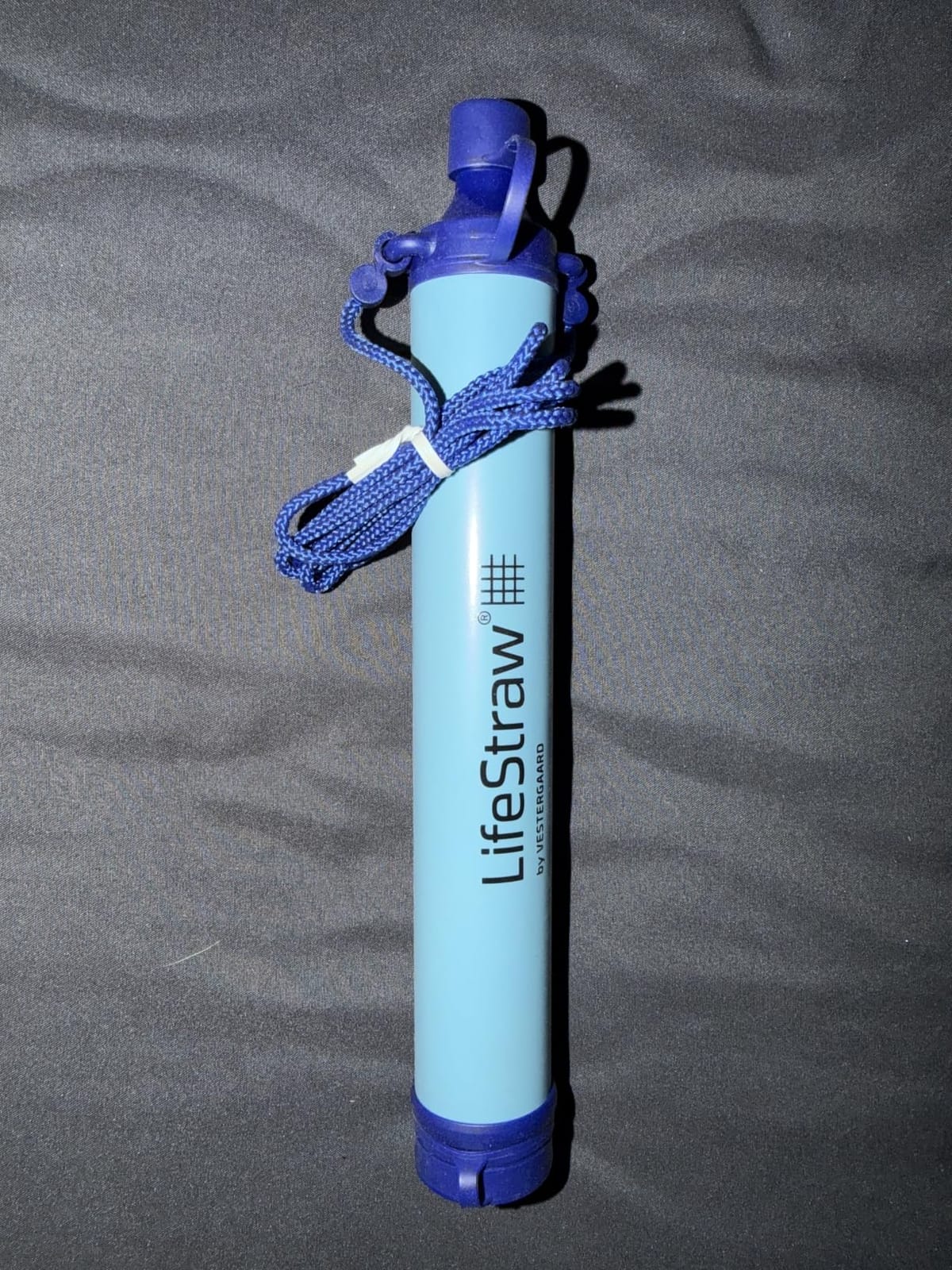
This is the filter we hand to anyone who asks for one recommendation. It weighs 0.09 lb, it needs no dirty bag, no pump and no batteries, and you put its tip in the stream and drink. After decades of use and a review count north of 125,000, it is the most proven piece of water gear on this list, and for a solo hiker on a trail with reliable sources it is genuinely hard to argue with.
The membrane removes 99.999999 percent of waterborne bacteria including E. coli and Salmonella, 99.999 percent of parasites including Giardia and Cryptosporidium, and microplastics down to 1 micron. It is tested to US EPA, NSF and ASTM protocols, and the materials are BPA free.
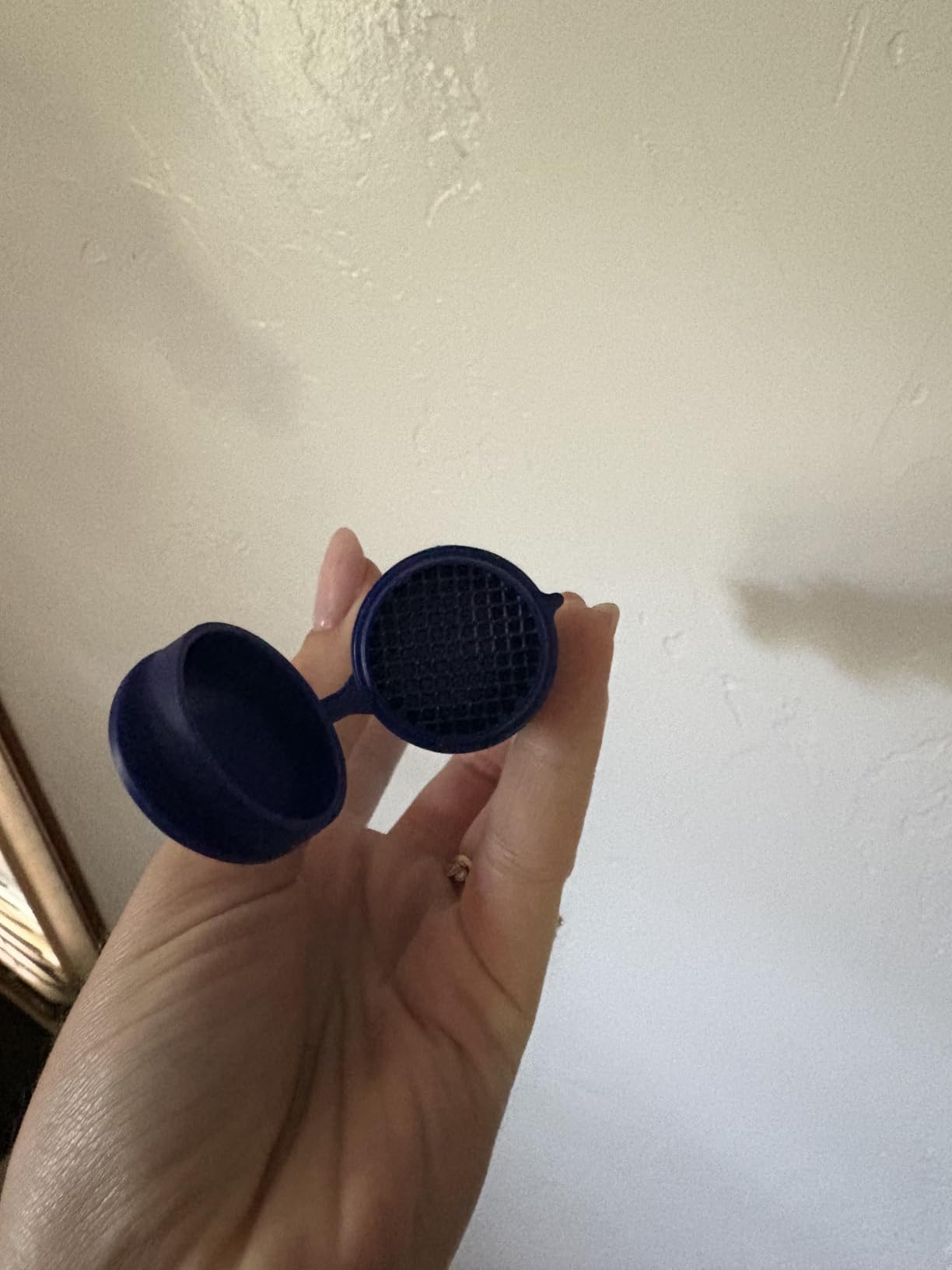
The compromise is flow. You are sipping through a straw membrane rather than pushing water through a squeeze bag, so filling a one-litre bottle is a slow job that is better done at a stream than at camp. Microplastic capture is also capped at 1 micron, which is coarser than the 0.1 micron hollow fiber used by the Sawyer and Katadyn models here, and there is no virus or dissolved-chemical removal at all.
Turbidity is reduced to 0.2 microns, so sediment and cloudiness drop, but the water tastes exactly like the source. In a desert canyon with tannin-stained water, that is the one place this filter will disappoint you.
When the LifeStraw Personal is the right call
It suits solo hikers, day hikers, trail runners, anglers and anyone carrying a first-aid or emergency kit. It is the easiest filter in this roundup to keep in a jacket pocket for a whole season and still have it work on day 30.
It is also a sensible primary filter for international travel, paired with a couple of chlorine dioxide tablets in case you need virus protection on a given day. Most travellers end up using it for tap water and reserving the tablets for questionable sources.
When the LifeStraw Personal is the wrong call
Do not buy it to filter a group. Six people drinking four litres each is 24 litres of slow sipping, and nobody will do it.
Skip it for silty desert water, for shallow puddles full of sediment, and for any trip where human waste contamination is plausible. It also cannot handle water above its temperature rating without damage, so keep it out of a hot vehicle.
2. Sawyer Squeeze SP129: Best All-Around Backpacking Filter
Sawyer Products SP129 Squeeze Water Filtration System w/Two 32-Oz Squeeze Pouches, Straw, and Hydration Pack Adapter
0.1 micron hollow fiber
1.7 L per minute
2 oz with lifetime warranty
Pros
- 2 oz filter body with 1.7 L per minute
- Lifetime manufacturer warranty on filter defects
- Two reusable pouches plus straw and bladder adapter
- Every unit individually tested three times
Cons
- Squeeze action slows as the pouch empties
- No virus removal
- Flow drops in freezing water
If you read one profile in this roundup, make it this one. The Sawyer Squeeze is the reference point every other squeeze filter is measured against, and the reason is the combination of a 0.1 micron absolute hollow-fiber element, a stated 1.7 liters per minute flow rate and a lifetime manufacturer warranty against defects on the filter itself.
The kit gives you two 32-ounce collapsible BPA-free pouches, a replaceable pop-up drinking straw and a hydration pack adapter, all inside a mesh storage bag. Fits standard 28 mm threaded bottles, so it drops straight into a Nalgene without an extra part.
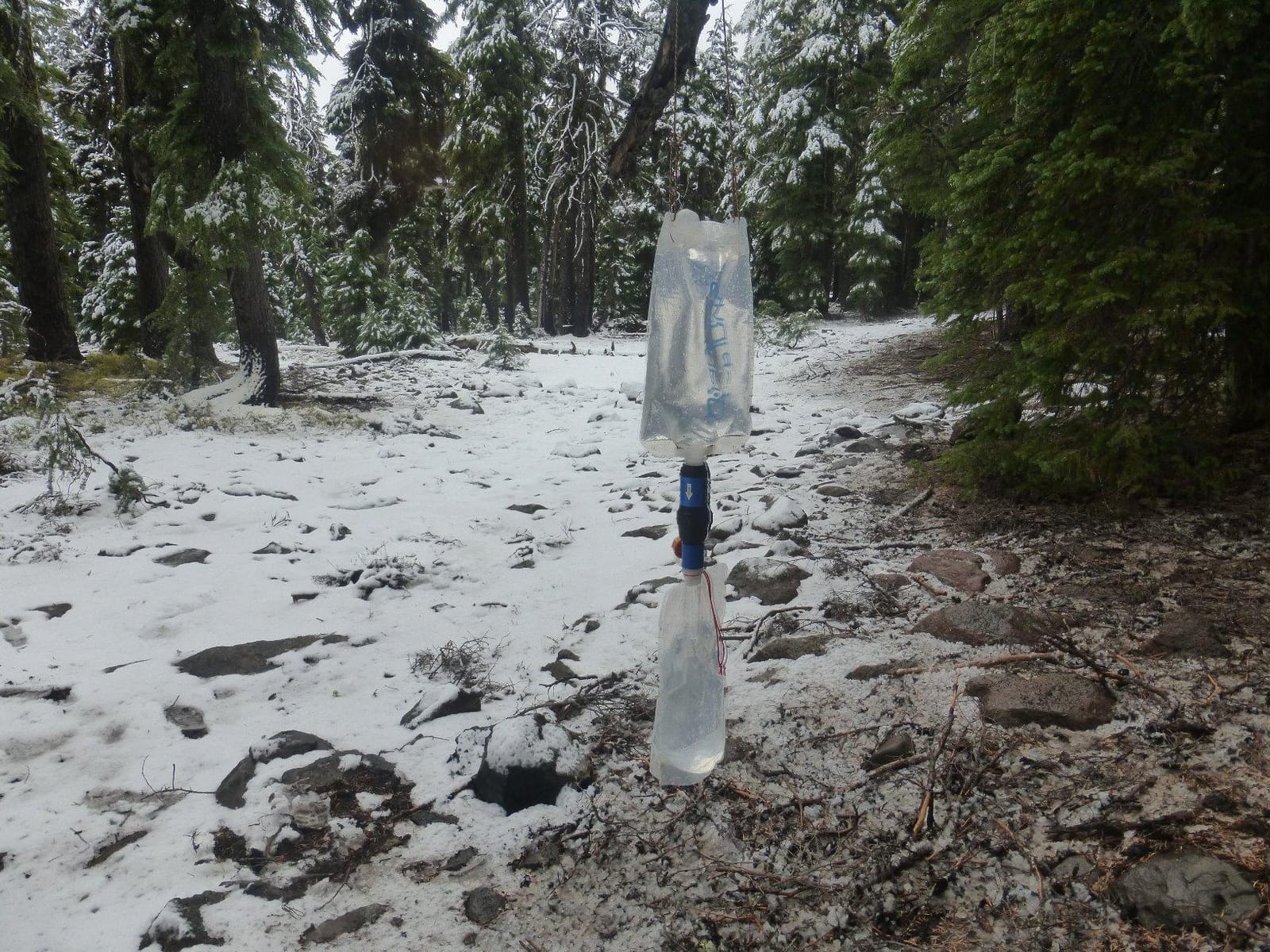
Removal rates are 99.999999 percent for bacteria, 99.9999 percent for protozoa and 100 percent for microplastics. The element is rated to 1,000 TDS and a maximum of 40 °C, which matters more than most hikers realise: push hot water through it and the membrane can be damaged permanently.
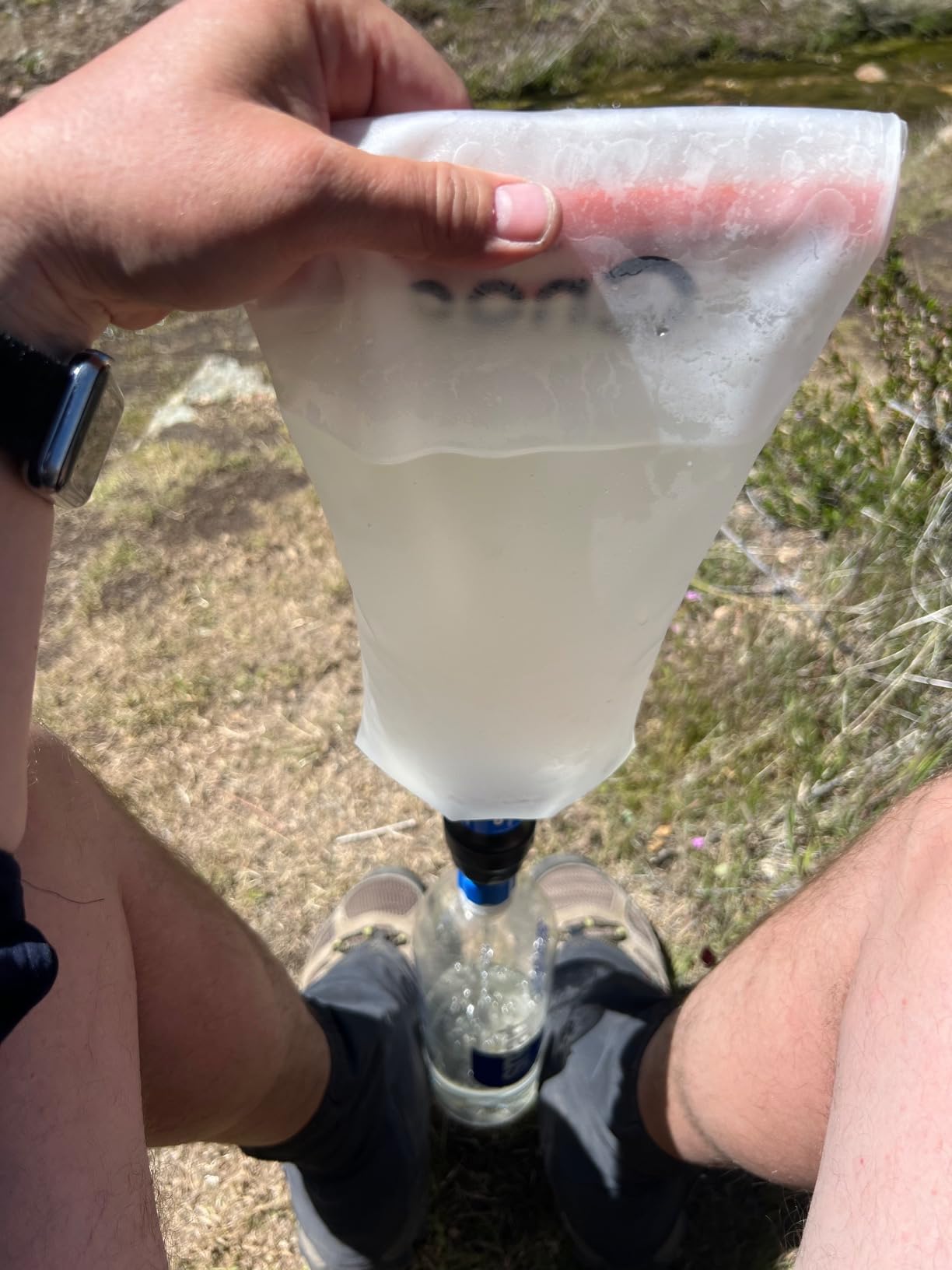
The two weak points come straight from owner reports. Squeezing gets tiring and the flow slows noticeably as a pouch empties, so filtering a full litre for two people is real arm work. And the honest, near-universal complaint across hiking forums is that flow collapses in genuinely cold water, which is the number one practical gripe in every backpacking water thread we read.
When the Sawyer Squeeze is the right call
It is the most flexible option for one to two people, because the same element runs as a straw, a squeeze filter into a 28 mm bottle, or an inline filter on a dirty reservoir. That flexibility is why it shows up in so many trip reports.
On r/hiking, users weighing intermittent use keep landing on the Sawyer Squeeze and the Katadyn BeFree as the same answer, and the recurring argument is that the decision is really about pouch and flask pairing rather than the element.
When the Sawyer Squeeze is the wrong call
It is a filter, not a purifier, so it is the wrong tool anywhere with virus risk: outside North America, Western Europe and Australia, or near farms and settlements.
The pouches are also the failure point most cited by owners. They develop seam holes after repeated squeezing and rolling, and they are awkward to fill in a deep, fast-moving stream, so bring a bottle or jug to the water rather than dipping the pouch in mid-current.
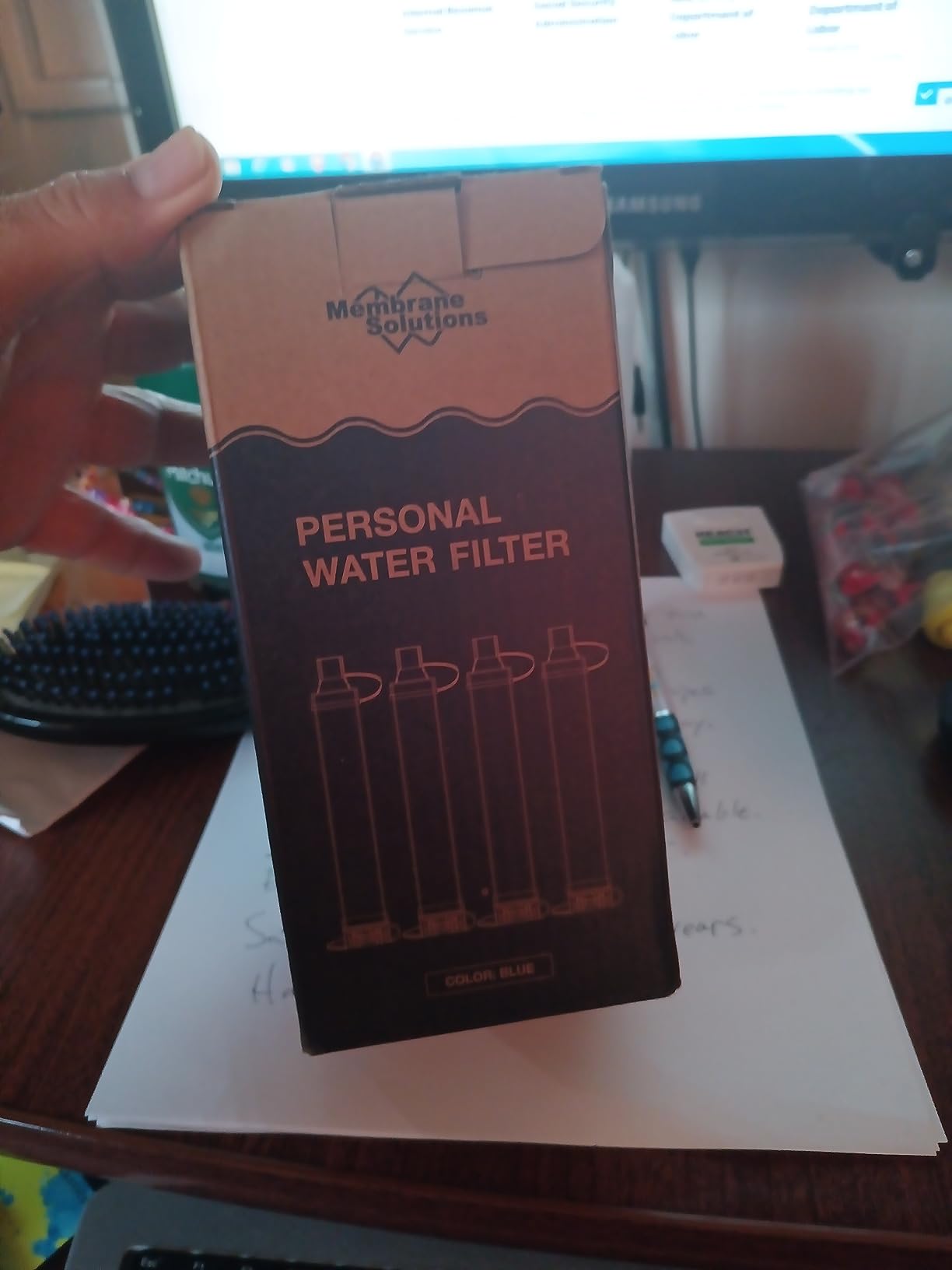
3. Membrane Solutions S1: Best Certified Backpacking Filter
Membrane Solutions Personal Water Filter Straw S1 (Blue, 4 Pack)
NSF 42, 372 and 401
0.1 micron
500 ml per minute
Pros
- Rare triple NSF certification
- Removable ends allow backflushing and filter life extension
- Clean taste with no chemical aftertaste
- Fits 28 mm threaded bottles
Cons
- No virus or chemical removal
- Carbon stage has a shorter useful life than the membrane
- 1320 gallon capacity trails some rivals
Certification is the reason this filter earns its place. It is certified to NSF/ANSI 42, 372 and 401, a triple that is unusual in the backpacking category, and it removes 99.9999 percent of total coliforms including E. coli at a 0.1 micron pore size with flow up to 16.9 fluid ounces per minute.
What those three standards mean in plain terms: 42 covers aesthetics and particulate reduction, 372 covers lead and other health-contaminant claims, and 401 is the cyst reduction protocol for Cryptosporidium. If you want a spec sheet you can point at rather than a marketing claim, this is the one.
It is a five-stage unit rather than a bare membrane: hollow-fiber ultra membrane, activated carbon, double PP cotton fibre and a coarse filter. That carbon stage is why owners report clean-tasting water with no chemical aftertaste, and why it also does not lower TDS, leaving the natural mineral balance in the water intact.
The trade-offs are modest. The coconut shell carbon stage has a shorter useful life than the membrane itself, and the 1,320 gallon rated capacity is lower than the very long headline numbers some competitors print. Removable ends let you backflush and extend effective life, which is what keeps the membrane performance up over a season.
When the Membrane Solutions S1 is the right call
It is a strong pick for anyone who filters on a schedule rather than by whim, because the certification and the backflushable ends make performance predictable. Backflush it after a muddy source and the flow comes back.
It suits solo and two-person trips where taste matters, such as desert routes with a lot of tannin-heavy runoff, and it is a comfortable match with any 28 mm bottle, cup or pouch.
When the Membrane Solutions S1 is the wrong call
Like everything else here, it is a microfilter with no virus removal and no treatment of dissolved chemicals, pesticides or fuel.
Filtering several litres by hand is slower than a pump, so it is not a group or basecamp solution. And while the carbon stage improves flavour, it cannot make brown water clear.
4. LifeStraw Peak Series Personal Filter: Best for Day Hiking and Emergency Kits
LifeStraw Peak Series Personal Water Filter for Hiking, Camping, Travel, and Emergency Preparedness, 1 Pack, Mountain Blue
2.5 L per minute
4000 liter capacity
Works as straw, bottle or gravity
Pros
- Faster 2.5 L per minute than the original Personal
- Re-engineered membrane resists sand and silt
- Attaches to bottles and gravity hoses
- 5 year spare part availability
Cons
- Best on relatively clear water
- No virus or chemical removal
- Sip-through use is slower than squeeze or pump
This is the modern version of the filter above, and the improvement is real rather than cosmetic. Flow goes from a slow sip to a stated 2.5 liters per minute, listed up to 3, and the re-engineered membrane is designed to resist clogging from sand and silt, which was the classic complaint about the original.
It keeps the same 4,000 liter capacity, removes 99.999999 percent of bacteria, 99.999 percent of parasites and 99.999 percent of microplastics, and a removable threaded bottom cap lets it attach to water bottles and standard gravity hoses. That makes it a genuine three-way tool: straw, bottle filter, or component in a gravity system.
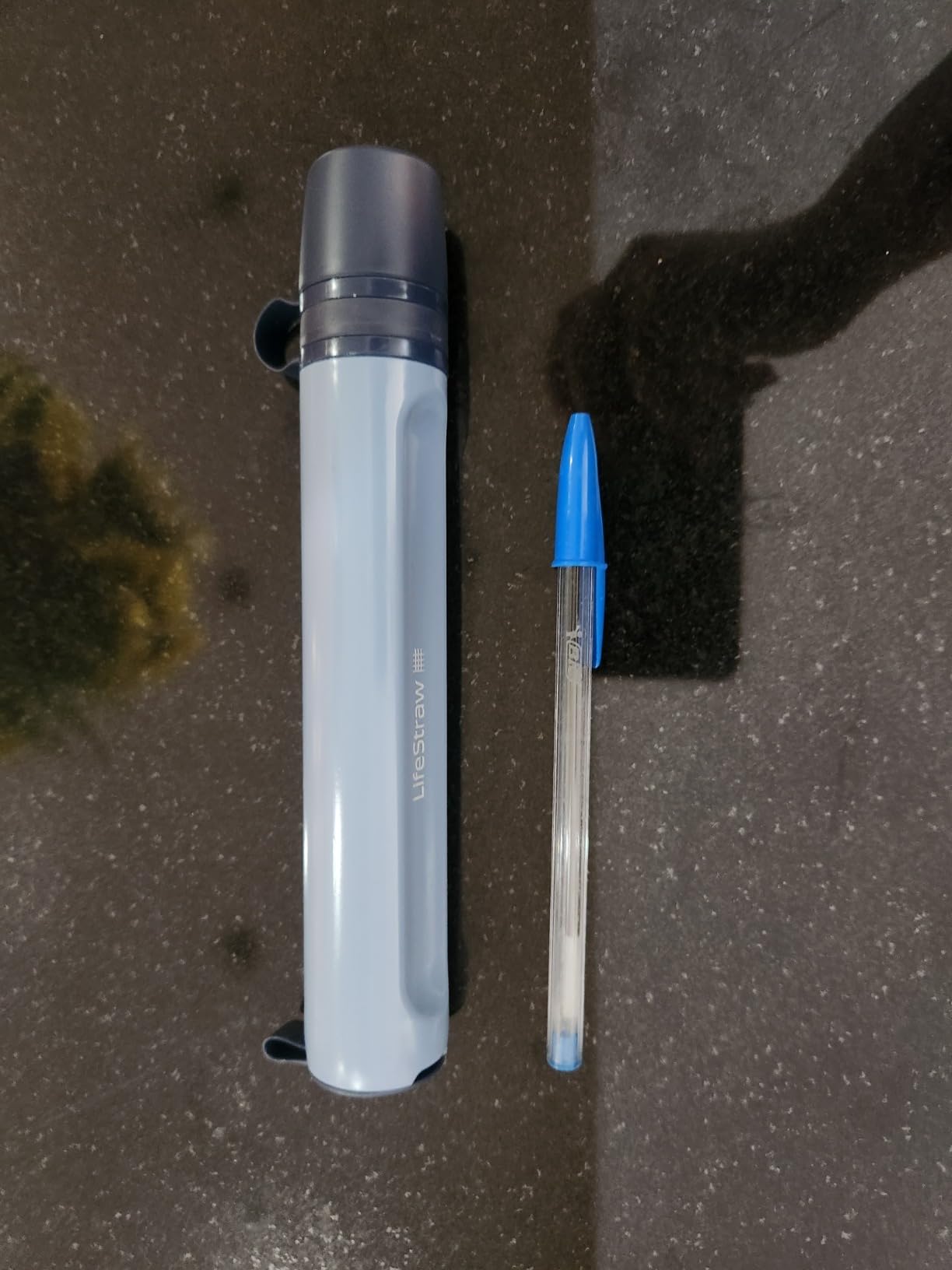
Owners consistently rate it as a step up from the classic Personal, praising flow, durability and the taste of the finished water. The five-year spare part availability is a quieter but real advantage over a filter that becomes a dead end once a part fails.
Its limit is water quality. The membrane is a microfilter, so murky sources still need pre-filtering, and no amount of membrane improvement changes the fact that viruses and dissolved chemicals pass straight through. Sip-through use also remains slower than squeezing or pumping, so it is a personal-volume tool.
When the LifeStraw Peak Series is the right call
It works well for hikers who filter at stream crossings while walking rather than at camp, because the faster flow matters when you are stopped for a minute, not for half an hour.
It is also the right pick for a vehicle kit, a desk drawer at work, and any emergency bag, where the ability to run it as a straw off a gravity hose in a sink is genuinely useful.
When the LifeStraw Peak Series is the wrong call
It is not for group water collection, and it is not for brown desert water unless you pre-filter. At roughly 3.5 oz it is heavier in the pocket than the original Personal, though far lighter than a pump.
Anyone needing virus protection should pair it with tablets rather than assume the higher flow rate changes what the membrane can remove.
5. GRAYL GeoPress: Best Water Purifier for Backpacking
GRAYL GeoPress 24 oz Water Purifier & Water Filter Bottle, Black Camo
24 oz vessel
Removes viruses, PFAS and heavy metals
710 ml in 8 seconds
Pros
- Only option here that removes viruses as well as bacteria and protozoa
- Strips chemicals
- PFAS
- pesticides and heavy metals
- No batteries
- chemicals or setup
- 10 year warranty and shelf life
Cons
- Heavy at 15.9 ounces
- Needs real arm or body weight to press
- Must stay under the fill line with cap venting
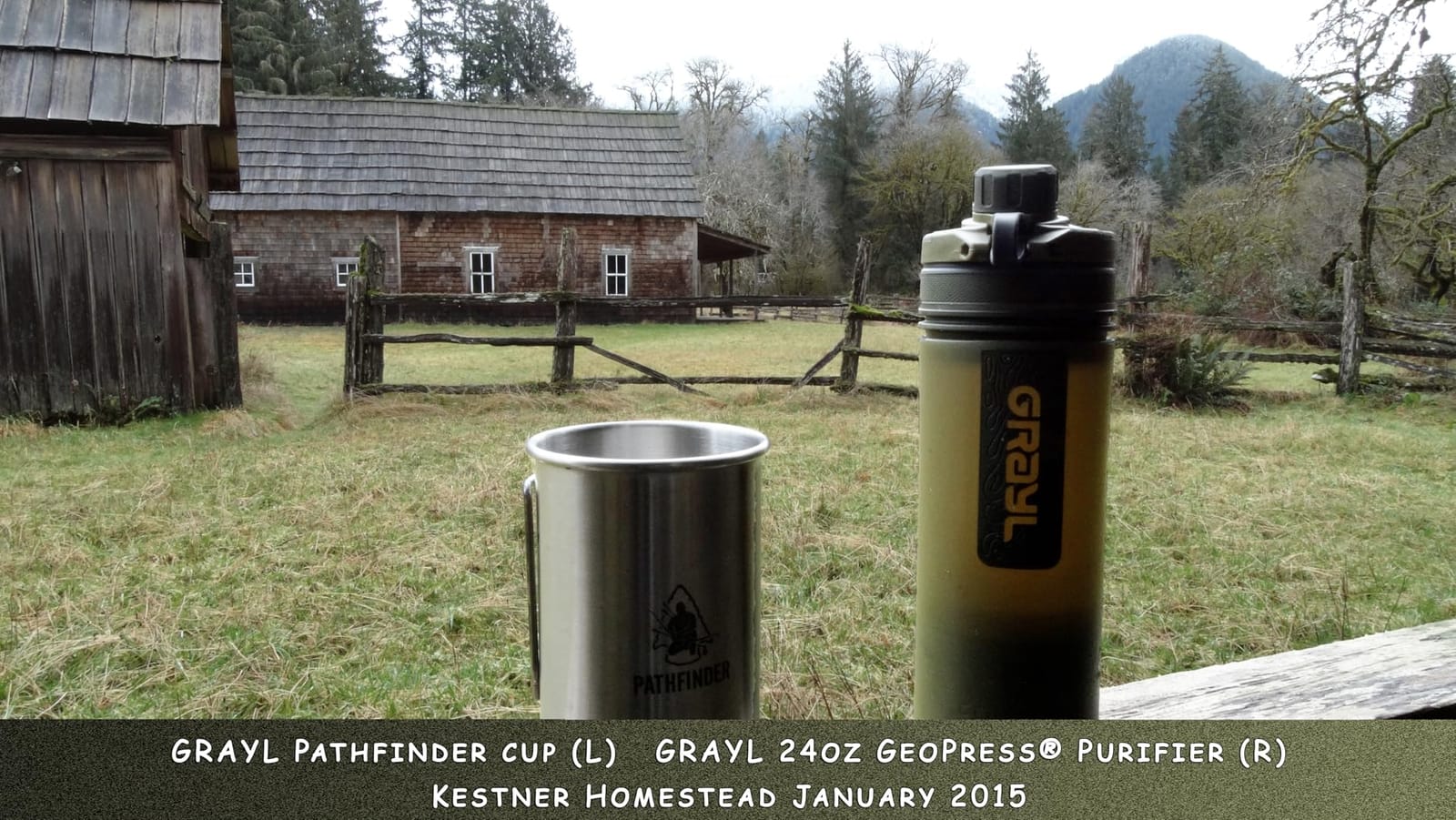
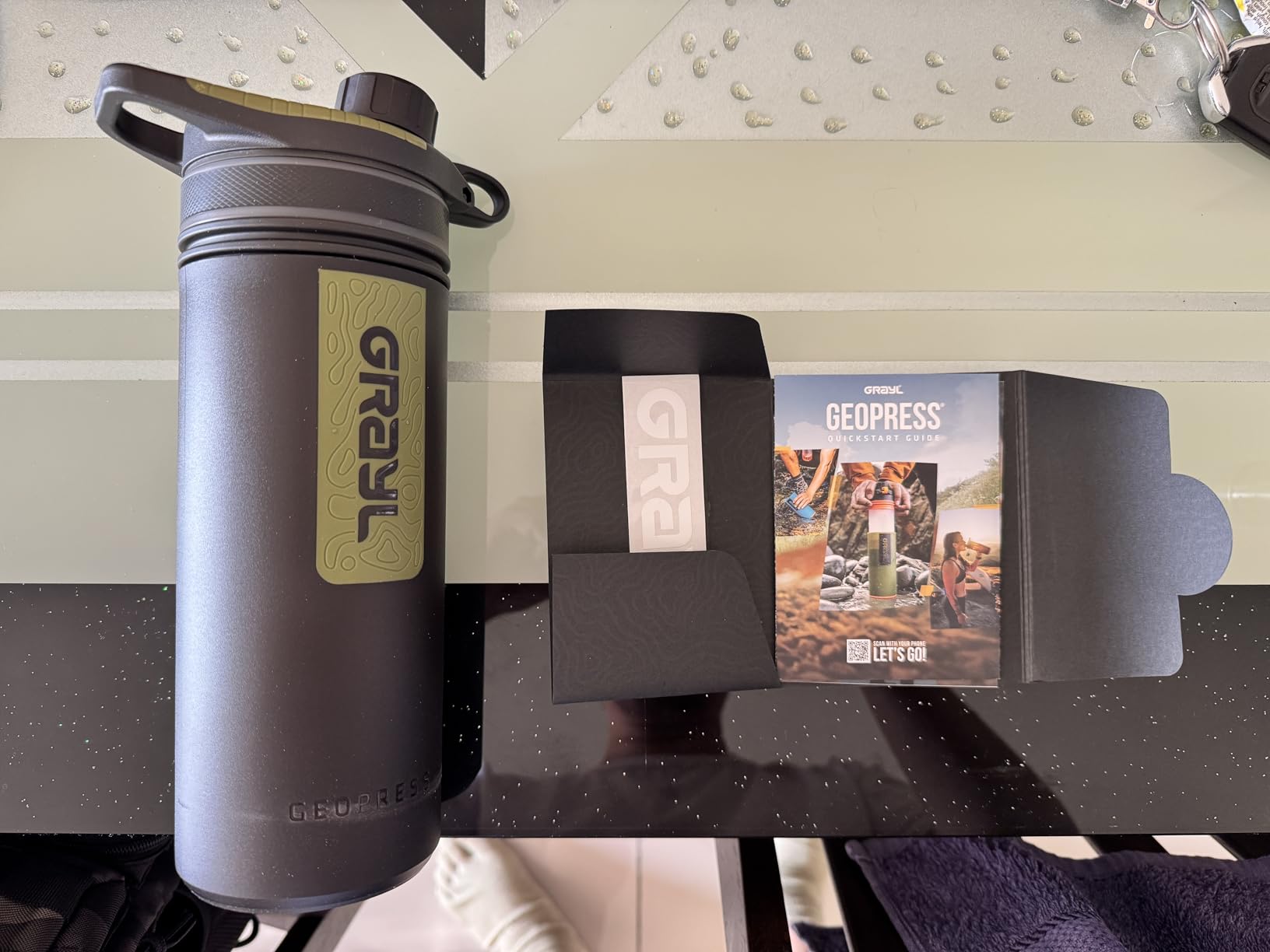
This is the only product in the roundup that answers the virus question properly. The GeoPress uses electroadsorption with an activated carbon stage to remove rotavirus, norovirus and hepatitis A alongside bacteria and protozoa, and it also adsorbs VOCs, PFAS, chemicals, pesticides, herbicides, heavy metals, flavours and odours. Rated maximum TDS is 300 ppm.
The workflow is unusual and worth understanding before you buy. You fill the 24-ounce inner vessel, replace the cap, press the inner cartridge down with the outer cup, and about eight seconds later you have 710 ml of purified water with no pump, no batteries and no consumables.
Because the mechanism is adsorptive rather than membrane-based, the replaceable cartridge is rated for 65 gallons, or 250 litres, which is a consumable to plan for rather than a lifetime element. The manufacturer also states a 10 year product shelf life and a 10 year warranty on workmanship and materials.
Family campers and travellers who have dealt with questionable tap water rate it very highly for clearing chlorine, chemical flavours and cloudy water. The consistent complaints are physical: at 15.9 ounces it is heavy for a day hike, you need genuine arm or body weight to drive the press, and you must respect the max fill line and vent the cap or water pushes out the sides.
When the GRAYL GeoPress is the right call
It is the pick for international travel, for anywhere with virus risk, and for water with a chemical problem, such as camping near agricultural runoff or treating suspect tap water without boiling.
It also doubles as clean storage. The 24-ounce vessel is a real bottle, and having one that both purifies and holds purified water removes a piece of kit from the pack.
When the GRAYL GeoPress is the wrong call
It is the wrong choice for solo or fast hiking. At 15.9 ounces before you add a bottle, it is roughly six times the weight of a hollow-fiber squeeze filter, and you cannot put more than one vessel through it at a time.
It is also a cartridge system, so over a season of heavy use the 250-litre element needs replacing, and the press action gets tiring when you are filtering a full group load in the evening.
6. Survivor Filter PRO: Best Three-Stage Pump Filter
Survivor Filter PRO Portable Water Filter for Camping, Survival & Emergency
0.1 micron, carbon and 0.01 micron
500 ml per minute
Works from 32 to 120 F
Pros
- Three replaceable stages including a carbon stage
- Pumps about 500 ml per minute
- Keeps dirty and clean water separate in one device
- Lifetime defect warranty
Cons
- Heaviest pump style option at 12.8 ounces
- No true mesh pre-filter so silty water can clog it
- Outlet cap is a known fragile point
Most filter-versus-purifier debates come down to cartridge geometry, and the Survivor Filter PRO makes the difference unusually visible. It is a three-stage system: a 0.1 micron pre-filter, a carbon filter, and a 0.01 micron ultra filter, and the manufacturer states 99.999 percent removal of tested virus, staph, bacteria and protozoa, plus heavy metal reduction per NSF/ANSI standards.
It pumps roughly 500 ml, or 17 ounces, per minute, which is a workable rate for two people and good for group camp volume, and it is specified to work from 32 °F to 120 °F. The stated capacity is 100,000 litres, and every element is individually replaceable.
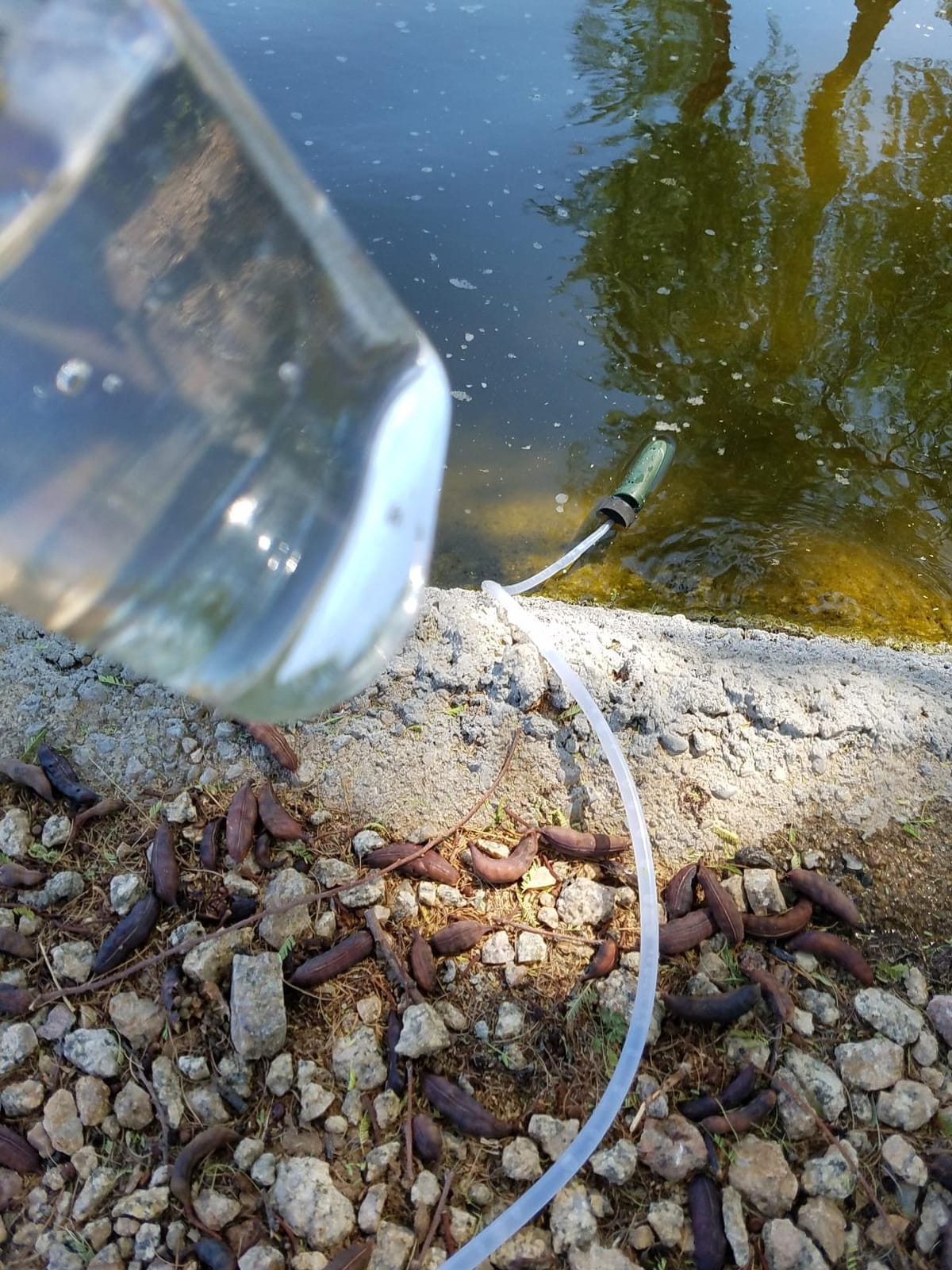
The box includes a back-washing syringe, hose clip, inlet and outlet silicone hoses, a carrying case, and both the ultra pre-filter and the internal ultra filter. The dirty and clean sides stay physically separate inside one body, which is good hygiene practice and removes the cross-contamination risk that comes from swapping hoses on an inline setup.
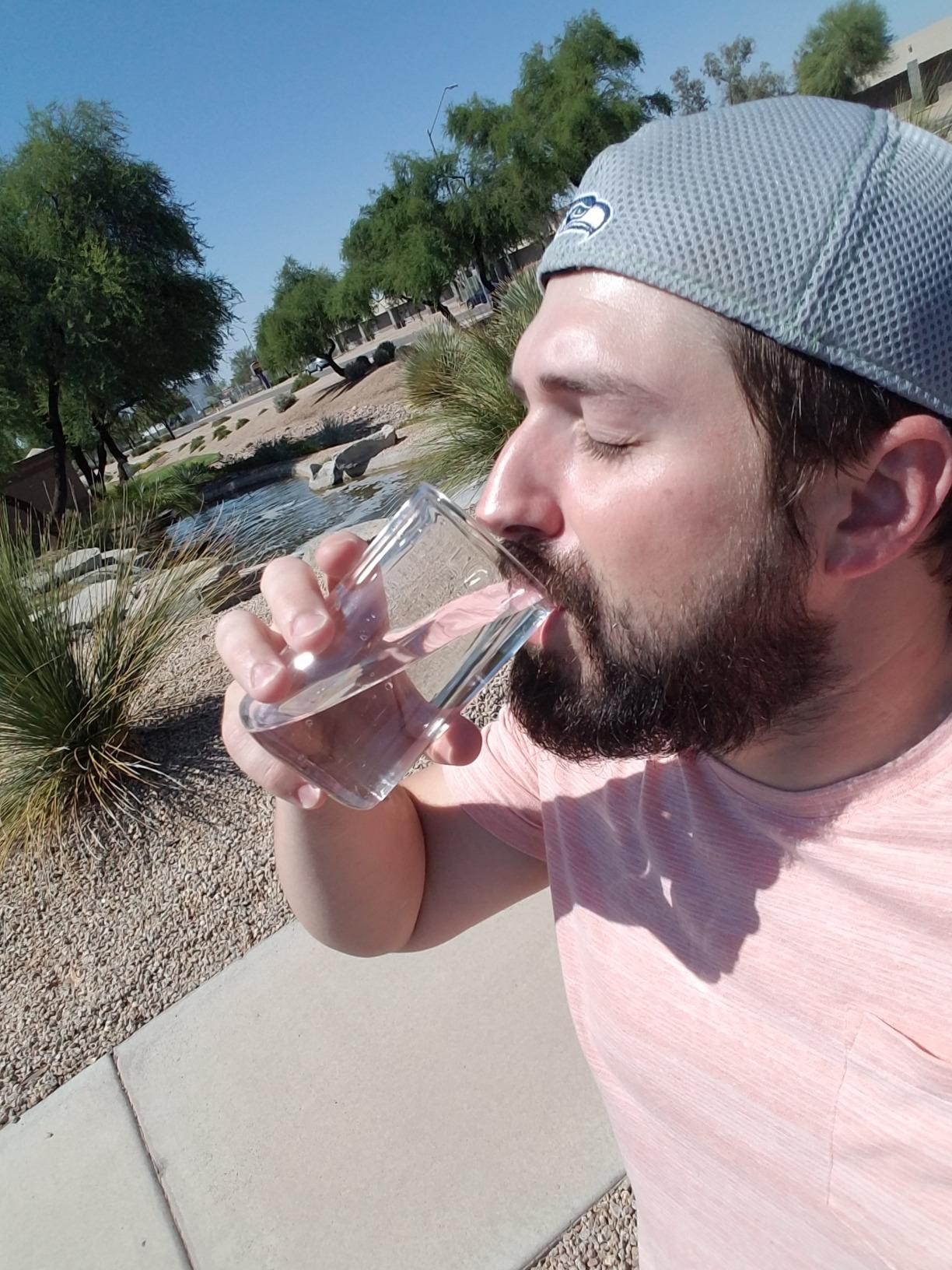
Owners who filter dirty sources praise the taste improvement and the virus capability over lighter squeeze filters. The drawbacks are equally clear: it is the heavier option at 12.8 ounces, there is no true mesh pre-filter so the 0.1 micron stage can clog in silty water, and pumping several litres takes time, with the small outlet cap a known fragile point for some owners.
When the Survivor Filter PRO is the right call
It fits trips where virus risk is real and volume matters, such as travel outside North America and Western Europe, or basecamp setups with a human-waste question nearby.
It is also the choice when you want carbon taste improvement alongside purification, since the middle stage does the flavour work that hollow-fiber-only systems skip.
When the Survivor Filter PRO is the wrong call
At 12.8 ounces it is too heavy for fast hiking, and a syringe is required for cleaning, which is one more piece of kit to keep dry.
For desert silty water it needs a separate pre-filter step, and the stated virus performance relies on the third stage staying within spec, so replace elements on the schedule the manufacturer gives rather than when flow drops.
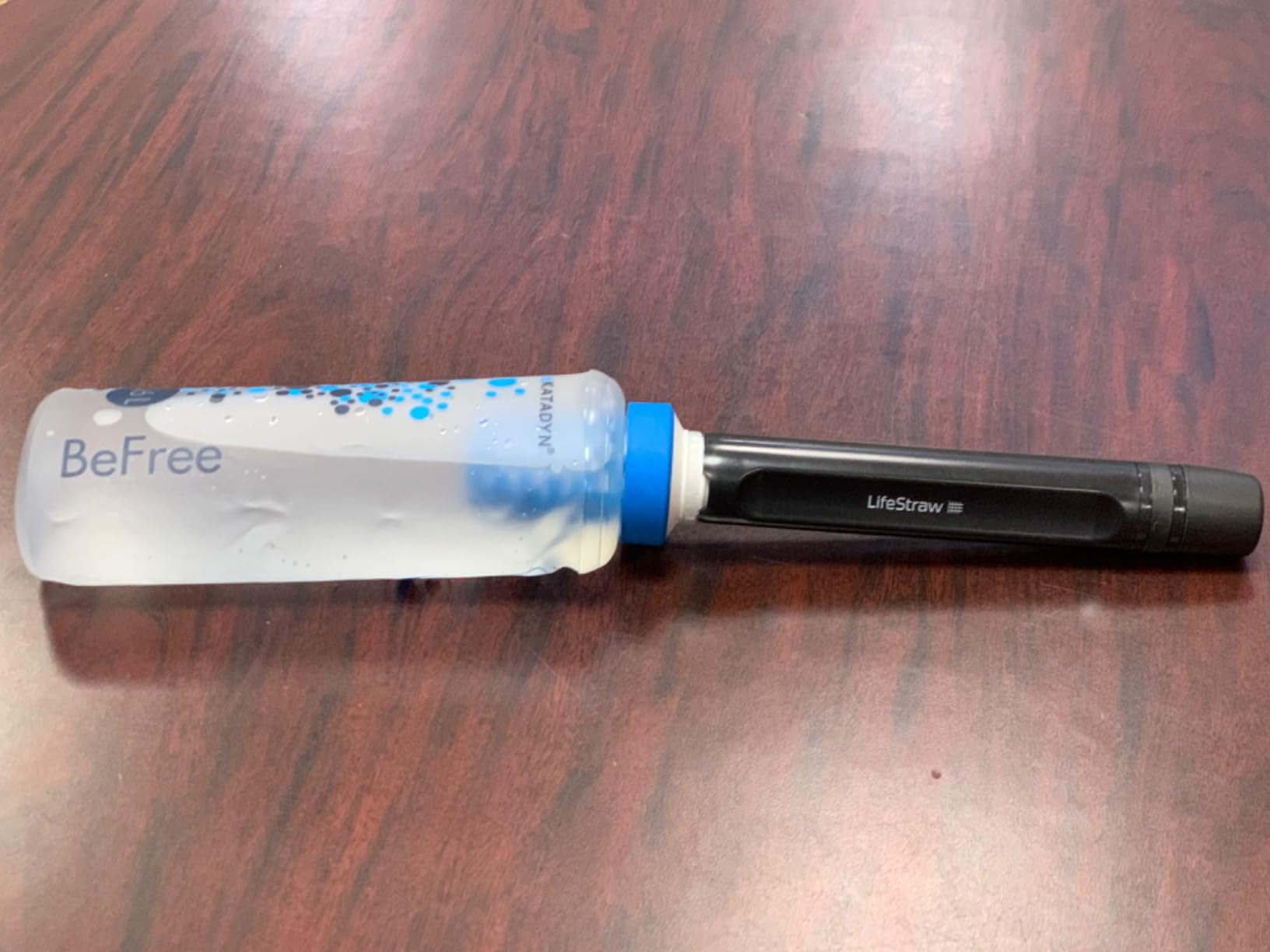
7. Katadyn BeFree 1L: Flattest-Packing Backpacking Filter
Katadyn BeFree AC 2-Stage Filter Collapsible Travel Water Bottle 1L, Clear
1 L collapsible bottle
0.1 micron hollow fiber
2 L per minute
Pros
- Folds completely flat and weighs 2.24 oz
- Fast 2 L per minute squeeze flow
- Filter and bottle in one with no separate dirty bag
- Cleans by swishing
- no backflush needed
Cons
- Collapsible bottle is prone to pinhole leaks
- No virus or chemical removal
- 1 L means repeated fills for a full day
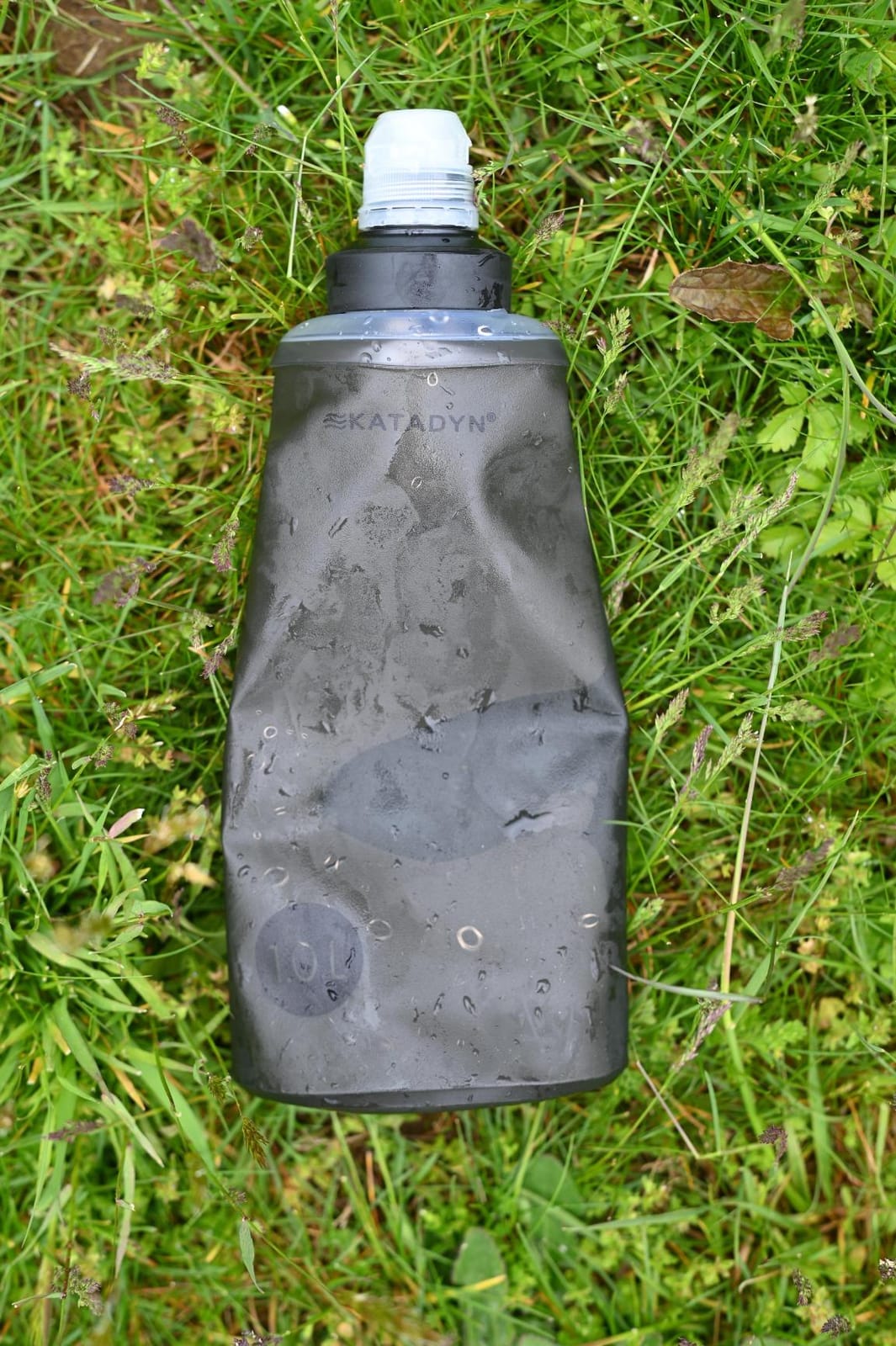
The BeFree solves a problem no other filter here does: it disappears into a jersey. The 1 L bottle collapses flat enough to pack into shorts, a vest or the side of a pack, and the whole thing weighs 2.24 ounces with a stated 2 liters per minute flow through a 0.1 micron hollow-fiber membrane.
Cleaning is the easiest on this list by some margin. You unscrew it, add a little source water and swish or shake it, then reassemble. There is no backflush, no syringe and no separate dirty bag, because the filter is built into the bottle.
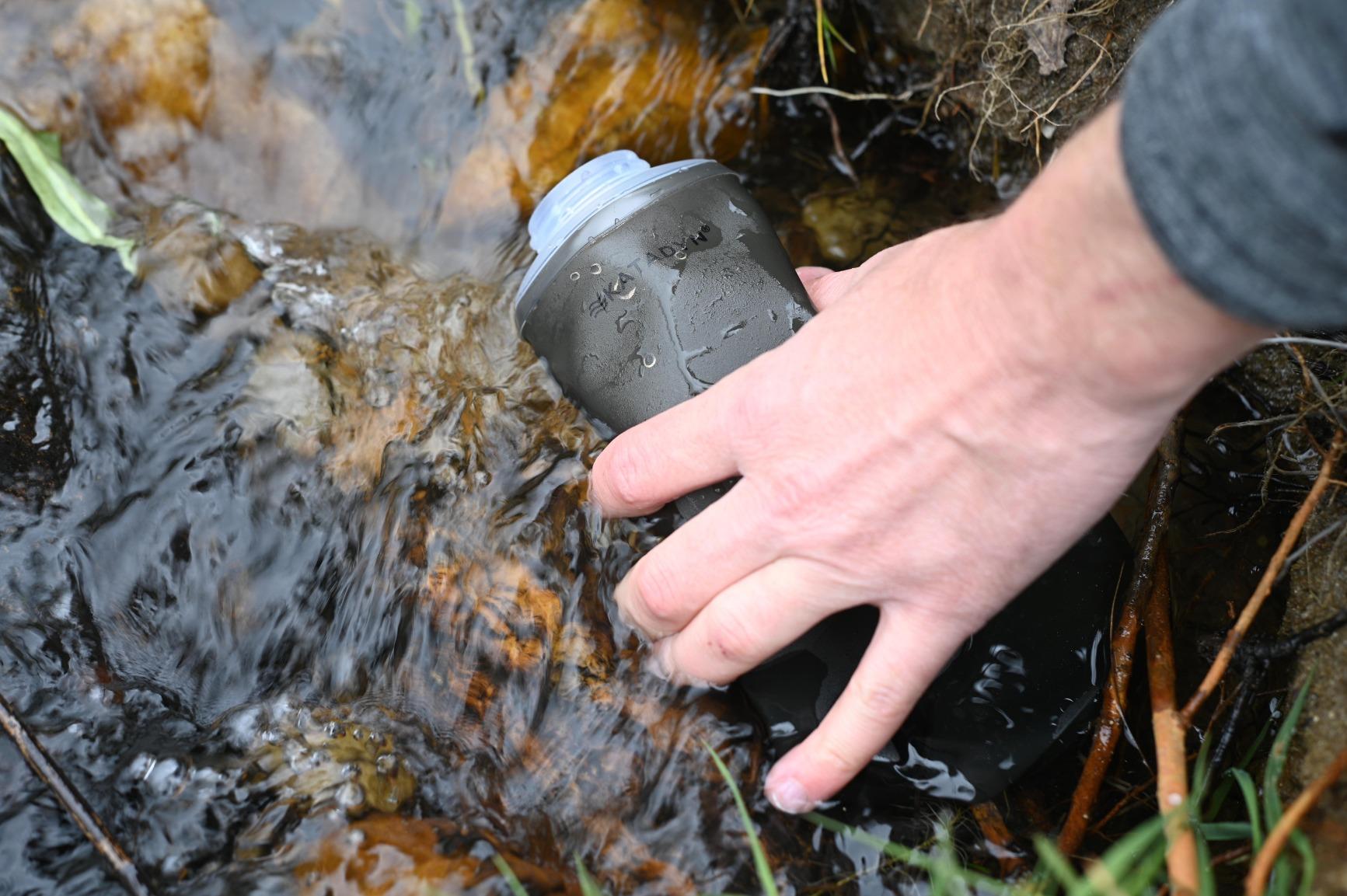
It is BPA free throughout, has a modular replaceable carbon filter, handles sediment and fine particles, and is rated for 1,000 litres with a maximum supported TDS of 1,000 ppm, which is the highest figure in this roundup.
Long-term users call it the fastest and most packable filter they own. The most repeated complaint is that the flexible bottle eventually develops pinholes, which is a fitting failure rather than a membrane failure, and a few note slower flow after use in freezing conditions.
When the Katadyn BeFree is the right call
It is the best choice for fast hikers, trail runners and anyone who values pack volume over capacity, because the empty profile is a few centimetres thick.
It also suits users who will not do maintenance. No syringe, no backflush schedule and no separate reservoir means fewer ways to get it wrong on a long trip.
When the Katadyn BeFree is the wrong call
One litre is a single-person day volume, so a party of three refills it constantly. And the 2 L per minute rating is measured on clear, warm water, so in a cold alpine stream the real number is meaningfully lower.
It removes no viruses and no chemicals, and the bottle pinhole issue means you should inspect it before every trip and replace it rather than patch it.
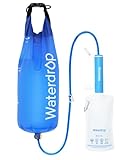
8. Waterdrop Gravity Straw Kit: Best Backpacking Filter for Groups
Waterdrop Gravity Water Filter Straw, Camping Water Filter, 0.1 Micron
0.1 micron straw
1.5 gallon gravity bag
700 ml per minute
Pros
- 1.5 gallon gravity bag covers a full day of group water in one fill
- Faster 700 ml per minute gravity throughput
- Both ends disassemble to fit bottles or bags
- Backflushable to keep the membrane clear
Cons
- Gravity bag adds bulk versus a plain straw
- Maximum supported TDS only 300 ppm
- 30 day limited warranty
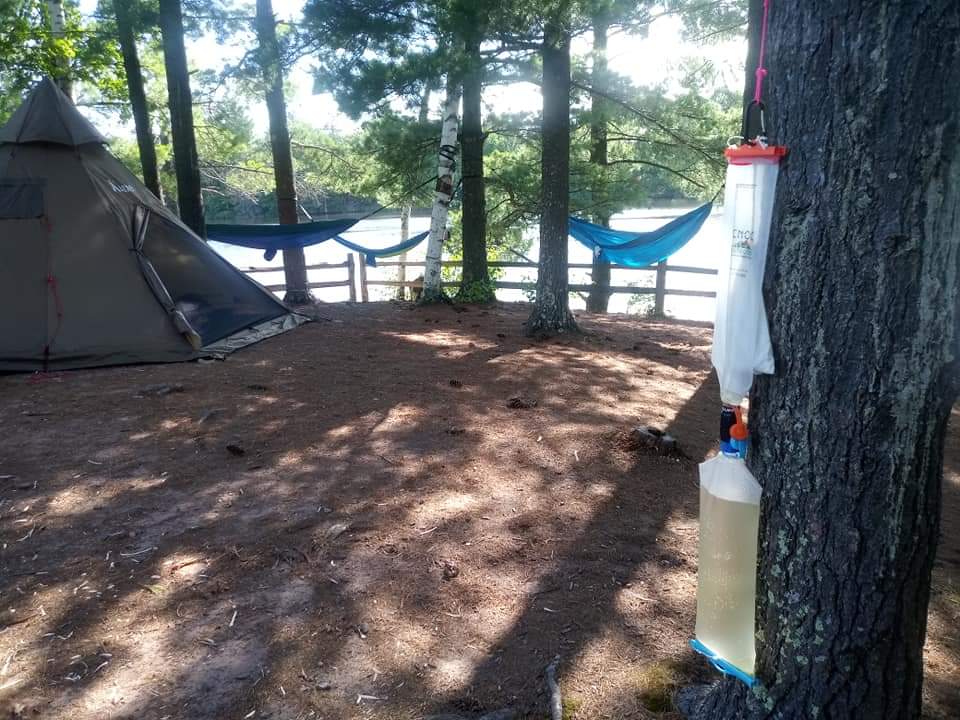
Gravity systems are the answer for camp volume rather than personal volume, and this kit is the most complete one here. The 1.5 gallon gravity bag holds a full day of water for several people in a single fill, and the 0.1 micron ultrafiltration straw inside pushes roughly 700 millilitres per minute, which is fast for a gravity arrangement.
It reduces chlorine, sediment, sand, microplastics, bad taste and odour, and is rated for 1,400 gallons, or 5,300 litres. Both ends of the straw disassemble so you can fit it into bottles or into another bag, and the backwash function works using a bottle cap or the gravity bag itself.
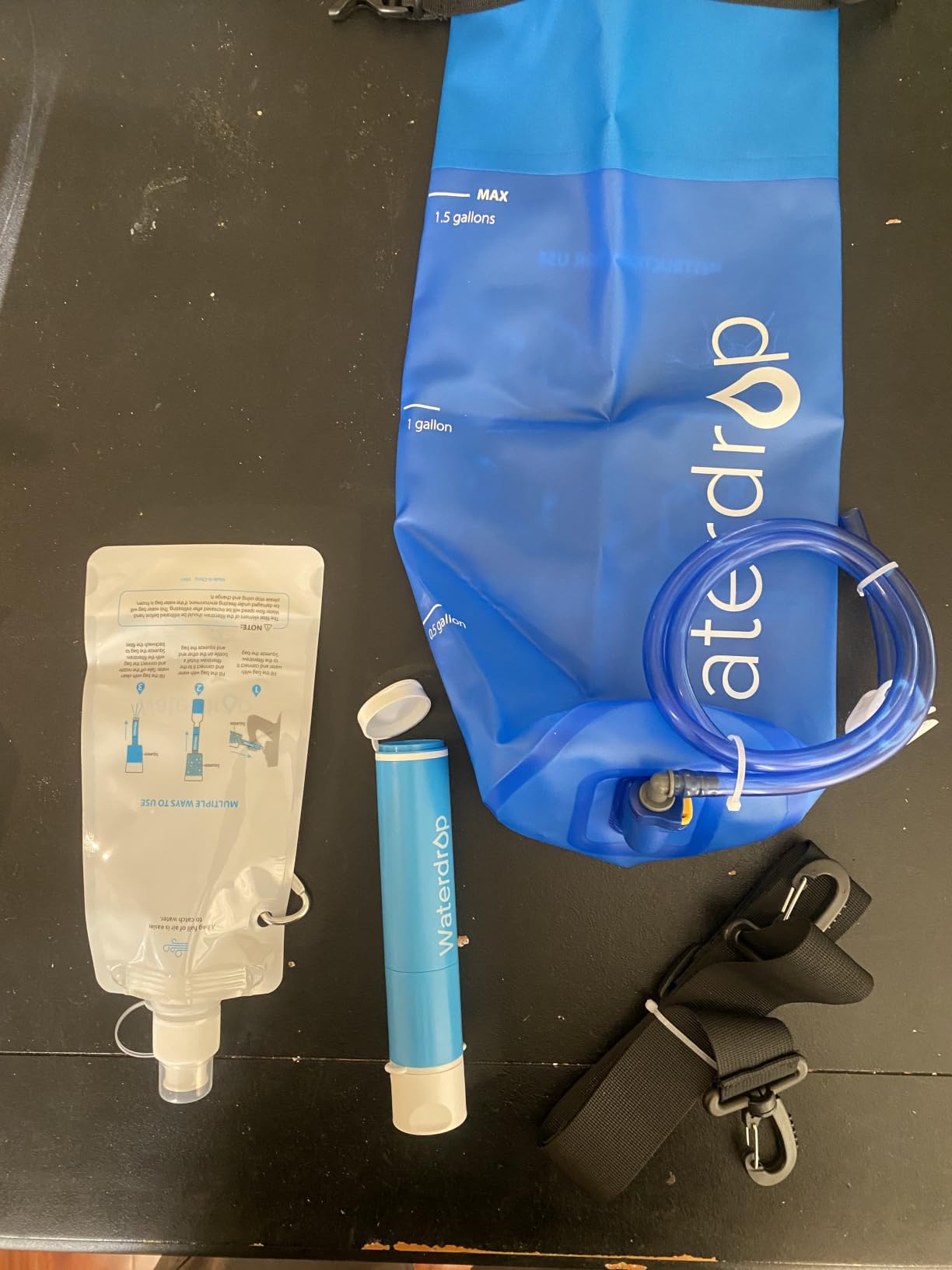
Campers like the completeness of the package, which includes the straw, the 1.5 gallon bag and a 16 oz pouch, so nothing else needs buying. That matters for a first trip, where a missing adapter or a missing hose is a common reason a filter never gets used.
The trade-offs are bulk and the warranty length. The 1.5 gallon bag is the weight you notice when it is full, the maximum supported TDS is 300 ppm, and the filter carries a 30 day limited warranty rather than a lifetime one, so long-term owners should not expect the same spare-part support as a Sawyer or a Katadyn.

When the Waterdrop Gravity Kit is the right call
It works for three or four people at basecamp, for a family that filters once at dinner rather than all day, and for anyone who wants to fill bottles and a cooking pot in one pass.
It is a good companion to a personal squeeze filter, using the straw for camp volume and the squeeze for the trail between sources.
When the Waterdrop Gravity Kit is the wrong call
It is not a solo thru-hiking tool. Carrying a 1.5 gallon bag of water has a weight cost that a 1 L flask does not, and hanging a bag is a stationary activity.
It is also unsuitable for high-TDS water above 300 ppm, and as with the rest of this roundup it does not remove viruses or dissolved agricultural chemicals.
9. Sawyer Micro Squeeze SP2129: Smallest Squeeze Kit
Sawyer Products SP2129 Micro Squeeze Water Filtration System, 1 Pack, Black/Blue
2 oz body
1.4 L per minute
Rated to 100000 gallons
Pros
- Smaller and lighter cost than the standard Squeeze with the same element
- 1.4 L per minute is among the fastest squeeze flows
- Includes cleaning coupling
- backflush plunger and spare gasket
- Each filter individually tested three times
Cons
- No carbon stage so taste and odour are unchanged
- Does not remove viruses
- Small 1 L pouch means many refills
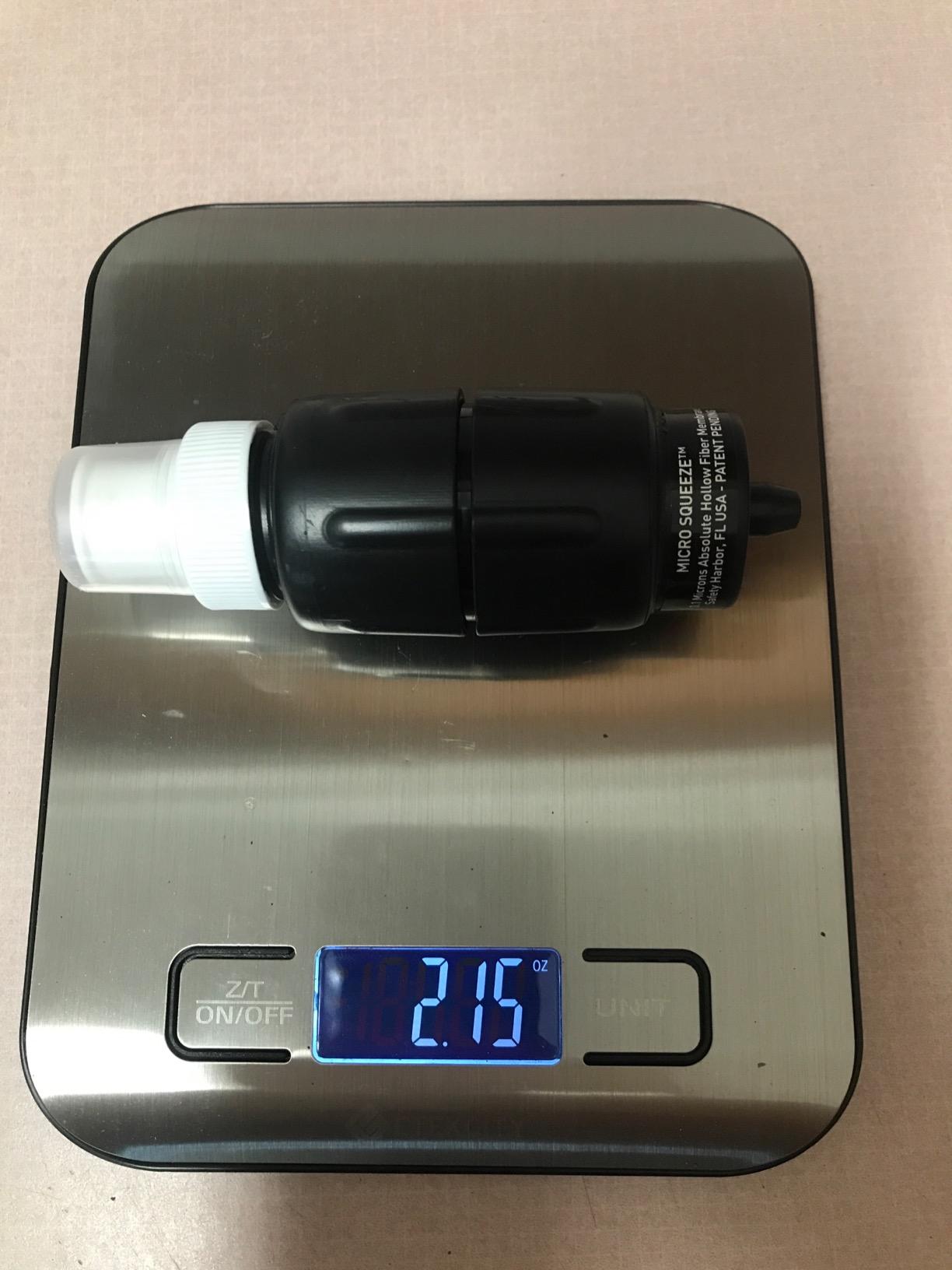
The Micro Squeeze is the Sawyer Squeeze element in a smaller, cheaper body, and the included kit is unusually generous: squeeze filter, pouch, cleaning coupling, backflush plunger, straw and a spare gasket. A spare gasket matters more than it sounds, because it is the part most likely to fail in the field.
It delivers 1,400 millilitres per minute through a 0.1 micron absolute hollow-fiber element weighing 2 ounces, removes 99.99999 percent of bacteria, 99.9999 percent of protozoa and 100 percent of microplastics, and each filter is individually tested three times by the manufacturer.
The rated lifespan is 100,000 gallons, maximum supported TDS is 500 ppm and the upper temperature rating is 40 °C. So it is a maintenance-free-in-practice element with no cartridge to buy, and the main thing to protect is the element itself from heat and freezing.
Owners treat it as the value version of Sawyer’s flagship, praising flow, size and the included cleaning kit. The recurring caveat is the lack of a carbon stage, so the water tastes exactly like the source, and a 1 L pouch means many refills across a full day of drinking.
When the Sawyer Micro Squeeze is the right call
It suits anyone who wants Sawyer’s element and warranty in the smallest possible package, particularly fast hikers who filter a few hundred millilitres at a time rather than litres.
It is also the option for users who do not care about taste, such as trips where water is filtered mainly for tea, instant coffee or a cup at camp rather than for enjoyment.
When the Sawyer Micro Squeeze is the wrong call
No carbon means no flavour improvement, so it is a poor match for anyone who cares about water taste, and its 500 ppm TDS ceiling is lower than the BeFree’s 1,000 ppm.
It is also a personal-volume tool. Filtering a group load means many small fills with a small pouch, which is slower than any pump on this list.
10. Katadyn Hiker Pro: Best Hand Pump for Heavy Use
Katadyn Hiker Pro Transparent Hand Pump Water Filter
1 L per minute hand pump
Pleated glass fiber cartridge
Transparent pump body
Pros
- Proven design used for decades of backcountry trips
- Fast 1 L per minute with a smooth stroke
- Drains down and packs flat between trips
- Clear housing shows water and cartridge condition
Cons
- Heaviest option here at 11.2 ounces
- Replacement cartridges cost a lot relative to the unit
- Intake flapper valve failures reported
Pump filters earn their place on long trips and large volumes, and the Hiker Pro is the design most proven of that group. It pumps a steady 1 liter per minute with a smooth, consistent stroke, which is roughly ten minutes of pumping for a 10-litre group load, and it will not slow to a trickle as the day goes on the way a membrane can.
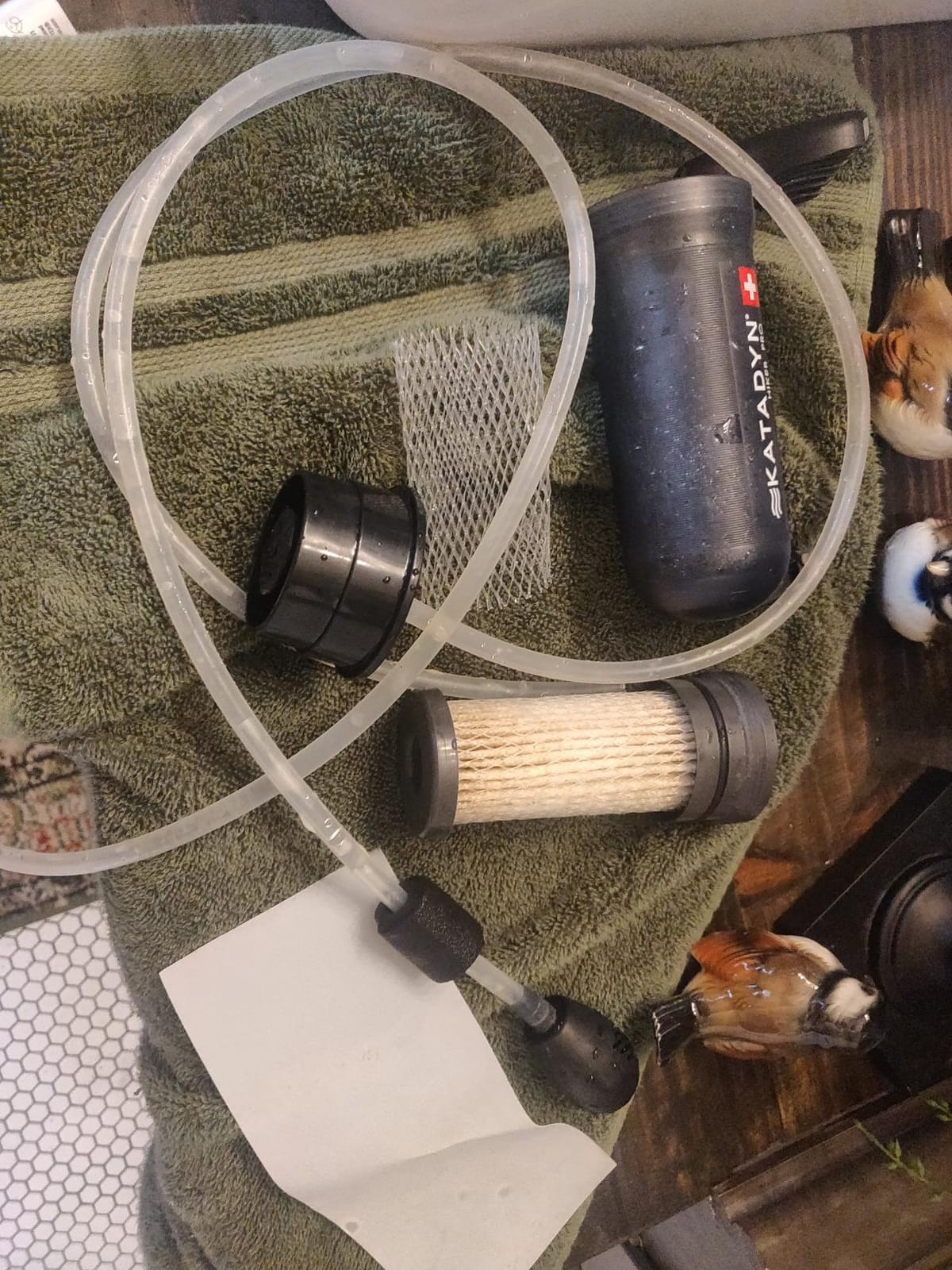
It uses a pleated glass-fiber cartridge rated for roughly 250 to 300 gallons, and the modular intake pre-filter is there specifically to keep silt away from the cartridge. The transparent pump body lets you see the water and the condition of the element, which is unusual and genuinely useful.
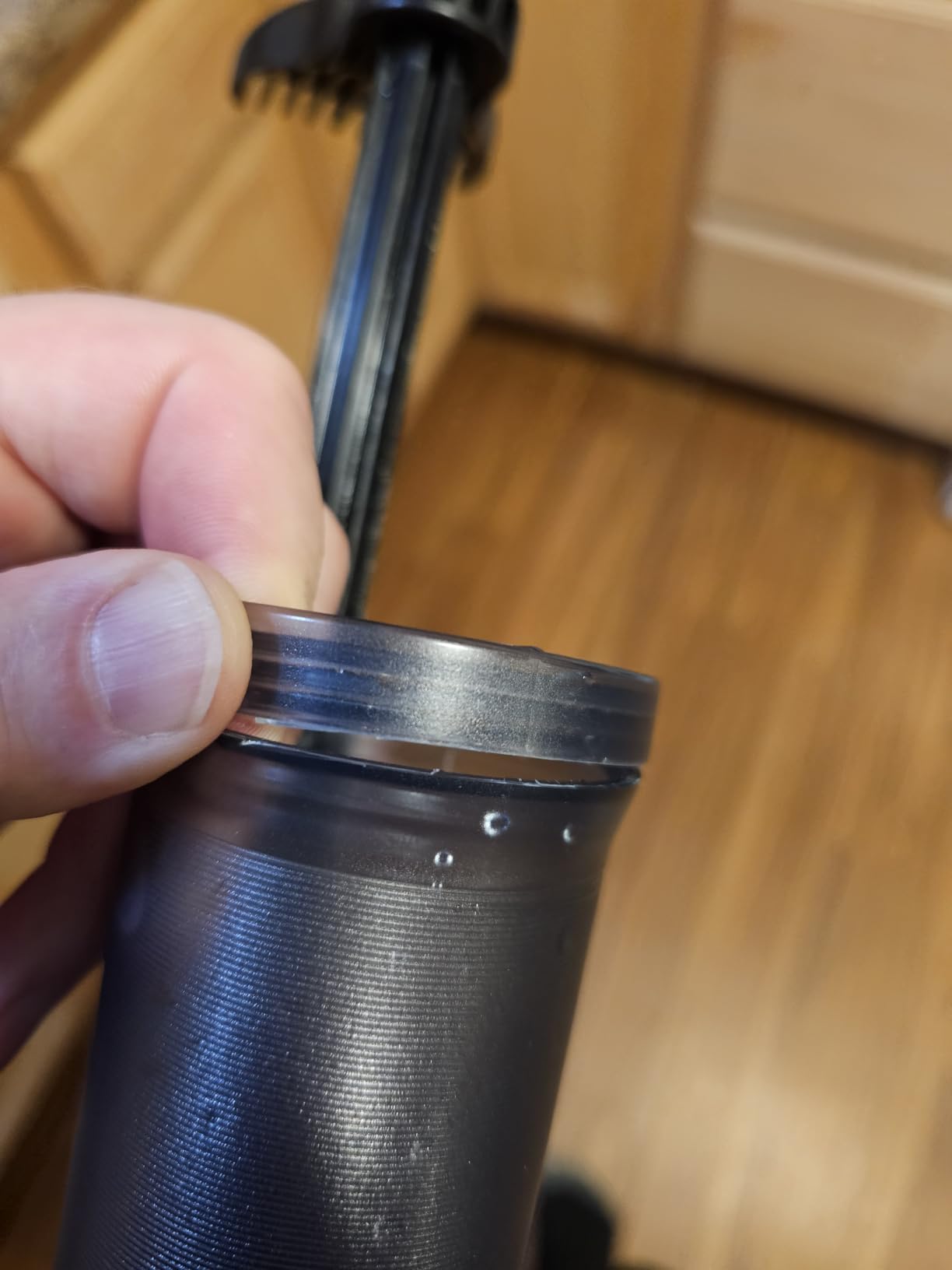
The box includes the intake hose with modular pre-filter, an output hose with an Easy Fill bottle adapter, a quarter-inch hydration system connector, a cleanable filter protector, a carry bag and instructions. It drains down and packs flat between trips, and it handles up to 1,000 ppm TDS.
Long-haul hikers rate it as dependable, fast and easy to service, with the clear housing a real plus. The complaints centre on cartridge pricing relative to the unit cost, and on the occasional intake flapper valve failure, though the manufacturer has replaced units promptly for owners who reported it.
When the Katadyn Hiker Pro is the right call
It is built for high volume: two to four people, or a basecamp where you are filling bottles, a pot and a bladder at once. Pumping a litre a minute means the filter is never the bottleneck.
It also suits users who want to service parts themselves, and who prefer seeing their water and their filter rather than trusting a sealed housing.
When the Katadyn Hiker Pro is the wrong call
At 11.2 ounces it is far too heavy for solo fast hiking, and it is a cartridge system with a finite 250 to 300 gallon life, so the cost per litre rises sharply if you filter a lot.
It is also the wrong tool for anyone who will not carry a spare cartridge, because a failed pump in the backcountry is a trip-ending event without one.
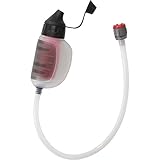
11. MSR TrailShot: Best Design for Avoiding a Dirty Bag
MSR TrailShot Ultralight Backpacking and Camping Squeeze Water Filter
1 liter in 60 seconds
5.44 oz
Detachable 15 inch hose
Pros
- Unique design avoids a dirty bag entirely
- Filters a liter in about 60 seconds one-handed
- Backflushes with the pump bulb
- no syringe needed
- Handles abuse and disassembles for full drying
Cons
- Soft rubber outlet hose nicks and wears
- 15 inch hose is short
- no virus or chemical removal
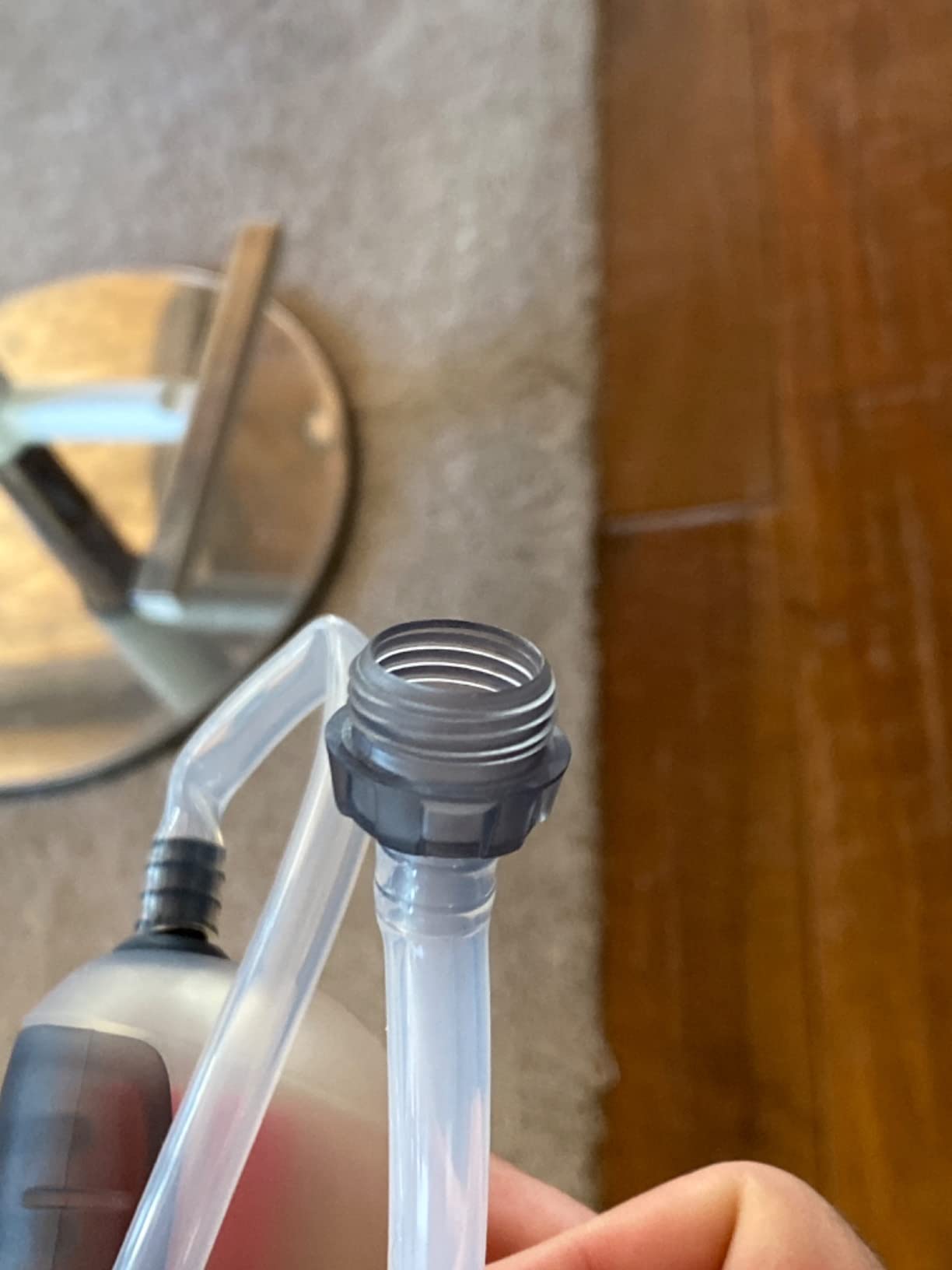
The TrailShot solves the dirty bag problem rather than managing it. You place the inlet directly in the water source and the outlet goes into your bottle, so you never handle a pouch of contaminated water and there is no bag to fill, seal, roll and eventually split at the seam.
It filters a liter in about 60 seconds one-handed, runs at 1 liter per minute through a hollow-fiber membrane that removes 99.9999 percent of bacteria and 99.9999 percent of protozoa, and the body weighs 5.44 ounces with a detachable 15 inch hose. It operates down to 33 °F and supports up to 1,000 ppm TDS.
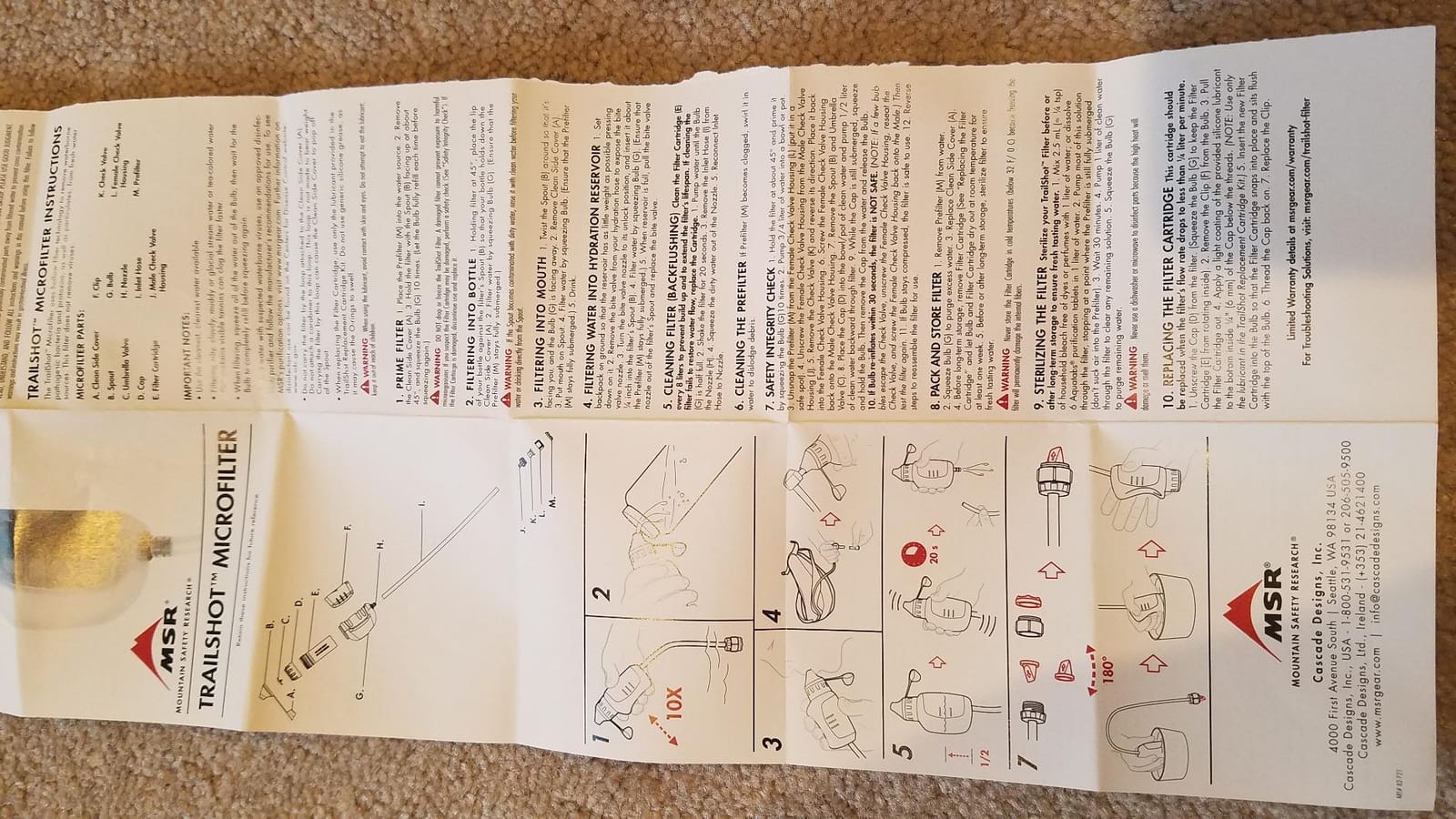
There is an integrated coarse pre-filter at the inlet, which is the part that saves it in silty water, and backflushing is done with the pump bulb rather than a syringe, so there is one fewer small plastic part to lose.
Reviewers admire the clean workflow, the flow rate and the simple backflush. The most mentioned drawbacks are the short hose, which means crouching to reach a source, and the soft rubber outlet tubing that picks up nicks with use, plus the usual inability to strip chemicals.
When the MSR TrailShot is the right call
It is the pick for anyone who objects to handling dirty water, and for trips where the source is a deep pool or a fast stream where filling a pouch is awkward.
It is also a strong option for hikers who want a simple backflush, since the bulb-based cleaning needs no syringe and takes seconds.
When the MSR TrailShot is the wrong call
The 15 inch hose is short, so at many sources you are crouched or kneeling, and that wears on knees over a long trip. At 5.44 ounces it is also heavier than a straw or squeeze filter.
It is a personal-volume tool, not a camp-volume one, and like the rest of the squeeze and pump filters here it does nothing about viruses or dissolved chemicals.
12. LifeStraw Peak Squeeze 650 ml: Best All-in-One Filter Bottle
LifeStraw Peak Squeeze Filter Bottle, 650 ml, Dark Mountain Gray
650 ml collapsible bottle
Filter built into the cap
Backwash kit included
Pros
- Filter and collapsible bottle in one
- Thicker leak-proof materials that survive drops
- Works on international tap water and natural sources
- Steady flow when filling cups
Cons
- Initial charcoal taste that fades after a few uses
- Some owners report flow stopping after light use
- Stored water left in the bag develops an off taste
This is the shape most people picture when they say backpacking filter bottle: a 650 ml collapsible bottle with the membrane built into the cap. There is nothing extra to pack, no adapter to buy, and it removes 99.999999 percent of bacteria, 99.999 percent of parasites and 99.999 percent of microplastics, plus silt, sand and cloudiness.
The membrane is re-engineered with a backwash accessory for sand and silt resistance, and the body uses what the manufacturer calls 2x thicker premium leak-proof materials. It also works as a bottle, as a straw, or into other drinkware and Peak Series setups, which makes it the most flexible layout in this roundup.
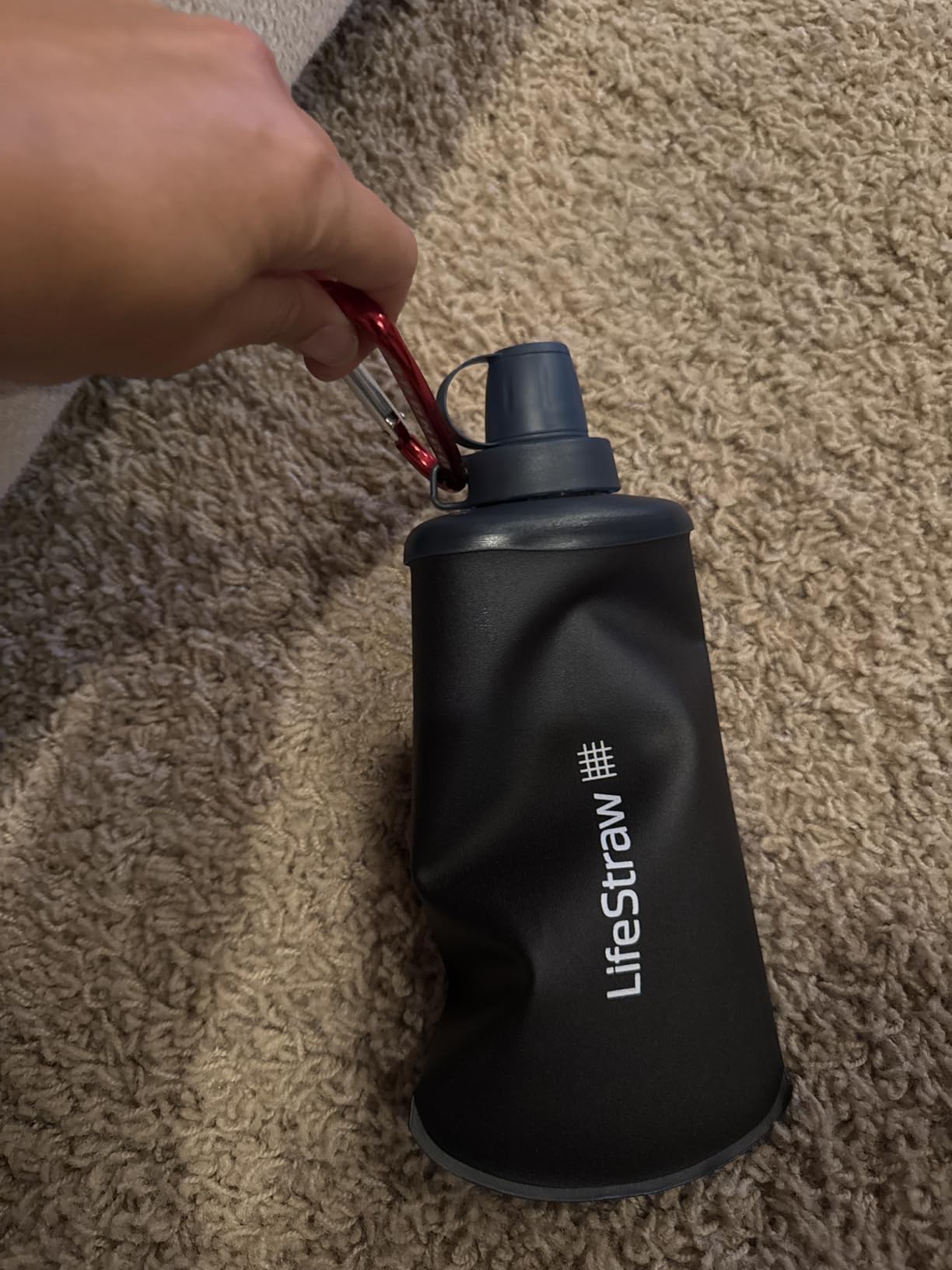
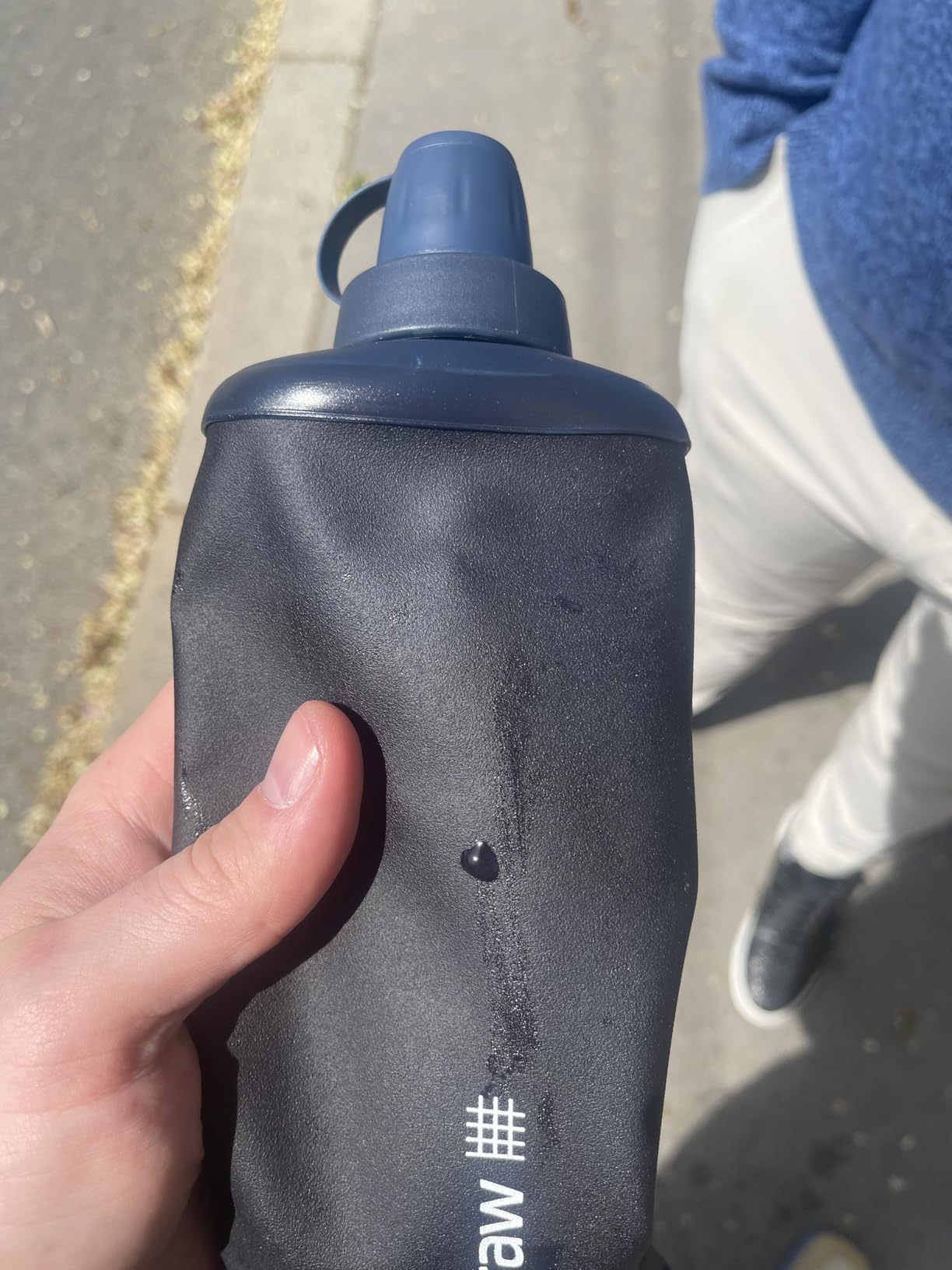
Most buyers like the all-in-one design and its effectiveness on questionable tap and stream water. The recurring feedback is that it needs backflushing after every trip to keep the flow where it should be, and that new units can impart a charcoal taste that fades after a few uses.
This is also the lowest-rated product in the roundup at 4.4, and the reason is a small but consistent group of owners reporting that flow stops entirely after a handful of uses. Water stored in the bag overnight also develops an off taste, so treat it as a drinking vessel for today, not a storage bottle.
When the LifeStraw Peak Squeeze is the right call
It works well for first trips and for anyone who wants zero setup, and it performs well on international tap water where the real problem is chlorine taste rather than organisms.
It suits users who prefer one object that does everything, particularly for short trips where 650 ml is the right daily volume.
When the LifeStraw Peak Squeeze is the wrong call
It is not for large groups, and it is not a storage bottle. Overnight water goes off, and the flow complaints among owners make it a harder choice for a long, multi-week trip than a bare straw filter.
It is also a microfilter with no virus removal, so on an international trip it needs tablets alongside it, and the collapsible body is easily punctured on sharp gear.
How to Choose a Backpacking Water Filter?
Here is how the decision actually works. Start with the trip, not the spec sheet, because the same filter is perfect for one hike and wrong for the next one.
Filter types and the scenario each one wins
Straw and personal filters, like the LifeStraw Personal, the LifeStraw Peak Series and the Membrane Solutions S1, are for drinking straight from the source. They weigh the least and do the least, and they are right for solo hikers, day hikers and emergency kits.
Squeeze filters, like the Sawyer Squeeze, the Sawyer Micro Squeeze, the Katadyn BeFree and the LifeStraw Peak Squeeze, put more water through faster per minute of effort, which is what makes them the default for one to two people on multi-day trips.
Pump filters, like the Katadyn Hiker Pro and the Survivor Filter PRO, are for volume rather than speed, and they dominate when several people need litres at once or when you want a carbon stage and virus protection in the same device.
Gravity systems, like the Waterdrop kit, hang a full bag from a tree and let the weight of the water do the work. They are unbeatable for camp fills and pointless for walking.
Chemical treatments, mainly chlorine dioxide tablets, have no moving parts and wait 15 minutes to several hours while you do something else. They are the perfect backup and a poor primary, because they leave an unpleasant taste and do not clear suspended sediment.
UV purifiers kill organisms with a battery-powered bulb and remove nothing else. Debris stays where it was, a dead battery ends treatment, and a lamp in a pack for a fortnight is a liability.
Pore size and what each number means
A 1 micron absolute rating catches Giardia and Cryptosporidium, which are the two organisms responsible for most backcountry water illness. Every product on this list meets that bar.
Bacteria need finer pores, and 0.1 or 0.2 micron hollow fiber is the standard. Viral filtration needs 0.02 micron or a chemical or adsorptive stage, which is the line between a filter and a purifier.
One caution: absolute and nominal pore ratings are not the same promise. An absolute rating means the largest opening is that size; a nominal rating is an average and can pass larger particles. Every product listed states absolute or equivalent, which is the one to buy.
Flow rate, and why cold water changes it
Manufacturer flow rates are measured on clear water at room temperature, which is close to the best case you will ever meet. Viscosity rises sharply as water gets cold, so a hollow-fiber membrane that pushes 2 L per minute in a laboratory can be markedly slower in an alpine stream at 35 °F, and that is the single most repeated complaint in every hiking water thread we read.
Practical consequences: a bigger number on the box is not a guarantee, and cold-morning camp water is the real test. Filters that force water through a thin membrane, like the straw designs, suffer more from cold than pumps do.
Silt matters as much as temperature. A membrane clogs on particle load, not on water clarity, and a 700 ml per minute rating on a clear stream is irrelevant in a silty desert wash.
Filter life and replacement cost
Stainless and hollow-fiber elements with no cartridge, like the Sawyer Squeeze, the Sawyer Micro Squeeze and the Katadyn BeFree, are rated in the hundreds of thousands of litres and need no consumables, though real-world life depends entirely on how much sediment you push through them.
Cartridge systems trade weight for a consumable. The Katadyn Hiker Pro cartridge runs roughly 250 to 300 gallons, and the GRAYL GeoPress cartridge is rated at 65 gallons, or 250 litres. Divide the cartridge cost by that number and you get the honest cost per litre, which is the only figure that matters over a long trip.
For chemicals, the per-litre maths is simple: the packet cost multiplied by the number of treatments, and each treatment covering one litre. Tablets win on cost and lose on taste, and they cannot clear brown water.
Bottle, flask and bladder compatibility
Any 28 mm threaded bottle works with a bare hollow-fiber filter, which covers the classic Nalgene and most soft flasks. Wide-mouth bottles, insulated wide-mouth bottles and most hydration bladders need an adapter hose, and that hose is the item most first-time hikers forget to budget for.
Check what is included before you buy. The Sawyer Squeeze kit includes a straw and a hydration pack adapter; the Katadyn Hiker Pro includes a quarter-inch hydration connector and a bottle adapter hose; the Membrane Solutions S1 fits 28 mm cups, pouches and bottles directly.
Pre-filtering muddy and silty water
When a source is silty, pre-filter before you filter. Put a bandana or a coffee filter over the mouth of the bottle, pour slowly, and let the sediment settle behind the fabric rather than in front of the membrane.
Then fill your dirty reservoir with the clearer water above the sediment line, and keep the reservoir mouth above the bottom so you do not draw the settled layer in. A second pass through the same bandana improves it further, and this single step prevents most of the clogging complaints we found in reviews.
What to carry as a backup
Carry two or three chlorine dioxide tablets in every first-aid kit, even with a good filter. They cover the three realistic failure modes: a frozen element, a cracked bottle found in a pack, and a source you should not have drunk from.
A bandana or a paper coffee filter is the second backup and costs almost nothing. A spare gasket or O-ring for your chosen filter is the third, and it is the cheapest insurance on this list because those parts are tiny and breakable.
Maintenance, Backflushing and Freezing
Maintenance is the difference between a filter that flows at full rate in week three and one that has quietly slowed to a trickle. Hollow-fiber membranes are self-cleaning to a degree, and backflushing reverses flow to push accumulated sediment off the outside of the fibers.
For a syringe backflush, the standard sequence is simple. Fill a clean syringe with clean water, attach it to the filter’s inlet, and push water backwards through the element until it runs clear. Then disconnect, tap the filter body to knock loose particles, and flush forwards with two or three litres of water before use.
For a squeeze or inline filter, the equivalent is to connect the dirty and clean sides with the cleaning coupling and push water through backwards, which is why the Sawyer Micro Squeeze kit includes a cleaning coupling and plunger. The Katadyn BeFree and the LifeStraw Peak Squeeze do not need this at all; swishing the bottle in source water is sufficient for both.
The MSR TrailShot backflushes with its own pump bulb, and the Waterdrop straw backflushes using a bottle cap or the gravity bag, so check which method your model uses before you need it.
On freezing: do not let a hollow-fiber filter freeze inside a reservoir. Ice crystals can damage the fiber element, and a cracked element can pass contaminated water while still flowing. If a filter does freeze, let it thaw completely in its own bag, then backflush it hard and test it on clear water before trusting it again, and never let a dirty reservoir freeze with a filter sitting in it.
Finally, keep the dirty and clean sides physically separate and label them if you use an inline setup. The Survivor Filter PRO and the MSR TrailShot both design this out of the problem, and where you use hoses, a strip of coloured tape on the dirty hose is a cheap way to stop a costly mistake.
Frequently Asked Questions
Which is better, a water purifier or a water filter?
A filter removes protozoa such as Giardia and Cryptosporidium plus bacteria, which covers nearly all backcountry water in North America and Western Europe. A purifier also removes viruses at 0.02 micron, so you need one for travel outside those regions, near farms and settlements, or anywhere with human waste. If virus risk is low, a lighter filter is the better tool.
What kind of water filter should I get for backpacking?
Match the type to the volume you need. One hiker filtering as they walk wants a straw or squeeze filter. Two to four people want a squeeze filter plus a dirty bag, or a pump such as the Katadyn Hiker Pro. Five or more at basecamp want a gravity system. International travel wants a purifier such as the GRAYL GeoPress.
How do I know which water filter to get?
Check seven things: pore size of 0.1 micron or finer, stated flow rate in cold as well as warm water, filter life in litres, weight including its bags, whether it fits your bottle thread without an adapter, how it is cleaned, and what a replacement element costs. If two filters tie, choose the one with a lifetime warranty and a manufacturer that sells spare parts.
What micron filter is needed to remove viruses?
Around 0.02 micron. Filters rated at 0.1 or 0.2 micron catch bacteria and protozoa but pass viruses straight through, which is why they are not adequate outside North America, Western Europe and Australia. Only a purification membrane, an adsorbing cartridge or a chlorine dioxide treatment reaches that threshold.
How often should you backflush a backpacking water filter?
Backflush after filtering dirty or silty water, after every trip if you used it, and any time flow rate drops noticeably. With a syringe, push clean water backwards through the element until it runs clear, then flush forwards with two or three litres. Squeeze and inline filters reverse flow with a cleaning coupling, and the Katadyn BeFree and LifeStraw Peak Squeeze only need swishing.
Is a Sawyer Squeeze better than a Katadyn BeFree?
Neither is better, they suit different trips. The Sawyer Squeeze has a lifetime warranty, 1.7 L per minute flow, a 0.1 micron element and fits 28 mm bottles, and it is easier to backflush. The BeFree packs flatter, runs faster at 2 L per minute, needs no backflush at all, and carries a carbon stage, but its collapsible bottle is prone to pinholes.
Conclusion: Our Top Backpacking Water Filters in 2026
After working through twelve options, the best water filters for backpacking split cleanly by trip type rather than by winner. The LifeStraw Personal is the best all-round choice for most hikers, because it weighs 0.09 lb, needs no bags or power, and has a 4.8 rating across more than 125,000 reviews for bacteria, parasite and microplastic removal.
For one or two people filtering several litres a day, the Sawyer Squeeze SP129 offers the best combination of 1.7 L per minute flow, a 0.1 micron element, 28 mm bottle compatibility and a lifetime warranty. If certification matters to you, the Membrane Solutions S1 is the only one here with triple NSF/ANSI 42, 372 and 401.
The LifeStraw Peak Series is the fastest personal filter, the GRAYL GeoPress is the only true virus and chemical purifier, and the Survivor Filter PRO is the pick when you need carbon and purification in a pumped format. For group camp volume, the Waterdrop gravity kit does the work without you lifting a finger, and the Katadyn Hiker Pro is the pump to buy if a cartridge and visible housing suit you better.
Travel flat and light with the Katadyn BeFree, take the Sawyer Micro Squeeze if pack size matters more than taste, and pick the MSR TrailShot if you would rather never touch a dirty bag. The LifeStraw Peak Squeeze is the most convenient single object but carries the lowest rating here, so backflush it after every trip.
Whichever you choose, add two or three chlorine dioxide tablets, a spare gasket and a bandana to the same pocket. A two-ounce filter plus those three items removes almost every way a backpacking water system can fail you, and that is what makes it worth carrying in the first place. For anyone building out a broader water setup, our guides to whole house water filters for hard water and RV water filters for hard water cover the other end of the problem.