
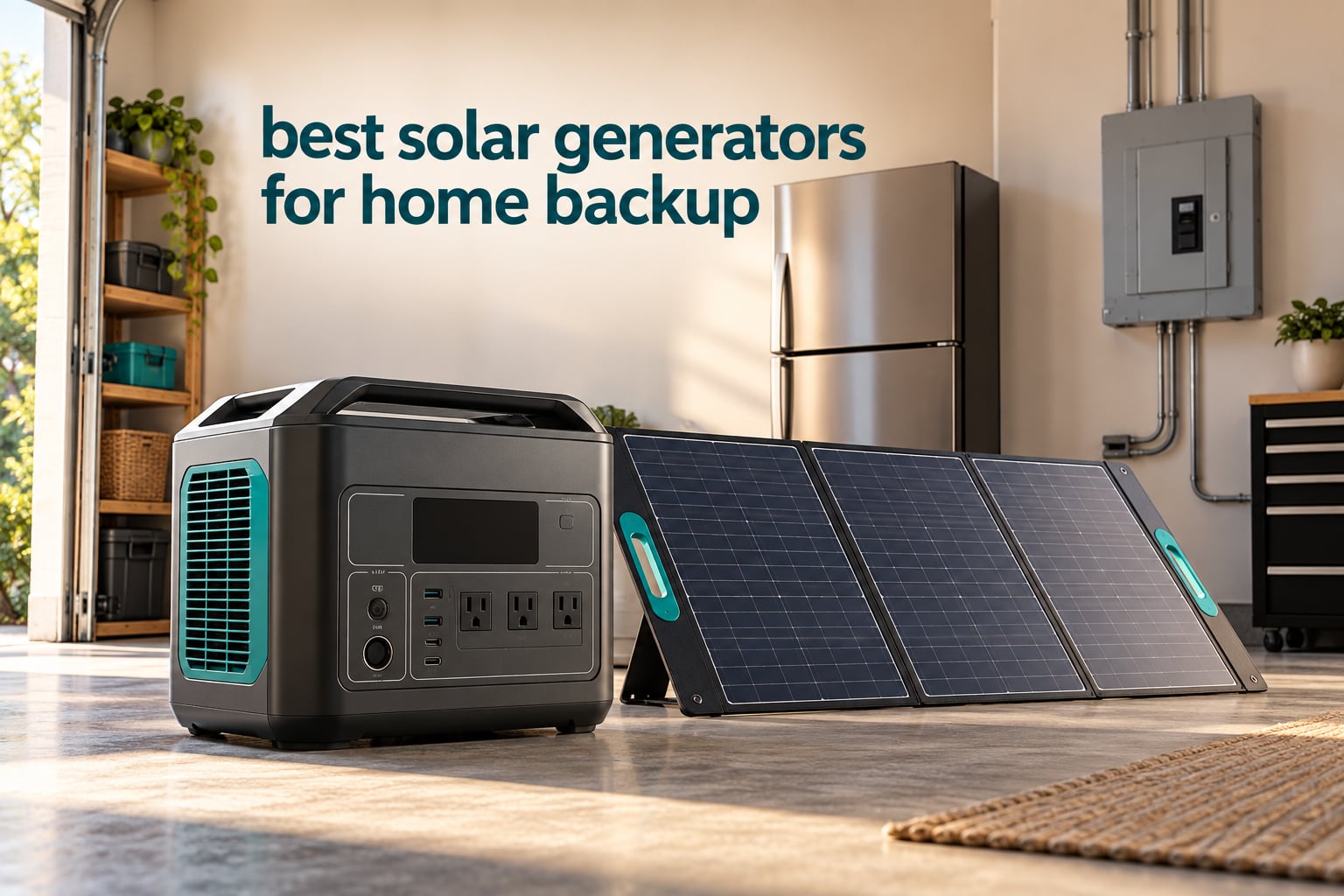
A solar generator is not a solar panel and it is not a gas engine. It is a battery with an inverter bolted to the top: a lithium pack, a pure sine wave inverter that turns stored DC into household AC, and a set of outlets you plug your fridge into. The panels are optional, most units ship without one, and the honest truth is that a lot of buyers never need one. What they need is a quiet box that sits in the garage and keeps the refrigerator, the Wi-Fi and the oxygen machine alive for three days without anyone filling a fuel can.
That is what we looked at. We compared 10 solar generators for home backup across four angles: real usable capacity after depth-of-discharge losses, continuous and surge output, whether the unit can produce 240V, and how fast it switches over when the grid drops. We also flagged the piece almost every roundup ignores, which is the hardware that turns a box of batteries into actual home backup: a transfer switch, a permit, and in some cases a neutral-ground bonding jumper. If you want the fixed-installation route instead, read our home energy monitor picks first so you can see what your load actually looks like before you size anything.
For the cabin and off-grid crowd rather than the storm-season household, we have covered the same hardware in separate guides on off-grid cabins and off-grid living, plus a broader look at portable power stations for home backup where the panel is secondary. Everything below is current as of 2026 and none of the hardware is discontinued.
Table of Contents
Top 3 Solar Generator Picks for Home Backup in 2026
These three cover the most common household situations. The Anker SOLIX C1000 Gen 2 has the deepest owner base in the group and the fastest recharge. The BLUETTI Elite 100 V2 ships with a panel and the most AC outlets at this size. The Jackery Solar Generator 1000 v2 is the one-hand carry option with the strongest support reputation.

BLUETTI Elite 100 V2
- 1024Wh LiFePO4
- 1800W AC / 3600W surge
- 4 AC outlets plus 200W panel
- 10ms UPS switchover
Anker SOLIX C1000 Gen 2
- 1024Wh LiFePO4
- 2000W / 3000W peak across 9 ports
- 49-minute full recharge
- Under 10ms UPS

Jackery Solar Generator 1000 v2
- 1070Wh LiFePO4
- 1500W AC / 3000W surge
- 23.8 lb one-hand carry
- One-hour emergency charging
All 10 Solar Generators Compared at a Glance (October 2026)
Read the 240V column first. If your essential loads include a well pump, an electric water heater, a mini split or a 3-ton central air unit, only the DELTA Pro 3, the DELTA Pro Ultra and the Jackery HomePower 3600 Plus can drive them without an extra conversion box. Everything else is a 120V-only appliance runner, which is fine for a fridge and a CPAP machine and useless for your electric range.
| Product | Specifications | Action |
|---|---|---|
| BLUETTI Elite 100 V2 |
|
Check Latest Price |
| Anker SOLIX C1000 Gen 2 |
|
Check Latest Price |
| Jackery Solar Generator 1000 v2 |
|
Check Latest Price |
 BLUETTI Elite 200 V2 BLUETTI Elite 200 V2 |
|
Check Latest Price |
 Anker SOLIX S2000 Anker SOLIX S2000 |
|
Check Latest Price |
 EcoFlow DELTA Pro Ultra 6kWh EcoFlow DELTA Pro Ultra 6kWh |
|
Check Latest Price |
 EcoFlow DELTA Pro 3 EcoFlow DELTA Pro 3 |
|
Check Latest Price |
 BLUETTI Elite 300 BLUETTI Elite 300 |
|
Check Latest Price |
 Jackery HomePower 3600 Plus Jackery HomePower 3600 Plus |
|
Check Latest Price |
 EcoFlow DELTA 3 Classic EcoFlow DELTA 3 Classic |
|
Check Latest Price |
1. BLUETTI Elite 100 V2 – Best Overall Solar Generator for Home Backup
BLUETTI Solar Generator Elite 100 V2 with 200W Solar Panel Included, 1024Wh
1024Wh LiFePO4
1800W AC, 3600W surge
2700W Power Lifting
10ms UPS
25 lb
Pros
- One of the few sub-2kWh picks that lists a 200W panel with the kit
- Four AC outlets plus 100W USB-C
- 10ms UPS keeps CPAP and network gear alive
- 30dB silent mode suits a bedroom closet
Cons
- Heavier than NMC rivals at this capacity
- Display shows watts but not separate volts and amps
- Modest DC output amperage for RV or DC panel work
I put the Elite 100 V2 at the top because it solves the two problems that trip up most first-time buyers in a single box. The first is outlets: four grounded AC receptacles on a 1kWh pack is unusual, and it means a fridge, a router, a lamp and a coffee maker can all run at once without a power strip you found in a drawer. The second is that a 200W panel is listed with the kit, which removes the most common bait-and-switch complaint in this category.
Usable capacity is the number that matters and it is not the headline number. Take the 1,024Wh label, apply a realistic 90% depth of discharge and roughly 85% inverter efficiency, and you land near 780Wh of genuinely available energy. Run that against your own load list rather than the label: a 25-watt fridge load clears 30 hours, and a 220-watt space heater on Power Lifting mode lasts about three and a half hours.

The 10ms UPS switchover is the feature I would not give up. Owners running powered medical equipment report that their CPAP machines and concentrators ride through a grid drop without restarting, which is the difference between a backup power source you can sleep next to and one you cannot. Silent mode is rated at 30dB, quiet enough to sit in a hallway closet rather than a garage corner.
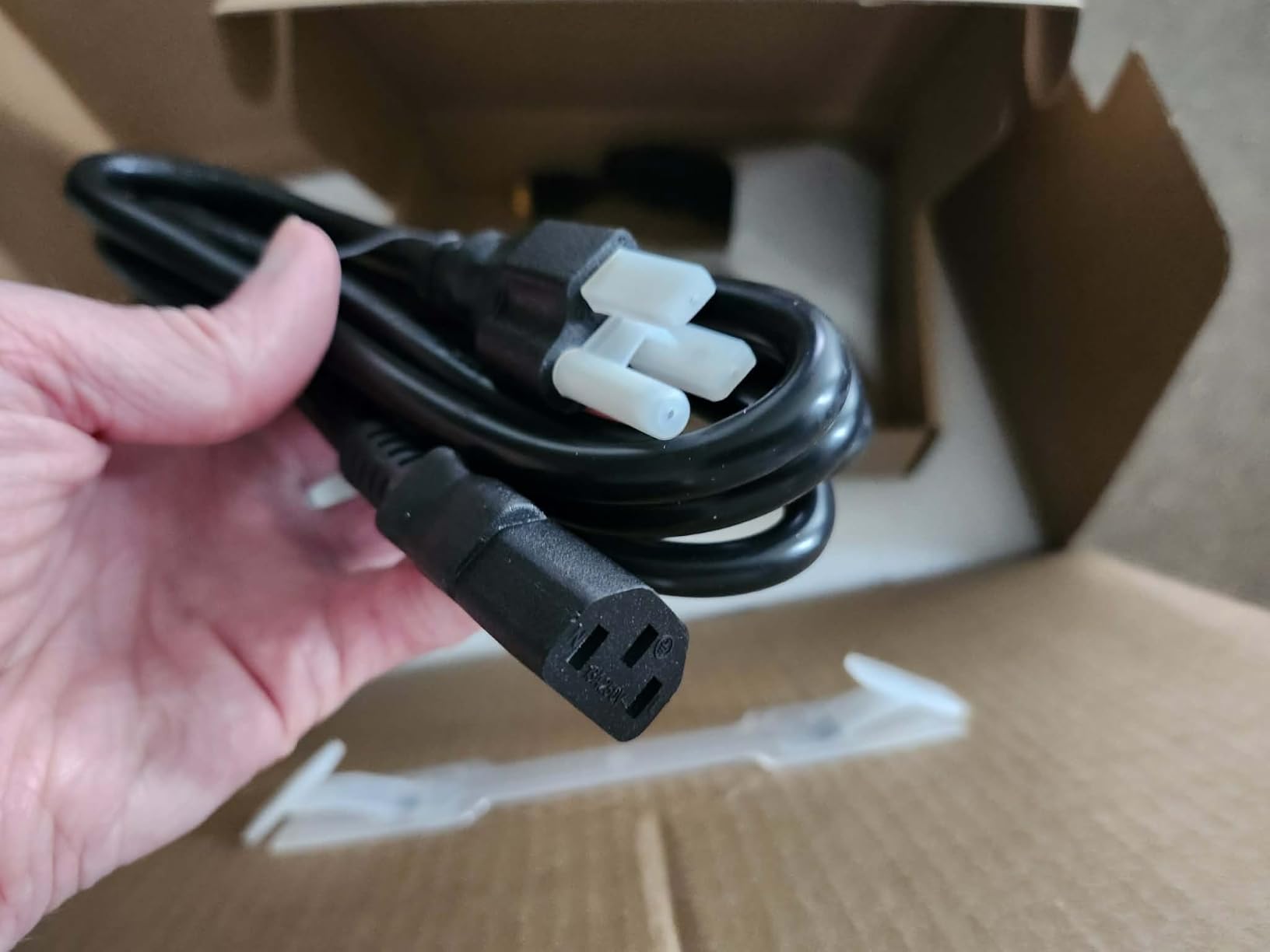
Two details the spec sheet does not dwell on. The 200W panel is listed as arriving separately, so check what actually arrives in the box before you plan a rooftop array around it. And the DC output circuit is modest, which means this is not the right tool for rigging a small RV or a DC distribution panel from a battery bank.
Check this before you buy
Confirm the four AC outlets are what you need, because adding a fourth simultaneous 1,500W load will trip the inverter long before the battery is empty. Owners running a 1,200W resistive space heater report it works, but only through Power Lifting mode, which deliberately clips the current and lengthens runtime rather than delivering true 1,200W.
Also weigh the unit. At 25 pounds it is a two-hand lift in an emergency, and LiFePO4 cells are the reason: the chemistry is heavier than NMC for the same watt-hour count, and that weight is the price of the 4,000-plus cycle life.
Who should skip it
Skip this if you need 240V. It is a 120V-only design, so a well pump, a 3-ton air conditioner or an electric water heater is off the table without a step-down transformer, which defeats the point of buying one in the first place.
Skip it also if you are certain you will expand. This is a fixed 1,024Wh pack, and adding capacity later is not a path the Elite 100 V2 offers.
2. Anker SOLIX C1000 Gen 2 – Best Solar Generator for Fast Recharge and Deep Support
Anker SOLIX C1000 Gen 2 Portable Power Station with 200W Solar Panel
1024Wh LiFePO4
2000W continuous, 3000W peak
9 ports, 6 outlets
49-minute recharge
5-year warranty
Pros
- Largest owner base in this roundup at 1615 reviews
- 49-minute full recharge on 1600W HyperFlash
- 14% smaller and 11% lighter than comparable models
- App time-of-use scheduling for peak-rate households
Cons
- Gen 2 dropped the battery expandability earlier Anker offered
- 15-20% harmonic distortion reported on microwave loads
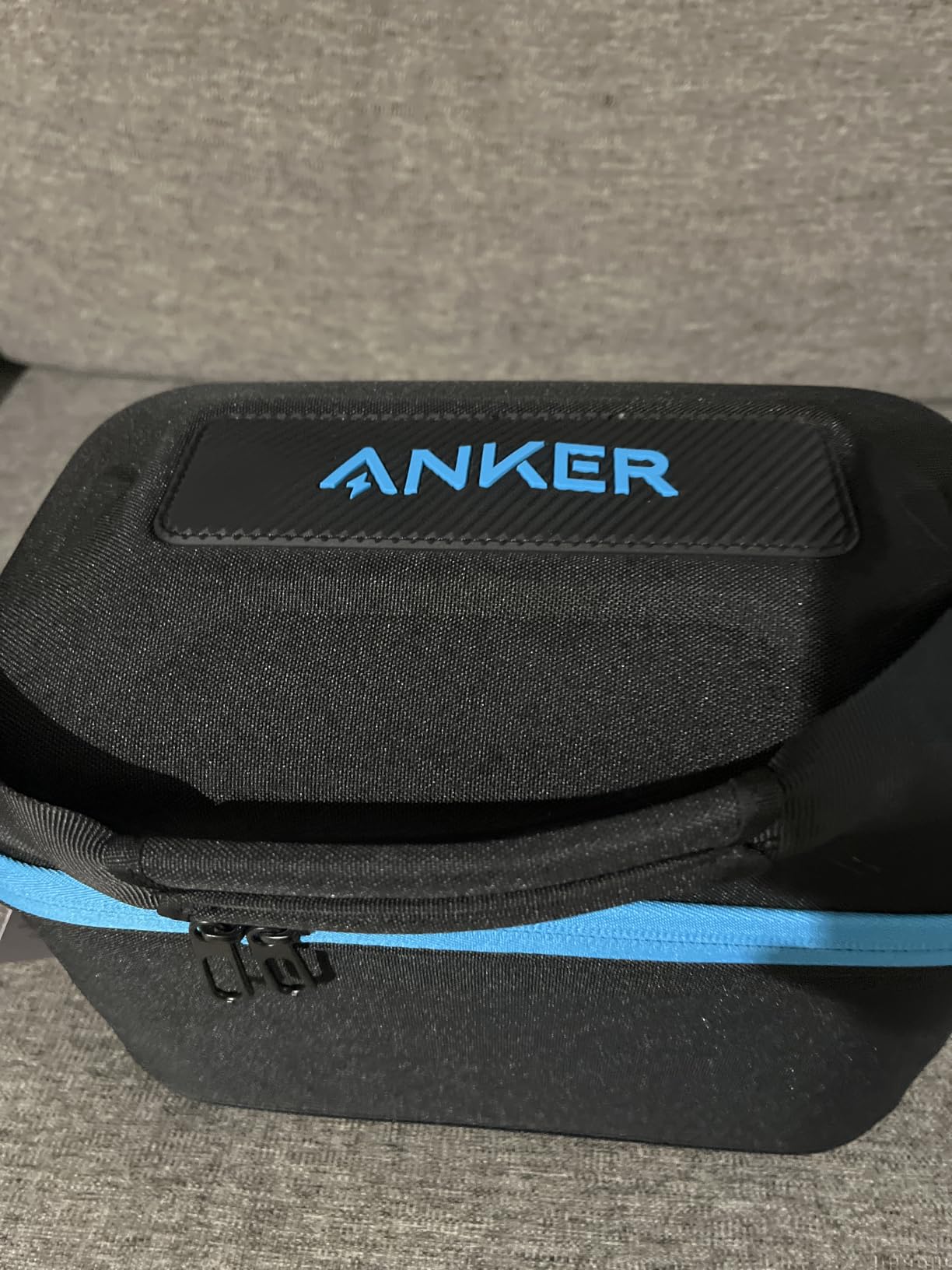
- No storage case included with the kit
The C1000 Gen 2 has more owner feedback behind it than anything else on this list, 1,615 reviews, and that matters more for a battery product than the spec sheet does. When a warranty claim goes wrong you want thousands of people who have already done the process. Anker’s five-year warranty and Anker’s app both benefit from that scale.
Speed is the headline. A full recharge in 49 minutes on the 1,600W HyperFlash mode means you can top the pack up during a lunch break between outage waves, and a full solar recharge in 1.8 hours on 600W of panel input is roughly double what the bundled smaller panels achieve. With 2,000W continuous and 3,000W peak across nine ports, it also has more usable AC headroom than the other 1kWh picks here.
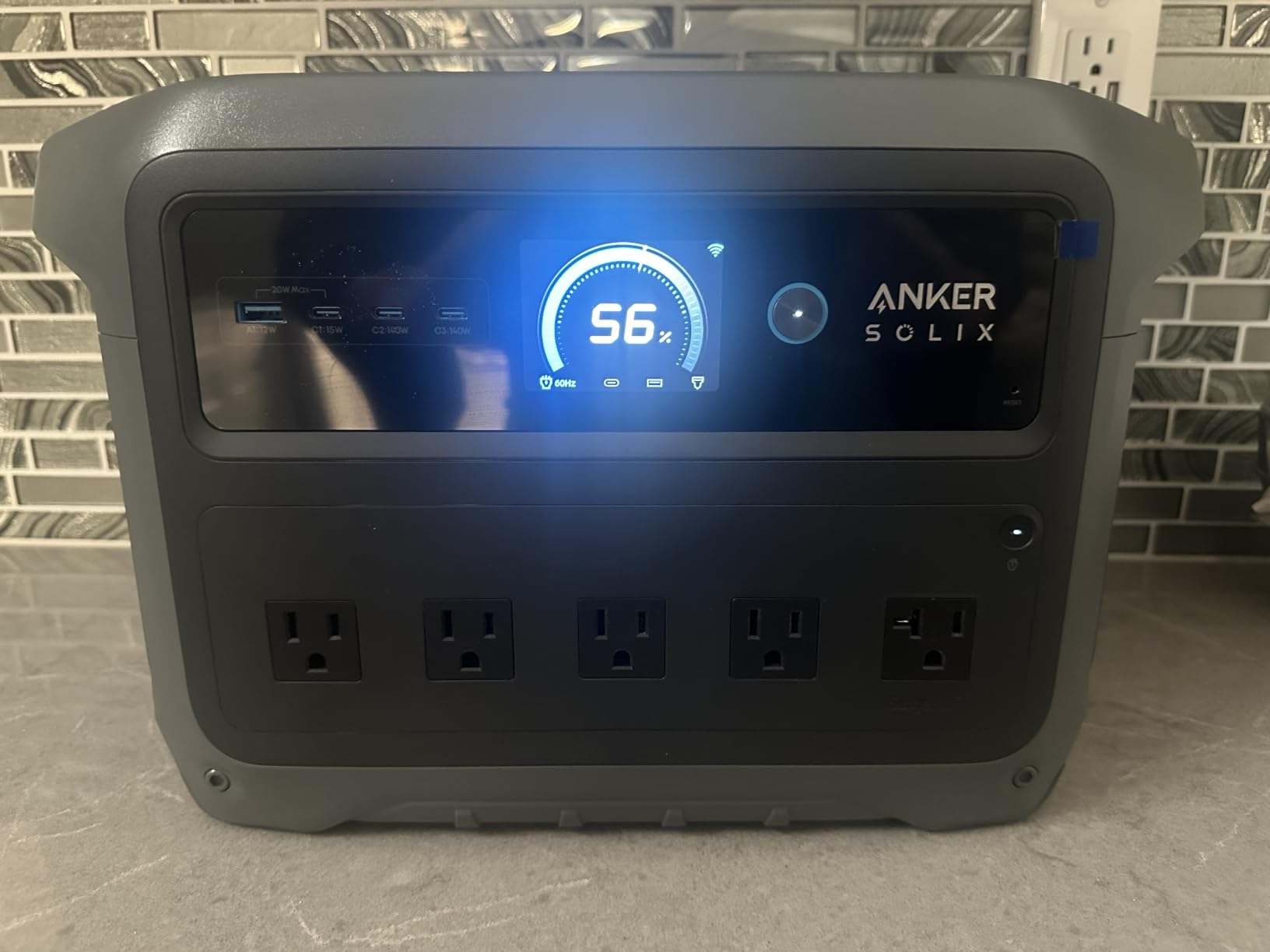
Reviewers describe it as effectively silent in normal use, and the under-10ms UPS transfer keeps routers, network racks and a UPS-style fridge backup running straight through a multi-hour event. One owner documented a 1,800W fridge backup pass-through lasting five hours on a single charge, which tracks with the math once you apply real-world conversion losses to the 1,024Wh label.
The 10-year InfiniPower rating claims 80% capacity remaining after 4,000 cycles, which is the strongest longevity claim at this size. That figure is the one to care about when you are thinking about how the pack holds up past year five.
Check this before you buy
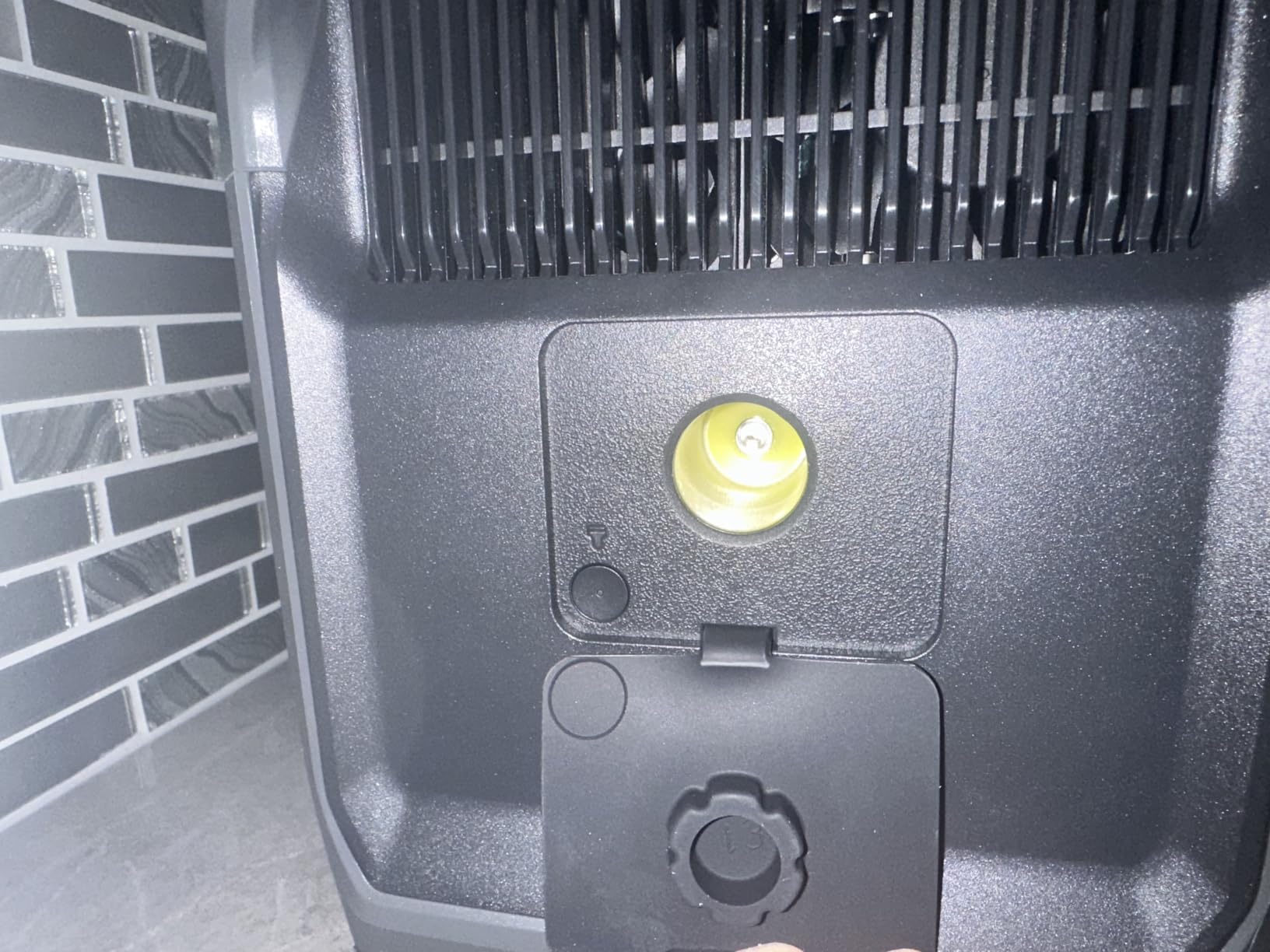
Look closely at the harmonic distortion note. Reviewers who run microwaves off the inverter report 15-20% distortion plus added acoustic noise. It is a minor irritation for reheating leftovers, but it is a reason to test the specific appliance you care about before you depend on it in a storm.
Then think about whether you will ever add capacity. Anker removed expandability from the Gen 2 C-series that earlier models offered. If your outage is likely to run past a day, this is a closed box and you should be sizing accordingly from the start.
Who should skip it
Skip it if your plan was to start small and grow. There is no extra-battery path here, so a household that anticipates a three-day grid-down event needs a different pick.
Skip it if a well pump, an electric range or any 240V load is on your critical list. This is a 120V-output design and there is no split phase.
3. Jackery Solar Generator 1000 v2 – Best Lightweight Pick for One-Hand Carrying
Jackery Solar Generator 1000 v2 and 200W Solar Panel,1070Wh,1500W AC
1070Wh LiFePO4
1500W AC, 3000W surge
23.8 lb
Three pure sine wave outlets
5-year warranty
Pros
- Lightest serious option here at 23.8 lb
- 1-hour emergency charge via the app
- Three pure sine wave AC outlets plus 100W PD USB-C
- Customer support repeatedly praised for handling warranty issues
Cons
- Bundled 200W panel sags and needs propping in wind
- Panel cable is short
- limiting shade-friendly placement
- One-hour charge requires app emergency mode which cuts battery life
At 23.8 pounds this is the one you can actually move by yourself at 2am with a flashlight in your teeth. The portability premise of a portable power station collapses the moment the unit weighs 60 pounds, and the Jackery Solar Generator 1000 v2 is the pick that survives contact with a real outage when you need to get it from the closet to the kitchen.
It is also about 18% smaller than the previous generation and folds down to roughly the footprint of a carry-on. The 1,070Wh LiFePO4 pack with 1,500W continuous and 3,000W surge output covers the same load profile as the other 1kWh options, with three pure sine wave AC outlets, two USB-C ports including 100W PD, one USB-A and a 12V car port.
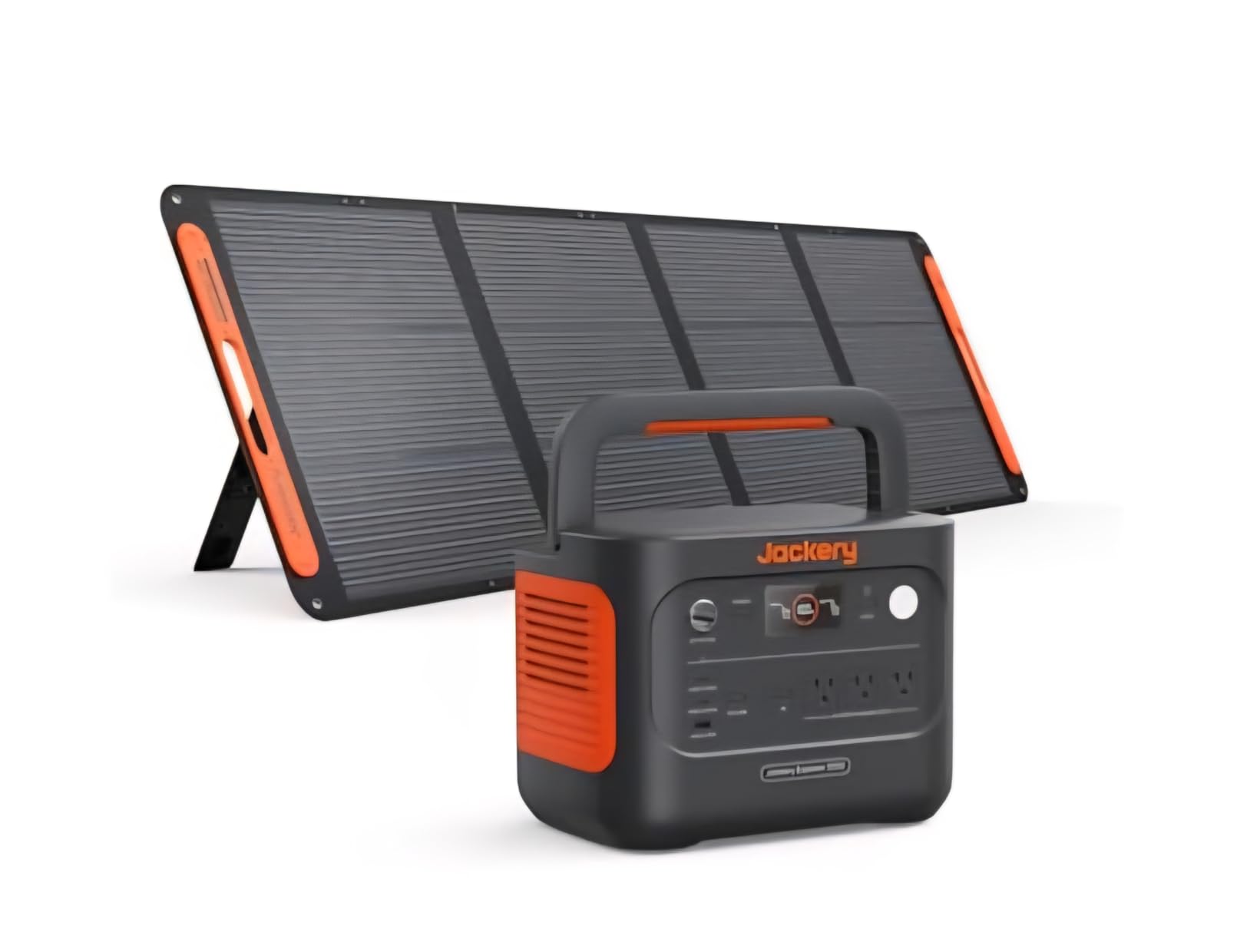
Outage reports are encouraging. Owners run a full-size side-by-side refrigerator for nine hours overnight on a single charge and rely on it for laptops, a router and a CPAP machine, which is exactly the essential-load scenario most households are actually buying for. The 30dB quiet charging mode keeps it usable in a bedroom without waking anyone.
Longevity is rated at over 4,000 cycles while holding 70% or more of original capacity, which points to a 10-year-plus service life before you start losing meaningful runtime. Jackery’s support reputation comes up repeatedly in reviews, and after a decade that matters as much as the battery.
Check this before you buy
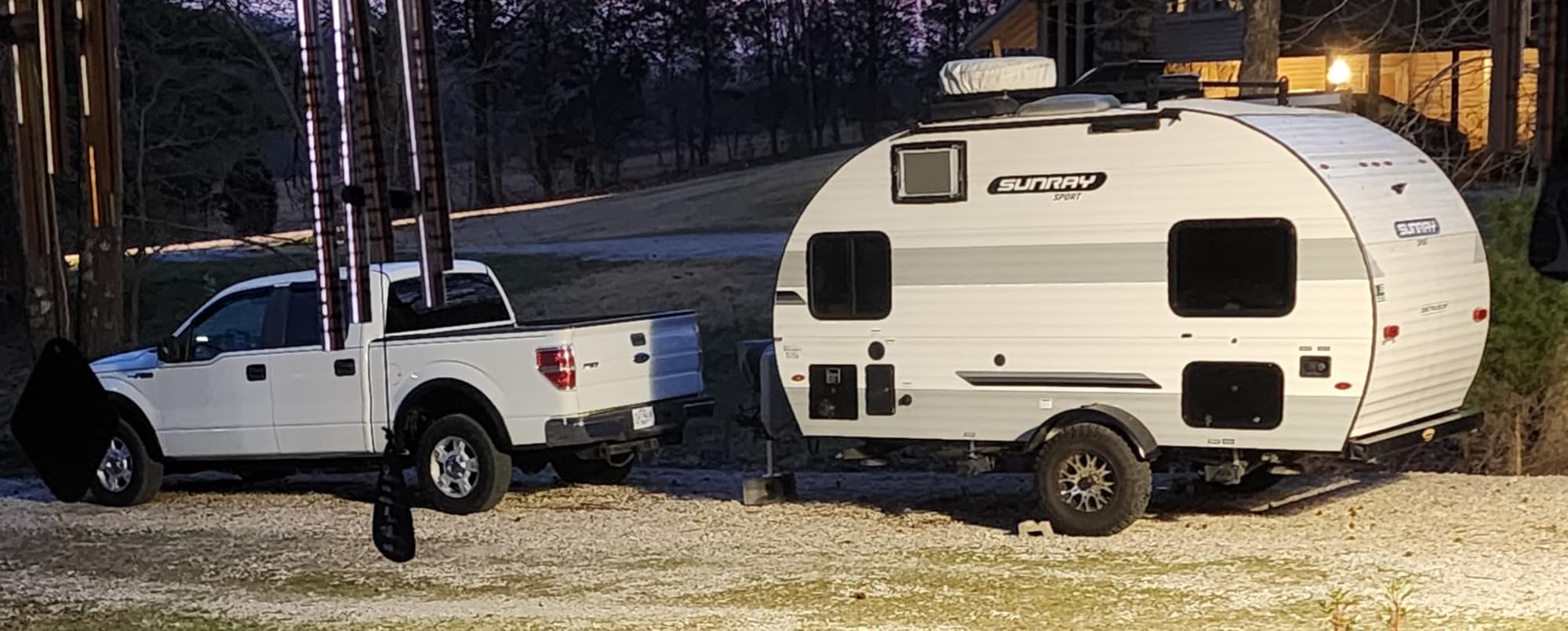
Read the panel complaints before you get excited about the bundled 200W SolarSaga panel. Owners report it sagging in the middle and needing to be propped up to stand in wind, with legs that collapse while you reposition it toward the sun, and a lead cable short enough to make shade placement frustrating. Treat the panel as a maintenance trickle charger, not a rescue plan.
Also decide how you feel about the one-hour charge. It requires enabling emergency mode in the Jackery app, and the company is straightforward that this shortens battery life. The default 1.7-hour charge is the setting you probably want to live on.
Who should skip it
Skip it if you plan to be self-sufficient on solar. An 18% smaller panel and 80% charge in about six hours is fine for topping up between events and close to useless for recovering a full pack during a multi-day overcast stretch.
Skip it if you need more than 1,500W on a single appliance. A 1,200W microwave plus a fridge simultaneously will not fit comfortably inside the inverter’s headroom.
4. BLUETTI Elite 200 V2 – Best Balanced Solar Generator for a Full Kitchen Load
BLUETTI Elite 200 V2 Solar Generator & 2x200W Solar Panel Included 2073.6Wh
2073.6Wh LiFePO4
2600W AC, 3900W lifting
6000+ cycles
53.4 lb
Two 200W panels included
Pros
- Owners run two freezers a fridge and a microwave at once
- 6000+ cycle CNAS-certified battery rated 17 years
- 0-80% in 50 minutes with dual charging
- 10W standby draw reported as far below peers
Cons
- 53.4 lb is a hard lift for one person
- No 30A 12V output or 5521 ports
- Solar input capped at 1000W
- Not expandable with BLUETTI battery modules
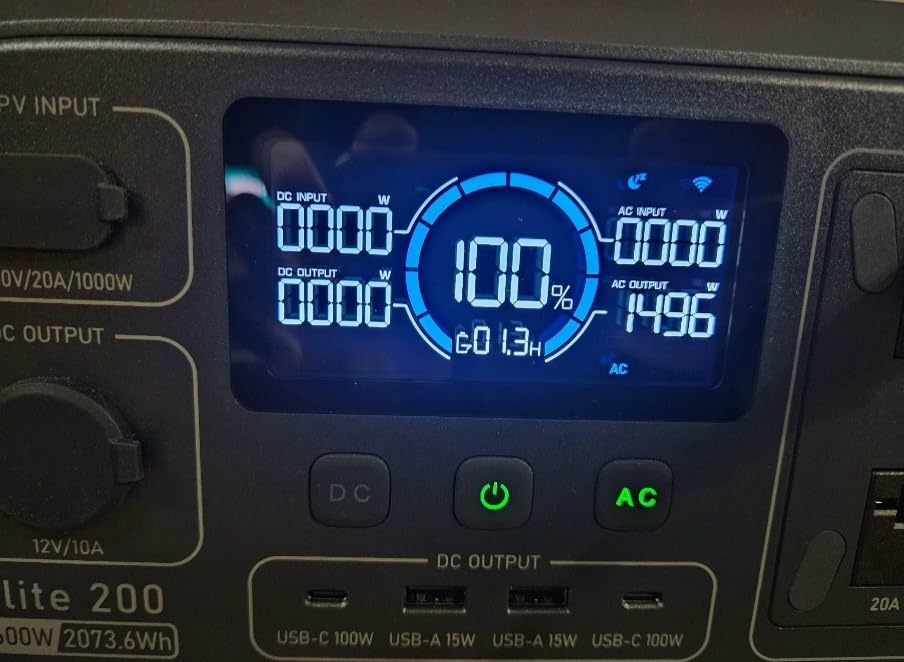
If your backup priority is a working kitchen rather than a working internet connection, the Elite 200 V2 is the unit owners in this roundup keep recommending. Multiple reviews describe running two freezers, a refrigerator, fans, a microwave and an air fryer at the same time, which is a load profile most 2kWh competitors cannot sustain at 2,600W of continuous output.
It is also the best-prepared for a long outage on wall power alone. Zero to 80% in 50 minutes with dual AC and DC charging, and a full charge in about two hours through 1,200W alternator charging, mean you can refill it from a car while the pack runs your fridge. The 10W standby draw is the sleeper feature: idle losses are what quietly eat a 2kWh pack over a three-day event, and this one measures about a third of comparable 2kWh systems.
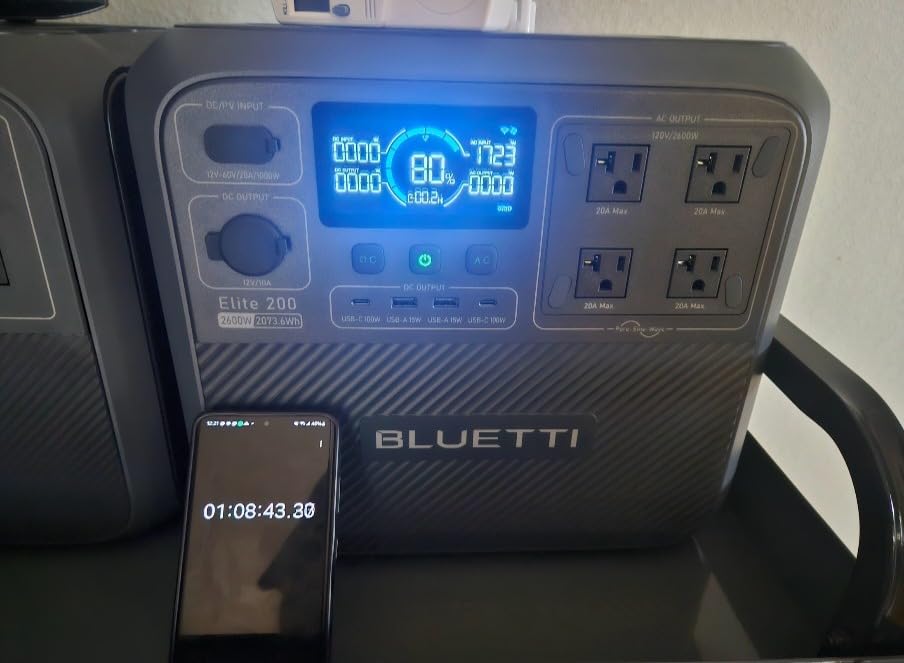
Two 200W panels are listed as included with this kit. From that 400W combined they reach full charge in roughly 5.5 hours in good sun, or 2.4 hours if you invest in 1,000W of panels. The battery is CNAS-certified automotive-grade LiFePO4 rated at 6,000-plus cycles and a 17-year lifespan, which is the strongest longevity claim in the group.
UPS mode runs under 15ms, fast enough to keep refrigerators and computers from restarting when the grid flickers. Reviewers who ran a 29 cubic foot fridge-freezer for 24-plus hours on a single charge attribute that directly to the inverter efficiency and the low standby draw working together.
Check this before you buy
At 53.4 pounds you need two hands and a clear path. Dual handles help, but plan where the unit lives before the storm, because you do not want to be moving this thing through a dark hallway. A dedicated outlet near your electrical panel is worth the planning.
Check your DC needs too. There is no 30A 12V output and no 5521 ports here, so RV and trailer owners who want to run 12V circuits directly off the battery will be disappointed. This unit also does not expand with BLUETTI’s extra battery modules, so 2,073.6Wh is all you get.
Who should skip it
Skip it if your home’s critical gear includes an electric water heater, a central air conditioner or a well pump. It is a 120V-only unit, and those loads will not start or run on it.
Skip it if you are the only person in the house physically able to move something this heavy. In that situation a smaller unit you can actually relocate is a better backup than a bigger one you cannot get out of the garage.
5. Anker SOLIX S2000 – Best Compact 2kWh Unit for Moving Between Rooms
Anker SOLIX S2 Portable Power Station, 2,010Wh, 1,500W
2010Wh LiFePO4
1500W continuous, 3000W peak
35.7 lb
6W idle draw
8 ports front and rear
Pros
- 2010Wh at only 35.7 lb
- 30% smaller than the 2kWh class average
- 6W idle draw gives roughly 35 hours of fridge runtime
- 10000 cycle and 15-year rated 314Ah LFP battery
Cons
- Charging fan becomes a loud drone at 1200W
- Strong chemical smell during the first charge
- Solar input capped at 400W
- No built-in alternator or DC-DC charging
The S2000 solves the weight problem that makes 2kWh units impractical for most people. At 35.7 pounds it is 25% lighter than the industry average for this class and 30% smaller, and the vertical footprint means it shelves like a tall kitchen appliance instead of taking floor space. You can move it from the garage to the kitchen without recruiting help, which is the whole difference between a backup plan and a garage ornament.
The 6W idle draw is the number to notice. Owners verified roughly 35 hours of refrigerator runtime on 220-liter and 29 cubic foot fridges running directly off the idle state, and about 3W in UPS mode, which undercuts conventional small UPS hardware. A 10,000-cycle, 15-year rated 314Ah LFP battery is the highest cycle claim in this roundup.
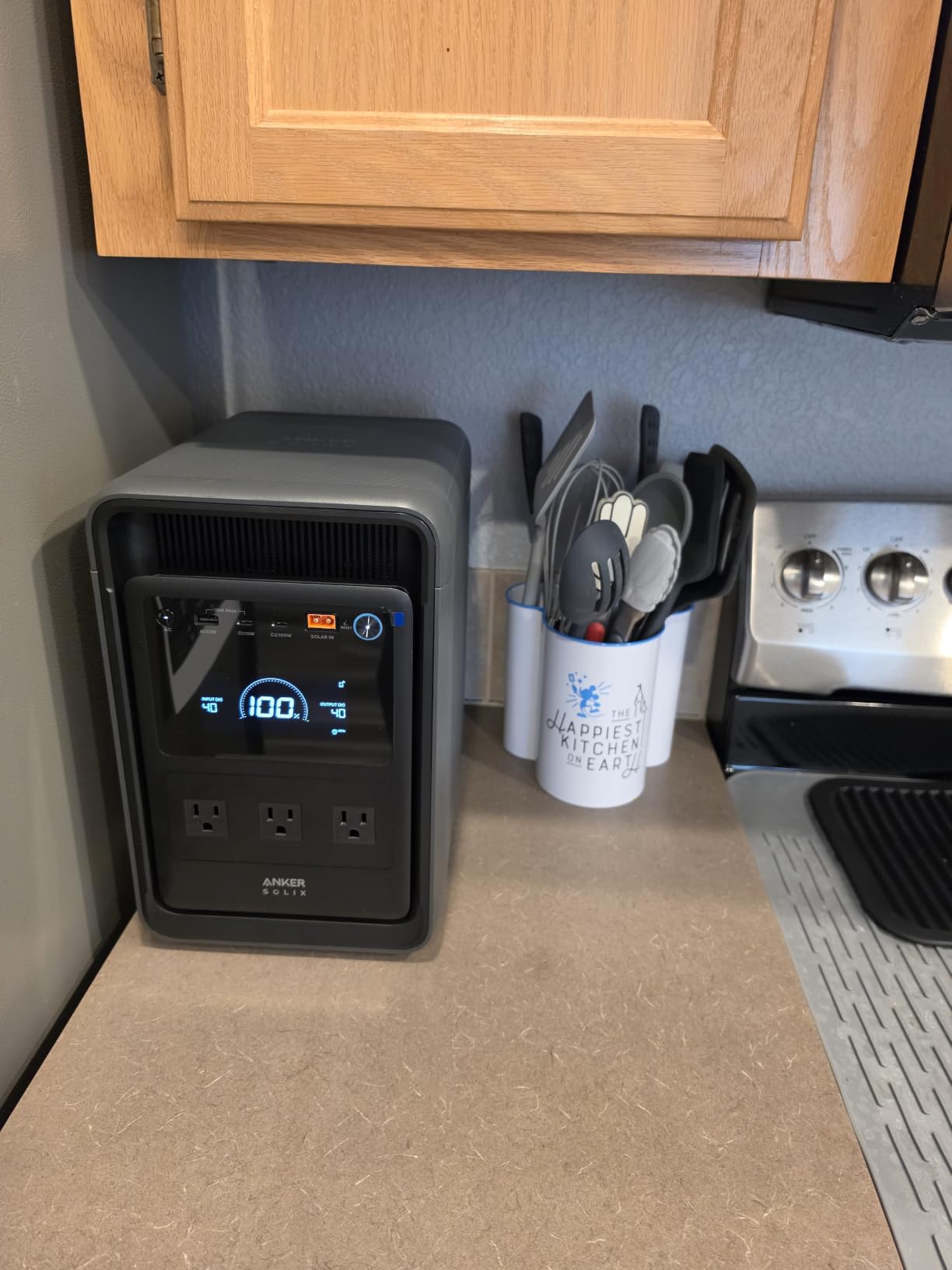
Output is 1,500W continuous and 3,000W peak, enough for a window air conditioner, induction cooking or an Instant Pot, and outlets sit on both the front and the rear so you can wire always-on appliances without a cable snaking across the room. Reviewers have carried it through 24- to 30-hour outages running refrigerators, network racks and medical devices.
Full recharge takes about 1.5 hours at 1,200W, and the app gives you control down to 100W increments, which is unusually granular. Time-of-use scheduling and energy usage graphs let you shift charging to off-peak rates when the grid is still up.
Check this before you buy
The cooling fan is the dominant complaint. At the full 1,200W charging rate owners describe a consistent, annoyingly loud drone, so if you plan to recharge overnight in a living space, plan to do it in the garage or a shed. Several buyers also report a strong chemical smell during the initial first charge, which is normal for lithium cells venting off residual manufacturing solvents in a sealed new pack, but worth knowing about in advance.
Check your panel plans. Solar input tops out at 400W, which is low for a 2,010Wh pack, and there is no built-in alternator or DC-DC charging, so your recharge options are wall, 12V car port and panel only.
Who should skip it
Skip it if a fast solar recovery matters to you. At a 400W input ceiling, refilling this battery from panels takes a long time and a 400W panel is about all the input it can use anyway.
Skip it if you plan to add capacity later, or if you need 240V. Both are closed doors with this design.
6. EcoFlow DELTA Pro Ultra 6kWh – Best Solar Generator for Whole-Home Backup
EF ECOFLOW Power Station 6144Wh DELTA Pro Ultra with 2x400W Portable Panel
6144Wh LFP
7200W continuous, 120V and 240V
Expandable to 90kWh
218 lb
5-year warranty
Pros
- 7200W from a single inverter including a 3-ton central air conditioner
- 6144Wh base pack recharges fully in about 2 hours
- Modular inverter battery and Smart Home Panel design
- Two 400W IP68 panels at 35.3 lb each
Cons
- Battery state-of-charge display reported as unreliable
- EV charger input tops out around 6100W
- Standby consumption of roughly 5-10% per day
- No built-in alternator or DC-DC charging
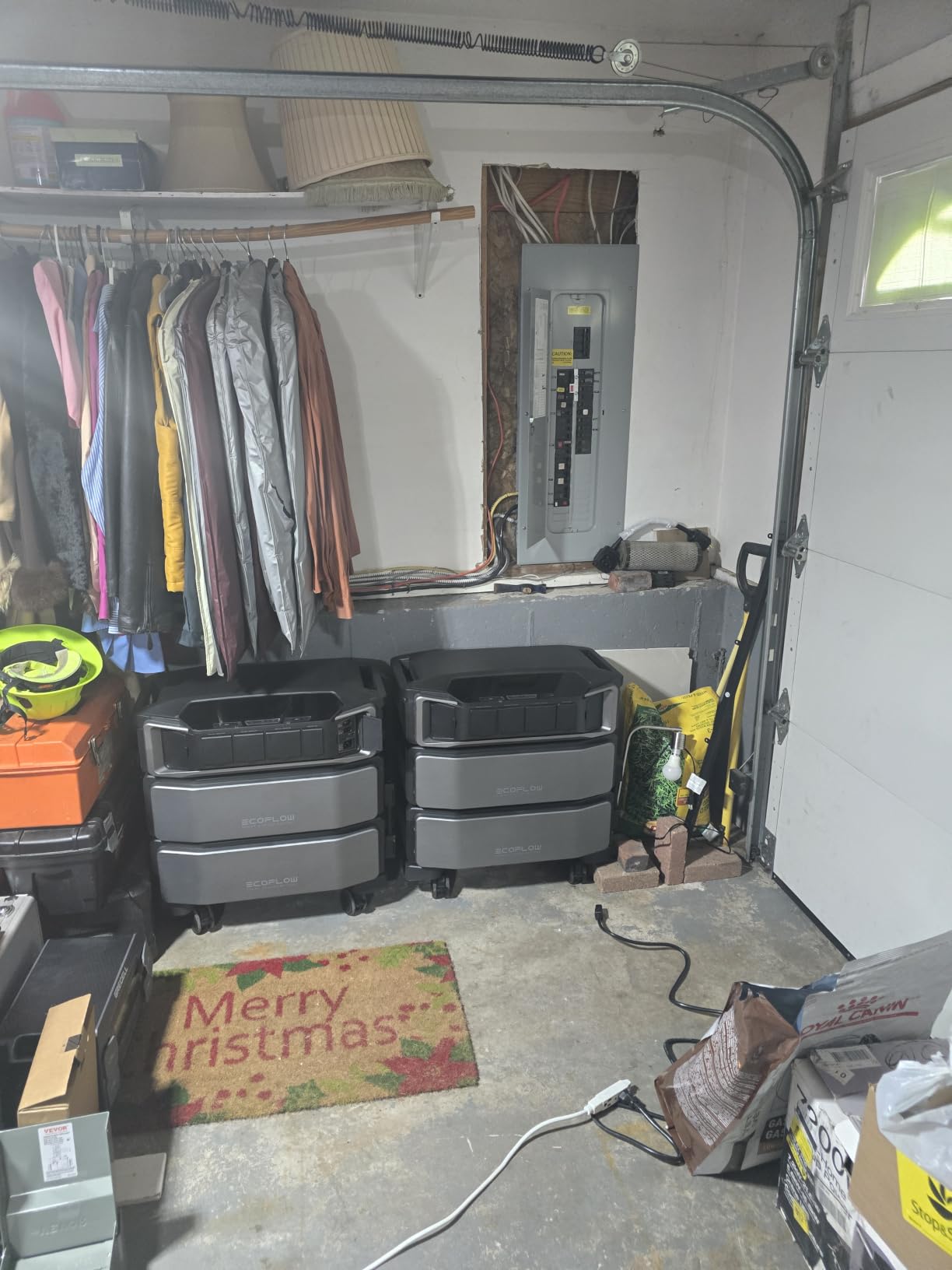
This is the only pick in the roundup that can plausibly carry a house rather than a circuit list, and it gets there with a single 7,200W inverter that outputs 120V and 240V from the same hardware. Owners run it against a 3-ton central air conditioner, a mini split, Starlink, security cameras and a full computer setup simultaneously, and the modular inverter, battery and Smart Home Panel architecture is what makes a fixed install clean rather than improvised.
Capacity scales from the 6,144Wh base pack to 90kWh, which EcoFlow frames as roughly 30 days of essential power for a typical North American household. The base pack fully recharges in about two hours, faster than any comparable 6kWh system, and it will also take power from a gas generator, an EV charging pile or AC in addition to solar.
The two included 400W IP68 panels are unusually good hardware, each only 35.3 pounds with a carry case, and portable enough to reposition as the storm moves across. The app gives per-circuit visibility with on and off control plus consumption data, which is how you decide what to switch off when the battery gets low.
That said, the 4.2 average rating is the lowest among the picks here and the complaints are technical rather than emotional. The state-of-charge display is reported as reading far off actual, the EV charger input caps around 6,100W instead of the advertised 7,200W, the LCD brightness cannot be turned off, and standby consumption of roughly 5-10% per day is meaningful if you are planning to live off-grid rather than ride out a storm.
Check this before you buy
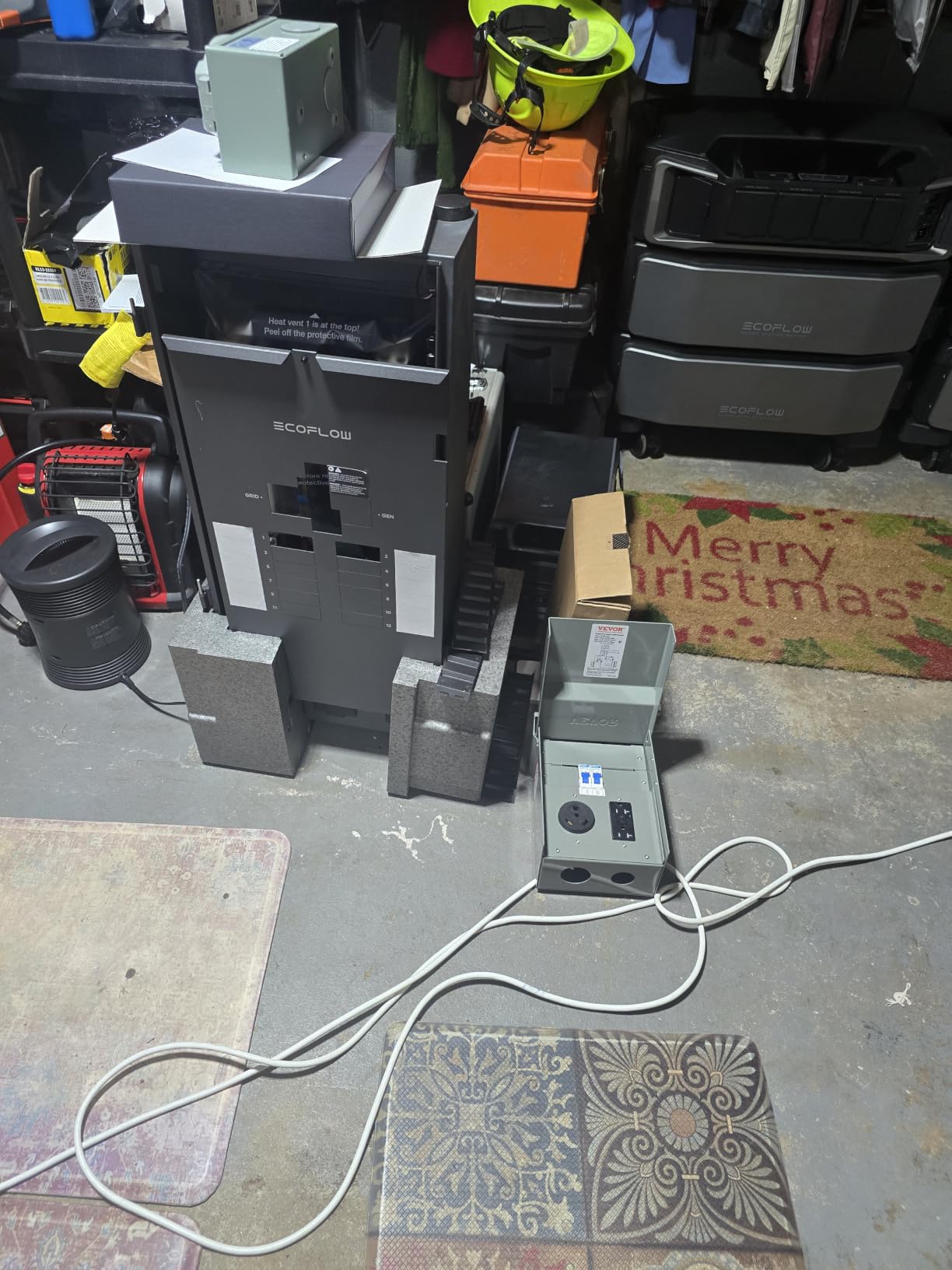
Budget for the installation hardware, not just the box. This unit is designed to pair with the EcoFlow Smart Home Panel 2 transfer switch, and connecting a battery to a live home panel is licensed electrical work in most jurisdictions. Our guide to the best manual transfer switches for home generators covers the hardware side, but budget separately for a permit and an electrician.
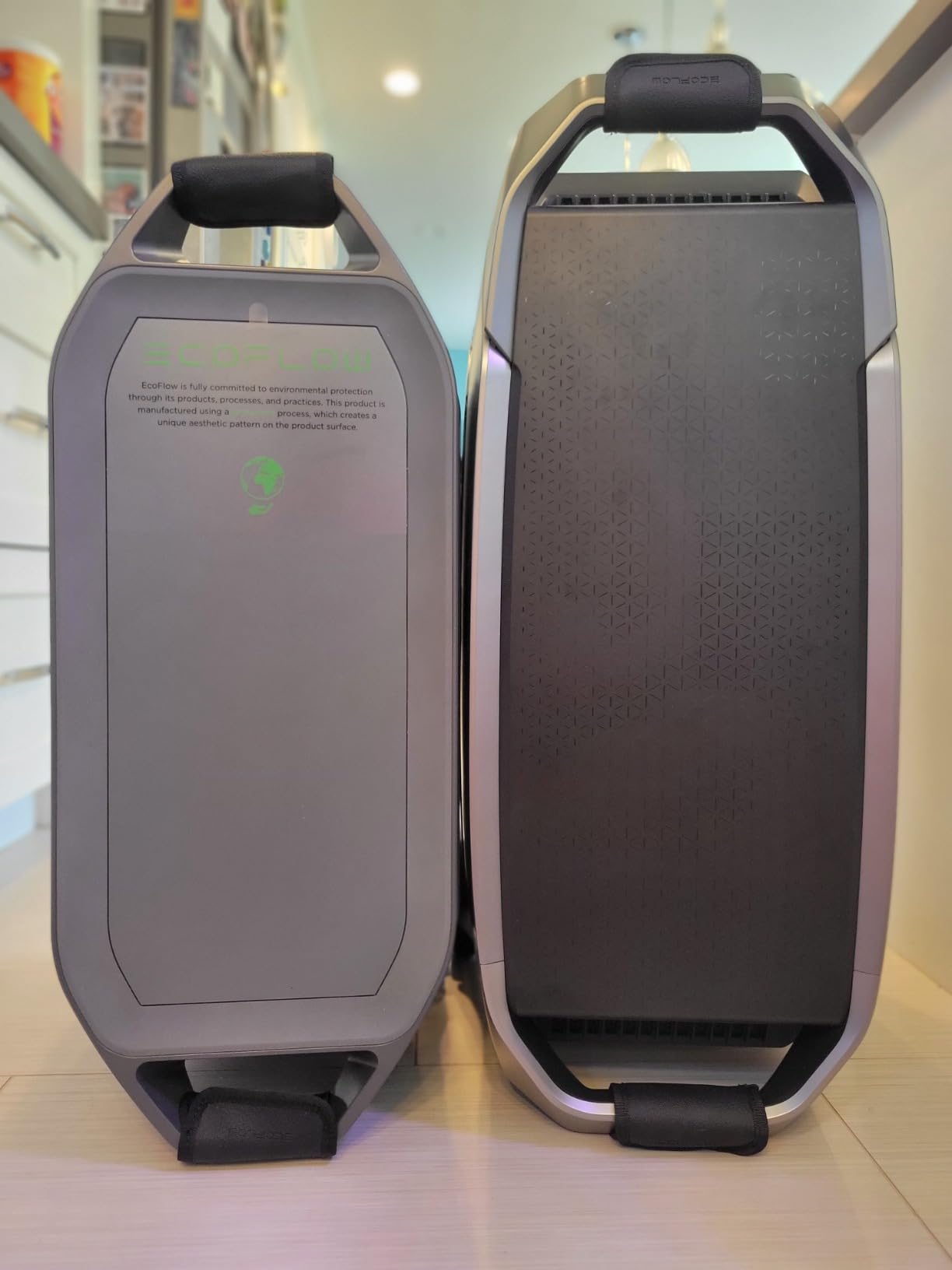
Check the logistics. At 218 pounds before any expansion battery, this is not a one-person lift, and it needs a floor location near your panel, not a garage shelf you plan to drag out during a flood.
Who should skip it
Skip it if your goal is a fridge, a router and a lamp. You would be spending vastly more than you need for capacity you will never touch, and you would still need the transfer switch and permit before it does anything for your house.
Skip it if the standby draw matters to you, which it does if you are planning extended off-grid living. Five to ten percent per day of a 6,144Wh pack is a lot of energy spent doing nothing, and the gauge that reports your remaining capacity is not reliable enough to plan around.
7. EcoFlow DELTA Pro 3 – Best Solar Generator for 240V Split Phase Output
EF ECOFLOW DELTA Pro 3 Portable Power Station, 4096Wh, 4000W AC Output
4096Wh LFP
4000W continuous, 6000W with X-Boost
120V/240V split phase
115 lb
2,600W solar input
Pros
- Native 120V and 240V from one unit with no voltage hub
- 4000W continuous and 12000W when two are paralleled
- 0-80% in about 50 minutes from an 1800W wall outlet
- Built-in neutral-ground bonding switchable in the app
Cons
- 115 lb makes it a two-person lift
- Stacking extra batteries on top immobilises it for travel
- No built-in 12V cigarette output port
- One documented Error 71 BMS failure with a difficult warranty return
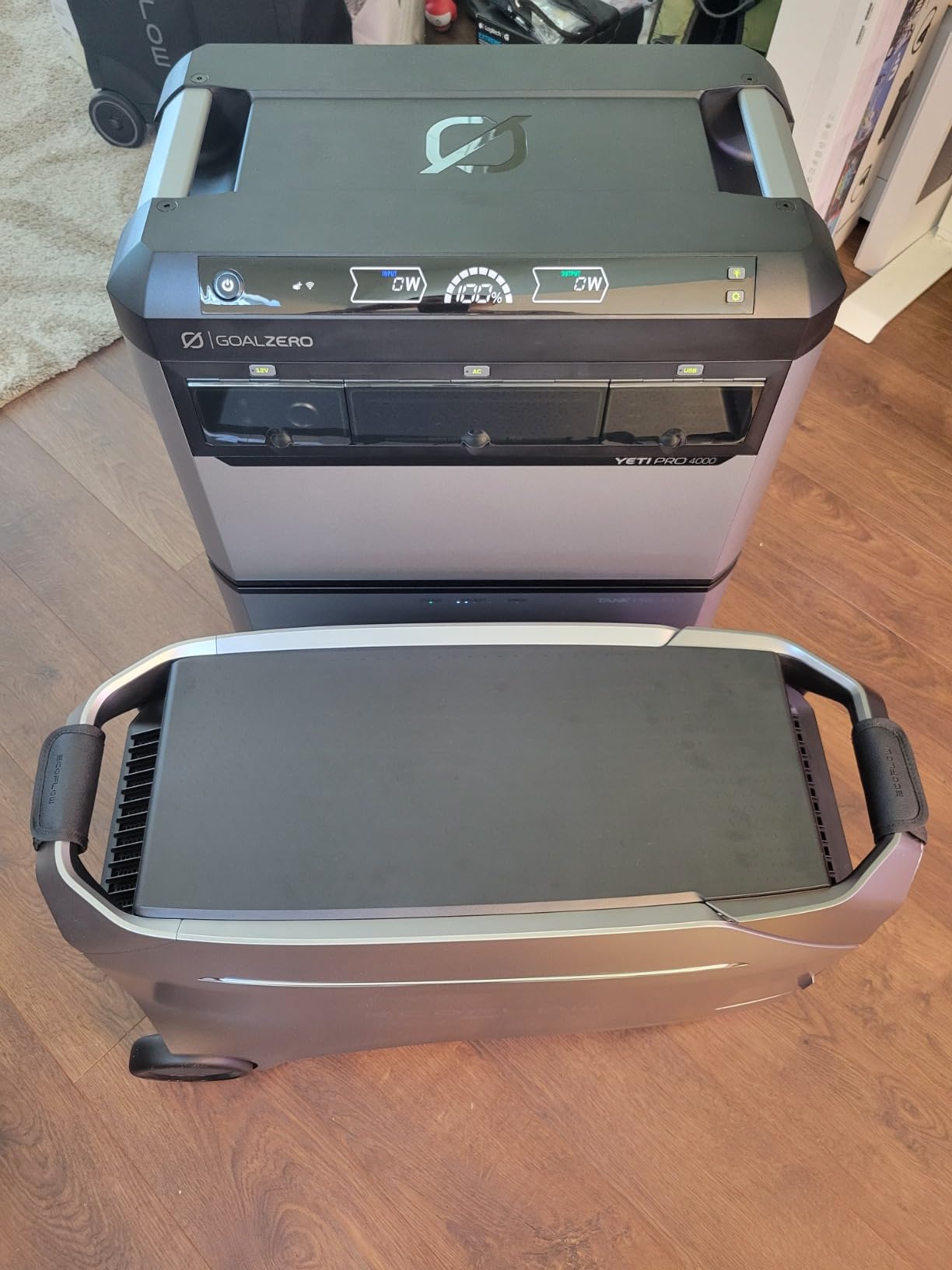
If your backup list contains a single 240V appliance, this is the most capable split-phase unit in the roundup. The DELTA Pro 3 puts 4,000W continuous and a native 120V/240V split phase in one enclosure, with X-Boost pushing it to 6,000W and paralleling two units for 12,000W. Crucially it delivers 240V on its own, so you are not hunting down a double-voltage hub accessory to make a well pump or a water heater start.
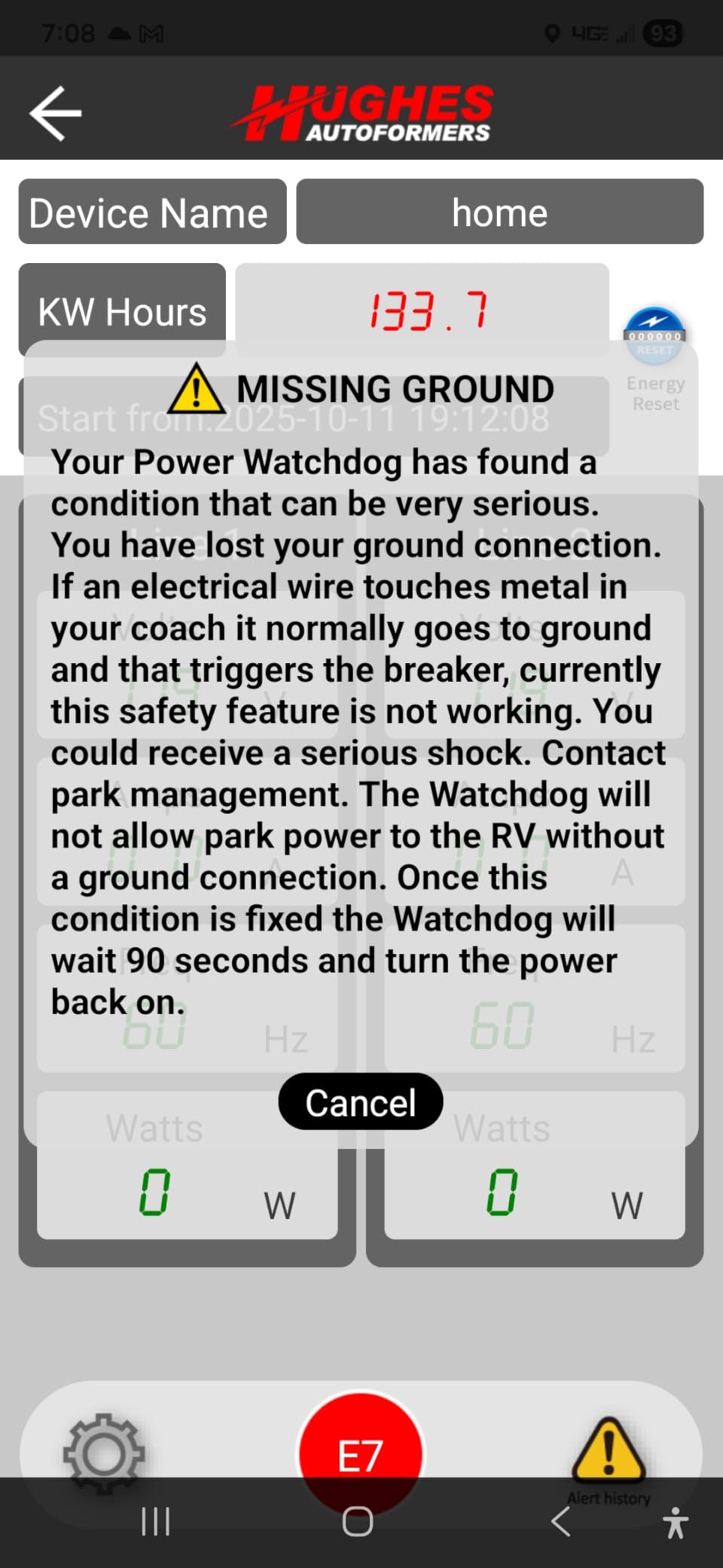
Owners who need 240V appliances in an outage consistently praise the output, the expandability and how quiet it is compared with the original DELTA Pro, with X-Quiet operation down to 30dB. Several run it as a whole-home source through a transfer switch or a 30A RV pedestal, and the built-in neutral-ground bonding, switchable in the app, makes those hookups considerably simpler than a separate bonding jumper.
Charging is fast and flexible. Zero to 80% in about 50 minutes from an 1,800W AC wall outlet, 2,600W of combined solar input across two MPPT ports at 1,600W and 1,000W, and up to 7,000W when you add solar to a smart generator. The 10ms switchover keeps NAS boxes, servers and desktops running through outages, which is the niche where it beats everything else here.
The 4,096Wh LFP pack expands to 12,288Wh with two extra batteries. Bigger wheels and a telescoping handle make it far easier to move than the original DELTA Pro, and the IP65-rated CTC battery pack is backed by a five-year warranty.
Check this before you buy
Read the failure reports before you commit. The 4.2 average includes a 14% one-star share, and one widely-upvoted account documents a catastrophic Error 71 BMS failure and a protracted warranty return process. That is a single anecdote rather than a pattern, but with lithium battery hardware it is the failure mode you should price into your decision.
Confirm the 12V situation. There is no built-in cigarette lighter output and the required dongle is not included, so if you want 12V DC for a trailer or a tool battery you are buying an accessory up front. The display is also harder to read at most angles than competing screens, which is an irritation in a dark garage at 3am.
Who should skip it
Skip it if you have no 240V loads. You would be paying for a capability you will never use, and the ELITE 200 V2 or the S2000 cover the same essential-loads scenario with less mass and more usable outlets.
Skip it if you are alone and moving hardware is your problem. At 115 pounds it is the heaviest unit in this roundup apart from the DELTA Pro Ultra, and stacking expansion batteries on top immobilises the whole thing for travel.
8. BLUETTI Elite 300 – Best Solar Generator for RV and DC Output
BLUETTI Solar Generator Elite 300 with 350W Solar Panel Included, 3014.4Wh
3014Wh LiFePO4
2400W continuous, 4800W surge
TT-30 RV port and 12V/30A
58 lb
350W panel included
Pros
- Full 3kWh in a body nearly 59% smaller than traditional designs
- 2400W output with 4800W surge for resistive loads like kettles
- Dedicated TT-30 RV outlet plus 12V/30A DC
- 0-80% in 78 minutes for fast turnaround
Cons
- Smallest owner base here at 230 reviews
- 58 lb is heavy for its class
- Bundled 350W panel is a modest input so full solar recharges take most of a day
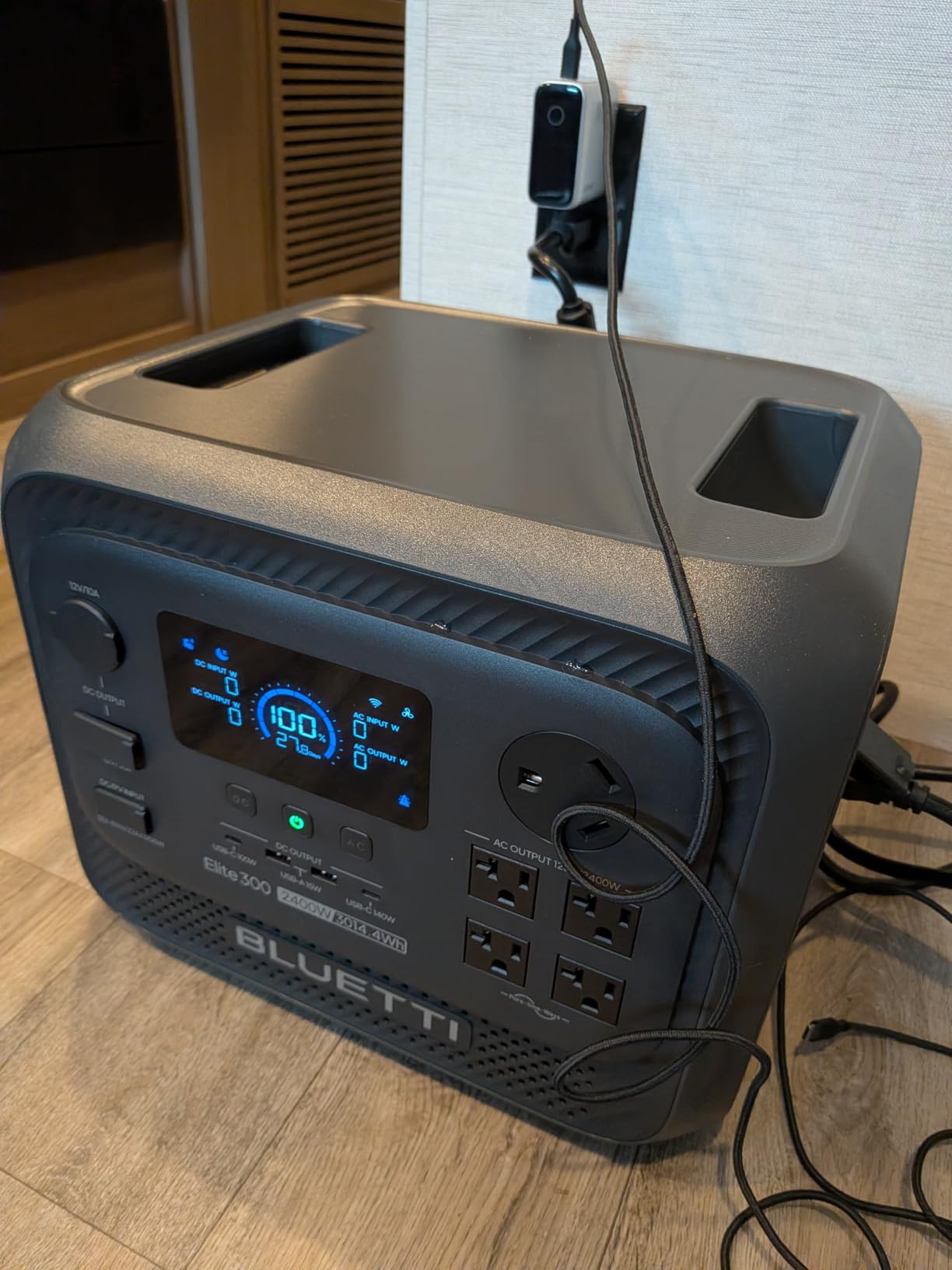
The Elite 300 is the density play. Frost and Sullivan recognised it as the world’s smallest 3kWh portable power station, and at 3,014Wh in a body nearly 59% smaller than traditional large power stations, it is the unit to choose when floor space or vehicle cargo space is the binding constraint. Buyers pick it over larger 3kWh designs specifically because of that footprint, with 2,400W continuous and 4,800W surge output to back it up.
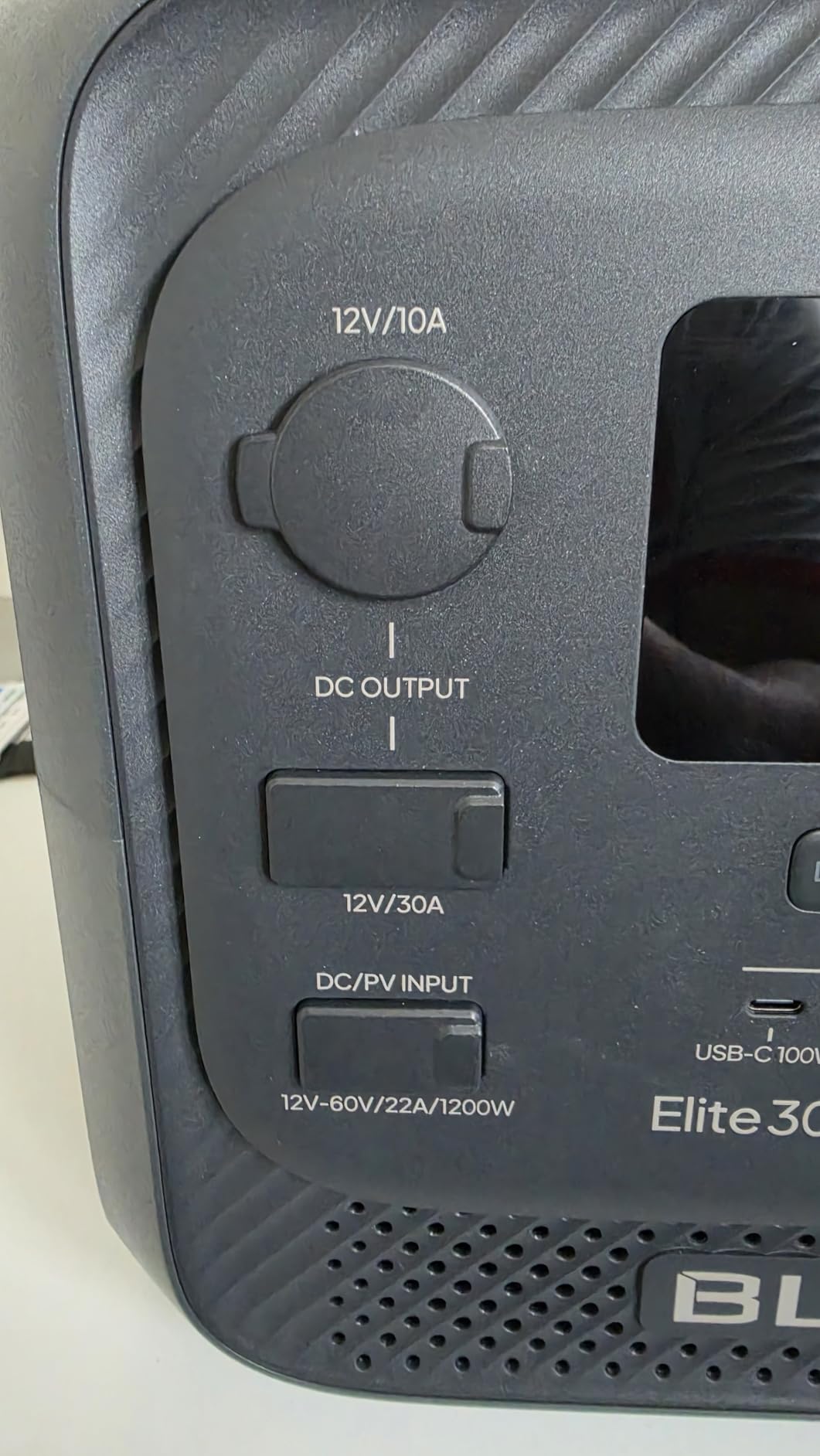
It is the most RV-ready unit in the roundup. A dedicated TT-30 RV outlet and a 12V/30A DC port mean you can plug a travel trailer directly in with no adapter, which matters if you want to run a 1,100W rooftop air conditioner during a highway outage. Other owners use it for kettles and other resistive loads thanks to the 4,800W surge headroom.
The battery is rated at 6,000-plus cycles, matching the longevity claim of the larger Elite 200 V2, and zero to 80% in 78 minutes gives you a workable turnaround between outage events. That is slower than the Elite 200 V2’s 50 minutes, which is a direct consequence of the larger pack and the lower input ceiling.
Realistic expectations on the panel: the included 350W unit takes roughly 8 to 17 hours for a full recharge depending on conditions, so it is a maintenance charger. Anyone expecting to recover a full 3kWh pack during a two-day storm should budget for additional panels or rely on wall power.
Check this before you buy
Note the review count. Two hundred and thirty reviews is the smallest owner base in this group, and with a lithium battery that means less long-term field data on cell degradation and firmware behaviour than the Anker or Jackery models carry. That is a real consideration for a purchase you expect to keep for a decade.
At 58 pounds it is heavy for its class, so test whether you can lift it into a vehicle unaided. If not, the smaller Elite 100 V2 at 25 pounds may serve you better even at less capacity.
Who should skip it
Skip it if you expect to recover from solar during a long outage. The 350W bundled panel is sized for keeping the battery topped up between events, not for emergency recharging.
Skip it if the TT-30 RV port and 12V/30A output are not relevant to you. Those are the features that justify it, and without them the 58-pound weight works against you.
9. Jackery HomePower 3600 Plus – Best Solar Generator You Can Wheel Out of Storage
Jackery HomePower 3600 Plus & 2x200W Solar Panels, 3584Wh, 3600W AC Output
3584Wh LFP
3600W continuous, 7200W parallel
120V and 240V
77.2 lb with wheels
5-year warranty
Pros
- Luggage-style vertical chassis with heavy-duty wheels and a telescoping handle
- 3584Wh expandable to 21kWh per unit
- Full 0-100% recharge in about 2 hours with hybrid AC plus DC
- Holds charge for months with no drain
Cons
- Bundled 200W panels criticised for real-world output of 100-150W each
- One owner reports a panel falling apart within five months
- No cigarette-lighter DC output
- 77.2 lb is heavy even with wheels
The HomePower 3600 Plus is built around a problem the other big units ignore: how do you move 3.5kWh of battery from storage to the place you need it. The vertical luggage-style chassis, heavy-duty wheels and a telescoping handle mean it rolls like a carry-on, and at 3,584Wh with 3,600W continuous output it is one of the few units in this roundup you do not need a second person to reposition.
Capacity expands to 21kWh per unit and the system supports 120V and 240V dual voltage in a parallel configuration, with 7,200W available from two. The battery uses high-temperature tested ceramic membrane cells rated for 6,000 cycles and a 10-year lifespan, and the unit holds its charge for months with no drain, which makes it a genuine always-ready reserve rather than something that needs seasonal conditioning.
Charging is quick: zero to 100% in about two hours using hybrid AC and DC, or 2.5 hours on AC or from a gas generator. Reviewers power multiple freezers, security systems, cameras and networking gear through seven-hour outages on minimal charge, and one full-time RVer runs an entire travel trailer from it including a 1,100W air conditioning unit. It is quiet even in fast charge mode and needs no electrician for basic plug-and-play use.
This is a unit built for outage preparedness rather than off-grid living, and it works with the Jackery manual transfer switch if you want to back up whole-house circuits properly. Our transfer switch guide covers what that install involves.
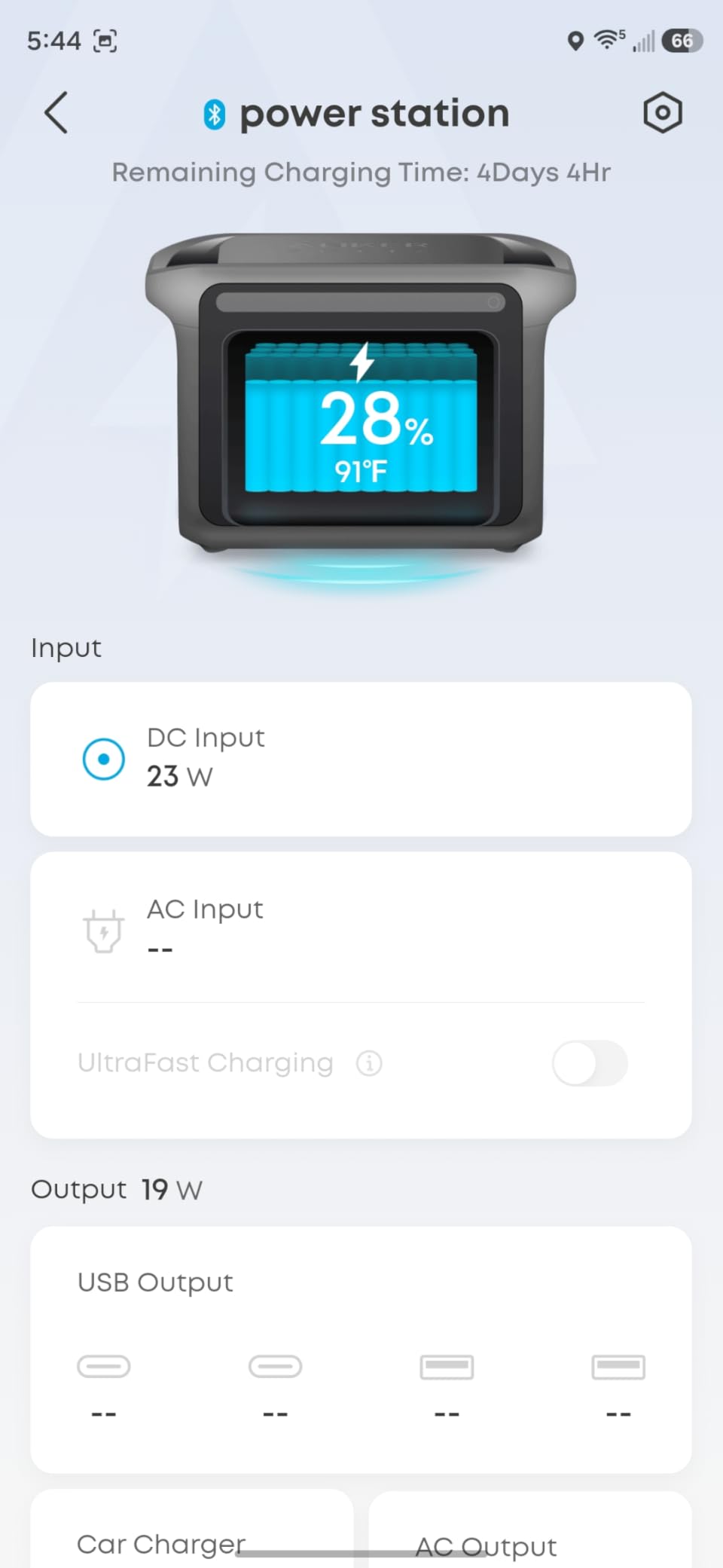
Check this before you buy
Be skeptical about the bundled panels. They draw the harshest criticism in this entire roundup: reviewers report real-world output of around 100-150W each rather than the rated 200W, and one owner documents a panel falling apart within five months. The solar charging cables are also too short for practical placement. If you want solar charging, buy better panels separately.
Also note the DC limitations. There is no cigarette-lighter output and DC options beyond USB are minimal, and the vertical format is awkward to store in a vehicle or a travel trailer even though it rolls well across a garage floor.
Who should skip it
Skip it if you expect to back up your home panel without extra hardware. This unit cannot power whole-house circuits on its own; you will need a manual transfer switch and extension cords until then.
Skip it if the bundled solar panels are the reason you are buying. They are the weakest link in an otherwise well-engineered package, and reviewers say so repeatedly.
10. EcoFlow DELTA 3 Classic – Best Budget Solar Generator for Essential Loads Only
EF ECOFLOW Portable Power Station Delta 3 Classic, 1024Wh 1800W AC
1024Wh LiFePO4
1800W continuous, 3600W surge
0-80% in 45 minutes
Under 10ms UPS
26.7 lb
Pros
- Largest owner base in the entry tier with 1294 reviews
- 0-80% in 45 minutes and full recharge in about an hour
- Owners ran two sump pumps for two days on 50% charge
- App supports scheduling and storm alerts
Cons
- At 26.7 lb still on the heavy side for hand-carrying
- Not compatible with DELTA Smart Extra Battery so no expansion path
- Standalone 12V car charging is slow for extended off-grid driving
The DELTA 3 Classic is where most households should start, and 1,294 reviews at a 4.7 average make it the most proven value pick we could find. For a fridge, a router, a couple of lamps and a CPAP machine, a 1,024Wh LiFePO4 pack with 1,800W continuous and 3,600W surge output is genuinely sufficient, and you avoid the 100-pound problems that come with the larger units.
Charging speed is the standout. Zero to 80% in 45 minutes with X-Stream AC charging and a full recharge in about an hour means the pack is rarely the bottleneck. A 500W solar panel refills it in roughly 2.5 hours, and the under-10ms UPS switchover makes it a viable backup for a refrigerator, routers or a network rack where a restart would be disruptive.
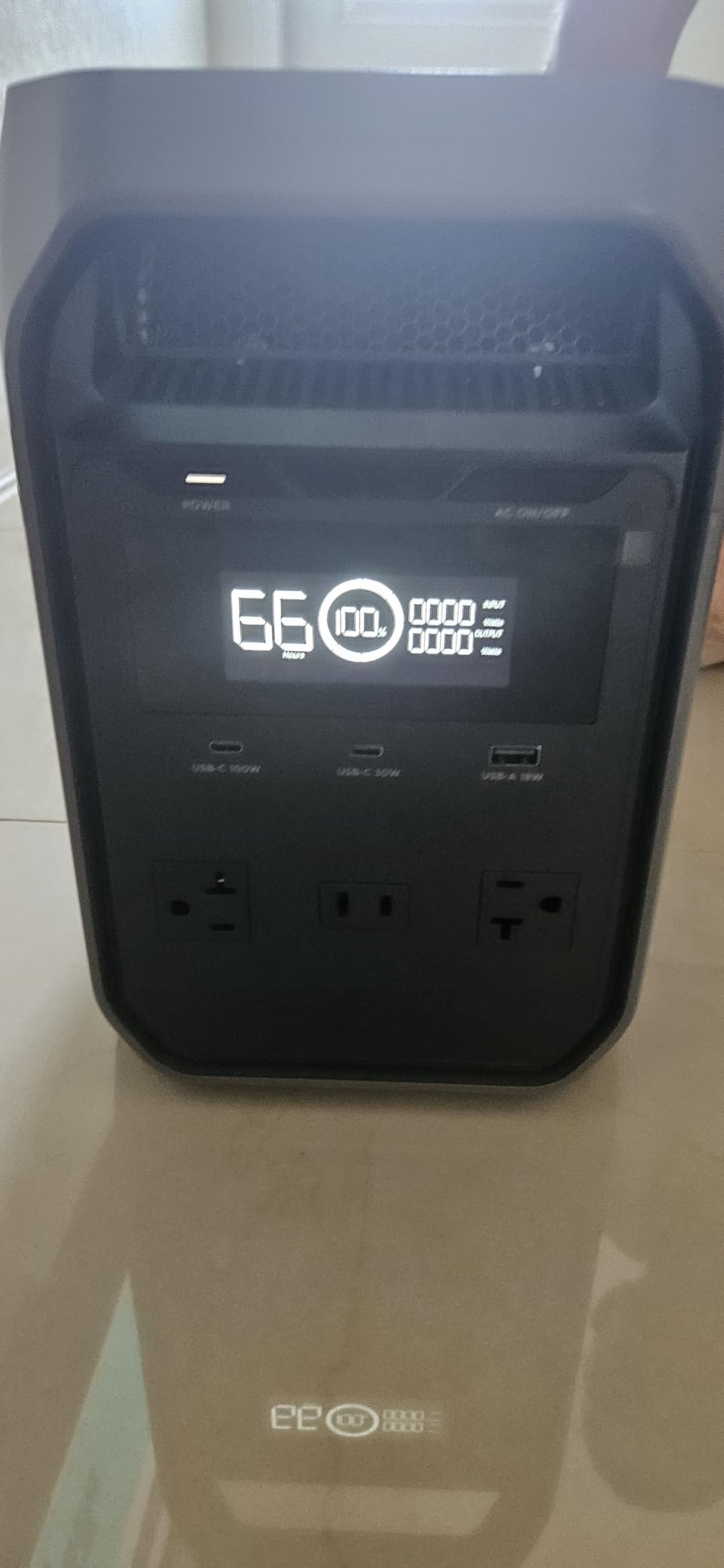
Owners report holding a refrigerator for up to 10 hours and, more impressively, running two sump pumps for two days on a 50% charge, which is exactly the drainage scenario that makes backup power worth having in the first place. The app supports scheduling, storm alerts and a self-powered mode, and the design is clean, with two top handles, non-skid base pads and side-flared outlets. It packs neatly into a minivan.
The LiFePO4 cells are rated for 10-plus years of daily use, with an EV-grade CTC design and a smart battery management system. For a first-time buyer on a tight budget this is the shortest path to a working backup plan.
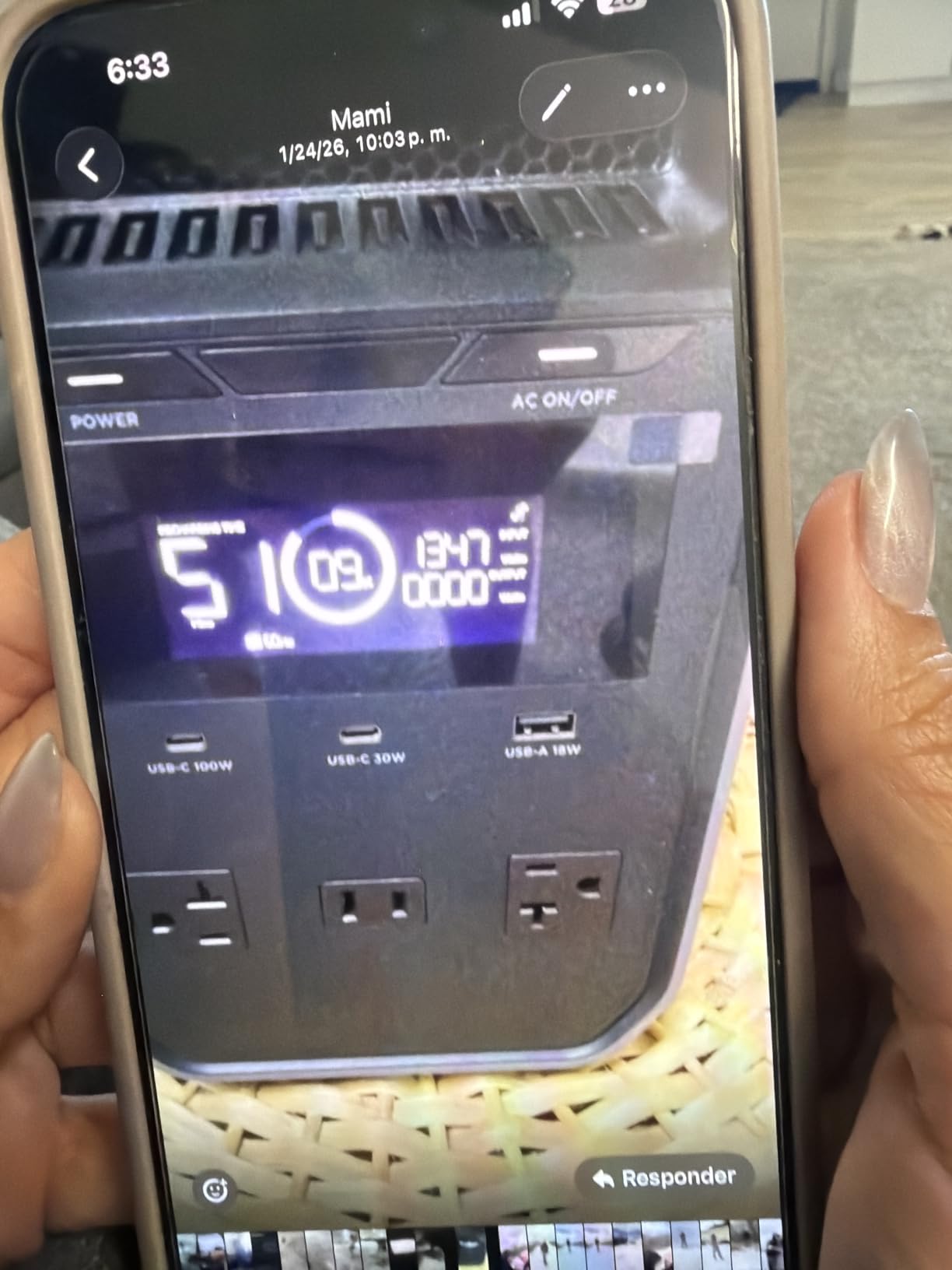
Check this before you buy
Confirm there is no expansion path. This unit is not compatible with the DELTA 2 or DELTA 3 Series Smart Extra Battery, so the 1,024Wh is a hard ceiling. If you might need more capacity after your first storm season, the BLUETTI Elite 100 V2 or the Anker SOLIX C1000 Gen 2 are safer long-term buys.
At 26.7 pounds it is still on the heavy side for hand-carrying, and standalone 12V car charging is slow if you plan to run the whole plan from a vehicle battery.
Who should skip it
Skip it if you want a microwave, a window air conditioner or anything with a compressor cycling on and off at the same time as a refrigerator. 1,800W sounds generous until you stack two high-draw loads on it.
Skip it if you are storing it in an unheated garage through a freezing winter. Lithium iron phosphate chemistry tolerates cold far better than NMC, but charging a pack below freezing is still something to check against the manual for your climate.
How to Choose a Solar Generator for Home Backup in 2026?
What size solar generator do you need to run a house?
Most households do not need to run a house. They need to run about six circuits for three days. Add up the running watts of everything you would keep on, multiply by the hours you need it, then check that the result lands inside your battery’s usable capacity after conversion losses. Add roughly double your largest motor load for surge headroom, and match the output to 120V or 240V depending on what is on the list.
For reference, the running loads that show up in almost every backup plan are these. A refrigerator compressor draws 100 to 400W depending on size, a chest or upright freezer 70 to 200W, a Wi-Fi router and a network switch together 15 to 30W, a laptop 45 to 65W, a CPAP or oxygen concentrator 30 to 60W, a microwave 900 to 1,400W, a sump pump on start 900 to 1,100W, a well pump on start 1,000 to 1,500W, a window air conditioner 800 to 1,200W, a small electric water heater 1,500W with a 3,000W surge, and a 3-ton central air conditioner around 3,500W. A list of a fridge, a router, a lamp and a CPAP machine lands around 300W running, which is why most 1kWh units handle it overnight and most 2kWh units handle it for a couple of days.
Usable capacity is roughly 76% of the label
This is the single most misleading number in the category, and it is worth memorising before you compare anything. Take the nameplate watt-hours, multiply by a realistic 90% depth of discharge because you should never fully empty a lithium pack, then multiply by roughly 85% inverter efficiency. A 1,024Wh unit yields about 783Wh of usable energy, not 1,024Wh. A 6,144Wh pack yields closer to 4,700Wh.
Any manufacturer claiming “expandable to 90kWh” is quoting nameplate capacity. Design your outage plan against the number above the line, not the number below it, and you will avoid the disappointment of planning an eight-hour evening and getting four.
LiFePO4 versus NMC, and why it matters indoors
Every pick in this roundup uses lithium iron phosphate, and that is not a coincidence. LFP chemistry is far more thermally stable than the NMC cells used in phones and laptops, tolerates thousands more cycles before degrading meaningfully, and is far less likely to enter thermal runaway the way an NMC pack can. Reddit’s prepping community consistently rates LFP cells at 3,000 to 5,000 cycles as the practical benchmark, which matches the 4,000 to 10,000 cycle claims here. Do not buy an NMC unit for indoor backup use, and if you do, store it away from living space.
120V versus 240V, and the hardware nobody mentions
Only three units here output 240V: the DELTA Pro Ultra, the DELTA Pro 3 and the Jackery HomePower 3600 Plus. If a well pump, an electric water heater, a central air conditioner or an electric range is on your list, everything else is disqualified.
For whole-home backup you also need a transfer switch, a permit and an electrician, in that order. Connecting a battery to a live panel is licensed work nearly everywhere, and the transfer switch is what legally and safely isolates your home from grid power when you switch to the battery. A neutral-ground bonding jumper may also be required, which the DELTA Pro 3 handles with an app-switchable internal bonding switch and the DELTA Pro Ultra handles through its Smart Home Panel. Our guide to the best manual transfer switches for home generators walks through the hardware options; budget for the install separately from the battery.
UPS versus EPS, and why CPAP users care
UPS mode transfers in under 20ms and the power never actually drops, so a CPAP machine, an oxygen concentrator or a NAS does not restart. EPS mode allows a brief interruption, sometimes 10 to 30ms, which is fine for a refrigerator restarting its compressor and unacceptable for a life support device. Several picks here advertise 10ms or 15ms transfer, and one claims under 10ms. If you run powered medical equipment, read that figure on the specific card before you buy.
Solar recharge reality and panel sizing
Two things buyers are not told often enough. First, panels are not included with most kits in this category, and several that are included are undersized for the battery they ship with, as the reviews on the Jackery and BLUETTI Elite 300 bundles make clear. Second, a 400W panel produces far less than 400W in practice. Budget 8 to 17 hours for a full recharge of a 3kWh pack from a 350W panel, and expect overcast weather to stretch that further. For a first-year backup purchase, wall power and a car alternator charge will serve you better than any panel you own.
Who should not buy a portable solar generator
If you need to run your air conditioner, well pump and water heater for a week, a portable unit is the wrong purchase. Talk to an installer about a fixed home battery with a panel, which is what most of our readers on r/solar end up choosing. If you cannot move the unit, weight defeats the whole premise, and a smaller box you can relocate beats a bigger one you cannot. And if your outages only ever last four hours, a quality UPS and a surge strip may cover you for a fraction of the commitment.
Frequently Asked Questions
What is the best solar back-up generator for a home?
The BLUETTI Elite 100 V2 is our top pick for most homes, with 1,024Wh of LiFePO4 capacity, 1,800W continuous output, four AC outlets, a 10ms UPS switchover and a bundled 200W panel. The Anker SOLIX C1000 Gen 2 is the alternative if recharge speed and a large owner base matter more to you, and the EcoFlow DELTA 3 Classic is the value entry point.
What size solar generator is needed to run a house?
For essential circuits, add the running watts of everything you would keep on and multiply by the hours you need. A fridge, router, lamps and a CPAP machine together run about 300W, which a 1kWh unit covers overnight and a 2kWh unit covers for two to three days. Running an actual whole house needs 240V output, 7,200W class hardware, a transfer switch and a licensed electrician.
What will a 3000 watt solar generator run?
A 3,000W continuous output handles a 1,200W window air conditioner, a 1,400W microwave or a well pump on start, plus a refrigerator and networking gear at the same time. It will not run a 3-ton central air conditioner or a full electric water heater alongside anything else. For those loads you need 7,200W class equipment such as the DELTA Pro Ultra.
Can a solar generator run a whole house?
Not by itself. A portable power station needs a transfer switch, a permit and a licensed electrician to connect to your home panel safely, and it needs 240V split phase output to carry your heavy 240V circuits. Units like the EcoFlow DELTA Pro Ultra, the DELTA Pro 3 and the Jackery HomePower 3600 Plus have the output for it. Everything else covers selected circuits only.
Do solar generators come with solar panels?
It varies. The BLUETTI Elite 100 V2, the Elite 200 V2 and the Elite 300, the DELTA Pro Ultra and the Jackery Solar Generator 1000 v2 include panels, and the Jackery HomePower 3600 Plus includes two. The Anker SOLIX C1000 Gen 2, the Anker SOLIX S2000 and the EcoFlow DELTA Pro 3 do not. Bundled panels are often undersized, so check the wattage before planning around them.
Is LiFePO4 better than NMC for home backup?
Yes. Lithium iron phosphate is far more thermally stable, tolerates thousands more charge cycles and is the safer chemistry to store in a garage attached to a house. NMC packs carry a higher energy density but a meaningfully higher fire risk, which is why every unit in this roundup uses LiFePO4 cells rated for 4,000 to 10,000 cycles.
Conclusion: Our Top Solar Generator for Home Backup in 2026
The BLUETTI Elite 100 V2 wins this roundup for most households. It is one of the few sub-2kWh picks that lists a 200W panel with the kit, it carries four AC outlets rather than three, and its 10ms UPS transfer keeps medical equipment and network gear alive through a grid drop without a restart. At 25 pounds you can move it by yourself, and 1,800W of continuous output with 3,600W of surge covers everything short of a 240V appliance.
Match your household to one of the other three profiles and the choice makes itself. If recharge speed and the deepest support network in the category matter most, take the Anker SOLIX C1000 Gen 2, which fills from a wall outlet in 49 minutes. If you want a working kitchen rather than a working internet connection, the BLUETTI Elite 200 V2 at 2,073.6Wh runs two freezers, a fridge and a microwave at once. If you need 240V, the EcoFlow DELTA Pro 3 gives you split phase in a single unit without a voltage hub.
And if you are starting from zero, the EcoFlow DELTA 3 Classic is the shortest path to a plan that actually works when the power goes out. Whatever you choose, work out your usable capacity before you buy, remember that a transfer switch and a permit are what turn a battery into home backup, and use the best solar generators for home backup list in 2026 as a shortlist rather than a final answer. Nothing here is discontinued, and every pick is rated for a decade of service.