

If you just finished a room addition, bonus room over the garage, or a basement conversion, you have a space with no ductwork and no vents. The best wall mounted air conditioners for additions are ductless mini splits, because they drop into a room without running a single foot of sheet metal. We compared ten of them side by side on capacity, efficiency, sound level, warranty, and installation reality.
What surprised us most during this comparison was how much the hardware is not the hard part. Every one of the systems below is a legitimate answer for a new addition, and the deciding factor is usually line-set length, electrical capacity, and how much condensate routing your room allows.
We spent weeks reading the review histories, spec sheets, and installation notes for nine popular mini splits and one through-the-wall unit, then ranked them by how well each one actually suits a room somebody will sleep, work, or study in.
Table of Contents
What Is the Best Wall-Mounted Air Conditioner for an Addition?
The best wall mounted air conditioner for a room addition is a ductless mini-split heat pump sized to a Manual J load calculation for that specific room. Nine out of ten new additions need no ductwork extension at all, so a single-zone or multi-split system is almost always the correct answer.
That direct answer hides one important distinction, because the phrase wall-mounted AC covers two very different machines. A ductless mini split mounts a slim indoor head high on an interior wall and pairs it with an outdoor condenser. A through-the-wall air conditioner drops into a steel sleeve that is already cut into an exterior wall.
Here is the catch for new-build work: a brand-new addition has no wall sleeve. Sleeve units are replacement products for older buildings that were designed around them, which is exactly why most roundups on this topic quietly mix the two categories and confuse you.
Key Takeaways
Ductless mini splits are the only real option for a new addition, because a through-the-wall sleeve unit needs a pre-existing sleeve in an exterior wall that your addition does not have.
Size to a Manual J load calculation, not to the manufacturer calculator or the naive BTU-per-square-foot rule, which routinely oversize basements by two to three times.
The equipment is the small part of the bill. Line-set fabrication, a new electrical circuit, and condensate routing are what separate a reasonable quote from a shock quote, so insist on an itemised breakdown.
Top 3 Wall-Mounted AC Picks for Additions in 2026
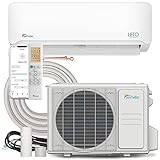
Senville LETO 12000 BTU
- 28 dB indoor head
- 12000 BTU 1 ton capacity
- 4-in-1 cooling heat dry and fan
- Alexa and app control

COSTWAY 12000 BTU
- 23 dB quietest head in group
- 115V plug-in power
- 5-year parts 8-year compressor
- Self-cleaning at 134.6F

Mountman 9000 BTU
- 26 dB sleep mode
- 110/120V simplified wiring
- 19 SEER2 inverter
- Four modes and 24-hour timer
Quick Picks: Every Wall-Mounted AC Compared in 2026
| Product | Specifications | Action |
|---|---|---|
| Senville LETO 12000 BTU Mini Split Heat Pump |
|
Check Latest Price |
 SereneLife 24000 BTU Mini Split AC and Heating SereneLife 24000 BTU Mini Split AC and Heating |
|
Check Latest Price |
| COSTWAY 12000BTU Mini Split AC and Heater |
|
Check Latest Price |
 ROVSUN 9000 BTU WiFi Mini Split Inverter ROVSUN 9000 BTU WiFi Mini Split Inverter |
|
Check Latest Price |
| Mountman 9000 BTU Mini Split Heat Pump |
|
Check Latest Price |
 DELLA Econo Series 23000 BTU Mini Split DELLA Econo Series 23000 BTU Mini Split |
|
Check Latest Price |
 Cooper and Hunter 24000 BTU MIA Series Cooper and Hunter 24000 BTU MIA Series |
|
Check Latest Price |
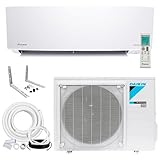 Daikin 18000 BTU Entra R32 Heat Pump Daikin 18000 BTU Entra R32 Heat Pump |
|
Check Latest Price |
 ROVSUN 8000 BTU Through the Wall AC with Heat ROVSUN 8000 BTU Through the Wall AC with Heat |
|
Check Latest Price |
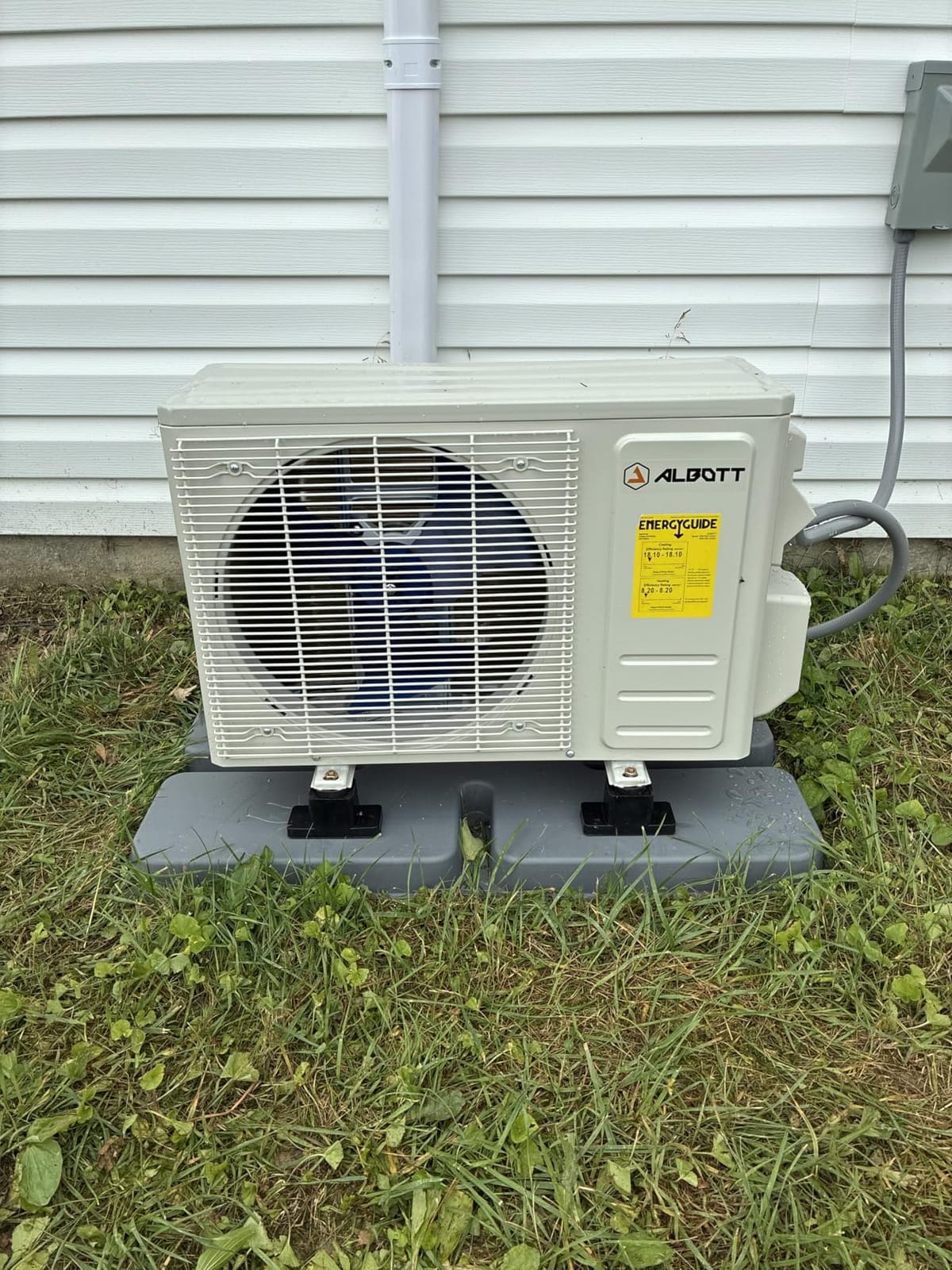
 Albott 12000 BTU Mini Split 115V Albott 12000 BTU Mini Split 115V |
|
Check Latest Price |
One thing the table makes obvious: this category has thin trust signals. Review counts in this roundup run from a few dozen to several thousand, and the noise figures vary by more than 30 decibels between the quietest and loudest indoor heads.
Sorting by star rating alone will mislead you. Sort by review volume first, then read the one-star and two-star reviews looking for the same failure words, which in this category are condensate, warranty, and install.
1. Senville LETO 12000 BTU – Best All-Round Mini Split for a Mid-Size Addition
Senville LETO Mini Split Air Conditioner, Heat Pump, White, 12000 BTU
12000 BTU 1 ton
28 dB indoor head
SEER 20.8 inverter
Heating to 5F
16 ft line set
Pros
- Largest review base in this roundup at 2185 ratings
- Very quiet 28 dB operation
- Heating and dehumidification in one head
- Includes 16 ft pre-charged line set
Cons
- 2-year parts warranty is short for the category
- Not BEE star compliant
- Professional install required for warranty
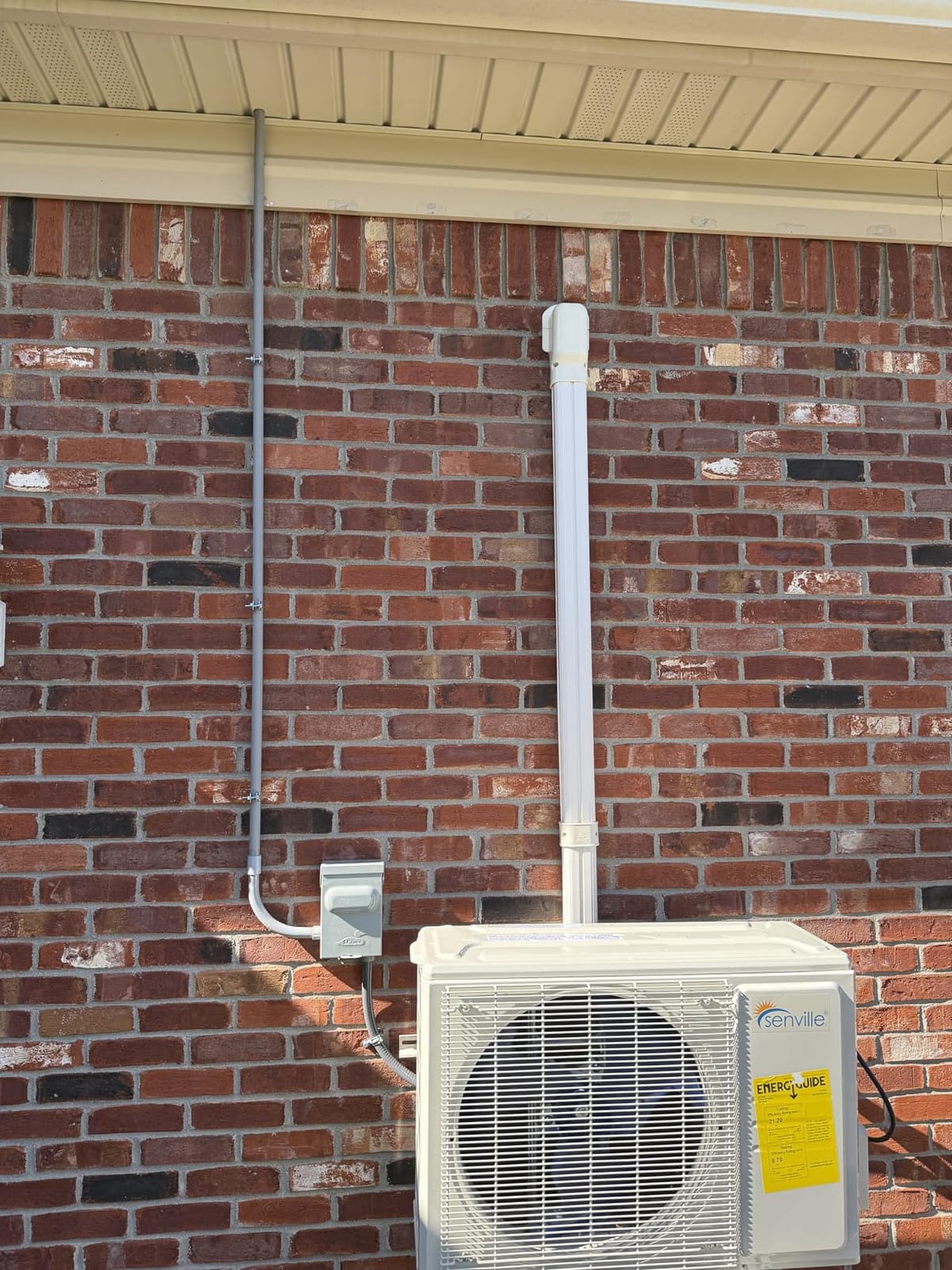
The Senville LETO is the unit we kept coming back to while working through this list. It is a 12000 BTU one-ton inverter heat pump rated to cover 700 square feet, which lands it squarely in the middle of what most additions need.
Four operating modes cover cooling, heating, dry, and fan, and the heat pump runs down to 5F, so a year-round addition does not need a separate heat source in most climates. The included 16 foot line set is pre-charged for up to 25 feet, which means most additions with a nearby exterior wall will not pay for extra line set at all.
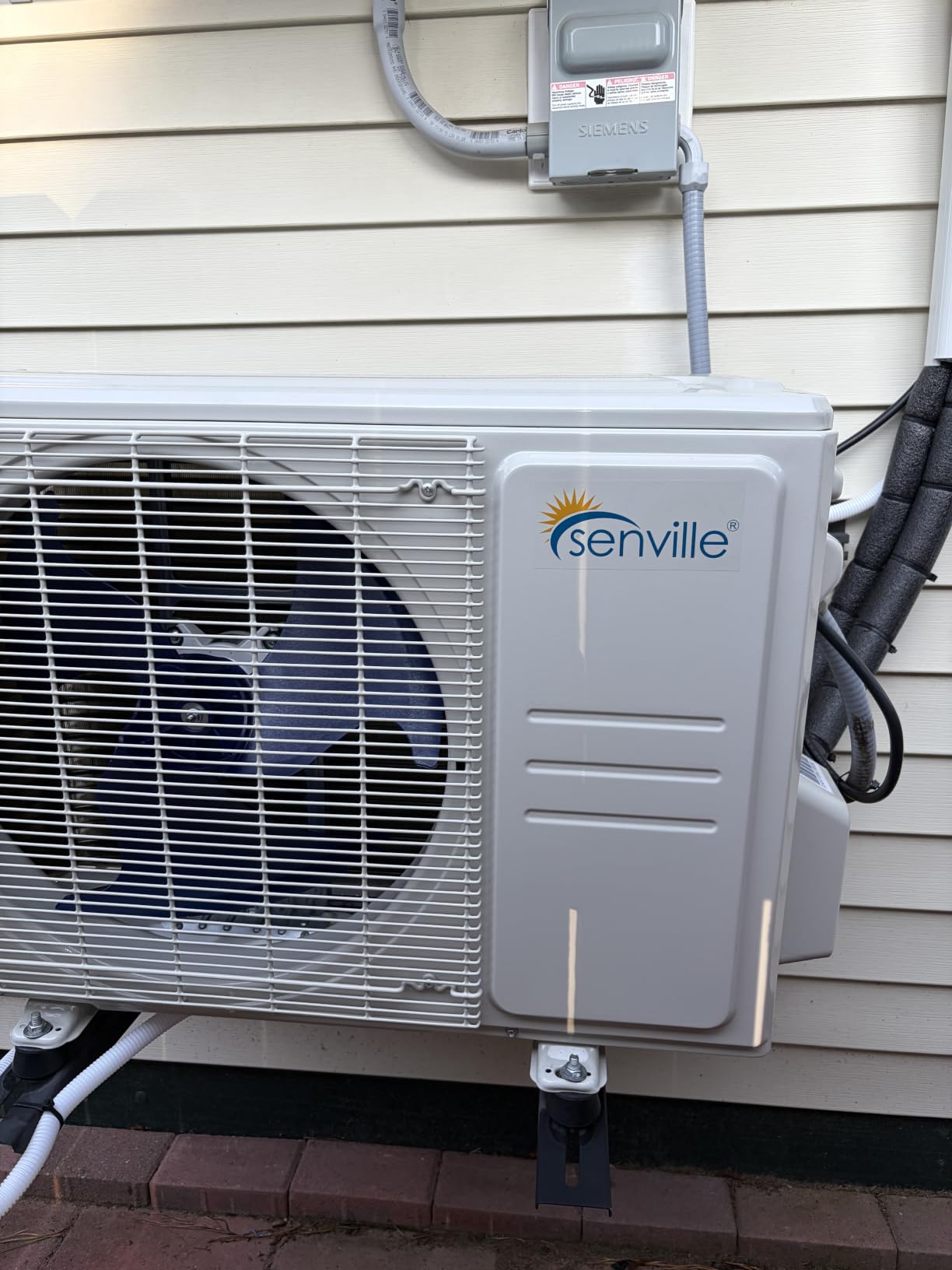
The 28 dB indoor head is the number that matters if the room is a bedroom or a home office. That is quieter than a refrigerator running in the next room, and it is well below the 50 to 60 dB range that general wall-unit guidance suggests.
Its weakness is warranty math. A 2-year parts and 5-year compressor warranty is respectable, but several cheaper-looking competitors in this roundup actually carry longer parts coverage, and the Senville is not BEE star compliant, which may matter if your utility offers rebates for certified equipment.
Who This Wall-Mounted AC Suits
A finished basement, a first-floor family room addition, or a main-floor office between roughly 500 and 700 square feet with a standard ceiling and one accessible exterior wall. If you want one system that handles August and January without a second heat source, the inverter heat pump side of this unit is the deciding factor.
It is also the safest pick for buyers who want a proven failure record rather than a spec sheet. A large body of owners reports repeat purchases across rooms, which tells you the parts supply and support question has been answered over time.
Where It Falls Short
If your addition is 900 square feet or larger, this head is undersized and you should be looking at the 18,000 to 24,000 BTU class instead. Oversizing a mini split is the single most common and most expensive sizing mistake in basement work.
Budget owners should also note that professional hookup is required, and labour is where most of the money in an addition install actually goes. The unit being inexpensive changes very little about the total.
2. SereneLife 24000 BTU – Best for a Large Addition Over 1,000 Sq. Ft.
SereneLife 24,000 BTU Mini Split AC & Heating System, 230V Indoor & Outdoor Wall-Mounted Units with WiFi, Installation Kit Included for Home, Office & Bedroom, Up to 1400 Sq. Ft. Coverage
24000 BTU 2 ton
Up to 1400 sq ft
SEER 21
230V
58 dB
Pros
- Largest coverage claim in the roundup at 1400 sq ft
- Complete install kit with copper line and power cord
- WiFi remote plus app and auto-restart
- Multiple modes with programmable timer
Cons
- Only a 1-year warranty
- Non-inverter compressor runs on and off
- 58 dB is the loudest indoor head here
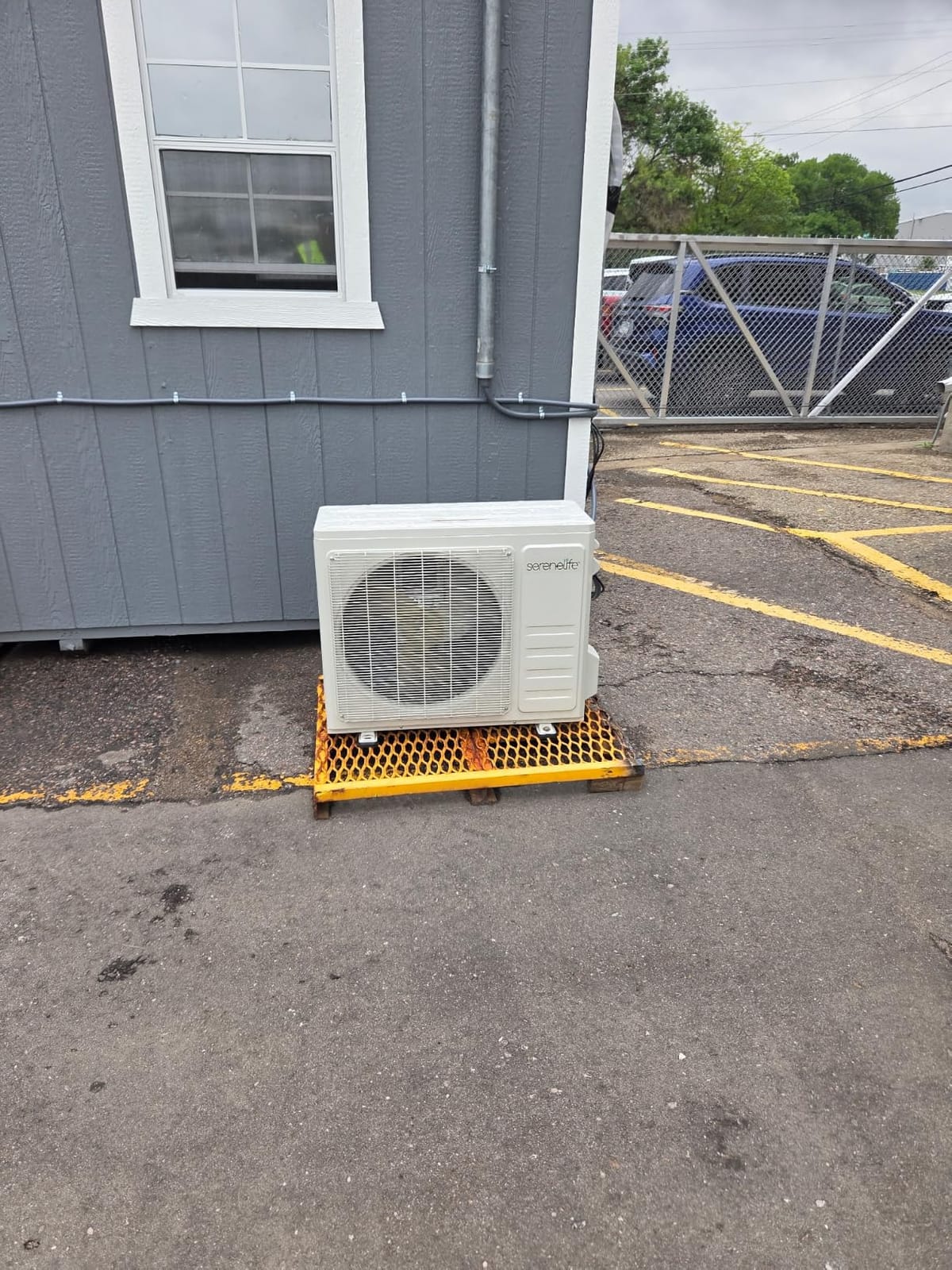
Most additions are not this big, but a great-room-over-the-garage project or a full lower level can be, and that is where this 2-ton system fits. The manufacturer lists coverage up to 1400 square feet, which is the highest claim in the group.
The install kit is unusually complete for a retail system. You get roughly five meters of copper line, a power cord, a drain hose, and the remote, so the parts list you hand to a contractor is short.
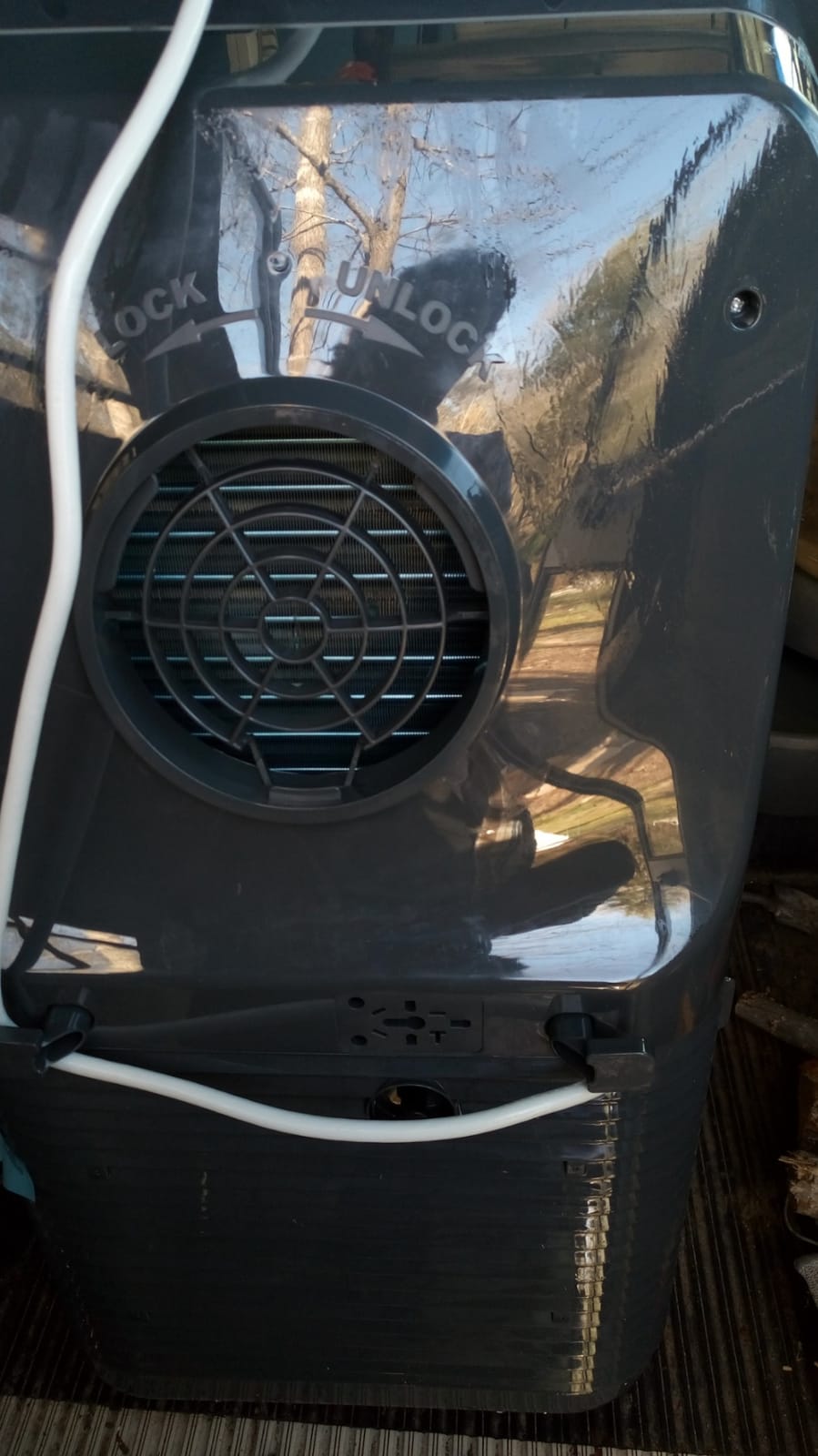
What gives us pause is the efficiency architecture. This is a fixed-speed scroll compressor with no inverter, so it cycles on and off rather than modulating. In a large room with long run times, that shows up as uneven comfort and a noisier start-stop, and it is why the 58 dB figure matters more here than on the smaller units.
The 1-year warranty is the shortest we found, and it is the detail most buyers overlook. If the head fails in month 14, you are arguing with a distributor, not a manufacturer with a long parts commitment.
Who This Wall-Mounted AC Suits
Large open additions above a garage, sunrooms, shops, and lower levels that will be conditioned all day every day. If your room genuinely exceeds 1,000 square feet, going smaller to save on equipment is the wrong trade.
It also suits buyers who want app control without hunting for it. Built-in WiFi, a programmable timer, and auto-restart after a power interruption are all present, and that combination filters out a lot of otherwise capable competitors.
Where It Falls Short
A bedroom, nursery, or home office is a poor match. At 58 dB this is the loudest indoor head in the roundup, and fixed-speed operation means it runs loud at low settings too.
Anyone planning to keep this system for a decade should weigh the 1-year warranty carefully. It is the shortest coverage of any product here, and it is the opposite direction from the trend in the rest of this list.
3. COSTWAY 12000 BTU – Best Value Mini Split With a Long Parts Warranty
COSTWAY 12000BTU Mini Split Air Conditioner& Heater
12000 BTU 1 ton
23 dB
115V plug-in
5-year parts
8-year compressor
Pros
- Quietest indoor head in the roundup at 23 dB
- 115V power removes the need for a new 230V circuit
- 8-year compressor and 5-year parts warranty
- Self-cleaning cycle at 134.6F plus auto-defrost
Cons
- Brand has a smaller service network than major HVAC names
- Licensed HVAC installer required
- Coverage figure is a manufacturer estimate
The COSTWAY 12000 BTU is the quietest indoor head in this entire roundup, at 23 dB, and it is also one of the few that runs on 115V plug-in power. For a new addition where an electrician has not yet run a 230V circuit, that single detail can save more than the equipment ever cost.
Five modes with four fan speeds, plus sleep, ECO, iFEEL, and turbo functions, cover the feature set most people assume only premium brands offer. The washable filter and high-temperature self-cleaning cycle reduce the maintenance burden in a room nobody wants to service often.
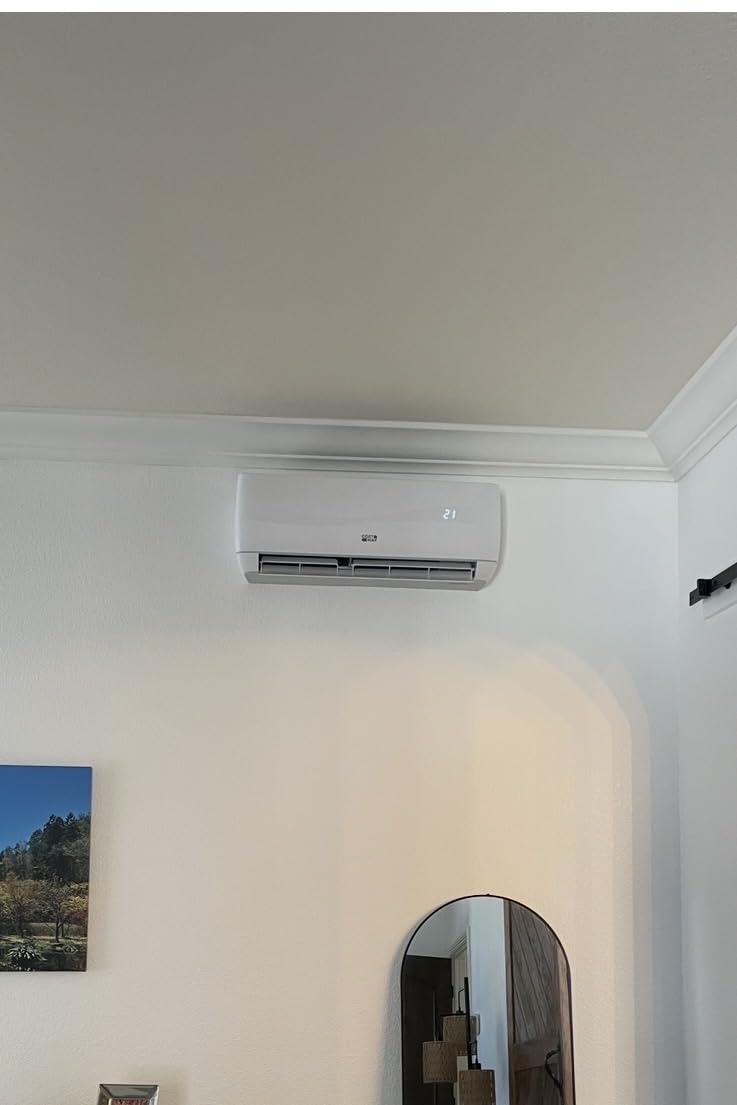
On paper this is also the best-protected product we reviewed: 5 years on parts and 8 years on the compressor. That is longer than anything else in the group, and warranty length is the one spec that keeps its value in year five.
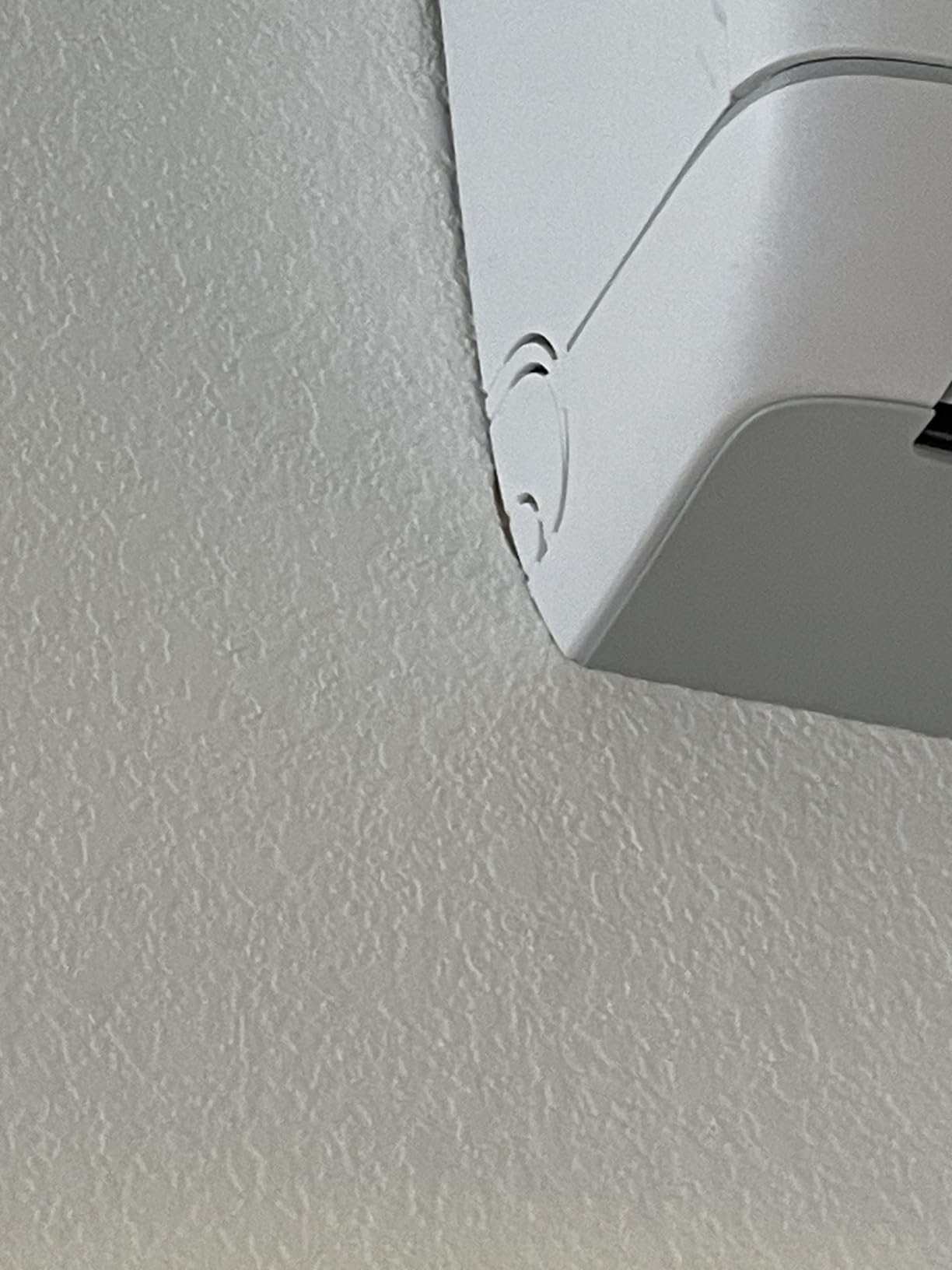
The trade-off is support reach. Buyers consistently like the machine, and the recurring theme in reviews is that installation must be handled by a licensed professional. But a brand with a smaller service network means that if something fails, you may be shipping a part rather than calling a local tech.
Who This Wall-Mounted AC Suits
A bedroom addition, nursery, or quiet home office where fan noise is the top concern, in a building where 115V power is easier than a 230V run. The 23 dB figure is low enough that a sleeping room genuinely works here.
It also suits buyers optimising total ownership rather than sticker value. Long parts coverage and a self-cleaning cycle both reduce the expected cost of the system over a decade in an addition.
Where It Falls Short
Roughly 750 square feet is the coverage estimate, which leaves large additions short. If you need 24,000 BTU of capacity, this class simply is not the answer regardless of how quiet it is.
If you live far from a major metro area, check local service coverage before committing. A long compressor warranty is only useful if someone can get to the unit.
4. ROVSUN 9000 BTU – Best for Small Additions and Bedrooms
ROVSUN 9000 BTU Wifi Enabled Mini Split Air Conditioner & Heater with Inverter, 20 SEER2 Energy Saving 115V Ductless Split AC Unit with Pre-Charged Condenser, Heat Pump & Installation Kit
9000 BTU 3/4 ton
450 sq ft
20 SEER2 inverter
28 dB
115V
Pros
- Right size for a small bedroom or office addition
- 20 SEER2 inverter with strong efficiency claims
- App plus remote plus Alexa and Google Assistant
- Heating down to 61F for shoulder seasons
Cons
- Only a 1-year warranty
- Arrives as two separate boxes that must both arrive first
- Startup leak-test instructions are not clear
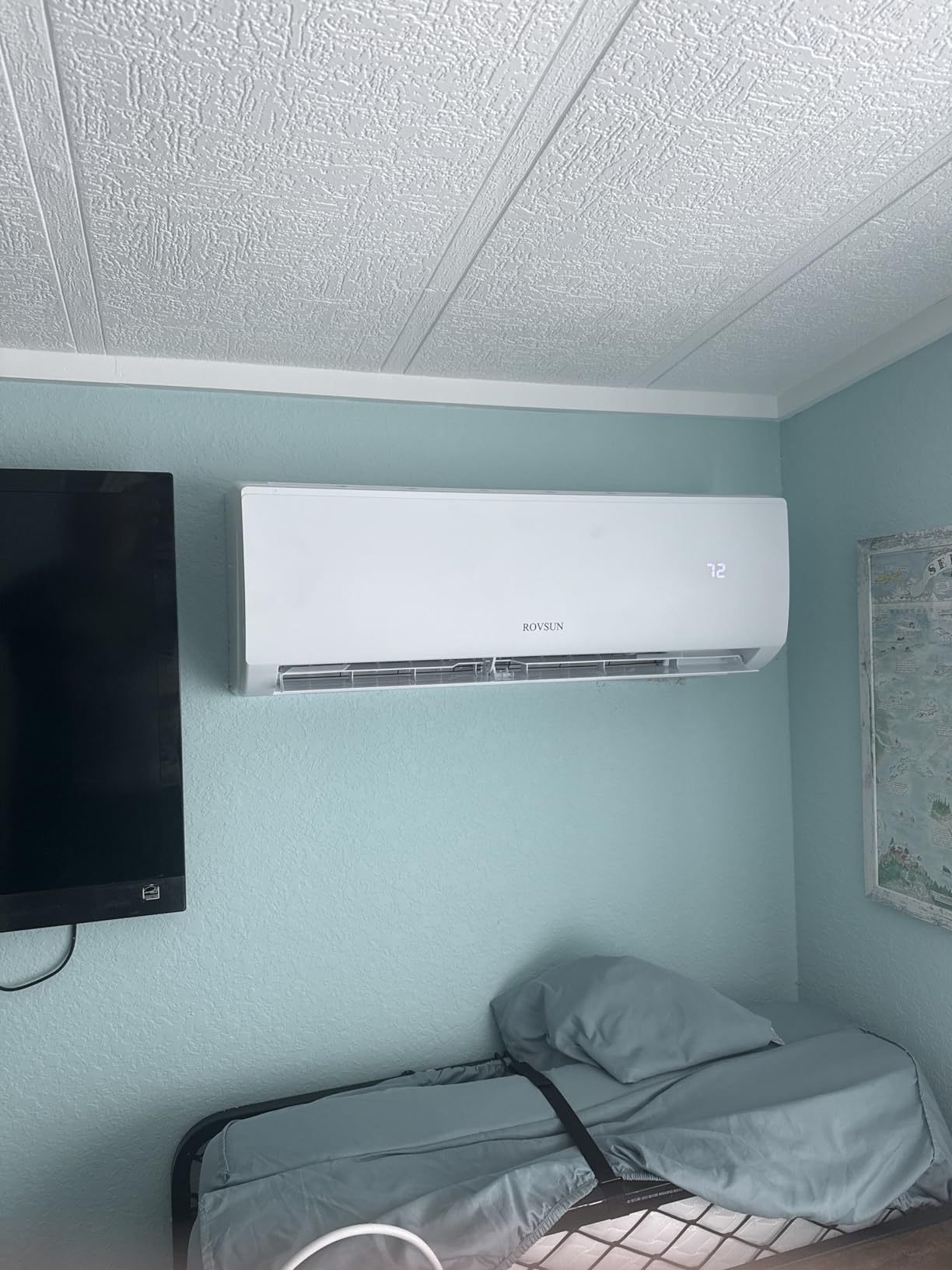
A 0.75-ton system is easy to overlook because it does not sound impressive, but for a 300 to 450 square addition it is the correct capacity rather than a compromise. Buying 12,000 BTU for a small room is how people end up with short-cycling and poor humidity control.
The efficiency figure is the surprise here. At 20 SEER2 with a true inverter compressor and R-32 refrigerant, this small head is more efficient than several of the larger systems in this roundup, and it runs at 28 dB in mute mode.
Control options are genuinely good for this tier: app, remote, and voice assistant support, with a 16.4 foot copper line set and signal cord in the box. Several reviewers report buying more than one, which is a decent sign for a compact unit.
The drawbacks are logistical. It arrives as two boxes, so a partial delivery stalls the install, and the startup vacuum and leak-test procedure is not well documented, which is exactly the step a licensed tech should be doing anyway.
Who This Wall-Mounted AC Suits
A small bedroom addition, a home office nook, a sunroom corner, or a lower-level room in the 300 to 450 square foot range. A 1-year warranty makes this a renter or short-horizon purchase more than an estate purchase.
It also suits anyone who wants smart control in a modest budget. Voice assistant and app support at this capacity level is not the norm in the category.
Where It Falls Short
The heating side is modest. Operation to 61F means it will not carry a cold-climate addition on its own, and you will still need supplemental heat in genuine winter.
Owners have also raised humidity and moisture complaints after installation, and we would treat that as a signal to have your condensate line and drain slope verified during commissioning rather than after.
5. Mountman 9000 BTU – Top Rated 115V Head With a 26 dB Sleep Mode
Mountman 9000 BTU Mini Split AC/Heating System,19 SEER2 110/120V Energy Efficient Ductless Inverter System,Cools Up to 450 Sq.Ft with Pre-Charged Condenser,Heat Pump & Installation Kits
9000 BTU
26 dB sleep mode
19 SEER2
110/120V
450 sq ft
Pros
- Strongest rating score in the roundup at 4.5 across 352 reviews
- 26 dB sleep mode is the second quietest figure here
- 110/120V plug-in power simplifies wiring in additions
- Self-cleaning cycle and auto-defrost reduce upkeep
Cons
- Warranty terms are not spelled out in the listing
- Cooling capacity is described inconsistently
- Long-term reliability record is still short
Among nine mini splits and one sleeve unit, the Mountman posts the highest average rating in the group. That matters more than it sounds, because in a category where ratings cluster between 4.0 and 4.4, a 4.5 with a few hundred reviews is a genuinely better signal than a 4.4 with two thousand.
It is a 9000 BTU system at 19 SEER2 with an inverter compressor, rated for 110 or 120V, and the sleep mode sits at 26 dB. Four operating modes, four fan speeds, a 24-hour timer, ECO, and turbo round out a complete feature set.
Two details gave us pause during the review. The warranty is listed only as limited, with no term spelled out, and the coverage figure is inconsistent between the spec table at 450 square feet and marketing copy claiming up to 750. Ask for the written warranty terms in writing before you commit.
The rating is also backed by fewer reviews than most rivals here, and the listing is newer, so there is less long-term data. We would watch this one for a year rather than treat the current score as settled.
Who This Wall-Mounted AC Suits
A bedroom, nursery, or study addition in the 350 to 450 square foot range where quiet operation is the deciding factor and you would rather use an existing 120V outlet than have an electrician run a new circuit.
It also suits buyers who weight current owner satisfaction over warranty paperwork, which is a reasonable stance if you plan to sell or move within a few years.
Where It Falls Short
Anyone hoping to size to written marketing figures should treat the 450 square foot number as the real capacity and disregard the larger claim, because capacity mismatch is the expensive mistake in this category.
Unclear warranty terms and a short service history mean we would not pair this with a basement addition where reliability over a decade is the priority.
6. DELLA Econo Series 23000 BTU – Best for Big Sun-Exposed Additions
DELLA Econo Series 23000 BTU Mini Split Air Conditioner 17 SEER2, 230V Cools up to 1500 Sq. Ft, Works with Alexa and Wifi, Heater Ductless Inverter System with Heat Pump,16.4ft Installation Kit
22000 BTU listed cooling
Up to 1500 sq ft
17 SEER2
230V
41 dB
Pros
- Largest capacity claim in the roundup at up to 1500 sq ft
- Heat pump operation down to 5F for year-round rooms
- Alexa and WiFi plus remote-sensor I Feel function
- Owners in sun-exposed rooms report replacing window units
Cons
- Lowest SEER2 in the roundup at 17
- Requires a 230V 25A circuit
- Installation paperwork omits wire gauge guidance
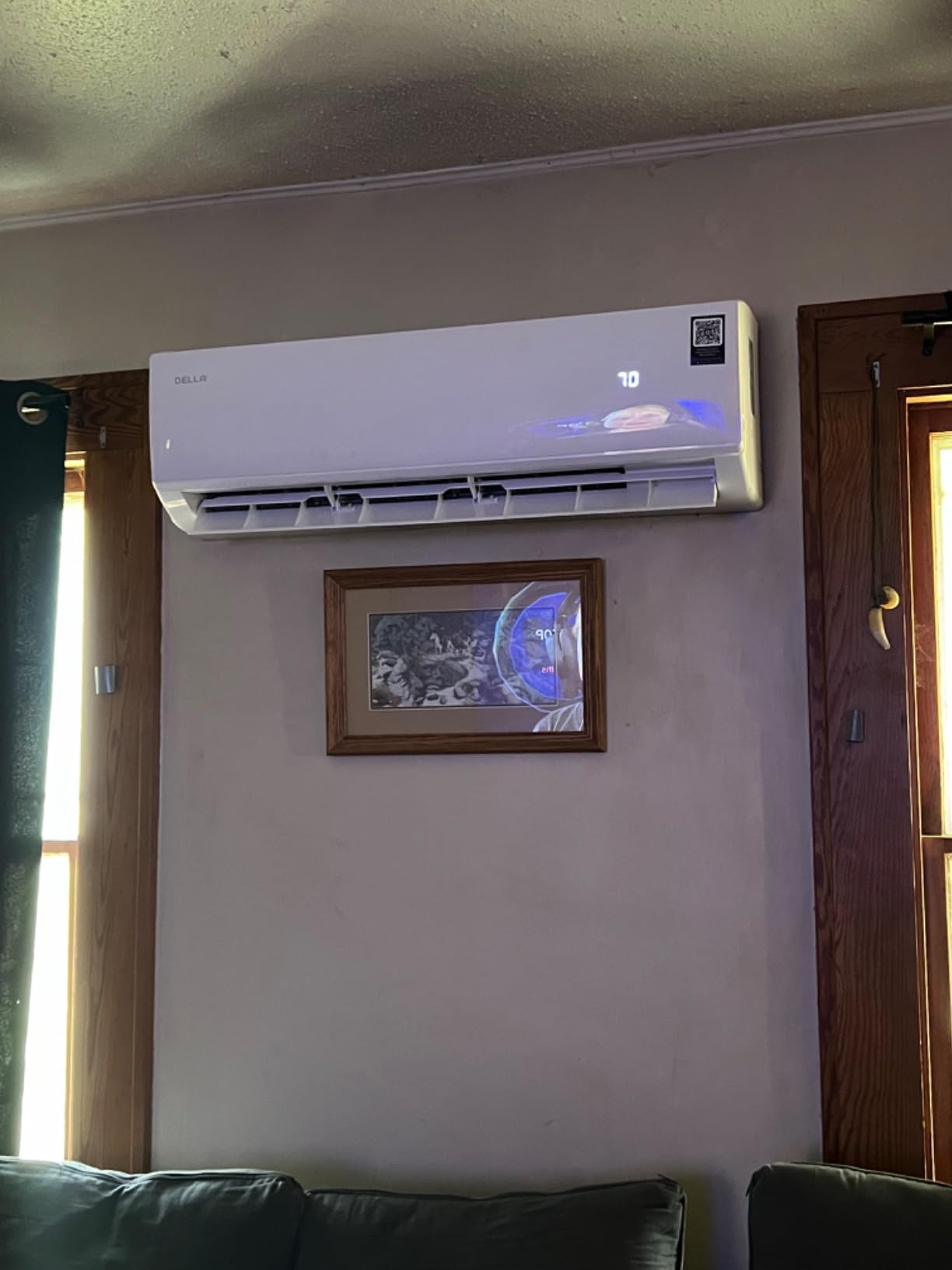
Additions with west-facing glass and a south or west wall run hotter than any other room in the house, and this 2-ton class is where you need to be for that. The listing gives 22,000 BTU of cooling in the spec table and markets the series as 23,000 BTU, rated for up to 1,500 square feet.
The heat pump runs down to 5F, which makes it one of the few units here that can carry a genuinely year-round addition. Owners in sun-exposed bungalow conversions report replacing window units and seeing lower power bills afterwards.
Efficiency is the trade. At 17 SEER2 this is the lowest seasonal rating in the roundup, and in a room that runs hard all summer that gap shows up as a higher operating cost than an 18.7 or 20-rated alternative.
It also needs a 230V circuit at 25 amps, so an addition without existing electrical capacity is now a project with a panel discussion in it. The installation documentation omits a mounting template and wire gauge guidance, so plan on a contractor who knows what they are doing.
Who This Wall-Mounted AC Suits
A great room over the garage, a sunroom, or a finished lower level over 1,000 square feet with heavy glass and direct afternoon sun. If your addition is the hottest room in the house, capacity beats efficiency here.
It also suits cold-climate additions needing real heating, since 5F operation means no separate heat source for most of the year.
Where It Falls Short
Buyers focused on running cost should compare against an 18.7 or 20-rated unit of similar capacity first. Over a decade of heavy summer use, the efficiency gap is real money.
If your addition is smaller than 900 square feet, this is oversized. A big unit in a small room short-cycles, fails to dehumidify, and wastes power doing it.
7. Cooper and Hunter 24000 BTU – Best for Shops, Garages and Bonus Rooms
Cooper & Hunter 24,000 BTU 230V Wall Mount Mini Split AC, 18.7 SEER2
24000 BTU 2 ton
18.7 SEER2
7-year compressor
35 dB
230V
Pros
- Longest compressor warranty in the group at 7 years with 5-year parts
- Complete kit includes pre-flared line set and drain extension
- 18.7 SEER2 inverter with heating down to 5F
- Marketed specifically for additions and bonus spaces
Cons
- Costs more than most units in this roundup
- Delivered by freight to an accessible point outside the home
- Wiring directions are incomplete on compressor to head mapping
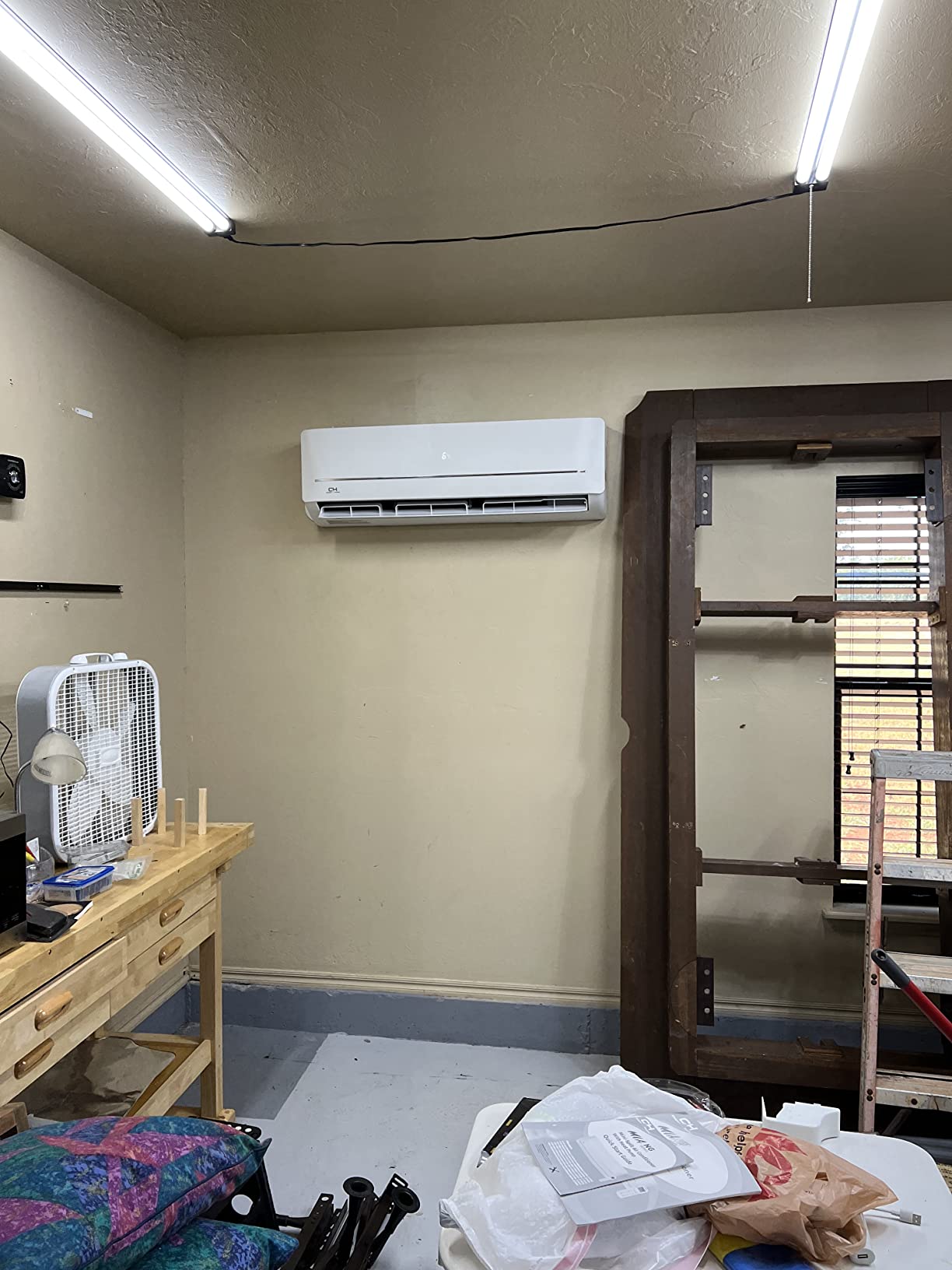
This is the system we would put in a shop, a detached garage workshop, or a bonus room that will be occupied every day, because the warranty is the best in the group. Seven years on the compressor and five on parts is the coverage that protects a high-run-time application.
Efficiency is also strong at 18.7 SEER2, with inverter heating down to 5F. The listed sound level is 35 dB, which is mid-pack here and fine for a working space.
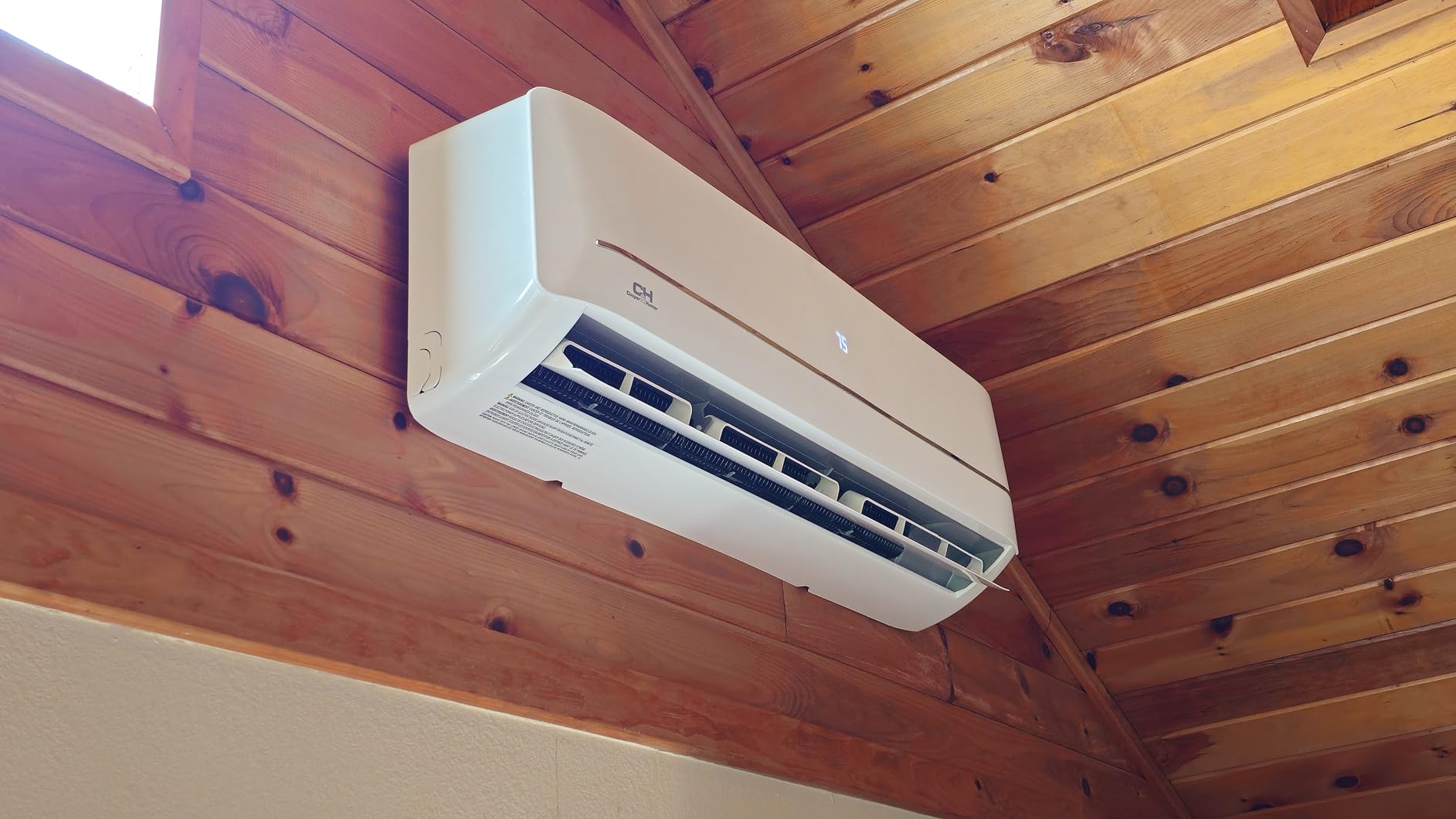
The install kit is unusually complete: a 16 foot pre-flared insulated line set, 16 foot of communication wire, and a 16 foot drain extension. That matters, because those are exactly the line items that inflate a quote when they are not already on hand.
Two practical notes. It arrives by freight to an accessible point outside the home, so you need a clear path and someone to receive it, and one owner has reported an indoor control board failure inside a year with a slow parts response. The factory support itself is rated highly by the people who have used it.
Who This Wall-Mounted AC Suits
A garage conversion, workshop, home office, or bonus room above a garage where the system will run long hours and you intend to hold the property for a decade. The warranty and support package reward that intent.
It also suits buyers who want a single itemised install. Because the line set, communication wire, and drain extension are included, the contractor has far less room to add line items later.
Where It Falls Short
It sits in the top price tier of this roundup, and in an addition with limited exterior wall access the freight delivery and rigging can add complications worth pricing in advance.
The listing states coverage of 600 square feet, which does not match a 24,000 BTU capacity. Treat the BTU figure as the real one and have your contractor size the room properly.
8. Daikin 18000 BTU – Best Long-Term Warranty for a Year-Round Addition
Daikin 18,000 BTU 18 SEER2 Entra R32 Series Heat Pump Mini Split A/C
18000 BTU 1.5 ton
18 SEER2 9 HSPF2
10-year warranty
1000 sq ft
37 dB
Pros
- Only 10-year manufacturer warranty in the roundup
- 18 SEER2 with 9 HSPF2 and 10.5 EER2 efficiency
- Cools from 50F to 115F and heats down to 5F
- Air-purifying filter plus Blue Fin corrosion protection
Cons
- Highest cost in the roundup
- Smallest review base at 55 ratings
- Warranty registration friction reported on marketplace purchases
The Daikin Entra is the only unit here with a 10-year manufacturer warranty, and for a year-round addition that is worth paying for. A 18000 BTU one-and-a-half ton system covers up to 1,000 square feet, which is the right class for a large family room addition.
Efficiency is specified properly for once. It lists 18 SEER2, 9 HSPF2, 10.5 EER2, and 3.30 COP, with an operating range of 50F to 115F for cooling and 5F to 65F for heating.
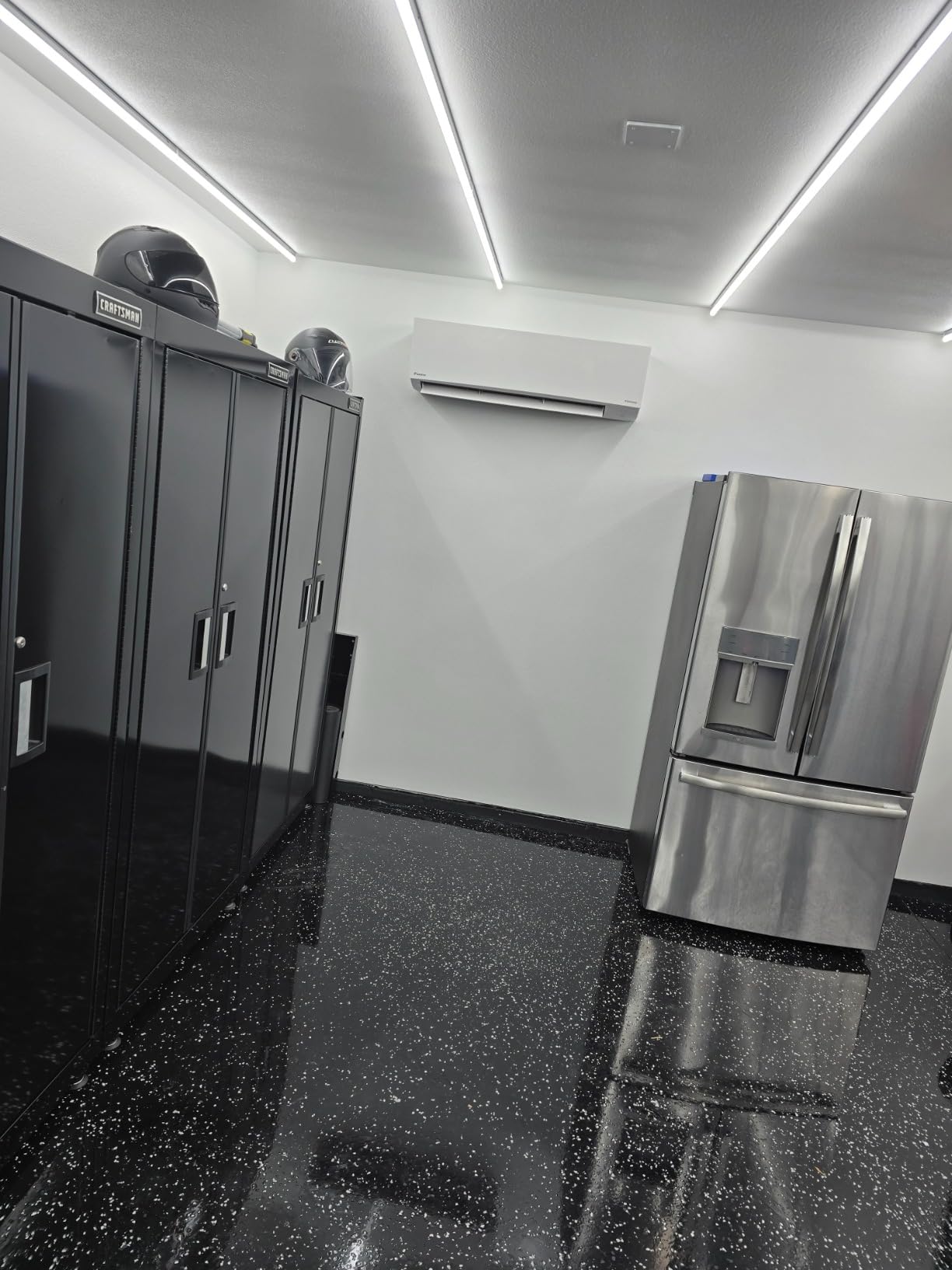
The build details are the differentiators: a titanium apatite photocatalytic air-purifying filter, Blue Fin corrosion protection on the outdoor coil, and cold-draft prevention. It is explicitly marketed for renovations, new construction, sunrooms, basements, attics, and garages.
It also comes with a genuinely complete package: indoor fan coil, pre-charged inverter condenser, remote, a 15 foot line set, and a Maxwell wall bracket. At 37 dB it is mid-pack, quieter than most and louder than the dedicated quiet units.
Who This Wall-Mounted AC Suits
A main-floor addition of 800 to 1,000 square feet that you will use year-round and plan to keep for a long time. If the system has to heat as well as cool, the 10-year warranty is the deciding factor.
It also suits households with coastal, humid, or coastal-salt exposure where corrosion protection on the outdoor coil is worth more than a lower purchase cost.
Where It Falls Short
This is the most expensive unit in the roundup by a wide margin, and the 55-review base is the thinnest here. A 4.6 rating on 55 reviews is encouraging but not the same evidence as thousands of owners.
If you buy through a marketplace, register the warranty directly with the manufacturer as soon as you install. Owners have reported friction registering coverage on marketplace purchases, and that is an avoidable problem.
9. ROVSUN 8000 BTU Through the Wall – Best for Sleeve Replacement Only
ROVSUN Smart 8000 BTU Through the Wall Air Conditioner with Heat, Wall AC Unit & Heater Combo with Remote, APP & Voice Control & Timer Function, Compatible with Alexa/Google Assistant, 115V/60Hz
8000 BTU cooling
4200 BTU heating
350 sq ft
Fits 25.5 inch sleeve
115V
Pros
- The only through-the-wall unit in the roundup
- Heating and cooling in one 115V unit
- App and voice control plus remote and LED panel
- Trim kit and back grille included in the box
Cons
- Wall sleeve is not included and must be bought separately
- Loudest in the roundup at 61 dB
- Only a 1-year warranty and a 4200 BTU heating capacity
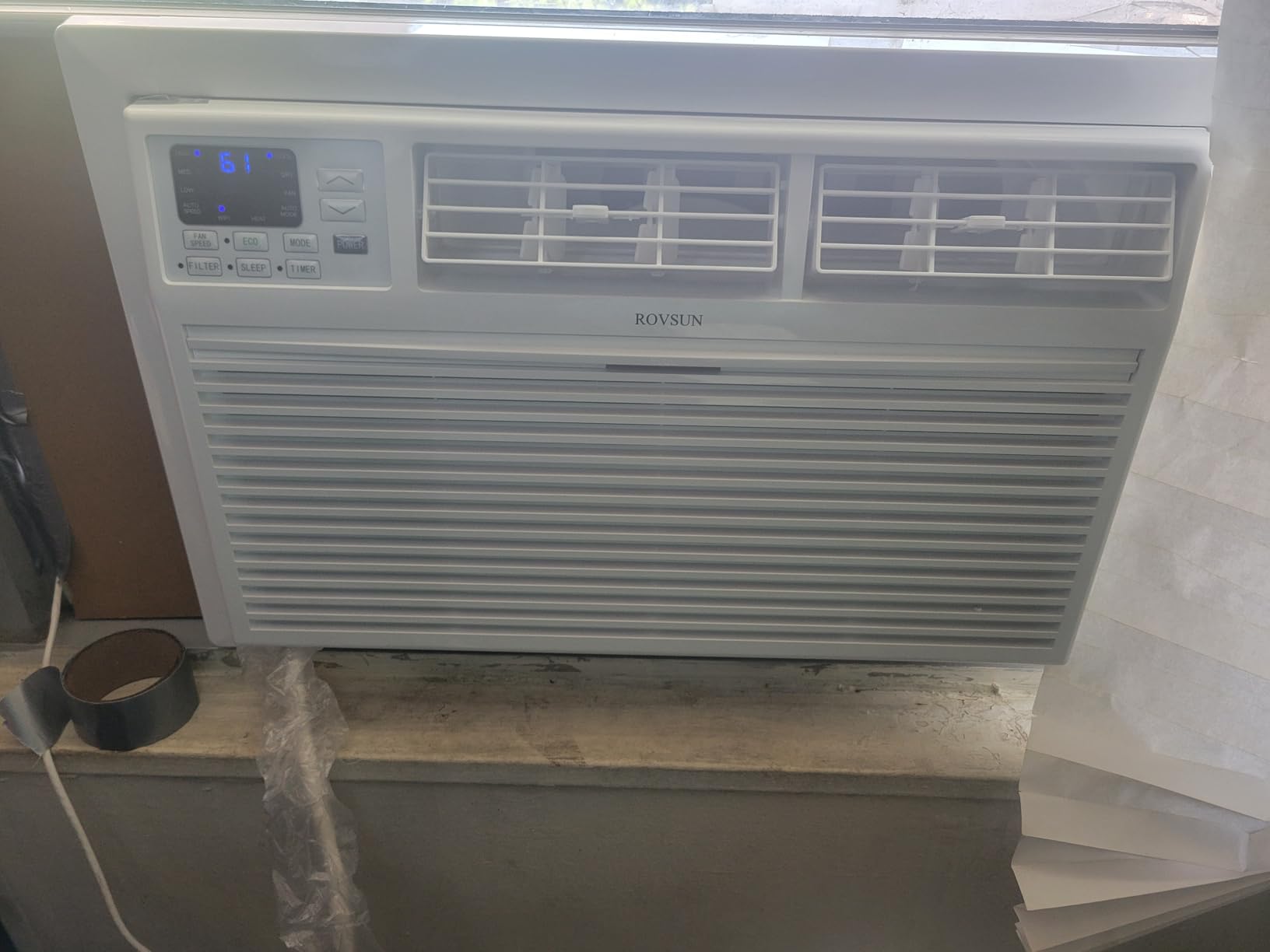
This unit matters for one specific job: replacing a failed through-the-wall air conditioner in a building that already has a sleeve. It fits the standard 25.5 inch sleeve, runs on 115V, and includes a trim kit and back grille.
For a new addition, though, it is the wrong answer, and we include it here to make that explicit rather than let you assume otherwise. A sleeve unit needs a pre-cut opening in an exterior wall with a steel containment sleeve already framed in.
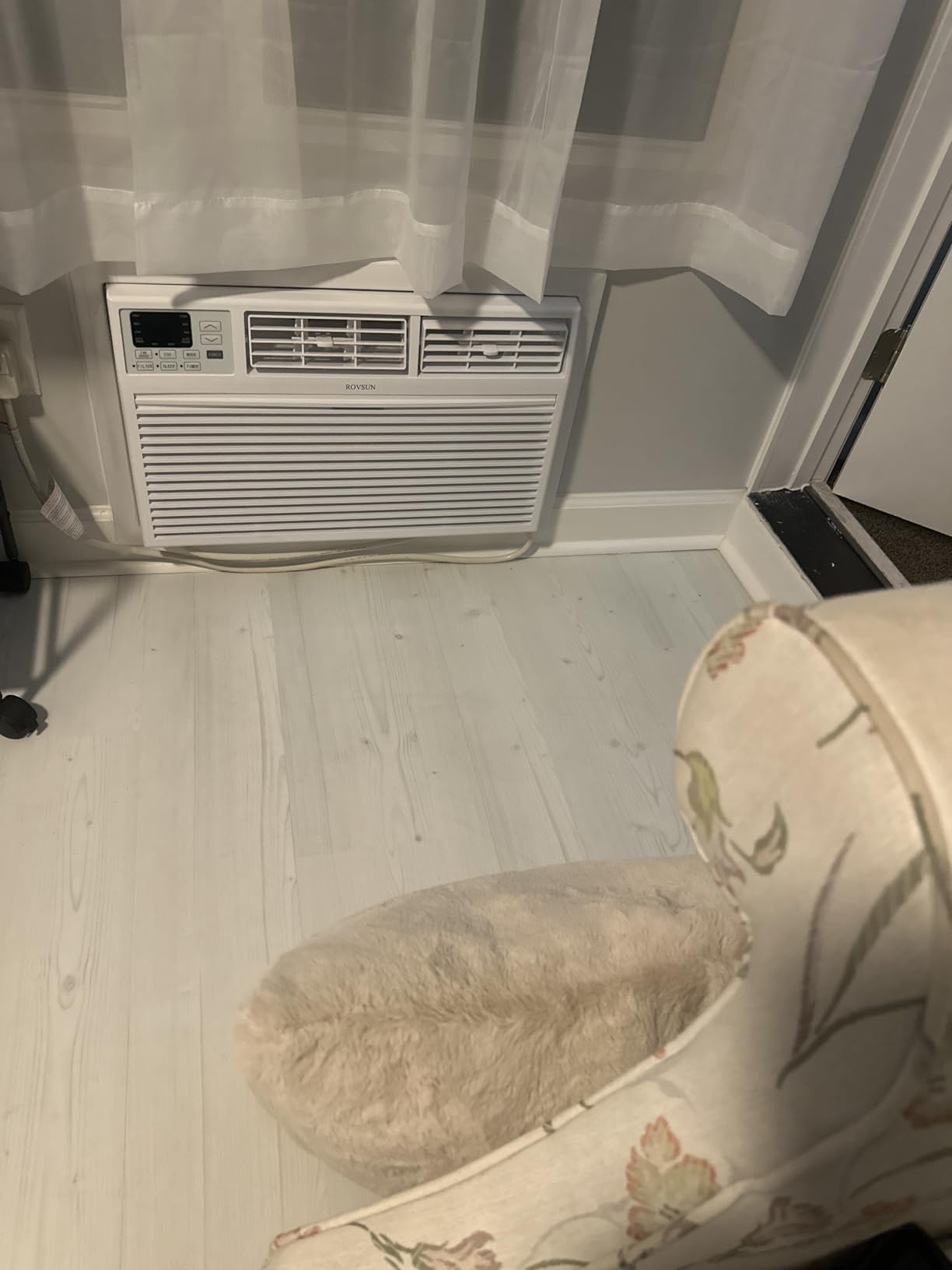
The category itself is genuinely thin, and long-running discussion on the appliance forum about how few through-the-wall options exist versus window units reflects that. Enthusiasts there consistently point to the Friedrich WallMaster as the enthusiast pick for sleeve work, which is a useful signal if you are replacing rather than building.
If you want a fuller look at that category, we covered through-the-wall units for apartments in a separate guide. For additions, the short version is that ductless wins every comparison.
On the machine itself: cooling is 8000 BTU with heating at 4200 BTU, five modes, three fan speeds, a 24-hour timer, and app plus voice control. The 61 dB rating is the loudest of anything we reviewed, and it only carries a 1-year warranty.
Who This Wall-Mounted AC Suits
An older condo, apartment, or pre-war building with an existing sleeve in an exterior wall, where you are replacing a failed unit rather than conditioning a new space. For those readers our through-the-wall air conditioner guide for apartments covers the category in more depth.
It also suits a small room around 350 square feet that only needs cooling and a little supplemental heat, with no willingness to run new line set and refrigerant work.
Where It Falls Short
Any new addition. Without an existing sleeve you are cutting an exterior wall and sourcing a sleeve separately, which costs more and delivers a louder, less efficient result than the same money spent ductless.
The heating capacity of 4200 BTU will not carry a cold room, and the 1-year warranty is the second shortest here. At 61 dB, plan on hearing it.
10. Albott 12000 BTU – Best 115V Option With a Wide Operating Range
Albott 12,000 BTU Mini Split Air Conditioner and Heater SEER2 18, 115V
12000 BTU 1 ton
18 SEER2
115V plug-in
750 sq ft
29 dB
Pros
- 115V plug-in power needs no 230V circuit or subpanel
- Longest warranty among 115V units at 5-year compressor 7-year parts
- Operates from 5F to 122F for cold heating and hot cooling
- Self-cleaning function with removable filters and air blades
Cons
- Lowest SEER2 among the mini splits here at 18
- Heaviest listed weight for a 12000 BTU system at 151 lb
- No line set dimensions or install kit details in the listing
The Albott is the option for an addition where running a 230V circuit is the main obstacle. It uses 115V plug-in power, which removes the panel work, the subpanel, and a meaningful slice of the labour from the project.
It also has the widest operating range we found, from 5F to 122F, and a warranty of 5 years on the compressor and 7 on parts. That is the best warranty coverage among the 115V systems in this roundup.
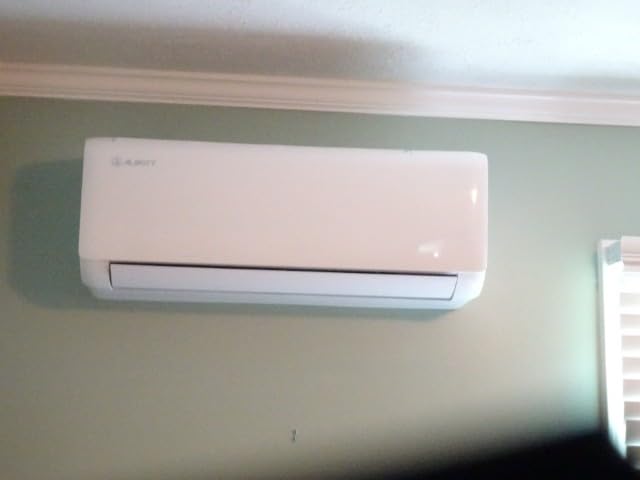
Sound sits below 29 dB, which is fine for a bedroom, and the self-cleaning function with removable filters and air blades keeps upkeep simple. Coverage is listed at up to 750 square feet.
The rating is the weakest of the mini splits here at 4.1, with 14 percent one-star reviews, and those complaints cluster around installation friction and post-purchase support rather than the machine itself. Efficiency at 18 SEER2 is also the lowest among the ductless units in this list.
Who This Wall-Mounted AC Suits
A first-floor addition, sunroom, or lower-level room between 500 and 750 square feet in a home with 115V capacity but no easy route for a new high-voltage circuit. The wide 5F to 122F range also makes it a genuine heat pump rather than a cooling unit with a backup.
It suits buyers who want longer parts coverage than the one-year options in this roundup without paying for 230V service.
Where It Falls Short
The listing gives no line set dimensions or install kit detail, so you need your contractor to source those. Combined with the highest listed weight in the group at 151 pounds, plan the mounting and lifting before the delivery date rather than on it.
If your priority is running cost over a decade, an 18 SEER2 rating is the lowest here. Buyers focused on the electric bill should look at a 20-rated unit of similar size.
Ductless Mini Split or Through-the-Wall Unit for a New Addition?
For a new addition, the ductless mini split is the answer. A through-the-wall unit only makes sense when a sleeve already exists in an exterior wall, and a brand-new addition has no sleeve because nobody framed one in.
The differences that matter in practice are bigger than the marketing suggests. A sleeve unit exhausts directly outdoors through its own opening, needs no refrigerant line set, and can be cheaper in hardware. A ductless head moves air inside the room and pushes heat out through a sealed refrigerant circuit to a condenser you have to find a place for.
That outdoor condenser is the real decision. Additions with a shallow side yard, a shared parking lot above, or strict condo exterior rules may leave you nowhere sensible to put it, and that constraint should be resolved before you buy anything. If a system cannot be installed within the manufacturer’s line-set limit, you need a different model, not a longer gamble.
The other honest argument for sleeve units is that the category is thin, and buyers report being surprised by both the limited selection and the pricing. Our apartment through-the-wall guide covers the sleeve category for the buildings where it genuinely fits.
How to Size a Wall-Mounted AC for an Addition
Size to a Manual J load calculation performed on your actual addition, not to a rule of thumb. Load calculations account for ceiling height, window area and glazing, sun exposure, insulation quality, and how many people will be in the room.
The reason this matters so much is that the alternative fails badly. Homeowners on the HVAC advice forums report manufacturer calculators demanding 27,000 to 36,000 BTU for a below-grade room, when a proper Manual J calculation for a comparable 585 square foot space came out near 9,200 BTU per hour. That is a threefold oversize, and an oversize unit short-cycles, fails to dehumidify, and runs expensive.
As a rough starting point only, most additions between 400 and 700 square feet with standard ceilings land in the 9,000 to 12,000 BTU band, and rooms from 800 to 1,000 square feet usually need 18,000 BTU. Additions above 1,000 square feet move into the 23,000 to 24,000 BTU class, and past that you should be discussing multi-split systems rather than one head.
Ask your contractor for the load calculation in writing. If the number comes back as a round figure pulled from a website form, keep looking.
Where the Installed Cost Actually Goes
The loudest complaint in homeowner forums about this category is not equipment cost, it is that a modest-looking unit turns into a much larger installed number. Forum threads document quotes landing several times higher than the equipment, and the difference is almost always the same list of line items.
Equipment – the indoor head, the outdoor condenser, and the wall bracket. This is the only part you pick off a shelf.
Line set – factory-pre-charged line set included with the unit covers a short run. Anything longer, or routed through walls, means fabricated line set plus the labour to braze and insulate it.
Electrical – a dedicated circuit, a breaker of the right size, and sometimes a panel or subpanel change. 230V systems pull more current than 115V plug-in models, so this line can grow with the model you choose.
Condensate routing – a line run to a drain or exterior exit, with the slope and trap that keeps water flowing. Below-grade additions often need the longest run of all.
Wall work and patching – cutting, chases, or a sleeve build-out, plus patching and painting afterwards.
Labour – the vacuum, leak test, refrigerant charge verification, commissioning, and the permit and inspection.
Nobody in these threads regrets buying a cheaper unit. Nearly all of them regret not demanding the itemised breakdown, because the line set and electrical lines were quietly doing most of the work in the total.
How to Get an Install Quote You Can Trust
Get three quotes, and this is the one piece of advice that repeats without exception across the forum threads and the editorial competitors. The spread between the lowest and highest quote for the same job is routinely enormous, and the difference is almost never the equipment.
Demand itemisation. Ask each contractor to break out equipment, line set, electrical, condensate, wall work, and labour as separate lines. A quote that will not itemise is telling you the number is a target rather than a cost.
Ask about electrical prep. If you are willing to run the circuit and install the pad and disconnect yourself before the crew arrives, some contractors will reduce labour. This is legitimate work to hand off, but confirm who is responsible for permits and inspection either way.
Confirm that wall cutting, chasing, and patching are inside the quote, and ask what happens to finishes if a wall has to be opened. Then confirm in writing that professional installation is what validates the warranty, since a number of these manufacturers tie coverage to licensed installation.
What to Confirm Before You Buy
Measure the line-set route from the intended indoor head position to the outdoor condenser location and check it against the manufacturer’s maximum. This is the most common reason a chosen unit gets swapped late, and it costs nothing to check now.
Confirm whether the room can take 115V or 230V power, and whether a circuit and breaker of the correct size already exist. If a 25A circuit has to come from a panel that cannot supply it, the electrical scope changes before the equipment order does.
Decide where the condensate goes. A finished basement addition needs a drain line with a defined slope and an accessible route, and the answer constrains the head position more often than people expect.
Register the warranty through the manufacturer directly once the unit is installed, rather than relying on a receipt or a marketplace account. One owner reported being unable to complete registration on a marketplace purchase with the longest warranty in this roundup.
Finally, decide the outdoor condenser location before you finalise the indoor head position. Clearance requirements, sight lines, and neighbour or association rules all constrain that spot, and moving the head afterwards is expensive.
Maintenance for a Mini Split in an Addition
Clean the filters monthly during cooling season. Most units here ship with a washable filter or removable air blades, and several include a self-cleaning cycle that runs a hot pass over the coil, but none of that replaces a filter that is not blocked.
Flush the condensate line at least twice a year, and more often in a below-grade addition. This is the single most common failure in the category, and it is also the cheapest to prevent.
Have the system serviced annually, with particular attention to the outdoor coil if your addition is in coastal or dusty surroundings. Keep the manufacturer’s recommended clearance around the condenser clear of shrubs and debris.
None of this is difficult, and all of it protects the one component you cannot cheaply replace in a confined addition space.
Frequently Asked Questions
What is the best wall-mounted air conditioner unit?
For a new room addition, the best choice is a ductless mini-split heat pump sized to a Manual J load calculation for that specific room. Single-zone inverter systems cover most additions between 400 and 1,000 square feet without any ductwork extension. Through-the-wall units are only appropriate when a wall sleeve already exists in an exterior wall.
What is the disadvantage of a wall-mounted air conditioner?
The main drawbacks are a small effective capacity ceiling compared with a full central system, the need for an outdoor condenser location, and installation labour that includes line set fabrication, a new electrical circuit, and condensate routing. Unlike a window unit, it needs professional installation to keep warranty coverage valid.
How much should I pay to have a mini split installed?
Equipment is only part of it, and experienced buyers on HVAC forums consistently report installed totals several times higher than the unit cost. The gap comes from line set fabrication, a dedicated electrical circuit, condensate routing, wall cutting and patching, and labour. Get three itemised quotes and compare the same line items across each.
Why is it so expensive to install a mini split?
Because the equipment is a small share of the job. A typical install includes fabricated line set beyond the factory length, a dedicated 230V circuit and possibly a panel change, a condensate drain run, wall work, plus vacuum, leak testing, commissioning and permits. Most of those items are invisible until a contractor itemises them in writing.
How much does it cost to install central air conditioning without existing ductwork?
Extending central ductwork into an addition means designing and installing supply and return runs, a new return plenum, and often an air handler or coil change, plus a large electrical scope. A single-zone ductless mini split conditions the same room without any ductwork, and most additions under 1,000 square feet are better served that way.
Our Verdict for 2026
For most additions in 2026, the Senville LETO 12000 BTU is the pick. It has the largest review base we found at 2,185 ratings, a 28 dB indoor head, inverter efficiency at SEER 20.8, and heating that runs to 5F, which means one system covers the whole year.
Choose the COSTWAY 12000 BTU instead if quiet operation is the priority at 23 dB, you want plug-in 115V power, and you care more about warranty length than local service reach. For a room over 1,000 square feet, look at the 23,000 to 24,000 BTU class, and for a decade-long year-round room, the Daikin warranty is the one worth paying up for.
Whatever you pick, size it with a Manual J calculation, get three itemised quotes, and sort out the outdoor condenser location before the equipment arrives. Those three steps decide whether the best wall mounted air conditioners for additions actually deliver a comfortable room at the end of the project.