
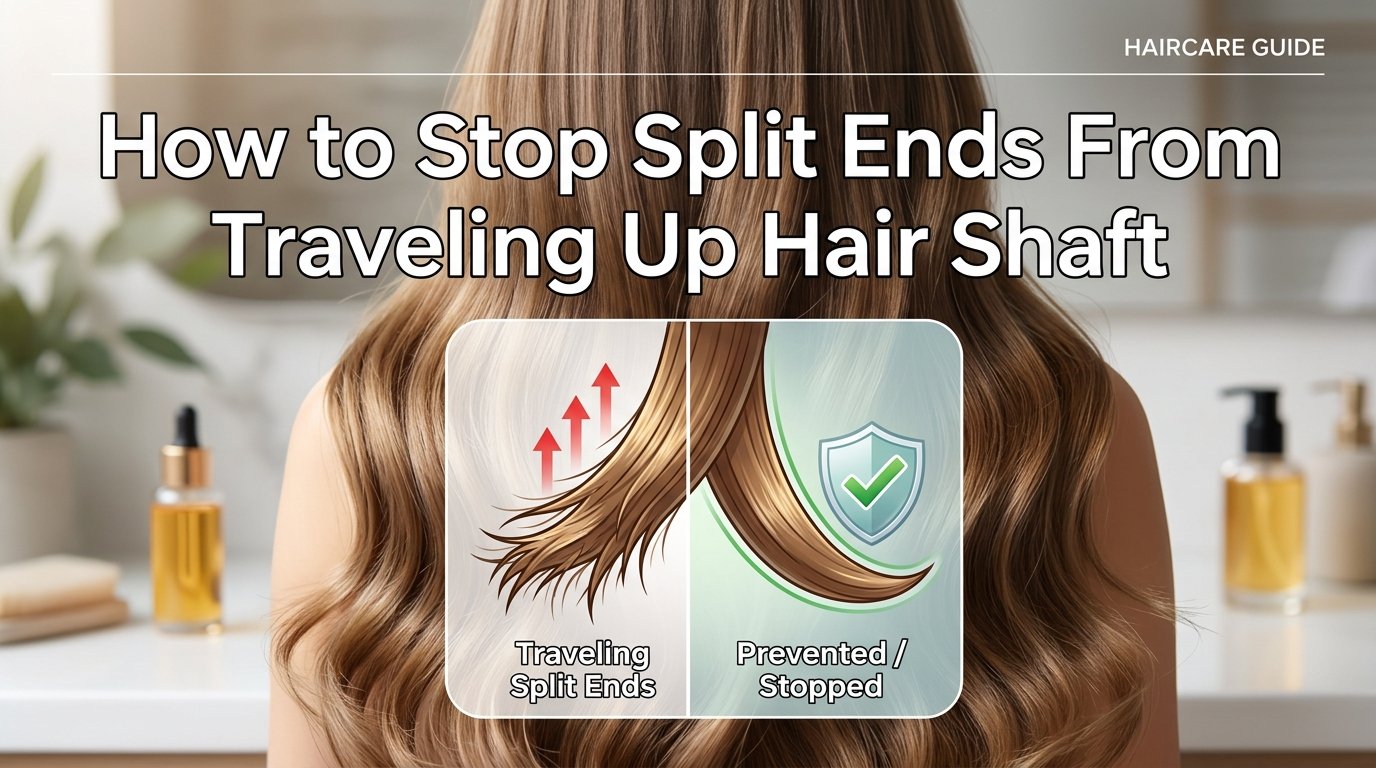
You brush your hair one morning and notice little white dots halfway up the strand. Then you see a Y-shaped split an inch from your scalp. If this sounds familiar, you are likely wondering how to stop split ends from traveling up the hair shaft before you lose the length you have worked hard to grow.
The short answer is that once a hair strand splits, the damage will keep climbing unless you cut above it. There is no way to glue a split end back together permanently. But there is a lot you can do to slow the travel, protect the rest of your hair, and prevent new splits from forming.
In this guide, I will walk you through exactly why split ends climb, what causes them, and the steps that actually work to keep damage from spreading. I have pulled insights from stylists, trichology forums, and dermatology resources to give you a clear plan you can start today.
Table of Contents
What Are Split Ends, Really?
Split ends, known medically as trichoptilosis, happen when the protective outer layer of your hair, called the cuticle, wears away. Once that protective shield is gone, the inner cortex of the hair fiber becomes exposed and begins to fray, crack, or split into two or more pieces.
Each hair strand is made of three layers. The outermost is the cuticle, which is made of overlapping scales that lay flat when healthy. Beneath that sits the cortex, which holds the moisture, pigment, and strength of the hair. At the center is the medulla, a soft core found in thicker strands.
When the cuticle is intact, your hair bends without breaking. When it is worn down by heat, chemicals, friction, or dehydration, the cortex dries out and the strand splits. The split almost always starts at the tip, since that is the oldest and most weathered part of the hair.
Why Split Ends Travel Up the Hair Shaft
Here is where the science matters and where most guides get vague. Split ends do not literally crawl upward like a vine. What actually happens is that the split creates a weak point, and everyday stress causes the fracture to extend further along the strand in the direction of the scalp.
Think of a rope that has started to unravel at one end. Every time you pull, stretch, or rub that rope, the fraying climbs higher. Hair works the same way. Each time you brush, wash, towel-dry, sleep on, or heat style a strand that has already split, the fracture line extends upward.
The cuticle near the split is also compromised, even if it has not fully split yet. That weakened zone is more likely to crack next. So the damage does not just travel through the existing split, it also spreads sideways and upward as neighboring sections of cuticle give way under stress.
This is why stylists and dermatologists agree on one point. The only way to permanently stop the split from climbing is to cut above the highest point of damage. Products can seal and temporarily smooth the area, but they cannot fuse the strand back together.
Common Causes of Split Ends
If you want to stop split ends from traveling, you first need to understand what started them. Most splits come from a combination of these factors.
Heat Styling Without Protection
Flat irons, curling wands, and hot blow dryers can reach temperatures above 400 degrees Fahrenheit. At those levels, the heat literally boils the moisture inside the hair shaft, creating tiny steam pockets that crack the cuticle from the inside out. Without a heat protectant, this damage accumulates fast.
Chemical Treatments
Coloring, bleaching, perming, and relaxing all break the disulfide bonds that give hair its strength. Bleach is especially aggressive because it strips melanin by swelling the cuticle open. Each chemical service weakens the strand, making it more prone to splitting.
Mechanical Friction
Rough towel-drying, aggressive brushing on wet hair, tight ponytails, and elastic bands without protection all create physical stress. Wet hair is especially vulnerable because water swells the cuticle and temporarily weakens the strand by up to 50 percent.
Hard Water
Hard water leaves mineral deposits, primarily calcium and magnesium, on the hair shaft. These deposits make hair feel rough, dry, and brittle over time. Many people do not realize their split end problem is actually a water problem until they install a shower filter.
Dehydration and Lack of Moisture
When hair lacks moisture, the cuticle lifts and the cortex becomes brittle. Dry hair has less elasticity, meaning it snaps instead of bending. This is why deep conditioning and oil sealing are so important for prevention.
Types of Split Ends and What They Mean
Not every split looks the same. Identifying the type can help you understand what caused it and how aggressively you need to act.
- Classic Y-split: The strand forks into two at the tip. This is the most common type and usually results from general wear and dehydration.
- Tree or feather split: Multiple branches peel off one side of the strand. This signals significant cuticle damage, often from over-brushing or chemical processing.
- Candle split: The tip tapers and thins out, almost melting away. This is typical of heat damage from hot tools.
- Knot split: The strand ties into a tiny single-strand knot, common in curly and coily hair textures. The knot weakens the strand and leads to breaking.
- Mid-shaft split: The strand splits in the middle rather than at the tip. This usually points to repeated friction at the same spot, like from a tight hair tie.
How to Stop Split Ends from Traveling Up the Hair Shaft
This is the section you came for. Here is a step-by-step plan to stop split ends from traveling up the hair shaft and protect the length you have.
1. Trim Above the Split
This is the only permanent fix. Cut at least a quarter inch above the highest visible split. If you can see splits two inches up, you need to remove those two inches. It feels painful in the moment, but it saves you from losing far more length later when the damage climbs higher.
2. Use Sharp, Hair-Specific Scissors
Never trim with household scissors, kitchen shears, or nail clippers. Dull blades crush the hair fiber instead of cutting cleanly, which actually creates new splits. Invest in a pair of professional hair-cutting shears and use them only for hair.
3. Apply a Bond Repair Treatment
Bond-building products, like those containing bis-aminopropyl diglycol dimaleate, work to reconnect broken disulfide bonds inside the hair. They do not glue split ends back together, but they do strengthen the surrounding cuticle, making it harder for new splits to form and existing ones to spread.
4. Seal With a Silicone or Oil
Silicone-based serums and natural oils like argan, jojoba, and coconut coat the strand and create a temporary barrier against friction and moisture loss. Apply a small amount from mid-shaft to ends after every wash to slow the progression of existing splits while you wait for your next trim.
5. Detangle Gently From the Bottom Up
Always start detangling at the ends and work upward toward the roots. Use a wide-tooth comb or a brush designed for wet hair, and never yank through tangles. Ripping through knots is one of the fastest ways to create and extend splits.
6. Protect Your Hair While You Sleep
Cotton pillowcases create friction and absorb moisture from your hair overnight. Switch to a satin or silk pillowcase, or wrap your hair in a satin bonnet. For longer hair, try a loose pineapple or low braid to keep strands from tangling as you move.
7. Always Use a Heat Protectant
Before any blow drying, flat ironing, or curling, apply a heat protectant from roots to ends. These products form a temporary film that slows moisture loss and reduces the severity of heat damage. No heat protectant makes heat safe, but skipping one makes damage far worse.
8. Deep Condition Weekly
A weekly deep conditioning mask restores moisture and improves elasticity. Well-hydrated hair bends instead of breaks, which directly reduces the chance that an existing split will travel further. Look for masks with hydrolyzed protein, shea butter, or glycerin.
9. Reduce Wash Frequency
Every wash exposes your hair to water, friction, and surfactants that strip natural oils. Try stretching washes to every two or three days, and use a sulfate-free shampoo to reduce cuticle wear. Co-washing between full washes can also help preserve moisture.
10. Consider a Shower Filter
If you live in a hard water area, a shower filter can dramatically reduce mineral buildup on your hair. Less mineral deposit means a smoother cuticle, less dryness, and fewer opportunities for splits to form and travel.
How to Treat Split Ends Already High Up
Many readers ask what to do when split ends have already climbed several inches. This is a frustrating situation, especially if you are trying to grow your hair out. Here is the honest approach.
First, book a consultation with a professional stylist. Ask them to assess how far the damage has actually traveled. Many people are shocked to learn that splits they thought were near the scalp are still an inch or two from the root, meaning a trim is salvageable.
If the damage is severe and widespread, you may need a more significant cut. A stylist can use a technique called dusting, where they remove only the fraided tips without taking noticeable length. This works well if the splits are concentrated near the ends.
For mid-shaft splits that you cannot cut without losing major length, focus on damage control. Use bond repair treatments, seal daily with oil or silicone, and minimize all heat and friction. This buys you time, but understand that those strands will eventually need to be trimmed.
Do not fall for products that claim to permanently repair split ends. They cannot. What they can do is temporarily smooth and seal, which makes the damage look better and slows further travel. Use them as a bridge between trims, not a replacement for cutting.
Signs You Have Split Ends Traveling Up
You cannot always see splits with the naked eye, especially if your hair is fine or light-colored. Here are the signs to watch for.
- White dots on the strand: These are the early stage of a split forming. The white dot is the cortex showing through a cracked cuticle.
- Tangling that gets worse: As splits multiply, strands catch on each other more easily. If your hair tangles suddenly, check for splits.
- Uneven or thin-looking ends: When splits travel, the bottom of your hair looks thinner and see-through compared to the top.
- Rough, dry texture mid-shaft: Run your fingers up a strand. If it feels rough or bumpy partway up, the cuticle is likely damaged there.
- Breakage on the floor or brush: Short broken pieces in your brush or on your shoulders signal that splits are causing the hair to snap.
- Strands that split when gently pulled: Take a single strand and give it a light tug. If it peels apart, the structural integrity is compromised.
Can You Repair Split Ends Without Cutting?
This is one of the most searched questions on this topic, and I want to give you a straight answer. No, you cannot permanently repair a split end once it has formed. The hair fiber is dead tissue. It has no living cells to rebuild itself.
What you can do is temporarily mend the appearance of the split and protect the surrounding hair. Here is what actually helps.
Bond repair treatments strengthen the intact portion of the strand, which prevents new splits from forming nearby. Split-end sealing serums, usually silicone-based, coat the split and hold it together visually until your next wash. These products are useful but temporary.
Keratin smoothing treatments can help reduce friction and make the hair feel smoother, but they do not reverse splits. Protein masks fill in gaps in the cuticle temporarily, improving strength and elasticity but not fusing splits back together.
The only permanent solution for a split that has already formed is to cut above it. Everything else is a delay tactic. That said, delay tactics have value when used as part of a smart maintenance routine between trims.
At-Home Maintenance Tips to Prevent Split Ends
Prevention is always easier than treatment. Here are the daily and weekly habits that keep splits from forming and traveling.
Sleep on a satin or silk pillowcase to reduce overnight friction. If you have long hair, loosely braid it or wrap it before bed. Never sleep with wet hair, as it is at its weakest when damp.
Use a microfiber towel or an old cotton t-shirt to dry your hair instead of a terry cloth towel. Blot and squeeze rather than rub. This alone can dramatically reduce mechanical damage.
Switch to a wide-tooth comb for detangling, and always start at the ends. Reserve brushing for dry hair, and use a boar bristle brush to distribute natural oils from root to tip.
Avoid tight hairstyles that put tension on the same spot every day. Rotate your ponytail and bun placement, and use fabric-covered elastics or claw clips instead of rubber bands.
Rinse with cool or lukewarm water at the end of your shower. Hot water raises the cuticle and increases moisture loss. A cool rinse helps seal the cuticle flat, locking in hydration.
Schedule a trim every six to eight weeks even if you are growing your hair out. Ask for a dusting, which removes only the very tips. Consistent small trims prevent the need for large cuts later.
Eat a balanced diet rich in protein, omega-3 fatty acids, zinc, and vitamins A, C, and E. Hair is made primarily of keratin protein, and nutritional deficiencies show up as weakness and breakage within months.
How to Stop Split Ends from Traveling Up the Hair Shaft: FAQ
What to do if split ends already travel up the hair shaft?
If split ends have already traveled up, the only permanent fix is to trim above the highest point of damage. Schedule a consultation with a professional stylist, use bond repair treatments to strengthen the surrounding hair, and seal splits daily with a silicone serum or oil until your appointment.
How to stop hair from splitting up the shaft?
Trim split ends with sharp hair scissors, apply a bond repair treatment, seal strands with oil or silicone, detangle gently from the ends up, sleep on a satin pillowcase, always use a heat protectant, deep condition weekly, and reduce wash frequency. These steps slow the spread of existing splits and prevent new ones from forming.
How to fix split ends up the hair?
Split ends cannot be permanently fixed without cutting. Bond repair treatments, protein masks, and split-end sealing serums can temporarily smooth and protect the strand, but the only way to stop the damage permanently is to trim above the split.
Why are my split ends so high up?
Split ends climb higher when they are left untreated and the hair is exposed to ongoing stress like heat styling, chemical processing, rough brushing, friction from cotton pillowcases, or hard water. The split extends upward along the shaft each time the weakened strand is pulled, rubbed, or heated.
Do split ends stop hair growth?
Split ends do not stop hair growth from the root, but they can cause breakage that outpaces growth. This makes it look like your hair is not growing, when in reality it is breaking off at the ends faster than it grows from the scalp.
How often should you trim to prevent split ends?
Most stylists recommend trimming every six to eight weeks to prevent split ends from forming and traveling. If your hair is very healthy and you minimize heat and chemical damage, you may stretch to every ten to twelve weeks with regular deep conditioning.
Conclusion
Learning how to stop split ends from traveling up the hair shaft comes down to one hard truth and a lot of supportive habits. The hard truth is that once a strand splits, only a trim above the damage will permanently stop it from climbing. There is no product that can fuse hair back together.
The supportive habits are what keep the rest of your hair safe while you grow and maintain length. Trim regularly with sharp scissors, seal with oils or silicones, use bond repair, protect against heat and friction, sleep on satin, and deep condition every week. Small consistent actions prevent the kind of damage that forces a major chop.
Start by checking your ends today. If you see white dots or splits, book a trim within the next two weeks. The sooner you remove the damage, the more length you preserve in the long run. Your hair will thank you for it.