
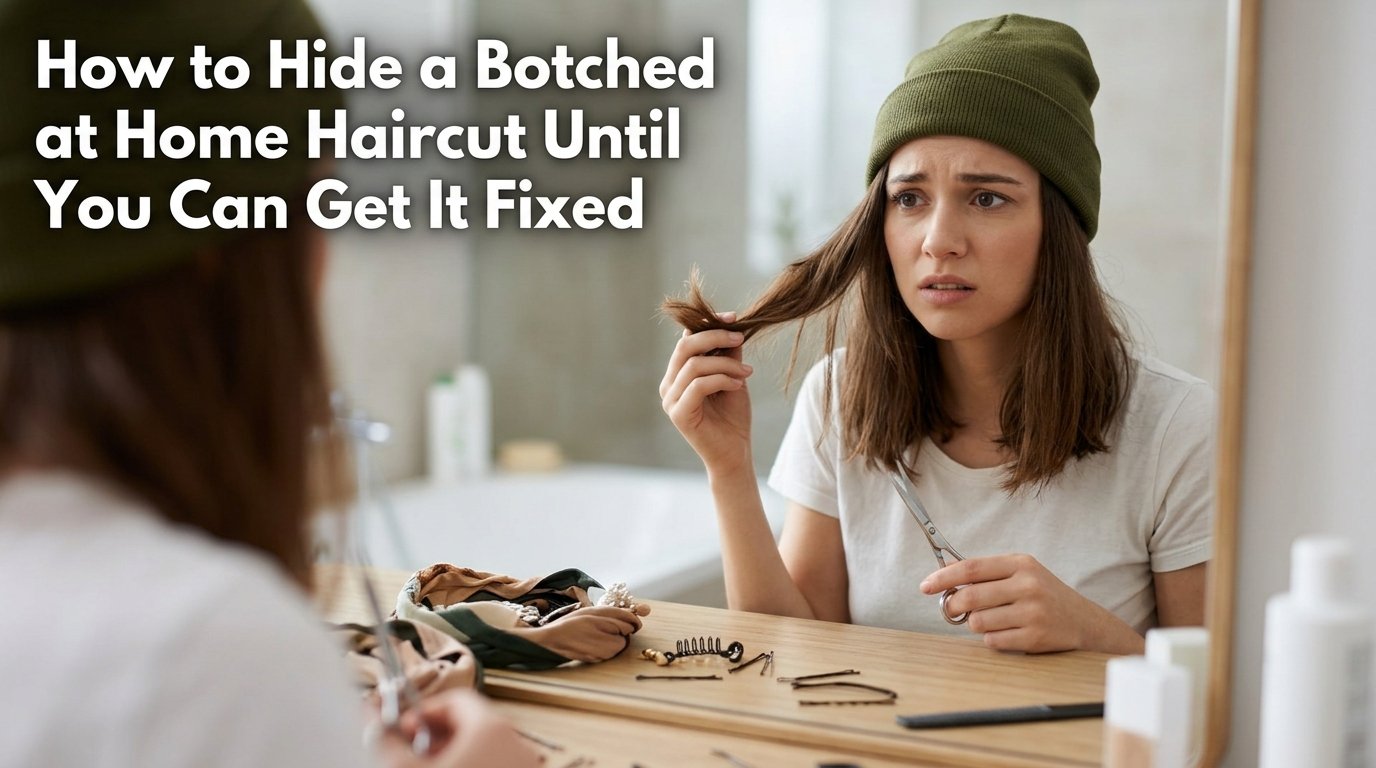
We have all been there. You watched one tutorial too many, grabbed the kitchen scissors, and now a chunk of your hair is two inches shorter than the rest. The mirror feels like an enemy, and panic is setting in fast.
If you are wondering how to hide a botched at home haircut until you can get it fixed, take a deep breath. You have more options than you think, and most of them use items already sitting in your bathroom drawer.
This guide walks through every disguise technique I have personally used and seen work: accessories, hot tools, styling tricks for specific problems like bad bangs and choppy layers, and exactly when to call in a professional. By the end, you will have a concrete plan to face tomorrow morning without a hat glued to your head (though we cover hats too).
Table of Contents
First Steps: Take a Breath Before You Panic
The first thing to know is that almost everyone who has cut their own hair has botched it at least once. There is an entire Reddit community called Justfuckmyshitup dedicated to sharing haircut disasters as a form of solidarity. You are not alone, and this is fixable.
Before you touch your hair again, stop cutting. I repeat: put the scissors down. The number one mistake people make after a botched at-home haircut is trying to even it out themselves, which almost always makes things worse. Each correction cut removes more length and creates new uneven sections to hide.
Wash and dry your hair the way you normally style it. Wet hair looks shorter and more uneven than it actually is, so you need to see the real picture before deciding on a plan. Blow dry or air dry, add whatever product you usually use, then assess honestly in good lighting.
Take photos from the front, sides, and back. This gives you a clear baseline and helps you track what is working as you try different disguise techniques. It also comes in handy if you decide to book a salon consultation, because the stylist can see exactly what they are working with.
Give yourself 24 to 48 hours before making any big decisions. Hair that looked catastrophic on day one often settles into something manageable by day three as it finds its natural fall. Many people on hair forums report that the haircut they hated on Saturday looks fine by Monday.
Quick Temporary Fixes You Can Do Today
When you need to walk out the door in an hour and your haircut is a disaster, reach for these instant fixes first.
Change Your Part
This is the single fastest trick, and forum users recommend it constantly. If you normally part your hair on the right, flip it to the left. A new part changes how the hair falls, redistributes volume, and can completely hide uneven sections or short pieces that were exposed by your old parting.
Use a comb to create a clean new part, then add a small amount of styling cream or pomade to hold it in place. The change takes 30 seconds and costs nothing.
Slick It Back
When in doubt, slick it back. A generous amount of gel, pomade, or styling cream brushed through damp hair and pulled away from your face hides almost every sin. The wet look smooths down uneven ends, blends choppy layers into one uniform shape, and looks intentional rather than accidental.
For a polished version, gather the slicked hair into a low bun or ponytail at the nape of your neck. This works especially well if the back of your haircut is the problem area.
Add Texture with Dry Shampoo or Sea Salt Spray
Smooth, straight hair shows every uneven line. Adding texture camouflages the harsh edges that make a bad haircut obvious. Spray dry shampoo or sea salt spray through your lengths, then scrunch with your hands to create piece-y, undone waves.
The messier the texture, the better it hides mistakes. A haircut that looks ragged when worn sleek can pass as a deliberate shaggy style when textured properly.
Tuck and Pin
Grab bobby pins and start tucking. Short pieces can be pinned behind your ears. Longer uneven sections can be twisted back and pinned at the sides. The half-up, half-down style is your best friend here because it pulls problem pieces away from your face while letting the rest of your hair fall naturally.
How to Hide a Botched at Home Haircut With Accessories
Accessories are the most reliable way to hide a botched at home haircut, and they work for every hair length and type. Here is a breakdown of what to reach for depending on what went wrong.
Headbands for Bangs and Front Layers
If your bangs are the casualty, a headband is your first line of defense. Brush the bangs straight back off your forehead and secure them with a wide fabric headband. Tuck any stubborn short pieces underneath the band using bobby pins crossed in an X shape for extra hold.
For thinner bangs that will not stay tucked, try a narrow elastic headband positioned right at the hairline. Push it back about an inch so the bangs sweep under it, creating a smooth, face-framing look that hides the chopped edges entirely.
Scarves for Full Coverage
A silk or cotton scarf tied around your head covers the entire hairline and the first two inches of growth, which is where most at-home haircut disasters are concentrated. Fold the scarf into a wide band, place it at your hairline, and tie it at the nape of your neck or off to one side.
This works brilliantly for bad bangs, uneven front layers, and choppy face-framing pieces. It also looks stylish and intentional, so nobody will suspect you are hiding anything. Keep a scarf in your bag for emergency touch-ups throughout the day.
Hats for Total Concealment
Sometimes you just need a hat. Beanies, baseball caps, fedoras, and wide-brim hats offer complete coverage when nothing else is working. A beanie pulled down to your eyebrows hides bangs, front layers, and crown mistakes all at once.
If you need to look professional, a structured fedora or a wide-brim hat reads as a deliberate style choice rather than a cover-up. Pair it with simple earrings and clean makeup, and nobody will question it.
Claw Clips and Bobby Pins for the Back
When the back of your haircut is uneven, claws clips and bobby pins are essential. Twist your hair into a low French twist or a messy bun and secure it with a large claw clip. This gathers all the uneven ends into one hidden bundle and creates a clean silhouette.
For medium-length hair that is too short to bun, try a low half-up style. Take the top section of hair, twist it loosely, and pin it at the back of your head. This covers the transition point between layers and draws attention upward to the smooth top section.
Elastic Headbands and Sports Bands
For workouts or casual days, a thick elastic headband pushed back about an inch from your hairline holds short pieces in place while looking sporty and deliberate. This is a great option if your bad bangs will not cooperate with a regular headband.
Using Hot Tools to Disguise the Damage
Hot tools reshape your hair temporarily, and that is exactly what you need when the shape itself is the problem. Different tools solve different haircut disasters.
Curling Iron for Uneven Layers
Uneven layers become nearly invisible when your hair is curled. The key is to curl every section the same way so the eye cannot follow where one layer ends and another begins. Use a 1.25-inch or 1.5-inch curling iron, wrap sections away from your face, and hold each for about 8 seconds.
Once all sections are curled, gently brush through the curls with a paddle brush to create soft waves. The blended wave pattern masks choppy transitions and makes the overall shape look intentional. Add a light hold hairspray to lock it in.
If your layers are very short on top, use a smaller barrel curling iron or even a flat iron to create tighter waves at the crown. Tighter texture in short areas, looser texture in long areas creates a balanced, tousled look.
Flat Iron for Smooth, Lengthened Appearance
A flat iron makes hair appear longer and smoother, which helps if your haircut ended up shorter than intended. Straightening pulls the hair down and removes volume that might expose uneven layers. Work in small sections from the roots to the ends for the smoothest result.
For short pieces that stick out, use the flat iron to bend them under. Clamp near the root of the short piece and curve the iron downward as you glide through. This tucks problem pieces into the longer surrounding hair.
You can also use a flat iron to create loose waves by clamping at the root and twisting the iron 180 degrees as you pull through. This adds the texture that hides unevenness without the uniform curl of a curling iron.
Hot Rollers for Volume and Camouflage
Hot rollers add root lift and overall volume, which is useful when your haircut looks flat and exposes every mistake. Volume at the roots lifts the hair away from the scalp and creates a rounded shape that hides uneven lengths underneath.
Use larger rollers at the crown for height and smaller rollers around the face for soft, face-framing volume. Leave them in for 15 to 20 minutes, then unroll and finger-comb. The result is full, bouncy hair that looks styled even if the cut underneath is rough.
Round Brush and Blow Dryer
A round brush blowout smooths rough ends and bends hair under at the bottom, which is one of the best ways to disguise a choppy perimeter. Use a large round brush on the top sections for smoothness and a medium brush at the ends to curl them under.
Direct the airflow downward from roots to ends to smooth the cuticle and reduce frizz. This alone makes a rough haircut look polished enough for the office.
Styling Tricks for Specific Botched Haircut Problems
Different haircut disasters need different disguise strategies. Here is how to handle the most common at-home haircut problems.
Bad Bangs
Bad bangs are the most stressful botched haircut problem because they sit right on your face. If your bangs are too short, too thick, or crooked, you have several options.
The fastest fix is to part your hair down the middle and sweep the bangs to each side, pinning them with bobby pins. This creates a curtain-bang effect that looks deliberate. If the bangs are too short to sweep, push them straight back with a headband or scarf.
For bangs that are uneven but long enough to wear forward, use a flat iron to smooth them into one straight line. Add a tiny amount of styling cream to weigh down any pieces that stick up. Texturizing with a razor comb (gently) can soften blunt, choppy edges.
Uneven Layers
Uneven layers show up as obvious steps or shelves in your hair. The best disguise is curls or waves, which blur the transition points. If you prefer straight hair, use a flat iron and a light smoothing serum to create one uniform length appearance.
A half-up style also works well for uneven layers. Pull the top layer back into a small ponytail or bun, leaving the bottom layer loose. This hides the shortest layers and lets the longer pieces frame your face cleanly.
Choppy or Blunt Ends
If you cut straight across instead of point cutting, you will have blunt ends that look harsh and obvious. Soften them by adding texture with sea salt spray and scrunching. You can also twist small sections of hair and lightly run scissors down the twisted section to remove bulk from the ends, but only if you trust your hand steadiness.
Curling the ends under with a round brush or flat iron also softens blunt lines. The bend hides the straight-cut edge and makes the perimeter look natural.
Haircut Too Short Overall
If the entire haircut is shorter than you wanted, you cannot add length back, but you can create the illusion of length. Straighten your hair for maximum downward pull, tuck the sides behind your ears to elongate your face, and wear V-neck tops that draw the eye downward.
Clip-in extensions are the most effective fix for too-short hair. They snap in within minutes and add instant length and volume. Choose extensions that match your color closely, and have a friend help you place them for the most natural result.
Patches or Bald Spots
If you accidentally created a thin patch or a near-bald spot, this is a job for strategic combing and accessories. Comb surrounding hair over the patch and pin it in place with bobby pins. A headband or scarf placed directly over the area provides full coverage.
If the patch is significant, consider a professional fix sooner rather than later. Some damage requires a stylist to blend and reshape, and waiting too long can make the fix more complicated.
The Mushroom Cut or Shelf
If your at-home haircut created a mushroom shape with a heavy perimeter and no blending, texture is your answer. Use thinning shears (carefully) on the bottom two inches to soften the shelf, then add waves with a curling iron to break up the heavy line.
A high ponytail also removes the mushroom effect entirely by pulling all the heavy perimeter hair up and away. Smooth the sides with gel for a sleek finish.
Should You Try to Fix It Yourself?
The short answer is usually no. Most at-home fixes make the problem worse, and you end up with less hair to work with when you finally see a professional.
That said, there are two minor corrections that are relatively safe if you are careful. Point cutting, which is holding scissors vertically and snipping into the ends of your hair rather than across, softens blunt edges without removing significant length. Do this on dry hair so you can see exactly what you are removing.
The second safe technique is using thinning shears on the last inch of your hair to blend heavy sections. Hold the thinning shears vertically and make small, gentle cuts. Do not thin anywhere except the very ends, and stop after one or two passes.
If your haircut is significantly uneven, has bald patches, or involved removing way more hair than intended, do not try to fix it yourself. Book a salon appointment and wear a hat or use the disguise techniques above until you get there.
When to See a Professional
Most botched at-home haircuts benefit from professional correction, but the timing matters. If the cut is uneven by more than an inch, has visible patches, or is so short that styling tricks are not working, call a salon within the first week.
When you book, tell the receptionist you need a correction cut. Many salons reserve specific appointment types for corrections, and some stylists specialize in fixing bad haircuts. Bring photos of what your hair looked like before the disaster and photos of the cut you were trying to achieve.
Be honest with the stylist about what happened. They have seen it all, and they are not there to judge you. The more information they have about what you did and what you want, the better they can correct it. If the stylist says the best option is to go shorter, listen to them. Sometimes the cleanest fix is a shorter, intentional cut that grows out evenly.
Hair grows about half an inch per month on average. If your bad haircut is only slightly off, waiting two to three weeks gives you enough growth for a stylist to make a meaningful correction without sacrificing much length. For major disasters, do not wait. A stylist can reshape what you have right now.
FAQs
How to hide a bad haircut at home?
Use accessories like headbands, scarves, and hats to cover problem areas. Change your part to redistribute volume. Slick hair back with gel or pomade, or add texture with sea salt spray to blur uneven edges. Bobby pins can tuck short pieces behind your ears, and a claw clip bun hides choppy ends at the back.
How to cover your hair after a bad haircut?
Cover your hair with a scarf tied around your hairline, a wide headband pushed back off your face, or a hat like a beanie or fedora. Claw clips and bobby pins let you twist hair into buns and half-up styles that conceal uneven layers and short pieces entirely.
What to do when you get a botched haircut?
Stop cutting immediately and wash and dry your hair to see the real result. Wait 24 to 48 hours before making big decisions. Use temporary disguise techniques like accessories and hot tools while you decide whether to book a salon correction. Take photos to track what is working.
How long to wait to fix a bad haircut?
Wait at least one to two weeks before booking a correction so the hair has some growth to work with. Hair grows about half an inch per month. For major disasters like bald patches or severely uneven sections, do not wait and see a stylist right away.
Can a bad haircut be fixed?
Yes, most bad haircuts can be fixed by a professional stylist. They can blend uneven layers, reshape choppy ends, and even out length. In some cases the fix involves going shorter, but a skilled stylist will preserve as much length as possible while making the cut look intentional.
How long does hair take to grow back after a bad haircut?
Hair grows an average of half an inch per month, so expect about six inches of growth per year. Short pieces from a botched fringe or layers usually blend in within four to eight weeks. A significantly too-short cut may take three to six months to reach your desired length.
You Will Get Through This
Learning how to hide a botched at home haircut until you can get it fixed is a survival skill, and now you have the full toolkit. Start with a part change or a headband for an instant fix, layer in hot tools for longer coverage, and book a salon appointment when you are ready.
Your hair grows about half an inch every month, which means this disaster has an expiration date. Be patient with yourself, keep your scissors out of reach, and remember that every stylist has seen worse.