
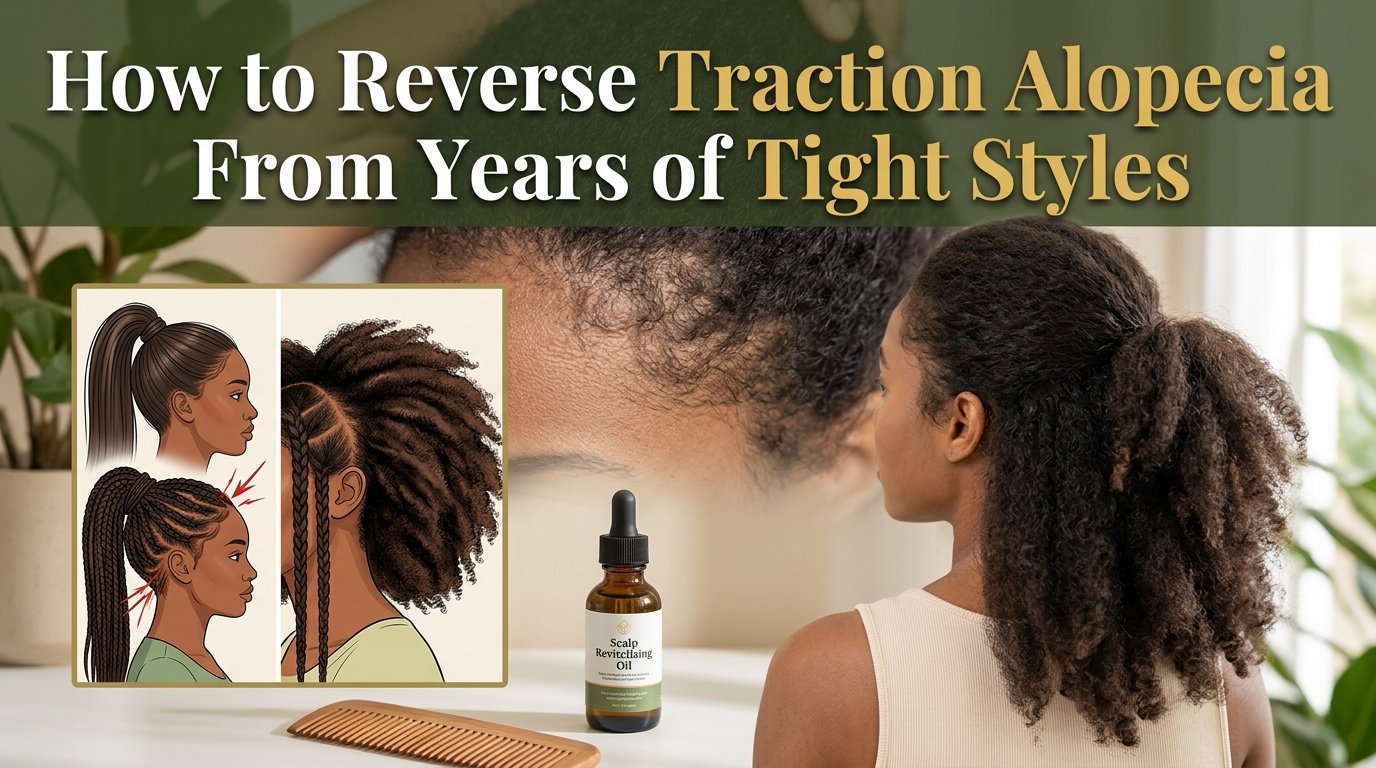
If you have been wearing tight braids, sleek buns, sew-in weaves, or extensions for years and noticed your edges thinning or your hairline creeping backward, you are not imagining things. That hair loss has a name: traction alopecia. And the question keeping you up at night is whether the damage from years of tight styles can actually be undone.
The short answer is that traction alopecia can be reversed in many cases, even after years of tension, but it depends on how much follicle damage has occurred and whether scarring has set in. Early to moderate cases respond well to a combination of removing tension, medical treatments, and time. Advanced cases with scarring may require hair restoration procedures.
I have spent years researching hair and scalp health from a salon perspective, talking with clients who have dealt with this exact situation. This guide walks you through everything you need to know about reversing traction alopecia from long-term tight styling. We will cover what the condition is, how to identify your stage, the step-by-step reversal protocol, treatment options compared side by side, realistic recovery timelines, and how to know when damage might be permanent.
Whether you are a Black woman who has worn protective styles for decades, someone who has worn tight ponytails daily for work, or a parent worried about your child’s edges from too-tight braids, this guide was written for you. Let us get into the practical, evidence-based steps you can take starting today.
Table of Contents
Quick Answer: Can Years of Traction Alopecia Be Reversed?
Yes, traction alopecia from years of tight styles can often be reversed, but with an important caveat. If the hair follicles are still alive and no scarring has formed on the scalp, regrowth is possible with the right combination of tension removal and treatment. However, if the scalp has become smooth and shiny in the thinning areas, this usually indicates scarring alopecia, meaning the follicles have died and hair will not regrow on its own.
The key factors that determine reversibility are how long the tension continued, whether inflammation was treated early, and whether scarring has replaced the follicles. Most people with mild to moderate traction alopecia see significant regrowth within 6 to 12 months of removing the source of tension and starting treatment.
For advanced cases where scarring has occurred, surgical options like follicular unit extraction (FUE) can restore the hairline, though this requires a consultation with a hair restoration specialist.
What Is Traction Alopecia?
Traction alopecia is a form of hair loss caused by prolonged, repetitive tension on the hair shafts and follicles. Unlike genetic hair loss (androgenetic alopecia) or autoimmune hair loss (alopecia areata), traction alopecia is entirely mechanical in origin. The hair falls out because it is being pulled.
Here is what happens at the follicle level. Each hair grows from a follicle, a small structure beneath the scalp that produces hair in cycles. When hair is pulled tightly for extended periods, that constant tension stresses the follicle. Over time, the follicle becomes inflamed, shrinks, and eventually stops producing hair altogether. If the tension continues long enough, the follicle dies and is replaced by scar tissue.
According to the StatPearls medical reference published by the National Center for Biotechnology Information (NCBI), traction alopecia was first described in 1907 in Greenlandic women who wore tight ponytails. More than a century later, the mechanism is the same even if the hairstyles have evolved.
How It Differs From Other Types of Hair Loss
People often confuse traction alopecia with other forms of hair loss, and the distinction matters because the treatments differ significantly.
Androgenetic alopecia (pattern baldness) is hormone-driven and genetic. It typically causes thinning at the crown and temples in a predictable pattern. Traction alopecia, by contrast, appears exactly where the hair was pulled, usually along the hairline, temples, or nape.
Alopecia areata is an autoimmune condition where the immune system attacks hair follicles, causing patchy, round bald spots that can appear anywhere on the scalp. Traction alopecia follows the pattern of the hairstyle causing it.
Central centrifugal cicatricial alopecia (CCCA) is a scarring hair loss that starts at the crown and spreads outward, most commonly affecting Black women. While CCCA is distinct from traction alopecia, research suggests that years of tight styling combined with chemical relaxers can contribute to its development. The two conditions can overlap, which is why a dermatologist’s diagnosis is valuable.
Trichotillomania is a psychological condition where a person compulsively pulls their own hair out. The hair loss pattern may look similar, but the cause and treatment are completely different.
The Hair Growth Cycle and Why It Matters
To understand traction alopecia recovery, it helps to understand the normal hair growth cycle. Each follicle cycles through three phases: anagen (active growth, lasting 2 to 7 years), catagen (transition, lasting 1 to 2 weeks), and telogen (resting and shedding, lasting 3 to 4 months).
When tension disrupts this cycle, follicles can be pushed prematurely into the telogen phase, causing excessive shedding. With repeated tension over months and years, follicles become miniaturized and eventually stop cycling altogether. Reversal means getting those dormant but alive follicles back into the anagen phase, which is why recovery takes months rather than weeks.
Symptoms and Stages of Traction Alopecia
Traction alopecia does not happen overnight. It progresses through recognizable stages, and identifying which stage you are in is critical for setting realistic expectations about reversal.
Stage 1: Early Traction Alopecia
In the earliest stage, you may notice mild symptoms that are easy to dismiss. The scalp may feel tender or itchy after removing a tight style. You might see small bumps or pimple-like spots around the hairline. Some hair breakage occurs, but significant thinning has not yet developed.
At this stage, follicles are stressed but still healthy and fully functional. Removing the source of tension alone is often enough for complete recovery. Hair typically regrows within 3 to 6 months without any medical intervention.
Stage 2: Moderate Traction Alopecia
Stage 2 is when most people start to notice something is wrong. The hairline begins to recede, particularly around the temples and ears. You may see broken hairs along the hairline that never seem to grow longer. The scalp may show redness, flaking, or mild inflammation.
Follicles at this stage are damaged but largely recoverable. Removing tension combined with topical treatments like minoxidil typically produces visible regrowth within 6 to 9 months. Some dermatologists also recommend corticosteroid injections to reduce inflammation at this stage.
Stage 3: Advanced Traction Alopecia
In advanced cases, the thinning becomes pronounced. Large sections of the hairline may be visibly bare, with only sparse, short hairs remaining. The skin in affected areas may appear thinner or slightly different in texture. Folliculitis (inflammation of the follicles) may be present, with recurring pus-filled bumps.
At Stage 3, some follicles are still alive but struggling, while others may have been damaged beyond natural recovery. Aggressive treatment is needed: removing all tension, using minoxidil consistently, and possibly pursuing treatments like platelet-rich plasma (PRP) therapy or low-level laser therapy. Recovery at this stage takes 9 to 12 months or more, and results vary.
Stage 4: Permanent Scarring (Cicatricial) Traction Alopecia
Stage 4 is the point of no return for natural regrowth. The scalp in affected areas becomes smooth, shiny, and completely devoid of hair follicles. This smooth appearance indicates that follicles have died and been replaced by scar tissue. No cream, oil, supplement, or medication can regrow hair from dead follicles.
At this stage, the only option for restoring hair is surgical: follicular unit extraction (FUE) or follicular unit transplantation (FUT), where healthy follicles are harvested from a donor area and transplanted into the scarred region. These procedures can be effective, but they are expensive and require recovery time.
Symptom Checklist: What to Look For
Here is a quick checklist of symptoms across all stages. If you notice any of these, it is time to take action:
Scalp tenderness or soreness after removing hairstyles
Small bumps, redness, or pimple-like spots along the hairline
Broken hairs at the edges that refuse to grow longer
Visible thinning or recession at the temples, hairline, or nape
A widening part or reduced hair density in tension-prone areas
Headaches or scalp discomfort while wearing a style
Pus-filled bumps or signs of folliculitis
Smooth, shiny patches of scalp with no hair growth
If you checked anything in the first seven items, your traction alopecia is likely still reversible. The eighth item, smooth shiny patches, suggests possible scarring and warrants a dermatologist visit.
Causes and Risk Factors: Why Years of Tight Styles Cause Damage
Traction alopecia is caused by one fundamental thing: sustained pulling force on the hair. But the specific hairstyles and habits that create this force are worth understanding in detail, because reversing the condition means eliminating every source of tension.
Hairstyles That Cause Traction Alopecia
The most common culprits include tight braids (including box braids and knotless braids installed too tightly), cornrows, sew-in weaves, glued-in extensions, clip-in extensions worn daily, tight ponytails, slicked-back buns, dreadlocks that are tightly twisted or heavy, wigs attached with tight elastic bands or strong adhesives, and even tight headbands or helmets worn for long periods.
The common thread is sustained tension. A single tight hairstyle worn for one day will not cause traction alopecia. The damage accumulates over weeks, months, and years of repeated tension without adequate recovery periods.
The Compounding Effect of Chemical Damage
For many people, traction alopecia is worsened by chemical treatments. Relaxers, texturizers, and frequent heat styling weaken the hair shaft and irritate the scalp, making follicles more vulnerable to tension damage. The combination of chemical relaxers and tight braids or weaves is particularly damaging, which is one reason traction alopecia rates are disproportionately high among Black women who use both.
Research published in JAMA Dermatology has highlighted the connection between chemical processing, tight styling, and conditions like CCCA. If you have been relaxing your hair and wearing tight styles simultaneously for years, your follicles have likely been under compounded stress.
Who Is Most at Risk?
Traction alopecia does not discriminate, but certain groups face higher risk due to cultural hair practices and occupational requirements.
Black women are disproportionately affected. Protective styles like braids, weaves, and extensions are deeply rooted in Black hair culture, and while these styles can be worn safely, the combination of tight installation, chemical processing, and extended wear times creates significant risk. Studies have found that nearly one-third of Black women experience some form of hair loss, with traction alopecia being a leading cause.
Children are also vulnerable, particularly when braids or ponytails are installed tightly. A child’s hairline is delicate, and years of tight styles starting in childhood can cause permanent damage by early adulthood.
Ballet dancers and gymnasts who wear tight buns for hours daily face occupational risk. Sikh men who wear their hair tightly wrapped under a turban can develop traction alopecia at the frontal hairline. Nurses and healthcare workers who wear hair pulled back tightly for shifts, cyclists and motorcyclists with tight helmet straps, and military personnel with regulation hairstyles are also at elevated risk.
Why “Years of Damage” Is a Different Scenario
Most articles about traction alopecia focus on early-stage cases where removing tension solves the problem quickly. But if you have been wearing tight styles for 5, 10, or 20 years, your situation is different in important ways.
Years of tension means your follicles have been through repeated cycles of inflammation, partial recovery, and re-injury. Some follicles may be deeply miniaturized. The scalp skin itself may have changed, becoming thinner or showing early signs of scarring in areas of maximum tension. You may also have overlapping conditions like CCCA or androgenetic alopecia complicating the picture.
This is why long-term traction alopecia requires a more aggressive, multifaceted approach than a few months of damage. Simply removing tension is necessary but may not be sufficient. You likely need active treatment, possibly medical intervention, and a longer recovery timeline.
How to Reverse Traction Alopecia: A Step-by-Step Protocol
If you have years of tight styling damage, reversing traction alopecia requires a systematic approach. Here is a step-by-step protocol that addresses every layer of the problem, from immediate damage control to long-term regrowth.
Step 1: Eliminate All Sources of Tension Immediately
This is the non-negotiable first step, and it means exactly what it says. Stop wearing every hairstyle that pulls on your hair. No tight braids, no tight ponytails, no slicked-back buns, no sew-in weaves, no glued wigs, no headbands that grip tightly. Even styles that feel only mildly tight are too tight for a recovering scalp.
I know this step is emotionally difficult, especially if your hairstyle is tied to your identity, profession, or social comfort. But every day you continue wearing tension-causing styles, you are pushing follicles closer to permanent death. Think of it as physical therapy for your scalp: you cannot rehabilitate an injury while continuing to re-injure it.
What should you wear instead? Loose, low-manipulation styles that put zero tension on the hairline. Options include wearing your hair loose and natural, loose two-strand twists that are not pulled taut at the roots, a satin or silk bonnet at night to protect without tension, or a wig worn without adhesive or tight elastic (the wig should rest on your hairline gently, not grip it). If you must tie your hair back, use a silk scrunchie loosely and never pull the hair tight against the scalp.
Step 2: Reduce Inflammation on the Scalp
Years of tension have likely left your scalp inflamed, even if you cannot see it. Reducing this inflammation creates the environment follicles need to recover. Several approaches help.
Topical corticosteroids prescribed by a dermatologist can calm inflammation directly. Over-the-counter options include scalp treatments containing ingredients like niacinamide, which has anti-inflammatory properties. Avoid harsh shampoos with sulfates, and wash your scalp gently with your fingertips rather than scratching with nails.
Some people find relief with cold compresses applied to tender areas for 10 minutes at a time. Aloe vera gel applied directly to the scalp can also soothe irritation. If you have active folliculitis (pus-filled bumps, significant redness, pain), see a dermatologist, as you may need antibiotic or prescription-strength anti-inflammatory treatment.
Step 3: Start a Proven Regrowth Treatment
Removing tension and reducing inflammation are foundational, but if you have years of damage, you likely need an active regrowth stimulant. The most evidence-backed option is topical minoxidil.
Minoxidil (the active ingredient in Rogaine and generic equivalents) works by increasing blood flow to follicles and extending the anagen (growth) phase. While minoxidil is FDA-approved for androgenetic alopecia, dermatologists frequently prescribe it off-label for traction alopecia because the mechanism of stimulating dormant follicles applies regardless of the original cause of hair loss.
The standard approach is 5% minoxidil solution or foam applied to the affected areas twice daily. It takes patience: most people do not see visible regrowth for 8 to 12 weeks, and peak results appear at 6 to 12 months. Some people experience an initial shedding phase in the first few weeks, which is normal and temporary as the follicles reset.
If minoxidil alone is not producing results after 6 months, a dermatologist may add corticosteroid injections directly into the thinning areas to reduce deep inflammation that topical treatments cannot reach.
Step 4: Nourish Your Scalp and Body for Regrowth
Hair growth requires specific nutrients, and deficiencies can slow your recovery even if you are doing everything else right. Focus on getting adequate amounts of the following through diet or supplementation.
Iron is critical for hair growth, and iron deficiency is one of the most common nutritional causes of hair shedding, especially in women. Ask your doctor for a ferritin test to check your iron stores. Vitamin D deficiency is also linked to hair loss, and many people are deficient without knowing it. B vitamins, particularly biotin and B12, support hair health. Protein intake matters because hair is made primarily of keratin, a protein. Zinc supports follicle function and tissue repair.
Before starting any supplement regimen, get bloodwork done. Taking high-dose supplements you do not actually need can sometimes cause more harm than good. A doctor or registered dietitian can identify genuine deficiencies worth addressing.
Step 5: Incorporate Scalp Massage and Stimulation
Scalp massage is one of the few natural techniques with research behind it for hair growth. A small 2016 study found that 4 minutes of standardized scalp massage per day for 24 weeks increased hair thickness in participants. The proposed mechanism is that massage increases blood flow to follicles and may stretch the dermal papilla cells, stimulating growth.
To do it effectively, use your fingertips (not nails) to apply firm, circular pressure across your entire scalp for 4 to 5 minutes daily. You can add a few drops of a lightweight oil like jojoba or rosemary oil to reduce friction, though the oil itself is secondary to the massage technique.
Some people also use dermarollers (microneedling devices) on the scalp to stimulate follicles. There is emerging evidence that microneedling combined with minoxidil produces better results than minoxidil alone. However, microneedling should be done carefully to avoid infection or further scarring. Use a clean device, do not press too hard, and avoid areas with active inflammation or infection.
Step 6: Manage the Emotional Journey
This step is often overlooked in medical articles, but it matters enormously. Hair loss carries significant emotional weight, particularly for women and especially for Black women whose hair is deeply tied to cultural identity, self-expression, and community standards of beauty.
If you are feeling grief, frustration, embarrassment, or anger about your hair loss, those feelings are valid. Many people in online communities like Reddit’s r/NaturalHair and r/HaircareScience describe the emotional devastation of discovering their hairline has receded after years of protective styling. You are not alone in this experience.
Consider connecting with others who have gone through traction alopecia recovery. Peer support from people with similar hair types and experiences is invaluable. If the emotional impact is significant, speaking with a therapist who understands body image and hair loss concerns can help. Be patient with yourself. Recovery is a marathon, not a sprint, and stress itself does not help the process.
Step 7: Track Progress and Adjust
Take baseline photos of your hairline and thinning areas before you start your reversal protocol. Then take photos in the same lighting and angle every 4 weeks. Because regrowth is gradual, you may not notice changes day to day, but monthly photos will reveal progress that your daily mirror check misses.
If you see no improvement after 3 months of consistent treatment, it may be time to see a dermatologist for a more targeted approach. If you see some improvement but it plateaus, your dermatologist can adjust your treatment plan. The key is consistency: skipping minoxidil applications, going back to tight styles, or stopping treatment early will sabotage your results.
Treatment Options Compared: What Actually Works
Multiple treatment options exist for traction alopecia, and understanding how they compare helps you make informed decisions about your reversal strategy. No single treatment works for everyone, and combining approaches often produces the best results.
Topical Minoxidil
Minoxidil is the most accessible and widely studied treatment for traction alopecia. Available over the counter in 2% and 5% concentrations (5% is generally recommended for traction alopecia), it works by increasing blood flow to follicles and prolonging the growth phase. Apply it directly to thinning areas twice daily.
Pros: Accessible without a prescription, affordable, proven track record for stimulating follicle activity, easy to use at home.
Cons: Requires consistent daily use indefinitely to maintain results, initial shedding phase can be alarming, may cause scalp dryness or irritation in some users, results take 3 to 6 months to become visible.
Best for: Stages 1 through 3 traction alopecia where follicles are still alive. Most effective when combined with complete tension removal.
Corticosteroid Injections
Dermatologists can inject corticosteroids directly into areas of active inflammation. This treatment targets the inflammatory component of traction alopecia, reducing swelling around follicles that may be preventing them from functioning.
Pros: Directly addresses deep inflammation that topical treatments cannot reach, fast-acting for reducing inflammation, performed by a medical professional.
Cons: Requires dermatologist visits (typically every 4 to 6 weeks), involves needles, can cause temporary skin thinning at injection sites if overused, may not be sufficient alone for regrowth.
Best for: Moderate to advanced cases with significant inflammation, often used in combination with minoxidil.
Platelet-Rich Plasma (PRP) Therapy
PRP therapy involves drawing your blood, separating the platelet-rich plasma, and injecting it into the scalp. The growth factors in platelets are thought to stimulate follicle activity and improve hair density.
Pros: Uses your body’s own growth factors, may help follicles that have not responded to minoxidil, increasingly offered at dermatology and hair restoration clinics.
Cons: Expensive (often several hundred dollars per session, with multiple sessions needed), not covered by most insurance for traction alopecia, evidence is mixed compared to better-studied treatments, results vary widely between individuals.
Best for: People who have tried minoxidil for 6+ months without adequate results and want to try a more advanced option before considering surgery.
Low-Level Laser Therapy (LLLT)
LLLT devices, including laser caps and combs, use red light therapy to stimulate follicle activity. Some studies suggest LLLT can improve hair density when used consistently.
Pros: Non-invasive, can be done at home with FDA-cleared devices, no significant side effects, may complement minoxidil treatment.
Cons: Devices can be expensive, requires consistent use (typically several times per week), evidence for traction alopecia specifically is limited compared to androgenetic alopecia studies.
Best for: People looking for a complementary, non-invasive treatment to add to their minoxidil or post-surgery routine.
Hair Transplant Surgery (FUE and FUT)
For Stage 4 traction alopecia where scarring has destroyed follicles, surgical hair restoration is the only option for regrowth. Follicular Unit Extraction (FUE) removes individual follicular units from a donor area (usually the back of the scalp) and transplants them into the thinning or scarred areas. Follicular Unit Transplantation (FUT) removes a strip of scalp from the donor area and divides it into follicular units for transplantation.
Pros: Only option for restoring hair to scarred areas where follicles have died, can produce natural-looking results when performed by an experienced surgeon, permanent solution.
Cons: Most expensive option by far (often several thousand dollars), surgical procedure with recovery time, results depend heavily on surgeon skill, not all candidates qualify (need adequate donor hair), requires careful aftercare to avoid damaging transplanted follicles.
Best for: Stage 4 permanent scarring traction alopecia where no other treatment can produce regrowth.
Natural Oils and Home Remedies
Many people ask about natural options like rosemary oil, castor oil, peppermint oil, and jojoba oil. Let me give you an honest assessment based on the current evidence.
Rosemary oil has the strongest research behind it. A 2015 study comparing rosemary oil to 2% minoxidil found similar results after 6 months, with rosemary causing less scalp itching. However, this study was small and focused on androgenetic alopecia, not traction alopecia specifically. Rosemary oil is typically diluted in a carrier oil and massaged into the scalp.
Castor oil is widely recommended in natural hair communities, but there is no clinical research proving it regrows hair. It is a thick, moisturizing oil that may improve scalp condition and reduce breakage, which can make existing hair look healthier even if it does not stimulate new growth.
Peppermint oil showed promising results in a mouse study, increasing follicle count and depth. Human studies are lacking, but some people find it stimulating when diluted and massaged into the scalp.
The honest truth: natural oils are unlikely to reverse years of traction alopecia on their own. They can be a helpful complement to proven treatments like minoxidil, and scalp massage with oils improves scalp health. But do not rely on oils alone if you have moderate to advanced hair loss. You will lose valuable recovery time that could have been spent on more effective treatments.
Recovery Timeline: What to Expect Month by Month
One of the most common questions is how long it takes to reverse traction alopecia. The answer depends on your stage, the treatments you use, and how consistently you follow your protocol. Here is a realistic timeline based on clinical experience and user reports.
Month 1 to 2: The Rest Phase
In the first 4 to 8 weeks after removing tension and starting treatment, you may not see visible regrowth. This is normal. If you are using minoxidil, you might actually experience an initial shedding phase as the treatment pushes resting follicles out to make way for new growth. Do not panic if your hair looks thinner temporarily during this period.
What you should notice is that scalp tenderness decreases, inflammation begins to subside, and any active folliculitis starts to clear. Your scalp is healing even if your hair has not started visibly regrowing yet.
Month 3 to 4: Early Regrowth
By month 3, many people begin to see fine, fuzzy new hairs emerging along the hairline and in thinning areas. These baby hairs are a sign that dormant follicles are reactivating. The growth is typically slow and the hairs are initially fine and colorless.
This is when monthly progress photos become valuable. Side-by-side comparisons from month 1 to month 3 often reveal subtle improvements that daily observation misses. If you are using minoxidil, this is when results typically become noticeable.
Month 5 to 8: Visible Improvement
Between months 5 and 8, those fine new hairs begin to thicken and darken. Coverage improves in previously thin areas. The hairline starts to look denser, though it may not yet match your pre-damage thickness.
For people with moderate traction alopecia (Stage 2), this is often the period where the most dramatic visible improvement occurs. People with Stage 3 may still be in the slower phase of recovery, with gradual improvements continuing.
Month 9 to 12: Approaching Full Recovery
By the end of the first year, most people with reversible traction alopecia see significant regrowth. Areas that had thinning should be noticeably denser. The hairline should be more defined, though it may not return to exactly its original position if some follicles were permanently lost.
At this point, you and your dermatologist can assess whether to continue minoxidil maintenance, taper off, or explore additional treatments for any areas that have not responded.
Beyond 12 Months: What It Means
If you have been consistent with tension removal and treatment for 12 months and certain areas still show no regrowth, those areas likely have permanent follicle damage. A dermatologist can examine the scalp to determine whether scarring is present. If scarring is confirmed, your options are surgical restoration or acceptance and cosmetic approaches like hairline-friendly wigs, makeup, or micro-pigmentation.
When Is It Too Late? Recognizing Permanent Damage
This is the question that causes the most anxiety, and I want to address it honestly rather than offering false hope. Traction alopecia becomes permanent when hair follicles die and are replaced by scar tissue. Once that happens, no treatment short of surgery can restore hair to those areas.
Signs That Damage May Be Permanent
Several indicators suggest you may have moved beyond the reversible stage:
The scalp in thinning areas is smooth and shiny, with no visible hair follicles or peach fuzz
You have removed all tension and used minoxidil consistently for 12 months with zero regrowth in specific areas
A dermatologist has confirmed scarring through examination or scalp biopsy
The affected skin feels different from surrounding scalp (thinner, tighter, or more taut)
You have no visible follicle openings on the scalp surface in the affected area
Signs That Damage Is Still Reversible
Conversely, these signs suggest your follicles are still alive and recovery is possible:
You can see tiny hairs, even if they are sparse and short, in the thinning areas
The scalp has normal texture, not smooth or shiny
You experience occasional tingling or itching in the area (signs of follicle activity)
Your traction alopecia is less than 5 years old with intermittent breaks from tension
A dermatologist confirms no scarring on examination
What to Do If Damage Is Permanent
If you determine that certain areas have permanent scarring, you still have options. Hair transplant surgery (FUE or FUT) can restore hair to scarred areas using healthy follicles from elsewhere on your scalp. This is a significant procedure requiring consultation with an experienced hair restoration surgeon, ideally one who has experience with textured hair and traction alopecia cases.
Cosmetic options include scalp micropigmentation (tattooing the scalp to create the appearance of fuller hair), hairline powders and fibers that temporarily fill thin areas, and well-fitted wigs or partial hairpieces that do not grip the hairline. These approaches do not reverse the damage, but they can help you feel confident while you explore longer-term solutions.
Most importantly, even if some areas are permanent, continue protecting the rest of your scalp. Removing tension prevents further follicle death and preserves the hair you still have.
Prevention: Safe Styling After Recovery
Once you have made progress reversing traction alopecia, the priority shifts to prevention. The goal is to never recreate the conditions that caused the damage in the first place.
Principles of Low-Tension Styling
Safe styling comes down to one principle: the hair should never feel like it is being pulled at the root. If a style causes tension, soreness, or a feeling of tightness, it is too tight. Communicate clearly with any stylist braiding or installing your hair that you want a loose install, and if it feels tight during the appointment, speak up.
Safe Hairstyles During and After Recovery
Styles that are gentle on the hairline include loose wash-and-go styles, Bantu knots done loosely, chunky two-strand twists (not small or tight), braid-outs and twist-outs, and wearing hair loose under a silk or satin scarf. If you want to wear braids or extensions, look for installers experienced with knotless braids done loosely, and limit wear time to 4 to 6 weeks maximum with breaks in between.
Styles to Avoid or Use Rarely
High-risk styles include tight box braids with small parts, cornrows pulled taut at the hairline, sew-in weaves where the tracks are sewn tightly, glued-in extensions or wigs, slicked-back buns held with elastic bands, tight ponytails, dreadlocks that are heavy or tightly maintained, and any style that causes headaches or scalp soreness.
Protective styles can absolutely be part of a healthy hair routine, but they must be installed loosely, worn for limited periods, and followed by real breaks where the hair is completely down and free from manipulation.
Conclusion
Reversing traction alopecia from years of tight styles is possible for many people, but it requires commitment, patience, and realistic expectations. The formula is straightforward: remove all sources of tension, reduce scalp inflammation, use proven regrowth treatments consistently, nourish your body for hair health, and give the process at least 6 to 12 months before evaluating results.
The earlier you start, the better your chances of full recovery. But even long-term cases often see meaningful improvement with the right approach. If you have been wearing tight styles for years and noticing thinning, the best time to start your reversal protocol is today. Every day without tension is a day your follicles can begin healing.
If you are unsure where to start or want a professional assessment of whether your damage is reversible, schedule a consultation with a dermatologist who specializes in hair loss and has experience with textured hair. They can evaluate your scalp, confirm whether scarring is present, and create a treatment plan tailored to your specific situation.
FAQs
Can years of traction alopecia be reversed?
Yes, traction alopecia from years of tight styles can often be reversed if the hair follicles are still alive and no scarring has formed. Removing all tension, using minoxidil, and reducing inflammation can stimulate regrowth over 6 to 12 months. If the scalp has become smooth and shiny, scarring may be present, meaning natural regrowth is unlikely and surgical options may be needed.
How long does it take for traction alopecia to reverse?
Most people see visible regrowth within 3 to 6 months of starting treatment, with significant improvement by 12 months. Early-stage cases may recover fully in 3 to 6 months, while moderate to advanced cases can take 9 to 12 months or longer. Consistency with tension removal and treatment is the biggest factor in recovery speed.
Can you get traction alopecia from one tight hairstyle?
No, a single tight hairstyle is unlikely to cause traction alopecia. The condition develops from repeated, prolonged tension over weeks, months, or years. One tight braiding session may cause temporary soreness and breakage, but the follicles typically recover within days once the tension is removed.
How do I know if my traction alopecia is permanent?
Traction alopecia is likely permanent if the affected scalp areas are smooth, shiny, and completely devoid of any hair follicles or peach fuzz. If you have removed all tension and used minoxidil consistently for 12 months with zero regrowth in specific spots, a dermatologist can confirm whether scarring is present through examination or scalp biopsy.
Will minoxidil work for traction alopecia?
Minoxidil is frequently prescribed off-label for traction alopecia and is effective for many people, especially in early to moderate stages. It works by increasing blood flow to follicles and stimulating the growth phase. Most people see results within 3 to 6 months of consistent twice-daily use. It is most effective when combined with complete removal of all hair tension.
Can I wear protective styles again after recovery?
Yes, but they must be installed loosely and worn for limited periods. Choose knotless braids done loosely, avoid small tight parts, limit wear time to 4 to 6 weeks, and take real breaks between installs where your hair is completely free. Always communicate with your stylist that you want a loose install, and never tolerate soreness or tension during or after installation.
What does traction alopecia look like?
Early traction alopecia appears as scalp tenderness, small bumps, and broken hairs along the hairline. As it progresses, the hairline recedes at the temples and edges, creating visible thinning. In advanced stages, large bare patches appear with only sparse short hairs. In the permanent stage, the scalp becomes smooth and shiny with no visible hair follicles in affected areas.
Can kids get traction alopecia?
Yes, children can develop traction alopecia from tight braids, ponytails, or other styles. A child’s hairline is especially delicate, and years of tight styling starting in childhood can cause permanent damage by early adulthood. Parents should insist on loose styles, avoid tight ponytails or braids, and give children’s hair regular breaks from manipulation.