
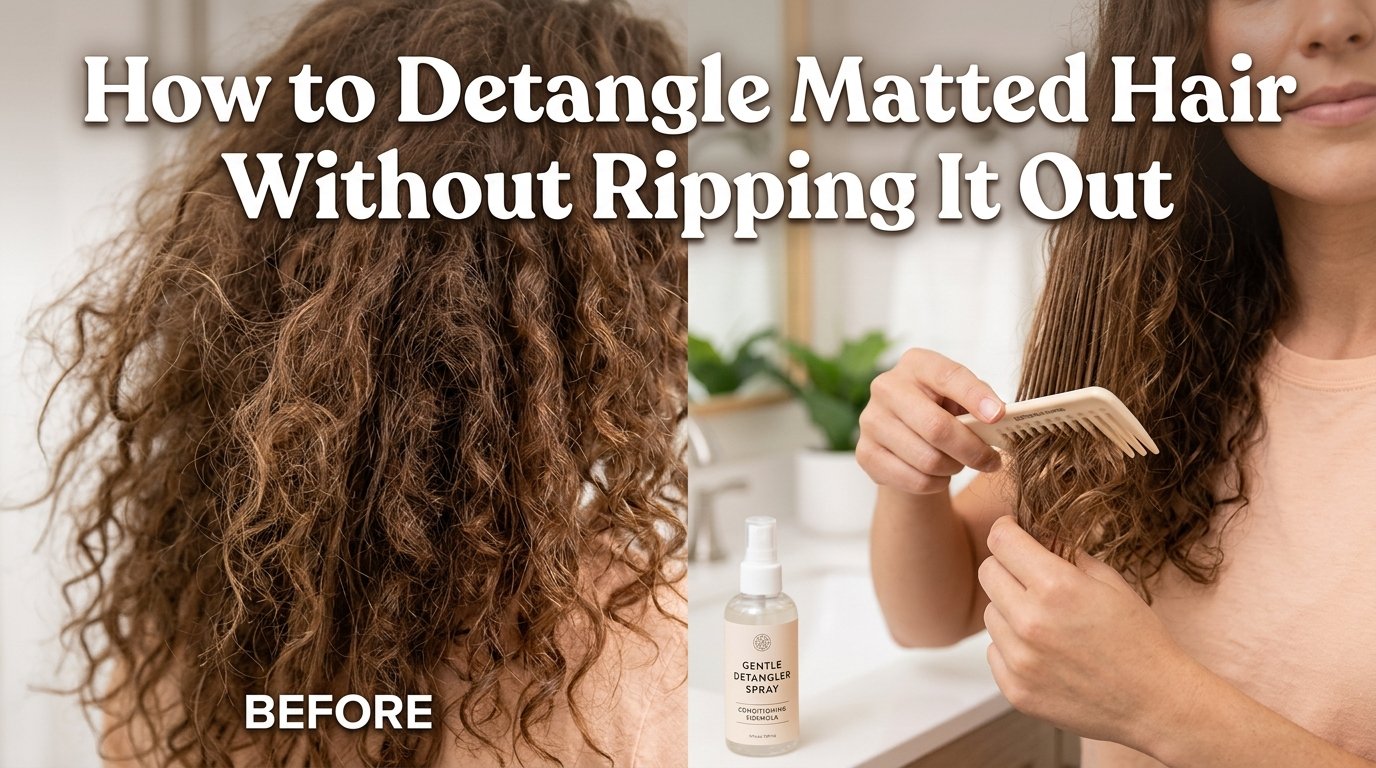
If you are reading this with a knot of tangled hair and a knot in your stomach, take a breath. You are not alone, and your hair can almost certainly be saved. Learning how to detangle matted hair without ripping it out is a process that requires patience, the right products, and a gentle hand, but it is absolutely doable at home.
Many people end up with severely matted hair after going through a rough patch. Depression, illness, a chaotic schedule, or simply not having the right hair care routine can all lead to knots that seem impossible. One Reddit user shared that they went two months without brushing their hair during a mental health struggle and felt terrified they would have to cut it all off. Stories like this are incredibly common, and they deserve empathy, not judgment.
Matted hair is different from a few regular tangles. It happens when shed hairs interlock with growing hairs over time, forming dense, web-like clumps that fuse together. The good news is that with the right approach, you can detangle even severely matted hair without cutting it, without excessive breakage, and without the pain of yanking a brush through it.
In this guide, our team walks you through the complete step-by-step process, the tools you need, realistic time expectations, and special tips for different hair types. Whether your hair is mildly knotted or has been matted for months, you will find a path forward here.
Table of Contents
What Causes Severely Matted Hair
Understanding what causes severely matted hair helps you approach the detangling process with the right strategy. Matting is not a sign of dirty or unhealthy hair. It is a mechanical process that can happen to anyone.
Every day, you naturally shed 50 to 100 hairs. When you brush or comb regularly, those shed hairs are removed easily. But when hair goes unbrushed for days or weeks, those loose hairs get trapped. They wrap around growing hairs multiple times, twisting and interlocking with each friction event. Over time, this creates dense, web-like clumps that are the hallmark of matted hair.
Several factors accelerate this process. Curly and coily hair textures (like 3b or 4c hair) naturally have more inter-strand friction because the curves and coils cause hairs to catch on each other. Damaged hair cuticles from heat styling, chemical treatments, or bleach create a rougher surface that grips neighboring strands more aggressively. Sleeping without a silk or satin pillowcase causes friction that tangles hair overnight.
Infrequent washing also contributes. Natural oils, sweat, and product buildup make hairs stickier, causing them to clump together rather than slide apart. And for many people, the root cause is simply a period where hair care fell to the bottom of the priority list due to depression, illness, or life circumstances. That is completely human, and it is fixable.
Tools and Products You Need Before You Start
Before you learn how to detangle matted hair without ripping it out, gather your supplies. Having everything within arm’s reach prevents mid-process frustration and keeps you from reaching for the nearest brush in desperation.
Here is your checklist:
A slip agent: This is the most important item. You need a deep conditioner, detangling spray, leave-in conditioner, or natural oil (coconut oil, olive oil, jojoba oil, or argan oil). Slip refers to how slippery your hair becomes when coated with product, allowing strands to slide past each other instead of catching.
A spray bottle filled with warm water: For dampening sections as you work.
A wide-tooth comb: Your primary detangling tool. The wide spacing between teeth prevents the comb from gathering too many hairs at once.
A detangling brush: Like a Wet Brush or Tangle Teezer for the final smoothing pass.
A rat tail comb: For gently picking apart the edges of stubborn individual knots.
Sectioning clips: To keep separated hair out of the way while you work.
Thinning scissors or regular scissors: Only for the scissors-thinning technique on the most stubborn mats, never for cutting hair off.
A mirror: So you can see the back of your head.
Entertainment: A podcast, movie, or audiobook. You will be here a while, and that is okay.
The single most important concept to understand is slip. Slip is what happens when a conditioning product coats each hair strand, creating a smooth, slippery surface that reduces friction. Without slip, you are essentially trying to untangle dry, interlocked Velcro. With slip, those same strands can glide apart with gentle pressure. This is why you should never attempt to detangle matted hair dry and without product.
How to Untangle Matted Hair: Step-by-Step
This is the core process our team has refined through research, community wisdom from hair care forums, and techniques shared by professional stylists. Follow these steps in order, and do not skip any of them.
Step 1: Set Up Your Space and Section Your Hair
Start in a comfortable spot with good lighting. The bathroom works well if you do not mind getting messy, but a couch with a towel draped over it works just as well. Comfort matters because you will be sitting for a while.
Divide your hair into four to eight sections using your fingers. Clip each section up and out of the way. You will work on one section at a time, which prevents the overwhelming feeling of facing the entire head of matted hair at once. Smaller sections are always better. If a section feels too dense to manage, split it in half.
This section-and-conquer approach is the universal consensus among hair care professionals and community members alike. It transforms an impossible task into a series of manageable ones.
Step 2: Saturate With a Slip Agent
Take down one section and thoroughly saturate it with your chosen slip agent. If you are using deep conditioner, apply it generously, coating every strand from root to end. If you are using a detangling spray, spray until the hair is visibly wet with product. If you are using oil, work it through the section with your fingers, focusing on the matted areas.
Do not skimp on product. This is not the time for a light misting. You want the hair to feel slick and slippery to the touch. For severe matting, apply the conditioner or oil and then leave it for 20 to 30 minutes before you start working. Some people even apply a deep conditioner, wrap their hair in a plastic cap, and sleep on it overnight before detangling the next day.
One community-recommended trick is to use two different products in layers. Start with a lightweight oil like jojoba (which is closest to your scalp’s natural sebum) to penetrate the mat, then layer a creamy deep conditioner on top for maximum slip. The combination creates a double-action smoothing effect that makes finger detangling much easier.
Step 3: Finger Detangle First
Before any comb or brush touches your hair, use your fingers. Your fingers are the most gentle detangling tool you own because they can feel resistance and adjust pressure in real time. No comb can do that.
Start at the ends of the hair section and slowly work your way up toward the roots. Gently pull apart the outer edges of the mat, separating whatever strands come free easily. Think of it like untangling a delicate necklace chain. You are coaxing, not forcing.
When you encounter resistance, stop. Apply more conditioner or spray to that specific area and try a different angle. Hold the hair above the knot with one hand to anchor it, which prevents pulling directly on the scalp. This simple technique dramatically reduces pain and gives you better control.
You will not get every knot out with your fingers. That is expected. The goal of finger detangling is to remove the loose shed hairs and separate the outer layers of the mat. This makes the comb step far gentler.
Step 4: Comb From Ends to Roots
Once you have finger-detangled a section as much as possible, switch to your wide-tooth comb. The golden rule of detangling is to always start at the ends and work upward toward the roots. Never comb from the roots down. Combing downward pushes into the densest part of the mat and tightens the knot further.
Place the comb a half inch from the very tips of the hair and gently draw it downward and out. Move up another half inch and repeat. Keep working in small increments until the comb can pass through the entire section from root to end without catching.
If the comb gets stuck, do not pull. Remove it, apply more slip agent to the stuck area, finger detangle that spot a bit more, and try again. Patience here prevents breakage and pain.
Step 5: The Half-Twist Scalp Protection Technique
This is a technique from professional stylist circles that deserves more attention. It protects your scalp from the pulling force of the comb and reduces pain dramatically.
Grasp a portion of hair about the thickness of a marker between your fingers. Give it a gentle half-twist. This twist absorbs the tension when the comb hits a snag, so the pulling force hits your fingers instead of your scalp. It is like creating a shock absorber for your hair roots.
Hold this twisted section firmly above the area you are combing. As you work the comb through the ends, any resistance is absorbed by your grip rather than transferred to the scalp. For anyone with a sensitive scalp, this technique can be the difference between a manageable detangling session and one that is too painful to continue.
Step 6: Deal With Stubborn Individual Knots
Some knots will not respond to finger detangling or combing. For these holdouts, you have two specialized techniques.
For dense single knots, use a rat tail comb to gently pick at the outer edges. Insert the thin metal tail into the edge of the knot and carefully tease apart the outermost hairs. Work from the outside in, loosening the perimeter until the core loosens. Apply conditioner to the knot as you work for continued slip.
For truly stubborn mats that refuse to budge, use the scissors-thinning technique. Take a pair of scissors and make small vertical snips into the mat, cutting upward into the knot rather than across it. This thins the density of the mat without shortening your hair length. Once thinned, apply more conditioner and try combing again. The reduced density makes it much easier to separate.
Never cut horizontally across a mat unless you are prepared to lose that section of hair. Vertical snips thin the knot. Horizontal cuts remove it.
Step 7: Rinse, Shampoo, and Condition
Once a section is fully detangled, clip it out of the way and move to the next. Do not rinse each section individually. Wait until you have completed all sections, then head to the shower.
Rinse your hair thoroughly with warm water to remove the conditioner or oil buildup. Follow with a gentle shampoo, focusing on the scalp. Apply a final round of conditioner from mid-length to ends, leave it for 2 to 3 minutes, and rinse with cool water to seal the cuticle.
Your hair will likely feel lighter and softer than it has in a while. Take a moment to appreciate the work you just did.
Realistic Time Expectations
No competitor in the search results tells you how long this process takes, so let us be honest about it. The time required depends on severity, hair type, and mat density.
For mild matting, where hair has been untended for one to two weeks, expect the process to take 30 to 60 minutes. Moderate matting, where hair has been untended for several weeks to a month, typically requires 1 to 3 hours. Severe matting that has been building for two or more months can take 3 or more hours, often split across multiple sessions over several days.
One forum user shared that they spent 16 hours over two days detangling their severely matted hair and still were not finished. Another user with 3b curly hair needed multiple two-hour sessions just for the front sections. These are not failures. Severe matting is a marathon, not a sprint.
Also expect to see a lot of hair coming out during the process. This can be alarming, but it is completely normal. Those are shed hairs that have been trapped in the mats for weeks or months. You are not losing growing hair. You are releasing hairs that already detached from the scalp long ago. The average person sheds about 100 hairs per day. If you have not brushed your hair in 60 days, that is roughly 6,000 shed hairs waiting to come out.
Special Considerations for Different Hair Types and Situations
Curly and Coily Hair (3b, 4c, and Natural Hair)
Curly and coily hair textures are more prone to matting because the natural curves and coils cause strands to interlock easily. If you have 4c hair or tightly coiled natural hair, finger detangling should be your primary method, with combing as a secondary step.
For coily hair, heavier slip agents work better than lightweight sprays. Dense, creamy deep conditioners, shea butter, and heavier oils like castor oil or olive oil provide the sustained slip that coily textures need. Jojoba oil is especially good because its molecular structure closely mimics your scalp’s natural sebum.
Many people with textured hair find that detangling on damp hair (not soaking wet) works best. The hair has enough moisture for flexibility but not so much that the weight of water stretches and weakens the strands.
Children’s Hair
Detangling a child’s matted hair requires extra patience and a focus on pain management. Children have sensitive scalps and low tolerance for sitting still. Break the process into short sessions of 15 to 20 minutes each rather than one long sitting.
Use the half-twist technique to minimize scalp pulling, and distract them with a favorite show or tablet. Start with a generous application of detangling spray, let it sit for 10 minutes, and always finger detangle before reaching for any tool.
Bedridden or Elderly Hair Care
Caregivers asking how to detangle matted hair on a bedridden person face a unique challenge. The person may not be able to sit up or hold their head in certain positions, and conditions like Alzheimer’s may make it difficult for them to understand or tolerate the process.
Work in small sections, use plenty of slip agent, and keep sessions short to avoid fatigue or distress. A spray bottle with diluted conditioner allows you to apply moisture without needing to wet the entire head. Focus on gentle, steady movements, and take breaks as needed.
Hair Extensions
Extensions are notorious for matting at the bonds or tracks where they attach to natural hair. If your extensions have matted, do not pull. Saturate the matted area with a lightweight oil or leave-in conditioner spray, then finger detangle gently, working from the bond area outward.
Avoid pulling on the bonds themselves, as this can cause the extension to slip or the natural hair to break at the attachment point. One forum user shared that their extension matting required 11 hours of professional work to resolve, so if the matting is severe, seek a professional who specializes in extensions.
When to See a Professional Instead of DIY
While most matted hair can be detangled at home with patience and the right technique, there are times when calling a professional is the better choice. Here is how to decide.
Try DIY if the matting is mild to moderate, you have the time and patience to work slowly, and you have access to the basic tools and products listed above. Many people successfully detangle months of matting at home.
Consider a professional if the matting covers your entire head, if the mats are rock-hard and cannot be penetrated even with oil saturation, or if you have attempted detangling for multiple sessions without progress. Also seek professional help if the scalp underneath is irritated, sore, or if you notice an odor, which can indicate a need for scalp care.
Professional detangling services exist specifically for this situation. Many salons offer detangling as a standalone service, and some specialists (often in textured hair communities) offer dedicated detangling sessions. They have products like Taking Down Remover Detangler cream that are formulated specifically for severe matting. Prices vary, but many people find it worth the investment to preserve their hair length.
There is no shame in needing help. A good stylist will treat you with respect and focus on saving your hair, not judging how it got matted.
How to Prevent Matted Hair From Coming Back
Once you have successfully detangled your hair, you want to keep it that way. Prevention comes down to building a simple, sustainable routine that keeps tangles from escalating into mats.
Detangle your hair regularly, even when it seems fine. For straight and wavy hair, a quick pass with a brush every day or two is usually enough. For curly and coily hair, finger detangle or use a wide-tooth comb every few days during your wash routine. The key is consistency. A few minutes of gentle detangling every few days prevents the buildup that leads to matting.
Sleep on a silk or satin pillowcase, or wear a satin bonnet to bed. Cotton pillowcases create friction that tangles hair overnight, while silk and satin allow hair to glide across the surface. This single change makes a significant difference for all hair types.
Apply a leave-in conditioner or light oil to your ends after washing. Well-moisturized hair is more flexible and less prone to the interlocking that causes mats. Focus on the ends, which are the oldest and driest part of your hair.
If you go through another period where hair care feels impossible, try the bare minimum: pull your hair into a loose, low ponytail or braid before bed. This takes ten seconds and prevents the friction that starts the matting process. Something is always better than nothing.
FAQs
Does WD-40 work on matted hair?
No, WD-40 is not recommended for detangling matted hair. While some anecdotal sources mention it, WD-40 is a petroleum-based product designed for mechanical lubrication, not hair or skin. It can damage the hair cuticle, irritate the scalp, and leave a chemical residue that is difficult to wash out. Instead, use conditioner, detangling spray, or natural oils like coconut oil, olive oil, or jojoba oil that are formulated for hair care.
What is the best detangler for severely matted hair?
The best detanglers for severely matted hair are products that provide maximum slip. Look for a thick deep conditioning treatment with behentrimonium chloride or cetrimonium chloride as these ingredients provide excellent slip. Pair this with a wide-tooth comb for initial detangling and a detangling brush like the Wet Brush for final smoothing. Natural oils such as coconut oil, olive oil, or jojoba oil also work well as pre-treatments. The key is choosing products that coat the hair thoroughly to reduce friction.
What loosens up matted hair?
Matted hair is loosened by saturating it with a slip-producing agent such as deep conditioner, detangling spray, leave-in conditioner, or natural oil (coconut, olive, jojoba, or argan oil). These products coat each hair strand, reducing friction so knots can separate more easily. For severe matting, apply the product generously and let it sit for 30 minutes or even overnight before starting to detangle.
What causes severely matted hair?
Severely matted hair is caused by shed hairs interlocking with growing hairs over time when hair is not regularly detangled. Every day you shed 50 to 100 hairs, and without regular brushing these loose hairs wrap around attached strands forming dense clumps. Curly and coily textures, damaged cuticles, infrequent washing, and sleeping without a silk pillowcase all increase the likelihood of matting. Periods of depression, illness, or stress that interrupt hair care routines are also common causes.
Final Thoughts on Detangling Matted Hair Gently
Learning how to detangle matted hair without ripping it out is a skill that combines the right products, patient technique, and self-compassion. The process comes down to seven steps: section your hair, saturate it with a slip agent, finger detangle first, comb from ends to roots, use the half-twist technique for scalp protection, tackle stubborn knots with specialized methods, and finish with a proper wash.
If you take away one thing from this guide, let it be this: patience beats force every time. Conditioner and time will do what no amount of aggressive combing can. Give yourself permission to take breaks, split the process across multiple sessions if needed, and celebrate each section you free. Your hair is worth the effort, and so are you.