
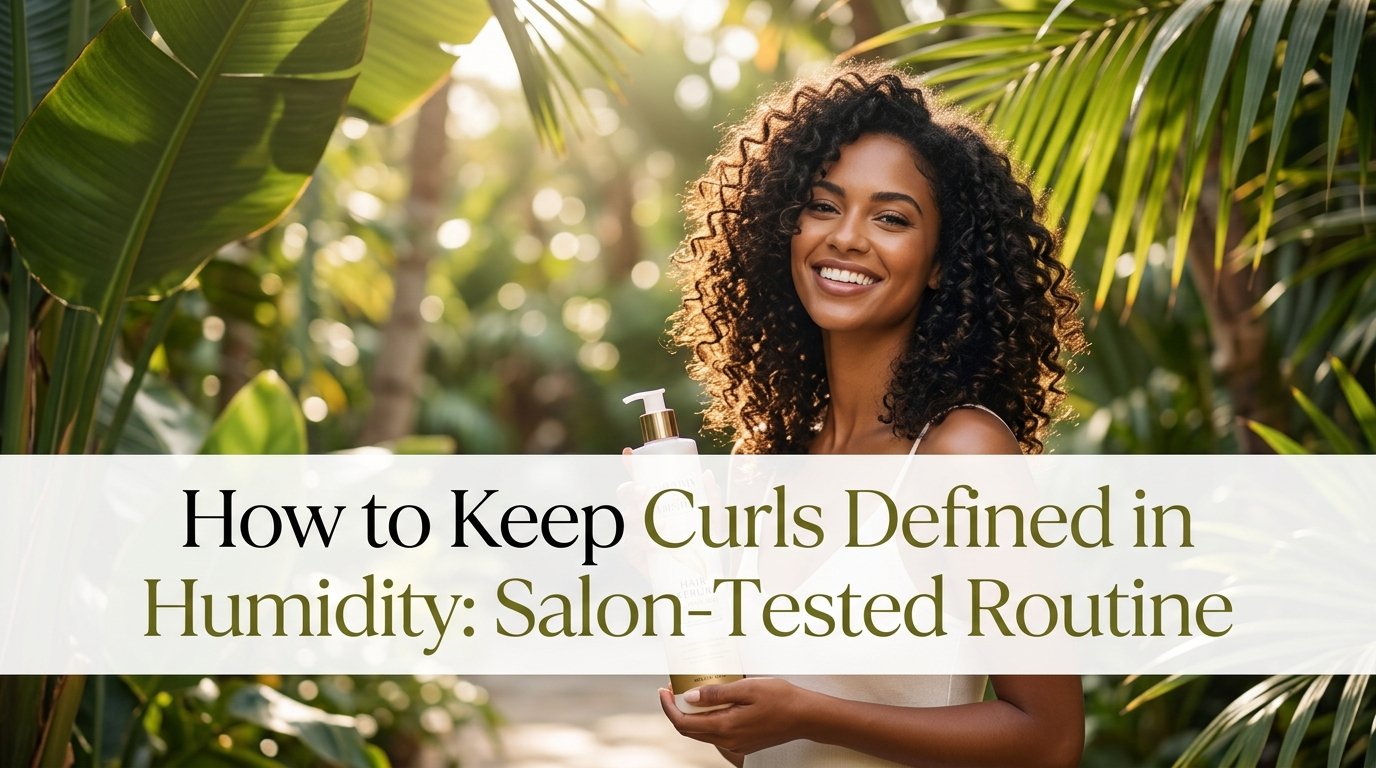
If you have ever spent an hour perfecting your curls only to watch them dissolve into a frizzy cloud the second you step outside, you are not imagining things. Humidity is the single biggest threat to curl definition, and it works fast. At our salon, we hear the same frustration from clients every summer: their wash-and-go lasts 20 minutes in humid air before falling flat or poofing up.
Here is the good news. Once you understand the science behind why humidity ruins curls, you can build a routine that fights back at every step. This guide breaks down exactly how to keep curls defined in humidity, from wash day through next-day refresh, with specific techniques we have tested on hundreds of curly-haired clients.
Table of Contents
Why Humidity Wreaks Havoc on Curly Hair
Humidity destroys curl definition because human hair is hygroscopic, meaning it actively absorbs moisture from the surrounding air. When humidity levels rise above 60 percent, your hair shaft pulls water vapor right out of the atmosphere.
That absorbed moisture causes the hair cuticle to swell and lift. As the cuticle layers separate, the smooth pattern that defines your curls breaks down. The hydrogen bonds that hold each curl in its shape temporarily snap and reform in random directions, creating frizz.
Curly hair is more vulnerable than straight hair because its oval-shaped shaft and raised cuticle layers already allow easier moisture entry. The tighter your curl pattern, the more points of weakness exist along each strand where moisture can penetrate.
This is why the same products that work beautifully in dry winter air fail completely in July humidity. The problem is not your hair. It is the rate of moisture absorption outpacing your product’s ability to seal the cuticle shut.
How Different Curl Types Respond to Humidity
Not all curls react to humidity the same way. Understanding your curl type helps you predict and prevent the specific failure mode your hair experiences.
Type 2 (Wavy): Wavy hair tends to fall completely flat in humidity. The loose wave pattern lacks the structural tension to fight moisture intrusion, so waves drop and hair appears straighter but frizzier.
Type 3 (Curly): True curls experience the most dramatic shift. You get curl shrinkage combined with perimeter frizz. The curl pattern tightens unpredictably while individual strands separate from the curl cluster.
Type 4 (Coily): Coily hair absorbs moisture quickly due to its highly porous structure. This can actually cause temporary shrinkage and tightening, but the main issue is loss of definition as coils lose their clumped pattern and individual strands frizz outward.
The Humidity Index and Your Hair
The dew point matters more than relative humidity for predicting how your hair will behave. When the dew point exceeds 60 degrees Fahrenheit, expect significant frizz regardless of your curl type. Dew points above 70 degrees mean you need maximum defense.
Check your local dew point the same way you check the weather forecast. This single number tells you how aggressive your anti-humidity routine needs to be that day.
How to Keep Curls Defined in Humidity: The Step-by-Step Routine
The core principle is simple: prevent your hair from absorbing excess moisture in the first place. Every step below serves that goal. Follow this routine on wash day, and your curls will survive humid conditions far longer.
Step 1: Wash With Cool or Lukewarm Water
Hot water raises the hair cuticle, which is exactly what you want to avoid before facing humid air. Cool or lukewarm water keeps the cuticle flat and tightly sealed during cleansing.
Finish your shower with a 30-second cool water rinse. This final blast forces the cuticle closed and creates a smoother surface that resists moisture absorption throughout the day.
Use a sulfate-free shampoo or co-wash. Sulfates strip natural oils that act as your hair’s built-in moisture barrier. Without those oils, your hair becomes a sponge for humidity.
Step 2: Apply Leave-In Conditioner to Soaking-Wet Hair
Do not towel-dry first. Apply your leave-in conditioner while your hair is still dripping wet in the shower. The water helps distribute the product evenly and ensures the cuticle is fully saturated with good moisture before it seeks out bad moisture from the air.
Rake the product through section by section, then smooth each section from ends to roots. This downward motion presses the cuticle flat and trains the curl clumps to form cleanly.
Hydrated hair does not chase humidity. If your hair is fully moisturized from your products, it has less incentive to pull water from the atmosphere. This is the moisture management principle in action.
Step 3: Apply a Strong-Hold Gel With Film-Forming Ingredients
This is the most important step for humidity defense. You need a strong-hold gel that contains film-forming polymers. These ingredients create a flexible invisible barrier around each curl that blocks humidity from penetrating the hair shaft.
Look for these specific ingredients on your gel’s label:
- Polyquaterniums (Polyquats): Polyquaternium-4, Polyquaternium-11, and Polyquaternium-69 are the gold standard for humidity resistance. They form a durable film that holds curl shape while repelling excess moisture.
- VPVA Copolymer: This vinyl-based polymer creates a hard hold that locks curl definition in place even in tropical conditions.
- Hydroxyethylcellulose: A film-forming thickener that adds structure to the gel’s hold and helps seal the cuticle.
Apply the gel using the praying hands method first to coat each strand, then scrunch upward to encourage curl formation. Use more product than you think you need. Most people under-apply gel and wonder why their curls fall apart.
You are looking for a gel cast, that crunchy shell that forms as the gel dries. This cast is your humidity shield. Once hair is fully dry, you scrunch out the crunch to reveal soft curls underneath.
Step 4: Seal With a Lightweight Oil or Serum
After applying gel, add a thin layer of lightweight oil to seal the hair’s moisture barrier. This step locks in the hydration from your leave-in and creates an additional hydrophobic layer that repels atmospheric moisture.
Use lightweight options like argan oil, jojoba oil, or a silicone-based anti-frizz serum. Apply just a few drops, emulsified between your palms, and gently glide over the surface of your hair. Focus on the canopy and ends where frizz appears first.
One critical warning we give every client: avoid heavy oils and heavy butters in high humidity. Shea butter, castor oil, and coconut oil can actually attract moisture and worsen frizz by drawing water into the hair shaft. Save these for dry winter months.
Step 5: Dry Completely Before Stepping Outside
This step is non-negotiable. If your hair is even slightly damp when you walk into humid air, the cuticle is still open and the gel cast has not fully formed. Humidity will rush in and undo everything you just did.
Diffuse your hair on low heat and low speed until it is 100 percent dry. Air-drying works too, but plan for at least two to three hours before going outside. Press a strand between your fingers. If it feels cool at all, keep drying.
Once fully dry, let the hair cool completely, then scrunch out the gel cast. This sequence matters. Scrunching while hair is still warm breaks the cast before it has fully hardened and invites frizz.
Step 6: Refresh Without Adding Water
Day two and beyond require a different approach. The biggest mistake we see is saturating curls with water to refresh them. Water reopens the cuticle and restarts the humidity absorption cycle.
Instead, use a small amount of leave-in conditioner or curl cream on your fingertips to reshape individual curls that have lost definition. Smooth and twist the curl back into place without wetting the surrounding hair.
For surface frizz, rub a drop of oil between your palms and gently press it over the top layer of hair. This calms flyaways without disturbing the curl structure underneath.
Key Ingredients That Fight Humidity (And Which to Avoid)
Knowing which ingredients to look for and which to skip makes the difference between curls that survive a humid day and curls that collapse before lunch. Here is what works and what hurts.
Seek out film-forming polymers. Polyquats, copolymers, and hydroxyethylcellulose create the physical barrier that prevents moisture from entering the hair shaft. These are the active ingredients in humidity-resistant gels and styling creams.
Embrace water-soluble silicones. Ingredients like dimethicone copolyol create a lightweight seal that blocks humidity without building up on the hair. They are especially effective for fine and wavy hair types that cannot handle heavy oils.
Avoid humectants in high dew points. Glycerin, propylene glycol, and honey are humectants that draw moisture from the air into your hair. In dry climates this is helpful. In humidity above 60 dew point, these ingredients accelerate frizz by flooding the hair shaft with excess water.
Avoid heavy oils and butters. As mentioned above, shea butter and heavy oils attract rather than repel moisture in humid conditions. They coat the hair without sealing it, creating a sticky surface that grabs water vapor.
Common Mistakes That Ruin Curls in Humidity
Even with the right products, certain habits will sabotage your humidity defense. These are the four most common mistakes we correct during client consultations.
Mistake 1: Touching your hair throughout the day. Every time you run your fingers through your curls, you break the gel cast and disrupt the curl clumps. Once your hair is styled and dry, hands off until your next wash day.
Mistake 2: Going outside with damp hair. We covered this above, but it deserves repeating because it is the number one cause of instant frizz. Wet or damp hair plus humid air equals immediate curl collapse.
Mistake 3: Using too much moisture and not enough hold. Many people pile on leave-in conditioner and curl cream but skip the gel. Without a strong-hold product to seal everything in, all that moisture escapes and invites humidity to replace it.
Mistake 4: Skipping the cool water rinse. That final cool rinse is what closes the cuticle after washing. Without it, your cuticle stays raised and becomes an open door for humidity the moment you step outside.
Sleep Protection for Next-Day Humidity Resilience
How you sleep directly affects how your curls handle humidity the next day. Cotton pillowcases absorb moisture from your hair overnight, leaving it dry and porous by morning. Porous hair absorbs humidity faster.
Switch to a satin or silk pillowcase, or wear a satin bonnet to bed. Both options preserve your hair’s moisture balance and protect the curl pattern from friction that causes frizz while you sleep.
For longer hair, try the pineappling technique. Gather your curls loosely at the top of your head with a satin scrunchie before bed. This keeps curls intact without flattening them, so your humidity defense from yesterday’s styling carries into the next day.
Setting Realistic Expectations for Humid Weather
No routine makes curls completely immune to 90 percent humidity with a 75 degree dew point. The goal is extending your curl definition from 20 minutes to a full day, not achieving perfection in extreme conditions.
On the worst humidity days, consider protective styles that tuck your ends away. Buns, braids, and updos keep your curl pattern safe until conditions improve. Your curls will still be there when the humidity drops.
Frequently Asked Questions
Why do my curls fall out when it’s humid?
Your curls fall out in humidity because curly hair absorbs moisture from the air, causing the cuticle to swell and the hydrogen bonds that define your curl pattern to break and reform randomly. This moisture intrusion separates curl clumps and creates frizz, which makes curls appear to fall apart or lose their shape.
What is the best product to hold curls in humidity?
The best product for humidity resistance is a strong-hold gel containing film-forming polymers, specifically polyquaterniums like Polyquaternium-4, Polyquaternium-11, or Polyquaternium-69. These ingredients create a flexible barrier around each curl that blocks moisture from entering the hair shaft. Brands like Ouidad, Living Proof, and The Doux formulate gels specifically for humid climates.
How do I stop curly hair poofing up in humid weather?
To stop curly hair from poofing in humidity, apply leave-in conditioner to soaking-wet hair, follow with a strong-hold gel using film-forming polymers, seal with a lightweight oil, and dry your hair completely before going outside. Avoid heavy butters and humectants like glycerin when the dew point is above 60 degrees Fahrenheit.
Can progesterone make your hair curly?
Hormonal changes, including shifts in progesterone and estrogen levels during pregnancy or menopause, can alter your hair’s curl pattern. These hormones affect the shape of the hair follicle, which can cause straight hair to become wavy or curly, or change existing curl patterns. This is separate from humidity effects and reflects a permanent change in hair texture.
The Bottom Line on Curls and Humidity
Learning how to keep curls defined in humidity comes down to one principle: moisture management. Hydrate your hair fully in the shower so it does not seek moisture from the air, then seal it shut with film-forming ingredients and a strong-hold gel.
The clients who see the best results do not rely on a single miracle product. They follow the full routine consistently, every wash day, from cool water rinse through complete diffusing. Build the habit, check your dew point, and adjust your product choices based on what the atmosphere throws at you.
Your curls can survive humid weather. They just need the right defense system in place before you walk out the door.