
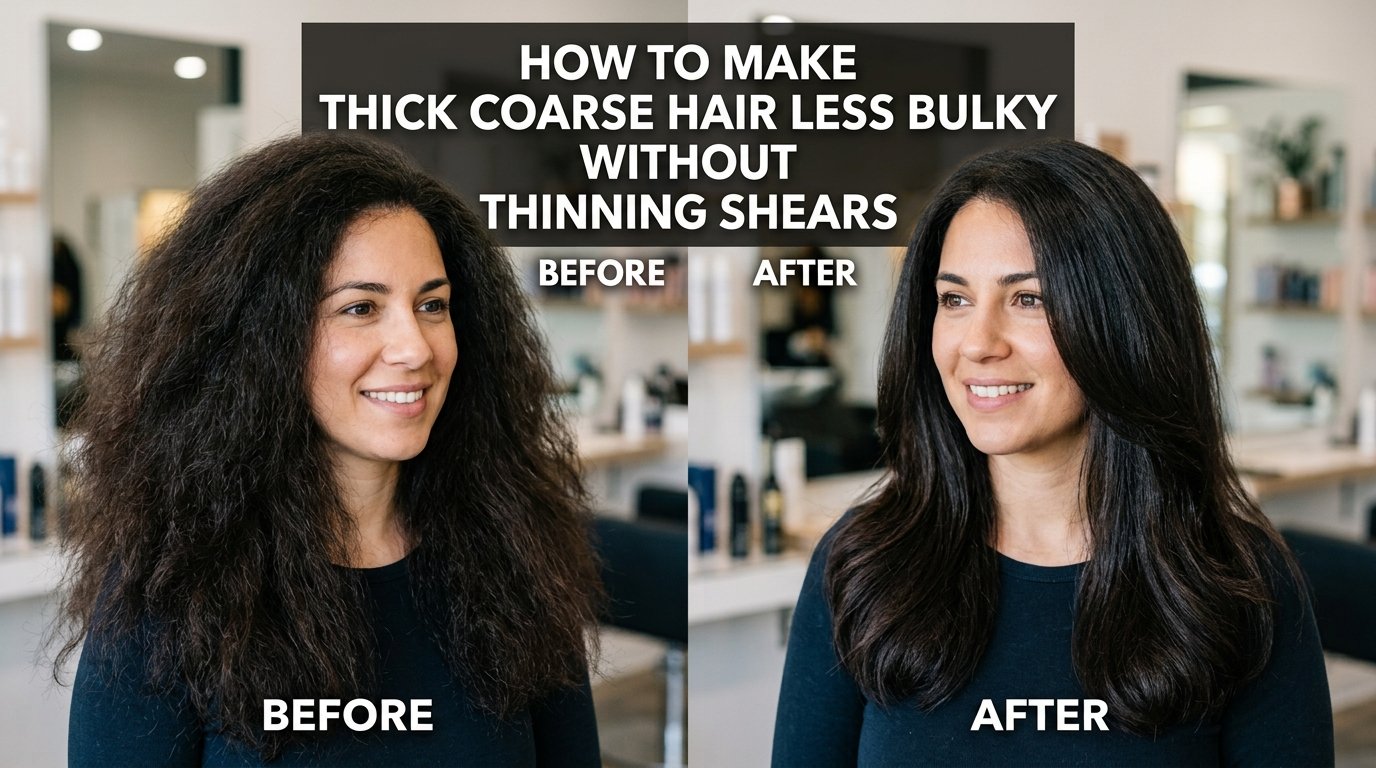
If you have thick, coarse hair, you already know the struggle. Your hair holds weight like a blanket, dries into a triangle shape, and pulls at your scalp by the end of the day. Thinning shears seem like the obvious fix, but they often create frizz, damage the ends, and grow out unevenly.
The good news is that you can absolutely reduce bulk without ever touching a pair of thinning shears. In this guide, I will walk you through the cutting techniques, styling methods, and home-care habits that salon professionals use to keep thick hair manageable, lightweight, and full of movement.
The goal here is not to make your hair look thinner. It is to make it feel lighter, easier to style, and free of that heavy “blanket” feeling. Let us get into how to make thick coarse hair less bulky without thinning shears.
Table of Contents
Why Thick Coarse Hair Feels So Bulky
Thick hair is not just about the width of each strand. It is about density, which means how many individual hairs grow per square inch on your scalp. High-density hair packs more strands into the same area, and that creates real, physical weight.
Coarse hair adds another layer to the problem. Each strand is wider in diameter, which means it takes up more space and holds more moisture. When coarse strands are cut bluntly at one length, they stack on top of each other like bricks, creating that dreaded triangle silhouette where the bottom flares out and the top lies flat.
Debulking is the professional term for removing that stacked weight. Unlike thinning, which randomly cuts strands short all over, debulking targets specific zones where weight collects. It preserves your length while changing how the hair distributes its volume.
Thinning shears cause problems because they chop random strands at different lengths, which creates frizz and encourages the coarse texture to puff outward. Debulking techniques, by contrast, work with your natural growth pattern.
How to Make Thick Coarse Hair Less Bulky Without Thinning Shears
Here are five professional cutting techniques that remove bulk without thinning shears. Each one serves a slightly different purpose, and most stylists combine two or three of them in a single appointment.
Strategic Layering (Interior and Exterior)
Layers are the single most effective way to reduce bulk, and they work for every hair type from bone-straight to tightly coiled. The key is understanding that there are two different kinds.
Exterior layers are cut on the surface of the hair. They remove weight from the top and create visible movement, which is what gives hair that light, bouncy look. Shorter exterior layers near the crown lift the top section so it does not lie flat against the heavy mass below.
Interior layers are cut underneath, close to the nape of the neck. This is where most of the weight lives. By removing length from the underneath sections while leaving the top layer long, your stylist can take out serious bulk without changing your visible length at all. Many people are surprised to learn that interior layering alone can transform heavy hair.
For curly and coily coarse hair, layers prevent the triangle effect by distributing curl volume vertically instead of stacking it at the bottom. Ask for longer layers spaced throughout the length rather than short, choppy ones.
Point Cutting for Soft, Weightless Ends
Point cutting is a technique where the stylist holds the scissors vertically and cuts upward into the ends of the hair rather than straight across. This creates a soft, feathered edge instead of a blunt line.
Why does this reduce bulk? A blunt cut stacks every strand at the same length, which concentrates all the weight at one point. Point cutting distributes those ends across slightly different lengths, so the weight spreads out and the hair falls more naturally.
This technique works especially well on coarse hair because the wide strand diameter makes blunt lines look heavy and blocky. Point cutting softens that effect immediately, and it is one of the easiest alternatives to thinning shears because it uses regular cutting shears.
For thick hair that is prone to puffing, ask your stylist to point cut dry rather than wet. Dry cutting lets the stylist see exactly how your hair falls and how much weight sits where, so the result is far more precise.
Slide Cutting to Remove Length Bulk
Slide cutting is a method where the stylist opens the shears and glides them down the length of the hair in a smooth motion. Instead of making a single cut, the blades gently taper the hair shaft as they travel downward.
This technique is excellent for removing bulk from the mid-lengths to the ends of thick hair. It thins out the visual density of each section without chopping strands short, which means no frizz-prone short pieces sticking out.
Slide cutting works particularly well on wavy and curly coarse hair because it follows the natural curve of the hair. The result is a seamless transition from thicker roots to lighter ends, and the hair looks balanced rather than bottom-heavy.
One important note: slide cutting requires sharp, high-quality shears with a convex edge. Dull scissors will pull and damage the hair, so this is a technique best left to a professional.
Slice Cutting for Coarse Textures
Slice cutting is similar to slide cutting but the motion is more deliberate. The stylist takes a section of hair, holds it taut, and slices through it at an angle, removing a sliver of hair from the interior of the section.
This is different from thinning shears because the stylist controls exactly which pieces get removed. Thinning shears close on a chunk of hair and cut whatever falls between the teeth, but slicing lets the stylist choose the weight points and remove them with intention.
Slice cutting is one of the best techniques for coarse hair because the wide strand diameter means even a small reduction in each section makes a noticeable difference. Your stylist can remove weight from the areas where your hair feels heaviest, like the sides and the back base, while leaving the perimeter intact.
Undercut and Interior Shaping
For the heaviest, most stubborn bulk, an undercut or interior shaping may be the answer. This involves removing hair from the underneath layer at the nape, where weight tends to collect most aggressively.
An undercut takes this a step further by actually shaving or clipping the bottom layer very short, hidden beneath the longer top layers. This dramatically reduces weight while keeping the visible length untouched. It is a popular choice for people who get headaches from heavy ponytails or who struggle with drying time.
Interior shaping is a gentler version. Instead of shaving, the stylist uses cutting shears to remove bulk from the bottom interior sections. The result is lighter, more breathable hair without the dramatic commitment of an undercut.
What to Ask Your Stylist
One of the biggest pain points people share is not knowing what to say in the salon chair. Here are exact phrases you can use to get the result you want without thinning shears.
Say this: “I want to reduce the bulk in my hair, but I do not want thinning shears. Can you use layering and point cutting to remove weight instead?”
If your hair triangles out, add: “My hair stacks at the bottom and gets heavy. Can you add interior layers underneath to distribute the weight?”
If you want to keep your length, say: “I want to keep my length but take out as much weight as possible. Can you slide cut or slice cut through the mid-lengths and ends?”
If your stylist insists on thinning shears, that is a sign they may not be comfortable with the alternative techniques. It is worth finding a stylist who specializes in thick or textured hair, because these techniques require skill and practice to execute well.
Styling Methods That Reduce Bulk at Home
What you do between salon visits matters just as much as the cut itself. The right styling routine can keep your hair looking light and manageable for weeks.
Blow-Dry in Sections
Drying thick hair all at once guarantees frizz and uneven results. Instead, divide your hair into four to six sections using clips. Work through each section one at a time, pulling the hair upward with a round brush as you dry.
Pulling the hair upward while drying lifts the root area and prevents the top from lying flat against the heavy sides. This single change in technique can make thick hair look significantly less bulky, even on days when you do not wash.
Always use a concentrator nozzle on your dryer. It directs the airflow downward along the hair shaft, which smooths the cuticle and prevents the coarse texture from puffing outward.
Choose Lightweight Products
Heavy creams and oils will weigh coarse hair down and make it look greasy at the roots while the ends stay dry. Look for products labeled as lightweight, volumizing, or smoothing without weight.
A smoothing milk or lightweight serum applied to damp hair before drying helps control frizz without adding bulk. Avoid applying product to your roots, where it will flatten the hair and undo all the work your stylist did with layers.
Wash Less Frequently
Thick coarse hair does not need daily washing. In fact, washing too often strips the natural oils that keep coarse strands flexible and smooth. Most people with thick hair do best with two to three washes per week.
Between washes, a small amount of dry shampoo at the roots can absorb oil and add lift. This keeps the top of your hair from going flat under the weight of the bulk below.
One warning from the forums: thick hair that is not dried completely can develop a mildew smell at the underneath layers. Always make sure the nape area is fully dry before you leave the house or go to sleep.
Signs Your Hair Needs Debulking
Not sure if your hair actually needs weight removal? Here are the most common signs that it is time to ask your stylist for debulking techniques.
Your hair forms a triangle or pyramid shape when it dries naturally. This is the classic sign that weight is stacking at the bottom and needs interior layers to redistribute it.
You get headaches or scalp soreness from wearing your hair up. Heavy hair pulls on the follicles, and ponytail headaches are a real problem for high-density hair.
Your hair takes more than an hour to dry, or the underneath layers stay damp long after the top feels dry. Excess density traps moisture, and this can lead to scalp issues if left unchecked.
Your hair looks great for one day after washing but becomes unmanageable by day two. This often means the cut is not supporting the natural movement of your hair, and layers or point cutting would help distribute the weight more evenly.
FAQs
How to take bulk out of hair without thinning shears?
Ask your stylist for interior layers, point cutting, and slide cutting. Interior layers remove weight from underneath while keeping length. Point cutting softens blunt ends so weight distributes more evenly. Slide cutting tapers the mid-lengths and ends to reduce visual density without creating frizz-prone short pieces.
What can I use instead of thinning shears?
Regular cutting shears can remove bulk using point cutting, slide cutting, slice cutting, and strategic layering. These techniques give the stylist precise control over which sections get thinned, unlike thinning shears which randomly cut strands. An undercut or interior shaping can also reduce weight dramatically without thinning shears.
How to make thick hair look thinner without cutting it?
Blow-dry in sections pulling the hair upward to lift roots and prevent the top from lying flat. Use lightweight smoothing products instead of heavy creams. Wash two to three times per week to preserve natural oils. These styling habits reduce the appearance of bulk between salon visits, though cutting techniques provide the most noticeable difference.
What is debulking hair?
Debulking is the process of removing weight from specific areas of thick hair to improve manageability. Unlike thinning, which randomly cuts strands at different lengths, debulking targets zones where weight collects, such as the nape and mid-lengths. The goal is to preserve length and natural density while making the hair feel lighter and easier to style.
How to reduce bulk in thick hair?
Combine professional cutting techniques with smart home care. In the salon, ask for interior layers, point cutting, and slide cutting. At home, blow-dry in sections, use lightweight products, and wash less frequently. The combination of a properly debulked cut and a supportive styling routine is the most effective way to keep thick hair manageable long-term.
Why do thinning shears cause frizz in coarse hair?
Thinning shears cut random strands at different lengths throughout the hair. In coarse textures, these short pieces push outward against the surrounding hair, creating frizz and puffiness. The cut ends of coarse strands are also wider and more visible, which makes the frizz effect more pronounced than it would be on fine hair.
Conclusion
Making thick coarse hair less bulky without thinning shears is entirely possible when you know which techniques to ask for. Interior layers, point cutting, slide cutting, slice cutting, and undercutting all remove weight strategically, and they do it without the frizz and damage that thinning shears cause.
The most important step is communication. Walk into your salon with the exact phrases from this guide, and find a stylist who is comfortable working with regular shears on thick hair. Pair the right cut with section-by-section blow-drying and lightweight products, and your hair will feel lighter, move better, and actually behave between washes.
Remember, the goal of learning how to make thick coarse hair less bulky without thinning shears is not to fight your natural density. It is to work with it so your hair feels like an asset instead of a burden.