
Most bad haircuts do not happen because your stylist lacks skill. They happen because of miscommunication between you and the person holding the scissors. If you have ever left a salon thinking “this is not what I asked for,” you already know how frustrating that gap can be.
Learning how to describe the haircut you want so your stylist gets it right is a skill anyone can develop. You do not need to memorize a cosmetology textbook or learn a secret barber language. You just need a few reference points, a handful of key terms, and a willingness to speak honestly about what you want.
Our team at Mercer Street Salon has seen every type of consultation imaginable, from clients who bring a folder of magazine clippings to those who simply say “make it look better.” This guide breaks down exactly what works, what does not, and how to walk into your next appointment with total confidence.
Table of Contents
Why You Leave the Salon Disappointed (And How to Fix It)
Nearly every disappointing haircut traces back to one root cause: vague instructions. One Reddit user in r/IWantToLearn summed it up perfectly when they wrote, “I know no hair terminology and generally go with ‘long on top and short round the sides’ which has been interpreted a wide variety of ways by different barbers.”
That comment resonated with thousands of people because it describes a universal experience. The phrase “short on the sides” could mean a quarter inch to one stylist and two inches to another. “Just a trim” might mean half an inch to you and three inches to someone who cuts hair every day.
The fix is not complicated. You need to replace vague descriptors with specific ones, back up your words with visual references, and learn just enough terminology to bridge the gap between what you picture in your head and what your stylist hears. When you describe the haircut you want with precision, your stylist can actually deliver it.
A professional stylist at a salon will almost always ask you clarifying questions during the consultation. But you cannot count on that alone. The more clearly you communicate upfront, the less room there is for interpretation, and the happier you will be with the result.
The 3-2-1 Rule: A Quick Framework for Any Haircut
If you remember nothing else from this article, remember this framework. The 3-2-1 Rule gives you a simple structure for communicating any haircut to any stylist, whether you are at a high-end salon or a neighborhood barber shop.
Here is the 3-2-1 Rule for haircuts:
- 3 measurements: Tell your stylist how long you want the top, the sides, and the back. Use body anchors like “to the collarbone” or “two fingers above the ear.”
- 2 reference photos: Bring one photo of the style you want and one of what you definitely do not want. Two photos give your stylist a visual range.
- 1 thing to avoid: State clearly the one thing you do not want, such as “no layers shorter than my chin” or “do not go above the ear on the sides.”
That is it. Three measurements, two photos, one dealbreaker. This framework works because it covers length, visuals, and boundaries all at once. Your stylist gets numbers they can act on, images they can reference, and a clear line not to cross.
The 3-2-1 Rule is especially useful if you feel nervous or tend to freeze up during consultations. Write it down on your phone before the appointment and read through it while you wait. You will sound organized, clear, and respectful of your stylist’s time.
Bring Reference Photos (But Not Just Any Photos)
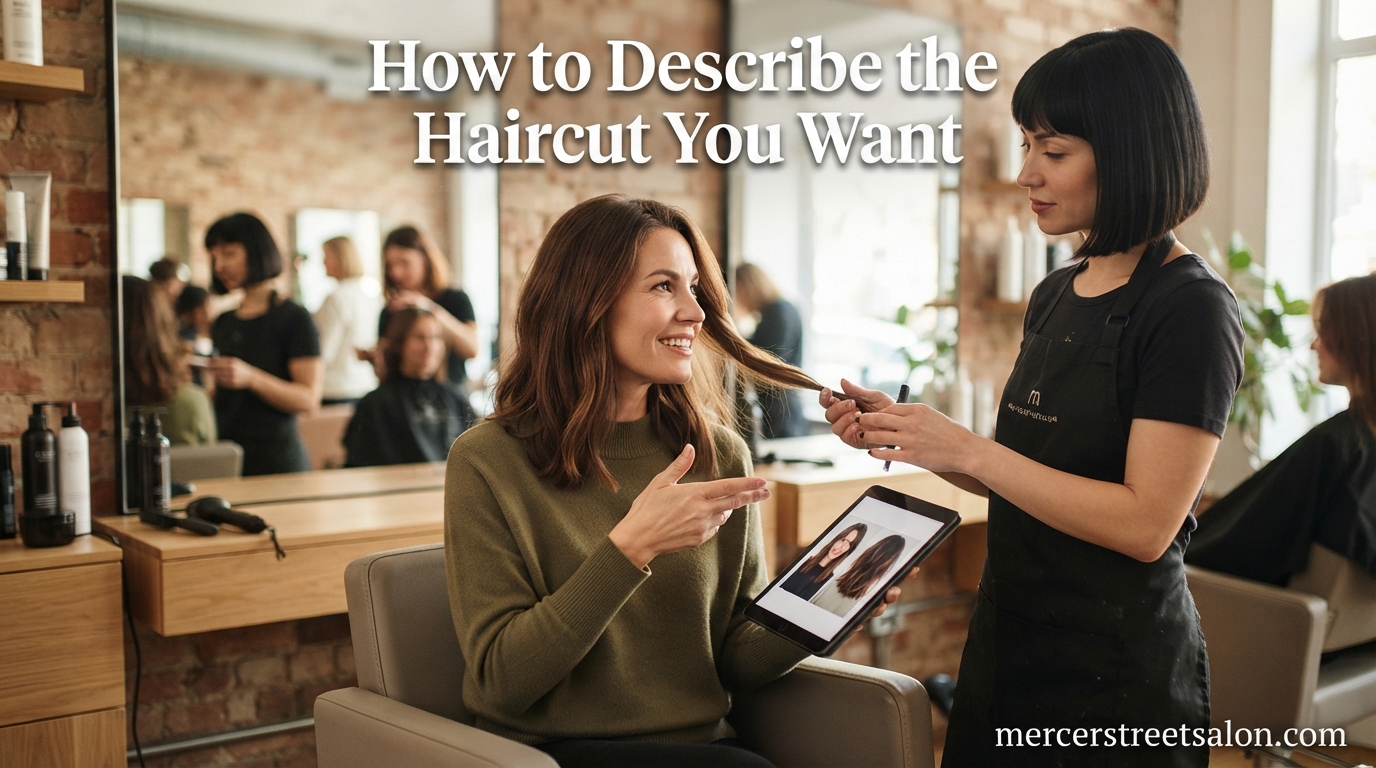
A picture removes ambiguity in a way that words rarely can. Nearly every professional stylist and barber agrees that reference photos are the single most effective communication tool you can bring to an appointment. One hairdresser on Reddit put it bluntly: “Just show them the reference photo rather than trying to describe it in words.”
But not all reference photos are created equal. The wrong photo can actually create more confusion than it solves. Here is how to choose photos that actually help your stylist.
What Makes a Great Reference Photo
The best reference photos share three qualities. They show the haircut from multiple angles, they feature hair with a similar texture and density to yours, and they were taken in natural lighting without heavy filters.
If you find a photo of a celebrity with pin-straight fine hair and you have thick wavy hair, the photo is less useful than you think. Your stylist can adapt the shape of the cut, but they cannot change your hair type. Look for reference photos featuring hair that behaves like yours.
Try to bring two to three photos rather than relying on a single image. One photo shows the overall vibe, another shows the back or side angle, and a third can highlight a specific detail like the fringe or the neckline. Multiple angles help your stylist see the full picture.
Where to Find Good Reference Photos
Pinterest and Instagram are the two best sources for haircut inspiration in 2026. On Pinterest, search for specific terms like “collarbone length layers” or “low taper fade” rather than generic terms like “cute haircut.” Specific searches return photos with descriptive captions that often include the terminology you need.
On Instagram, look at your salon’s own page or your stylist’s personal portfolio. Before and after photos from the same salon are the gold standard because they show what that specific stylist can actually produce. A celebrity red carpet photo looks great, but it may have been styled by a team of professionals with an hour of work and specialized tools.
Watch Out for AI-Generated Photos
This is a growing problem in 2026. AI-generated hairstyle photos are flooding Pinterest and Instagram, and they look incredibly realistic. But AI hair does not follow the rules of real hair. The textures are often impossible, the densities do not match any real person, and no stylist can replicate what a computer imagined.
How can you tell if a photo is AI-generated? Look for inconsistent details like hair that merges into clothing, impossibly uniform curls, or backgrounds that look slightly warped. When in doubt, stick to photos from real salons, tagged accounts, or verified hairstyle accounts run by actual professionals.
Learn These 10 Haircut Terms Before Your Appointment
You do not need to speak fluent cosmetology, but knowing a handful of terms will dramatically improve your consultation. Think of these words as a shared vocabulary that helps you and your stylist get on the same page quickly. Here are the 10 terms that matter most when you describe the haircut you want.
1. Fade
A fade is a gradient cut where the hair transitions smoothly from short to long, typically on the sides and back. The key word is gradient. There is no hard line where the short hair meets the long hair. Instead, the length blends seamlessly.
Fades come in different heights. A low fade starts just above the ears. A mid fade starts around temple height. A high fade goes up toward the crown of the head. Tell your stylist which height you want and they will know exactly what to do.
2. Taper
A taper is similar to a fade but more subtle. Instead of a dramatic gradient, a taper gradually decreases in length around the ears and neckline while leaving more length overall. Think of a taper as a gentler cousin of the fade.
Many people confuse fade and taper. Here is the simple difference: a fade goes short fast and creates a visible gradient, while a taper keeps more length and transitions more gradually. If you want clean edges without going skin-short, ask for a taper.
3. Blunt Cut
A blunt cut means the hair is cut straight across in a clean line with no layering or texturizing. This creates a sharp, solid edge at the bottom. Blunt cuts are popular for bobs and one-length styles because they make hair look thick and dense.
If you want your hair to look full and heavy at the ends, ask for a blunt cut. If you want movement and softness, you probably want layers instead.
4. Layers
Layers are sections of hair cut at different lengths to create movement, volume, and texture. Short layers sit higher on the head and add body. Long layers are more subtle and add dimension without removing too much weight.
When asking for layers, specify where you want them to start. “Layers starting at the chin” gives your stylist a clear landmark. “Just give me some layers” does not.
5. Face Framing
Face framing is a technique where shorter pieces of hair are cut around the face to soften your features and create a flattering shape. Think of the pieces that curve around your cheekbones or jawline. Face framing is different from full layers because it only affects the front sections.
This is one of the most requested techniques in salons because it works with almost any length and adds a polished finish without a dramatic change.
6. Undercut
An undercut involves shaving or cutting the hair very short underneath while leaving length on top. The longer hair covers the short sections, so the undercut is hidden until you pull your hair up. This technique reduces bulk and adds an edgy element.
7. Guard Numbers (Clipper Sizes)
Guard numbers refer to the plastic attachments that go on clippers to control how much hair is removed. The system runs from 0 to 8. A number 0 is essentially bare clippers, leaving almost no hair. A number 3 leaves about three-eighths of an inch. A number 8 leaves about an inch.
If you get your hair cut with clippers, knowing your preferred guard number is incredibly helpful. Saying “a number 2 on the sides” tells your stylist exactly what length you want, with zero room for misinterpretation.
8. Neckline
The neckline is how the hair is finished at the back of the neck. Options include a squared neckline, a rounded neckline, or a tapered neckline. For longer hair, the neckline might refer to whether the back is cut straight across or shaped into a V.
9. Fringe (or Bangs)
A fringe, commonly called bangs in the United States, refers to the hair cut across the forehead. Fringes come in many styles: blunt straight across, wispy and textured, side-swept, or curtain bangs that part in the middle and frame the face.
If you want bangs, specify the style and the length. “Wispy curtain bangs to the cheekbone” is far more useful than “I want some bangs.”
10. Texturizing
Texturizing is a technique where the stylist uses thinning shears or a razor to remove bulk and add movement to the hair. It softens blunt lines and makes thick hair more manageable. If your hair feels heavy or puffy at the ends, texturizing can help.
Be specific about how much texturizing you want. Light texturizing removes just a bit of weight. Heavy texturizing creates a significantly softer, more piece-y look.
Be Specific About Length: Stop Saying Just a Trim
Length is the number one source of haircut miscommunication. The phrase “just a trim” is notorious in the salon world because it means something different to every person who says it. To you, a trim might mean a quarter inch. To a stylist, a trim might mean an inch and a half.
One Reddit user shared a painful story in r/AskWomenOver30: “I got a decent haircut yesterday but I’m upset because it’s about 3 inches shorter than I wanted.” That three-inch gap between expectation and reality is exactly what we are trying to prevent.
Use Body Part Anchors
Instead of using inches (which are hard to visualize in hair), use body part anchors. These are physical reference points on your body that both you and your stylist can see and agree on.
For example: “I want the front to reach my collarbone.” “Leave the back long enough to touch my bra strap.” “Take the sides to two fingers above my ear.” “I want the fringe to hit right at my eyebrow.”
Body anchors are unambiguous. Your stylist cannot misinterpret “to the collarbone” the way they might misinterpret “about two inches shorter.”
Show the Length on Your Body
Even better than naming a body part is physically pointing to it. During the consultation, pull your hair to the exact length you want it and hold it there. Say “this is the longest I want it” and then say “and this is the shortest I would be okay with.” That gives your stylist a range to work within.
This technique is especially helpful if you are nervous about your hair being cut too short. By establishing the shortest acceptable length before the scissors come out, you set a boundary that protects you from leaving with a haircut that makes you unhappy.
Clarify What You Mean by Trim
If you genuinely want a trim, meaning you want to keep your current style and just clean up the ends, say that explicitly. Try: “I want to keep the exact same style. Just remove the split ends, about a half inch maximum.”
The words “same style” and “half inch maximum” give your stylist clear boundaries. There is no room for creative interpretation when you specify both the shape and the amount being removed.
Describe Your Real Styling Routine (Not Your Aspirational One)
Here is a truth that many people learn the hard way: a haircut is only as good as your ability to style it at home. If your stylist creates a look that requires 45 minutes of blow-drying and curling every morning, but you are a wash-and-go person, that haircut will never look the same again after you leave the salon.
Be brutally honest about your daily routine. Tell your stylist how many minutes you actually spend on your hair each morning. If the answer is five minutes, say five minutes. If the answer is zero and you rely on dry shampoo and a ponytail three days a week, tell them that too.
Mention the tools you use regularly. If you never touch a flat iron, your stylist needs to know. If you blow-dry every day but never use a round brush, that matters. If you air-dry your hair and embrace its natural texture, that changes the entire approach to the cut.
Talk about products too. If you are someone who does not like the feeling of product in your hair, your stylist can recommend a low-maintenance cut that works without styling creams or pomades. If you enjoy experimenting with products, they can give you a more versatile cut with more styling options.
The goal is to get a haircut that fits your real life, not the life you wish you had. A great stylist will appreciate this honesty because it helps them design a cut that you can actually reproduce at home. Nobody wins when you love the salon version but hate the day-three version.
7 Phrases That Guarantee a Haircut You Will Not Like
Certain phrases are almost guaranteed to produce a haircut you did not want. These phrases are vague, open to interpretation, or based on assumptions that do not match reality. Here are seven things to stop saying and what to say instead.
1. “Just a trim”
As we covered earlier, “just a trim” means something different to everyone. Say instead: “I want to keep the same style and remove half an inch to clean up the ends.”
2. “Short but not too short”
This phrase gives your stylist zero useful information. Short to one person is a buzz cut. Short to another is a bob. Say instead: “Take the sides to a number 2 guard and leave about three inches on top.”
3. “Do whatever you think looks good”
This sounds like you are being easygoing, but it actually puts your stylist in an impossible position. They do not know your preferences, your lifestyle, or your comfort level with change. Even if you trust your stylist’s judgment, give them a starting point and some boundaries.
4. “Make me look like this celebrity”
Celebrity photos are fine as general inspiration, but expecting to look exactly like a photo is unrealistic. Your hair texture, face shape, and density are different. Say instead: “I love the shape of this cut. Can we adapt it for my hair type?”
5. “A little off the ends”
“A little” is subjective. Say instead: “One inch off the length, and clean up the layers so they start at the collarbone.”
6. “Something different”
“Something different” could mean anything from adding side-swept bangs to shaving your head. If you want a change but are not sure what, describe the feeling you are after. “I want something lower maintenance” or “I want to try face framing” both give your stylist direction.
7. “I do not use any products”
Unless you literally use nothing, not even shampoo and conditioner, be specific. If you use product occasionally but do not want to rely on it daily, say that. “I am willing to use a styling cream on damp hair but I do not want to use heat tools” is much more helpful than “I do not use anything.”
5 Questions to Ask Your Stylist Before They Start Cutting
A good consultation goes both ways. You should absolutely ask your stylist questions before they pick up the scissors. This is not rude or demanding. It is responsible communication, and any professional stylist will welcome it. Here are five questions that can prevent a disappointing cut.
1. “Based on my hair texture, will this cut work the way I am picturing it?”
Your stylist can look at your hair type, density, and growth patterns and tell you honestly whether the style you want will behave the way you expect. Fine hair may not hold volume the way thick hair does. Curly hair springs up significantly when dry. Ask this question and listen to the answer.
2. “Will this cut work with my natural texture, or will I need heat tools every day?”
This question directly addresses the styling routine issue. If your stylist says the cut requires a flat iron every morning and you hate flat irons, you can adjust the plan before it is too late.
3. “How often will I need to come back to maintain this cut?”
Some cuts look great for two weeks and then fall apart. Others grow out beautifully and last three months. Know the maintenance commitment before you commit. If you only want to visit the salon twice a year, tell your stylist so they can design accordingly.
4. “How will this grow out?”
This is one of the most overlooked questions. A great haircut should not just look good on day one. It should grow out gracefully. Ask your stylist what the cut will look like in six weeks and eight weeks so you are not surprised by the awkward phase.
5. “Is there anything about my hair that would make this style difficult?”
This question invites honest feedback about cowlicks, growth patterns, thinning areas, or other factors that might affect the cut. A professional stylist will appreciate that you are asking because it shows you want realistic expectations, not false promises.
How to Speak Up During the Cut Without Feeling Awkward
One of the biggest fears people have is speaking up mid-appointment. You see the stylist cutting and something looks off, but you do not want to be rude or seem like you are micromanaging them. Here is the truth: speaking up is always better than staying silent.
The key is timing and tone. Wait for a natural pause, like when the stylist steps back to check their work or switches tools. Then use a calm, specific statement rather than a vague concern.
Instead of “I do not like it,” try “I was hoping the sides would stay a bit longer. Could we leave a little more length there?” This is specific, respectful, and gives your stylist something to work with.
Remember that your stylist wants you to be happy. A good stylist would much rather hear your concern during the appointment than read a disappointed review later. Speaking up is not being difficult. It is being a partner in the process.
If you are someone who feels anxious speaking up, practice what you want to say in the mirror before the appointment. Having a script ready makes it much easier to speak up in the moment.
Special Tips for Curly, Coily, and Textured Hair
Communicating about curly, coily, and textured hair requires a different approach than straight hair. The most important rule: always tell your stylist whether your hair should be cut dry or wet. Curly hair shrinks significantly when it dries, and a cut that looks perfect wet may end up dramatically shorter than expected.
Ask for a dry cut if you have curls. This allows the stylist to see exactly how each curl falls and shape the cut accordingly. Dry cutting is the standard for curly hair specialists because it eliminates the shrinkage surprise.
Be specific about your curl pattern. Type 2 waves behave differently than type 3 curls, which behave differently than type 4 coils. Tell your stylist how your hair reacts to humidity, how much it shrinks, and whether different sections of your head have different textures.
Discuss your wash routine openly. If you wash once a week and refresh with a spray bottle on other days, your stylist needs to know. Curly cuts are often designed around a specific washing and styling routine, and the wrong routine can make even a great cut look frizzy or shapeless.
Finally, seek out a stylist who specializes in textured hair if you can. A curl specialist understands shrinkage, curl mapping, and how to cut each curl type for optimal shape. This is one case where the right professional makes an enormous difference in the outcome.
What to Do If You Still Get the Wrong Cut
Sometimes, despite your best efforts, the haircut does not turn out the way you wanted. It happens, and it is okay to feel disappointed. Here is what to do.
First, speak up before you leave the salon. If you are still in the chair and something looks wrong, say so politely but clearly. Most salons will offer to adjust the cut immediately or have a more senior stylist take a look. This is the fastest path to a fix.
If you have already left and realized later that the cut is not right, call the salon within a week. Explain what is bothering you and ask if they can book you for an adjustment. Reputable salons want you to be happy and will usually offer a fix at no additional charge.
If the cut is simply too short and cannot be fixed, focus on the grow-out plan. Ask your stylist for a timeline and recommendations for managing the awkward phase. A good cut should grow out gracefully, and your stylist can suggest styling tricks to get you through the transition.
Remember that hair grows back. The average person’s hair grows about half an inch per month. A cut that feels too short today will look different in three weeks and completely different in two months. This is not permanent, even if it feels that way in the moment.
FAQs
How do you describe a haircut to your stylist?
Bring 2 to 3 reference photos showing the style from multiple angles, use body part anchors to specify length (such as to the collarbone or two fingers above the ear), learn 5 key terms like fade, taper, layers, blunt cut, and face framing, and describe your honest daily styling routine. The more specific and visual you can be, the better your stylist can deliver exactly what you want.
How do I describe what haircut I want?
Use the 3-2-1 Rule: describe 3 measurements (how long you want the top, sides, and back), bring 2 reference photos (one of what you want and one of what you do not want), and state 1 thing you definitely do not want. This framework gives your stylist specific numbers, visual references, and clear boundaries in under a minute.
What is the 3 2 1 rule for haircuts?
The 3-2-1 Rule is a simple haircut communication framework. You describe 3 length measurements (top, sides, and back), bring 2 reference photos (your desired style and one style you want to avoid), and state 1 thing you definitely do not want (such as no layers above the chin). This covers length, visuals, and boundaries so your stylist has everything they need.
How do you say you want your haircut?
Use specific language instead of vague phrases. Replace just a trim with keep the same style and remove half an inch. Replace short but not too short with a number 2 guard on the sides and three inches on top. Use body anchors like to the collarbone or to the eyebrow and always bring reference photos to back up your words.
Conclusion: Walk In Confident, Walk Out Happy
Knowing how to describe the haircut you want so your stylist gets it right comes down to three things: be specific, be visual, and be honest. Specific means using measurements and body anchors instead of vague phrases. Visual means bringing real reference photos from multiple angles. Honest means describing the styling routine you actually have, not the one you wish you had.
The 3-2-1 Rule gives you a simple formula for any appointment. Three measurements, two photos, one dealbreaker. Write it in your phone, bring it to your next consultation, and you will immediately notice a difference in how smoothly the conversation goes.
Your stylist is your partner in this process, not a mind reader. The more clearly you communicate, the better your results will be. Armed with the right terminology, the right reference photos, and the right questions, you can walk into any salon with confidence and walk out with a haircut you genuinely love.