
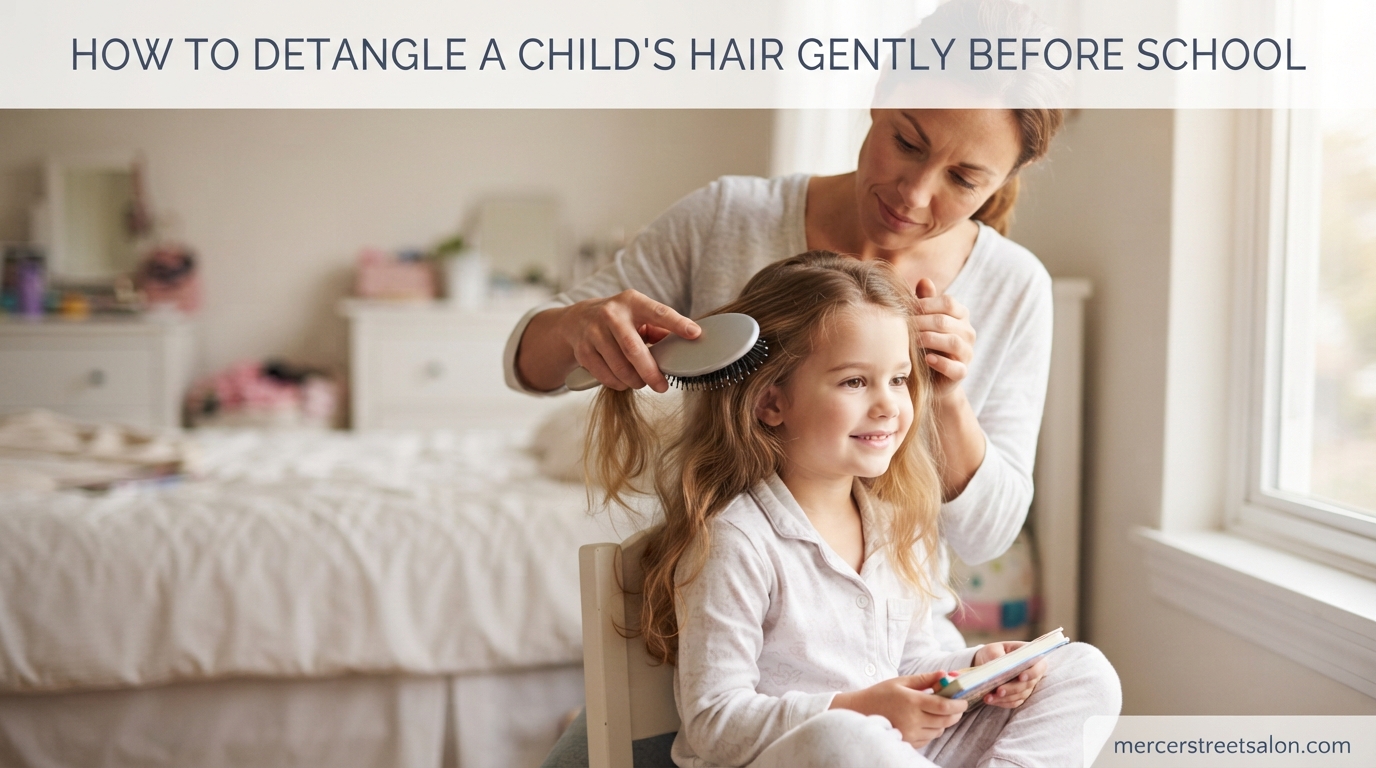
School mornings are chaotic enough without a standoff over hair brushing. If your child winces, cries, or flat-out refuses to sit still while you fight through knots, you are far from alone. In Reddit parenting groups, this exact struggle comes up weekly, with desperate parents asking why their kid’s hair tangles so fast and how to fix it without tears.
Our team at Mercer Street Salon has worked with families across every hair type, from stick-straight fine hair to tight 4c coils. This guide covers how to detangle a child’s hair gently before school using techniques we have refined over years of real-world practice. You will find a numbered step-by-step process, a fast 5-minute morning routine, hair-type-specific advice, and prevention strategies that actually work.
By the end, you will have a clear, repeatable system that turns the worst part of your morning into one of the easiest.
Table of Contents
Why Children’s Hair Tangles So Easily
Understanding why your child’s hair knots up is the first step to stopping it. Children’s hair is naturally finer and more delicate than adult hair, which means individual strands tangle around each other more readily. The cuticle layer is also thinner, creating friction whenever strands rub together.
Sleep is the biggest culprit. Tossing and turning on a cotton pillowcase creates friction that compresses and twists hair into dense knots overnight. By morning, the back of the head, where contact is highest, often looks like a bird’s nest.
Activity during the day adds to the problem. Playground wind, car seat headrests, hoodies, and collars all create friction. Fine hair tangles almost immediately after brushing because individual strands are so lightweight they wrap around each other with minimal provocation.
Curly and coily hair types face a different challenge. The natural curl pattern causes strands to coil around neighboring hairs, creating single-strand knots and eventual matting if left unchecked. This is why parents on r/Naturalhair emphasize that detangling is not optional for textured hair but a regular maintenance necessity.
Using the wrong products makes everything worse. Two-in-one shampoos do not provide enough slip for knotty hair, and adult formulas can be too harsh for a child’s sensitive scalp. Switching to a dedicated conditioner with good slip is the single change most parents report as a turning point.
Essential Tools for Tear-Free Detangling
Having the right tools within arm’s reach before you start makes the difference between a smooth session and a meltdown. Here is what our team recommends for every parent’s detangling kit.
A spray bottle with water: Plain water in a fine mist spray bottle is your foundation. Hair needs moisture to become pliable before you start working through knots. A continuous mist spray bottle gives even coverage without soaking.
A wide-tooth comb: This is your workhorse for curly, coily, and thick hair. The wide spaces between teeth let knots pass through without snapping strands. Look for seamless combs with smooth edges.
A detangling brush: The Wet Brush and Tangle Teezer are the two brands parents in forums mention most often for fine and straight hair. Their flexible bristles bend through knots instead of ripping through them.
A leave-in conditioner or detangling spray: Slip is everything. A good detangling spray adds the lubrication strands need to slide past each other. For textured hair, a creamy leave-in conditioner works better than a watery spray.
Hair clips for sectioning: Sectioning hair into four parts keeps the process organized and prevents you from re-tangling areas you have already completed. Simple snap clips or duckbill clips both work.
A satin or silk pillowcase: This is a prevention tool, not a detangling tool, but it belongs in your kit because it stops the problem before it starts.
How to Detangle a Child’s Hair Gently Before School
This is the core method our team uses and teaches. Follow these steps in order, and your school mornings will change dramatically.
Step 1: Dampen the hair. Start by lightly misting the hair with water from a spray bottle. You want the hair damp, not soaking wet. Damp hair stretches and becomes more elastic, which means it will release knots instead of snapping. Dry brushing causes breakage and pain, so never skip this step.
Step 2: Apply a detangling product. Spray a detangling spray or work a small amount of leave-in conditioner through the dampened sections. The product creates slip, which is the smooth film that lets strands slide past each other instead of catching. Without slip, every knot becomes a tug-of-war.
Step 3: Use your fingers first. Before reaching for any tool, gently pull apart the largest knots with your fingers. Your fingers can feel resistance and adjust pressure in a way no brush can. Work slowly, holding the hair above the knot to avoid pulling at the scalp. This single step prevents most tears.
Step 4: Section the hair. Divide the hair into four sections using clips. Working one section at a time keeps the process manageable and means you never lose track of where you have already been. For shorter toddler hair, two sections may be enough.
Step 5: Start from the ends and work upward. This is the single most important rule of detangling. Never brush from the scalp down. Start at the very bottom of the hair ends, gently work through the last inch, then move up half an inch, and repeat. Working from the ends up prevents you from pushing loose tangles into a larger knot below.
Step 6: Use the right tool for the hair type. For fine and straight hair, use a detangling brush with flexible bristles. For curly and coily hair, use a wide-tooth comb. Hold the hair firmly above where you are combing so the tension stays in your hand and not on the scalp.
Step 7: Style and seal. Once all knots are out, style the hair into a protective style like braids, twists, or a ponytail. Apply a small amount of leave-in or light oil to seal the hair and keep it smooth through the school day.
Step 8: Clean up and prep for tomorrow. Mist the hair lightly before bed, secure it in a loose braid or pineapple, and lay the child on a satin pillowcase. This overnight routine means tomorrow morning’s detangling takes a fraction of the time.
The 5-Minute Morning Detangling Routine
When the bus comes in ten minutes, you need a fast system. Here is the streamlined 5-minute routine our team developed for school-day mornings specifically.
Minute 1: Prep and dampen. Have your child sit down with a tablet, show, or book. Mist the hair quickly with your spray bottle. Apply a pump of detangling spray to the areas that tangle worst, usually the back of the head and the nape of the neck.
Minute 2: Finger-detangle hot spots. Quickly pull apart the worst knots with your fingers while your child is distracted. Focus on the crown and the back, where sleep friction concentrates. Do not aim for perfection, just loosen the densest areas.
Minute 3-4: Brush or comb through. Working from the ends up, run your detangling brush or wide-tooth comb through the hair in smooth downward strokes. With proper slip from your spray, this should take under two minutes for most hair types.
Minute 5: Style and go. Quick ponytail, braid, or clip arrangement seals the hair for the day. If bedtime prep was done correctly the night before, this routine will consistently take under five minutes.
The key to speed is the night before. If you prep the hair at bedtime with a satin pillowcase and a protective style, the morning routine becomes maintenance rather than rescue.
Tips by Hair Type
Different hair textures need different approaches. Here is how to adapt the core method for your child’s specific hair type.
Fine, Straight Hair
Fine hair tangles almost instantly because individual strands are so light they twist around each other with any movement. Use a lightweight detangling spray, not a heavy cream, which will weigh fine hair down. The Wet Brush is ideal here because its IntelliFlex bristles flex through fine strands without pulling.
Avoid heavy oils and butters. They coat fine hair and actually increase tangling by making strands sticky. A light mist of water with a few drops of detangling spray is all you need.
Curly Hair (Types 3A to 3C)
Curly hair tangles at the curl points where strands coil. Always detangle curly hair damp with a leave-in conditioner for slip. A wide-tooth comb works better than a brush for defining curls while removing knots.
Work in sections and be patient. Rushing curly hair leads to frizz and breakage. Once detangled, avoid brushing dry curls, which disrupts the curl pattern and causes instant new tangles.
Coily and Natural Hair (Types 4A to 4C)
Coily hair is the most tangle-prone because tight coils naturally wrap around neighboring strands. Detangling should always happen on damp hair saturated with conditioner, never dry. The LOC method (Leave-in, Oil, Cream) or LCO method (Leave-in, Cream, Oil) provides the layered moisture this hair type needs.
Finger detangling is essential before using any comb for type 4 hair. Sectioning is non-negotiable. Plan for longer sessions, ideally on wash days rather than rushed school mornings, and maintain nightly with a protective style.
Thick, Wavy Hair
Thick wavy hair combines volume with texture, creating tangles throughout the length rather than concentrated at the ends. Use a detangling brush with stiff-but-flexible bristles and work in smaller sections than you think you need. A leave-in conditioner spray provides enough slip without flattening the wave pattern.
How to Make Brushing Enjoyable for Reluctant Kids
If your child runs at the sight of a brush, the technique matters less than the experience. Parents in forums consistently report that changing the emotional dynamic around hair care transforms cooperation.
Give them control. Let your child hold the spray bottle, choose the brush color, or pick the style for the day. Offering choices gives them ownership of the process and reduces resistance.
Use distraction strategically. A favorite show, audiobook, or tablet game during brushing is not a bribe, it is a tool. Most parents report brushing time drops dramatically when a screen is involved because the child stops focusing on every pull.
Make it a bonding moment, not a battle. Talk to your child while you brush. Tell a story, ask about their day, or sing. The physical closeness of hair care can become a daily connection ritual if the tone stays warm.
Praise the effort, not just the result. Specific praise like “You sat so still for that whole section” reinforces cooperation. Avoid saying “finally” or “see, that was not so bad,” which frames the experience negatively.
Stop before the meltdown. If tension is rising, pause. Walk away for two minutes, regroup, and come back. Pushing through a crying child teaches them that brushing equals distress, which makes the next session harder.
Preventing Tangles Before They Start
The best detangling strategy is preventing knots in the first place. These habits, practiced consistently, will dramatically reduce how much work mornings require.
Switch to a satin or silk pillowcase. This is the highest-impact change you can make. Cotton pillowcases create friction that mats hair overnight, while satin and silk let hair glide smoothly. Multiple parents on r/Parenting call this their single best discovery for reducing morning tangles.
Secure hair at bedtime. A loose braid, loose ponytail, or pineapple style keeps hair contained overnight. Never send a child to bed with wet hair loose, as damp hair is more vulnerable to friction damage.
Use conditioner every wash. Skip the two-in-one products. A dedicated conditioner applied from mid-shaft to ends provides the slip and moisture that prevent knots from forming between wash days.
Braid or style for the school day. Loose hair tangles on the playground, in car seats, and under jackets. A simple braid or twist keeps hair contained and reduces end-of-day knots.
Trim split ends regularly. Damaged ends catch on healthy strands and create tangles that multiply. A trim every 8 to 12 weeks keeps ends smooth and reduces how often you need to detangle.
Common Mistakes to Avoid
Even with the right tools, a few common mistakes sabotage the process. Avoid these and your mornings will stay smooth.
Brushing dry hair. Dry brushing is the leading cause of tears and breakage. Always dampen hair first, even if it is just a light mist of water.
Starting at the scalp. Brushing top-down pushes every tangle into the one below it, creating a dense mass at the ends. Always start at the ends and work up.
Rushing through it. Speed comes from prevention, not from rushing the detangling itself. Yanking through a knot quickly causes pain and damage that makes the next session worse.
Using adult products. Adult formulas can be too harsh or heavy for children’s hair and scalps. Stick with kid-formulated or gentle, sulfate-free options.
When to Seek Professional Help
Severely matted hair sometimes requires professional intervention. If a mat has compressed into a solid mass that cannot be separated with fingers, conditioner, and patience, do not force it. Forcing dense mats causes significant breakage and pain.
A professional stylist trained in detangling can often save matted hair that parents would otherwise have to cut out. They have the time, tools, and experience to work through severe tangles gently.
If matting happens repeatedly despite good home care, talk to your pediatrician. Persistent matting can sometimes signal underlying scalp or hair conditions that benefit from medical evaluation.
FAQs
How to get matted knots out of child’s hair naturally?
Start by saturating the matted area with warm water and a generous amount of conditioner. Use your fingers to gently pull the mat apart from the outer edges inward, working slowly. Follow with a wide-tooth comb starting from the ends, and apply a natural oil like coconut or argan oil for extra slip if needed.
How to fix frizzy hair before school?
Lightly mist frizzy areas with water, apply a small amount of leave-in conditioner or curl cream, and smooth with your palms. A few drops of argan oil rubbed between your hands and gently pressed over the hair will tame flyaways without weighing it down.
Is matted hair considered neglect?
Occasional tangles and mats are normal in active children and are not considered neglect. Persistent, severe matting that goes unaddressed for long periods can sometimes be a sign that a family needs support or resources, but occasional knots are simply part of childhood hair care.
Is it better to untangle hair when it’s wet or dry?
For most hair types, damp hair is the best state for detangling because it is more elastic and pliable. Fully soaking wet hair can be fragile, so aim for damp, not drenched. For coily and natural hair types, saturated with conditioner is ideal.
How to detangle 2 year old hair?
Use a spray bottle to lightly dampen the hair, apply a small amount of toddler-safe detangling spray, and finger-detangle the largest knots first. Follow with a soft-bristle detangling brush or wide-tooth comb, working from the ends up. Keep sessions short and always offer distraction like a show or toy.
How to get a child’s hair unmatted?
Saturate the matted section with conditioner and warm water. Hold the hair above the mat to protect the scalp, then gently work the mat apart with your fingers starting from the outer edges. Use a wide-tooth comb once the mat loosens, and never pull or force a dense mat.
How to stop a toddler’s hair from getting matted?
Use a satin or silk pillowcase, secure hair in a loose braid or pineapple at bedtime, apply a leave-in conditioner after every wash, and brush daily. Regular trims every 8 to 12 weeks also prevent split ends from catching and creating new tangles.
Conclusion
Learning how to detangle a child’s hair gently before school is not about finding a magic product. It is about combining the right tools, a consistent technique, and prevention habits that stop knots before they form.
Start with damp hair, always work from the ends up, use your fingers before any tool, and never skip the slip. Pair this with a satin pillowcase and a bedtime protective style, and your school mornings will transform from a daily battle into a calm five-minute routine.
Pick one change to implement tonight. The satin pillowcase is the easiest place to start, and most parents see a noticeable difference within a single week.