
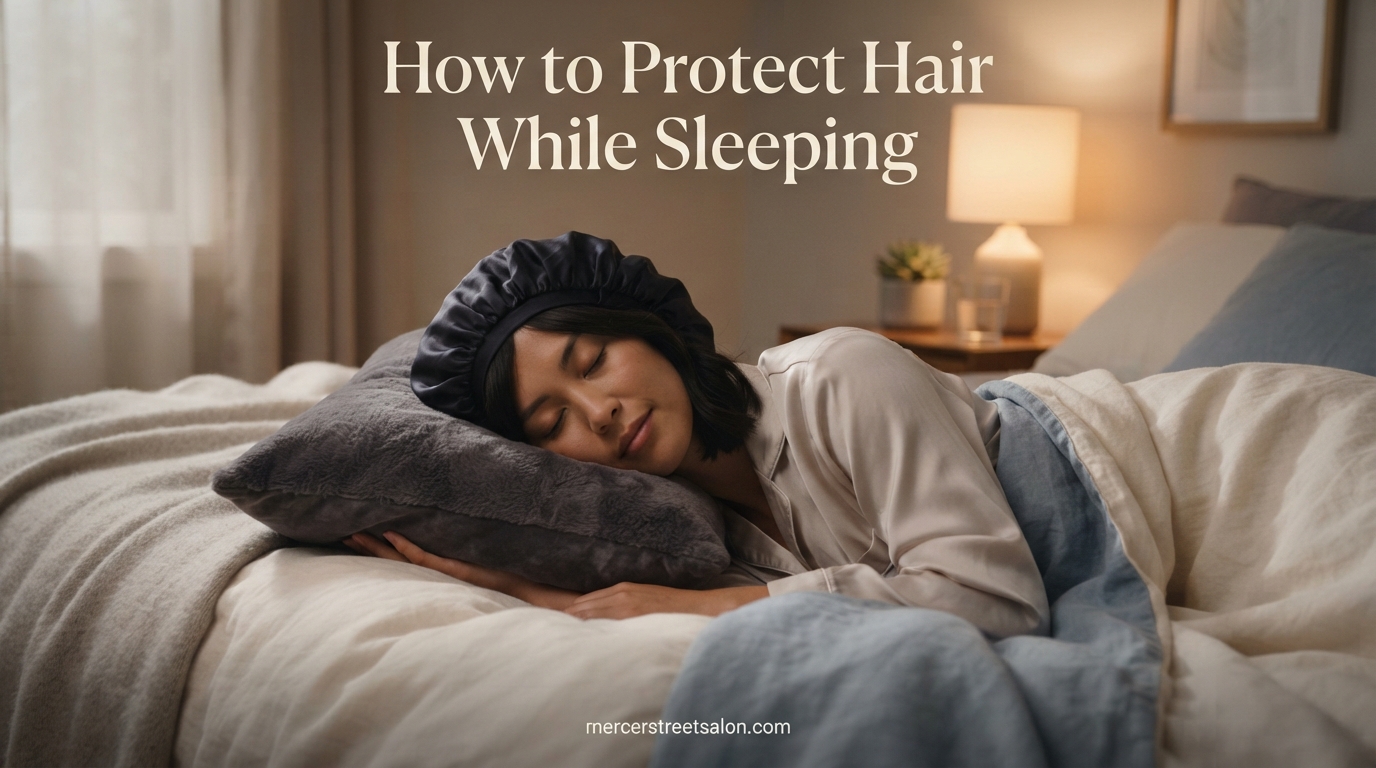
If you are someone who tosses, turns, flips, and rolls all night, you already know the morning struggle. You go to bed with smooth, freshly detangled hair and wake up with a knotted, frizzy mess. Learning how to protect your hair while you sleep if you move around a lot comes down to five things: detangle before bed, lock in moisture, choose a protective style that stays put, swap cotton for silk or satin, and add a physical barrier like a bonnet or scarf.
For restless sleepers, the stakes are higher than for someone who sleeps like a statue. Every roll creates friction. Every flip pulls hair across the pillowcase. Over weeks and months, that constant rubbing causes breakage, split ends, frizz, and moisture loss that no morning product can fully undo.
The good news is that you do not have to change how you sleep. You just have to change what your hair interacts with while you do it. In this guide, I will walk you through exactly what works for active sleepers, which hairstyles stay in place through a tossing session, and what to do when your bonnet ends up across the room by 3 AM.
Table of Contents
Why Nighttime Hair Damage Happens (And Why Restless Sleepers Get It Worse)
Hair damage at night comes down to two main forces: friction and moisture loss. Friction happens when your hair rubs against a pillowcase, sheets, or even itself as you move. Moisture loss happens because cotton and other absorbent fabrics pull water and natural oils right out of your strands while you sleep.
Every time your hair drags across a cotton pillowcase, the rough fibers catch on the hair cuticle. The cuticle is the outermost layer of each strand, and when it gets roughed up, hair becomes brittle, frizzy, and prone to snapping. Over time, that mechanical damage adds up to visible breakage and split ends that travel up the hair shaft.
For restless sleepers, this damage multiplies. Someone who shifts position 20 or 30 times a night experiences far more friction hours than someone who barely moves. You are essentially putting your hair through a low-grade stress test for seven or eight hours straight.
That is why the standard advice you read on most beauty blogs falls short for active sleepers. A loose pineapple might work fine for someone who sleeps on their back all night. But if you are a side-to-stomach flipper, that same pineapple will be a tangled disaster by morning. The strategies in this guide are built specifically for people who cannot seem to stay still.
Cotton vs Silk vs Satin: What Your Pillowcase Does to Your Hair
The fabric your hair touches all night matters more than almost any product you can buy. Cotton is absorbent and rough. It pulls moisture from your hair and creates friction with every movement. If you are using a standard cotton pillowcase and wondering why your hair feels dry and tangled in the morning, that is your answer.
Silk and satin are fundamentally different. Both create a smooth, low-friction surface that lets hair glide rather than snag. Silk is a natural fiber produced by silkworms, while satin refers to a weave pattern that can be made from silk, polyester, or other materials. Both dramatically reduce friction and do not absorb moisture the way cotton does.
For people who move around a lot, switching to a silk or satin pillowcase is the single highest-impact change you can make. It will not solve everything on its own, but it removes the most damaging surface your hair encounters each night.
The 5-Step Pre-Bed Hair Routine for Active Sleepers
If you do nothing else, follow these five steps before your head hits the pillow. This routine takes about 5 to 10 minutes once you get the hang of it, and it is the foundation for how to protect your hair while you sleep if you move around a lot.
Step 1: Detangle Before Bed
Going to sleep with tangles guarantees you will wake up with worse ones. As you move during the night, loose hairs wrap around existing tangles and tighten them into knots that take real effort to comb out the next morning.
Start at the ends and work upward with a wide-tooth comb or your fingers. Do not yank through knots. If you hit resistance, hold the hair above the tangle with one hand and gently work through it with the other. This prevents pulling at the root, which can cause shedding and breakage over time.
If your hair is curly or coily, detangle on damp hair with a leave-in conditioner for slip. For straight or fine hair, a light detangling spray works well. The goal is to start the night with zero knots so that whatever movement happens overnight has less to work with.
Step 2: Moisturize and Seal
Hydrated hair is flexible hair. When your strands have enough moisture, they bend instead of breaking. Dry, brittle hair snaps under the kind of repeated friction that restless sleepers deal with every night.
For curly, coily, and natural hair, the LOC method is a popular approach. LOC stands for Leave-in conditioner, Oil, and Cream. You apply a water-based leave-in first, follow with a sealing oil like jojoba or argan, and finish with a cream to lock everything in. Some people prefer the LCO method, swapping the oil and cream order. Either way, the principle is the same: layer moisture and then seal it in.
For straight or fine hair, a lightweight leave-in conditioner or a few drops of hair oil through the mid-lengths and ends is usually enough. You do not want to overload fine hair, or it will look flat and greasy by morning.
Step 3: Choose a Protective Style That Stays Put
This is the step that matters most for restless sleepers. Loose hair is the enemy. When your hair is free to move, it wraps around itself, catches on fabric, and tangles with every position change. A protective style keeps hair contained and controlled.
The key for active sleepers is choosing a style that does not come undone. A loose ponytail will slide right out of a silk scrunchie by morning if you toss enough. A secure braid, a well-placed pineapple, or two-strand twists will stay where you put them.
I will cover the best protective styles for each hair type in detail in the next section. For now, the rule is simple: if it falls out easily when you shake your head, it will not survive a restless night.
Step 4: Secure With a Silk Scrunchie
Throw out your rubber bands and tight elastic ties. They cause breakage at the point where they grip the hair, and over time, that repeated stress can contribute to traction alopecia, a form of hair loss caused by constant pulling.
Silk scrunchies are gentler because they distribute pressure across a wider area and the smooth fabric does not grab or snag the hair shaft. Phone-cord style spiral ties are another option some people prefer because they do not leave a dent.
For restless sleepers, use a double-tie approach. Place one silk scrunchie at the base of your style and a second one a few inches down. This creates redundancy so that even if one slips, the other holds.
Step 5: Add a Physical Barrier
The final layer of protection is a physical barrier between your hair and the world. This means a satin bonnet, a silk scarf, or at minimum a silk pillowcase. For people who move around a lot, I recommend using both a bonnet or scarf and a silk pillowcase as a backup.
If your bonnet slips off at 2 AM, the silk pillowcase catches your hair before it hits rough cotton. Think of it as a safety net. No single method is perfect for a heavy tosser, so layering your protection gives you the best shot at waking up with intact hair.
Best Protective Hairstyles for Active Sleepers
Not every protective hairstyle works for someone who moves around a lot. Here is a breakdown of the most reliable options, ranked by how well they survive a restless night.
The Pineapple Method (Best for Curly and Long Hair)
The pineapple method involves gathering all your hair at the very top of your head near the hairline and securing it loosely with a silk scrunchie. The hair falls forward over your forehead, resembling a pineapple. This keeps curls stacked on top of each other rather than compressed under your head, which preserves curl definition overnight.
For restless sleepers, the pineapple is effective but can slip. To make it work, gather the hair slightly farther back than usual (toward the crown rather than the very front) and use a double scrunchie. If your hair is very long, loop the scrunchie twice but not three times. You want it secure enough to hold but loose enough not to dent the hair.
One Reddit user with long curly hair shared that 100 percent silk scrunchies tied in a pineapple work far better than cotton ones, which grip too hard and cause breakage at the tie point.
A Single Loose Braid (Best for Straight and Medium Hair)
If you have straight, wavy, or medium-length hair, a single loose braid down the back is one of the most reliable styles for active sleepers. A braid contains all your hair in one controlled unit, so there is nothing loose to tangle.
Start the braid at the nape of your neck or slightly below. Braid loosely so you are not creating tension at the roots, but secure the end firmly with a silk scrunchie. A too-tight braid can cause headaches and pull at the hairline overnight.
One straight-haired Reddit user put it plainly: braiding at night is the only way they avoid tangles. If you wake up and want to undo the wave pattern the braid creates, a quick pass with a damp brush or a light spray of water and air-drying usually resets it.
Two-Strand Twists (Best for Natural and Coily Hair)
For type 3 and type 4 hair, two-strand twists are a go-to protective style for sleeping. They keep natural hair stretched, defined, and contained through the night. Twists are gentler than braids for coily textures because they do not create as much tension at the root.
For a restless sleeper, do four to six medium twists rather than two large ones. Smaller sections stay put better and are less likely to unravel with movement. Secure each twist at the end with a small silk scrunchie or a flexible clip.
In the morning, you can unravel the twists for a defined twist-out, or leave them in and refresh with a light oil. Either way, your hair stays moisturized and tangle-free overnight.
Low Loose Bun (Best for Short to Medium Hair)
If your hair is too short for a full braid or pineapple, a low loose bun at the nape of your neck is a solid option. Twist the hair gently and wrap it into a coil, then secure with a silk scrunchie. Do not use pins or clips, which can stab your scalp when you roll over.
The low position matters for active sleepers. A high bun will press against your head when you lie on your back and come undone when you flip to your side. A low bun sits below the head and stays relatively undisturbed through most sleep positions.
One Reddit user with long hair shared that they wrap their hair into a high bun and put a silk cap over it. For shorter hair, the same principle works with a low bun and a satin scarf.
The Satin Wrap or Doobie Wrap (Best for Blowouts and Silk Presses)
If you have a fresh blowout, silk press, or straightened style you want to preserve, wrapping your hair flat against your head is the move. This technique, sometimes called a doobie wrap, involves combing the hair in a circular pattern around the head and pinning or clipping it flat.
You then cover the wrapped hair with a satin scarf to hold everything in place. This keeps straight hair smooth and frizz-free overnight, even if you move around a lot.
The challenge for restless sleepers is that scarves slip. Use a scarf with a built-in elastic or add a few flat clips around the perimeter. Some people combine a wrap with a silk pillowcase for double protection.
Why High Buns and High Ponytails Fail for Restless Sleepers
Many general hair guides recommend a high bun or high ponytail for sleeping. For a calm sleeper, that might work. But for someone who flips from back to side to stomach, a high bun creates a lump at the top of your head that presses into your scalp every time you lie on your back.
It also catches on the pillow when you roll, which either pulls the style out or yanks at your roots. If you have been wearing a high bun to bed and waking up with headaches or a tender scalp, this is likely why.
Bonnet vs Scarf vs Pillowcase: Which Is Best for Restless Sleepers?
When it comes to physical barriers, you have three main options. Each has strengths and weaknesses, especially for people who move around a lot at night.
Satin Bonnet: The Best Overall Option for Active Sleepers
A satin bonnet is the most comprehensive form of nighttime hair protection. It covers all your hair at once, keeps it contained regardless of sleep position, and creates a consistent friction-free environment. For natural hair, curly hair, and anyone with longer strands, a bonnet is hard to beat.
The problem restless sleepers run into is slippage. A bonnet that fits loosely will slide off during the night, leaving your hair exposed. This is the number one complaint I see from active sleepers on forums.
The fix is to look for a bonnet with an adjustable strap or a wide elastic band that can be tightened to fit your head snugly. A double-layer bonnet also stays in place better than a single-layer one because the extra weight helps it grip. Some bonnets come with a built-in satin-lined edge band that holds the front in place.
Silk Scarf: A Flexible Alternative
If bonnets give you headaches or feel too bulky, a silk scarf is a lighter alternative. You can wrap it, tie it, or fold it into different configurations depending on your hair type and style. Scarves are especially popular for wrapping straight hair flat against the head.
The downside is that scarves require some skill to tie securely. A poorly tied scarf will slip off even faster than a bonnet. Practice wrapping techniques until you find one that stays put, and look for scarves with a slight grip or texture rather than ultra-slick charmeuse.
One Reddit user who cannot wear bonnets due to headaches said a silk pillowcase combined with a loosely tied scarf is their go-to combination. The scarf provides extra protection without the pressure of a full bonnet band.
Silk Pillowcase: The Essential Backup Layer
A silk or satin pillowcase is the minimum baseline for nighttime hair protection. Even if you wear a bonnet or scarf, a silk pillowcase serves as your safety net. When your bonnet slips off at 3 AM, your hair lands on silk instead of cotton.
For people who absolutely cannot tolerate anything on their head at night, a silk pillowcase plus a protective hairstyle is a workable combo. It will not protect your hair as well as a bonnet would, but it is dramatically better than a cotton pillowcase with loose hair.
The Combo Strategy: Layering for Maximum Protection
For the best results as a restless sleeper, combine multiple methods. Here is the setup I recommend for maximum overnight protection:
First, put your hair in a protective style. Second, cover it with a well-fitting satin bonnet or a securely tied silk scarf. Third, sleep on a silk pillowcase. If you are a very active sleeper and one layer fails during the night, the next layer catches your hair before damage occurs.
This layered approach is what separates people who consistently wake up with decent hair from people who wake up fighting tangles every single morning. It takes an extra minute at night and saves you ten minutes of detangling in the morning.
Solutions for People Who Cannot Keep a Bonnet On
If you have tried bonnets and they always end up on the floor, you are not alone. This is one of the most common frustrations among restless sleepers. Here is how to deal with it.
Why Bonnets Slip Off During the Night
Bonnets slip for a few reasons. The most common is a poor fit. If the elastic band is too loose, the bonnet will slide off with any movement. If the band is too tight, it causes headaches and you may unconsciously push it off in your sleep.
The fabric of the bonnet also matters. A slick single-layer satin bonnet will slide more than a double-layer bonnet with a slightly textured interior. The shape matters too. A bonnet that is too deep or too shallow for your head and hair volume will shift around as you move.
Adjustable and Double-Layer Bonnet Options
Look for bonnets with an adjustable strap that lets you customize the fit. These typically have a ribbon or buckle system at the back that you can tighten or loosen until the bonnet stays securely in place without causing pressure.
Double-layer bonnets are also worth trying. The extra layer adds weight and structure, which helps the bonnet grip your head better. Some double-layer bonnets have a satin exterior and a slightly grippier interior lining that prevents sliding.
The Silk Pillowcase Plus Loose Braid Combo
If bonnets are a lost cause for you, your best bet is a silk pillowcase combined with a protective style. A single loose braid secured with a silk scrunchie, plus a silk pillowcase underneath, provides solid protection without anything on your head.
This is not as effective as a bonnet, but it is far better than nothing. The braid keeps your hair contained so it cannot wrap around itself, and the silk pillowcase reduces friction for whatever hair does touch the surface.
All-in-One Solutions Like the Sleepy Tie
Some products combine a protective style and a hair covering in one piece. The Sleepy Tie, for example, is a silk-covered sponge-like accessory that you wrap your hair around and secure. It functions as both a style and a barrier, and several Reddit users report it stays in place better than a traditional bonnet for active sleepers.
You can also find silk sleeping caps that are designed with a built-in ponytail or bun pouch. These hold your style inside the cap, which reduces bulk and helps the cap stay in position.
Emergency Morning Detangling: What to Do When Protection Fails
Even with the best routine, some nights will not go your way. If you wake up with a tangled mess, here is how to recover without causing more breakage.
Start by dampening your hair lightly with a spray bottle of water. Do not attack dry tangles with a brush. Add a leave-in conditioner or detangling spray for slip, then use a wide-tooth comb starting at the very ends and working up in small sections. Hold the hair above the knot to avoid pulling at the root.
If you hit a stubborn knot, apply a drop of oil directly to the tangle and gently work it apart with your fingers. Patience here saves hair. Rushing through detangling is how people end up with snapped strands and thinned-out sections.
Hair Type-Specific Tips for Restless Sleepers
Different hair types face different challenges overnight. Here is how to adjust your approach based on your texture and length.
Curly and Coily Hair (Types 3 and 4)
Curly and coily hair is the most vulnerable to overnight damage because the natural curl pattern creates more inter-strand friction. Each curl can wrap around its neighbor, creating tangles that are difficult to undo without breakage.
For type 3 and 4 hair, moisture is everything. Use the LOC or LCO method before bed, then two-strand twists or a pineapple depending on length. Cover with a satin bonnet, and always use a silk pillowcase as backup.
For 4c hair specifically, braids or twists are more reliable than a pineapple because the tighter curl pattern holds the style in place. A Reddit user from the natural hair community shared that a satin bonnet over two-strand twists is their tried-and-true combination for protecting natural hair while sleeping.
Fine and Thin Hair
Fine hair is easily flattened and damaged by friction. The challenge is that heavy protective styles and thick bonnets can weigh it down or cause it to look greasy by morning. Use a lightweight approach.
A single loose braid or a low loose bun secured with a silk scrunchie works well for fine hair. Skip heavy creams and oils. A light leave-in conditioner spray is enough moisture for most fine hair types. A silk pillowcase is essential, and a lightweight satin sleep cap can work if it fits without being too bulky.
One fine-haired Reddit user noted that they have slept with their hair in a low braid for years and still deal with some tangling at night. For fine hair, expect that you will need some morning touch-ups, but a consistent routine will dramatically reduce the severity.
Straight Hair
Straight hair is often overlooked in nighttime hair care guides, which tend to focus on curly and natural textures. But straight hair still suffers from friction, breakage, and morning frizz, especially for restless sleepers.
A single loose braid is the most effective style for straight hair at night. If your hair is too short to braid, a low loose bun works. Apply a few drops of lightweight hair oil to the ends to prevent splitting, and sleep on a silk pillowcase. If you want to preserve a blowout or straightened style, use the wrap method with a satin scarf.
Short Hair
Short hair is tricky because most protective styles require enough length to braid, twist, or gather. But short hair still benefits from nighttime protection, especially if you color treat it or have it styled in a specific shape.
For short hair, focus on the barrier layer. A silk pillowcase is your primary tool. Apply a small amount of leave-in conditioner or oil to the ends, and sleep on silk. If your hair is short enough that it does not reach the pillow when you lie down, you may not need a bonnet at all. But if you have bangs or face-framing pieces, a lightweight satin scarf can keep them from getting crushed overnight.
Long Hair
Long hair has the most to lose overnight because there is simply more hair to tangle. A single braid or a pineapple is your best bet, combined with a bonnet or scarf and a silk pillowcase.
For very long hair, consider braiding in two sections (pigtail braids) rather than one. Two braids are shorter and less likely to shift around or get caught under your body when you roll. Secure each with a silk scrunchie and tuck the ends up into a bonnet.
Common Nighttime Hair Mistakes to Avoid
Even with a solid routine, certain habits can undermine all your effort. Here are the mistakes I see most often among restless sleepers.
Sleeping With Wet Hair
Wet hair is at its most vulnerable. When hair is saturated with water, the cuticle swells and the strand stretches, making it far more elastic and prone to breakage. Friction against a pillowcase while wet causes damage that dry hair would resist.
If you shower at night, dry your hair at least 70 to 80 percent before bed. Air-dry for a while, or use a blow dryer on a low, cool setting. Never go to sleep with soaking wet hair, especially if you move around a lot.
There is also a scalp health concern. Sleeping with wet hair trapped under a bonnet or scarf can create a warm, damp environment that encourages mildew and fungal growth on the scalp. Always make sure your hair is at least mostly dry before covering it.
Using Rubber Bands or Tight Elastic Ties
Rubber bands, plain elastic bands, and tight hair ties with metal clasps are some of the most damaging things you can put in your hair. They grip too hard, create a single point of intense pressure, and literally slice through strands when you move.
Replace them with silk scrunchies, satin-covered bands, or spiral ties. The difference in morning hair health is immediate. If you have been using rubber bands and noticing breakage at the same point on your strands, this is the cause.
Sleeping With Hair Completely Loose on Cotton
Loose hair on a cotton pillowcase is the worst-case scenario for a restless sleeper. Every toss and turn creates friction, tangles, and moisture loss. If you only change one thing from this guide, make it this: never sleep with loose hair on cotton.
At minimum, put your hair in a loose braid and switch to a silk pillowcase. That single change will reduce your morning tangles by more than half.
Skipping Moisturizer
Dry hair breaks. It is that simple. If you are not applying any moisture before bed, your hair is spending eight hours losing what little hydration it has. You do not need a complicated routine. A leave-in conditioner spray, a few drops of oil, or a dab of cream on the ends is enough.
Over-Tightening Bonnets and Scrunchies
There is a fine line between secure and too tight. A bonnet that leaves a red line across your forehead is too tight. A scrunchie that leaves a deep dent or causes a headache is too tight. Chronic tension on the hairline can lead to traction alopecia, a form of hair loss caused by sustained pulling.
Find the sweet spot where your bonnet stays on without leaving marks. If that is not possible with your current bonnet, try an adjustable strap version or a different size.
FAQs
How do I protect my hair while I’m sleeping?
To protect your hair while sleeping, detangle before bed, apply a leave-in conditioner or oil, put your hair in a protective style like a loose braid or pineapple, secure it with a silk scrunchie, and sleep on a silk or satin pillowcase. For maximum protection, add a satin bonnet or silk scarf over your hair.
What is the healthiest way to have your hair at night?
The healthiest way to wear your hair at night is in a loose protective style, such as a low braid, two-strand twists, or a pineapple, secured with a silk scrunchie and covered with a satin bonnet or scarf. Sleep on a silk or satin pillowcase as a backup. Avoid tight styles, rubber bands, and cotton pillowcases.
Is it better to sleep with hair tied up or down?
For most hair types and lengths, sleeping with hair tied up in a loose protective style is better than leaving it down. Tied-up hair stays contained, experiences less friction, and is less likely to tangle overnight. Very short hair that cannot be gathered can be left loose on a silk pillowcase with a light oil on the ends.
How to protect the hair system when sleeping?
To protect a hair system or hairpiece while sleeping, wear a satin sleep cap or silk bonnet that fully covers the system. Sleep on a silk pillowcase for backup friction reduction, and avoid sleeping with the system wet. If the system is removable, taking it off at night is the safest option.
How do I keep my bonnet from slipping off if I move a lot?
To keep a bonnet from slipping off as a restless sleeper, choose a bonnet with an adjustable strap that can be tightened for a custom fit. Double-layer bonnets stay in place better than single-layer ones. You can also try a bonnet with a wide elastic band or a built-in edge grip. As a backup, always sleep on a silk pillowcase so your hair is still protected if the bonnet does come off.
Can I protect my hair while sleeping without a bonnet?
Yes, you can protect your hair without a bonnet by combining a silk pillowcase with a protective hairstyle like a loose braid or pineapple secured with a silk scrunchie. A silk scarf tied over your hair is another alternative if bonnets cause discomfort or headaches. The key is to keep hair contained and away from cotton surfaces.
Final Thoughts on Protecting Your Hair While You Sleep If You Move Around a Lot
Figuring out how to protect your hair while you sleep if you move around a lot is not about training yourself to sleep differently. It is about building a system that works with your natural movement instead of against it.
Start with the basics: detangle, moisturize, and put your hair in a style that stays put. Add a silk or satin barrier, whether that is a bonnet, a scarf, or at minimum a pillowcase. Layer your protection so that if one piece fails during the night, another catches your hair before damage happens.
It takes a few weeks of consistency to see results. But once you build the habit, you will spend less time fighting tangles in the morning and notice less breakage, less frizz, and healthier hair overall. Your hair deals with enough during the day. Give it a fighting chance at night.