
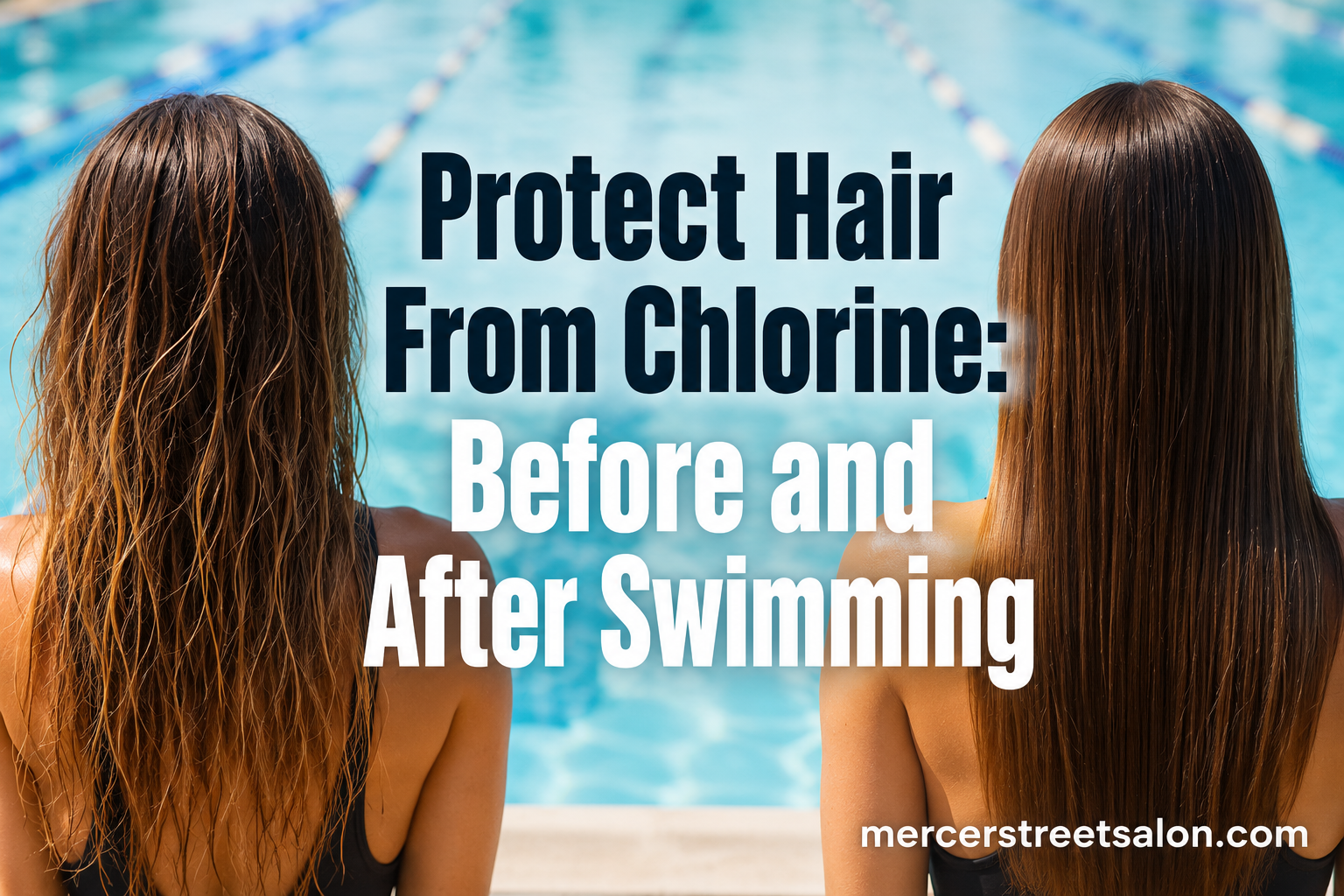
Every summer, our salon sees the same thing: clients walking in with dry, brittle, green-tinted hair after a few weeks of pool time. The good news is that chlorine damage is almost entirely preventable when you know what to do before and after you swim. In this guide, our team at Mercer Street Salon breaks down exactly how to protect your hair from chlorine before and after swimming, with a salon-tested routine you can start using today.
Whether you are a competitive swimmer in the pool every morning or someone who enjoys a casual swim on vacation, the steps are the same. The difference is how often you need to apply them and how aggressively you treat your hair afterward. We have pulled together advice from our stylists, swimmer communities on Reddit, and the latest hair science research to create a routine that actually works.
By the end of this article, you will know what to put on your hair before jumping in, how to wash chlorine out properly, which hair types need extra care, and what to do if your hair is already showing signs of damage. Let us start with a quick reference you can screenshot and take to the pool.
Table of Contents
Quick Reference Checklist: Before and After Swimming
If you only read one section, make it this one. Here is the short version of how to protect your hair from chlorine before and after swimming:
Before Swimming Checklist
1. Pre-soak your hair with clean tap water from a shower or bottle until it is fully saturated.
2. Apply a leave-in conditioner, coconut oil, or a dedicated swim-protectant spray to damp hair.
3. Put on a silicone swim cap, positioning it to cover your hairline completely.
4. Tie long hair in a low bun or braid to keep it compact under the cap.
After Swimming Checklist
1. Rinse your hair with clean, warm water immediately after getting out of the pool. Do not let chlorine sit.
2. Wash with a clarifying or swim-specific shampoo to remove chlorine residue.
3. Apply a deep conditioning mask and leave it on for 5 to 10 minutes.
4. Air dry or use a microfiber towel. Avoid heat styling for at least a few hours.
How Chlorine Damages Your Hair (The Science)
To understand why protection matters, it helps to know what chlorine actually does to your hair. Chlorine is a powerful oxidizing chemical added to pool water to kill bacteria and keep the water safe. Unfortunately, it does not distinguish between harmful bacteria and your hair.
When chlorine comes into contact with your hair, it does three things. First, it strips away sebum, the natural oil your scalp produces to coat and protect each strand. Without sebum, hair loses its moisture barrier and becomes dry and brittle. Second, chlorine penetrates the hair cuticle and breaks down disulfide bonds, the protein connections in keratin that give hair its strength and elasticity. When those bonds break, hair becomes weak, stretchy when wet, and prone to snapping.
Third, chlorine reacts with trace metals in pool water, especially copper. When copper oxidizes, it bonds to the protein in your hair shaft and creates a green tint. This is the famous swimmer’s green hair effect, and it is most visible on blonde, lightened, or gray hair. The green is not actually chlorine color. It is oxidized copper attached to your hair.
At our salon, we explain it this way: think of chlorine like a harsh dish soap. It does a great job cleaning, but it strips everything, including the oils you want to keep. The more often your hair is exposed without protection, the more cumulative damage builds up. Over time, this leads to split ends, color fading, frizz, breakage, and that stiff, straw-like texture swimmers know all too well.
One more thing our stylists always mention: UV exposure makes chlorine damage worse. If you sit in the sun with chlorinated water in your hair, the heat opens the cuticle and accelerates the chemical reaction. Always rinse before sunbathing after a swim.
How to Protect Your Hair From Chlorine Before and After Swimming
This is the core of the routine. Here is exactly what to do before you get in the pool, broken down step by step. Each step has a specific purpose backed by hair chemistry.
Step 1: Pre-Soak Your Hair With Clean Water
This is the single most effective thing you can do, and it is completely free. Hair is like a sponge. When it is dry, it absorbs whatever liquid it contacts first. If you jump into a chlorinated pool with dry hair, your strands will soak up chlorinated water like a dry sponge dropped in a bucket.
But if you saturate your hair with clean tap water first, your hair absorbs that clean water instead. There is only so much room inside the hair shaft. Pre-soaking fills that space with non-chlorinated water, dramatically reducing how much pool water your hair can absorb. Daily swimmers on Reddit consistently confirm this is the one step that makes the biggest difference.
Step 2: Apply a Protective Barrier
After pre-soaking, apply a product that creates an additional barrier between your hair and the chlorinated water. The most popular options are leave-in conditioner, coconut oil, or a dedicated swim-protectant spray.
Coconut oil is a favorite among swimmers because it actually penetrates the hair shaft rather than just sitting on top. A thin layer applied to damp hair before swimming helps reduce the amount of chlorine that gets inside. Olive oil and jojoba oil work similarly. Just be careful not to overapply, or your hair will feel greasy and may slip out of your swim cap.
Leave-in conditioner adds a hydrating layer that chlorine has to break through first. Look for one with protein or keratin for extra bond protection. Swim-specific sprays are designed to neutralize chlorine on contact and are a good option if you swim frequently.
Step 3: Wear a Silicone Swim Cap
A swim cap will not keep your hair 100 percent dry, but it dramatically reduces the volume of chlorinated water that reaches your hair. It also compresses your hair against your head, limiting surface area exposure.
We recommend silicone caps over latex for most people. Silicone is thicker, more durable, and creates a better seal. It is also more comfortable and easier to put on without snagging hair. Latex caps are cheaper but rip more easily and can pull hair during removal. For swimmers with long or thick hair, look for caps specifically designed with extra room in the back.
If you cannot wear a swim cap due to comfort, medical conditions, or hair thickness, focus heavily on steps 1 and 2. Pre-soaking and applying a barrier become even more important when you skip the cap.
Step 4: Tie Long Hair Up Securely
If you have long hair, tie it in a low bun or braid before putting on your cap. This keeps hair compact and prevents loose strands from escaping into the water. A braid is especially good for curly or textured hair because it reduces tangling and makes post-swim detangling much easier.
Avoid tight elastic bands with metal clasps, which can snag and break wet hair. Use a soft fabric hair tie or spiral band instead.
Post-Swim Hair Care: Removing Chlorine After Swimming
What you do after swimming is just as important as what you do before. The goal is to remove chlorine from your hair as quickly and thoroughly as possible, then restore the moisture and protein that chlorine strips away.
Step 1: Rinse Immediately With Clean Water
Do not wait until you get home. Rinse your hair at the pool shower before the chlorine has time to keep working. Even a 60-second rinse with clean tap water removes a significant amount of surface chlorine. The longer chlorine sits on your hair, the more damage it does.
Use lukewarm water, not hot. Hot water opens the hair cuticle, which can actually drive chlorine deeper into the shaft. Lukewarm water rinses the surface without opening the cuticle further.
Step 2: Wash With a Clarifying or Swim-Specific Shampoo
A regular shampoo is not always enough to fully remove chlorine. Clarifying shampoos are formulated to strip buildup, including chlorine, minerals, and product residue. Swim-specific shampoos go a step further by containing ingredients that chemically neutralize chlorine.
Brands like Ultra Swim and Malibu Swimmers are the most recommended by actual swimmers in our salon and across swimmer forums. Malibu Swimmers Wellness Shampoo comes up repeatedly as a trusted option for daily swimmers because it removes chlorine without being overly harsh.
One warning from our stylists: do not use a clarifying shampoo every single day unless you are swimming daily. These shampoos are powerful and can strip natural oils if overused. If you swim a few times a week, alternate between a clarifying formula and your regular moisturizing shampoo.
Step 3: Apply a Deep Conditioning Mask
After any pool session, replace the moisture chlorine removed with a deep conditioning treatment. A regular conditioner helps, but a mask is thicker and designed to penetrate more deeply. Apply it from mid-shaft to ends, leave it on for 5 to 10 minutes, then rinse with cool water to seal the cuticle.
For daily swimmers, we recommend deep conditioning at least twice a week. Look for masks with keratin, argan oil, or shea butter. If your hair is color-treated, choose a mask formulated for color protection to prevent fading.
Step 4: Air Dry and Be Gentle
After washing, avoid rough towel drying. Rubbing a regular towel against wet hair causes friction that leads to frizz and breakage. Use a microfiber towel or a soft cotton t-shirt to gently squeeze excess water out instead of rubbing.
Let your hair air dry whenever possible. Heat from a blow dryer compounds the dryness that chlorine already caused. If you must use heat, apply a thermal protectant first and keep the temperature on a medium setting. Avoid tight ponytails or buns while hair is wet and vulnerable, as the tension can cause breakage at the hair tie point.
Which Hair Types Are Most Vulnerable to Chlorine Damage
Not all hair reacts to chlorine the same way. Some hair types need significantly more protection because their structure makes them more absorbent, more fragile, or more prone to visible damage.
Color-treated and bleached hair is the most vulnerable. The coloring process lifts the cuticle and alters the hair’s internal protein structure, making it more porous. Porous hair absorbs chlorine faster and deeper than virgin hair. Bleached blonde hair is especially at risk for green discoloration because the copper-chlorine reaction shows up clearly on light strands.
Fine and thin hair has less structural mass to begin with, so the same amount of bond damage represents a larger percentage of the strand’s total strength. Fine hair also tends to be more porous than medium or coarse hair. If you have fine hair, be extra diligent with pre-soaking and use lighter oils that will not weigh your hair down.
Curly and coily hair is naturally drier than straight hair because scalp oils have a harder time traveling down the curl pattern. Chlorine makes that dryness worse, leading to frizz, shrinkage, and loss of curl definition. Coily hair also tends to be more fragile when wet, so detangling should be done gently with a wide-tooth comb and plenty of conditioner.
Children’s hair deserves special attention. Kids’ hair is finer and more delicate than adult hair, and children are less likely to tolerate swim caps or wait patiently for a post-swim wash. We recommend pre-soaking their hair, applying a light leave-in conditioner, and rinsing immediately after swimming. For kids who refuse swim caps, focus on the pre-soak and barrier steps and keep swim sessions shorter.
How to Fix Chlorine-Damaged Hair
If your hair is already showing signs of chlorine damage, do not panic. Most damage is reversible with the right approach, especially if you catch it early. Here is what our salon recommends, from at-home remedies to professional treatments.
At-Home Repair: Clarifying Treatments and Protein Masks
Start by doing a clarifying wash to remove any remaining chlorine and mineral buildup. If your hair still feels gummy, dry, or stiff after clarifying, the next step is a protein treatment. Protein treatments temporarily rebuild the broken disulfide bonds that chlorine has damaged.
Look for a treatment containing hydrolyzed keratin or silk proteins. Use it once a week for damaged hair, following with a deep moisturizing mask. Protein without moisture makes hair brittle, so always pair them together.
Deep Conditioning Schedule for Recovery
For hair recovering from chlorine damage, increase your deep conditioning to two or three times per week. Apply the mask to clean, damp hair, cover with a shower cap, and leave it on for 15 to 20 minutes. The shower cap traps body heat, which helps the mask penetrate more deeply.
Trim split ends every 6 to 8 weeks during recovery. Split ends travel up the hair shaft if left untreated, so cutting them prevents the damage from spreading.
When to See a Professional
If your hair is severely damaged, breaking in handfuls, or has a green tint that home remedies will not fix, it is time to book a salon appointment. Professional treatments we offer include bond-building services that go deeper than anything available for home use, mineral-removing treatments to strip copper buildup, and tone correction for green or brassy color.
A salon treatment can also include a custom trim and restyle to remove the most damaged portions and give your hair a fresh start. Do not wait until the damage is severe to seek professional help. The earlier we see it, the more we can preserve.
Green Hair From Chlorine: Why It Happens and How to Fix It
Green hair is the most visually dramatic effect of chlorine exposure, and it is also one of the most misunderstood. Many people think chlorine itself is green, but the green tint actually comes from copper. Pool water contains trace amounts of copper from pipes, algaecides, and mineral sources. Chlorine oxidizes that copper, and the oxidized copper bonds to the protein in your hair shaft.
This shows up most obviously on blonde, bleached, or gray hair because there is no underlying pigment to mask the green. Brunette hair can also develop a greenish tint, but it is less noticeable.
Home Remedies for Green Hair
A baking soda paste is one of the most effective home remedies. Mix two tablespoons of baking soda with a quarter cup of water to form a paste. Work it through damp hair, focusing on the greenest areas, then rinse and follow with a deep conditioner. The alkaline baking soda helps lift the copper deposits.
A diluted apple cider vinegar rinse can also help. Mix one part vinegar with two parts water, pour it over clean hair, let it sit for a few minutes, then rinse thoroughly. Follow with conditioner, as vinegar can be drying.
For stubborn green, a mineral-removing shampoo or a tomato juice rinse can work. Tomato juice contains acids that help break down copper deposits. Saturate your hair with plain tomato juice, let it sit for 15 minutes, then rinse and condition.
The best approach is prevention. Pre-soaking, wearing a cap, and rinsing immediately after swimming dramatically reduce the amount of copper that bonds to your hair in the first place.
What to put on hair before swimming in chlorine?
Before swimming, wet your hair thoroughly with clean tap water, then apply a leave-in conditioner, coconut oil, or a swim-protectant spray. These products create a barrier that reduces chlorine absorption. Finish by wearing a silicone swim cap to further protect your hair.
How do I protect my hair if I swim every day?
Daily swimmers should pre-soak hair with clean water before every session, always wear a silicone swim cap, rinse immediately after swimming, wash with a swim-specific shampoo like Malibu Swimmers, and deep condition at least twice per week. Consistency matters more than any single product.
Will swimming once a week damage my hair?
Swimming once a week is unlikely to cause significant damage for most hair types, especially if you follow basic protection steps like pre-soaking and post-swim rinsing. However, color-treated, bleached, or fine hair is more vulnerable and should be protected even with occasional swimming.
Can you reverse chlorine damage to hair?
Most chlorine damage is reversible with consistent care. Use a clarifying shampoo to remove buildup, apply weekly protein treatments to rebuild broken bonds, deep condition two to three times per week, and trim split ends regularly. Severe damage may require a professional bond-building salon treatment.
Does coconut oil protect hair from chlorine?
Yes, coconut oil creates a barrier on the hair shaft that reduces chlorine absorption. Apply a thin layer to damp hair before swimming. It also penetrates the hair to help prevent protein loss. Avoid overapplying, as too much oil can make hair greasy and cause your swim cap to slip.
How do I get the chlorine smell out of my hair?
To remove chlorine smell, wash your hair with a clarifying or swim-specific shampoo immediately after swimming. If the smell lingers, try a baking soda rinse followed by a deep conditioning mask. The smell persists when chlorine residue remains on the hair shaft, so thorough removal is key.
Conclusion
Protecting your hair from chlorine does not require expensive products or complicated routines. It requires consistency. Pre-soak, apply a barrier, wear a cap, rinse immediately, wash with the right shampoo, and deep condition. Do those things every time you swim, and your hair will stay healthy regardless of how often you are in the pool.
At Mercer Street Salon, we see the difference this routine makes every single day. Clients who follow these steps swim year-round without dryness, breakage, or green hair. If your hair is already damaged, start the recovery process now and do not hesitate to book a professional treatment if you need one. Knowing how to protect your hair from chlorine before and after swimming means you never have to choose between the pool you love and the hair you want.