
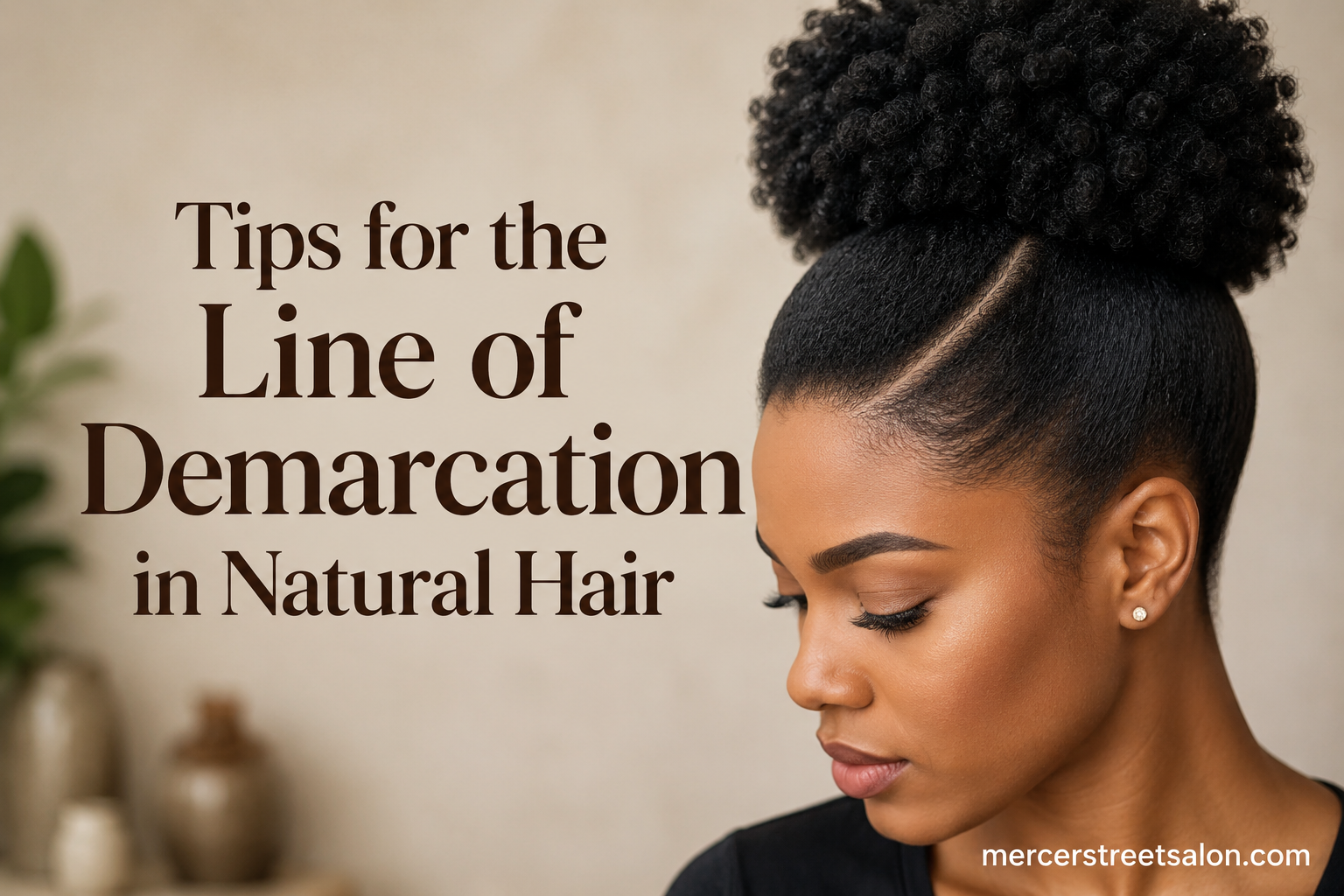
If you are currently transitioning from relaxed hair back to your natural curl pattern, you have probably noticed that distinct line where your new growth meets your chemically treated ends. That boundary is called the line of demarcation, and it is often the most challenging part of the entire transition process. The line of demarcation is where two structurally different hair textures meet, which means it is also where breakage most commonly happens. At Mercer Street Salon, we have worked with hundreds of clients navigating this exact challenge, and we understand how frustrating it can feel when your hair seems to snap right at that dividing line. Many of our clients have told us they stood in front of the mirror wondering whether to chop it all off or keep pushing through the awkward in-between phase. This guide will walk you through exactly how to deal with the line of demarcation when transitioning to natural hair, using proven techniques that our stylists recommend to clients every day.
Transitioning to natural hair is a deeply personal journey, and the line of demarcation is not just a physical challenge. It is also an emotional one. The moment you look in the mirror and see that visible divide between your straight relaxed ends and your curly new growth, it is normal to feel discouraged, self-conscious, or even overwhelmed. Many of our salon clients have told us they avoid taking photos or wearing their hair down during the early months because of how prominent the line of demarcation appears. The good news is that with the right care routine and techniques, you can strengthen that fragile zone, minimize breakage, and eventually blend those two textures into healthy, thriving natural hair. Whether you are three months into your transition or approaching the one-year mark, the strategies below will help you care for your hair with confidence.
Table of Contents
What Is the Line of Demarcation and Why Does It Matter?
The line of demarcation is the visible boundary where your new natural hair growth meets your chemically relaxed ends. It forms because relaxers permanently break the disulfide bonds in the hair shaft, leaving those ends straight, weak, and structurally different from your new natural growth. This zone is the most vulnerable part of your transitioning hair because you are essentially working with two different hair textures that require different levels of care. Understanding what the line of demarcation is will help you treat it with the gentleness it deserves.
The line of demarcation matters because it is where breakage almost always begins during a transition. Our stylists at Mercer Street Salon have seen clients lose several inches of length because they did not give this zone the extra attention it needed. The chemically relaxed ends are brittle and dry, while your natural roots are stronger and more elastic. When these two textures meet, the relaxed end tends to snag, tangle, and eventually snap. The longer your hair takes to transition, the more new growth accumulates, and the more prominent that line becomes. Taking care of the line of demarcation from day one will save you inches of hair and months of frustration.
One of the first things you should do when you start transitioning is to inspect the line of demarcation closely. Run your fingers gently from root to tip and feel for that spot where the texture changes. You may notice the hair feels rougher, drier, or more brittle at that exact point. Some clients describe it as a “rough patch” that catches on their fingers. That rough patch is your line of demarcation, and it needs a targeted care approach. Think of it as the seam where two different fabrics are stitched together. You would treat that seam with extra care, and the same logic applies to your hair.
Why the Line of Demarcation Is the Weakest Part of Your Hair
To truly understand how to deal with the line of demarcation when transitioning to natural hair, it helps to know why this area is so vulnerable at a structural level. Hair is made of proteins called keratin, and the shape of your curl pattern is determined by disulfide bonds between those protein molecules. Relaxers, perms, and texturizers break those bonds deliberately to straighten the hair. The problem is that those bonds do not grow back. Every inch of relaxed hair you still have on your head has permanently damaged protein structures, making it far weaker than your natural growth.
When your natural hair pushes out from the scalp, it emerges with its original curl pattern intact and all its natural strength. But at the line where these two sections meet, you have a structural mismatch. The natural hair wants to curl, shrink, and spring back. The relaxed hair hangs straight and has very little elasticity. During everyday activities like washing, styling, and even sleeping, these two textures pull against each other. The weaker relaxed side always loses first. This is why you see so much breakage concentrated at that exact spot.
Hair porosity also plays a role in making the line of demarcation fragile. Relaxed hair tends to be high-porosity because the chemical process has lifted the hair cuticle. High-porosity hair absorbs moisture quickly but also loses it just as fast. Your natural new growth may have a different porosity level depending on your hair type. When you apply a moisturizing product, the relaxed section at the demarcation line may drink it up and then dry out again within hours, while your natural roots stay moisturized for longer. This mismatch means the line of demarcation needs more frequent moisture applications than the rest of your hair.
Our stylists often explain the line of demarcation to clients using a simple analogy. Imagine two ropes tied together. One rope is thick, strong, and flexible. The other is thin, frayed, and stiff. When you pull on that knot, the frayed rope is going to break first. Your hair works the same way. The chemically treated section is the frayed rope, and the line of demarcation is the knot. Protecting that knot is the key to preventing breakage during your transition.
7 Practical Techniques for Dealing with the Line of Demarcation
The following techniques have helped dozens of Mercer Street Salon clients manage their line of demarcation with less breakage and more confidence. Each one targets a different aspect of the problem, so combining them into a complete routine gives you the best results.
1. Finger detangle with conditioner in the shower. Finger detangling at the line of demarcation is one of the most trusted methods among experienced transitioners. The key is to do it only when your hair is saturated with a slippery, moisturizing conditioner. Many of our salon clients report that finger detangling in the shower, starting at the ends and working upward to the line of demarcation, significantly reduces snags and single-strand knots. A Reddit user in the Naturalhair community shared that finger detangling roots and the line of demarcation with conditioner in the shower really works for preventing breakage. The idea is to remove tangles gently before they turn into breakage-causing snarls. Avoid using a comb at the line of demarcation on dry or even damp hair without product. The teeth of a comb can easily catch on that rough texture change and pull the hair right out.
2. Pre-poo with a penetrating oil before every wash. Pre-poo means applying a natural oil to your hair before you shampoo it. For transitioning hair, this step is non-negotiable at the line of demarcation. Oils like jojoba, almond, olive, and coconut oil coat the hair shaft and create a barrier that protects the fragile relaxed ends from the stripping effects of shampoo. Curly Nikki contributor Michelle Thames, who transitioned for 24 months, emphasized that keeping the line of demarcation moisturized is critical. She recommends misting with water daily and adding a little oil to keep that zone supple. At Mercer Street Salon, we suggest pre-pooing for at least 30 minutes before washing, and using a warm towel or shower cap to help the oil penetrate deeper.
3. Deep condition weekly with a protein-balanced treatment. Deep conditioning is the workhorse of any transitioning hair care routine. The line of demarcation needs a deep conditioner that balances protein and moisture. Too much protein can make the relaxed ends stiff and brittle. Too much moisture without protein can leave the natural roots mushy and weak. Look for a deep conditioner that lists hydrolyzed protein among its first few ingredients but also contains moisturizing agents like shea butter, glycerin, or avocado oil. Leave it on for at least 20 minutes under a plastic cap, and use a warm towel or hooded dryer for better penetration. Our stylists recommend deep conditioning once a week as the minimum, and twice a week if your line of demarcation feels especially dry or brittle.
4. Seal moisture using the LOC or LCO method. The LOC method stands for Liquid, Oil, and Cream. The LCO method stands for Liquid, Cream, and Oil. Both techniques are designed to lock moisture into the hair shaft after washing, and they are particularly effective at the line of demarcation. Start with a water-based leave-in conditioner or a simple water spritz as your liquid layer. Follow with an oil like jojoba, castor, or argan oil to seal in that moisture. Then finish with a cream or butter to lock everything in place. The order of oil and cream determines whether you are using LOC or LCO. Experiment with both methods to see which keeps your line of demarcation moisturized longer. For high-porosity hair that loses moisture quickly, try the LOC method with a thicker oil like castor oil. For lower-porosity hair that resists product absorption, the LCO method may work better because the cream helps carry the moisture through the cuticle layer before sealing with oil.
5. Minimize heat styling on the line of demarcation. Heat is one of the fastest ways to damage transitioning hair at the line of demarcation. Flat irons and blow dryers cause the already-weakened relaxed ends to become even drier and more brittle. Many new transitioners make the mistake of straightening their hair to make the two textures look more uniform, but this actually accelerates breakage at the line. Michelle Thames from Curly Nikki admitted that she used to visit her stylist every two weeks to get her hair blown out and straightened, and she warns others not to repeat that pattern. Instead, embrace your two textures and use heat-free styling methods like twist-outs, braid-outs, and flexi rods to blend them visually without causing damage.
6. Trim the relaxed ends gradually, every 3 to 4 months. Trimming is not just about removing split ends. During a transition, regular trims serve a specific purpose: they shorten the length of relaxed hair you have to manage, which means less breakage at the line of demarcation over time. The trim does not have to be dramatic. Ask your stylist for a “dusting” or a very light trim that removes just the most damaged half-inch of relaxed ends. Doing this every three to four months means you will have removed most of your relaxed hair within a year without ever having to do the big chop. At Mercer Street Salon, we offer transition-friendly trims that respect your length while keeping the line of demarcation as healthy as possible.
7. Sleep on a satin pillowcase or satin bonnet. The friction between your hair and a cotton pillowcase overnight is surprisingly damaging to the line of demarcation. Cotton absorbs moisture from your hair and creates friction that pulls at the fragile zone. Switching to a satin pillowcase or wearing a satin bonnet to bed reduces that friction dramatically and helps your hair retain moisture overnight. This is one of the simplest changes you can make, and our clients consistently tell us they notice less breakage after making the switch. Pair this with a loose protective style like pineappling or a loose braid before bed for even better results.
The Best Moisture Routine for Transitioning Hair at the Demarcation Line
Moisture is the single most important factor in caring for the line of demarcation. If you remember only one thing from this guide, let it be this: the line of demarcation needs moisture more than any other part of your hair. The relaxed section cannot hold moisture on its own, so you have to provide it consistently and seal it in properly. In the video below, our stylist Jessica demonstrates the moisture routine we teach transitioning clients at Mercer Street Salon.
On a typical wash day, start with a pre-poo oil treatment. Apply jojoba, almond, or olive oil to your hair, paying special attention to the line of demarcation. You want to coat every inch of the relaxed ends and that transition zone. Leave the oil on for at least 30 minutes before shampooing. This step protects the hair from the stripping effects of shampoo and adds an extra layer of moisture that penetrates the high-porosity relaxed section.
When you shampoo, use a sulfate-free formula. Sulfates are harsh cleansing agents that strip natural oils from the hair. For transitioning hair, they are especially damaging at the line of demarcation because that area already struggles to retain moisture. A gentle sulfate-free shampoo will clean your scalp without dehydrating the fragile transition zone. Focus the shampoo on your scalp where the oil and product buildup is, and let the suds run down the length of your hair rather than scrubbing the demarcation line aggressively.
After shampooing, apply a deep conditioning treatment. Use a protein-balanced deep conditioner and leave it on for a minimum of 20 minutes. For extra moisture, cover your hair with a plastic cap and apply gentle heat from a hooded dryer or a warm towel. This opens the hair cuticle and allows the conditioning ingredients to penetrate more deeply into the line of demarcation. Deep conditioning once a week is the minimum recommendation from our stylists at Mercer Street Salon. If your hair feels especially dry between treatments, consider a quick 10-minute deep conditioning session mid-week.
Once you have rinsed out the deep conditioner, apply a leave-in conditioner while your hair is still damp. Look for a leave-in that contains humectants like glycerin or honey, which attract moisture from the air into the hair shaft. Apply it section by section, making sure the line of demarcation gets an extra amount. You want that zone to be the most moisturized part of your hair, not the least. After the leave-in, apply your oil and cream using either the LOC or LCO method. For the line of demarcation specifically, add a second drop of oil and work it in gently with your fingers to ensure that transition zone is fully sealed.
In between wash days, keep a moisture spray handy. Mix water with a few drops of leave-in conditioner and a small amount of oil in a spray bottle. Mist your hair every morning and evening, paying close attention to the line of demarcation. This daily moisture habit is one of the most effective things you can do to prevent breakage. It keeps the hair flexible and less likely to snap during styling. Many of our clients keep a small spray bottle at their desk, in their gym bag, and by their bedside so they never miss a session.
Protective Styles That Hide and Blend the Line of Demarcation
Protective styles are hairstyles that keep your natural ends tucked away and protected from daily manipulation. For transitioning hair, they serve a dual purpose: they reduce breakage by limiting how much you handle your hair, and they help hide the line of demarcation so you can feel more confident about your appearance. The right protective style can blend your two textures so well that most people will not even notice you are transitioning.
Mini twists are one of the best options for transitioning hair. They are small, two-strand twists that can be done with a combination of your natural roots and your stretched relaxed ends. Mini twists are low-maintenance and can last for two to three weeks when properly maintained. They are also very effective at hiding the line of demarcation because the twisted structure visually blends the two textures. Many of our clients at Mercer Street Salon choose mini twists as their go-to protective style during the early and mid-stages of their transition.
Bantu knots are another excellent option, especially for shorter transitioning hair. Bantu knots are created by sectioning the hair, applying a styling product like a curl cream or gel, and then twisting each section into a small knot close to the scalp. They are a great heat-free style that adds definition to your natural roots while tucking away the relaxed ends. Bantu knots can be worn for about a week before needing to be refreshed. For a more polished look, you can unravel the knots into a twist-out for a second style that lasts another few days.
Flexi rods are flexible, bendable rods that you wrap your hair around to create defined curls or waves without heat. For transitioning hair, flexi rods work beautifully on your natural new growth while the relaxed ends can be wrapped and stretched to blend more naturally. Set your hair on flexi rods overnight or under a hooded dryer for about 30 to 45 minutes. The result is a style that adds bounce to your roots while softening the appearance of the relaxed ends. Flexi rods are particularly good for special occasions or when you want a more finished look without using heat.
Knotless braids are a protective style that involves braiding the hair starting with your natural roots and gradually adding in the relaxed ends as you go down the braid. The technique is called “feed-in braiding,” and it creates a braid that sits flat against the scalp and looks seamless from root to tip. Knotless braids are a fantastic option for transitioning hair because the gradual blending of textures makes the line of demarcation virtually invisible. They also put less tension on the scalp than traditional box braids, which is important for protecting your edges and new growth. Knotless braids can last anywhere from four to eight weeks depending on how well you maintain them.
Wigs and weaves can be a helpful coping strategy during the most awkward phases of your transition. If you have a day where you are feeling self-conscious about your two textures, a well-fitted wig can give you a break from the daily visibility of the line of demarcation. Many of the women we have spoken with in natural hair forums use wigs as a way to protect their natural hair while it grows out. The key is to make sure your natural hair is properly moisturized and protected underneath the wig. Wear a satin-lined wig cap, keep your scalp clean, and avoid wigs that are too tight or cause friction at your edges.
Here is a quick comparison of the most popular protective styles for transitioning hair and how well they help with the line of demarcation:
| Protective Style | Best For | Duration | Line of Demarcation Blend | Skill Level |
|---|---|---|---|---|
| Mini Twists | Daily wear, all curl types | 2-3 weeks | Excellent | Easy |
| Bantu Knots | Short transitioning hair, special occasions | 1 week | Good | Moderate |
| Flexi Rods | Defined styles, medium-length hair | 3-5 days | Good | Moderate |
| Knotless Braids | Long-term protection, thick hair | 4-8 weeks | Excellent | Advanced |
| Wigs | Quick coverage, versatility | 1-4 weeks | Complete (when worn) | Easy |
| Braid-Outs | Low manipulation, two-texture blend | 1-2 weeks | Fair | Easy |
When choosing a protective style, consider your daily routine, your styling skill level, and how much time you want to spend on maintenance. Mini twists and bantu knots are excellent starting points if you are new to protective styling. If you have a bit more experience, knotless braids offer the longest wear time and the best blending effect at the line of demarcation. The goal is not just to hide the two textures, but to protect your hair from daily manipulation that causes breakage at that vulnerable zone.
Common Mistakes That Make the Line of Demarcation Worse
Even with the best intentions, it is easy to make choices that actually worsen breakage at the line of demarcation. Knowing what to avoid is just as important as knowing what to do. Our stylists at Mercer Street Salon have observed these common mistakes across hundreds of transitioning clients, and steering clear of them will make a noticeable difference in your hair health.
Mistake 1: Over-manipulating the hair around the line of demarcation. Every time you comb, brush, or even finger-comb the line of demarcation, you create opportunities for the weaker relaxed hair to break. Try to handle that zone as little as possible. Finger detangle only when necessary, and always with conditioner in the hair. Avoid styles that require a lot of tying, pulling, or banding at the transition point. The less you touch the line of demarcation, the stronger it will become over time.
Mistake 2: Skipping moisture at the line of demarcation. Many transitioning clients focus their moisture routine on their natural roots and forget that the relaxed ends and the line of demarcation need even more attention. The relaxed section cannot retain moisture on its own. If you are only spritzing your roots and ignoring that transition zone, you are setting yourself up for breakage. Make the line of demarcation the most moisturized part of your hair on every single wash day and in between.
Mistake 3: Using the wrong products for the line of demarcation. Products that work beautifully on your natural hair may be completely wrong for the chemically treated section. Heavy gels and strong-hold products can dry out the relaxed ends. Protein-heavy treatments without enough moisture can make the demarcation line stiff and prone to snapping. Pay attention to how your hair responds to different products, and adjust accordingly. The line of demarcation may need a separate treatment from the rest of your hair.
Mistake 4: Heat styling the line of demarcation regularly. Using a flat iron or blow dryer on the transition zone repeatedly will cause the relaxed ends to become increasingly dry, brittle, and damaged. It may make your hair look smoother temporarily, but the long-term damage is not worth it. If you must use heat for a special occasion, use a heat protectant spray and keep the temperature below 350 degrees Fahrenheit. Better yet, use heat-free styling methods like flexi rods or twist-outs to achieve similar results without the damage.
Mistake 5: Trimming too aggressively or avoiding trims entirely. Some transitioners avoid trimming because they are afraid of losing length. Others trim too aggressively and end up with a shorter overall style than they intended. Both extremes cause problems. Trimming too little means you are carrying around damaged relaxed ends that will eventually break off anyway, usually at the worst possible moment. Trimming too aggressively removes healthy natural hair along with the damaged relaxed hair. The sweet spot is a light dusting every three to four months. Ask your stylist to remove just the most damaged half-inch at the line of demarcation. This gradual approach keeps your length while steadily improving the health of your transition zone.
Mistake 6: Comparing your transition to others. Social media can make the transition process feel discouraging. You might see someone with a perfectly blended transition after six months and wonder why your own line of demarcation still looks prominent. The truth is that every person’s hair grows at a different rate, has a different porosity, and responds differently to treatments. Your transition timeline is your own. Some people see significant blending after eight months. Others take 18 months or longer. The goal is healthy hair, not a fast transition. Comparing your hair to someone else’s will only add unnecessary stress to an already challenging process.
What to Expect at Each Stage of Your Transition
Understanding the different stages of transitioning can help you set realistic expectations and plan your hair care routine accordingly. The line of demarcation will look and behave differently at each stage, and your approach should evolve as your hair grows and changes.
Early transition (first 3 months): In the early months, your line of demarcation will be very close to your scalp. Your new growth is short, and the contrast between your natural roots and your relaxed ends is sharp and obvious. This is the stage where breakage risk is highest because the relaxed ends are still long and vulnerable. Focus on moisture, gentle handling, and protective styling. Keep your hair in low-manipulation styles like twists or bantu knots that do not require much touching. Deep condition every week, pre-poo before every wash, and moisturize the line of demarcation daily. Do not worry about blending the textures yet. Your priority in this stage is simply keeping both sections healthy and preventing breakage.
Mid-transition (months 4 through 8): By the middle stage, your natural hair has grown several inches and the line of demarcation has moved further down the shaft. The contrast between textures is still visible, but you have more natural hair to work with. This is the stage where many transitioners start experimenting with styles that blend the two textures. Twist-outs, braid-outs, and flexi rod sets can create a nice visual bridge between your curly roots and your straight ends. Continue deep conditioning weekly and consider adding a protein treatment every two weeks if your hair feels mushy or lacks strength. At this stage, you might also start thinking about your first trim if the relaxed ends feel particularly rough or damaged.
Late transition (9 months and beyond): In the late stage, most of your hair is now natural growth, and the line of demarcation is near the ends. The relaxed section is now a much smaller portion of your overall hair, which means less breakage risk overall. Many clients at this stage choose to do a “big chop” to remove the remaining relaxed ends all at once, resulting in a uniform head of natural hair. Others continue trimming gradually until all the relaxed hair is gone. Either approach is valid. If you choose to keep transitioning without the big chop, you may find that your styling options have expanded significantly. Your hair is now long enough for more intricate protective styles like knotless braids or faux locs. Continue your moisture routine and keep deep conditioning. The finish line is in sight.
How Your Curl Type Affects the Line of Demarcation
Not all transitioning hair experiences the line of demarcation in the same way. Your curl type plays a significant role in how noticeable the line is and how aggressively it needs to be managed. Type 2 wavy hair tends to have a less dramatic line of demarcation because wavy and straight textures are closer in structure than kinky curly and straight hair. The transition may feel smoother, but the relaxed ends still need the same moisture-focused care to prevent breakage.
Type 3 curly hair usually experiences a very obvious line of demarcation. The contrast between loose curls at the roots and straight relaxed ends is visually striking, and the difference in texture can cause significant tangling at that junction point. Type 3 hair also tends to be more prone to shrinkage, which means the line of demarcation may appear to move more slowly than it actually is. What looks like an inch of new growth may shrink down to half an inch when dry. Be patient and measure your growth when your hair is stretched for a more accurate picture.
Type 4 coily and kinky hair often has the most challenging line of demarcation simply because coily roots and straight relaxed ends are the most structurally different. The shrinkage in type 4 hair can be extreme, sometimes up to 75 percent, which means the line of demarcation is constantly under tension as the natural hair shrinks against the weight of the relaxed section. Type 4 transitioners need to be especially vigilant about moisture, deep conditioning, and gentle detangling. Trims may need to be slightly more frequent because the tension on the demarcation line is greater with coily textures.
Regardless of your curl type, the fundamental principles remain the same: moisturize aggressively, handle gently, and protect from manipulation. The difference is in the frequency and intensity of those routines. Type 4 hair generally needs more moisture and more frequent deep conditioning than type 2 or 3 hair. Type 2 hair may get away with a lighter moisture routine but still needs the same protective strategies to prevent breakage at the line of demarcation.
Tracking Your Progress Through the Transition
One of the hardest parts of transitioning to natural hair is that progress can feel slow. Hair grows at about half an inch per month, which means visible change happens gradually. On top of that, the line of demarcation can make your hair look more damaged than it actually is, which adds to the feeling that nothing is improving. Keeping a record of your journey can help you see how far you have come, even when the day-to-day changes feel minimal. Many of our clients find that tracking their progress in a hair journal or through progress photos makes the transition feel more rewarding and less discouraging.
A hair journal does not need to be complicated. Start with a simple notebook or a notes app on your phone and jot down a few observations after each wash day. Note how your hair feels, what products you used, and how the line of demarcation responded. Track your trim dates, any breakage you noticed, and the styles that worked best that week. Over time, this record becomes a valuable reference. You will start to see patterns, like which deep conditioners give you the best results or how often your hair actually needs moisture. Jaycee Naturals, one of the more comprehensive guides we studied, highlighted the value of hair journaling as a way to stay connected to your progress. Our stylists agree it is one of the most underused tools in a transitioner’s arsenal.
Progress photos are another powerful tracking tool. Take a photo of your hair from the front, back, and both sides every month, using the same lighting and background each time. The change may not be obvious from week to week, but when you compare photos from three months ago, you will see real growth. Seeing the line of demarcation move further down your hair over time is motivating and helps you stay committed to the process. Some clients also take photos of their hair after specific treatments, like a deep conditioning session or a fresh trim, to see how those steps affected the health of their transition zone. A Reddit user who completed a two-year transition shared that looking back at their progress photos helped them realize the journey was working even when it did not feel like it in the moment.
A Professional Salon Perspective on the Line of Demarcation
At Mercer Street Salon, we work with transitioning clients every week, and we have developed a clear perspective on what actually works. The biggest mistake we see is clients who try to do everything at once. They buy ten different products, try five different techniques in the same week, and then wonder why nothing is working. The reality is that the line of demarcation responds best to consistency and simplicity. Pick a moisture routine that fits your schedule, stick with it, and give it at least four to six weeks before deciding whether it is working.
Another observation from our stylists is that many transitioning clients underestimate how often the line of demarcation needs moisture. We tell our clients to think of the demarcation zone as the driest part of their hair, always. If you think you have moisturized it enough, add one more layer. If you think you are being too gentle with it, you are probably being about the right amount of gentle. The line of demarcation cannot be over-moisturized, but it can easily be under-moisturized, and that is where most breakage starts.
We also encourage our transitioning clients to build a relationship with a professional stylist who understands natural hair. A good stylist can assess your hair porosity, identify weak spots at the line of demarcation before they turn into breakage, and recommend trims that preserve your length while removing damaged ends. If you are in the New York area, we invite you to visit Mercer Street Salon for a transition consultation. We will walk through your hair with you, point out exactly where your line of demarcation is, and create a care plan tailored to your curl type, porosity, and lifestyle. There is no reason to navigate this transition alone when professional support is available.
Frequently Asked Questions
What is the line of demarcation in natural hair?
The line of demarcation is the visible boundary where your new natural hair growth meets your chemically relaxed or permed ends. It forms because relaxers permanently break the disulfide bonds in the hair shaft, leaving those sections weaker, drier, and structurally different from your natural roots. This zone is the most fragile part of transitioning hair and requires extra moisture and gentle handling to prevent breakage.
How do you fix a demarcation line in hair?
You cannot completely eliminate the line of demarcation until all your relaxed hair has grown out or been trimmed off, but you can significantly improve its appearance and reduce breakage by using seven key techniques: finger detangling with conditioner, pre-poo oil treatments before every wash, weekly deep conditioning, sealing moisture with the LOC or LCO method, minimizing heat styling, trimming relaxed ends every three to four months, and wearing protective styles that blend the two textures. Consistency with these steps will strengthen the demarcation zone over time.
How long does it take to transition to natural hair?
Transitioning to natural hair typically takes between six months and two years, depending on your hair growth rate and how quickly you trim away relaxed ends. The average person’s hair grows about half an inch per month. If you are transitioning from shoulder-length relaxed hair and trimming lightly every three months, expect the process to take 12 to 18 months. The line of demarcation will gradually move down the shaft as your natural hair grows out, and you will see less breakage as the transition progresses.
Can you transition to natural hair without cutting it?
Yes, you can absolutely transition to natural hair without cutting it. This is called a long-term transition, and it involves gradually trimming your relaxed ends over time while growing out your natural hair. Many people prefer this approach because it preserves length and avoids the dramatic change that comes with the big chop. The key to a successful no-cut transition is consistent moisture, gentle detangling, and regular trims every three to four months to remove the most damaged relaxed ends without losing overall length.
How do you blend the line of demarcation when going gray natural?
When transitioning to natural gray hair, the line of demarcation can be even more noticeable because gray hair has a different texture and porosity than pigmented hair. The same principles apply: keep the line of demarcation heavily moisturized, use protein treatments to strengthen the zone, and choose protective styles that blend textures. Gray hair tends to be drier, so you may need to deep condition more frequently and use richer oils like shea butter or castor oil to seal in moisture. Some transitioners with gray hair also find that temporary color treatments or toning products help create a more uniform appearance while the gray grows out.
How do you stop breakage at the line of demarcation?
Breakage at the line of demarcation happens because the chemically relaxed section is weaker than your natural growth, and the two textures pull against each other during daily handling. To stop breakage, moisturize the line of demarcation daily with a water-based spray, pre-poo with a penetrating oil before every wash, deep condition weekly, avoid combing that zone without conditioner, minimize heat styling, and wear protective styles that reduce manipulation. The most important habit is consistent moisture. The line of demarcation should be the most hydrated part of your hair at all times.
What is the best protective style for transitioning hair?
The best protective style for transitioning hair depends on your hair length, texture, and lifestyle, but mini twists are the most versatile option for most people. Mini twists work well with two textures, last two to three weeks, and require minimal daily maintenance. Knotless braids are excellent for longer transitions and provide the best line of demarcation blending. For shorter transitioning hair, bantu knots offer a stylish option that keeps the hair tucked away. Wigs and weaves provide complete coverage and can be a good option for days when you want a break from managing two textures.
Wrapping Up Your Transition Journey
Learning how to deal with the line of demarcation when transitioning to natural hair is not about finding one magic product or one perfect technique. It is about building a consistent routine that gives that fragile zone the moisture, gentleness, and protection it needs. The seven techniques we covered in this guide, from finger detangling to protective styling, work best when you combine them into a regular practice. The line of demarcation is not your enemy. It is simply a sign that your hair is in the process of healing and returning to its natural state. With patience and proper care, that line will move further down your hair, and eventually it will be gone entirely.
At Mercer Street Salon, we believe that transitioning hair is a journey that deserves support, not just products. If you are in the New York area and want a professional assessment of your line of demarcation, our stylists are here to help. We can evaluate your hair porosity, recommend a tailored moisture routine, and give you a trim that respects your length while removing damaged ends. You do not have to navigate this transition alone. Whether you are in the early months or approaching the two-year mark, we have seen every stage of the journey and we know how to help you reach your natural hair goals.