
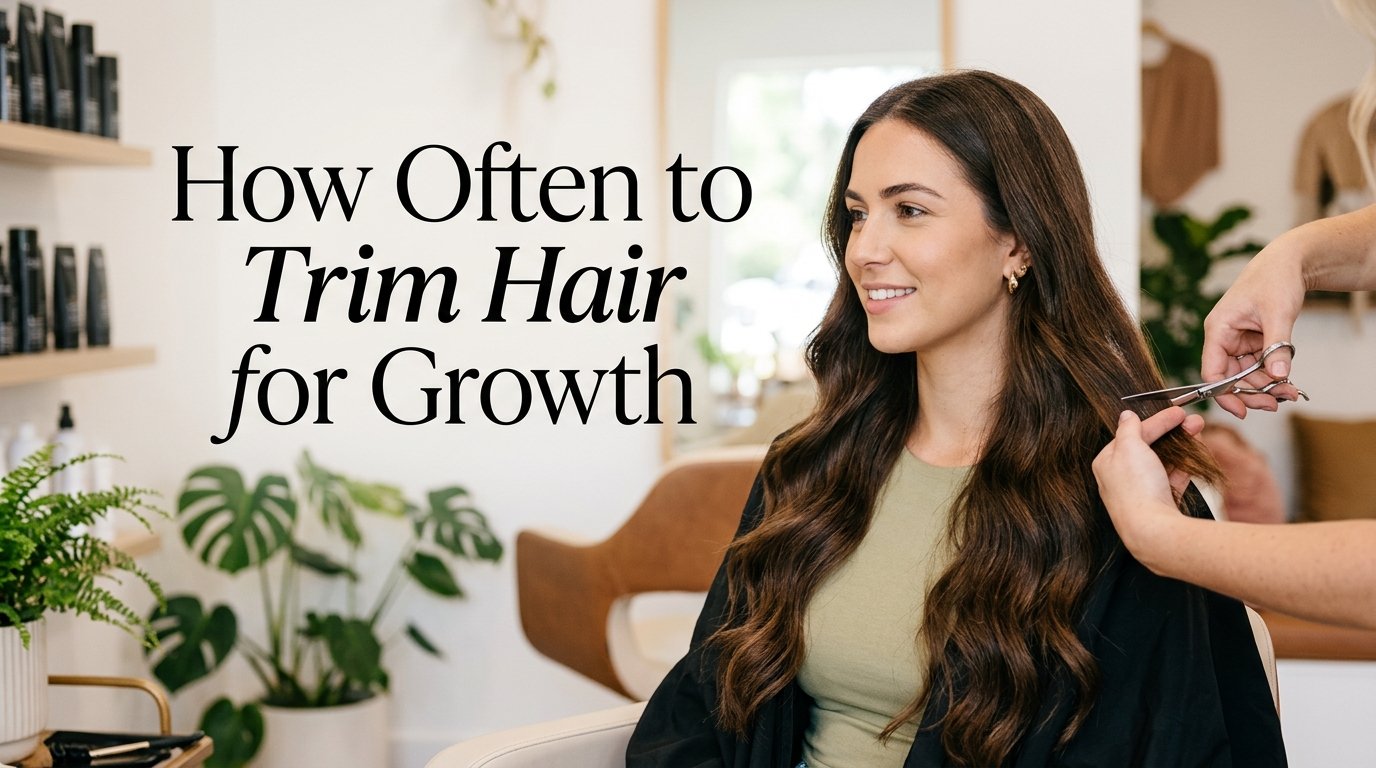
Growing long hair tests your patience in ways few things can. You wait months for visible length, then panic sets in every time a stylist reaches for the shears. If you have ever wondered whether that trim is helping or hurting your growth journey, you are in the right place.
Here is what you will learn in this guide: the real signs your hair needs a trim, a hair-by-hair-type schedule you can follow, and the simple science of why trimming actually protects the length you are working so hard to build. We will also clear up the biggest myth in hair care, the one that says skipping trims makes hair grow faster.
By the end, you will know exactly how to know how often to trim hair that is trying to grow long without second-guessing every salon visit. No guesswork, no conflicting Reddit threads, just a clear plan you can stick to.
Table of Contents
How Often Should I Trim My Hair for Growth?
The short answer: trim healthy hair every 10 to 12 weeks (roughly 2.5 to 3 months) while growing it long. If your hair is fine, color-treated, or already showing damage, shift that window to every 6 to 8 weeks. Trim only a quarter to half inch each visit to stay ahead of split ends while preserving maximum length.
Hair grows an average of half an inch per month. If you cut a full inch every 8 weeks on healthy hair, you are trimming away roughly the same amount you grew. That is why the frequency matters more than the size of the trim itself.
The goal is not to remove as much as possible. The goal is to remove just enough damaged hair to stop breakage from traveling up the shaft, while keeping every possible millimeter of healthy length.
Signs You Need a Trim Now
Your hair sends clear signals before serious damage sets in. The trick is learning to read those signals before split ends turn into widespread breakage. Here are the seven signs our team tells clients to watch for when they are growing their hair out.
1. Split Ends You Can See
Take a small section of dry hair and twist it gently. Look at the bottom inch under bright light. If you see single strands splitting into two or forming a tiny “Y” or “V” shape at the tips, that is a split end.
One or two split ends is normal. When you spot them throughout multiple sections, it is time to book a trim. Split ends do not heal, they only travel further up the shaft if left alone.
2. Hair Tangles More Than Usual
Healthy ends glide past each other. Damaged ends catch, grip, and form tiny knots that feel like Velcro when you run your fingers through your hair.
If your detangling time has doubled and your brush keeps getting stuck near the ends, your hair is crying out for a trim. Those rough, frayed ends are gripping neighboring strands.
3. Dry, Brittle Feeling at the Tips
Compare the texture of hair near your scalp to the ends. The ends will always be slightly drier because they are older, but a sudden, dramatic dryness difference is a warning sign.
When the ends feel crunchy, stiff, or like straw even right after conditioning, the cuticle has worn down and moisture is no longer staying locked inside. A trim removes that damaged portion so your conditioner can actually do its job on healthier hair.
4. Visible Breakage on Clothing
Check the shoulders of your shirts at the end of the day. A few strands is normal shedding from the root. Short, broken pieces (under 2-3 inches) scattered on your collar signal breakage from the ends.
Breakage means hair is snapping before it can reach its full length. Trimming the weakest points prevents further snapping up the hair shaft.
5. Ends Look Thinner Than the Roots
Pull your hair into a low ponytail and look at the thickness near the band versus the tips. If the ponytail tapers dramatically, you are losing length to breakage.
A healthy growth pattern keeps the ponytail fairly uniform in thickness. A noticeable “V” taper or see-through quality at the ends means breakage is outpacing growth.
6. Dull, Lifeless Color at the Ends
Damage strips the shine from hair. When your roots look glossy but your ends look flat and lifeless no matter how much you style them, those ends are beyond saving with product.
A fresh trim instantly restores the appearance of healthy hair because you are removing the section that has absorbed the most environmental and styling damage.
7. Your Ends Will Not Hold a Style
Healthy hair holds a curl, a wave, or a sleek blowout with reasonable effort. Damaged ends either refuse to curl or fall flat within an hour.
If your styling results are inconsistent and the ends always look frizzy or undefined, the structural integrity of those strands has weakened. A trim restores uniform behavior across all your hair.
How to Know How Often to Trim Hair That Is Trying to Grow Long
There is no single trim schedule that works for everyone. Your hair type, texture, color history, and styling habits all change the math. Here is a breakdown of how to know how often to trim hair that is trying to grow long, organized by hair type.
Fine or Thin Hair
Trim every 6 to 8 weeks. Fine hair has a smaller diameter, which means each strand wears down faster from brushing, washing, and heat styling. Damage shows up sooner and spreads more visibly.
Fine hair also shows breakage more easily because there is less density to hide it. Even small amounts of damage make the ends look stringy and sparse, which kills the illusion of length.
Ask for a quarter-inch trim. That small amount is usually enough to clean up the weakest ends without sacrificing noticeable length.
Medium or Normal Hair
Trim every 8 to 10 weeks if you use heat tools regularly, or every 10 to 12 weeks if you air-dry most of the time. Medium hair has enough diameter to handle daily wear reasonably well.
This is the hair type that has the most flexibility. If your ends still look healthy and feel smooth at week 10, you can stretch to week 12 without consequences.
Thick or Coarse Hair
Trim every 10 to 12 weeks. Thick hair strands are larger in diameter, which gives them more natural resistance to daily damage. You can usually go longer between trims without seeing breakage spike.
The risk with thick hair is not breakage so much as bulk. Skipping too many trims leads to dense, heavy ends that drag down your style and make your hair look shapeless.
Curly and Wavy Hair
Trim every 10 to 12 weeks for looser curls (2A to 3C) and every 12 to 16 weeks for tighter curl patterns. Curly hair is naturally drier because scalp oils take longer to travel down the coil, but the curl pattern also tends to hide split ends better than straight hair.
Always ask a stylist who specializes in curly hair, and consider a dry trim. Wet curls spring up differently once dry, and a wet trim can leave you with an uneven result that affects how your curls behave for months.
Coily and 4C Hair
Trim every 12 to 16 weeks, or roughly 3 to 4 times per year. Coily hair has the most fragile strand structure despite looking strong, so protective styling and gentle handling matter more than frequent trims.
Look for single-strand knots (tiny beads along individual strands) as your main signal. Those knots cause breakage when neighboring strands pull on them. A careful trim removes the knotted ends and prevents the chain reaction.
Color-Treated or Chemically Processed Hair
Trim every 6 to 8 weeks regardless of natural texture. Bleach, permanent dye, relaxers, and perms all weaken the hair shaft structurally. Damage accumulates faster and split ends travel upward more aggressively.
Color-treated hair also tends to feel drier at the ends because the chemical process strips moisture. Keeping those ends trimmed lets your conditioning treatments work on healthier hair rather than fighting a losing battle with fried ends.
The Long Stretch Approach
Some people successfully go 6 months to a year between trims. This works when hair is virgin (no chemical processing), air-dried most of the time, rarely heat-styled, and worn in protective styles.
The risk is that you cannot see split ends developing until they have already caused breakage. If you want to try a long stretch, check your ends monthly using the signs above and trim the moment you spot trouble.
Trim vs Cut vs Dusting: What Each One Means
These three terms get used interchangeably, and that confusion leads to bad salon visits. Knowing the difference helps you communicate exactly what you want and protect your length.
Dusting
Dusting removes only the very tips of the hair, usually a quarter inch or less. The name comes from the idea that you are removing just the “dust” of damage off the ends.
Best for: healthy hair that just needs a tiny refresh between regular trims, or someone terrified of losing length who wants to maintain health without a real cut.
Trim
A trim removes a quarter inch to one inch of hair. This is the standard maintenance service for someone growing their hair long.
Best for: every 8 to 12 weeks on healthy hair, or every 6 to 8 weeks on fine and color-treated hair. A trim removes visible split ends before they spread.
Cut
A cut removes more than an inch and may also change the shape, layers, or overall style of your hair. Cuts are about transformation, not just maintenance.
Best for: removing significant damage, reshaping grown-out layers, or starting fresh after a period of neglect. If a stylist says you need a cut rather than a trim, they have spotted damage that extends beyond the very ends.
Which One Do You Need?
If you are growing long hair and your ends look decent, ask for a dusting or a trim. Reserve the word “cut” for moments when you are willing to lose real length to fix damage or change shape.
Always communicate in inches, not vague terms. “Half an inch maximum” gives your stylist a clear boundary and prevents the dreaded moment when they take off two inches because they thought you wanted shape.
The Hair Growth Cycle Explained
Understanding why hair grows at its own pace helps explain why trim timing matters. Hair grows in three distinct phases, and every strand on your head is in a different stage.
Anagen Phase (Growth)
This is the active growth phase, and it lasts anywhere from 2 to 7 years depending on your genetics. About 85 to 90 percent of your hair is in this phase at any given time.
During anagen, cells at the root divide rapidly and push the hair shaft out of the follicle. This is when your hair gains visible length, at roughly half an inch per month.
Catagen Phase (Transition)
This short phase lasts about 2 to 3 weeks. The hair stops growing and detaches from the blood supply. The follicle shrinks. Only about 1 to 2 percent of your hair is in catagen at any time.
Telogen Phase (Resting and Shedding)
The hair rests in the follicle for about 3 months, then sheds naturally. You lose 50 to 100 telogen hairs per day, which is completely normal. After shedding, the follicle resets and a new anagen hair begins growing.
What This Means for Trimming
Trimming does not affect the growth phase at the root. Cutting the ends has zero impact on what your follicles are doing under the scalp. Anyone who tells you trimming “stimulates growth” is wrong.
What trimming does is preserve the length you already have. Split ends, when left alone, travel up the shaft and cause strands to break off higher than they would have otherwise. You end up with shorter hair despite steady growth at the root.
Think of it like a leaky bucket. Growth adds water at the top, but breakage drains it out the bottom. Trims patch the leaks so the water level actually rises.
How to Maintain Hair Between Trims
What you do between salon visits matters as much as the trims themselves. These habits extend the life of each trim and keep damage from creeping in early.
Use Heat Protectant Every Single Time
Heat styling is the single fastest way to damage healthy ends. A good heat protectant creates a barrier between your hair and the hot tool, reducing damage significantly.
Apply it to damp hair before blow-drying, and again on dry hair before flat ironing or curling. Skipping heat protectant once will not destroy your hair, but skipping it regularly will shorten the time between your trims.
Switch to a Silk or Satin Pillowcase
Cotton pillowcases create friction that tugs on hair while you sleep. Over time, that friction wears down the cuticle and contributes to split ends.
Silk and satin let hair glide smoothly, which reduces overnight damage. This is one of the easiest upgrades you can make for long-hair health, and it pays for itself in fewer trims.
Detangle From the Bottom Up
Never start brushing at the roots. That pushes all the tangles down to the ends, where they bunch up and cause breakage.
Start at the very tips and work upward in small sections. Use a wide-tooth comb on wet hair and a brush designed for detangling on dry hair. Patience here prevents the small daily damages that add up over weeks.
Deep Condition Weekly
A weekly deep conditioning treatment restores moisture and protein to ends that are weeks or months old. Healthy, well-moisturized ends resist splitting far longer than dry ones.
Look for a treatment with hydrolyzed protein if your hair is damaged, or a moisture-focused mask if your hair is simply dry. Apply from the mid-lengths down and leave it on for the full recommended time.
Minimize Tight Hairstyles
Ponytails and top knots held with thin elastic bands create tension points that cause breakage. Switch to silk scrunchies or spiral hair ties that distribute pressure more gently.
Vary your placement too. Wearing a ponytail at the exact same spot every day creates a weak point on those strands. Rotate between high, low, and loose styles.
Protect Hair From the Elements
Sun, wind, chlorinated pool water, and salt water all damage hair over time. Wear a hat in strong sun, rinse hair with fresh water before swimming so it absorbs less chlorine, and use a leave-in conditioner with UV protection if you spend a lot of time outdoors.
What Happens If You Skip Trims Entirely
Many people try to skip trims in the hope that untouched hair will grow faster. This is the most common myth in hair care, and it backfires every time.
Hair grows from the root at the same rate whether you trim or not. What changes when you skip trims is how much length you keep. Split ends travel upward, sometimes an inch or more, weakening the hair until it snaps off on its own.
The result is hair that appears to stall in length even though it is growing steadily from the scalp. You are growing new hair at the top while losing the same amount to breakage at the bottom.
People who skip trims for a year often end up needing a significant cut to remove all the accumulated damage. They lose more length in one dramatic visit than they would have across several small trims.
The lesson is simple: regular small trims almost always preserve more total length than skipping and doing one large correction cut later.
FAQs
How often should I trim my hair if I want it long?
For most healthy hair, trim every 10 to 12 weeks while growing it long. If your hair is fine, color-treated, or already damaged, shift to every 6 to 8 weeks. Trim only a quarter to half inch per visit so you keep more length than you remove.
What is the 3:2:1 rule for haircuts?
The 3:2:1 rule is a stylist guideline for cut frequency. It suggests trimming the back of your hair every 3 months, the sides every 2 months, and the bangs or fringe every 1 month. This schedule keeps each area of the hair looking intentional as it grows, since different zones grow out at noticeably different rates.
What is the 2.25 rule for hair?
The 2.25 inch rule comes from hairstylist John Frieda and refers to a measurement that helps determine if short hair will suit your face. Measure from your earlobe to the bottom of your chin. If that distance is under 2.25 inches, short hairstyles tend to flatter your proportions. If it is over 2.25 inches, longer styles usually balance your features better.
Is it better to cut hair before chemo?
Many people choose to cut their hair short before starting chemotherapy because it can make the eventual hair loss feel less shocking and emotionally jarring. Some also shave their head proactively. This is a deeply personal decision and there is no medical need to cut it beforehand. Talk to your care team about cold cap therapy if you want to reduce hair loss during treatment.
Does trimming hair actually make it grow faster?
No. Trimming has no effect on the growth rate at the scalp. Hair grows about half an inch per month regardless of whether you trim it. Trimming helps by removing split ends before they travel up the shaft and cause breakage, which preserves the length you already have.
Can I go a year without trimming my hair?
Some people with virgin, air-dried, rarely styled hair can stretch to a year between trims without major damage. For most people, going a year leads to accumulated split ends and breakage that often requires a significant corrective cut. You usually preserve more total length with 3 to 4 small trims per year.
Should I trim during the awkward growth stage?
Yes, but only dustings. The awkward stage, usually around months 4 to 10 of growing out a short cut, is when hair feels shapeless and hard to style. Light dusting trims every 10 to 12 weeks keep the ends healthy and the silhouette intentional without sacrificing the length you are building.
How do I check for split ends at home?
Take a small section of dry hair and twist it into a loose rope. Hold the twist under bright light and look at the bottom inch. Split ends show up as tiny Y, V, or fork shapes where one strand divides into two. Check sections from the front, sides, back, and underneath to get an accurate picture of overall damage.
Building Your Own Trim Schedule
Now you know how to know how often to trim hair that is trying to grow long. The framework comes down to three pieces: know your hair type, watch for the seven signs of damage, and stick to a trim window that matches your hair type and styling habits.
Start by marking a trim date on your calendar based on the schedule for your hair type. Between visits, check your ends monthly using the twist test. If you see split ends before your scheduled trim, move the appointment up. If your ends still look great at week 10, you have room to stretch.
The people who successfully grow long hair are not the ones who skip trims. They are the ones who trim strategically, communicate clearly with their stylist, and protect their hair between visits. Treat trimming as length insurance, not length loss, and your growth journey will feel a lot less stressful.