
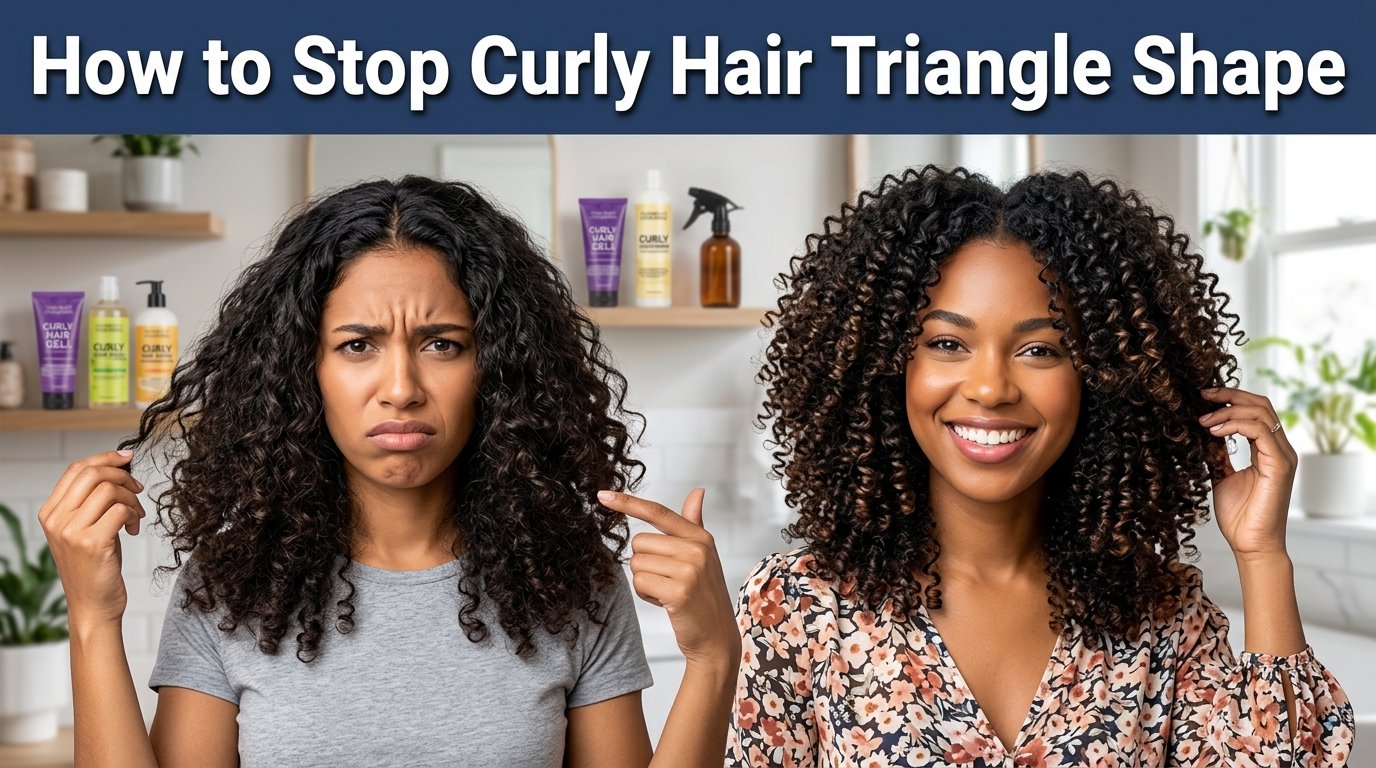
You leave the salon feeling amazing, wash your hair the next morning, and suddenly your curls have ballooned into a wide, bottom-heavy triangle. If this sounds familiar, you are far from alone. Learning how to stop curly hair from turning into a triangle shape is one of the most common struggles in the curly hair community, and the good news is that it is completely fixable.
Triangle hair, also called pyramid head, happens when your curls sit flat against your scalp on top while expanding outward at the bottom. The result is a shape that adds unnecessary width to the sides of your face and kills any natural volume at your crown. It is frustrating, it affects your confidence, and it makes you wonder whether your stylist even understood your hair.
In this guide, we cover exactly what causes triangle hair, the layering techniques that prevent it, why dry cutting matters, and the at-home styling fixes you can start using today. We also share the exact phrases to use at your next salon appointment so you never walk out with pyramid head again.
Table of Contents
What Is Triangle Hair and Why Does It Happen?
Triangle hair is exactly what it sounds like: your hair forms a triangular silhouette when viewed from the front or side. The crown sits flat against your head, the mid-lengths puff out, and the ends create a wide base. In the curly hair world, this is often called pyramid head, and it is the number one complaint from people with type 3 and type 4 curls.
The shape is not caused by one single thing. It is a combination of how curly hair naturally behaves and how it has been cut. Curly hair is not uniform like straight hair, which means every section behaves differently depending on its curl pattern, density, and porosity.
When you have curls, your hair does not fall straight down. Each curl spirals outward and upward, expanding in every direction as it dries. This natural curl expansion means that without the right internal structure built into the cut, your hair will always gravitate toward that wide, triangular shape.
The problem is widespread. Over on the r/curlyhair community on Reddit, threads about triangle hair routinely pull in hundreds of comments. One user described it perfectly: they have fine but dense wavy hair where the waves start midway down, creating what they called a recipe for triangle head. That combination of fine strands and high density is one of the most common patterns behind this issue.
What Causes Curly Hair to Turn Into a Triangle Shape
Understanding the root cause is the first step in figuring out how to stop curly hair from turning into a triangle shape. At its core, triangle hair is a weight distribution problem. The bulk of your hair sits at the bottom, gravity pulls it down, and nothing at the top lifts it up.
Curly hair naturally carries more volume than straight hair because each curl takes up three-dimensional space. When all that volume is concentrated at one length, the ends expand outward while the roots stay flat. Think of it like an umbrella: the top is compressed and the bottom fans out.
Here are the specific causes behind the curly hair triangle shape:
1. One-length cuts. Blunt, single-length haircuts are the biggest culprit. Without layers to remove weight and create movement, all your curl volume stacks at the bottom. This is the classic cause of pyramid head curly hair.
2. Wet cutting with straight-hair techniques. Most cosmetology schools teach cutting techniques designed for straight hair. When these methods are applied to curly hair, the stylist cannot see how the curls will spring up and expand once dry. The result is a shape that looks balanced wet but turns into a triangle once the curls shrink and expand.
3. Incorrect layer placement. Even when layers are added, they are often too long or too uniform. Layers that start too low do not remove enough weight from the top. Layers cut at the same length all over can actually make the triangle worse by adding bulk at the sides.
4. Incomplete blending between layers. If the top layers and bottom layers are not blended smoothly, you end up with a shelf effect. The shorter layers sit on top of the longer ones, creating a visible line where the curl pattern changes direction.
5. Wrong parting technique. Some stylists part curly hair the same way they part straight hair, without accounting for how each section will dry and expand. Incorrect parting can push volume to the sides instead of distributing it evenly.
6. Heavy products weighing down the crown. Even with a good cut, using heavy creams or butters near your roots can flatten the crown while the ends stay fluffy. This creates a styling-induced triangle effect that has nothing to do with the haircut itself.
The Best Layering Techniques to Prevent Triangle Hair
If there is one universal answer to how to avoid triangle hair, it is layers. But not just any layers. The right layering techniques for curly hair are specifically designed to distribute weight evenly, allow curls to nest into each other naturally, and create volume at the crown rather than the bottom.
Shari Harbinger, curl expert and former educator at Devachan Salon, explains it simply: curly hair needs internal structure. You are not just cutting length off the bottom. You are building a framework that supports each curl as it dries and expands.
Here are the most effective layering approaches for preventing pyramid head:
Diagonal Layers
Diagonal layers are cut at an angle rather than straight across. This creates a soft, cascading effect where shorter curls near the crown support and lift the longer curls beneath them. The diagonal angle prevents the shelf effect that happens with blunt horizontal layers.
This technique works well for most curl types, but it is especially effective for type 3b and 3c curls that have defined spiral patterns. The angled layers follow the natural spiral direction, allowing each curl to sit in its natural position without being forced flat or pushed outward.
Internal Layering
Internal layering involves removing weight from underneath the top layers of hair. The stylist lifts sections and cuts shorter layers beneath the surface that are not visible from the outside. This removes bulk from the interior without altering the overall length or shape.
This is one of the most powerful techniques for fine but dense hair, which is a combination many Reddit users say causes their triangle problems. Internal layering reduces the weight that pulls the crown flat while keeping the surface looking full and connected.
Curl-by-Curl Cutting
This method, popularized by the DevaCurl and Devachan approach, involves cutting each curl individually while the hair is dry and in its natural state. The stylist works with the hair exactly as it falls on a normal day, trimming curl by curl to create a balanced shape.
Curl-by-curl cutting is the gold standard for preventing triangle hair because it accounts for how each individual curl behaves. No two curls shrink the same amount, so cutting them all to the same length wet will always result in an uneven, triangular shape once dry.
Graduated Layers for Volume
Graduated layers build progressively shorter layers from the bottom to the top of the head. This creates a stacked effect that lifts the crown naturally. The graduation angle can be adjusted based on your curl type and how much volume you want at the top.
For type 3a and 3b curls with looser patterns, a gentler graduation creates subtle lift without looking puffy. For type 4a through 4c coils, a more pronounced graduation can create dramatic root volume that balances the natural shrinkage at the ends.
The Curly Shag
The curly shag has become one of the most requested cuts for triangle prevention, and for good reason. Shag cuts for curls incorporate face-framing layers, crown layers, and disconnected pieces that break up any solid shape. The varied lengths prevent bulk from collecting at any single point.
A well-cut curly shag distributes weight so evenly across the head that triangle hair is nearly impossible. The layers are intentionally varied in length, which means curls have room to expand in every direction without stacking into a pyramid.
Why Dry Cutting Matters for Curly Hair
If you take away one thing from this guide, let it be this: dry cutting is the single most important factor in preventing triangle hair. When curly hair is cut wet, it stretches and appears longer than it actually is. Once it dries, each curl springs up and shrinks by 20 to 40 percent depending on your curl pattern.
A stylist cutting curly hair wet is essentially working blind. They cannot see the final shape, they cannot predict where each curl will sit, and they cannot account for how different sections will expand. This is why so many people leave the salon happy but wash their hair the next day to find a triangle.
Dry cutting solves this problem entirely. The stylist sees your hair exactly as it lives on your head. They can see which curls need to be shortened, which sections need weight removed, and where the shape is unbalanced. Tension-free dry cutting means the hair is not pulled straight before cutting, so the final result matches what you see in the chair.
Tanya Williams, a curl educator who specializes in texture cutting, puts it this way: you would not hem a pair of pants while someone was sitting down, because the measurement would be wrong. The same logic applies to curly hair. Cutting it in a state it never actually exists in naturally guarantees a result that does not match reality.
If your current stylist only cuts curly hair wet, that is a red flag. Many stylists who excel with straight hair simply do not have the training for dry curly cutting. Finding a curl specialist who dry cuts is the fastest path to never dealing with triangle hair again.
A quick comparison of the two approaches: with a wet cut, your hair is stretched flat, cut to one length, then left to spring up unpredictably. With a dry cut, your hair is shaped curl by curl in its natural state, with the stylist adjusting in real time. The dry cut gives you the shape you actually want; the wet cut gives you a shape that only exists when your hair is soaking wet.
How to Stop Curly Hair From Turning Into a Triangle Shape at Home
While the right haircut is the foundation, your at-home styling routine plays a massive role in whether your curls maintain a balanced shape or collapse into a triangle. These are the techniques that make the biggest difference, and they all work together to create lift at the root and controlled volume at the ends.
If you are dealing with triangle hair right now and cannot get to a stylist immediately, these at-home fixes can noticeably improve your shape within a single wash day.
Root Clipping for Crown Volume
Root clipping is the single most effective at-home technique for fighting the flat crown that defines triangle hair. The concept is simple: while your hair is wet, you place small clips at the roots to lift them off your scalp. As the hair dries, it sets in a lifted position instead of drying flat against your head.
Here is how to root clip properly:
Step 1: Start with clean, wet hair that has already had your styling products applied. Your leave-in conditioner and gel or cream should already be distributed through your curls.
Step 2: Take a section of hair at your crown and gently lift it upward. Place a single-prong clip or a duckbill clip right at the root, positioning it so the hair is held vertically rather than lying flat.
Step 3: Repeat this process across your crown, spacing clips about one to two inches apart. Focus on the areas where your hair tends to dry the flattest, which for most people is the top and back of the head.
Step 4: Allow your hair to air dry or diffuse while the clips are in place. Once your hair is about 80 percent dry, remove the clips gently.
The result is instant root volume that breaks up the triangle shape. This technique is mentioned repeatedly in curly hair forums as a game-changer for pyramid head prevention.
Diffusing Upside Down
Diffusing your hair upside down is another powerful way to create root lift and break the flat-top pattern. When you flip your head upside down, gravity naturally pulls your roots away from your scalp. Diffusing in this position sets the hair in a lifted state.
Use a diffuser attachment on low heat and low speed. High heat and high air pressure will frizz your curls and destroy the curl pattern you are trying to enhance. Gently cup sections of hair in the diffuser bowl and hold them close to your scalp while drying.
Once your roots are dry and lifted, you can flip back upright and finish diffusing the lengths of your hair from a normal position. This combination of upside-down root drying followed by right-side-up length drying creates balanced volume from top to bottom.
Plopping to Control Curl Pattern
Plopping involves wrapping wet, styled hair in a cotton t-shirt or microfiber towel and letting it sit for 15 to 30 minutes. This technique encourages curls to form in a compact, lifted pattern rather than being pulled down by their own weight.
For triangle hair prevention, plopping is most useful in the first 20 minutes after applying products. It helps your curls begin to set in a position closer to your scalp rather than hanging flat and wet. After plopping, follow up with root clipping or upside-down diffusing for maximum lift.
Use Lightweight Products at the Roots
Heavy products are a hidden cause of triangle hair that no haircut can fix. If you apply thick creams, heavy butters, or oil-based products near your scalp, they will weigh down your roots and flatten your crown within hours.
Keep heavy products concentrated from the mid-lengths to the ends, where your hair needs moisture and definition most. Use lightweight leave-in sprays or mousse near the roots if you need any product there at all. This simple adjustment can dramatically improve your root volume.
Strategic Parting for Volume
Changing where you part your hair can instantly add volume at the crown and reduce the flat-top effect. A deep side part creates natural height on one side, while a zigzag part lifts roots across the entire top of your head.
If you always part your hair in the same place, your hair trains itself to lay flat in that direction. Switching your part periodically forces the roots to lift and adjust, which creates natural volume that helps prevent the triangle silhouette.
What to Ask Your Stylist to Avoid Triangle Hair
One of the biggest pain points in curly hair forums is not knowing what to say to a stylist. People ask how to communicate their needs clearly, how to avoid stylists who do not understand curly texture, and what terminology actually works.
Here are the exact phrases and questions to use at your next appointment:
Ask about their curl experience. Before booking, ask: Do you cut curly hair dry? Do you have experience with my curl type? A stylist who only cuts wet or who cannot describe their approach to curls is a risk.
Use the right terminology. Say: I want to avoid a triangle shape, so I need internal layering to remove weight from the bottom and create volume at the crown. I am looking for layers that allow my curls to nest together rather than stacking flat.
Discuss curl-by-curl cutting. Ask: Can you cut my hair curl by curl while it is dry? This question immediately tells you whether the stylist has advanced curl training. If they seem confused by the concept, consider looking elsewhere.
Bring reference photos. Find photos of people with a similar curl type and density whose hair shape you love. Show them from the front, side, and back. Photos communicate more clearly than words alone.
Request face-framing layers. Face-framing layers soften the widest point of the triangle, which is usually around the cheeks and jaw. These layers break up the solid wall of curl volume on the sides.
Ask them to avoid thinning shears. Explicitly say: Please do not use thinning shears or texturizing shears on my hair. Thinning shears are one of the worst tools for curly hair and are a major contributor to frizz and unpredictable triangle shapes.
Talk about your styling routine. A good curl stylist needs to know how you style your hair at home. Tell them whether you diffuse or air dry, what products you use, and whether you root clip. This information helps them choose the right layering technique for your lifestyle.
Common Mistakes That Make Triangle Hair Worse
Some of the most common advice given about curly hair is actually the worst thing you can do if you are trying to avoid a triangle shape. Knowing what to avoid is just as important as knowing what to do.
Thinning shears. Thinning shears, also called texturizing shears, have teeth that remove random sections of hair. On curly hair, this creates uneven lengths that frizz and expand unpredictably. Instead of removing bulk evenly, thinning shears create scattered short pieces that stick out and make the triangle effect worse. Christo, a renowned curl specialist, strongly advises against thinning shears for curly hair. They remove the wrong kind of weight and destroy the curl pattern.
Razor cutting. Razor cutting on curly hair can cause similar problems. The razor creates wispy ends that do not hold a curl pattern well. For some curl types, razor cutting creates beautiful texture, but for most people dealing with triangle hair, it adds frizz without removing the bulk that causes the shape.
One-length bobs. One-length bobs are the most triangle-prone cut in existence for curly hair. Without any layers, all the curl volume sits at one level and expands outward. If you love the look of a bob, ask for graduated layers or stacked layers in the back to create natural lift.
Waiting too long between cuts. As curly hair grows, the ends become heavier and longer while no new layers are being added. This gradual weight increase slowly pulls your crown flatter and pushes the triangle shape wider. Regular trims every 8 to 12 weeks keep the shape balanced.
Using gel as a shell. Applying gel heavily over already-triangular hair creates what Curly Hair Artistry calls a hard shell. The gel locks the triangle shape in place, making it wind-proof and rigid. Apply gel to wet hair that has already been shaped with root clipping and proper product distribution to avoid freezing a bad shape in place.
FAQs
Why is my curly hair triangle-shaped?
Your curly hair is triangle-shaped because of uneven weight distribution. Without proper layering, all the bulk and curl volume sits at one length at the bottom of your hair. Gravity pulls the crown flat while the ends expand outward, creating the triangular silhouette. The most common causes are one-length cuts, wet cutting with straight-hair techniques, incorrect layer placement, incomplete blending between layers, and heavy products weighing down the roots.
How to make curly hair not go pyramid-shaped?
To prevent pyramid head, get a dry-cut layered haircut from a curl specialist, ask for internal layering and diagonal layers to distribute weight evenly, use root clips while your hair dries to lift the crown, diffuse upside down for root volume, and apply lightweight products near the roots while keeping heavier products at the ends. The combination of the right cut and proper styling technique is what keeps curls balanced and triangle-free.
How to make curly hair look less triangular?
To immediately make curly hair look less triangular at home, try root clipping while your hair is wet to create crown lift, diffuse your hair upside down to set roots in a lifted position, switch to a deep side part or zigzag part for instant volume, use plopping to encourage compact curl formation, and avoid heavy products near your scalp. For a permanent fix, visit a curl specialist for a dry cut with strategic layers.
How to fix hair shaped like a triangle?
The most effective fix for triangle hair is getting a dry-cut layered haircut from a curl specialist who can remove weight from the bottom and add internal layers for crown volume. At home, root clipping, upside-down diffusing, and lightweight root products can reduce the triangle effect between salon visits. If you are growing out a bad triangular cut, ask for internal layering to redistribute weight without losing overall length.
Final Thoughts on Beating Triangle Hair for Good
Learning how to stop curly hair from turning into a triangle shape comes down to two things: the right haircut and the right styling routine. Neither one works fully without the other. A perfect dry-cut layered style will still fall flat if you weigh it down with heavy products, and the best root-clipping routine cannot fix a one-length wet cut.
The most important step you can take today is finding a curl specialist who cuts dry. That single change eliminates the root cause of triangle hair for most people. Combined with internal layering, diagonal layers, and at-home techniques like root clipping and upside-down diffusing, you can finally say goodbye to pyramid head for good.
Your curls deserve to look balanced, lifted, and full of life from root to tip. With the right cut and the styling knowledge in this guide, you have everything you need to make that happen. The next time someone in a curly hair forum asks how to fix triangle hair, you will be the one with the answers.