
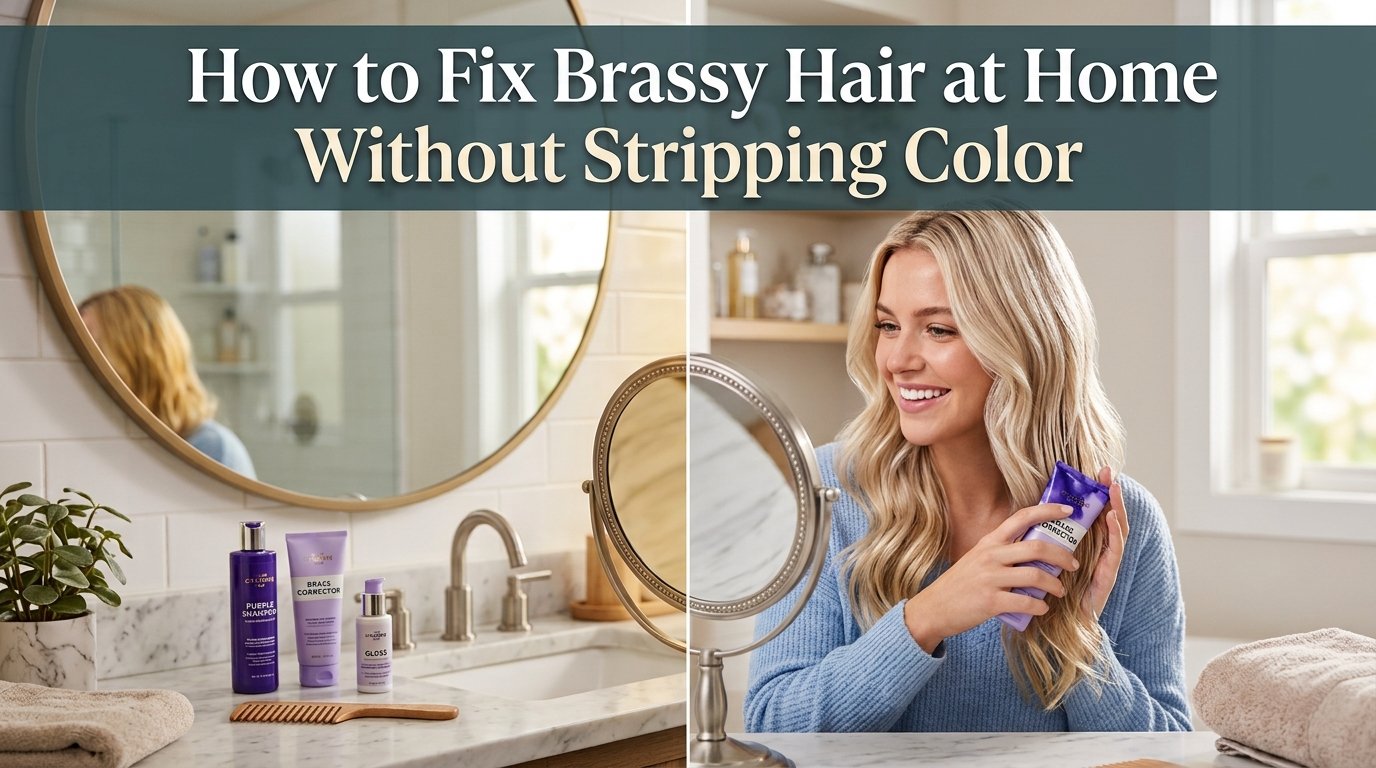
Brassy hair is the unwanted yellow, orange, or red warmth that appears in color-treated hair as your toner fades and underlying warm pigments get exposed. If you have noticed your once-cool blonde turning yellow or your brunette highlights pulling orange, you are dealing with brassiness, and you are not alone in wanting it gone.
The good news is that you can learn how to fix brassy hair at home without stripping your color using methods that deposit corrective pigments rather than lifting or bleaching your hair again. From purple shampoo to DIY vinegar rinses, there are at least five reliable at-home approaches that neutralize warmth without damaging your strands or undoing your salon investment.
In this guide, our team walks through why brassiness happens, the color science behind fixing it, and step-by-step methods you can try tonight. We cover options for blondes, brunettes, dark hair with highlights, gray hair, and over-toned hair, plus what to do if you accidentally go too far. By the end, you will know exactly how to neutralize brassy tones at home safely and keep them from coming back.
This is especially important because harsh stripping products, bleach washes, and repeated lightening can cause serious damage to already-processed hair. Every method in this guide works by depositing pigment or clarifying buildup, never by lifting color. That distinction is what makes them safe for color-treated hair in 2026 and beyond.
Table of Contents
What Is Brassy Hair? The Science Behind Those Unwanted Warm Tones
Brassy hair is what happens when the cool-toned pigments in your hair color fade faster than the warm underlying pigments beneath them. When you lighten your hair, whether to blonde or to a lighter brunette with highlights, the bleaching process removes your natural melanin. What remains is the raw, warm undertone of the hair shaft, usually yellow, orange, or red depending on how dark your starting color was and how light you lifted.
Your stylist applies a toner or gloss over those lifted strands to neutralize the warmth and create the cool, ashy, or neutral shade you want. That toner is semi-permanent, meaning it gradually washes out over 4 to 8 weeks. Once it fades, the warm undertones show through again, and that is brassiness.
The key thing to understand is that brassiness is not damage. Your hair is not broken when it turns brassy. The color has simply shifted because the corrective pigments have washed away, and the natural warmth that was always there is now visible. This is why you can fix it without stripping or re-bleaching.
Yellow vs Orange vs Red Brass: What Each Tone Means
Not all brassiness is the same, and the tone you see tells you what color you need to cancel it. Yellow brass typically appears on light blonde and platinum hair that was lifted to a level 9 or 10. Orange brass shows up on medium blonde to light brown hair, usually levels 6 through 8. Red or coppery warmth appears on darker brunettes and black hair that was lifted only a few levels.
This matters because the fix is different for each. Purple neutralizes yellow, blue neutralizes orange, and green neutralizes red. If you reach for purple shampoo when your hair is actually orange, you will see minimal results because purple does not cancel orange effectively.
Identifying your specific brass tone is the single most important step in choosing the right at-home fix. Take a photo of your hair in natural daylight, compare it to a level chart online, and note whether the warmth reads yellow, orange, or red. That answer determines which method in this guide will actually work for you.
What Does Stripping Your Color Actually Mean?
Color stripping refers to using chemical products, often containing bleach, ammonia, or strong sulfur-based compounds, to remove artificial pigment from the hair shaft. Stripping lifts the cuticle and breaks down color molecules, which causes cumulative damage, dryness, breakage, and porosity, especially on hair that has already been lightened.
Every method in this guide avoids that process entirely. We focus on depositing corrective pigments on top of the hair shaft and removing buildup that makes brassiness worse. Nothing here lifts, bleaches, or strips your existing color.
Understanding this distinction matters because many people assume the only way to fix brassiness is to lighten again. That assumption leads to over-processing, breakage, and hair that becomes too porous to hold color at all. The deposit-and-clarify approach keeps your hair healthy while still shifting the tone.
What Causes Brassy Hair? 7 Common Culprits
Understanding what is causing your brassiness helps you choose the right fix and prevent it from returning. Here are the seven most common causes our team sees, drawn from both salon experience and the patterns reported across hair care forums in 2026.
1. Natural oxidation. Every time your hair is exposed to oxygen, the color molecules in your toner slowly break down. This is unavoidable and happens to everyone with color-treated hair over 4 to 8 weeks.
2. UV and sun exposure. Ultraviolet rays break down both natural and artificial pigment in the hair shaft. If you spend time outdoors without a UV-protective hat or hair product, your color will fade and brassiness will show through faster.
3. Hard water and mineral deposits. Iron, copper, and calcium in hard water bind to the hair shaft and create a warm, sometimes greenish or brassy cast. If your shower water is hard, this is likely a major contributor to your brassiness, and it will keep coming back no matter how much purple shampoo you use.
4. Heat styling without protection. Hot tools that exceed 365 degrees Fahrenheit cause the hair cuticle to open and color molecules to escape. Flat irons, curling wands, and even very hot blow drying accelerate color fade and expose warm undertones.
5. Sulfate shampoos. Sodium lauryl sulfate and sodium laureth sulfate are detergents that strip color from the hair shaft along with dirt and oil. If your shampoo lathers heavily and is not labeled sulfate-free, it is likely washing your toner down the drain.
6. Chlorine from pools. Chlorine is an oxidizer that breaks down hair color quickly. It also deposits greenish minerals on light hair, compounding the brassy effect. Swimmers see brassiness faster than almost anyone.
7. Overwashing. Every wash removes a small amount of color pigment. If you are washing your hair daily, you are shortening the life of your toner by weeks compared to someone who washes two or three times a week.
Most people dealing with persistent brassiness have more than one of these factors working against them at the same time. Addressing causes, not just symptoms, is what separates a quick fix from a long-term solution that actually holds.
How Color Correction Actually Works (Without Stripping Your Color)
Color correction for brassiness relies on the color wheel, specifically the principle of complementary colors. Complementary colors sit directly opposite each other on the wheel, and when layered together, they neutralize each other to create a neutral or ashy tone.
Purple sits opposite yellow on the color wheel, so purple pigments cancel yellow brass. Blue sits opposite orange, so blue pigments cancel orange brass. Green sits opposite red, so green-based products cancel red or coppery warmth in very dark hair. This is not magic or marketing. It is basic color theory applied to the hair cuticle.
When you use a purple shampoo, the violet pigments deposit onto the cuticle and visually cancel the yellow tones underneath. The hair is not being lifted, stripped, or lightened. You are simply laying a sheer wash of complementary color on top, which shifts the overall tone from warm to cool. The same principle applies to blue shampoo for orange tones and green-based products for red tones.
This is why toning shampoos, masks, and glosses are safe for color-treated hair. They add pigment rather than removing it. The effect is temporary because the deposited pigments wash out over several shampoos, but you can reapply as needed without causing damage.
Think of it like tinted moisturizer for your skin. The sheer layer of color shifts the overall appearance without changing what is underneath. Toning products do the same thing for your hair, which is why they are the foundation of every anti-brass routine recommended by professional colorists in 2026.
How to Fix Brassy Hair at Home Without Stripping Your Color: 5 Methods
Here are five at-home methods to neutralize brassy tones without lifting or stripping your color. Each one works by depositing corrective pigments or removing the buildup that makes brassiness worse. Choose based on your hair tone, your budget, and how quickly you need results.
Method 1: Purple Shampoo for Yellow Tones (The Gold Standard)
Purple shampoo is the most popular and accessible method for fixing brassy hair at home, and it is the right starting point for blondes, platinum, silver, and gray hair dealing with yellow warmth. It works by depositing violet pigments onto the cuticle that visually cancel yellow tones, shifting your hair back toward cool, ashy, or neutral.
This method is best for hair lifted to level 8 or lighter. If your brassiness is yellow or pale yellow rather than orange, purple shampoo is your first line of defense.
Step-by-step: How to use purple shampoo without over-toning
1. Start with wet hair in the shower. Apply a quarter-sized amount of purple shampoo to your palms and distribute evenly through the mid-lengths and ends first, then work up to the roots.
2. Leave it on for 1 to 3 minutes if you are using it for the first time or if your hair is porous. Leave it on for 3 to 5 minutes if your hair is healthy and you have used purple shampoo before without it turning purple.
3. Rinse thoroughly with cool water. Cool water helps seal the cuticle and lock in the corrective pigments.
4. Follow with a hydrating conditioner, ideally one designed for color-treated hair. Purple shampoo can be drying, so conditioning is non-negotiable.
How often should you use purple shampoo? For most people, once or twice a week is plenty. If you use it daily, you risk over-toning, which leaves hair looking lavender, dull, or darker than you want. A common trick recommended on hair forums is to mix your purple shampoo half-and-half with your regular shampoo to control the intensity.
Signs you are over-toning: Your hair looks gray, lavender, or slightly purple, especially at the roots. It feels dry or gritty. The color looks muddy rather than bright and cool. If this happens, stop using purple shampoo immediately and switch to a clarifying shampoo to remove the excess pigment.
One more tip from our team: apply purple shampoo to dry hair before you shower for a stronger effect. The pigment grabs onto dry hair more intensely, which is useful if your brassiness is stubborn and a standard shower application is not cutting it. Leave it on for 5 minutes, then jump in the shower and rinse as usual.
Method 2: Blue Shampoo for Orange Tones (Best for Brunettes)
If your hair is brunette, dark blonde, or light brown with highlights and the brassiness you see is orange rather than yellow, blue shampoo is your match. Blue pigments sit opposite orange on the color wheel and cancel it out the same way purple cancels yellow.
Blue shampoo is the right call for level 5 through level 8 hair, including balayage on brunettes, highlighted dark hair, and box-dye color that pulled warm. It will not lighten your hair, but it will visibly cool down orange tones after one or two uses.
How to use blue shampoo: Apply to wet hair, focusing on the areas where orange tones are most visible, usually the mid-lengths and ends where highlights sit. Leave on for 2 to 4 minutes, then rinse and condition. Use once or twice a week, alternating with your regular color-safe shampoo.
One thing to watch for: blue shampoo can leave a slight blue or gray cast on very light blonde hair. If you have a mix of light blonde and darker sections, apply blue shampoo only to the darker, warmer areas and use purple shampoo on the lighter sections.
For brunettes with severe orange brassiness, a blue-based toning mask left on for 5 to 10 minutes once a week will deliver stronger results than shampoo alone. The thicker formula allows more pigment to deposit in a single session.
Many brunette clients we work with did not realize blue shampoo existed until 2026, because most marketing focuses on purple shampoo for blondes. If your highlights or balayage sit on a brown base and the warmth reads orange, switching from purple to blue is often the single change that makes everything start working.
Method 3: DIY Food Coloring Toner (Budget-Friendly Quick Fix)
This is the method that a SheKnows article made famous, and it genuinely works as a temporary, low-cost fix. The idea is to use liquid food coloring, which contains concentrated pigment, mixed with white vinegar to create a quick DIY toner that deposits corrective color onto the cuticle. The total cost is around $6, and the ingredients are available at any grocery store.
This method is best as an emergency fix before an event or when you do not have purple shampoo on hand. Results typically last 1 to 2 weeks, similar to a toning shampoo session.
What you need: Red and blue liquid food coloring, distilled white vinegar, a small bowl, and an applicator brush or squeeze bottle.
Step-by-step DIY food coloring toner:
1. In a small bowl, combine 2 to 3 cups of distilled white vinegar with 2 to 3 drops of red food coloring and 2 to 3 drops of blue food coloring. The red and blue combine to create purple, which cancels yellow tones. For orange tones, use more blue than red to create a blue-violet mix.
2. Mix well until the color is evenly distributed. The liquid should look deeply purple or blue-violet.
3. Apply to clean, damp hair, focusing on the brassy areas. Work it through with your hands or an applicator brush, saturating the warm sections evenly.
4. Leave on for 5 to 10 minutes. Do not exceed 10 minutes, or you risk staining the hair.
5. Rinse thoroughly with cool water, then shampoo and condition as normal to remove the vinegar smell.
Safety warnings: Keep this mixture away from your eyes, as vinegar will sting. Do a strand test first on a hidden section of hair to check the result before applying all over. Wear gloves, because food coloring stains skin and surfaces. Do not use this method on freshly bleached or damaged hair, as the vinegar can be too acidic for compromised cuticles.
This is a real method that real people use, but it is not a replacement for a quality toning shampoo. Think of it as a backup option when you need results today and the drugstore is your only resource.
The reason this method works at all is the same color theory that powers commercial toning products. Food coloring is simply pigment, and when you mix complementary colors and apply them to the cuticle, you get the same neutralizing effect as a store-bought toner, just less precisely formulated and without the conditioning agents that salon products include.
Method 4: Apple Cider Vinegar Rinse (Gentle Natural Option)
Apple cider vinegar rinses do not deposit pigment, so they will not directly cancel yellow or orange tones the way purple or blue shampoo does. What they do is remove the hard water minerals, product buildup, and dulling residue that make brassiness look worse than it actually is.
If your hair has a dull, warm cast and your toning shampoo does not seem to be working anymore, a vinegar rinse can strip away the mineral layer that is blocking your toning products from doing their job. Many users on hair forums report that their purple shampoo suddenly works again after a single clarifying rinse.
How to make an apple cider vinegar rinse: Mix 2 to 3 tablespoons of raw, unfiltered apple cider vinegar with 1 cup of cool water in a squeeze bottle. After shampooing, pour the mixture through your hair from roots to ends, working it through with your fingers. Leave it on for 1 to 2 minutes, then rinse thoroughly and follow with conditioner.
Use this rinse once every 1 to 2 weeks, not daily. Overuse can dry out your hair and disrupt your natural pH balance. If your hair is already dry or damaged, add a teaspoon of honey or a few drops of argan oil to the rinse for moisture.
This is a supporting method rather than a standalone fix. Pair it with your purple or blue shampoo routine, and you will likely see better results from both.
The clarifying effect of apple cider vinegar also helps your toning masks and glosses penetrate more evenly. If you have ever felt like your color-correcting products are sitting on top of your hair rather than soaking in, mineral buildup is likely the culprit, and a vinegar rinse is the fastest way to clear it.
Method 5: At-Home Hair Gloss and Toning Masks
Hair glosses and toning masks sit between daily shampoo and salon toning in terms of intensity. A gloss is a sheer, semi-permanent color-depositing treatment that refreshes tone and adds shine in one step. A toning mask is a thicker, more pigmented conditioning treatment that delivers stronger color correction than shampoo.
At-home glosses typically last 2 to 3 weeks, while toning masks can shift your color noticeably after a single 5 to 10 minute session. Both are safe for color-treated hair because they deposit pigment rather than lifting it.
How to use a toning mask: Shampoo your hair as usual, then squeeze out excess water so the hair is damp but not dripping. Apply the mask generously from mid-length to ends, comb through for even distribution, and leave on for 5 to 10 minutes. Rinse thoroughly and style as usual. Use once a week or every other week depending on how quickly your brassiness returns.
How to use an at-home gloss: Apply to clean, damp hair. Distribute evenly, leave on for the time specified on the product (usually 3 to 7 minutes), and rinse. Glosses are especially good for refreshing tone between salon appointments and adding shine that makes your color look fresh even when the toner is fading.
For the best results, alternate between a toning mask and your regular purple or blue shampoo. The mask gives you a deeper pigment deposit once a week, while the shampoo maintains the tone on the days in between.
Glosses also deliver a shine benefit that shampoos and masks cannot match. The sheer coating smooths the cuticle and reflects light, which makes your color look healthier and more vibrant even if the underlying tone has not fully shifted. This is why many colorists recommend a gloss as the finishing step in any anti-brass routine.
Quick Comparison: Which At-Home Method Is Right for You?
Choosing between five methods can feel overwhelming, so here is a quick comparison based on the most common situations we see in 2026.
For mild yellow brass on blonde hair: Purple shampoo once or twice a week is your baseline. Add a toning mask every other week for deeper results.
For orange brass on brunette or highlighted hair: Blue shampoo once or twice a week, alternating with a color-safe regular shampoo. Add a blue toning mask for stubborn warmth.
For brassiness caused by hard water: Start with an apple cider vinegar rinse to clear mineral buildup, then layer in your purple or blue shampoo. Install a shower filter for long-term prevention.
For an emergency fix before an event: The DIY food coloring and vinegar toner delivers visible results in one session. Follow with a hydrating mask to counteract the drying effect of the vinegar.
For maintaining color between salon visits: An at-home gloss every 2 to 3 weeks keeps your tone fresh and adds shine. Use purple or blue shampoo once a week between gloss applications.
For brassy gray or silver hair: Purple shampoo is specifically formulated for silver and gray tones. Use once or twice a week, and consider a purple toning mask for deeper deposit if the yellow is stubborn.
How to Fix Over-Toned Hair (When Purple Shampoo Goes Wrong)
This is a problem no major competitor addresses, but it comes up constantly on Reddit and in hair forums. If you have used purple shampoo too often or left it on too long, your hair can take on a lavender, gray, or dull purple cast. This is called over-toning, and it is fixable without a salon visit.
The fix is simple: you need to remove the excess pigment. Wash your hair 2 to 3 times with a clarifying shampoo, which is designed to strip buildup from the cuticle. Each wash will lift more of the purple pigment. After the second or third wash, the lavender cast should be gone.
If clarifying shampoo alone does not do it, try a baking soda paste. Mix 2 tablespoons of baking soda with a small amount of water to form a paste, work it through damp hair, leave on for 5 minutes, then shampoo and condition as normal. The mild abrasiveness of baking soda helps lift stubborn pigment, but use this method no more than once a month to avoid drying your hair.
Going forward, dilute your purple shampoo with regular shampoo, reduce your leave-on time to 1 to 2 minutes, and use it no more than once or twice a week. Over-toning happens when the pigment builds up faster than it washes away, so the goal is to slow down the deposit rate.
One reassuring note: over-toning is purely cosmetic. It does not damage your hair the way over-bleaching does. The purple pigment sits on the surface of the cuticle and will wash out within a few shampoos. The only risk is temporary discoloration, not structural damage to the hair shaft.
Brassy Hair on Dark Hair and Black Hair: Special Considerations
Most brassy hair advice assumes you are blonde, but brunettes and people with black hair who lighten or highlight their hair deal with brassiness too, and it shows up differently. On dark hair lifted to a level 5 or 6, the brassiness is typically red, copper, or deep orange rather than yellow.
Purple shampoo will not help here. You need blue-based or green-based products to cancel red and orange undertones. Blue shampoo works for orange tones on brunettes, while green-based color correctors handle red or copper warmth on very dark lifted hair.
For black hair with highlights that have gone brassy, start with a blue toning shampoo used once a week. If the orange is stubborn, follow with a blue toning mask once every 10 days. Avoid bleach baths and color strippers, which will cause severe damage on hair that has already been lifted from a very dark base.
If you have box-dyed black or dark brown hair that pulled warm after fading, a color-depositing conditioner in an ash or cool brown shade can help neutralize the warmth without any lifting. These products deposit a sheer wash of cool pigment each time you condition, gradually shifting the tone over a few washes.
Curly and coily hair types need extra caution here, because the cuticle is naturally more raised and prone to dryness. Always follow any toning product with a deep conditioning treatment, and space out your toning sessions more than you would on straight hair to avoid buildup and dullness.
Brassy Hair on Gray and Silver Hair
Gray, white, and silver hair is especially prone to yellowing, and the cause is not always color fade. Natural gray hair can yellow from UV exposure, hard water minerals, smoke, and even the natural oxidation of the hair shaft over time. If you have gone silver or are transitioning to natural gray, yellow brassiness is one of the most common complaints.
Purple shampoo is the standard fix here, and it works well because gray hair is essentially the lightest possible base with no underlying warmth to fight against. The violet pigments cancel the yellow cast and bring back a bright, silvery tone.
For stubborn yellowing that purple shampoo alone does not resolve, add a weekly purple toning mask. The deeper pigment deposit handles discoloration that daily shampoo cannot touch. If your gray hair has a greenish cast instead of yellow, that is usually mineral buildup from hard water, and an apple cider vinegar rinse will clear it faster than any toning product.
One thing to watch for on gray hair: over-toning leaves a stronger lavender cast on white hair than on blonde, because there is no underlying pigment to blend with the purple. Start with short leave-on times and increase gradually.
How to Prevent Brassy Hair From Coming Back
Fixing brassy hair is only half the battle. If you do not change the habits causing it, the warmth will return within a week or two. Here is our complete prevention checklist, based on what professional colorists recommend and what actually works in practice.
1. Switch to a sulfate-free, color-safe shampoo. Sulfates are the fastest way to wash your toner down the drain. Look for shampoos labeled sulfate-free and formulated for color-treated hair. This single change can extend your color by 2 to 3 weeks.
2. Wash less frequently. Every wash removes pigment. Aim for 2 to 3 washes per week, using dry shampoo between washes to absorb oil. If you currently wash daily, this change alone will dramatically slow your color fade.
3. Rinse with cool water. Hot water opens the cuticle and lets color escape. Cool or lukewarm water seals the cuticle and locks pigment inside. You do not need to take a cold shower, just turn the temperature down for the final rinse.
4. Use a heat protectant every time you style. Heat above 365 degrees Fahrenheit breaks down color molecules. Apply a heat protectant spray or cream before any hot tool use, and keep your flat iron or curling iron below 365 degrees when possible.
5. Install a shower filter for hard water. If hard water is contributing to your brassiness, a shower filter that removes chlorine, iron, and calcium is one of the highest-impact changes you can make. Expect to spend $30 to $60 on the filter, and replace the cartridge every 3 to 6 months.
6. Protect your hair from the sun. UV rays break down color pigment. Wear a hat in direct sun, or use a leave-in product with UV protection if you spend a lot of time outdoors.
7. Pre-wet your hair before swimming. If your hair is already saturated with clean water, it will absorb less chlorinated pool water. Apply a leave-in conditioner before swimming for extra protection, and rinse immediately after getting out of the pool.
8. Schedule regular gloss or toning appointments. Even with perfect at-home care, your toner will fade in 4 to 8 weeks. A 20-minute gloss appointment at the salon refreshes your tone without any lifting or damage, and it costs a fraction of a full color service.
9. Use a deep conditioning mask weekly. Healthy, well-moisturized hair holds color longer than dry, porous hair. A weekly mask keeps your cuticle smooth and your pigment locked in, which directly reduces how fast brassiness appears.
10. Avoid overlapping color applications. If you color your hair at home, only apply dye to the new growth. Overlapping onto previously colored sections causes pigment buildup and uneven warmth, which makes brassiness harder to manage over time.
Emergency Brassy Hair Fix: Same-Day Results Before an Event
If you have a wedding, photoshoot, or special event today and your hair is brassy, you need results fast. Here is the fastest path to cooler-toned hair before tonight.
Step 1: Wash with a clarifying shampoo to remove any mineral buildup that is dulling your color. This alone can brighten your tone noticeably.
Step 2: Apply a purple or blue toning mask (whichever matches your brass tone) to damp hair and leave it on for the full 10 minutes. This is stronger than shampoo and will deliver the most visible shift in a single session.
Step 3: Rinse with cool water and follow with a hydrating mask to add shine and counteract any dryness from the toning pigments.
Step 4: Style with a heat protectant and avoid hot tools above 365 degrees. Add a shine serum or gloss spray to finish, which will make your color look fresh and cool even if the toning effect is subtle.
If you do not have a toning mask, the DIY food coloring and vinegar method from Method 3 is your fastest alternative. Just do a strand test first and keep the leave-on time under 10 minutes.
When to See a Professional vs DIY
Most mild to moderate brassiness can be handled at home with the methods in this guide. But there are times when a professional colorist is the right call, and trying to fix it yourself will make things worse.
See a professional if your hair has multiple colors from previous box dye jobs, if the brassiness is severe and uneven, or if your hair is damaged and porous from repeated lightening. A colorist can assess the underlying pigment, apply a custom toner or gloss formulated for your exact hair, and correct unevenness in a way that at-home products cannot.
Handle it at home if your brassiness is mild and uniform, if you are maintaining color between salon visits, or if you need a quick fix before an event. The methods in this guide are designed for these situations, and they are safe for regular use on color-treated hair.
A good rule of thumb: if your hair feels healthy and the brassiness is a recent development, an at-home method will likely solve it. If your hair feels gummy, breaks easily, or has multiple layers of old color, see a professional before attempting any correction.
FAQs
What color cancels out brass in hair?
Purple cancels yellow tones, blue cancels orange tones, and green cancels red or coppery tones. This is based on complementary colors on the color wheel. For blonde hair with yellow brass, use purple shampoo. For brunette or highlighted hair with orange brass, use blue shampoo. For very dark lifted hair with red tones, look for green-based color correctors.
How to fix brassy hair after coloring?
To fix brassy hair after coloring, use a toning shampoo that matches your brass tone (purple for yellow, blue for orange) once or twice a week. Leave it on for 1 to 3 minutes before rinsing, then follow with a hydrating conditioner. If the brassiness is severe, add a weekly toning mask for deeper pigment deposit.
Can you fix brassy hair without toner?
Yes. You can use purple or blue shampoo, a DIY food coloring and vinegar toner, an apple cider vinegar clarifying rinse, or an at-home hair gloss. All of these methods neutralize or clarify brassy tones without requiring a professional toner application.
How to fix brassy hair at home naturally?
The most popular natural methods are an apple cider vinegar rinse to remove mineral buildup and a DIY food coloring toner to deposit corrective pigment. The vinegar rinse clarifies the cuticle so your toning products work better, while the food coloring toner provides a temporary color-correcting effect that lasts 1 to 2 weeks.
How often should I use purple shampoo for brassy hair?
Most people should use purple shampoo once or twice a week. If you use it daily, you risk over-toning, which leaves hair looking lavender or gray. If you are new to purple shampoo, start with once a week and increase only if the brassiness persists after 2 to 3 washes.
Can I use purple shampoo on brown hair?
Purple shampoo can be used on light brown or highlighted brunette hair to cancel yellow tones in the highlighted sections. However, it will not cancel orange brass on brunette hair. For orange tones on brown hair, use blue shampoo instead, which is formulated specifically to neutralize orange warmth.
Is brassy hair permanent?
No, brassy hair is not permanent. It is the result of toner fading and underlying warm pigments showing through. You can neutralize it at any time using toning shampoos, masks, glosses, or DIY methods. However, it will keep returning as long as your toner continues to fade, which is why prevention habits matter.
What happens if I use purple shampoo too much?
Using purple shampoo too often or leaving it on too long can cause over-toning, which leaves hair looking lavender, gray, or dull purple. To fix it, wash your hair 2 to 3 times with a clarifying shampoo to remove the excess pigment, then reduce your purple shampoo usage to once or twice a week going forward.
Conclusion: Neutralize Brassiness Without the Damage
Learning how to fix brassy hair at home without stripping your color comes down to understanding which tone you are dealing with and choosing the right complementary pigment to cancel it. Purple handles yellow, blue handles orange, and green handles red. Every method in this guide, from toning shampoos to DIY vinegar rinses, works by depositing pigment or removing buildup, never by lifting or bleaching.
Start with the method that matches your hair tone and severity. If you are blonde with yellow brass, purple shampoo is your baseline. If you are brunette with orange warmth, reach for blue. If you need a budget-friendly emergency fix, the food coloring and vinegar method works in a pinch. Pair whichever method you choose with the prevention habits in this guide, and your color will stay cooler for longer between salon visits.
The most important thing to remember is that brassiness is normal, temporary, and fixable. It is not a sign of damaged hair. With the right routine, you can keep your color looking fresh and cool without ever stripping, bleaching, or compromising the health of your strands in 2026 and beyond.