
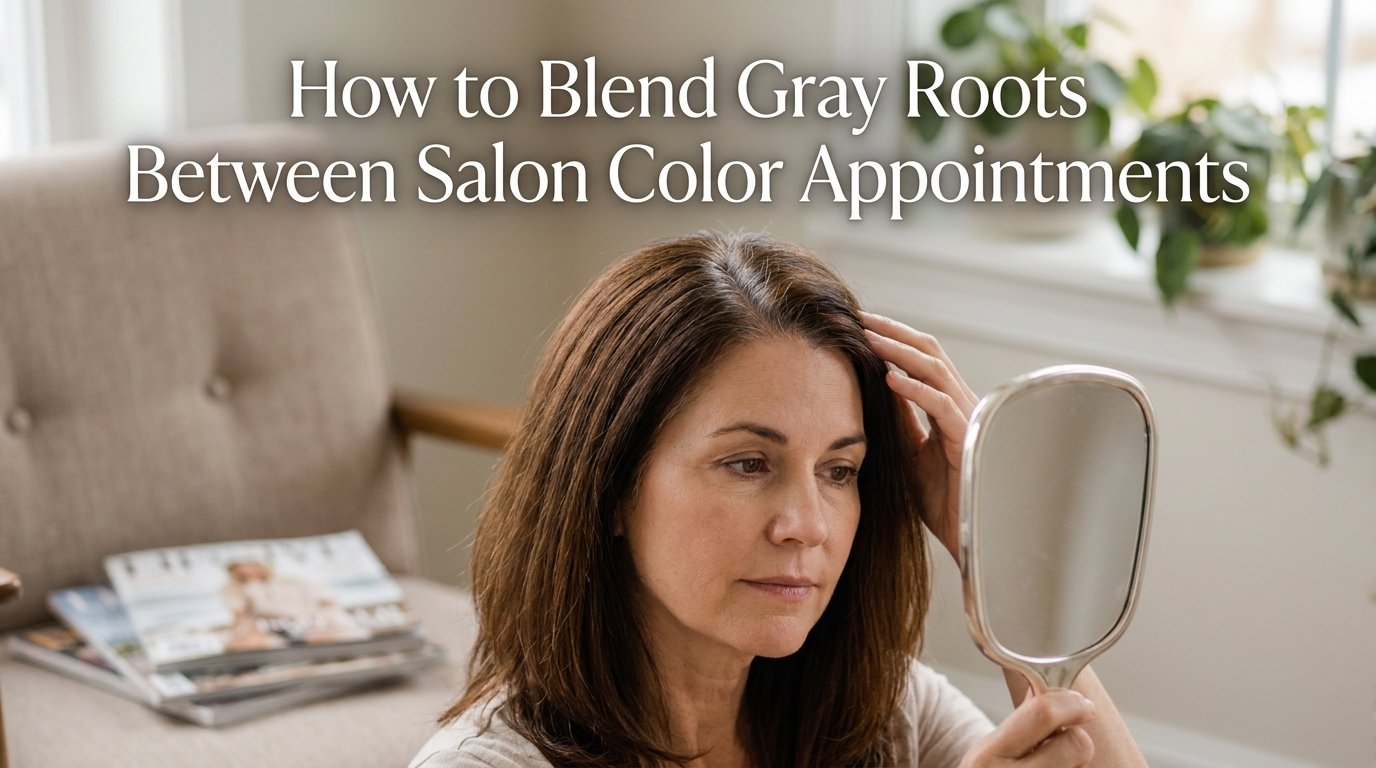
That familiar stripe of silver peeking through at week three is a frustration nearly every color client knows. You paid good money for that rich, even color, and within weeks the gray is back along your part line, your temples, and your hairline. Learning how to blend gray roots between salon color appointments gives you back control over those awkward in-between weeks without booking another full service every three weeks.
Our team at Mercer Street Salon has spent years helping clients stretch the life of their color. In this guide, we walk through the salon techniques that make regrowth less obvious, the at-home products that buy you extra time, and the small habits that keep your color looking fresh longer.
Table of Contents
What Gray Blending Actually Means
Gray blending is not the same as full gray coverage. Full coverage uses permanent color to deposit pigment over every gray strand, creating a uniform result that needs touching up every three to four weeks. Blending takes a softer approach, using dimensional techniques that make gray regrowth look like part of the design rather than a flaw.
The goal is to blur the line of demarcation, which is the harsh border between your colored hair and your natural regrowth. When that line softens, your roots stop announcing themselves and your grow-out looks intentional.
How to Blend Gray Roots Between Salon Color Appointments: Salon Techniques
The right technique depends on your gray percentage, your base color, and how much maintenance you are willing to commit to. Here are the five most effective salon approaches.
Demi-Permanent Color
Demi-permanent color deposits pigment without lifting your natural shade, so it blends gray into your existing tone rather than coating it completely. It fades gradually over four to six weeks, meaning there is no harsh grow-out line. This is one of the best options for clients with scattered gray who want a softer transition.
Highlights and Lowlights
Adding fine highlights around your part line and hairline breaks up the solid band of gray. Light pieces woven through the top of your head trick the eye into seeing dimension rather than regrowth. Lowlights add depth back where color has faded, creating a multi-tonal surface that hides new gray growth far longer than a single-process color.
Balayage and Root Smudge
Balayage hand-paints color onto the surface of your hair, leaving your natural roots darker and your ends lighter. A root smudge takes this further by gently smudging a transitional shade at the scalp so your regrowth blends into the painted lengths. Together, these techniques give you six to eight weeks before gray becomes noticeable.
Color Gloss and Toning
A clear or tinted gloss refreshes faded color, adds shine, and slightly deepens the tone so gray strands read as highlights rather than regrowth. Glosses last about four weeks and make a great express appointment between full color services.
At-Home Root Touch-Up: Which Format Works Best
Temporary root touch-up products are your fastest bridge between salon visits. No competitor has compared the four main formats side by side, so here is our breakdown based on what we see working on real clients.
Root Touch-Up Spray
Spray delivers a fine mist of color pigment that dries in seconds and washes out in one shampoo. It works best for broad areas like your part line and crown. Look for a targeted nozzle so you control where the color lands, and choose a shade that matches your mid-shaft, not your ends.
Root Powder
Powder is ideal for precise application along the hairline and temples. One of our favorite tips from the salon community is to spray a small makeup brush with a touch of holding spray, dip it into root powder, and dab it directly onto gray at your part. The powder grips coarser gray strands better than spray alone.
Color Mascara
Color mascara comes in a tube with a wand and is perfect for individual stubborn gray strands at your hairline. It gives the most control of any format and stays put until you wash your hair. Use it for spot coverage rather than full root areas.
Color Crayon
A crayon or chalk stick covers small patches quickly and travels well. It is the least natural-looking of the four formats, so reserve it for emergencies like a last-minute event when you cannot get to the salon.
Step-by-Step: Applying Root Touch-Up Spray at Home
Here is the application method we recommend for the cleanest, most natural result.
Step 1: Start with completely dry, styled hair. Product applied to damp hair will slide right off.
Step 2: Section your hair where the gray is most visible, usually your part line, crown, and hairline.
Step 3: Hold the spray or powder six to eight inches from your scalp and apply in short, light bursts. Build coverage gradually rather than soaking the area in one pass.
Step 4: Let the product dry for 60 seconds, then gently blend the edges with your fingertips or a clean brush so there is no harsh border.
Step 5: Avoid touching your hair throughout the day and sleep on a dark pillowcase to prevent transfer.
Color-Specific Tips for Blending Gray Roots
Dark Hair
Dark hair shows gray the fastest because the contrast is the sharpest. Ask your stylist for a demi-permanent root application one shade lighter than your natural color, then add a few face-framing lowlights. At home, a powder in a warm brown tone blunts the white-and-black contrast along your part.
Blonde Hair
Blondes have an advantage because gray strands blend into lighter tones naturally. Maintain warmth with a purple-toning shampoo once a week to prevent brassiness, and use a light blonde root spray for the few areas where gray reads brighter than your color.
Highlighted Hair
Highlights already create the dimension that hides gray, so your main task is refreshing the tone between visits. A tinted gloss every four weeks keeps highlights from fading flat, and a root shadow at the salon softens the transition from your natural base into your lightened pieces.
Targeting the Part Line and Hairline
The part line and hairline are where gray shows first and loudest. For your part, switch up where you part your hair every few days so the same strip of scalp is not always exposed. A zigzag part scatters the visible gray and makes it far less obvious than a straight line.
For your hairline, use a color mascara or powder applied with a small brush, working in the direction the hair grows. Avoid spraying directly at your face. Instead, spray the product onto a brush first, then press it onto the hairline hairs.
What to Tell Your Stylist for Better Gray Blending
The consultation shapes everything. Use these talking points at your next appointment.
Tell your stylist what percentage of gray you estimate you have and where it concentrates. Mention whether you want soft blending or fuller coverage. Ask about a root smudge or shadow to ease the grow-out. Request demi-permanent rather than permanent if you want a gentler fade. Finally, ask what maintenance schedule they recommend based on your hair type and lifestyle.
Your Week-by-Week Maintenance Timeline
Knowing what to expect helps you plan ahead rather than panic.
Weeks 1 to 2: Your color looks fresh. Use sulfate-free, color-safe shampoo and rinse with cool water to seal the cuticle.
Weeks 3 to 4: Gray begins to peek through at your part and temples. Start using root powder or spray for targeted coverage.
Weeks 5 to 6: The line of demarcation becomes more visible. This is the ideal window for a gloss or express root touch-up if your salon offers one.
Weeks 7 to 8: Schedule your next full color or blending appointment. If you are blending gradually, you may be able to stretch to 10 weeks.
Common Mistakes to Avoid
Do not apply root touch-up products to wet hair. They will not adhere and will transfer to your skin and clothing. Avoid using box dye that does not match your salon formula, since the mismatch creates a visible band that is harder to fix later. Finally, do not skip the color-safe shampoo. Sulfate formulas strip color faster and shorten the life of your investment.
FAQs
How to cover gray roots between salon visits?
Use a temporary root touch-up spray or powder on dry hair along your part line, hairline, and temples. Apply in light layers, let it dry for 60 seconds, and blend the edges. For longer-lasting coverage, ask your stylist for a demi-permanent root touch-up or a gloss between full color appointments.
What is the 50 50 50 rule for gray hair?
The 50 50 50 rule means that by age 50, approximately 50 percent of the population will have 50 percent gray hair. It is a general guideline that helps set realistic expectations for how quickly gray may appear and why blending strategies become important at that stage.
How do I blend my gray roots?
The most effective ways to blend gray roots are highlights and lowlights to add dimension, a root smudge to soften the grow-out line, demi-permanent color for gradual fading, and temporary root touch-up products between visits. The best choice depends on your gray percentage and base color.
What is the average cost of gray blending?
Gray blending costs vary widely depending on technique and location. A demi-permanent root touch-up or gloss typically runs lower than a full highlight service, while balayage with a root smudge sits at the higher end. Ask your salon for a consultation to get an exact quote based on your hair length and goals.
How long between grey blending appointments?
Most gray blending clients return every 6 to 8 weeks. Full coverage clients typically need 3 to 4 weeks. The softer and more dimensional your blending technique, the longer you can wait between appointments.
What is the best way to blend gray roots?
The best overall approach is combining a dimensional salon technique like highlights or a root smudge with at-home root touch-up products for the in-between weeks. This dual strategy gives you the longest-lasting, most natural-looking result.
Wrapping Up
Figuring out how to blend gray roots between salon color appointments comes down to combining the right salon technique with smart at-home habits. Dimensional color like highlights, lowlights, and root smudges gives you a longer grow-out window. Temporary root touch-up sprays, powders, and mascaras fill the gap when gray starts to show.
Talk to your stylist about shifting from full coverage to a blending approach, switch to a color-safe routine, and keep a root touch-up product in your bag for those weeks when you need a quick fix. Your color will last longer, your regrowth will look intentional, and you will spend fewer hours in the salon chair.