
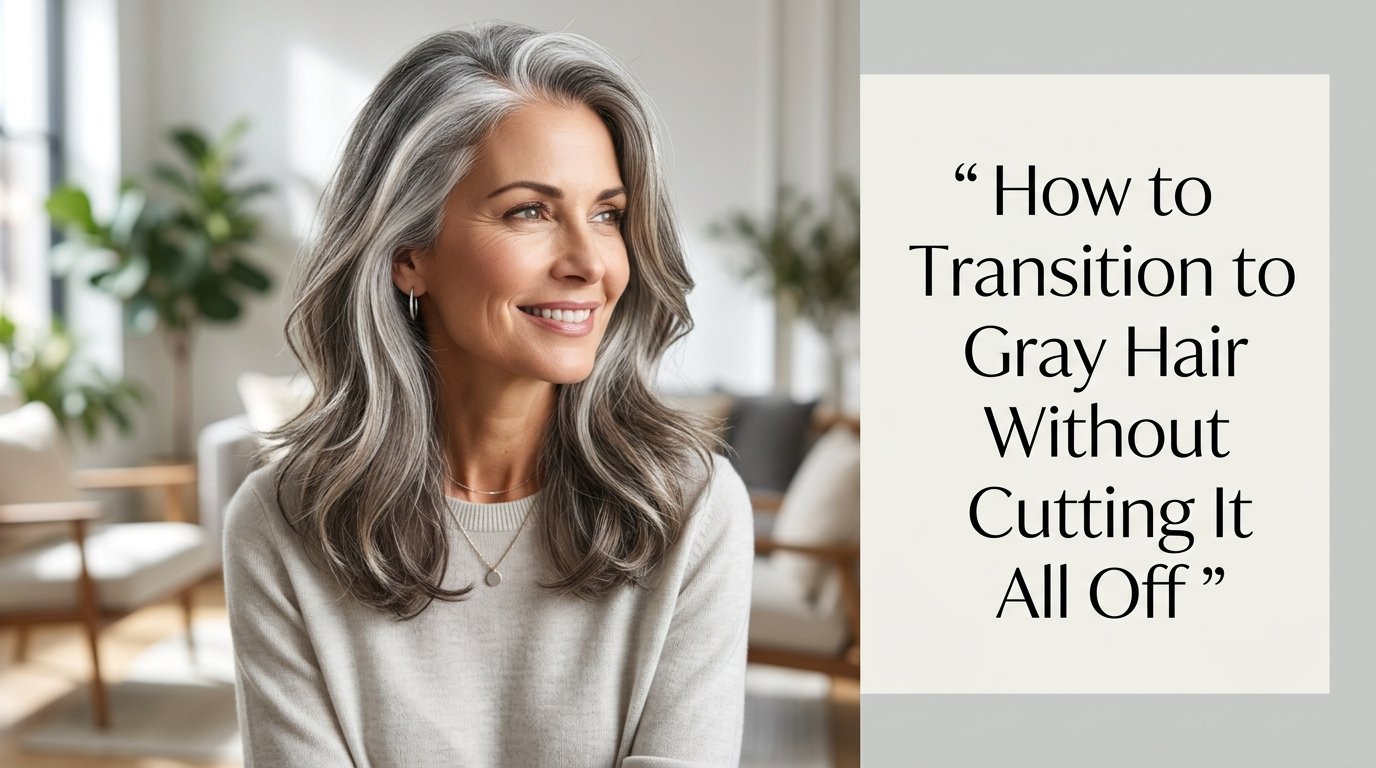
I have watched hundreds of women sit in my salon chair and say the exact same sentence: “I want to go gray, but I refuse to cut my hair short.” That fear of losing long hair is one of the biggest barriers to embracing your natural color. After years of helping clients navigate this exact transition at Mercer Street Salon, I can tell you with certainty that you do not need to sacrifice length to go gray. There are proven methods, salon techniques, and styling tricks that let you keep every inch of your hair while your silver grows in.
The first thing I tell anyone who sits down to discuss going gray is this: your gray hair is already there. It has been growing from your scalp since the very first strand turned silver, and every week that passes, more of it surfaces. The challenge is not making the gray appear. The challenge is managing how that new color looks alongside the dyed hair you still have. That is where the methods in this guide come in, and they are all designed to work with long hair.
Going gray without cutting it all off is not about finding one perfect solution. It is about finding the right combination of techniques for your hair type, your lifestyle, and your patience level. Some women want the fastest path. Others want the most natural look. Some need something that works in a corporate boardroom or on a client call. All of those paths exist, and none of them require you to walk into a salon and ask for a dramatic chop.
How to transition to gray hair without cutting it all off is a journey that unfolds over months and sometimes years, depending on your hair length. During that time, you will go through phases that feel awkward, phases that feel exciting, and phases where you genuinely forget that you ever dyed your hair in the first place. The goal of this guide is to help you navigate every one of those phases with confidence, practical strategies, and the knowledge that thousands of other women have walked this exact path before you.
In the sections ahead, I will walk you through every method that preserves your length. You will learn about the dye strip technique that most women have never heard of, salon options like gray blending and lowlights that professional stylists use to soften the grow-out line, and the styling tricks that can hide an awkward transition phase entirely. We will also talk about what to expect month by month, how to care for two-tone hair, the emotional side of going gray, and the mistakes that can make the transition harder than it needs to be.
This guide is based on my experience as a stylist at Mercer Street Salon, combined with research from the leading gray transition resources, insights from real women who have gone through the process, and the latest techniques in color theory and hair care. If you are ready to start your gray transition without sacrificing the long hair you love, you are in the right place.
Table of Contents
How to Transition to Gray Hair Without Cutting It All Off
The easiest way to transition to gray hair depends on your hair length and your patience. For the fastest transition with no grow-out line, a buzz cut or pixie cut works best. But for women who want to keep their long hair, the dye strip technique is the easiest method because it lets your gray grow in underneath a layer of dyed hair so no one sees the transition happening. Salon options like gray blending, lowlights, or balayage break up the harsh line between dyed hair and gray roots using strategic color placement that makes the grow-out look like a deliberate style choice. You can also use root spray, headbands, and strategic styling to camouflage the demarcation line while your hair grows out naturally.
Gray hair grows at roughly half an inch per month. That means if you have shoulder-length hair, it will take between twelve and eighteen months for all of your dyed ends to be trimmed away and fully replaced by natural silver. Most women do not want to wait that long with an obvious stripe of gray at the roots. The methods below are designed to bridge that gap, making the grow-out look intentional rather than neglected.
Here is a quick overview of the three main approaches that keep your length intact. Each has trade-offs in cost, maintenance, and how natural the result looks. Understanding these differences upfront will help you choose the method that fits your life.
Cold turkey means you stop dyeing entirely and let your gray grow in naturally. No highlights, no lowlights, no dye strip – just you and your roots. It is the cheapest option in terms of money, but it is also the most visible in the early months. The demarcation line will be there, plain to see. Cold turkey works best for women who are comfortable with the skunk stripe phase or whose gray comes in gradually and softly. It also works well for anyone who is primarily motivated by hair health and wants to remove all chemicals from their routine immediately.
The dye strip technique is the most popular method for women with long hair who want zero visibility of the grow-out. A stylist dyes only the top layer of your hair while leaving the bottom layer to grow out naturally. When you wear your hair down, you only see the dyed top section. When you pull it up or style it in certain ways, the gray underneath is hidden by the outer dyed layer. This method requires maintenance visits every six to eight weeks, but it gives you complete freedom to wear your hair however you want during the entire transition. Most women who use the dye strip technique tell me that their coworkers, friends, and even family members had no idea their hair was transitioning until they chose to reveal it.
Salon color transition methods – including gray blending, lowlights, highlights, and balayage – are the most sophisticated options available. Your stylist uses lighter or darker shades to break up the contrast between dyed hair and gray roots, creating a blended, dimensional look. Gray blending specifically uses a hand-painted technique that melts the demarcation line into something soft and barely noticeable. These methods cost more upfront but give the most polished, professional result. They are ideal for women in client-facing roles, women with dark brunette hair where the contrast is most stark, or anyone who wants their transition to look intentional from day one.
The Cold Turkey Method
Going cold turkey means stopping all hair dye and letting your natural gray hair grow in completely on its own. No highlights, no lowlights, no dye strip – just you and your roots. It is the simplest method in terms of maintenance because there is nothing to maintain. You stop dyeing, and you wait. But simplicity comes with visibility, and that visibility is what makes cold turkey the most challenging method for many women.
The biggest concern with cold turkey is the demarcation line. That sharp border where your dyed hair ends and your gray begins is impossible to ignore. On dark hair, it can look stark and obvious – like a skunk stripe running across your head. On lighter hair, the line tends to be softer and less jarring, because the gray and the dyed hair sit closer together on the color spectrum. Women with blonde or light brown starting hair often find cold turkey more forgiving than women with deep brunette or black hair.
I have had clients who went cold turkey with hair down to their waist. The first three months were rough for some of them. The demarcation line was impossible to hide with styling, and several told me they caught themselves staring at it in the mirror every morning. Then something interesting happened around month five or six. The contrast started to feel less severe as more gray grew in and the dyed ends began to read as a natural ombre rather than a maintenance issue. By month twelve, most of those clients had forgotten they ever dyed their hair at all.
Cold turkey works best when you have a plan for the awkward phase. That plan can include root spray for special events, a flattering haircut that removes some of the most damaged dyed ends, or simply committing to the process and owning every stage of it. Many women find that once they stop dyeing, their hair feels healthier almost immediately. The chemicals in permanent dye are harsh, and removing them lets your hair recover its natural texture, moisture level, and shine within just a few weeks.
One thing I tell every client considering cold turkey: your gray will not look exactly like the silver on aging movie stars, and that is a good thing. Gray hair is deeply personal and deeply genetic. Some women’s gray comes in as a cool, silvery white. Others get warm, sandy tones. Some get what we call calico hair – a mix of dark, light, and white strands that can look chaotic before it settles into something beautiful. All of these variations are normal. All of them are beautiful. The key is not expecting your transition to look like anyone else’s transition.
The Dye Strip Technique
The dye strip technique is the method I recommend most often to women who absolutely do not want anyone to see their grow-out. It works by creating a literal layer of dyed hair on top of your natural gray. Think of it as wearing your hair in two sections – the outer shell is still your old color, and the inner layer is transitioning to gray underneath. When your hair is worn down, the outside world sees only the dyed layer. Your gray grows in privately, hidden beneath the surface.
Here is how it works in detail. Your stylist sections your hair into at least two horizontal layers. The top layer – the layer that will be visible when your hair is worn down – is dyed to match your previous color or a shade very close to it. The bottom layer, which sits underneath when your hair is down, is left completely natural. Over the next few months, your gray grows in from the roots on all layers, but because the top layer is dyed, no one sees the new growth until you pull your hair up or section it to reveal the inner layer.
The dye strip technique requires regular maintenance to keep it working. You will need to return to the salon every six to eight weeks to re-dye the top layer and blend in the new growth. The bottom layer continues to grow out gray, so each visit means the stylist has to dye slightly more of the top layer to maintain full coverage. This creates an interesting dynamic where the dyed top section gradually gets smaller and smaller until eventually, it is entirely gray and the dye strip is no longer needed. That transition point usually happens around the twelve to fifteen month mark, depending on how thick your hair is and how quickly your gray grows in.
This technique is especially effective for women with thick, long hair who have social or professional reasons for keeping their hair looking uniformly colored. It is also great for anyone who wants a truly zero-visibility transition. The downside is cost – you are essentially maintaining two hair colors, which means more product, more time in the chair, and a higher salon bill each visit. But many women feel the cost is worth it for the peace of mind during those critical first months.
When I explain the dye strip to clients, I often describe it as a bridge. You are building a bridge between the hair you have now and the hair you want. The bridge is not the destination, but it gets you there without anyone noticing the construction work along the way. It is also worth mentioning that not every stylist knows how to execute a dye strip well. Ask for someone who has experience with the technique and who understands how to section hair precisely. A poorly executed dye strip will show gaps and uneven color that defeats the entire purpose.
Salon Methods That Preserve Your Length
If you are willing to invest in salon services, the options for managing your transition while keeping long hair are remarkably sophisticated. Modern color techniques have evolved far beyond the simple cover-up dye jobs of the past. Stylists now have an entire toolbox of methods designed specifically for the gray transition, and they can create results so natural that no one would guess your hair is in transition at all.
Gray blending is perhaps the most popular salon technique for women going gray. Unlike traditional highlights, which use foil to isolate sections of hair, gray blending is done freehand. Your stylist paints lighter or darker shades directly onto the hair using a brush, melting the color into your natural gray in a way that eliminates any visible line. The result is a soft, dimensional look where your gray hair looks intentional rather than like an overdue root touch-up. Gray blending works on every hair color – dark, light, and everything in between – because the stylist custom-mixes shades to match your specific hair and skin tone. The technique takes skill and practice, so ask your stylist to show you examples of their gray blending work before booking.
Lowlights add depth and dimension to gray hair by introducing darker strands throughout. For a woman with medium to dark starting hair, lowlights can make the gray look like a deliberate dimensional color rather than a half-finished dye job. They are especially effective when placed strategically around the face and crown, where the demarcation line is most visible. A well-executed lowlight service can soften the contrast between dyed and gray hair so thoroughly that even you will have trouble spotting the line in the mirror. Lowlights also add visual weight to fine or thinning hair, which is an added benefit for women who are experiencing both gray growth and density loss.
Highlights serve a different purpose than lowlights. If your natural gray is coming in very light or white, highlights can lift the overall brightness of your remaining dyed hair so it sits closer in tone to your gray roots. The result is a softer, more blended appearance across the entire head. Highlights also add dimension and movement, which can make two-tone hair look like a carefully chosen style rather than a transition in progress. Many stylists combine highlights and lowlights in the same service to create what we call “dimensional color” – a multi-tonal result that makes the grow-out virtually invisible.
Balayage is the technique that many stylists recommend as the gold standard for gray transition. The word balayage means “to sweep” in French, and that is exactly what the stylist does – sweeps color onto the hair in a freehand motion, creating a natural, sun-kissed gradient. For gray transition, balayage can be used to paint lighter tones through the ends of your hair so the overall effect is a smooth fade from your natural gray at the roots to lighter ends. It is one of the most low-maintenance options because there is no harsh grow-out line – the balayage grows out naturally and softly, so even if you wait an extra month between appointments, it still looks good.
The cost of these salon methods varies by location and stylist experience. Gray blending and balayage typically range from one hundred fifty to three hundred dollars per session, and you will need to return every three to four months to maintain the look. Lowlights and highlights are slightly less expensive, usually between one hundred and two hundred fifty dollars. Over the course of a full transition, salon methods are the most expensive option – but they are also the most effective at keeping your hair looking polished and professional throughout the entire process. For women who cannot afford the cost, the dye strip technique offers a middle ground that is more affordable than full gray blending but still provides complete coverage.
How to Camouflage the Grow-Out Line
Between salon visits and during the early stages of any transition method, you will need tools to manage the grow-out line on your own. Camouflaging the demarcation line is not about hiding it forever. It is about buying yourself confidence for the days when you need to look put-together – a work presentation, a family event, a photo session, or simply a day when you do not feel like explaining your hair to strangers at the grocery store.
Root spray is the most accessible and immediate camouflage tool available. Products like L’Oreal Magic Root Rescue or Clairol Nice n Easy Root Touch-Up come in a precision spray or wand applicator that deposits color directly onto your gray roots. They wash out with shampoo, so there is no long-term commitment. Many of the women I work with keep a can in their bathroom and use it before big events or photo days. It is not a permanent solution, but it is remarkably effective for those moments when you need your hair to look finished. The key to making root spray look natural is to choose a shade that matches your natural hair color rather than the color of the dye you have been using. You want it to blend with what is actually growing out of your head.
Root touch-up powders and mascaras work in a similar way but offer more precision. These are tinted products that you brush directly onto the visible roots at your part line. They typically last one to two shampoo cycles and come in a wide range of shades. The brush applicator lets you target exactly where the demarcation line is most visible, which is usually along your part and around your hairline. A good root powder applied lightly along the part line can make a dramatic difference in how polished your hair looks on camera or in natural daylight. I recommend practicing with these products at home before using them for an important event so you can get a feel for how much product to apply and how long the coverage lasts.
Strategic parting is a surprisingly effective camouflage technique that costs nothing. If your gray is most visible at your part line, try switching your part to the opposite side. A deep side part can hide the grow-out line behind the bulk of your hair, and it creates a different silhouette that feels fresh during the transition. Many women also find that a slightly off-center part softens the overall look of their hair, making the gray appear more like a style choice and less like a maintenance issue. The only downside is that switching your part can feel strange at first – your hair may fall differently and you may need a few days to get used to the new angle.
Headbands, scarves, and hats are not just accessories. They are transition management tools. A wide headband worn across the forehead can cover the hairline where the demarcation line is most visible. A silk scarf wrapped around the crown can add visual interest that draws attention away from the roots. Many of my clients build an entire accessory wardrobe during their transition, treating it as an opportunity to experiment with styles they might not have tried otherwise. For women in professional settings where accessories feel too casual, I recommend investing in a few high-quality braided headbands or decorative clips. These look intentional and polished while still providing coverage. The goal is never to hide your gray permanently – it is to give yourself options on the days when you need them most.
Styling Tricks to Hide the Transition
The way you style your hair can make the difference between a grow-out that looks intentional and one that looks like you forgot to book a root touch-up. Certain styles naturally hide the demarcation line, and mastering even a few of them can carry you through the most awkward months of your transition. The best part is that many of these styles are things you probably already know how to do – you just have not thought of them as camouflage tools before.
Braids are one of the most powerful tools in your transition arsenal. A French braid or Dutch braid pulls all of your hair away from the scalp and into one continuous woven section. Because the hair is so tightly gathered, the contrast between gray and dyed strands becomes much less noticeable. The texture of the braid also adds visual interest that draws the eye away from the roots. I have watched clients walk into my salon on the verge of tears about their grow-out, and leave feeling like a completely different person after I braid their hair. It is that effective. A single braid down the back, a crown braid around your head, or even two simple pigtail braids can completely transform how your hair looks without changing the color at all.
Updos and buns serve the same purpose as braids but with a different aesthetic. A messy top knot, a sleek chignon, or even a simple low ponytail pulls your hair away from the face and concentrates the color contrast at the back of your head, where it is less visible to others. Updos are also incredibly flattering on most face shapes, and they can make you feel polished and put-together even when your hair is in the middle of a dramatic change. One of my favorite tricks for clients who are six to nine months into their transition is a low twisted bun at the nape of the neck. It looks elegant and intentional, and because the hair is twisted before being secured, even the roots are less visible.
Volume is your friend, especially if you have fine or straight hair. Flat, limp hair makes the demarcation line more obvious because it lays the hair flat against the scalp, showing the root line clearly. Adding volume at the crown – through blow-drying techniques, volumizing products, or even a strategic cut that removes some weight – creates movement that softens the appearance of the grow-out. A side-swept bang can also be very effective at covering the front hairline where gray is most noticeable. If you have ever considered getting bangs, your gray transition is the perfect excuse. Face-framing bangs can hide the grow-out at the front while adding a youthful, fresh look to your overall style.
Texture tricks work especially well for curly and wavy hair. Curls naturally break up straight lines, and a well-defined curl pattern can make the transition between dyed and gray hair almost invisible. Many of my curly-haired clients tell me that going gray was actually easier for them than for their straight-haired friends because their curl pattern does such a good job of hiding the demarcation line. Scrunching products, curl creams, and diffusers can enhance this natural camouflage effect. The key for curly hair is to avoid heat styling, which can straighten the curls and make the root line more visible. Embrace your natural texture and let your curls do the work for you.
Finally, update your makeup. This is a tip that almost no one talks about in gray transition guides, but it makes a profound difference in how your hair looks. Gray hair changes the undertones of your entire face. What used to look good with your warm brown hair may wash you out with silver. Adding a touch of warmth to your foundation, switching to a cream blush instead of powder, and updating your brow color to match your new hair can make the entire transition look more cohesive and intentional. Many women discover that their gray hair looks better than their dyed hair ever did – they just needed the right makeup to bring it out.
How Long Will It Take? A Realistic Timeline
One of the most common questions I get from clients starting their gray transition is how long the entire process will take. The honest answer is that it depends on how long your hair is, how fast it grows, and which method you choose. But there are some general timelines that can help you set realistic expectations and avoid the disappointment that comes from expecting a six-month transformation when you are actually looking at a two-year journey.
Hair grows at an average rate of about half an inch per month, or approximately six inches per year. If you have chin-length hair, you are looking at roughly eighteen to twenty-four months for a full cold turkey transition where all dyed hair has been trimmed away or grown out. Shoulder-length hair adds another six months. If you have hair that reaches your mid-back or beyond, plan on three to five years for a full natural transition. This is exactly why the dye strip and salon methods exist for women with long hair – waiting five years for a fully natural transition is not realistic for most people.
Here is what the timeline looks like for someone going cold turkey with medium-length hair. Months one through three are the honeymoon phase. The gray is new, the growth is barely visible, and you feel excited about your decision. Many women in this phase tell me they feel liberated, like they have finally made a choice that is about them rather than about meeting other people’s expectations. Around month four, the demarcation line becomes undeniable. This is when many women start questioning whether they made the right choice, and it is also when I schedule extra check-in appointments to help them stay on track.
Months five through eight are where the real emotional work happens. The grow-out is visible, the calico phase may be in full swing, and you may feel self-conscious in photos and social situations. This is also when brassiness can become noticeable, especially if your gray is coming in with warm or yellowish tones. I tell clients to expect this phase and to have a plan for it – whether that plan is root spray, a flattering haircut, or simply leaning on your support system. The eight-month mark is where the emotional curve starts to turn upward for most women, as enough gray has grown in to start reading as a style rather than a mistake.
Months nine through twelve are what I call the breakthrough phase. By now, enough gray has grown in that the overall shape of your hair has changed. The contrast is still there, but it looks less like an overdue root touch-up and more like a deliberate style choice. Around the twelve to fifteen month mark, most of my clients start receiving compliments on their silver hair instead of questions about why they stopped dyeing. That shift in how people respond to you is a real psychological milestone. It signals that your transition is no longer the first thing people notice about your hair.
The full transition – the point at which all of your dyed hair has been cut or grown out – takes anywhere from two to five years depending on your starting length. Many women do not go fully natural during this period. They use the dye strip or salon techniques to maintain a polished look while the transition happens gradually. There is no shame in that. The goal is to feel good about your hair at every stage, not just at the finish line.
One thing I want to emphasize: the timeline is not linear. Some months your hair will seem to grow faster. Other months it will feel like nothing is happening. This is completely normal. Hair growth is affected by your health, your diet, the season, and even your stress levels. If you are tracking your progress with monthly photos, you will be able to look back and see changes that you did not notice day to day. I always encourage clients to take photos from the same angle with the same lighting once a month. Six months from now, when you feel like nothing is changing, those photos will show you just how far you have come.
How to Care for Two-Tone Hair During the Transition
Caring for hair that has both dyed and natural gray sections requires a slightly different approach than your usual routine. Gray hair has a different texture than pigmented hair – it tends to be drier, coarser, and more porous. The dyed sections, meanwhile, may be more fragile from years of chemical processing. Balancing these two needs without creating more contrast between the two sections is the goal.
Purple shampoo is your best friend during the transition. As gray hair grows in, it can pick up warm, brassy, or yellowish tones from minerals in your water, heat styling, and environmental exposure. Purple shampoo neutralizes those warm tones by depositing a small amount of violet pigment that cancels out yellow and orange. Use it once or twice a week in place of your regular shampoo, focusing it primarily on the gray sections. Be careful not to overuse it – too much purple shampoo can leave a slight lavender cast on lighter hair. Start with once a week and see how your hair responds before increasing to twice a week.
Conditioning becomes even more important when you have two different hair textures in one head. Gray hair craves moisture, and dyed ends are often porous from previous chemical processing. A good strategy is to use a moisturizing conditioner on your entire hair, then add a protein treatment or bond-building product like Olaplex on the previously dyed ends. This keeps the old hair strong while giving the new gray the hydration it needs. Leave-in conditioners and hair oils are also helpful, especially for women with curly or coily hair that tends to be dry anyway. Apply a small amount to the ends after washing and before styling to lock in moisture throughout the day.
When it comes to washing, cooler water is better for gray hair. Hot water opens the hair cuticle and can make gray hair look dull and brassy. Try turning down the temperature on your final rinse, and consider using a filtered shower head if your water is particularly hard. Mineral buildup is one of the biggest culprits behind dull, yellowed gray hair, and a good filter can make a noticeable difference in how vibrant your silver looks. Many of my clients invest in a filtered shower head during their transition and tell me it was one of the best decisions they made for their hair.
Heat protection is essential, especially if you are still using hot tools to style your hair. Gray hair is more fragile than pigmented hair, and heat can cause it to break or frizz more easily. A heat protectant spray applied before blow-drying or flat ironing will help preserve the integrity of your natural gray. Look for products that contain silicone or argan oil – these create a protective barrier that seals the hair cuticle and keeps moisture in. Apply it evenly throughout your hair before reaching for any hot tool, and keep your temperature settings as low as possible while still getting the style you want.
Transition Mistakes to Avoid
After years of guiding clients through the gray transition, I have watched enough people make the same mistakes to know which ones are worth warning you about. Avoiding these errors can save you months of frustration and keep your hair looking its best throughout the process.
The most common mistake is over-dyeing to hide the roots. I see this constantly. A client gets a few inches of gray, panics at the sight of the demarcation line, and immediately books a full dye job to cover it. The result is a cycle where the gray keeps coming in faster than they can dye it, the hair gets more damaged with each chemical treatment, and they feel trapped in the very routine they were trying to escape. If your goal is to eventually go fully gray, every full-coverage dye job is a step backward. Try root spray or a demi-permanent dye on just the roots instead. It covers the gray without compromising your long-term plan.
Using permanent dye during the transition is another mistake that I strongly advise against. Permanent color is too harsh for hair that is already processing a major change. The ammonia and peroxide in permanent dye lift the hair cuticle and deposit color deep inside the shaft, which causes cumulative damage with each application. Demi-permanent or semi-permanent dyes are gentler, deposit color without lifting the natural pigment, and fade gradually so there is no harsh line when they grow out. They also cause far less damage to the hair shaft, which matters when your hair is already dealing with the stress of a major color shift. Ask your stylist for a demi-permanent option during your transition.
Neglecting your conditioning routine will make the transition harder than it needs to be. Gray hair is drier than pigmented hair, and dyed ends are often porous from previous chemical processing. Without consistent moisture, your hair will look frizzy, dull, and unhealthy – which makes the contrast between the two sections even more noticeable. A weekly deep conditioning mask or hair oil treatment can make a huge difference in how your hair looks and feels. I recommend treating yourself to a deep conditioning session every Sunday evening as part of your self-care routine during the transition. It is a small act of kindness to yourself that pays off in how your hair looks every single day.
Henna is a trap for many women going gray. If you have used henna in the past, be aware that it is incompatible with synthetic dyes. Henna coats the hair shaft with a natural pigment that does not wash out, and any chemical dye applied afterward will react unpredictably with the henna residue. The result can be green, orange, or any number of unexpected colors. If you are a henna user and want to go gray, you will need to grow out the henna completely before using any other color treatment. There is no shortcut. Plan accordingly and be patient with the process, because trying to rush it with chemical dyes will only create more problems.
Finally, do not compare your transition to anyone else’s. I have had clients come in with Pinterest boards full of gorgeous silver-haired women and tell me they want their hair to look exactly like that in six months. The reality is that gray hair is deeply genetic. Your silver will come in a shade, texture, and pattern that is uniquely yours. Comparing your chapter one to someone else’s chapter twenty will only leave you feeling disappointed and frustrated. Embrace your own version of gray, whatever it looks like. The women who have the happiest transitions are the ones who stop trying to replicate someone else’s look and start celebrating their own.
Tips for Every Hair Type
Not all hair transitions to gray the same way. Your starting color, texture, and density all affect how the grow-out looks and which methods will work best for you. Understanding these differences can help you choose the right approach and avoid frustration along the way.
Dark brunette hair is the hardest starting color for a gray transition. The contrast between dark brown and silver is stark, and the demarcation line is immediately obvious. Calico hair – that mix of dark, warm, and gray strands – is most common in dark brunettes, and it can look chaotic before it settles into something beautiful. For dark hair, I almost always recommend a salon method. Gray blending or lowlights can break up the dark-to-silver contrast in a way that cold turkey simply cannot. If you do want to go cold turkey, be prepared for a more dramatic visible transition and consider using a darker root spray that matches your natural brown rather than trying to match the dye color you have been using. The calico phase is temporary, but it can feel very long when you are in it.
Blonde hair going gray has a natural advantage. Blonde and gray are close in value on the color spectrum, so the contrast is softer and the transition is often less noticeable. Many blonde women find that their gray blends in almost seamlessly with their existing color, making the grow-out barely visible to anyone except themselves. The main challenge for blondes is brassiness – gray hair tends to pick up warm, golden tones more easily than dark hair, and blonde hair can start to look muddy if those warm tones are not controlled. Purple shampoo and regular toning treatments are essential for blondes in transition. A toner service at the salon every few months can keep the brassy tones at bay and maintain a clean, cool blonde-silver look.
Curly hair has a natural advantage in the gray transition. The curl pattern creates texture and movement that break up straight lines, including the demarcation line. Many of my curly-haired clients report that their grow-out was barely noticeable to anyone except themselves. The key for curly hair is to avoid heat styling, which can straighten the curls and make the root line more visible. Embrace your natural texture, use curl-enhancing products, and let your curls do the camouflaging work for you. If you normally straighten your hair, your transition is the perfect excuse to let your curls take over. You may find that you love your natural texture more than you ever expected.
Fine or thinning hair presents a different set of challenges. Thin hair means less coverage, which makes the demarcation line more visible because you can see more scalp through the hair. For fine hair, I recommend adding volume at the crown to create more coverage over the roots. A layered cut can also help by removing weight and creating body. Root spray is particularly useful for fine hair because it adds color density exactly where you need it most – at the roots. If thinning is a significant concern, consider talking to your stylist about extensions or a volumizing treatment that adds density while you transition. These options can give you more coverage and more confidence during the grow-out phase.
The Emotional Side of Going Gray
Let me be honest with you about something that almost every gray transition guide skips: the emotional side of going gray is often harder than the physical process. I have sat with grown women in my salon chair crying because they could not stand the way their hair looked in the mirror. I have watched clients cancel plans because they did not want anyone to see their grow-out. I have had women tell me that going gray felt like one of the hardest things they had ever done, harder than some of the hardest professional and personal challenges they had faced.
The nine-month mark is consistently reported as the hardest point in the transition. This is not a random observation – it is a well-documented phenomenon among women going gray. Around the nine-month point, your hair is long enough that the dyed ends are beginning to feel like a style rather than just a transition phase. But you are not yet at the point where the gray is dominant enough to feel like a deliberate choice. You are in the messy middle, and the messy middle is where most people want to quit.
What helps is knowing that the nine-month wall is normal. It is not a sign that you made the wrong decision. It is not a sign that your gray hair looks bad. It is simply the point in the process where the novelty has worn off but the payoff has not arrived yet. Every woman who completes a successful transition has hit this wall. The ones who make it through are the ones who have a plan for getting past it. That plan might be scheduling a salon visit for a morale boost, reaching out to a support group, or simply reminding themselves of the reasons they started this journey in the first place.
That plan almost always includes a support system. Online communities like the Silver Revolution group on Facebook are made up of thousands of women who are going through or have been through exactly what you are going through. Reading their stories, sharing your own progress photos, and getting encouragement from people who understand the specific experience of growing out gray hair can make the emotional weight of the transition feel much lighter. You are not alone in this, even when it feels like you are. Many of the women who have completed their transition say that the community they found during the process was more valuable than any product or salon service they tried.
I also encourage every client to reframe how they think about their gray hair. Instead of seeing it as a problem to be solved or a transition to be endured, try seeing it as a choice you are making for yourself. You are choosing healthier hair, free from the chemicals in permanent dye. You are choosing to stop spending hundreds of dollars every year on root touch-ups. You are choosing to stop exposing your scalp to harsh processing. You are choosing authenticity over conformity. These are not small things. They are the kinds of choices that shape how you feel about yourself for years to come. When the grow-out feels hard, come back to these reasons. They are the foundation of your decision, and they are worth holding onto.
If you are worried about how other people will react, I have one piece of advice: most people will not notice as much as you think. We are all far more focused on our own perceived flaws than we are on other people’s hair. The comments you fear – from coworkers, from family, from strangers – are often more kind and supportive than you expect. And the ones that are not kind usually say more about the person making them than about your hair. The women who complete their transition and tell me about their experience almost always say the same thing: no one actually cared as much as they thought people would.
Frequently Asked Questions
What is the easiest way to transition to gray hair?
The easiest way to transition to gray hair depends on your hair length and patience. For the fastest transition with no grow-out line, a buzz cut or pixie cut works best. For keeping long hair, the dye strip technique is the easiest method – it lets your gray grow in underneath a layer of dyed hair so no one sees the transition.
What is the 50 50 50 rule for gray hair?
The 50-50-50 rule for gray hair is a dermatologist observation that 50% of people have roughly 50% gray hair by age 50. This means going gray is a completely normal and expected part of aging, not something out of the ordinary.
What does vinegar do to gray hair?
Apple cider vinegar helps gray hair by sealing the hair cuticle, which removes buildup from environmental toxins and hair products. This makes gray hair appear silkier, shinier, and less frizzy. Mix a small amount of ACV into your shampoo or use it as a rinse once a week.
Can I go grey without looking old?
Yes, you can go gray without looking older. Gray hair suits all skin tones – the key is updating your makeup and wardrobe to complement your new undertones. Add volume to your hair for movement, avoid overly stiff styles, and adjust your brow color and lipstick to match your evolving coloring.
How do I go from dark hair to grey gracefully?
Going from dark hair to gray gracefully means avoiding the harsh demarcation line. The best approach is the dye strip technique, where only the top section is dyed while grays grow underneath, or asking your stylist for gray blending with lowlights that match your skin tone. For dark brunettes, going cold turkey with long hair also works – embrace the calico phase as part of the journey.
What is the best hair color for transitioning to gray hair?
Demi-permanent hair color is the best option for transitioning to gray. It is less harsh than permanent dye, blends seamlessly with your natural grays, and creates a soft grow-out line. Ash brown and soft blonde tones work best for most women. Apply it to your roots every 4 to 6 weeks during the transition, then trim off the dyed ends gradually.
How to embrace the transition to gray hair while going gray?
Embrace the transition by reframing gray hair as a natural, bold choice – not a sign of aging. Find a support community of other women going gray. Document your journey with monthly photos. Experiment with new styles, scarves, and makeup that complement your changing color. Remind yourself why you started – freedom from dye, healthier hair, more money and time.
How to transition to gray hair without cutting it all off is a question with many valid answers, and the best one for you depends on your hair, your lifestyle, and your comfort level. Whether you choose cold turkey, the dye strip technique, or a salon method like gray blending and lowlights, the transition is something you can do while keeping your long hair. The key is to be patient with the process, honest about the difficult phases, and kind to yourself along the way. Your gray hair is already there, growing steadily from your scalp. All you have to do is let it.