
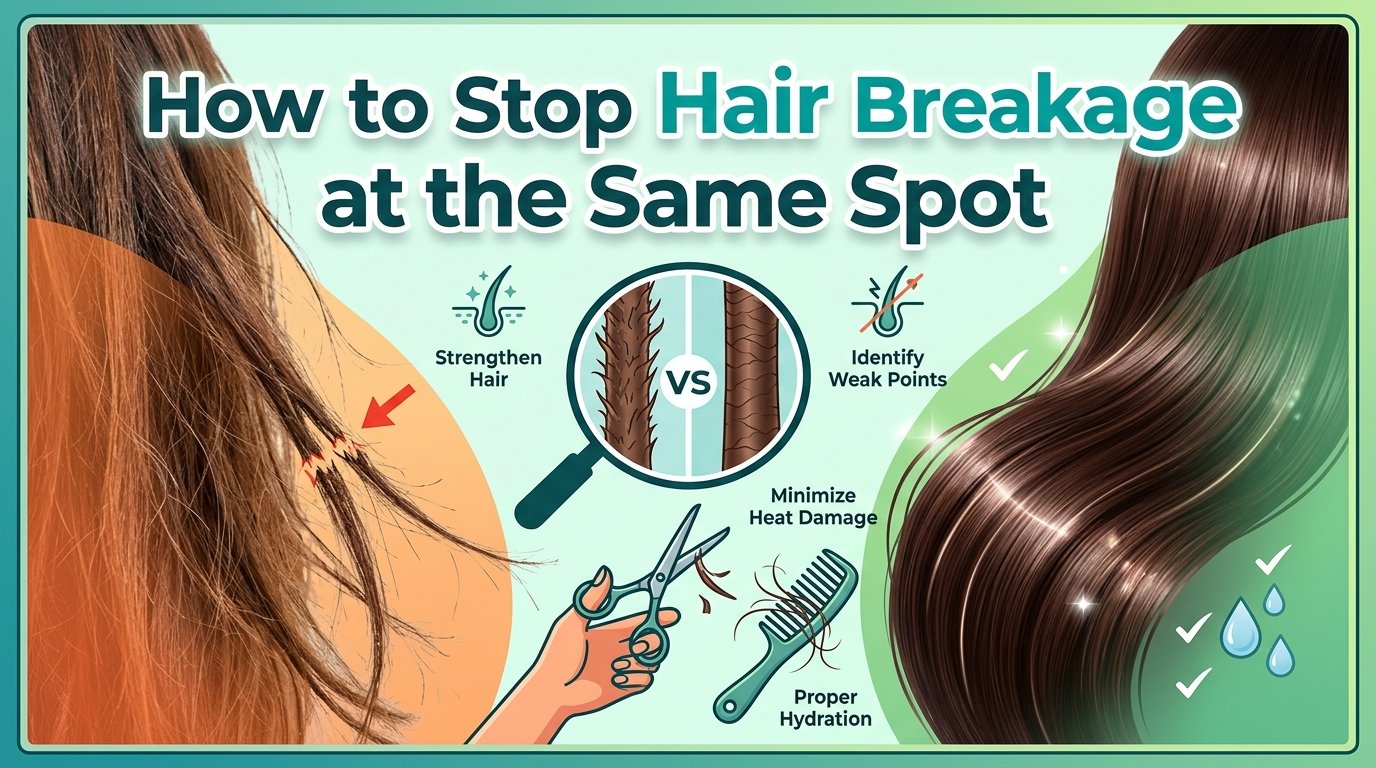
You part your hair the same way every morning, sweep it into the same ponytail, brush through the same tangle, and sleep on the same side every night. Then one day you notice it: short, broken hairs sticking up at the exact same spot on your head. You trim them, baby them, and three months later they are back. If this sounds familiar, you are dealing with one of the most frustrating hair problems out there.
At Mercer Street Salon, we see this pattern constantly. Clients tell us their hair “just won’t grow past a certain length” or that they have a “permanent cowlick” that never resolves. In nearly every case, the issue is not growth. The issue is that the hair keeps breaking at the same weakened point. Your hair is growing about half an inch every month, but it snaps off before that length becomes visible.
Learning how to stop breakage at the same spot on your hair every time means understanding what is weakening that specific area in the first place. Once you identify the cause (which is almost always a repeated mechanical habit or accumulated chemical damage), the fix is surprisingly straightforward. This guide walks you through why localized breakage happens, how to identify your breakage pattern, and the exact steps our salon team recommends to break the cycle for good.
Table of Contents
Why Does My Hair Keep Breaking Off in the Same Spot?
Hair breaks at the same spot every time because a specific section of the hair shaft has been weakened by repeated stress. That stress could be mechanical (the same ponytail placement, the same brushing direction, the same flat iron angle), chemical (color or relaxer overlapping in one zone), or thermal (heat concentrated on the same layers). Once the cuticle in that area is compromised, the cortex underneath loses protection and the strand snaps at that exact weak point.
The hair continues to grow from the root, but as soon as it reaches the length where that damaged section now sits, it breaks again. This is why it feels like your hair “won’t grow past” a certain length. It is growing, you just cannot keep it.
The most common culprits include:
The same tight ponytail or bun worn in the identical location day after day
Repeated heat styling at the same angle or on the same layers
Color or chemical treatments that overlap on previously processed hair
Brushing or detangling starting from the same spot and pulling downward
Sleeping on the same side of your head with cotton pillowcases creating friction
The good news: once you identify which of these applies to you, the fix is often as simple as changing one daily habit.
What Is Hair Breakage (and How Is It Different from Shedding)?
Before you can fix breakage, you need to confirm that what you are seeing is actually breakage. Many of our clients confuse breakage with normal shedding or even hair loss, and the treatments for each are completely different.
Hair breakage occurs when the hair shaft snaps somewhere along its length. The hair was growing fine, but the strand became weak at a specific point and broke. You will see short pieces of hair with no bulb at the end. Breakage is a hair shaft problem, not a follicle problem.
Hair shedding is when a fully grown hair falls out from the root. This is part of the normal hair growth cycle, and the average person sheds 50 to 100 hairs per day. Shed hairs have a small white bulb at one end. If you are seeing bulbs, that is shedding, not breakage.
Hair thinning or loss happens when the follicle itself stops producing hair or produces finer, weaker hair over time. This is typically a scalp or medical issue and requires a dermatologist’s evaluation rather than a conditioning treatment.
If your broken hairs have no bulb at the end and are concentrated in one area, you are dealing with breakage. That is exactly what this guide addresses.
Why Breakage Happens at the SAME Spot Every Time
This is the question no competitor answers clearly, and it is the heart of your frustration. Here is the science behind why breakage recurs at one specific location.
Every hair on your head grows from a follicle and pushes outward at roughly half an inch per month. The strand itself is made of three layers: the cuticle (outer protective layer), the cortex (the strong inner core that gives hair its structure), and the medulla (the innermost core in thicker hairs). When the cuticle is intact and lying flat, your hair is strong and flexible. When the cuticle is worn away or lifted, the cortex is exposed and becomes brittle.
Now imagine you wear a ponytail in the exact same spot every single day. The hair tie creates tension on the same group of strands, in the same location, day after day. Over weeks and months, that tension wears down the cuticle on those specific hairs. The cortex gets exposed. Eventually, those hairs become so weak at the ponytail point that any additional stress (brushing, wind, sleeping) causes them to snap.
The hair keeps growing from the root. But every time it reaches that same length, the new growth pushes the damaged section into a position where it experiences the same tension again. The cycle repeats. Your hair breaks at the same length, in the same spot, every single time.
The same principle applies to heat damage. If you always flat iron the same face-framing pieces first (when the iron is hottest), those strands take the most thermal punishment. They weaken faster than the rest of your hair and snap at mid-shaft length.
This is why trimming alone does not solve the problem. You can cut off the broken ends, but if you keep repeating the same styling habits, the new growth will break at the same point. You have to address the cause, not just the symptom.
The Breakage Location Guide: What Each Spot Means
Where your hair breaks tells you why it is breaking. Our salon team uses this mapping system to diagnose the root cause of localized breakage. Find your pattern below.
Breakage at the Hairline and Temples
This is the most common localized breakage pattern we see, and it almost always points to tension. Tight ponytails, slicked-back buns, braids installed too tightly, and extensions pulling at the hairline all create concentrated stress on the fine hairs at your face. The hair here is naturally finer and more fragile than the hair at the back of your head.
If you always part your hair in the same place and pull it taut, the tension lands on the same temple hairs every day. Over time, those hairs weaken and snap. You will notice flyaways and short stubble at the temples that never seems to grow out.
The fix: switch your part regularly, use looser styles, and never sleep with hair pulled tight. If you wear braids or extensions, make sure they are not pulling at the hairline on day one. Pain means damage.
Breakage at the Crown (Top of Head)
Crown breakage is often caused by friction and heat. If you sleep on your back, the crown of your head rubs against the pillowcase all night. If you always start blow-drying or flat ironing from the top, the crown hairs take the most direct heat.
Crown breakage can also come from wearing the same hats, beanies, or helmets repeatedly. The friction wears down the cuticle on those specific strands.
The fix: switch to a satin or silk pillowcase, rotate your sleep position, and use heat protectant every single time you style. Alternate which section of hair you dry or iron first so no single area takes the brunt of the heat every time.
Mid-Shaft Breakage (Middle of the Strand)
Mid-shaft breakage is when the hair snaps somewhere in the middle, not at the root and not at the ends. This is the most confusing type for our clients because there are no split ends to explain it. The hair just breaks in half.
The most common cause is the same ponytail worn at the same height every day. The hair tie sits at the same point on the strand, creating friction and tension until the hair weakens and snaps at that exact location. Other causes include aggressive detangling (ripping a brush through the same stubborn knot), repeated bleaching that overlaps on previously lightened hair, and mechanical damage from tight headbands or clips.
The fix: change your ponytail height daily (high, mid, low, and switch to claw clips on some days). Never use rubber bands or thin elastics. Switch to silk scrunchies or spiral ties that distribute pressure more evenly.
Breakage at the Ends
Ends are the oldest, most weathered part of your hair. They have been through the most washes, the most heat, and the most environmental exposure. Breakage at the ends typically looks like split ends, dry brittle tips, and hair that tapers significantly at the bottom.
This is the easiest type of breakage to fix because the solution is simple: trim regularly. Once the ends split, no product can seal them back together permanently. Dusting (trimming a quarter inch every 8 to 12 weeks) keeps the ends fresh before the splits travel up the shaft and cause breakage higher up.
The 7 Most Common Causes of Localized Breakage
Now that you know where breakage tends to occur and why it recurs, let us break down the specific causes. Most of our clients are dealing with more than one of these simultaneously.
1. Repeated Tight Hairstyles (Traction Damage)
This is the number one cause of same-spot breakage we see at the salon. The same ponytail, the same bun, the same braid, worn in the same location every day creates chronic tension on the same strands. The hair does not get a chance to recover. Over time, the constant pulling weakens the cuticle and the hair snaps at the tension point.
If left unchecked, traction damage can progress to traction alopecia, where the follicle itself becomes damaged and stops producing hair. This is permanent. If your scalp is sore or you see bumps at the hairline after styling, you are causing damage.
2. Heat Styling Concentrated in One Area
Heat damage is cumulative. Every time you apply a flat iron, curling iron, or hot comb to your hair, you temporarily break the hydrogen bonds that give hair its shape. At high temperatures, you also damage the cuticle and dry out the cortex.
If you always style the same sections first (when the tool is hottest) or always pass over the same layers multiple times, those hairs take disproportionate damage. They will weaken and break long before the rest of your hair.
3. Chemical Over-Processing in Overlapping Zones
Color, bleach, relaxers, and perms all alter the hair’s internal structure. The problem arises when new growth is treated and the product overlaps onto previously processed hair. That overlap zone has now been chemically treated twice (or more), and it becomes significantly weaker than the hair above or below it.
This overlapping damage creates a precise weak point. The hair will break at that exact line of overlap every time it grows to that length. This is why box dye and at-home bleach are common culprits. Professional colorists are trained to avoid overlap.
4. Aggressive or Repetitive Detangling
How you brush matters as much as how often. If you start detangling from the roots and rip downward through the same tangles every day, you are putting concentrated stress on the same sections of hair. The hairs caught in those daily tangles will weaken and snap.
Dry brushing is especially damaging because the hair is less elastic and more brittle than when it is wet and conditioned. Fine hair is particularly vulnerable to mechanical damage from rough detangling.
5. Friction from Sleep and Accessories
You spend roughly a third of your life with your head against a pillow. If you sleep on a cotton pillowcase, the fabric creates friction that pulls and tugs at the same strands every night. Hair caught under your body or twisted into the same sleep position takes the most damage.
Hats, beanies, helmets, and headbands worn regularly in the same position create the same friction problem. The area where the band sits is where the breakage will appear.
6. Product Buildup in One Area
This is an overlooked cause. If you always apply the same product (dry shampoo, hairspray, volumizing powder) to the same section (usually the crown or hairline), those hairs accumulate product residue that can dry out and stiffen the shaft. Stiff, coated hair is more prone to snapping.
Silicone buildup from certain conditioners and serums can have a similar effect, creating a coating that prevents moisture from penetrating the strand.
7. Environmental and Internal Factors
Hard water, sun exposure, chlorine from swimming, and dry winter air all contribute to overall hair weakness. While these factors tend to affect all of your hair rather than one specific spot, they lower the overall strength baseline so that mechanical stress causes breakage more easily.
Internal factors like nutritional deficiencies (especially iron, vitamin D, and protein), stress, thyroid imbalances, and certain medications including weight loss medications like Zepbound can increase hair shedding and make the remaining hair more fragile. If your breakage appeared suddenly or coincides with a medication change, consult your doctor.
How to Stop Breakage at the Same Spot on Your Hair Every Time
Here is the step-by-step plan we walk our salon clients through when they come in with localized breakage. Follow these in order. Most clients see visible improvement within 8 to 12 weeks.
Step 1: Cut to the Shortest Point of Breakage
This is the hardest step emotionally but the most important one practically. If your hair has broken to different lengths, you have damaged sections that will continue to fray and split upward. You need a clean baseline to start from.
This does not necessarily mean a dramatic chop. Talk to your stylist about cutting to the shortest broken piece. For hairline and temple breakage, this might mean face-framing layers that blend the broken hairs. For mid-shaft breakage, it might mean cutting to the length where the snapping occurs.
Trying to hold onto damaged length while treating breakage is like trying to fix a cracked wall without removing the crumbling plaster. The new hair will keep breaking against the damaged section.
Step 2: Identify and Change Your Repetitive Habit
This is where the real work happens. For three days, pay close attention to every single thing you do to your hair. Write it down.
Where do you place your ponytail? How do you part your hair? Which side do you sleep on? Where do you start flat ironing? Where do you spray dry shampoo? Which ear do you tuck hair behind? Do you hold your phone against your shoulder, pressing hair between your ear and the device?
Every one of these habits creates a stress pattern. Once you spot the repetition, change it. Alternate your part every few days. Switch ponytail heights. Sleep on the other side. Tuck hair behind the opposite ear. These sound small, but they redistribute stress across different hairs instead of punishing the same ones daily.
Step 3: Switch to Gentle Hair Accessories
Throw out rubber bands, thin elastics, and anything with metal clasps. Replace them with silk scrunchies, spiral ties, or fabric-covered elastics that distribute pressure across a wider area.
Better yet, swap tight ponytails for loose claw clips on some days. Claw clips hold hair without creating a single tension point. They are one of the easiest swaps our clients make, and the difference in breakage is often visible within weeks.
Step 4: Detangle Correctly Every Time
Start at the ends and work upward in small sections. Never start at the roots and pull down. Use a wide-tooth comb on wet, conditioned hair rather than a brush on dry hair. If you encounter a tangle, hold the hair above the knot to support the strand and gently work through it with your fingers first.
Apply a leave-in conditioner or detangling spray before combing to add slip. This one change in technique eliminates a massive amount of mechanical damage for most people.
Step 5: Use Heat Protectant Every Single Time
No exceptions. Heat protectant creates a barrier between your hair and the hot tool, reducing moisture loss and cuticle damage. Apply it to damp hair before blow-drying and reapply a lightweight spray before using a flat iron or curling iron.
Keep your hot tools at or below 375 degrees Fahrenheit for fine hair and never above 400 degrees for any hair type. Pass through each section only once. If one pass is not enough, your tool is too cold or your section is too thick.
Step 6: Add Weekly Deep Conditioning and Protein
A weekly deep conditioning mask restores moisture and elasticity to damaged hair. Look for masks with hydrating ingredients like shea butter, argan oil, or glycerin.
Alternate your moisture mask with a protein treatment every other week. Protein treatments temporarily fill in gaps in the hair shaft, making it stronger and more resistant to breakage. Bond repair treatments go a step further by reconnecting broken disulfide bonds in the hair structure.
One caution with protein: too much can make hair stiff and brittle. If your hair feels straw-like after a protein treatment, you have overdone it. Scale back and focus on moisture.
Step 7: Upgrade Your Sleep Setup
Switch to a satin or silk pillowcase immediately. The smooth surface allows your hair to glide rather than catch and pull, dramatically reducing overnight friction damage.
If you have long or curly hair, consider a satin bonnet or silk sleep wrap. These keep your hair contained and prevent the tossing and turning of sleep from creating tangles and friction points.
Never sleep with wet hair. Wet hair is in its most fragile state, and the friction of a pillowcase on damp strands causes significant breakage overnight.
Salon Treatments and Product Categories That Help
While no product can repair breakage that has already occurred (despite what marketing claims suggest), certain treatments and product categories can strengthen your remaining hair and prevent future breakage. Here is what our team recommends.
Bond repair treatments: These work by reconnecting broken disulfide bonds in the hair shaft. Professional in-salon treatments deliver the strongest concentration, and at-home maintenance versions help extend results between appointments. They are especially beneficial for color-treated and chemically processed hair.
Deep conditioning masks: A weekly mask restores moisture and improves elasticity, making hair more flexible and less prone to snapping. Apply to clean, damp hair, focus on the mid-lengths and ends, and leave on for the full recommended time.
Leave-in conditioners: These provide ongoing moisture and slip throughout the day, reducing friction from brushing and styling. They are especially important for fine and curly hair types that need lightweight hydration.
Heat protectants: Non-negotiable if you use any hot tools. Look for sprays or creams that offer thermal protection up to at least 400 degrees Fahrenheit.
Sulfate-free shampoos: Sulfates are harsh detergents that strip natural oils and can fade color faster. A gentle, sulfate-free cleanser preserves moisture and extends the life of your treatments.
Wide-tooth combs and silk accessories: These are tools, not products, but they make a bigger difference than most bottles on your shelf. Swap your brush for a wide-tooth comb on wet hair and trade rubber bands for silk scrunchies.
How Long Does It Take to Stop Breakage?
This is the question every client asks, and the honest answer is 8 to 16 weeks for visible improvement. Here is why.
Hair grows about half an inch per month. If you cut to the shortest broken point and start your prevention routine today, you will have about one inch of healthy new growth after two months and about two inches after four months. That is typically enough length to see a visible difference in the broken area.
However, the damaged hair above the breakage point will not heal. You are waiting for new, healthy growth to replace it. This is why patience and consistency with your prevention routine matter so much. If you revert to old habits during the regrowth period, the new hair will break at the same spot.
For hairline and temple breakage caused by traction, improvement is often faster because the hairs are shorter and regrow more visibly. For mid-shaft breakage, it can take longer because you need more length before the difference is noticeable.
When to See a Professional
If you have followed the steps above for three months and see no improvement, or if your breakage appeared suddenly and coincides with a medical change, schedule an appointment. Here is when to seek professional help.
See a licensed stylist if you need help identifying your breakage pattern, cutting to a clean baseline, or choosing the right product routine for your hair type. A professional assessment can pinpoint causes you might miss on your own.
See a dermatologist if you are experiencing scalp pain, itching, redness, or inflammation alongside breakage. Also consult a doctor if your breakage coincides with starting a new medication (including GLP-1 weight loss medications like Zepbound or Wegovy), if you notice your hair thinning at the crown or part, or if you have other symptoms like fatigue or weight changes that could indicate a thyroid issue or nutritional deficiency.
Conditions like lupus, thyroid disorders, iron deficiency anemia, and telogen effluvium (stress-related shedding) can all contribute to hair weakness and breakage. A dermatologist can run bloodwork and evaluate whether an underlying medical issue is contributing to your hair problems.
Signs Your Breakage Is Improving
Tracking progress keeps you motivated during the regrowth period. Here is what to look for over the first few months.
Fewer short hairs on your pillow, in the shower drain, and around your hairline. Less visible flyaway activity at the breakage site. New growth that feels smooth and consistent from root to tip rather than tapering or splitting. Your hair starts to feel thicker in the previously broken area as healthy new strands fill in.
Take a photo of the breakage site on day one and compare monthly. The changes are gradual enough that daily inspection will not show progress, but side-by-side photos over 8 to 12 weeks will reveal real improvement.
FAQs
Why does my hair keep breaking off in the same spot?
Hair breaks at the same spot because a specific section of the hair shaft has been weakened by repeated stress such as the same ponytail placement, the same heat styling angle, or overlapping chemical treatments. The hair continues growing but snaps at that weakened point every time it reaches a certain length, creating the illusion that your hair will not grow past that spot.
How to fix constant hair breakage?
Cut to the shortest broken point to create a clean baseline, identify and change the repetitive habit causing the damage, switch to silk scrunchies or claw clips, detangle from the ends upward with a wide-tooth comb, use heat protectant every time you style, apply weekly deep conditioning or bond repair masks, and sleep on a satin or silk pillowcase. Most people see improvement within 8 to 12 weeks.
Can you repair hair that keeps breaking in the same place?
Hair that has already broken cannot be repaired or sealed back together despite product marketing claims. You must cut to the shortest broken point and focus on preventing the new growth from breaking again. Bond repair treatments and protein masks can strengthen the remaining hair and reduce future breakage, but they do not fix strands that have already snapped.
Is breakage at the same spot a sign of something serious?
Usually it is caused by mechanical or chemical habits like tight hairstyles or overlapping color. However, if breakage appeared suddenly, coincides with medication changes, or comes with scalp irritation or other symptoms, it could indicate an underlying condition like thyroid imbalance, nutritional deficiency, or an autoimmune disorder. Consult a dermatologist if you suspect a medical cause.
How to stop losing hair on Zepbound or other weight loss medications?
GLP-1 medications like Zepbound and Wegovy can trigger telogen effluvium, a temporary shedding condition caused by rapid weight loss and reduced calorie intake. Focus on protein intake, stay hydrated, take a multivitamin, and be patient as shedding typically resolves within a few months. Always consult your prescribing doctor before making any changes to your medication or supplement routine.
Can lupus cause hair breakage?
Yes. Lupus can cause hair breakage and shedding through several mechanisms including discoid lesions on the scalp, inflammation of hair follicles, and the overall stress of chronic illness on the body. Lupus-related hair issues require medical management by a rheumatologist and dermatologist. If you suspect lupus, see your doctor for evaluation and bloodwork.
How do I know if it is breakage or normal shedding?
Examine the fallen hairs closely. Shed hairs have a small white bulb at the root end and are full-length. Broken hairs have no bulb, are shorter than your full strand length, and may have uneven or frayed ends. Normal shedding is 50 to 100 hairs per day. If you are seeing significantly more than that or lots of short broken pieces, it is likely breakage.
Why does my hair break at the same length every time?
Your hair breaks at the same length because the damage is located at a fixed point on older hair that has now grown to that length. As new hair grows from the scalp, the damaged section moves outward. When it reaches the zone where your daily styling stress occurs, the weakened hair snaps again at that same length, creating a permanent length ceiling.
Breaking the Same-Spot Breakage Cycle for Good
Learning how to stop breakage at the same spot on your hair every time comes down to one core principle: identify the repetitive stress and change it. Your hair is not defective. It is simply responding to the same damage pattern day after day.
The combination that works for almost every client we see is this: cut to the shortest broken point for a clean start, swap tight styles and rubber bands for loose clips and silk scrunchies, detangle gently from the ends with a wide-tooth comb, protect against heat every single time, deep condition weekly, and sleep on satin or silk. Do all of these consistently for 8 to 12 weeks and you will see the difference.
Your hair wants to grow. Give it the conditions to do so without breaking, and it will.