
Struggling with hair that feels off but you cannot pinpoint why? You are not alone. In our salon chairs at Mercer Street, this is the single most common question we hear from clients every single week.
Learning how to tell if your hair needs protein or moisture right now can save you weeks of frustration, wasted products, and unnecessary damage. The wrong treatment can actually make your hair worse, not better.
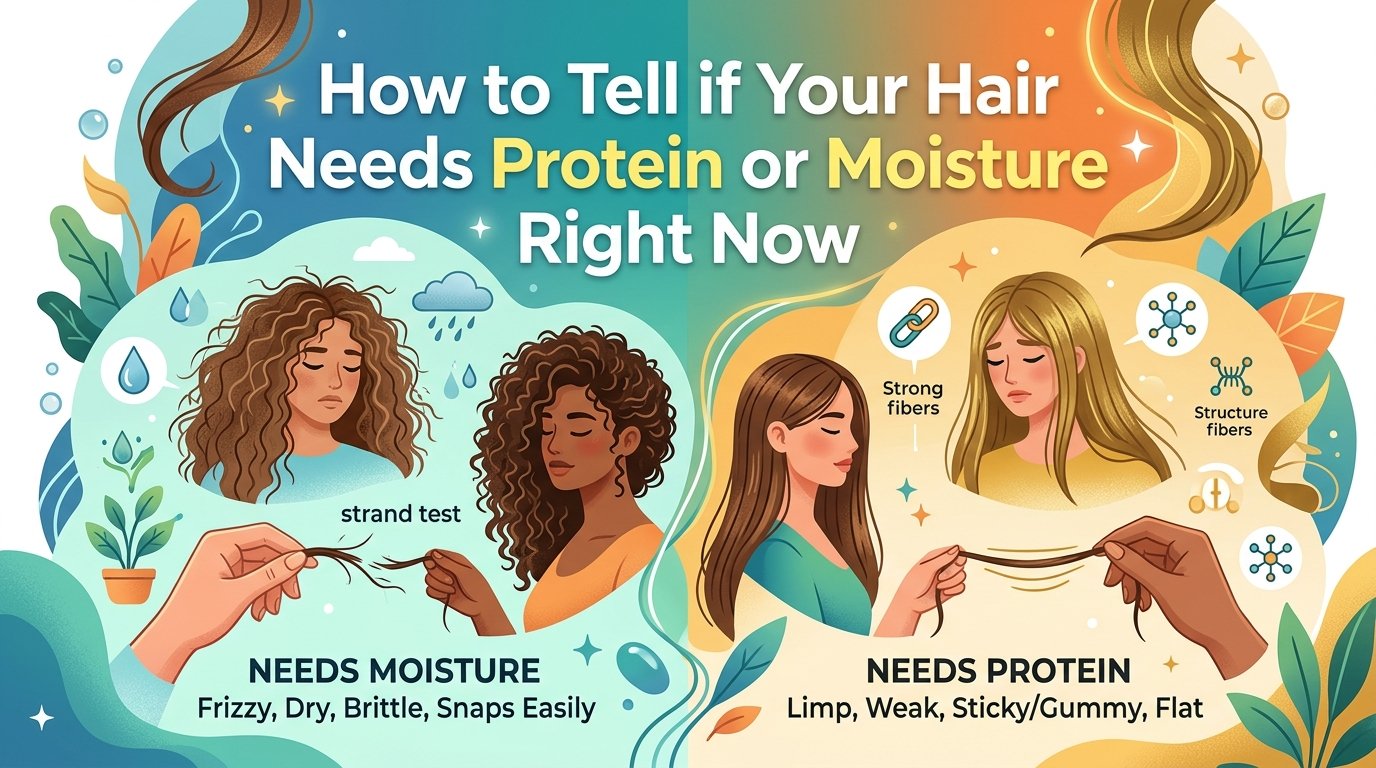
Here is the short version: if your hair feels weak, gummy, limp, or stretches too far before snapping, it likely needs protein. If it feels dry, rough, frizzy, or brittle and snaps immediately when pulled, it likely needs moisture. The rest of this guide walks you through exactly how to test, diagnose, and fix the issue today.
Our team has worked with every hair type imaginable, from pin-straight fine hair to tight coils, color-treated, heat-damaged, and everything in between. The principles below work across all textures because they are based on the actual structure of hair, not guesswork.
We have distilled years of salon experience and client feedback into a clear, actionable framework. By the end of this article, you will have a definitive answer for your own hair and a plan to bring it back into balance.
Table of Contents
Quick Diagnosis: How to Tell if Your Hair Needs Protein or Moisture Right Now
You can get a strong indication in under two minutes using nothing more than a single strand of shed hair and a glass of water. We use this exact method with clients before recommending any treatment.
Take one naturally shed strand from your brush (do not pull one out). Hold it between your thumb and forefinger about an inch apart. Gently pull the strand to stretch it, then release. Pay attention to how the hair behaves.
Healthy hair stretches slightly, then snaps back to its original length like a tiny rubber band. This means your protein-moisture balance is in good shape.
If the strand stretches far and does not snap back, or feels gummy and mushy, your hair has too much moisture and not enough protein. If it snaps instantly with zero stretch and feels stiff or wiry, your hair needs moisture and may have too much protein.
That one simple stretch test answers the core question most people spend months trying to figure out. We will break down every sign in detail below so you can confirm your diagnosis with confidence.
Many of our clients describe a lightbulb moment the first time they try this test. They had been chasing the wrong solution for months, sometimes years, and the fix was as simple as switching their treatment approach based on what the strand told them.
What Protein Actually Does for Your Hair
Protein is the structural backbone of every hair strand. Your hair is made up of approximately 95 percent keratin, a tough fibrous protein that gives strands their strength, shape, and resilience.
Every time you bleach, dye, heat-style, chemically relax, or even expose your hair to sun and pollution, you lose small amounts of that structural protein. The cuticle layer takes the hit first, and eventually the inner cortex weakens.
Protein treatments deposit temporary protein molecules onto the hair shaft and partially fill in damaged areas. They do not permanently rebuild hair, but they reinforce weak spots and restore a sense of structural integrity between washes.
Think of protein as the scaffolding of your hair. Without enough of it, strands lose their bounce, body, and ability to hold their natural shape.
Different protein molecules serve slightly different roles. Hydrolyzed keratin closely matches your hair’s natural composition and bonds well to damaged areas. Hydrolyzed wheat protein is smaller and penetrates deeper into the cortex. Hydrolyzed silk protein sits on the surface and creates a smooth, silky feel.
This is why you will often see multiple protein types listed in quality protein treatments. They work at different layers of the hair shaft to deliver both surface smoothness and internal reinforcement.
What Moisture Actually Does for Your Hair
Moisture is the hydration that keeps your hair flexible, soft, and manageable. Without adequate water content inside the hair shaft, strands become rigid, brittle, and prone to snapping under any tension.
Moisture enters the hair through humectants like glycerin and hyaluronic acid, and it gets sealed in by emollients and oils that smooth the cuticle layer. Together, these ingredients maintain the water balance that keeps hair pliable.
Well-moisturized hair bends without breaking. It feels soft to the touch, reflects light evenly for natural shine, and behaves predictably when you style it.
When moisture drops, hair loses that flexibility. Every strand becomes a tiny dry twig that snaps the moment it faces friction, tension, or environmental stress.
It is worth noting that moisture and oil are not the same thing. Hair oils seal in existing hydration and smooth the cuticle, but they do not actually add water to the hair shaft. This is why someone can have greasy roots and still have bone-dry ends.
True moisture comes from water-based products and humectants. If your hair feels dry despite regular oil use, the missing piece is almost always water-based hydration, not more oil.
5 Signs Your Hair Needs Protein
If you are seeing two or more of these signs, your hair is almost certainly protein-deficient. These symptoms tend to appear together because they all stem from the same underlying cause: weakened structural integrity.
1. Your hair feels gummy or mushy when wet. This is the classic hallmark of protein loss. Healthy wet hair has a slight resistance when you press it. Protein-deficient hair feels like chewing gum or soft taffy between your fingers.
2. Your hair stretches too far before snapping. When you do the stretch test described above, the strand pulls out long and thin instead of bouncing back. That excessive elasticity means the keratin structure is compromised.
3. Your hair is limp, flat, and stringy. Even after washing and volumizing, your strands hang lifelessly with no body. Protein gives hair its internal structure and natural lift. Without it, everything collapses.
4. Your hair is unusually porous. If water saturates your hair almost instantly in the shower but also evaporates just as fast, your cuticle layer is likely damaged and letting moisture escape through gaps that protein would normally fill.
5. You are seeing increased shedding or breakage. A sudden uptick in hair on your pillow, in the shower drain, or around your brush can signal that strands have become too weak to withstand normal daily handling.
Color-treated and chemically processed hair is especially prone to protein deficiency. The bleaching process in particular strips keratin from the cortex, which is why freshly bleached hair often feels gummy and over-stretchy within days of an appointment.
Heat damage works similarly but more gradually. Flat irons and curling wands operating above 350 degrees Fahrenheit slowly degrade the keratin bonds inside each strand. Over months and years, the cumulative effect mirrors chemical damage in both look and feel.
If your hair recently started showing these signs after years of being fine, look back at what changed. A new color service, a different hot tool, harder water, or even a new medication can shift the balance quickly.
5 Signs Your Hair Needs Moisture
If you are experiencing two or more of these symptoms, your hair is crying out for hydration. These signs are distinct from protein deficiency because they reflect dryness rather than weakness.
1. Your hair feels dry, rough, or straw-like. Run a strand between your fingers from root to tip. If it catches, feels coarse, or has a sandpaper quality, the cuticle is raised and the hair shaft is dehydrated.
2. Your hair is frizzy and unmanageable. When hair lacks internal moisture, the cuticle lifts to pull humidity from the air. That desperate grab for water is what creates the frizz pattern you see in the mirror.
3. You have visible split ends. Dry, brittle hair splits at the ends because the strand has lost the flexibility to bend without fracturing. Once a split starts, it travels up the shaft unless trimmed.
4. Your hair looks dull instead of shiny. Moisture keeps the cuticle flat and smooth, which allows it to reflect light evenly. Dehydrated cuticles scatter light, leaving hair looking flat and lifeless.
5. Your hair is hard to detangle and snaps easily. Dry hair has zero give. When you comb through it, instead of bending around tangles, individual strands simply snap. You will hear tiny popping sounds if you listen closely.
Environmental factors play a huge role here. Cold winter air, indoor heating, hard water, sun exposure, and frequent hot tool use all accelerate moisture loss from the hair shaft.
Hard water is an underrated culprit. Minerals like calcium and magnesium build up on the hair shaft over time, creating a film that blocks moisture from penetrating. If you have ruled out everything else and your hair still feels persistently dry, a clarifying or chelating shampoo may be the missing piece.
Seasonal changes also matter. Many clients notice their hair gets drier in winter when indoor heating drops humidity to desert-like levels. A simple humidifier in your bedroom can make a measurable difference in how your hair retains moisture overnight.
Protein Overload vs Moisture Overload
This is where most people get tripped up. It is entirely possible to overdo either treatment and create a brand-new problem. Recognizing overload symptoms is just as important as recognizing deficiency symptoms.
Protein overload happens when you use protein treatments too frequently or layer too many protein-containing products at once. The hair feels stiff, brittle, and almost crunchy. Strands snap with zero stretch when pulled. The texture can feel rough and wiry even right after conditioning.
The fix for protein overload is simple: stop all protein treatments immediately and focus purely on deep moisture conditioning for one to two weeks. Hair typically recovers its flexibility within a handful of washes.
Moisture overload is the opposite extreme. It occurs when you overload hair with heavy conditioners, leave-ins, and oils without ever reinforcing the protein structure. The hair feels mushy, overly soft, gummy when wet, and loses all its natural body and definition.
Fixing moisture overload requires a clarifying wash to strip excess product buildup, followed by a single protein treatment to restore structural integrity. Most people see improvement after just one corrective session.
On Reddit communities like r/HaircareScience and r/curlyhair, users frequently describe protein-overloaded hair as feeling like a dried-out scouring pad and moisture-overloaded hair as feeling like bubblegum. Those tactile comparisons are remarkably accurate diagnostic tools.
One common mistake we see in the salon is the assumption that if a little protein helped, more protein will help more. Protein treatments are potent, and more is rarely better. The goal is reinforcement, not coating the hair in so much protein that it becomes rigid.
Similarly, deep conditioning masks are concentrated. Using a heavy mask every single wash can push your hair into moisture overload faster than you would expect. Rotate treatments and listen to how your hair responds.
How Hair Type Affects Protein and Moisture Needs
Your hair type dramatically influences which side of the balance you lean toward. Treating fine hair like coarse hair, or low-porosity hair like high-porosity hair, is a fast track to frustration.
Fine hair has a smaller diameter and less internal structure, which means it tolerates protein well and is more prone to moisture overload. Fine-haired people can typically use protein treatments weekly without issue.
Coarse hair has a thicker diameter and naturally more protein density, so it tends to need moisture far more than additional protein. Heavy protein treatments on coarse hair often trigger immediate protein overload symptoms.
Curly and coily hair needs a careful balance because the curved shaft structure makes natural oils harder to distribute from root to tip. Most curl types benefit from regular moisture with occasional, measured protein use.
Straight and wavy hair tends to need less product overall because sebum travels more easily down the straighter shaft. However, heat-styled straight hair accumulates damage that periodically requires protein reinforcement.
Low-porosity hair has a tightly sealed cuticle that resists absorbing both protein and moisture. Lightweight products and heat (like a warm cap during deep conditioning) help open the cuticle enough for ingredients to penetrate.
High-porosity hair has gaps and tears in the cuticle from chemical or heat damage. It drinks up both protein and moisture quickly but also loses them fast, so it needs frequent, layered treatments.
Color-treated and chemically processed hair almost always falls into the high-porosity category. The chemical processes that change hair color or texture work by lifting or breaking the cuticle, which permanently alters how the hair absorbs and retains both protein and moisture.
Two At-Home Tests You Can Do Right Now
These are the same diagnostic tools we walk clients through during consultations. Both take under five minutes and require only items you already have at home.
The Stretch Test (for elasticity): Grab a single shed strand. Hold it horizontally between your fingers. Pull gently. If it stretches about 30 percent then snaps back, balance is good. If it stretches far and stays stretched, you need protein. If it snaps instantly with no stretch, you need moisture.
The Porosity Test (for cuticle health): Drop a clean shed strand into a glass of room-temperature water. Wait two minutes. If it floats, your hair has low porosity and resists absorbing products. If it sinks slowly, porosity is normal. If it sinks immediately, your hair has high porosity and loses moisture fast.
Run both tests together for a complete picture of what your hair needs right now. The stretch test tells you about structural health, and the porosity test tells you how your hair will respond to different treatments.
For the most accurate results, test hair that has been washed within the last 24 to 48 hours with no styling products in it. Heavy product buildup can skew both tests by coating the strand and altering how it stretches or absorbs water.
Test strands from different parts of your head too. The hair at your crown and hairline often experiences more sun and friction damage than the hair at your nape. Comparing results across areas can reveal localized damage patterns.
A Simple Decision Framework
If you want a fast yes-or-no answer without running the full tests, use this framework based on how your hair feels right now.
If your hair feels mushy, overly soft, stretches too much, or has lost its natural curl pattern and body, reach for a protein treatment. If your hair feels dry, rough, brittle, frizzy, or snaps at the slightest tension, reach for a moisture treatment.
If you are genuinely unsure, start with moisture. It is the safer default because most hair types tolerate hydration well, and moisture deficiency is more common overall. Reassess after two or three washes.
The only scenario where you should reach for protein first is recent chemical processing. Freshly bleached, permed, or relaxed hair almost always has acute protein damage that takes priority over moisture concerns.
Maintaining the Protein-Moisture Balance
Healthy hair is not about choosing protein over moisture or vice versa. It is about maintaining a dynamic balance that shifts based on season, chemical treatments, styling habits, and even your water hardness.
A simple starting framework: use a moisture-focused deep conditioner weekly, and add a protein treatment every two to four weeks depending on your hair type and damage level. Adjust based on how your hair responds.
Pay attention after every wash. If hair feels mushy, add protein next time. If it feels stiff or brittle, add moisture. Your hair tells you what it needs every single wash day, you just have to learn its language.
Keep a simple mental or written log for the first month. Note which products you used and how your hair felt the next day. Patterns emerge quickly, and once you see them, future product choices become automatic.
Frequently Asked Questions
How do I know if my hair needs protein or hydration?
If your hair stretches too far and feels gummy or mushy when wet, it needs protein. If it feels dry, rough, frizzy, and snaps immediately when pulled, it needs moisture. Run the stretch test on a single shed strand to confirm in under two minutes.
What does hair lacking protein look like?
Protein-deficient hair looks limp, flat, and stringy. It has reduced bounce and volume, may appear dull, and often feels soft in an unhealthy, over-stretched way when wet. You may also notice more shedding and breakage than usual.
What are 5 signs you need more protein in your hair?
The five key signs are: 1) gummy or mushy texture when wet, 2) hair stretches too far before snapping, 3) limp and stringy appearance with no body, 4) unusually high porosity, and 5) increased shedding or breakage. Two or more symptoms together strongly indicate protein deficiency.
Can hair have too much protein or too much moisture?
Yes. Protein overload makes hair feel stiff, brittle, and crunchy with no stretch. Moisture overload makes hair feel overly soft, gummy, and lifeless. If you experience either, pause the offending treatment and switch to the opposite for one to two weeks to rebalance.
Final Thoughts on Protein vs Moisture
Figuring out how to tell if your hair needs protein or moisture right now comes down to two simple things: how your hair stretches and how it feels to the touch. The stretch test alone resolves the question for most people within seconds.
Start with the diagnosis, then adjust one variable at a time so you can clearly see what is working. Healthy hair is not about piling on more products, it is about giving your hair exactly what it is asking for and nothing more.
Your hair renews itself constantly, which means its needs shift over time. What worked last summer may not work this winter. What fixed your hair after a bleaching session is not what your hair needs six months later when it has grown out. Stay curious, keep testing, and trust what your strands tell you.