
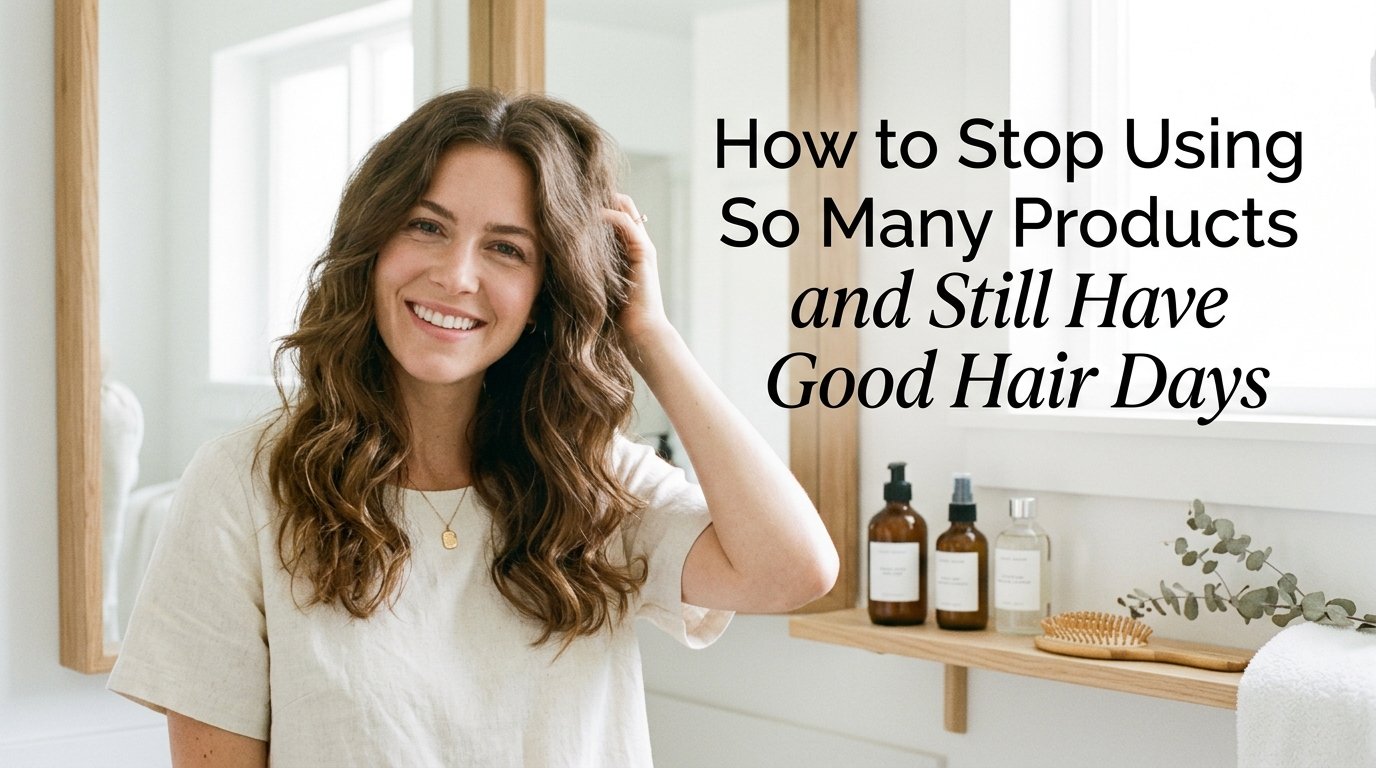
I used to have a shelf stuffed with 14 different hair products. Serums, mousses, leave-ins, heat protectants, three different shampoos for different moods. And somehow, my hair still looked flat, greasy, and unpredictable on most days.
If you have ever stood in front of the mirror wondering why your hair looked better before you started trying so hard, you are not imagining things. Many people discover that their best hair days happen when they use the fewest products, often on days they barely try.
Learning how to stop using so many hair products changed my routine entirely. In this guide, our team at Mercer Street Salon will walk you through exactly why less is often more, how to figure out which products you actually need, and how to build a simple routine that delivers consistent good hair days.
Table of Contents
Signs You Are Using Too Many Hair Products
Product overload hair is a real phenomenon, and it tends to sneak up on you. You add one product to fix a problem, then another to fix the side effect of the first one, and before long you have a six-step routine that leaves your hair worse off than before.
Here are five clear signs your hair is telling you to cut back:
Your hair feels heavy or greasy right after washing. This is one of the most common symptoms of product buildup. Even freshly washed hair can look dull and limp if layers of silicone, oil, and polymer from previous products have not been properly removed.
Frizz gets worse no matter what you apply. Many people reach for anti-frizz products when frizz is actually caused by too much product weighing the hair down or disrupting its natural texture pattern.
Your scalp feels itchy or flaky. Product residue on the scalp can clog follicles, irritate the skin, and create the kind of environment where flakes and itchiness thrive. This is not always dandruff. Sometimes it is simply buildup.
Your natural texture has disappeared. If your waves or curls used to form on their own and now need products to hold their shape, you may have coated your strands with so many layers that the hair cannot do what it naturally does.
You cannot tell which product is actually working. When you use five products at once and get a good result, you have no idea which one deserves the credit. And when you get a bad result, you cannot identify the culprit.
If three or more of these sound familiar, your hair is likely suffering from product dependency rather than benefiting from product support.
Why Less Product Can Mean Better Hair
The idea that hair needs a long list of products to look good is largely a marketing message, not a biological reality. Your hair is a remarkably self-sufficient structure when you let it do its job.
About 90 percent of your hair shaft is made of keratin, a tough protein that gives hair its strength and structure. The outer layer, called the cuticle, acts like a protective shingle pattern. When the cuticle lies flat and smooth, hair looks shiny and feels soft. When it is roughed up or coated in heavy ingredients, hair looks dull and limp.
Your scalp produces sebum, a natural oil that travels down the hair shaft to condition and protect it. This is your body’s built-in moisturizer. When you use heavy products, especially those containing silicones and heavy oils, you create a barrier that prevents sebum from doing its job. Your scalp then overproduces oil to compensate, which makes your hair look greasy faster.
This creates a frustrating cycle. You add product to fix the greasiness, which causes more buildup, which makes your scalp produce even more oil, which sends you back to the product shelf.
Beyond oil balance, your hair has a natural moisture barrier that helps it retain hydration. Constant application of different products with conflicting pH levels and ingredient profiles can disrupt this barrier. The result is hair that swings between oily and dry, never quite settling into a healthy middle ground.
When you strip back the layers and give your hair room to breathe, several things happen. The cuticle settles into its natural pattern. Sebum production regulates. The scalp rebalances. And within a few weeks, many people notice their hair actually looks better than it did when they were using a shelf full of products.
How to Audit Your Hair Product Collection
Before you can simplify your hair routine, you need to know what you are working with. A product audit is a practical step that no competitor in this space addresses, and it is the single most effective way to start your minimal hair care journey.
Here is the step-by-step process I used and now recommend to every client at our salon:
Step 1: Gather Everything
Pull out every hair product you own. Shampoos, conditioners, masks, leave-ins, oils, sprays, mousses, gels, serums. Lay them all out on a counter. Most people are shocked by the total number.
Step 2: Check Expiration Dates
Hair products degrade over time. Most have a small jar symbol with a number on the back, indicating how many months the product stays effective after opening. Anything past that date goes. Old products can harbor bacteria and lose effectiveness.
Step 3: Identify Duplicates
Group products by function. If you have three curl creams, two leave-in conditioners, and four styling serums, you have duplicates. Pick the best one from each category and set the others aside.
Step 4: Do a Two-Week Elimination Test
This is the most important step. Pick your absolute essentials, ideally a shampoo, a conditioner, and one styler. Use only those for two full weeks. Pay attention to how your hair looks and feels on days 7 through 14, not the first few days.
The first week may feel rough because your hair is adjusting. But by week two, you will start to see what your hair actually looks like without all the extra layers. This is your baseline.
Step 5: Add Back Only What You Miss
After two weeks, ask yourself honestly what is missing. If your hair genuinely needs a heat protectant because you blow dry regularly, add that one product back. If your ends feel dry, add a lightweight oil. But add things back one at a time, with a week between each addition, so you can evaluate the real impact.
Most people are surprised to find they only need three to four products total. Not the ten or twelve they were using before.
How to Simplify Your Wash Day Routine
Once you have audited your collection, the next step is restructuring your wash day so it works with fewer products. A simplified wash day routine focuses on technique over product quantity.
Wash Less Frequently
Washing every day strips natural oils and pushes you toward using more products to compensate for dryness. Most hair types do best with two to three washes per week. Fine hair may need three, while thick or curly hair can often go longer between washes.
If you have been washing daily, transition gradually. Add one extra day between washes each week until you reach a schedule your hair tolerates well.
Use a Clarifying Wash Strategically
A clarifying shampoo is the one specialty product worth keeping in a minimal routine. Used once every two to four weeks, it removes buildup from hard water, styling products, and environmental residue that regular shampoo leaves behind.
This single step can dramatically reduce your need for other products, because buildup is often the root cause of dullness, greasiness, and texture problems that people try to fix with more products.
Focus on Scalp Care Over Strand Coating
When you shampoo, focus on the scalp. Massage thoroughly to stimulate blood flow and loosen debris. When you condition, apply to the mid-lengths and ends only, avoiding the scalp entirely.
This technique keeps your scalp balanced and your ends moisturized without adding weight at the roots. Many people find this alone reduces the need for volumizing products and dry shampoos.
Let Your Hair Air Dry When Possible
Air drying is the simplest way to reduce both product use and heat damage. When you skip the blow dryer, you skip the heat protectant, the smoothing serum, and the finishing spray that usually follow.
If air drying leaves your texture looking uneven, try applying a single lightweight styler to damp hair, then letting it set naturally. You might be surprised at how well your hair forms its natural pattern without interference.
Between-Wash Maintenance Without Heavy Products
The biggest challenge people face when reducing products is figuring out what to do on non-wash days. This is where dry shampoo, leave-in sprays, and refresher creams typically fill the gap. But you can maintain great second-day hair with far less.
Use a Boar Bristle Brush
A boar bristle brush distributes natural oils from your scalp down through the lengths of your hair. This natural conditioning process tames frizz, adds shine, and refreshes texture without any product at all.
Brush from root to tip in long strokes, focusing on the sections that tend to get dry or frizzy. Two minutes of brushing in the morning can replace an entire category of products.
Rinse With Water Only
On days when your hair feels weighed down but is not ready for a full wash, try a water-only rinse in the shower. This removes loose dirt and sweat and resets your hair’s natural texture without stripping oils.
Protect Your Hair at Night
Sleeping on a silk or satin pillowcase reduces friction, prevents frizz, and helps your style last longer between washes. This simple change can extend a good hair day by 24 to 48 hours without any additional product.
For longer hair, a loose pineapple or low braid at night prevents tangling and preserves texture for the next morning.
Spot-Treat Instead of Full Refresh
If only your crown or hairline looks greasy on day two, you do not need to refresh your entire head. A tiny amount of dry shampoo or even cornstarch applied only to the oily section solves the problem without adding product to the rest of your hair.
Common Mistakes When Reducing Hair Products
Going from a heavy routine to a minimal one sounds simple, but there are a few traps that can derail your progress. Based on what we see at the salon and what people share in online communities, these are the mistakes to watch for:
Dropping everything at once. A sudden cold-turkey approach can shock your scalp and leave your hair looking worse before it gets better. Gradual reduction gives your scalp time to rebalance oil production.
Skipping clarifying washes. When you reduce products, the old buildup is still in your hair. If you do not remove it with a clarifying wash, your hair will continue to look weighed down and you will wrongly conclude that minimal hair care does not work for you.
Confusing adjustment period with failure. The first one to two weeks of using fewer products can be rough. Your hair may look greasy, flat, or inconsistent. This is temporary. Push through to week three before making judgments.
Replacing products with tools. Some people drop five products but then buy a hot tool to compensate. You have not simplified if you are trading one form of hair stress for another.
Ignoring your hair type. What works for fine, straight hair will not work for thick, coily hair. Simplify within the context of what your specific hair type needs to function well.
Hair Type Considerations for a Minimal Routine
Minimal hair care is not one-size-fits-all. Different textures and conditions have different baseline needs. Here is how to adapt a simplified approach to your specific hair type.
Fine and Straight Hair
Fine hair is the most easily overwhelmed by products. Even small amounts of heavy creams or oils can cause instant flatness. If you have fine hair, your minimal routine might be just two products: a volumizing shampoo and a lightweight conditioner applied to ends only.
Skip leave-ins entirely and rely on your natural texture. A boar bristle brush and strategic washing schedule will do more for volume than any styling product.
Thick and Wavy Hair
Thick hair can handle more moisture but still benefits from simplification. Focus on a hydrating shampoo, a rich conditioner, and one curl or wave definer. The Reddit wavy hair community consistently reports that reducing products improves wave definition and reduces the stringy, weighed-down look.
Curly and Coily Hair
Curly and coily hair needs more moisture than other textures, so minimal does not mean bare. A solid routine for this hair type includes a sulfate-free cleanser or co-wash, a deep conditioner, a leave-in, and one styling product. That is four products, which is minimal compared to the seven or eight many people with curly hair accumulate.
The key is choosing products that multitask. A leave-in that also provides hold eliminates the need for a separate gel.
Color-Treated Hair
If you color your hair, you need to account for color preservation. Use a color-safe shampoo, a hydrating conditioner, and a weekly deep conditioning mask. Avoid clarifying shampoos except immediately before a color appointment, since they can strip color along with buildup.
FAQs
How to have a good hair day every day?
Consistent good hair days come from a simple, repeatable routine rather than a long list of products. Wash two to three times per week with a shampoo suited to your scalp type, condition the lengths and ends, use one styling product at most, and protect your hair at night with a silk pillowcase. The key is consistency and giving your scalp time to balance its natural oil production.
What is the 3 rule for hair?
The 3 rule for hair generally refers to using no more than three core products in your routine: a shampoo, a conditioner, and one styler. Some stylists also interpret it as washing no more than three times per week. Both interpretations point toward the same principle of keeping your routine focused and minimal.
How many hair products should I actually use?
Most people need between three and four products total: a shampoo, a conditioner, one styling product, and optionally a deep conditioning mask used weekly. If your routine involves more than five daily products, you are likely experiencing diminishing returns and may benefit from a product audit.
What happens when you stop using so many hair products?
When you reduce your product usage, your scalp gradually rebalances its natural oil production, your hair cuticle settles into its natural pattern, and buildup that was weighing your hair down gets removed. The first one to two weeks may involve an adjustment period, but most people report shinier, more consistent hair within three to four weeks of simplifying.
Conclusion
Figuring out how to stop using so many hair products is not about deprivation. It is about giving your hair the chance to function the way it was designed to. When you remove the buildup, the conflicting ingredients, and the unnecessary layers, most hair types respond with more shine, better texture, and fewer unpredictable bad days.
Start with a product audit. Run a two-week elimination test. Add back only what your hair genuinely asks for. Within a month, you will likely find that your best hair days come from fewer products, not more.
If you are ready to take the next step, our team at Mercer Street Salon is always happy to help you assess your hair type and build a routine that works for your specific texture and lifestyle. Sometimes the best thing you can do for your hair is simply use less.