
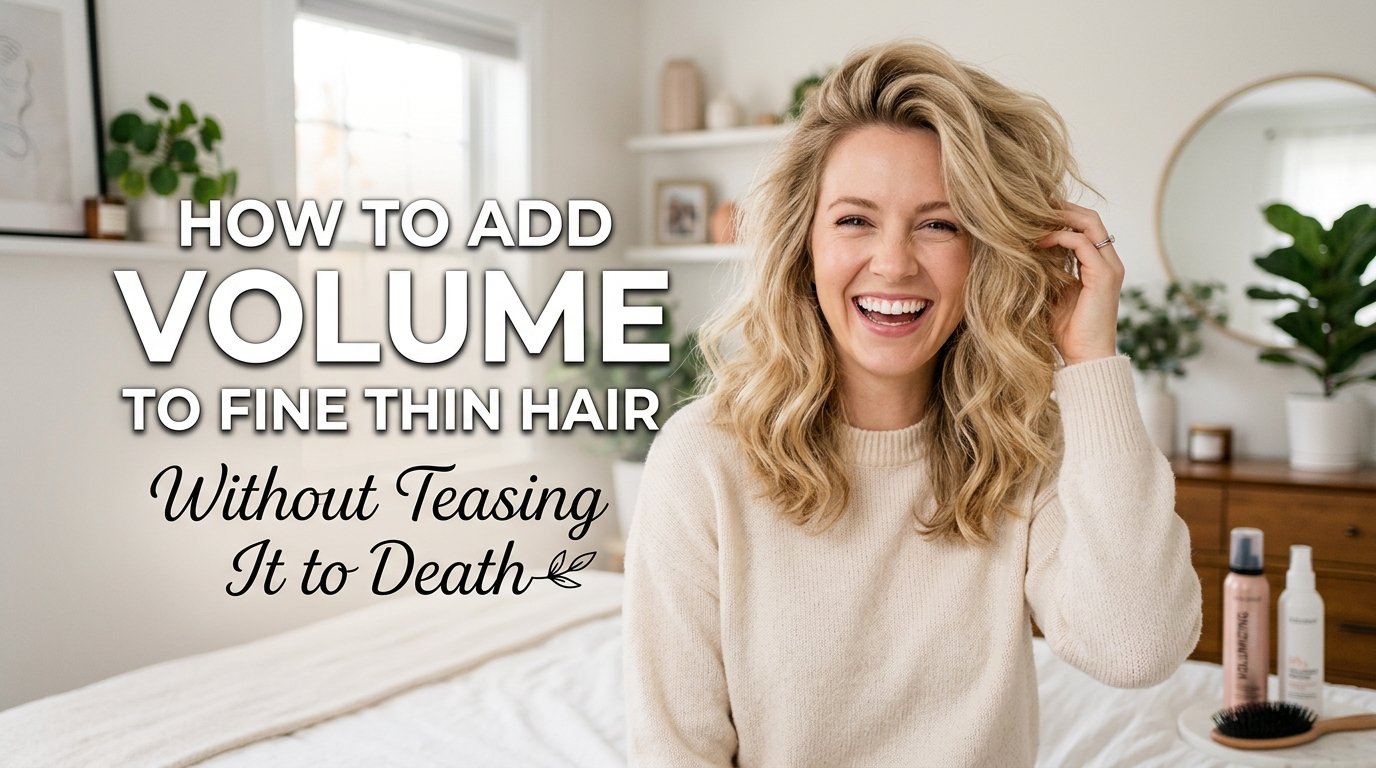
If you have fine or thin hair, you already know the daily struggle. You spend 30 minutes blow drying and styling, walk out the door feeling great, and by lunchtime your hair has collapsed flat against your scalp like it never happened. I have been there more times than I can count, and I know how frustrating it is to feel like the only option is aggressive backcombing that rips through your strands.
The good news is that you do not need to tease your hair to death to get real, lasting volume. There are gentle techniques that actually work better than backcombing for fine thin hair, and they will not leave you with tangles, breakage, or split ends. In this guide, I will walk you through exactly how to add volume to fine thin hair using methods that protect your strands while giving you the lift and body you want.
Everything here is based on what stylists recommend, what actually works for real people with fine hair (I have spent hours in fine hair communities reading what people swear by), and techniques you can start using today without buying a cabinet full of new products.
Table of Contents
Quick Volume Wins: The 60-Second Overview
If you want the short version, here are the seven most effective ways to add volume to fine thin hair without resorting to aggressive teasing:
The double cleanse method: Shampoo your roots, condition your lengths, then shampoo your roots again before rinsing everything out. This removes the heavy conditioner residue that weighs fine hair down.
Blow dry upside down: Drying your hair with your head flipped over pushes roots upward while they set, creating natural lift that lasts.
Use mousse, not cream: Lightweight foam mousse adds body without the weight. Creams and heavy serums are the enemy of fine hair volume.
Switch your part: Hair trained to fall in one direction lies flat. Flipping your part instantly creates lift at the crown.
Try velcro rollers: Rollers at the crown while you finish getting ready give you volume that no amount of hairspray can replicate.
Use dry shampoo on clean hair: Dry shampoo is not just for dirty hair days. It adds texture and grip to freshly washed hair so styles hold longer.
Sleep in a loose top knot: The pineapple method preserves overnight volume so you wake up with lift instead of flat roots.
Now let me walk you through each of these techniques in detail, plus a few more that can make a real difference for your hair type.
Why Fine Thin Hair Falls Flat in the First Place
Before we get into solutions, it helps to understand what is actually happening with your hair. Fine hair and thin hair are two different things, though many people have both. Fine hair means each individual strand has a small diameter, so even if you have a lot of hairs, each one is delicate and prone to lying flat. Thin hair means you have fewer strands per square inch on your scalp, which makes the overall density look lower.
Either way, the result is the same. Your hair lacks the structural rigidity to hold itself up, so gravity wins and everything collapses against your head. Add in natural scalp oils that travel down the hair shaft throughout the day, and by afternoon your roots are slicked flat.
Heavy products make this worse. Creams, oils, and rich conditioners coat each fine strand, adding weight that drags it down. This is why product selection matters so much for fine thin hair. Everything you put on your hair needs to be lightweight, or you are fighting an uphill battle from the start.
The techniques in this guide work because they address the root causes (pun intended). They lift hair at the base, add texture without weight, and avoid the heavy coatings that drag fine strands down.
The Double Cleanse Method: Volume Starts in the Shower
This is one of my favorite techniques because it costs nothing and requires zero extra products. I first saw this method discussed in fine hair communities, and it has since become a go-to trick for anyone struggling with flat roots.
Here is exactly how to do it:
Step 1: Wet your hair thoroughly and shampoo your scalp and roots as you normally would. Rinse completely.
Step 2: Apply a lightweight volumizing conditioner from your ears down to your ends. Avoid getting any conditioner on your roots or scalp. Fine hair gets weighed down instantly by conditioner near the scalp.
Step 3: Before rinsing out the conditioner, squeeze a small amount of shampoo into your hands and work it into your roots and scalp again. This second shampoo application breaks down any conditioner residue that may have drifted up toward your roots.
Step 4: Rinse everything out together. Your lengths get the conditioning they need, and your roots stay clean and lightweight.
The reason this works so well is that conditioner residue is one of the biggest hidden causes of flat fine hair. Even when you think you have rinsed thoroughly, a thin film of conditioning agents often remains on the scalp area. That film weighs down roots and kills volume before you even start styling. The double cleanse eliminates it completely.
One tip from my own experience: use a wide-toothed comb to detangle while the conditioner is still in your hair. This distributes the product evenly through your lengths and prevents the breakage that comes from yanking a brush through wet, fine strands. Fine hair is most vulnerable when wet, so treat it gently during this step.
How to Blow Dry for Maximum Root Lift
The way you dry your hair matters just as much as the products you use. If you air dry or blast your hair on high heat while standing upright, you are missing out on easy volume. Here is the blow drying technique that stylists recommend for fine thin hair.
Start with your head upside down. Flip your hair over and rough dry it with your fingers until it is about 80 percent dry. This forces your roots to dry in an upward direction, away from your scalp. When you flip back upright, the roots keep that lifted memory.
Use a round brush at the crown. Once your hair is mostly dry, sit upright and use a medium-barrel round brush to lift sections at the crown. Pull the hair straight up, apply heat at the root for a few seconds, then hit it with the cool shot button on your dryer. The cool air sets the shape so the lift actually holds.
Direct airflow upward. Always aim the nozzle of your dryer up toward the ceiling when drying roots, not down toward the floor. Downward airflow smooths hair flat against your head, which is the opposite of what you want.
Manage flyaways without flattening volume. One complaint I hear a lot, especially in fine hair forums, is that blow drying upside down creates crazy flyaways and baby hairs that stick up everywhere. The fix is simple. Once you flip upright, smooth a tiny drop of lightweight hair oil (no more than a pea-sized amount) over just the surface layer of your hair. This tames flyaways without touching the roots where your volume lives.
Always use heat protectant. Fine hair is more susceptible to heat damage than thicker hair because each strand has less structural mass. A lightweight heat protectant spray applied to damp hair before blow drying creates a barrier that prevents breakage. Breakage leads to frizz and uneven lengths, which makes hair look thinner over time.
Volumizing Products That Actually Work Without Weighing You Down
Product choice can make or break your volume efforts. The wrong products will undo every good technique in this guide. Here is a breakdown of what to use and what to avoid for fine thin hair.
Mousse is your best friend. If there is one product type that fine hair communities universally agree on, it is mousse. Foam mousse is incredibly lightweight because it is mostly air. It coats each strand with a flexible hold that adds body and texture without dragging hair down. Apply a golf ball-sized amount to damp hair, focusing on the roots and mid-lengths, then blow dry as described above. Real users in fine hair forums consistently recommend affordable options from Dove and Tresemme, along with higher-end picks from Nexxus.
Root lifting sprays target the crown. These are designed specifically for the root area and use lightweight polymers to push hair up from the scalp. Spray directly at the roots on damp hair before blow drying. Look for alcohol-free formulas since alcohol can dry out fine strands over time.
Dry shampoo adds texture, not just oil control. Most people think of dry shampoo as a way to stretch time between washes, but it is also one of the best volume tools available. Spraying dry shampoo on clean, dry hair at the roots adds grip and texture that helps hair hold its shape. It also absorbs the scalp oils that cause hair to fall flat throughout the day. Apply it immediately after styling, not just when your hair already looks greasy.
Texturizing powder is a secret weapon. A small sprinkle of texturizing powder at the crown creates instant grit and lift. These powders are weightless and work by adding microscopic particles between hair strands that create friction and separation. A little goes a long way, so start with a tiny amount.
What to avoid: Heavy creams, thick serums, leave-in conditioning masks, and hair oils applied anywhere near the roots. These products are formulated for thick, coarse hair that can handle the weight. On fine hair, they coat strands and drag everything down within minutes. If you want to use oil for shine or frizz control, apply it only to the very ends of your hair and keep it far away from your scalp.
Velcro Rollers and Heatless Volume Tricks
Not all volume requires heat. In fact, some of the best long-lasting volume comes from heatless methods that are actually gentler on fine hair. Here are three techniques that work especially well.
Velcro rollers at the crown. This is an old salon trick that still works beautifully. After blow drying your hair, while it is still slightly warm, section off the crown area and wrap 2 to 3 large velcro rollers into the top layer of hair. Leave them in while you do your makeup, get dressed, or eat breakfast. Fifteen to twenty minutes is plenty. When you remove the rollers, you will have bouncy, lifted volume at the crown that lasts all day. No heat, no damage, no teasing required.
For extra staying power, give each roller a quick blast of warm air from your dryer before letting the hair cool. The heat-then-cool cycle sets the shape permanently into the strand, just like curling with a round brush.
The overnight pineapple method. Before bed, gather your hair into a very loose, high top knot at the very top of your head. Use a soft scrunchie, not a tight elastic, to avoid creating a dent or crease. When you sleep with your hair gathered up high, it cannot flatten against the pillow the way it does when you sleep with it loose. In the morning, take it down and shake out your roots. You will have natural volume that you did not have to do anything to create.
Sleep on a silk or satin pillowcase. Cotton pillowcases create friction that pulls on fine hair and tangles it overnight. Silk and satin allow hair to glide smoothly, which means less breakage and less matting. Less breakage means your hair maintains its fullness over time instead of thinning out from constant friction damage. This is a small investment that pays off every single night.
The part switch trick. If you always wear your hair parted in the same direction, your hair trains itself to lie flat in that direction over time. Flipping your part to the opposite side, or trying a middle part if you usually go side-swept, instantly creates volume at the crown because the hair has to lift and redirect. You may feel like your hair looks weird for the first day or two, but after a few days the new part settles and you get free, effortless volume.
Gentle Alternatives to Aggressive Teasing
This section directly addresses the question that brought you here. You want volume but you do not want to destroy your hair with aggressive backcombing. So let me explain why traditional teasing is so damaging and what to do instead.
Why aggressive teasing damages fine hair: Traditional backcombing involves aggressively pushing a comb down the hair shaft toward the scalp, which forces the cuticle layers to open and interlock with each other. This creates tangles that are difficult to brush out, and the process of removing them often causes breakage. On fine hair, which already has a thinner cuticle layer than coarse hair, this damage accumulates fast. Over time, teasing causes split ends, mid-shaft breakage, and an overall thinner appearance, which is the exact opposite of what you want.
Here are four gentle alternatives that give you crown volume without the damage:
1. Root clipping for lift. Take small sections of hair at the crown and lift them straight up. Place a single flat metal clip (duckbill clip or alligator clip) at the base of each section, right against the scalp. Do this on dry hair after styling, then mist lightly with hairspray. Leave the clips in for 10 to 15 minutes while you finish getting ready. When you remove them, the hair holds the lifted shape. This technique creates the same effect as teasing but with zero friction or cuticle damage.
2. Volume powder at the crown. Sprinkle a small amount of texturizing or volume powder directly at the roots in the crown area. Use your fingertips to gently massage it in, pushing the hair upward. The powder creates instant separation and lift between strands. This takes about 10 seconds and requires no combing, no heat, and no tools.
3. Velcro rollers instead of a teasing comb. As described in the previous section, velcro rollers give you that same lifted, backcombed look at the crown but through a completely different mechanism. The hair is shaped while warm and sets as it cools, so there is no cuticle disruption.
4. If you must backcomb, do it gently. If you really cannot give up backcombing entirely, there is a gentler way to do it. Use a specialized teasing brush with soft bristles instead of a fine-toothed comb. Take small sections of hair, lift them up, and make just 2 to 3 gentle strokes downward, not aggressive raking. Only tease the underside of each section, never the top layer that people see. And always smooth the surface layer gently over the teased section with a soft brush. At the end of the day, use a detangling spray and a wide-toothed comb to gently work out the tangles from the ends upward, never rip downward from the roots.
Haircuts That Create the Illusion of Volume
The right haircut can make fine thin hair look significantly fuller with zero styling effort. The wrong cut can make it look even thinner. Here is what works and what does not.
Blunt cuts are better than razored cuts for fine hair. A blunt cut creates a clean, thick-looking line at the bottom of the hair, which makes the overall shape look denser. Razoring and heavy texturizing thin out the ends, which is the opposite of what you want. If your stylist reaches for thinning shears on fine hair, that is a red flag.
Shorter lengths carry volume better. Long fine hair has more weight pulling down on the roots, which makes it harder to maintain lift throughout the day. Chin-length bobs, collarbone-length cuts, and long pixies all work beautifully for fine hair because the reduced length means less downward pull. If you love long hair, keep it no longer than your collarbone to maintain some natural volume.
Face-framing layers add dimension. A few well-placed layers around the face can create the illusion of body and movement without thinning out the overall density. The key is to keep layers long and soft, not short and choppy. Ask your stylist for face-framing layers that start below the chin.
Common Mistakes That Make Fine Hair Look Thinner
Sometimes the things you are doing to add volume are actually working against you. Here are the most common mistakes I see people make with fine thin hair.
Applying conditioner to your roots. This is the number one cause of flat fine hair. Conditioner is designed to coat and smooth the hair shaft, which is great for your ends but disastrous for your roots. Keep conditioner from the ears down only. If your scalp feels dry, talk to a dermatologist rather than piling on conditioner.
Using too much product. More is not better with fine hair. A little mousse goes a long way, and piling on multiple products just creates buildup that weighs everything down. Start with one product, see how your hair responds, and add more only if needed.
Over-washing your hair. Washing every single day can strip the scalp of natural oils, causing it to overproduce sebum and making hair look greasy faster. Try stretching to every other day, using dry shampoo on the off day to absorb oil and add texture.
Skipping heat protectant. Fine hair is fragile. Every time you apply heat without protection, you are weakening the cuticle and setting yourself up for breakage that makes hair look thinner over time. A lightweight spray takes three seconds to apply and protects your investment in your hair health.
Letting product buildup accumulate. Over time, volumizing products, dry shampoo, and styling sprays leave residue on the scalp and hair shaft. Use a clarifying shampoo once every 1 to 2 weeks to remove buildup and reset your hair. You will be amazed at how much more body your hair has after a clarifying wash.
FAQs
How to get volume in very fine, thin hair?
Focus on lightweight products like mousse, use the double cleanse method in the shower, blow dry with your head upside down, and try velcro rollers at the crown. Avoid heavy creams and conditioners near the roots, and switch your part regularly to prevent hair from training flat.
How to give hair volume without teasing?
Use root clipping with flat metal clips, apply volume powder at the crown, sleep in velcro rollers or a loose pineapple top knot, and blow dry upside down. These methods create the same lifted look as teasing without damaging the cuticle.
What is the best volumizer for fine, thin hair?
Lightweight foam mousse is widely considered the best volumizer for fine hair because it adds body without weight. Root lifting sprays, texturizing powders, and dry shampoo are also effective. Avoid heavy creams, oils, and thick serums.
What not to do with thin, fine hair?
Avoid applying conditioner to roots, using heavy styling creams or oils near the scalp, aggressive backcombing, over-washing daily, skipping heat protectant, and using thinning shears. These practices weigh hair down or cause breakage that makes fine hair look thinner.
How to make fine, thin hair look fuller?
Get a blunt cut at chin to collarbone length, use volumizing mousse on damp roots before blow drying, add face-framing layers for dimension, use dry shampoo on clean hair for texture, and sleep on a silk pillowcase to reduce breakage.
The Bottom Line on Fine Hair Volume
Learning how to add volume to fine thin hair without teasing it to death comes down to working with your hair instead of against it. Lightweight products, smart washing techniques like the double cleanse method, blow drying upside down, and gentle alternatives like root clipping and velcro rollers will give you more volume than aggressive backcombing ever could. Your hair will look fuller, feel healthier, and actually stay lifted throughout the day.
Start with one or two techniques from this guide and build from there. The double cleanse method and a good mousse are the two highest-impact changes you can make today. From there, experiment with velcro rollers and the overnight pineapple method to find what works best for your hair. Fine hair does not have to mean flat hair, and you never need to tease it to death to prove it.