
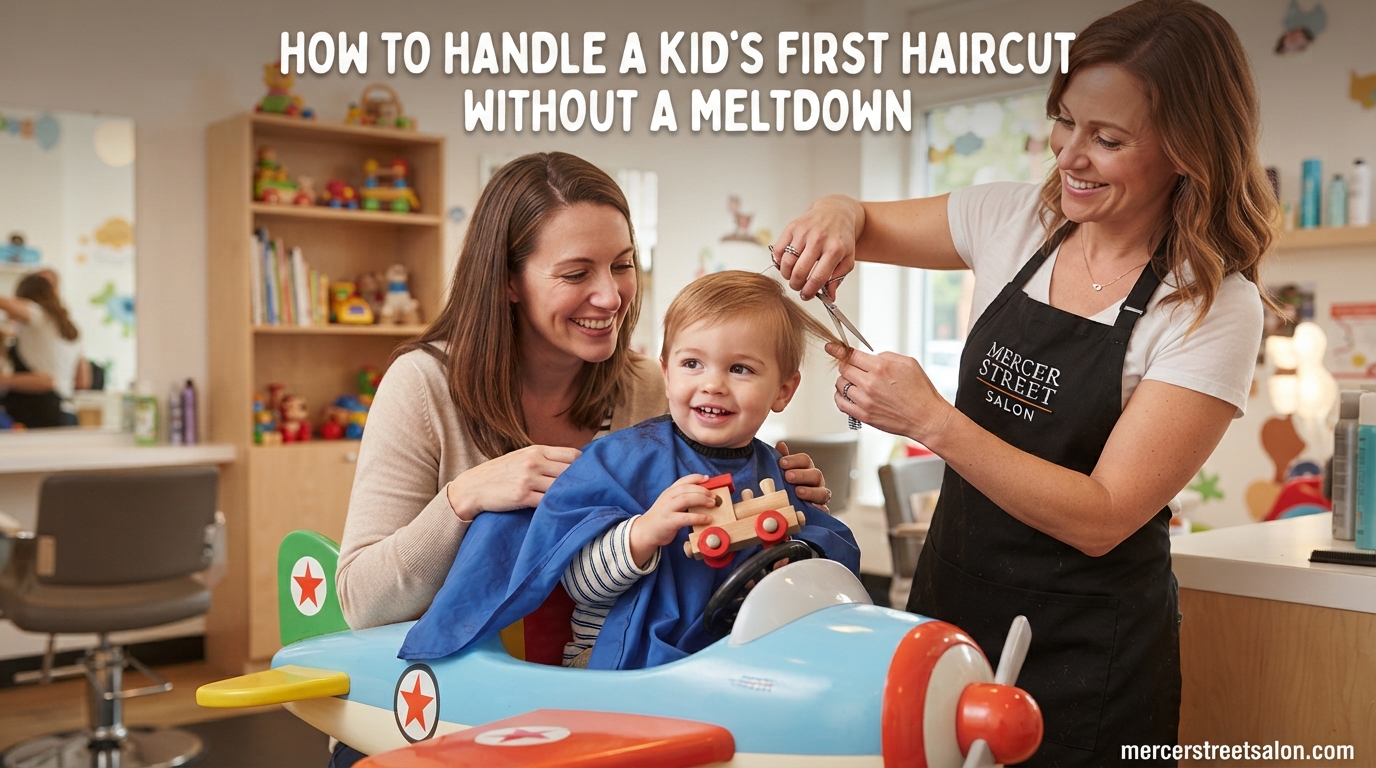
The best way to handle a kid’s first haircut without a meltdown is to prepare them days in advance, time the appointment around naps and meals, bring comfort items, and stay calm yourself. Toddlers resist haircuts because of sensory overload from the noise, the cape, the stranger touching their head, and the loss of control, not because they want to be difficult. When you understand what is actually overwhelming them, you can pre-empt most of the fear before you ever walk through the salon door.
At Mercer Street Salon, we have guided hundreds of families through this milestone. Some children sit perfectly still the first time. Many do not. Both are normal. What we have learned after years of cutting tiny heads of hair is that the parents who prepare feel calmer, and calm parents raise calm kids. This guide walks you through exactly what to do before, during, and after the appointment so the first haircut becomes a memory you actually want to keep.
Whether your toddler is 14 months or nearly four, the strategies below work because they address the root causes of haircut fear rather than just trying to distract around them. We will cover why toddlers cry, how to prepare at home, what to do in the chair, sensory-sensitive strategies, and what to do when the tears still come.
Table of Contents
Why Toddlers Resist Haircuts (The Real Reason Behind the Tears)
When a two-year-old screams through a haircut, they are not being naughty. They are experiencing what occupational therapists call a sensory pile-up. Multiple sensory inputs hit their nervous system at once, and their brain cannot process them all. The result is a meltdown that looks dramatic but is genuinely overwhelming from the inside.
Think about a haircut from a toddler’s perspective. A stranger they have never met puts a strange-smelling cape around their neck. Then that stranger picks up a buzzing metal object and brings it close to their ears. Bright lights shine overhead. Loose hairs tickle their skin. They are told to sit still, which is something toddlers are biologically wired not to do. Every single one of these inputs is individually tolerable. Stacked together, they become too much.
Stranger anxiety peaks between 12 and 15 months, which is exactly when many children get their first haircut. Their brain is saying “do not let unfamiliar adults touch you” at the same moment you are asking them to do exactly that. Add in the fear of sharp objects, the noise of clippers, and the itchy feeling of cut hair falling inside their collar, and you have a perfect recipe for tears.
There is also a control issue at play. Toddlers are just discovering that they have opinions and preferences. A haircut happens to them without their consent. They did not ask for it. They cannot see what is happening. Someone else is making decisions about their body. For a small person who is just learning to assert independence, that loss of control feels genuinely scary.
Understanding this changes everything. When you see the meltdown as overload rather than defiance, your whole approach shifts. You stop trying to enforce compliance and start trying to reduce the sensory load. That single shift in perspective is the foundation of everything that follows.
Before the Appointment: How to Prepare Kids for Their First Haircut
Preparation is where most of the meltdown prevention actually happens. The work you do in the week leading up to the appointment matters more than anything you do in the chair. Here is the preparation sequence we recommend to every parent at Mercer Street Salon.
1. Time the Appointment Around Their Body Clock
Book the haircut for the sweet spot in your child’s day, usually mid-morning after breakfast and before the nap window opens. Never schedule right before a nap, when they are hungry, or at the end of a long day of errands. A well-rested, well-fed toddler tolerates novelty far better than a tired, hungry one.
2. Talk It Up for Several Days Before
Start mentioning the haircut three to five days in advance, in a casual and positive tone. Say things like “on Saturday we are going to visit the salon and you will get to sit in a fun chair.” Keep it light. Do not over-explain or build anxiety by over-preparing. The goal is familiarity, not a briefing.
3. Read Books and Watch Episodes About Haircuts
Children process new experiences through stories. Read a haircut-themed picture book each night before the appointment. Daniel Tiger has a well-loved episode about getting a haircut that shows the process step by step in toddler-friendly language. Seeing a character they trust go through the experience makes it feel predictable rather than threatening.
4. Play Pretend Salon at Home
This is one of the most effective preparation techniques we see work. Set up a pretend salon with a stuffed animal or doll in a chair. Let your child be the stylist, using a clean comb or brush and a small towel as a cape. Then switch roles and let them sit in the chair while you gently comb their hair and narrate what you are doing. This builds muscle memory for the experience in a safe environment.
5. Visit the Salon Before Haircut Day
If you can, swing by the salon a few days earlier so your child can meet the stylist, see the chairs, and hear the sounds when nothing is at stake. Let them sit in the chair without getting a cut. Hand them a lollipop. The salon becomes a place they have been before, not a brand-new environment on the day of the cut.
6. Pack a Comfort and Distraction Bag
Bring a small bag with your child’s favourite comfort item, a fully charged tablet loaded with their most-loved show, a non-sticky snack like dry cereal or crackers, and a change of clothes. Hair down the back of a shirt is a top trigger for crankiness, so plan to swap their top right after the cut. Skip lollipops during the haircut itself because sticky hands plus loose hair equals misery.
7. Bring an Extra Adult if Possible
If you can, bring your partner, an older sibling, or a grandparent. One adult handles the child while the other handles logistics like photos, snacks, and the change of clothes. An extra familiar face also gives your toddler someone to focus on for entertainment while the stylist works.
During the Haircut: In-Salon Strategies That Actually Work
Even with great preparation, the chair is where the real test happens. These are the in-salon strategies our stylists use every single day to keep toddlers settled and smiling.
Use the Lap Trick
For nervous toddlers, have the parent sit in the stylist chair and place the child on their lap facing outward. Your body becomes a deep-pressure anchor that signals safety. Your child can lean back against your chest, and you can hold their hands gently if needed. This lap-sitting option is one of the single most effective tools we use, and we encourage every parent to ask for it.
Start With Distraction, Not the Cut
Hand your child the tablet or a favourite toy before the cape goes on, not after they start fussing. Once they are absorbed, the stylist can work quickly. Many of our fastest toddler haircuts happen in five to ten minutes because the child never fully registers what is happening.
Ask the Stylist to Avoid the Mirror
Some children get frightened watching a stranger’s reflection move around their head. Ask the stylist to position your child facing away from the mirror, or toward you. Eye contact with a calm parent is far more soothing than watching scissors approach in a reflection.
Take Breaks Without Apologising
If your child needs to pause, say so. A good kids stylist expects breaks and welcomes them. A 30-second pause for a sip of water or a hug can reset a wobbling toddler entirely. Do not feel rushed or apologetic. We would rather take two breaks and finish calmly than push through and create a lasting fear.
Use Calming Scripts
What you say during the haircut matters. Avoid saying “it is almost over” because it implies something bad is happening. Instead try phrases like “you are doing so well,” “look at all this hair you are going to give the birds for their nests,” or “almost done, then we get a treat.” Narrate the process in a warm voice: “now she is using the soft brush, now the buzzer that tickles.” Predictability reduces fear.
Blow Bubbles
A small bottle of bubbles is a secret weapon. Have your extra adult blow bubbles gently near your child’s face during the cut. The visual tracking and the gentle sensation on their skin gives their brain something pleasant to focus on. It sounds silly until you watch a sobbing toddler stop mid-cry to chase a bubble.
When Your Child Has Sensory Sensitivities
Some children need more than the standard toolkit. If your child has been diagnosed with sensory processing differences, is on the autism spectrum, or simply has a more sensitive nervous system, the strategies below can make the difference between a successful cut and a traumatic one.
Bring noise-canceling headphones designed for children. Clippers are loud and the sound is unpredictable, which is one of the hardest sensory inputs to tolerate. Headphones muffle the buzz without blocking your voice, so you can still talk your child through the process.
Ask for the first or last appointment of the day when the salon is quietest. Fewer people means less background noise, fewer strangers, and a calmer environment overall. Many salons, including ours, are happy to accommodate a quiet booking if you mention it when scheduling.
Use deep-pressure input before and during the cut. A weighted lap pad across your child’s legs provides calming proprioceptive feedback that helps regulate an overwhelmed nervous system. You can also do what therapists call “heavy work” before the appointment, such as jumping on a mini trampoline or carrying a heavy backpack to the salon, to give the body organising sensory input.
Practice desensitization at home in the weeks leading up. Let your child hold a turned-off pair of clippers or a clean comb and practice on a stuffed animal. Slowly introduce the sound of clippers from another room. Gradual exposure in a safe environment retrains the brain to interpret these inputs as non-threatening.
After the Cut: End on a Win
The way the haircut ends shapes how your child remembers it, so make the finish feel like a celebration. We give every first-haircut child a certificate at Mercer Street Salon, and many parents tell us their kid carried it around for days afterward.
Take a photo of the finished haircut, even if the cut itself was bumpy. Show your child the picture and tell them how great they look. Save a lock of hair in an envelope or baby book if that feels meaningful to you. Then deliver whatever small reward you promised, whether that is a trip to the park, a sticker, or a favourite snack.
Talk about the experience positively on the way home and again that evening at dinner. Say “you were so brave at the salon today” rather than “you cried but we got through it.” The narrative you build around the experience becomes the story your child carries into the next appointment.
What If the Meltdown Still Happens?
Sometimes, despite perfect preparation and every strategy in the book, the meltdown still comes. That does not mean you failed. It means your child is a child.
If the tears start, pause the cut. Let your child sit on your lap and regulate. If they calm down after a few minutes, the stylist can resume. If they do not, it is completely fine to stop for the day and come back another time. We have seen children need two or three attempts before they settle, and every single one of those children eventually learned to tolerate the chair.
Do not feel embarrassed. Every stylist who works with children has seen full meltdowns, and we do not judge them. What we notice and appreciate is the parent who stays calm, holds their child, and treats the whole thing as a normal part of growing up. Your reaction teaches your child how to feel about what just happened.
Avoid forcing the haircut to completion. Pushing through tears tends to create a lasting association between the salon and fear, which makes every future appointment harder. Stopping and trying again later teaches your child that you respect their limits, and that trust pays off down the road.
FAQs
What is the 3 2 1 haircut rule?
The 3 2 1 haircut rule is a simple timing guide for toddlers: book the appointment no more than 3 hours after waking, no more than 2 hours before a nap, and aim for 1 well-fed, rested child. Following this rhythm dramatically reduces the chance of a meltdown because your child arrives regulated and ready to tolerate a new experience.
How do I keep my baby calm during their first haircut?
To keep your baby calm during a first haircut, sit them on your lap facing outward so they feel your body as a deep-pressure anchor. Offer a fully charged tablet or favourite toy before the cape goes on. Ask the stylist to work quickly and position your child away from the mirror. Bring a non-sticky snack, a comfort item, and a change of clothes. Stay calm yourself because babies read your tension and mirror it back.
What is the 7 day haircut rule?
The 7 day haircut rule suggests starting haircut preparation a full week before the appointment. Spend those seven days reading haircut-themed books, watching episodes about haircuts, playing pretend salon at home, and talking about the upcoming visit in a positive tone. This gradual exposure builds familiarity so the salon does not feel brand-new and scary on the day of the cut.
How do I prepare my child for their first haircut?
To prepare your child for their first haircut, follow these steps: time the appointment after a meal and before nap time, talk about it positively for several days beforehand, read a haircut book and watch a relevant show like the Daniel Tiger haircut episode, play pretend salon with a stuffed animal at home, visit the salon before haircut day so the space feels familiar, and pack a bag with a comfort item, tablet, snacks, and a change of clothes.
A First Haircut Without a Meltdown Is Possible
A kid’s first haircut without a meltdown is not about luck. It is about preparation, timing, and meeting your child where they are developmentally. Understand that the tears come from sensory overload, not defiance. Prepare with books, pretend play, and a pre-visit to the salon. Use the lap trick, distraction, and calming scripts in the chair. And if the meltdown still happens, treat it as normal and try again another day.
Every child eventually learns to tolerate the salon. The patience and warmth you bring to the first visit sets the tone for every haircut that follows. If you are in the Mercer Street area and want a salon that specialises in children, we would love to meet your family. Book a first-haircut appointment and we will bring the bubbles, the certificate, and the patience.