
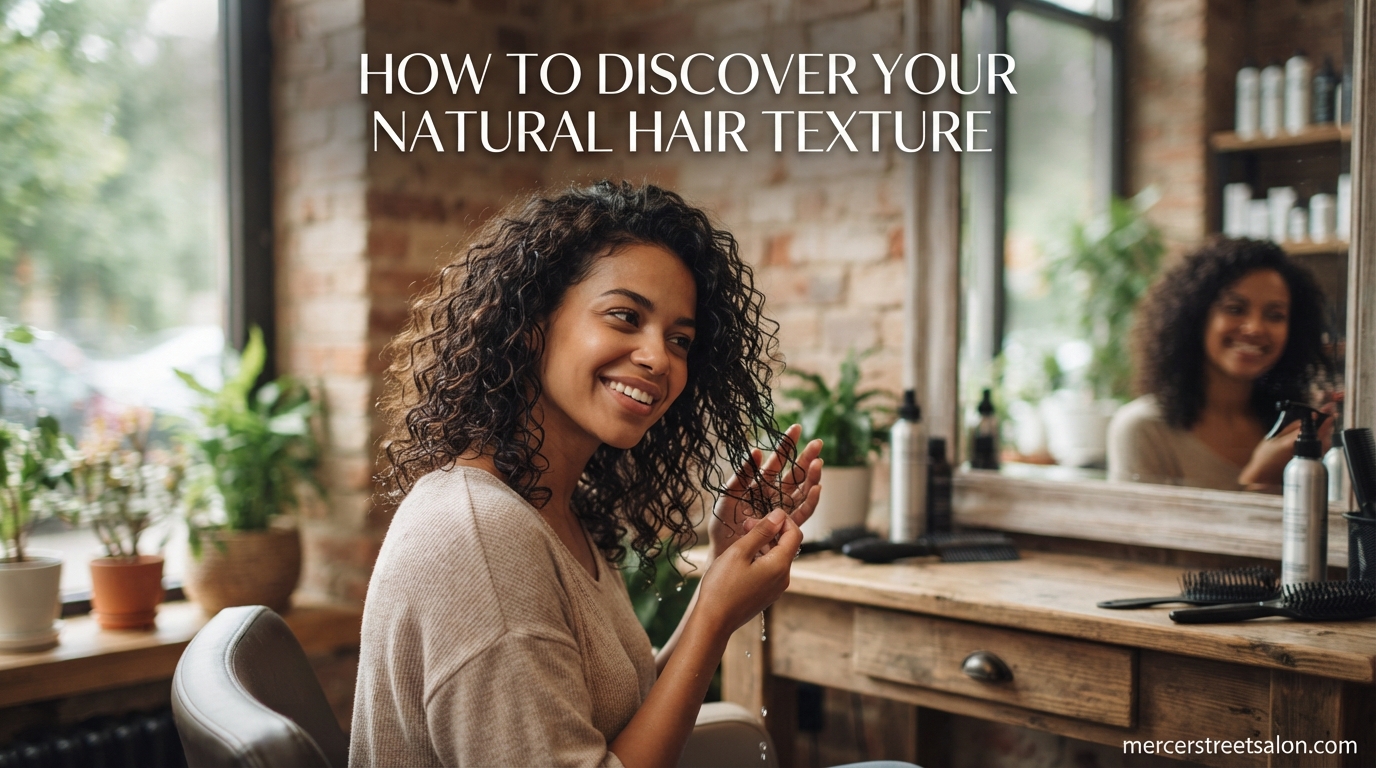
If you have spent years straightening, relaxing, or smoothing your hair, you might not actually know what your strands look like on their own. Learning how to figure out what your hair looks like with your natural texture embraced is the first step toward healthier, happier hair. This guide walks you through identifying your true curl pattern, understanding porosity and density, and building a routine that works with your texture instead of against it.
Our team has worked with clients across every hair type, from pin-straight Type 1 to tightly coiled Type 4. The breakthrough moment is always the same: once you stop fighting your hair and start reading it, everything gets easier.
Table of Contents
Why So Many of Us Lose Touch With Our Natural Texture
Most people reading this have been altering their hair for years, maybe decades. Heat styling, chemical relaxers, keratin treatments, and even constant tight ponytails all change how your hair behaves. After enough time, the memory of your real texture fades.
This is incredibly common in the natural hair community. One Reddit user in r/Naturalhair shared that she had been natural for 10 years before realizing she had spent that entire time fighting her true curl pattern. She is not alone.
The good news is that your natural texture is still there underneath the damage and the buildup. It just needs the right conditions to reveal itself.
How to Figure Out What Your Hair Looks Like With Your Natural Texture Embraced
The fastest way to see your true texture is to strip away every product, every styling habit, and every assumption. Here is the exact process we recommend.
Step 1: Clarify Your Hair
Start with a clarifying shampoo wash to remove product buildup, hard water minerals, and silicones that have been coating your strands. This gives you a clean slate so you can see what your hair actually does without interference.
If your hair is color-treated or already fragile, use a gentle clarifying shampoo rather than a harsh one. You want clean hair, not stripped hair.
Step 2: Deep Condition With Moisture Only
Apply a moisture-focused deep conditioner and let it sit for 20 to 30 minutes. Skip protein treatments for this step because protein can temporarily alter how your curl pattern looks. You want hydration, nothing else.
Step 3: Air Dry Without Touching It
This is the step most people skip, and it is the most important one. After washing, apply a small amount of leave-in conditioner or a light gel, then let your hair air dry completely without scrunching, flipping, or manipulating it.
Do not touch your hair while it dries. Do not diffuse. Do not plop. Just let it hang and dry on its own terms.
Step 4: Observe and Document
Once your hair is 100 percent dry, look at it in natural daylight. Take photos from the front, back, and sides. Now ask yourself a few questions. Does it dry straight, with a slight bend, with defined curls, or in tight coils? How much did it shrink from its wet length? Where is the curl or wave most prominent?
Those photos are your baseline. That is your natural texture, and everything you do from here should enhance it rather than fight it.
Understanding Your Curl Type (Type 1 Through Type 4)
Hair professionals use a classification system that breaks texture into four main categories, each with subcategories. Knowing where you land helps you choose the right products and techniques.
Type 1: Straight Hair
Type 1 hair has no natural curl. It tends to get oily quickly because sebum travels straight down the hair shaft. The goal here is volume and texture enhancement rather than curl definition.
Type 2: Wavy Hair
Type 2 hair forms an S-shaped wave pattern. Type 2A is loose and barely there, 2B is more defined, and 2C features thick, coarse waves with some curl. Wavy hair often benefits from lightweight products and the plopping method.
Type 3: Curly Hair
Type 3 hair forms defined springy curls. Type 3A has loose loops, 3B springs out in ringlets, and 3C forms tight corkscrews about the width of a pencil. Curly hair craves moisture and benefits from curl creams and diffusing.
Type 4: Coily Hair
Type 4 hair forms tight coils, zigzags, or no visible curl pattern at all. Type 4A has defined coils, 4B bends in sharp angles, and 4C has a tight Z-pattern with significant shrinkage. Coily hair needs heavy moisture, protective styles, and gentle detangling on wet, conditioned hair.
Hair Porosity and Density: Two Missing Pieces
Curl type tells you the shape of your hair. But porosity and density tell you how to actually care for it. Many people get fixated on their curl type and ignore these two factors entirely.
How to Test Your Porosity
Take a clean strand of shed hair and drop it into a glass of room-temperature water. If it sinks quickly, you have high porosity hair, meaning your cuticles are open and your hair absorbs moisture fast but also loses it fast. If it floats, you have low porosity hair, meaning products tend to sit on top of your strands.
High porosity hair loves heavy creams and sealing oils. Low porosity hair does better with lightweight, water-based products and heat-assisted deep conditioning.
Density vs Strand Thickness
Density refers to how many hairs you have on your head. Strand thickness refers to how wide each individual hair is. You can have fine hair with high density, or coarse hair with low density. Both factors affect which products and techniques work for you.
Building a Wash Day Routine That Works With Your Texture
Once you know your texture, porosity, and density, your routine becomes much simpler. Here is the framework we use with clients.
Hydration First
Every texture benefits from moisture, but the delivery changes. Wavy hair needs lightweight leave-ins. Curly and coily hair need richer creams and regular deep conditioning sessions. Aim to deep condition at least once a week if your hair is Type 3 or Type 4.
The Plopping Method
Plopping is a game-changer for wavy and curly hair. After applying your styling product, lay a cotton T-shirt flat, flip your head forward, and lower your wet hair onto the center. Wrap the sleeves around the back and secure them. Leave it for 15 to 30 minutes, then release and air dry or diffuse.
Plopping reduces frizz and encourages your natural pattern to form without disruption.
Diffusing Technique
If you want to speed up drying, use a diffuser attachment on low heat and low speed. Cup sections of hair in the diffuser bowl, hold them close to your scalp, and resist the urge to move constantly. Too much movement creates frizz and disrupts curl formation.
Protective Styling and Night Care
For Type 3 and Type 4 hair, protective styles like twists, braids, and buns help retain moisture and reduce manipulation. At night, sleep on a satin or silk pillowcase, or wrap your hair in a satin scarf to prevent friction and moisture loss.
Common Mistakes to Avoid During Your Natural Hair Journey
The transition to natural texture comes with a learning curve. Here are the mistakes we see most often.
Expecting instant results. If you have years of heat or chemical damage, your true texture will not fully reveal itself until that damaged hair grows out or is cut off. Patience is non-negotiable.
Using too many products. A common question in curly hair forums is whether using product defeats the purpose of embracing natural hair. It does not. But piling on five different stylers will weigh your hair down and hide your real pattern. Start simple: a cleanser, a conditioner, and one styler.
Detangling dry hair. Always detangle when your hair is saturated with conditioner and use a wide-tooth comb or your fingers. Detangling dry hair causes breakage, especially for Type 3 and Type 4 textures.
Comparing your hair to others. Your curl pattern, density, and porosity are unique. What works for someone with the same curl type may not work for you if your porosity or density differs.
When Texture Changes Over Time
Your hair texture is not necessarily permanent. Hormonal shifts from pregnancy, menopause, thyroid conditions, or illnesses like lupus can all alter your curl pattern. Some people see their hair go from straight to wavy, or from curly to coily, after major hormonal events.
If your texture suddenly changes and there is no obvious cause like new products or damage, check in with a doctor. Underlying health issues can show up in your hair first.
FAQs
How to figure out your natural hair texture?
Clarify your hair to remove buildup, deep condition with moisture only, then let it air dry completely without touching it. Once fully dry, observe your hair in natural daylight and photograph it. The pattern you see is your true natural texture.
What is the 3 rule for hair?
The rule of three refers to grouping your hair care into three categories: cleanse, condition, and style. Keep your routine simple with one product for each step, then adjust based on how your hair responds.
Can lupus change your hair texture?
Yes. Lupus and other autoimmune conditions can affect hair follicles and alter texture, often causing hair to become finer, thinner, or change its curl pattern. If your texture shifts suddenly with no clear cause, consult a doctor.
What are the top 3 rarest hair types?
The rarest natural hair types are Type 1A stick-straight fine hair, Type 3C tight corkscrew curls, and red hair combined with Type 4 coily texture. Natural red hair itself occurs in only about 1 to 2 percent of the global population.
Falling in Love With What Grows Out of Your Head
Learning how to figure out what your hair looks like with your natural texture embraced is more than a hair care exercise. It is a shift in how you relate to yourself. The people who succeed at this journey are the ones who stop comparing and start observing.
Your texture is written into your follicles. Once you learn to read it, you can finally work with it. Start with a clarify-and-air-dry day, take those baseline photos, and build from there. The real version of your hair has been waiting.