
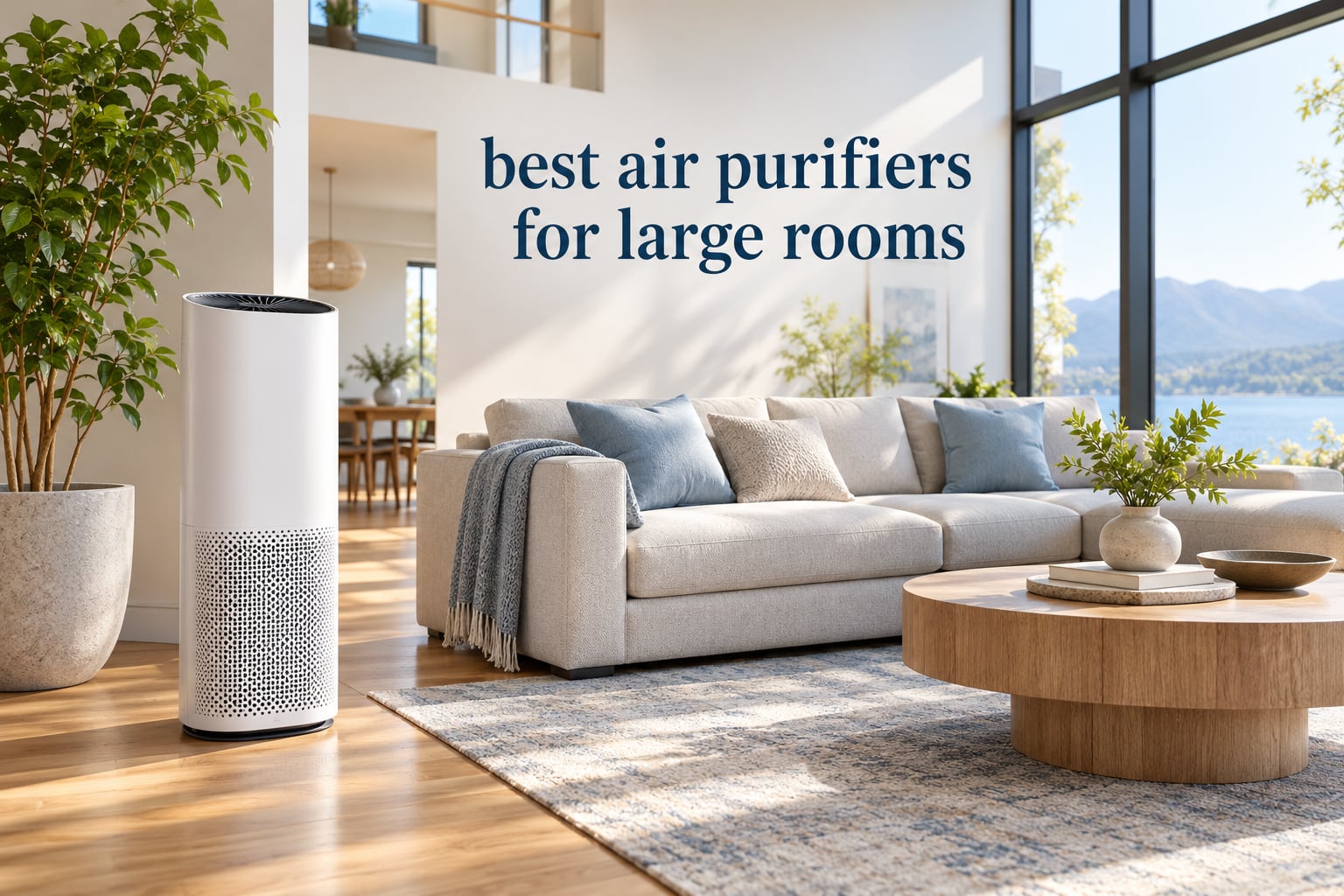
The best air purifiers for large rooms are units rated at roughly 300 CFM CADR or higher that can deliver 4 to 5 air changes per hour across 500 square feet or more of living space. Square footage on the box tells you very little. A 600 sq ft room with a 9 ft ceiling holds 5,400 cubic feet of air, and a purifier rated only at one air change per hour never fully cleans that volume in a working day.
That is why we built this guide around CADR, the clean air delivery rate, instead of the coverage numbers printed on the front of the box. CADR is measured in cubic feet per minute, and AHAM VERIFIDE certification means an independent lab verified the figure. The Winix 5510 is our number one rated pick in 2026 because it combines verified coverage, a washable pre-filter, app control and an unusually large owner base of more than 32,000 reviews.
We also modeled what each purifier can really deliver in a large open floor plan, tiered all 12 models by room size so you can self-select in seconds, and broke down the five-year ownership picture that buyers most often regret ignoring. Every spec below comes from the manufacturer’s published or AHAM-verified figures. We did not run smoke chamber tests ourselves, so treat our numbers as modeled performance rather than lab results.
If you are furnishing a smaller space first, our guides to the best air purifiers for large living rooms and the best air purifiers for apartments cover the same models from a different angle.
Table of Contents
Top 3 Best Large Room Air Purifiers for 2026
The three picks below cover the most common large-room situations. The Winix leads on verified coverage and ownership value, the Coway leads on filtration certification and monitoring, and the Levoit leads on smart control and measured CADR.


Coway Airmega Mighty2
- IEST certified HEPA and carbon
- PM1 PM2.5 PM10 display
- 19 dB sleep mode

Best Air Purifiers for Large Rooms by Room Size (2026)
Start with your floor area, then match it to a tier. These are the four size bands that cover nearly every large-room situation we get asked about, and the models that fit each one best.
400 to 500 sq ft: Aim for 250 to 300 CFM CADR. The Levoit Vital 200S-P, KNKA APH4000 and Honeywell HPA5300B all clear roughly 4.8 air changes per hour in this band.
500 to 700 sq ft: Aim for 300 to 400 CFM CADR. The Levoit Core 600S-P, Coway Airmega Mighty2 and Winix 5510 land here with the most headroom.
700 to 1,000 sq ft: Aim for 400 to 500 CFM CADR or plan on two machines. The Blueair Blue Pure 211i Max and the Coway Airmega 400 are built for this range.
1,000 sq ft and above: No single consumer machine delivers 5 ACH here. Run two or three purifiers spaced through the open space, or accept 2 to 3 ACH as a realistic target.
All 12 models appear in the comparison table below with the specifications that matter for a large space: verified coverage, CADR, filtration class and sleep-mode noise.
| Product | Specifications | Action |
|---|---|---|
| Winix 5510 |
|
Check Latest Price |
 Honeywell HPA304 AllergenPlus Honeywell HPA304 AllergenPlus |
|
Check Latest Price |
| Coway Airmega Mighty2 |
|
Check Latest Price |
| Levoit Core 600S-P |
|
Check Latest Price |
 PuroAir 400 PuroAir 400 |
|
Check Latest Price |
 Levoit Vital 200S-P Levoit Vital 200S-P |
|
Check Latest Price |
 Blueair Blue Pure 211i Max Blueair Blue Pure 211i Max |
|
Check Latest Price |
 KNKA APH4000 KNKA APH4000 |
|
Check Latest Price |
 Coway Airmega 400 Coway Airmega 400 |
|
Check Latest Price |
 Honeywell HPA5300B Honeywell HPA5300B |
|
Check Latest Price |
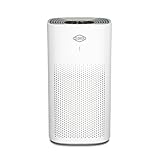 Clorox Large Room Clorox Large Room |
|
Check Latest Price |
 SIESEAN AP-480 SIESEAN AP-480 |
|
Check Latest Price |
1. Winix 5510 – Best Overall for Large Rooms with App Control
WINIX 5510 Air Purifier (New Generation of 5500-2 with App Support) for Home Large Room Up to 1881 Ft² in 1 Hr, True HEPA, High Deodorization Carbon Filter and Auto Mode, Captures Pet Allergies, Smoke
AHAM verified to 1881 sq ft
True HEPA 0.01 micron
23.5 dB sleep mode
13.3 lbs
Pros
- AHAM verified coverage of up to 1881 sq ft in one hour
- True HEPA capture claimed at 99.99% for 0.01 micron particles
- Washable fine mesh pre-filter
- App support for remote monitoring
- Quiet at 23.5 dB on the lowest speed
Cons
- Replacement filters add ongoing cost
- Panel indicator lights can be distracting at night
- Carbon layer must be replaced on schedule to keep odor control working
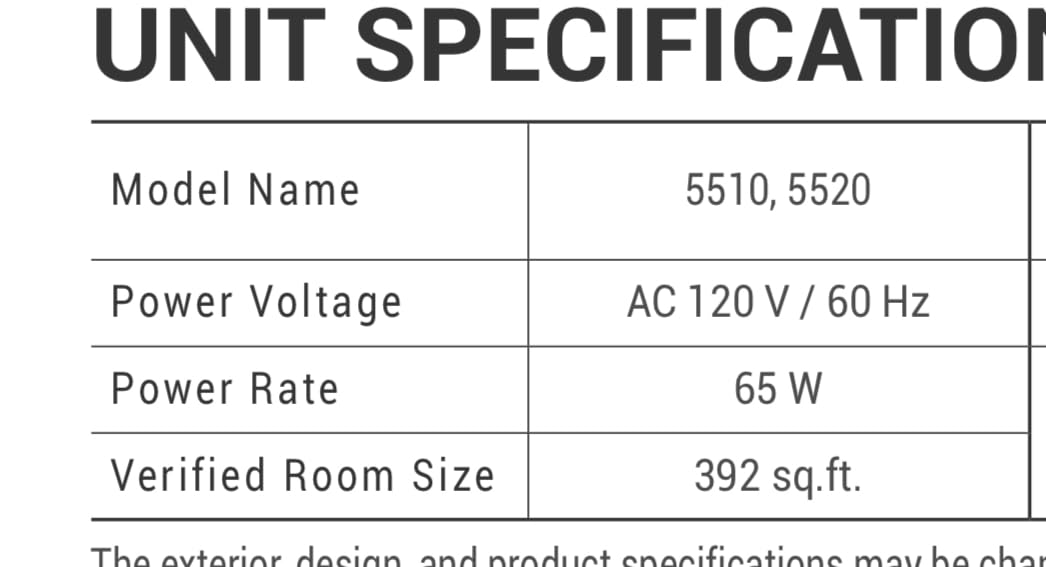
The Winix 5510 is the unit I recommend first for anyone with an open living space. It is AHAM verified at 392 sq ft with 4.8 air changes per hour, which is the only figure that actually matters, and the manufacturer publishes the full ladder: 941 sq ft in 30 minutes, 627 sq ft in 20 minutes and 470 sq ft in 15 minutes.
The specs that sell it are the washable fine mesh pre-filter and the light-automated sleep mode. Owners across more than 32,000 reviews consistently point to the pre-filter filling with visible hair and dust, which is the fastest way to confirm a machine is actually moving air through the room.
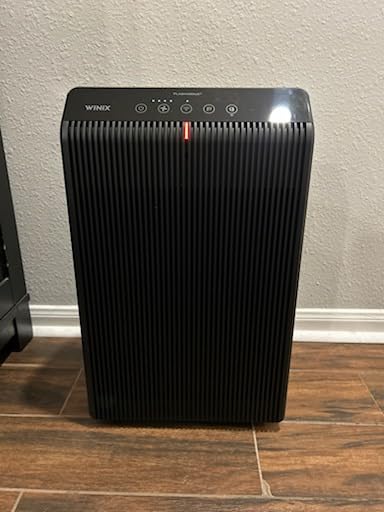
The Winix Smart App is the feature that separates it from most competitors at this level. Combined with the built-in smart sensor and auto mode, the fan adjusts to real conditions instead of sitting on a fixed speed all day, which cuts both noise and electricity use.
At 13.3 pounds and 11 by 15.9 by 25.2 inches, it is also one of the easier large-room machines to reposition when you move between the living room, the basement and a home office.
Why I picked the Winix 5510 for a large open floor plan
The deciding factor is the AHAM-verified 392 sq ft rate at 4.8 ACH, because that number survives contact with a real room. Most competitors advertise a 1,800 to 2,000 sq ft figure calculated at a single air change per hour, which the Winix also lists but as a separate, clearly framed claim.
For a 700 sq ft open space at a 9 ft ceiling, you need about 6,300 cubic feet of air moved per hour for 5 ACH. The Winix delivers that on its mid and high fan settings, and the auto mode will find the right speed once the sensor has a baseline.
Where the Winix 5510 falls short
Filter cost is the recurring complaint. The carbon layer is a consumable, and if you skip it, odor control degrades even though particle filtration still works, so budget for both stages rather than stretching a single cartridge.
The indicator panel is bright enough to notice in a dark room if sleep mode is overridden. If the unit shares a space with a light-sensitive sleeper, check that the display shutoff behaves the way you want before settling in.
2. Honeywell HPA304 AllergenPlus – Best for a Decade of Daily Use
Honeywell AllergenPlus HEPA Air Purifier for Home, 2250 Ft² Rooms in 1 hour, Reduces Allergens, Dust, Pollen, Smoke, Pet Dander, Odors, White, HPA304
465 sq ft at 4.8 ACH
99.97% particle capture
17 lbs
Wall-mountable
Pros
- Owners report 7 to 10 years of continuous daily use
- Places flush against a wall unlike most tower models
- Genuinely quiet on low and medium settings
- Pre-filter visibly collects dust pet hair and dander
- Filter and third-party replacements widely available
Cons
- High and turbo fan speeds are loud
- Uses three smaller HEPA filters so replacement sets cost more
- Timer lacks a clock-based on off schedule
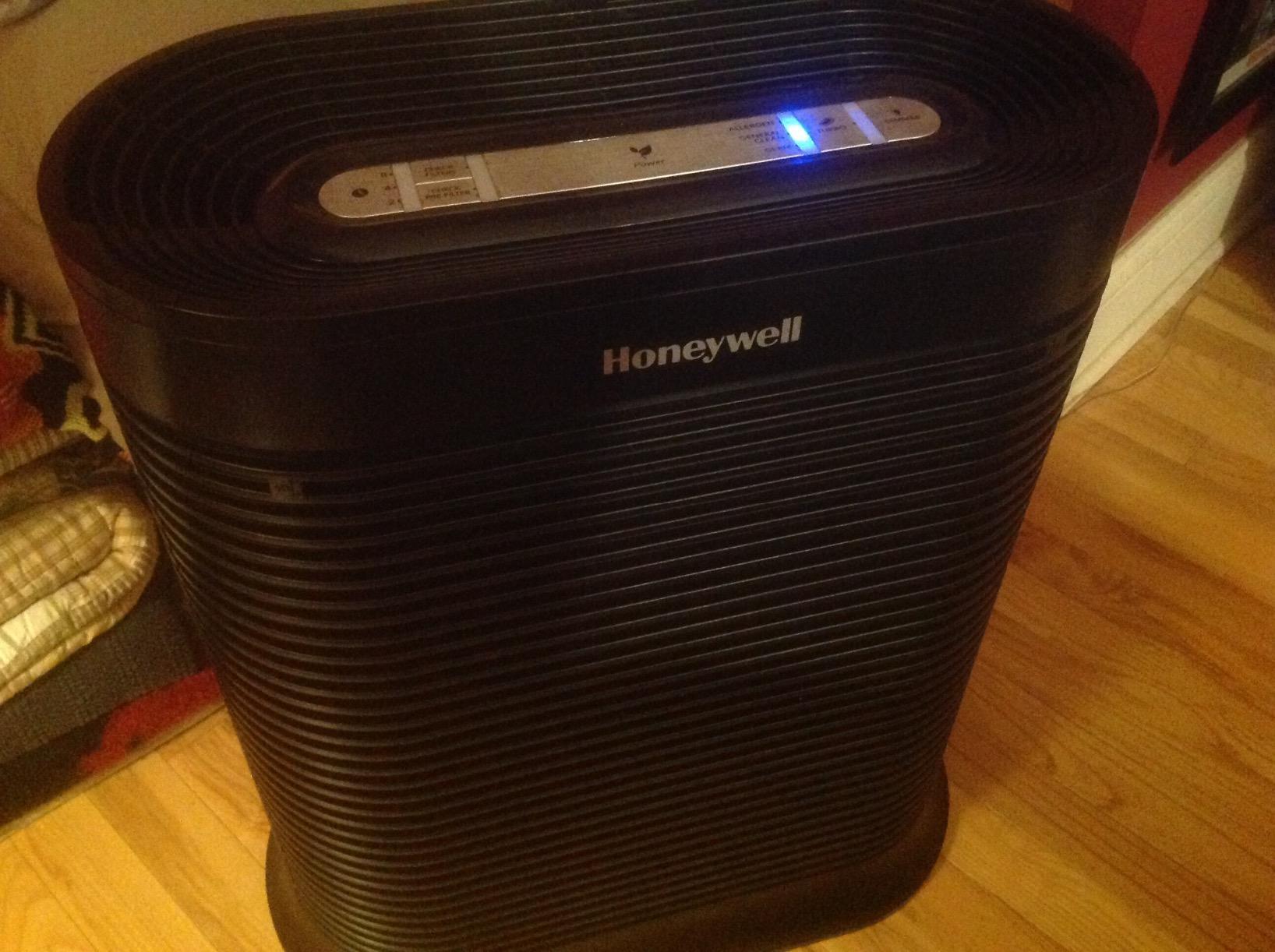
The Honeywell HPA304 AllergenPlus is the longest-serving large-room purifier in this group, and its review history spans more than a decade of ownership. Multiple reviewers report running units daily for seven to ten years with no degradation, and some keep four machines in the home.
The verified performance figure is 4.8 air changes per hour in 465 sq ft rooms, which is a genuinely strong large-room rate. The 2,250 sq ft claim you will see is calculated at a single air change per hour, so treat that number as a fast first pass rather than full purification.
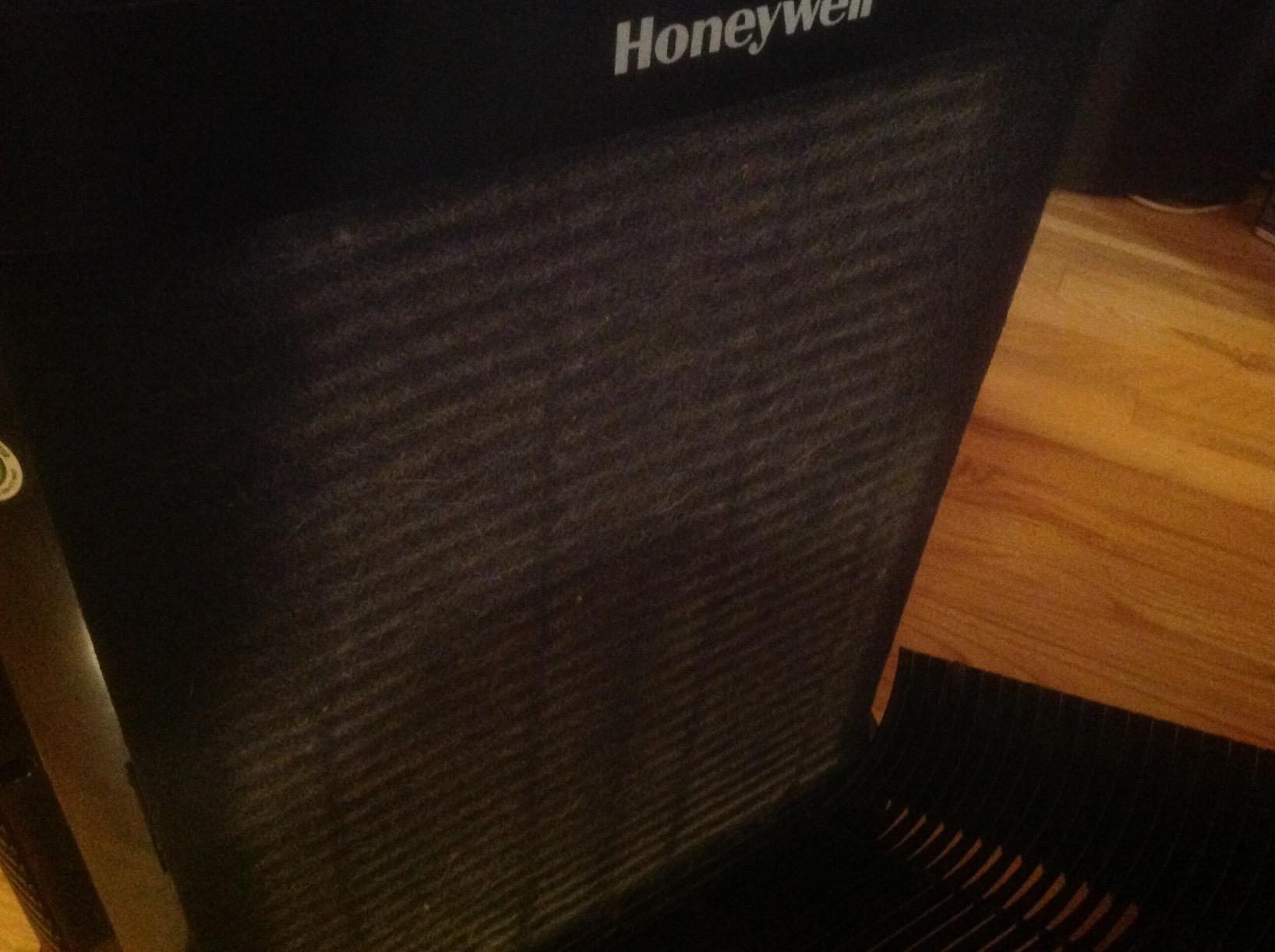
Two design details matter more in a big room than the spec sheet suggests. The top air discharge and wall-mountable form let you push it flush against a wall, freeing floor space, and the dimmable blue indicator light keeps it from lighting up a dark room.
Owners also like the evidence of work. The pre-filter visibly collects pet hair and dander within days, which makes it obvious when a filter is loaded and needs a clean or a change.
Why the Honeywell HPA304 suits allergy households
HEPA filtration traps up to 99.97% of microscopic airborne allergens and particles, and the three-stage approach targets dust mite debris, pollen, smoke and pet dander specifically. For a large family room where several people have seasonal allergies, that targeted list matters more than raw coverage.
Honeywell replacement filters and compatible third-party filters are both widely available, which removes the single most common long-term ownership problem. You are not locked into one supplier, and you can keep a spare on hand.
Where the Honeywell HPA304 falls short
Three separate filter cartridges instead of one large filter means a replacement set costs more each time, even if the total cost across a year works out similar. The high and turbo settings are genuinely loud, so a large open space is where you will really notice it.
The auto and sensor feature is reported by some owners as unreliable at judging actual room air quality. If you want a numeric readout, this is not the machine. The pre-filter is also no longer sold separately, so carbon material has to be cut to size.
3. Coway Airmega Mighty2 – Best Value with Real Particle Monitoring
COWAY Airmega Mighty2 Air Purifier, Next Gen of AP-1512HH, for Large Room & Home Cleans up to 1,800 ft², IEST certified HEPA and Active Carbon for Allergies, Smoke, Dust, Pets & Mold, AP-1512N(W)
CADR 240-249 CFM
IEST certified filtration
19 dB sleep mode
15.2 lbs
Pros
- IEST-RP-CC007 certified HEPA plus active carbon
- Real-time PM1 PM2.5 and PM10 display with LED indicator
- Numeric filter life indicator for pre-filter and Max2 filter
- Washable pre-filter slides out without tools
- Very quiet at 19 dB in sleep mode
Cons
- Max2 replacement filter is a separate ongoing purchase
- Very large open plans may still need a second machine
- No app connectivity listed for remote monitoring
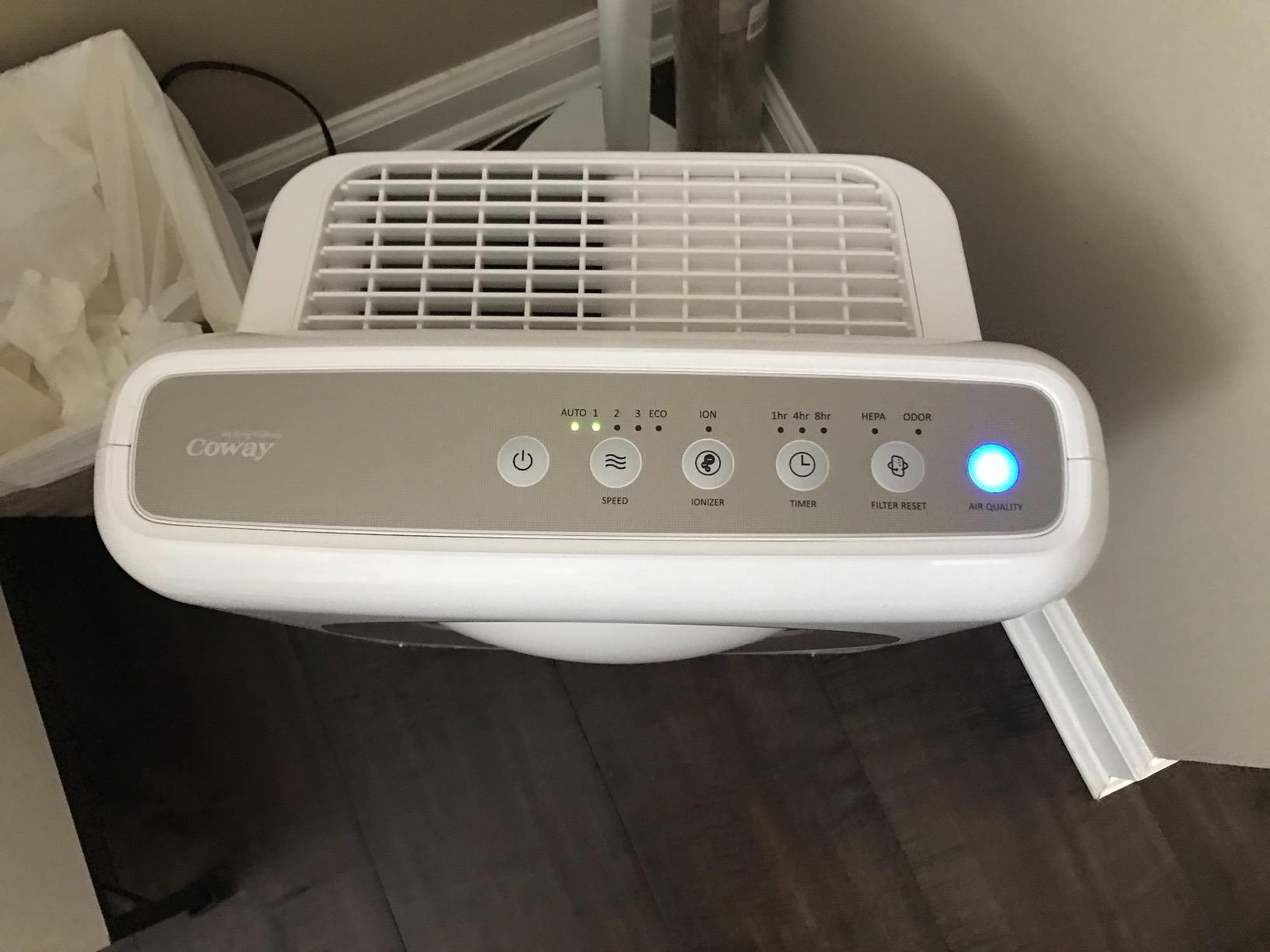
The Coway Airmega Mighty2 is the successor to one of the most recommended large-room purifiers of the last few years, and it upgrades the parts owners complained about most. The MegaScan laser sensor now detects PM1, PM2.5 and PM10 in real time with a numeric display, and a digital filter life indicator tracks the pre-filter and the Max2 filter separately.
Filtration is certified to the IEST-RP-CC007 standard, reducing up to 99.97% of particles as small as 0.3 microns and more than 99.5% of VOCs such as ammonia and formaldehyde. The 2-in-1 HEPA and Active Carbon Max2 filter handles both jobs in one cartridge.
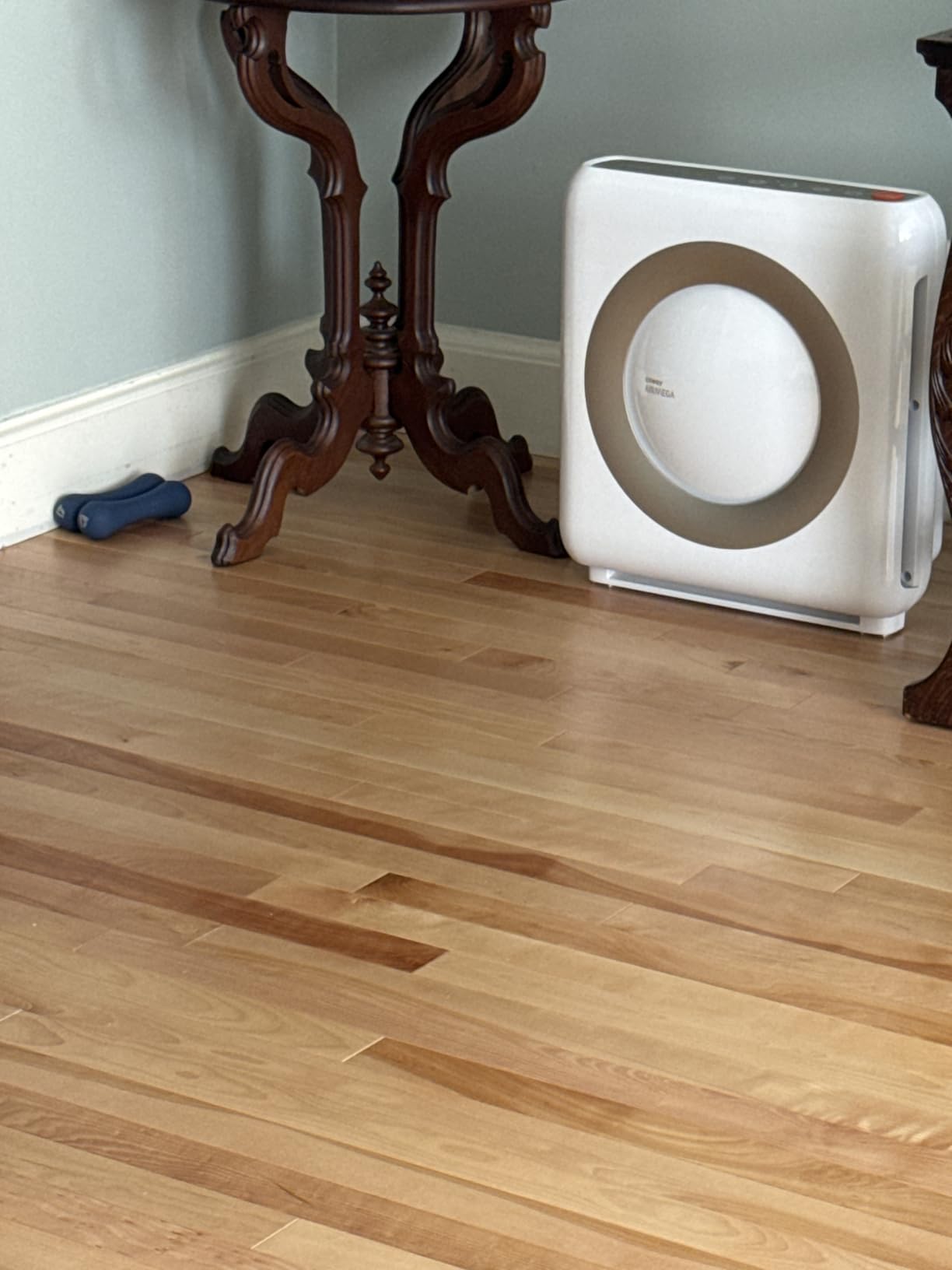
CADR figures sit at 242 for dust, 240 for smoke and 249 for pollen CFM, which puts it in the same band as the Levoit Core 600S-P at a lower tier of the market. Coverage is published as 900 sq ft in 30 minutes and 1,800 sq ft in 60 minutes.
Maximum power draw is 56W, which the manufacturer states uses 20% less energy than the previous generation. The three-year limited warranty is longer than most competitors in this group offer.
Why the Coway Airmega Mighty2 works for allergen and VOC problems
Owners with seasonal allergies and new-construction VOCs both rate it highly, and the numeric PM display is the reason. Watching a real number fall gives you something a colored light cannot, and it tells you when a room is genuinely clean rather than approximately clean.
The slide-out washable pre-filter is a real time saver in a large room where hair and dust load up fast. Cleaning it monthly takes a minute and extends the life of the expensive stage behind it.
Where the Coway Airmega Mighty2 falls short
There is no app listed, so remote monitoring and scheduling are not available. In a large open floor plan you may also find yourself wanting a second machine, because a single unit at 240 CFM cannot push 5 ACH through more than about 900 sq ft at a 9 ft ceiling.
The Max2 filter is a separate purchase and the main ongoing cost. The 2-in-1 design also means you replace the carbon section even when only the odor capacity is spent, which is a recurring theme across this category.
4. Levoit Core 600S-P – Highest Measured CADR in a Compact Body
Levoit Smart Air Purifiers for Home Large Room up to 2933 Ft², Core 600S-P
391 CFM CADR
AHAM VERIFIDE
2-in-1 smart app
13.7 lbs
Pros
- AHAM VERIFIDE certification backs the CADR and coverage claims
- Near silent in sleep mode and on low speeds
- Real-time PM2.5 numbers owners find satisfying
- WiFi app and Alexa control with scheduling
- Filter life indicator removes the guesswork
Cons
- Replacement filters are an ongoing expense
- Top fan speed is noticeably loud
- Advertised 2933 sq ft coverage is optimistic in real rooms
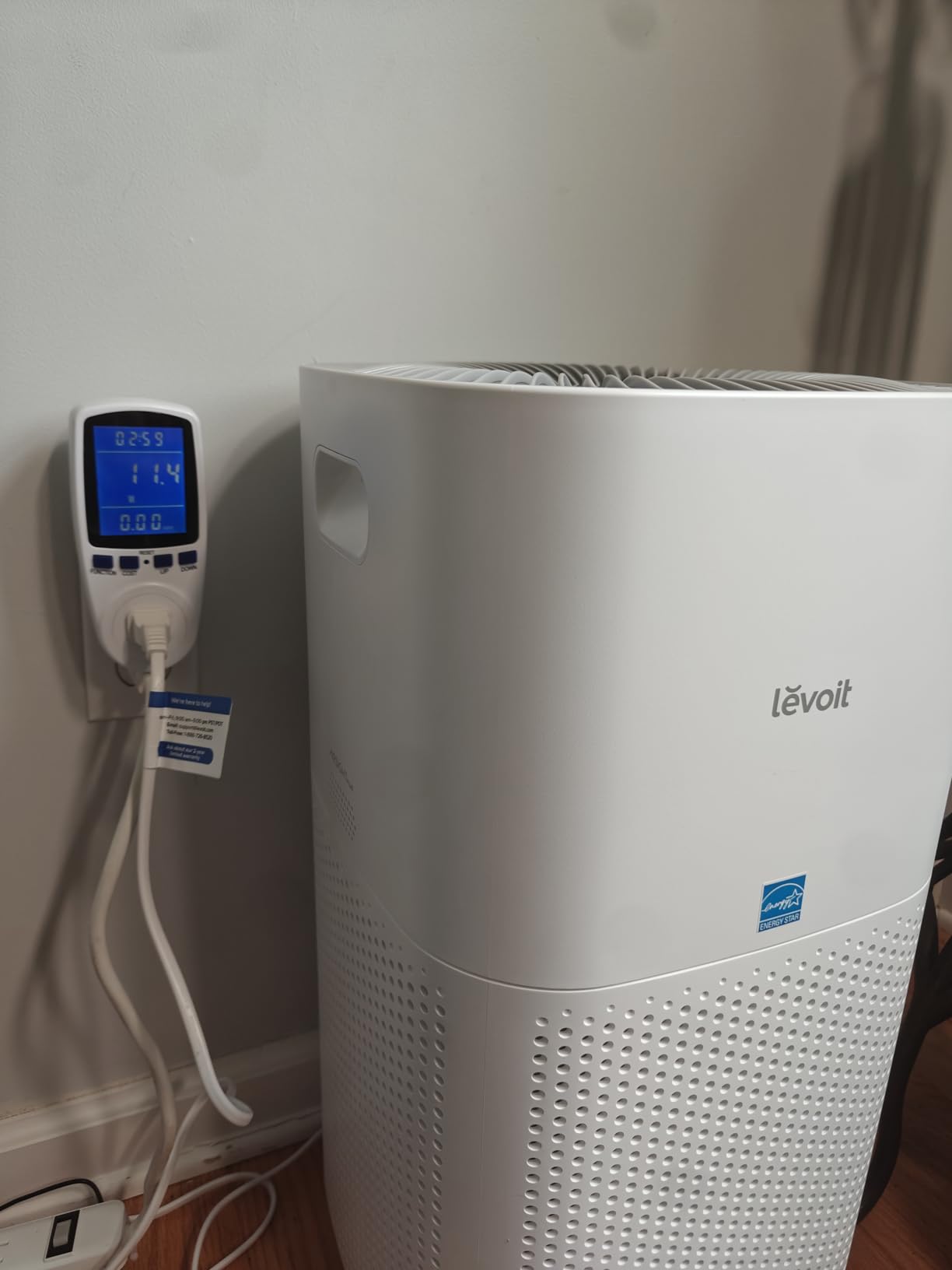
The Levoit Core 600S-P carries a 4.7 average across more than 24,000 reviews, and the reason is a combination of verified performance and genuinely useful software. VortexAir Technology 3.0 delivers a published CADR of 391 CFM, which is the highest figure in this group below the Blueair 211i Max.
It is AHAM VERIFIDE certified for both air cleaning performance and energy efficiency, and that certification is what makes the 2,933 sq ft claim worth examining rather than dismissing. Levoit also states the 606 sq ft every 12.5 minutes figure, which is the one to plan around.
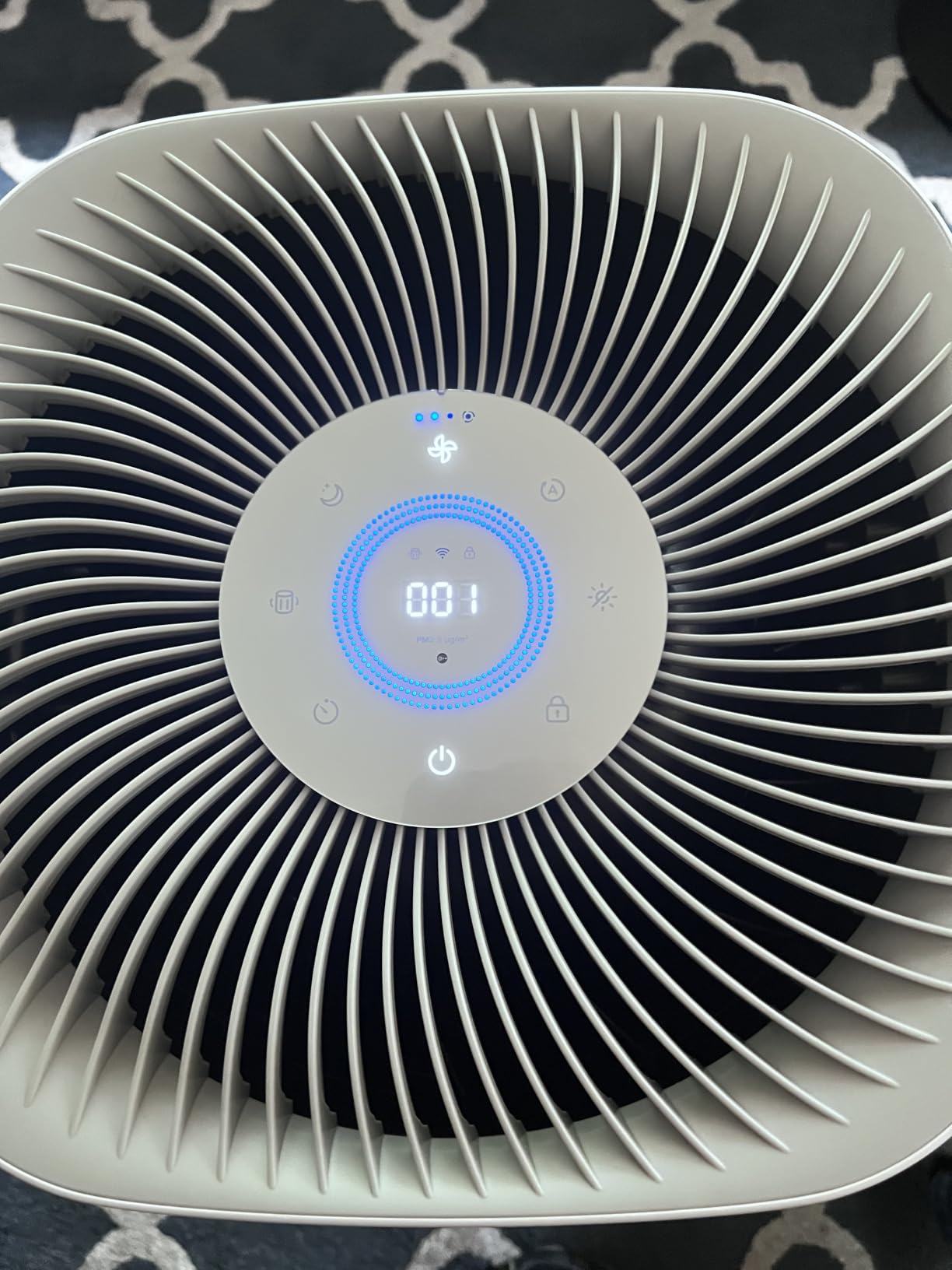
The smart features are better implemented here than on most competitors. The PM2.5 monitor shows real declining numbers, scheduling through the app works reliably, and the filter life indicator tells you when to act instead of guessing from a calendar.
Owners with wildfire smoke exposure report PM2.5 spikes coming back down in roughly an hour at high fan speed, which is the emergency use case that matters most in a large room.
Why the Levoit Core 600S-P handles large spaces well
A 391 CFM CADR in a 12.3 by 12.3 by 23.6 inch body is an unusually efficient package. For a 600 sq ft room at 9 ft ceilings, 5 ACH needs about 500 CFM, so one unit gets you close and a second gets you there with margin.
HEPA-grade performance is maintained in Sleep Mode when paired with Levoit’s original filter, verified by an independent lab. That matters in a large bedroom or loft where you want the unit running overnight without it being the loudest thing in the room.
Where the Levoit Core 600S-P falls short
The 2,933 sq ft headline is calculated at one air change per hour, and many owners find it performs best in small to medium rooms. Plan on the 606 sq ft figure instead, or buy two.
The top fan speed is noticeably loud, and the app asks for location and Bluetooth permissions plus a firmware update before the sensor reads accurately. The bottom panel can also unscrew during lifting, so move it upright and gently.
5. PuroAir 400 – Best for Buyers Who Want Documented Lab Testing
PuroAir 400 HEPA Air Purifiers for Home Large Room Pets Filter 2,000 Ft²
2000 sq ft coverage
Three-layer filtration
CARB ETL ISO and UL certified
Pros
- Coverage claims cite ISO 17025 certified lab testing
- CARB ETL ISO and UL certified
- Three-layer filter handles particles and odors
- Smart particle sensor adjusts power automatically
- Quiet sleep mode suited to continuous running
Cons
- Replacement filters are a recurring cost you must budget for
- Fewer published customer images and long-form reviews than the biggest brands
- 4.5 average trails the top-rated models in this group
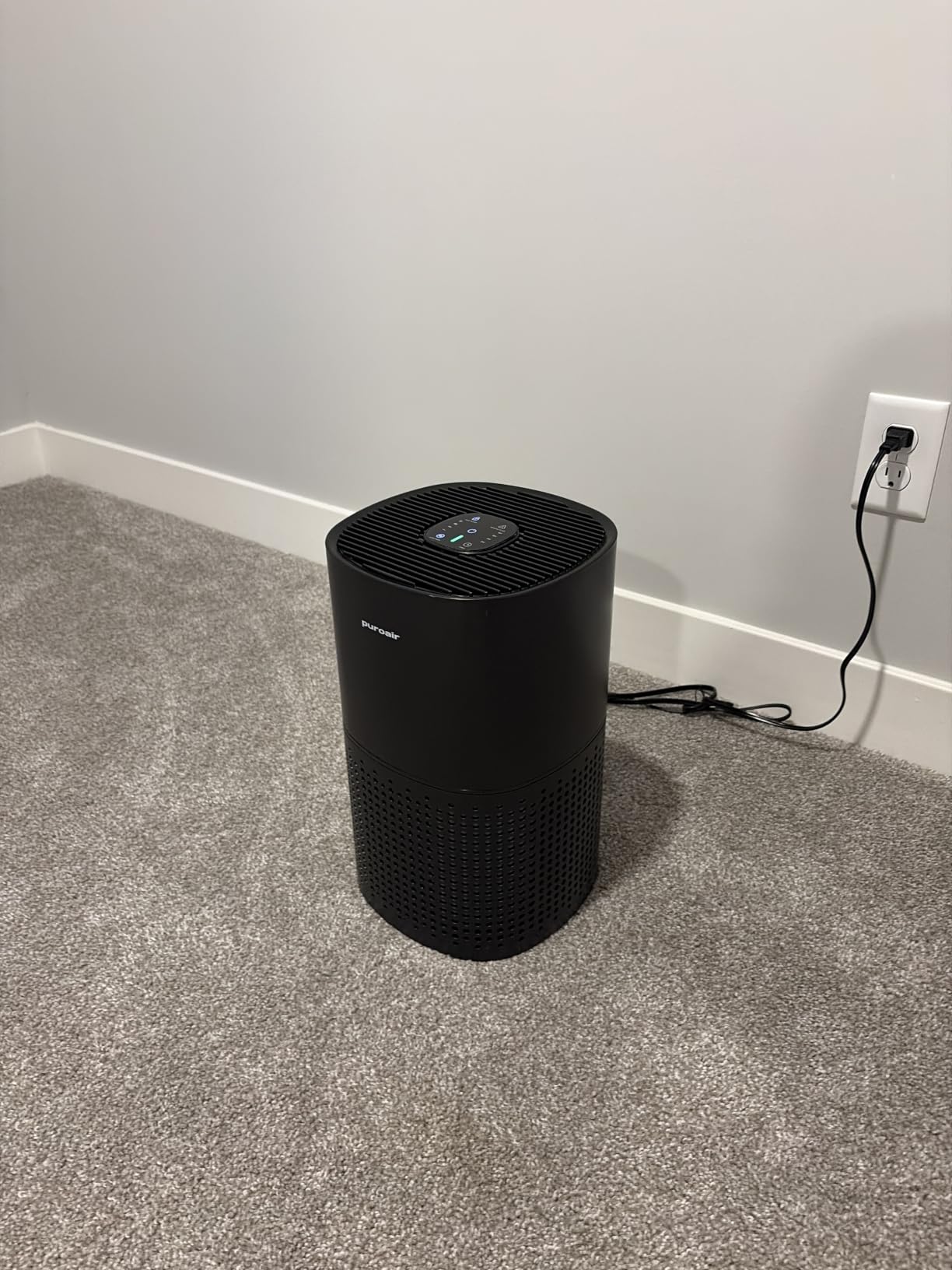
The PuroAir 400 is the pick for anyone who wants certification evidence rather than marketing copy. Coverage claims cite independent testing in an ISO 17025 certified lab, and the unit itself is certified by CARB, ETL, ISO and UL, a combination few competitors in this price range match.
Filtration is a three-layer stack of pre-filter, HEPA and activated carbon, filtering up to 99.9% of dust, pollen, smoke, pet dander and VOCs. The particle filtration is claimed at 700 times smaller than the width of a human hair.
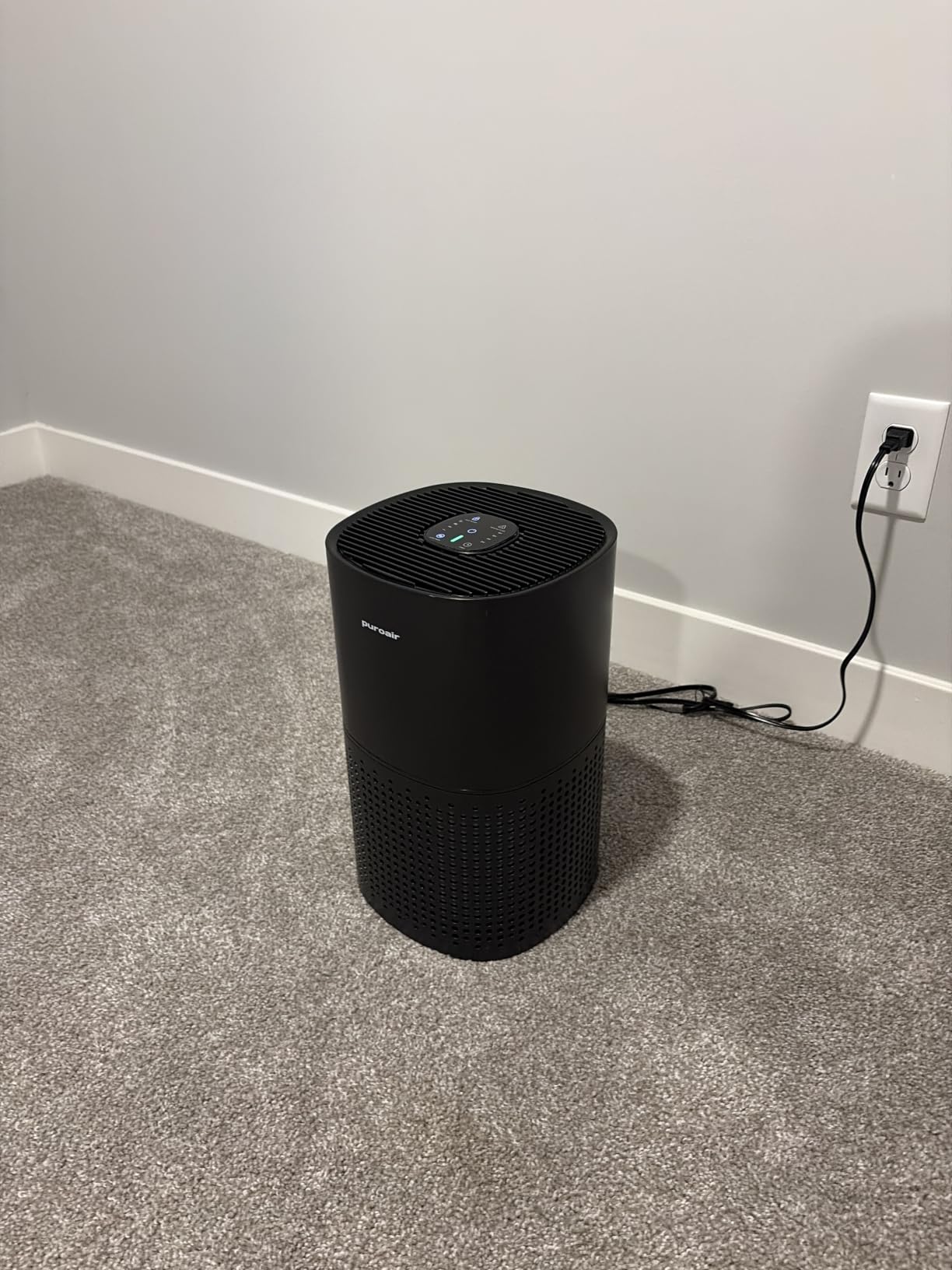
The smart particle sensor raises power automatically when pollution is detected, so the set-and-forget experience is genuinely hands-off in a large room where you do not want to walk over and adjust a dial every few hours.
Owners most often report allergy symptom relief and better sleep, and the quiet sleep mode is designed for continuous 24/7 running. The company is US-based with a two-year warranty and an American Lung Association partnership.
Why the PuroAir 400 suits allergy and asthma households
The 3,200 sq ft figure quoted by the manufacturer is based on typical residential room ventilation rates, which is a more honest framing than a bare maximum. At 2,000 sq ft per hour it is still a large-room machine in practice, and allergy relief is the benefit owners name most.
A 4.5 average across more than 19,000 reviews is solid, and the unit ranks eighth in HEPA filter air purifiers, so it is not an unknown. The lower score reflects a small share of buyers who were less happy with noise and top-setting performance.
Where the PuroAir 400 falls short
Replacement filters are a recurring cost, and keeping a spare on hand matters if you rely on a continuous cleaning schedule in a room that never gets opened windows.
There is no published CADR figure in the AHAM format that we could verify for this model, so if you like to plan from CFM numbers, you are working from the coverage claim instead. It also comes with fewer long-form customer reviews than the biggest brands, so independent user data is thinner here.
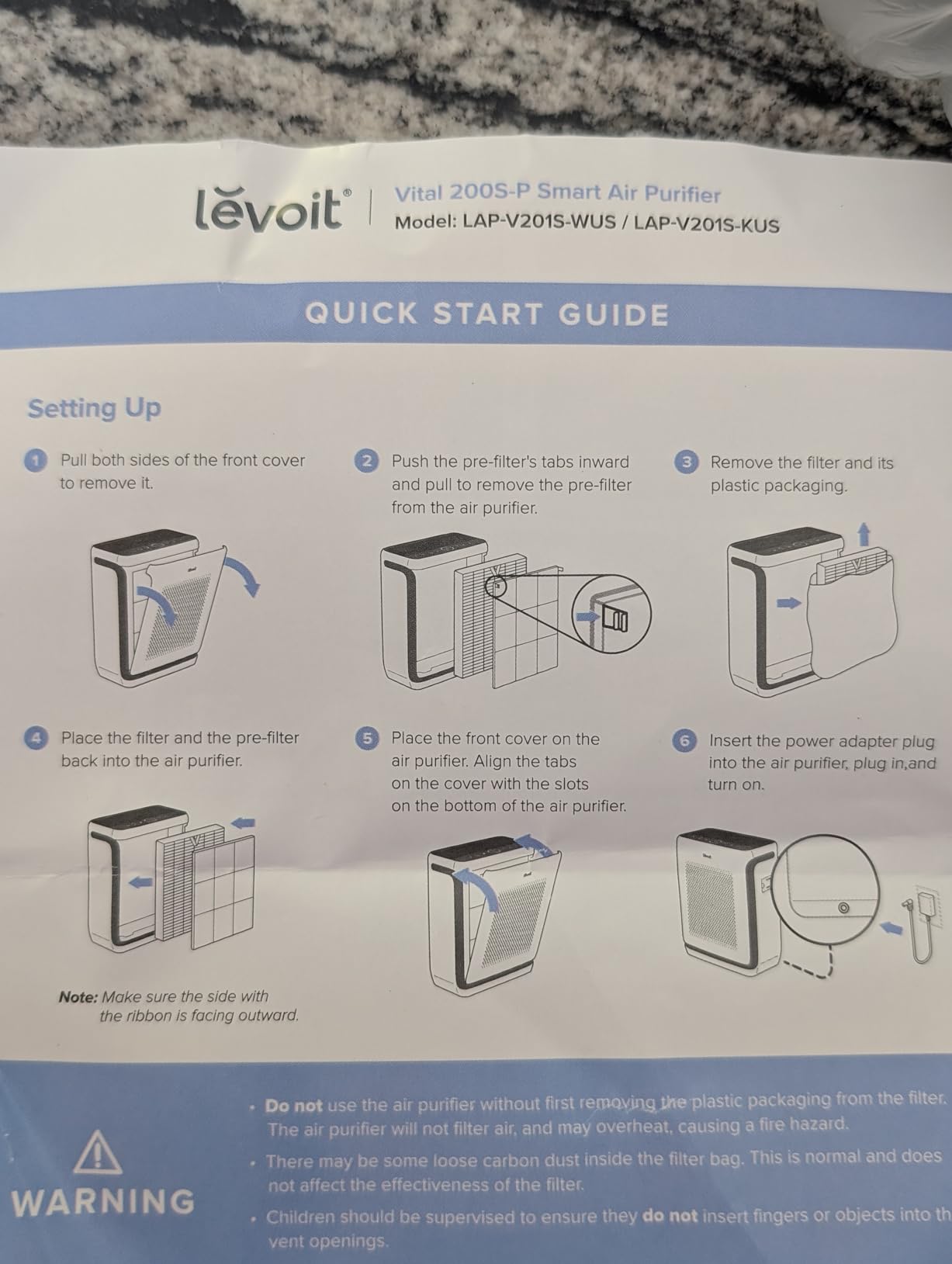
6. Levoit Vital 200S-P – Best for Pet Owners on a Mid Budget
LEVOIT Smart Air Purifier for Home Large Room up to 1875 Ft² Vital 200S-P
CADR 250-289 CFM
U-shaped pet hair intake
AHAM VERIFIDE
13.2 lbs
Pros
- Published CADR of 250 to 289 CFM for a mid-tier price
- AHAM VERIFIDE certified for performance and safety
- U-shaped secondary inlet traps pet hair and odors without clogging
- 4.7 average across more than 15000 reviews
- Designed specifically for allergy groups
Cons
- Levoit replacement filters are a recurring expense
- Smaller coverage ceiling than premium large-room models
- Smart features add setup friction for manual-only users
The Levoit Vital 200S-P is the one to look at if your large room is also a pet room. The U-shaped secondary air inlet is engineered to catch pet hair and odors before they reach the main filter, which is a real design answer to a real problem rather than a feature list item.
Published CADR figures run 250 CFM for smoke, 254 for dust and 289 for pollen, all AHAM VERIFIDE certified. That puts real particulate performance in the 500 to 600 sq ft band at 9 ft ceilings, which is most open living rooms.
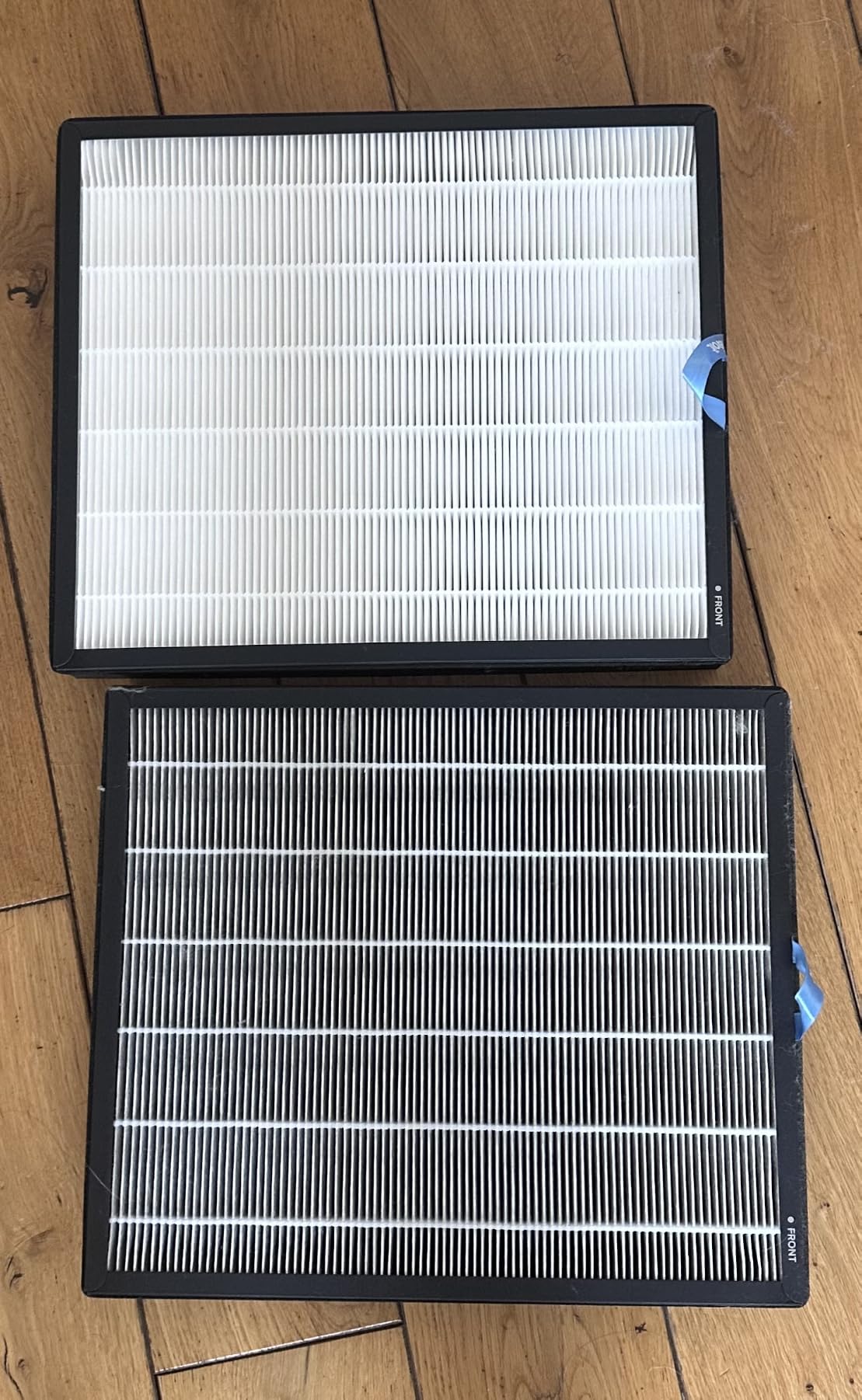
It shares a 4.7 average with the Core 600S-P but at a noticeably lower tier of the market, and it ranks first in its travel-size category. The pet hair and dander performance comes up repeatedly in reviews from homes with shedding animals.
Levoit describes it for living rooms, bedrooms, basements and open-concept homes, which covers most of the situations our readers ask about.
Why the Levoit Vital 200S-P handles pet hair well
The dual-inlet design keeps the traditional air path free while the U-shaped channel traps fur and odor, so the pre-filter does not clog as quickly as it would in a single-inlet tower. In a large room with two shedding pets, that translates to fewer unplanned filter changes.
Allergy relief is the most commonly reported benefit, and allergy groups are named explicitly in the product design. For a family room at 500 sq ft, 4 to 5 ACH is realistic on the higher fan settings.
Where the Levoit Vital 200S-P falls short
The 1,875 sq ft coverage figure is a one-air-change number, and the real large-room sweet spot is smaller. If your space is genuinely above 700 sq ft at 9 ft ceilings, budget for a second machine or move up to the Core 600S-P.
Smart features add app and WiFi setup friction if you only want a manual unit. Levoit filters are also a recurring expense, and this one-piece cartridge means the whole filter is replaced rather than just the odor section.
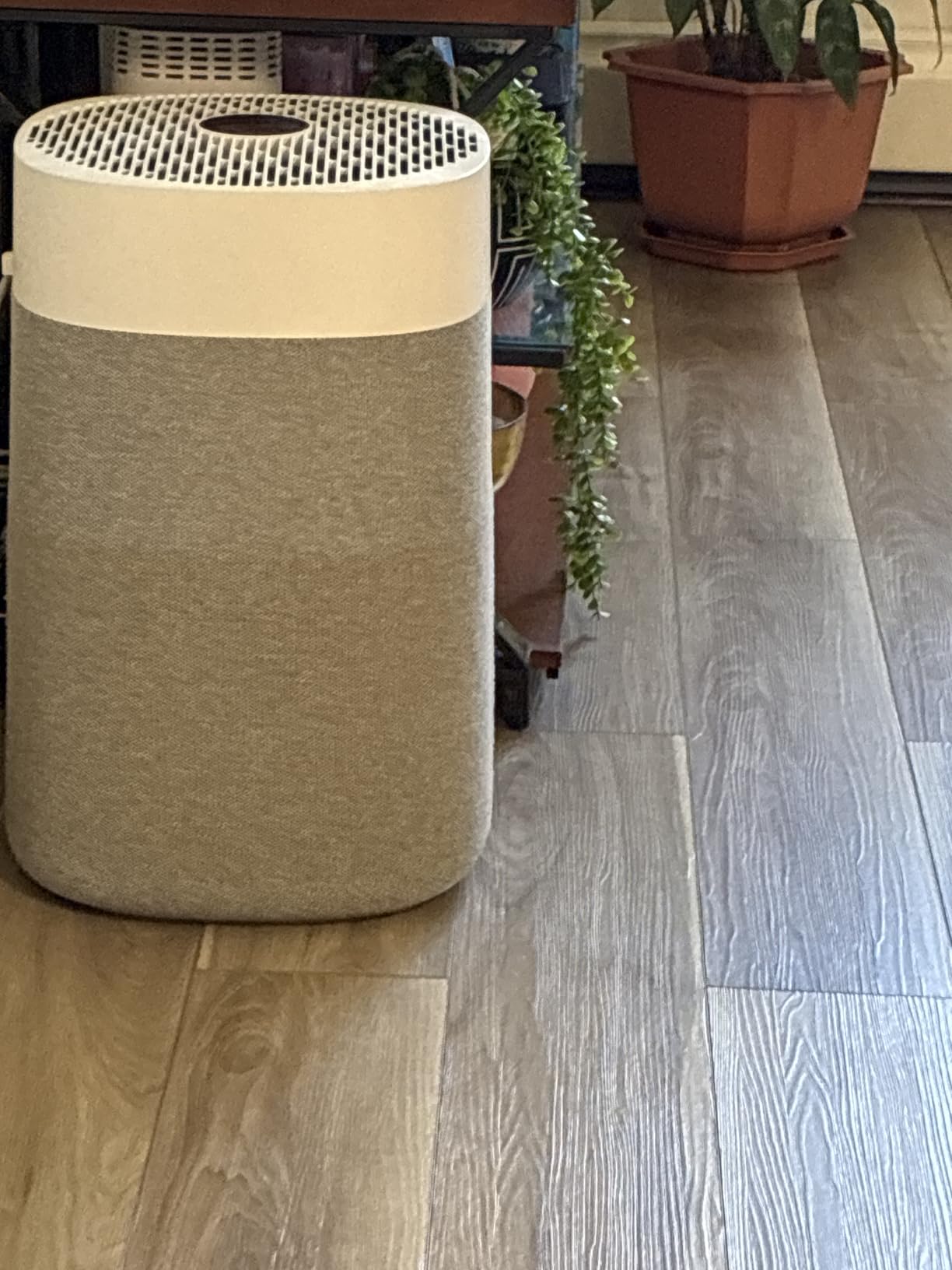
7. Blueair Blue Pure 211i Max – Highest Airflow for Open Plans
BLUEAIR Air Purifiers for Home Large Room up to 3,235 Ft², Blue 211i Max
CADR 435-452 CFM
HEPASilent with carbon
23-53 dB range
16 lbs
Pros
- Highest published CADR in this group at 435 to 452 CFM
- AHAM certified with 360 degree air intake
- Sensors react to trace smoke and cooking within a minute or two
- Washable fabric pre-filter extends main filter life
- Three-year warranty with registration
Cons
- Replacement filters are expensive with few aftermarket options found
- High fan settings are noticeably loud
- Heavy and awkward to move between rooms
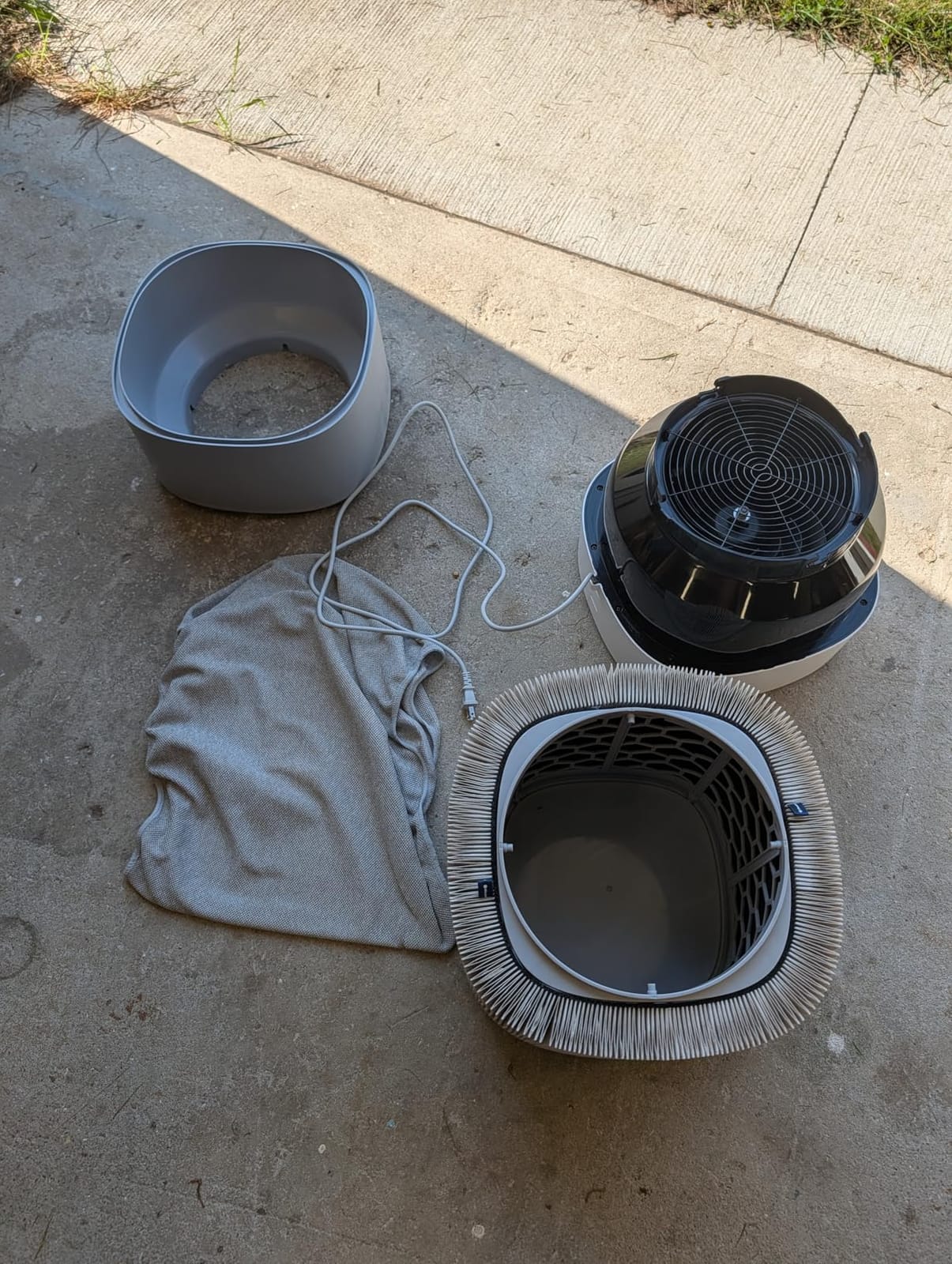
The Blueair Blue Pure 211i Max is the airflow specialist of this group. Its AHAM certified CADR figures of 450 for pollen, 452 for dust and 435 for tobacco smoke CFM are the highest published numbers in our lineup, and the 360-degree air intake uses that capacity properly.
Published cleaning performance is 674 sq ft in 12.5 minutes and 3,235 sq ft in one hour, and the HEPASilent system pairs particle filtration with an activated carbon stage for cooking odors and wildfire smoke.
Sensor responsiveness is a genuine strength. Owners report the built-in sensors reacting to trace smoke and cooking within a minute or two, which makes auto mode useful in an open kitchen and living space where pollution sources change quickly.
The fabric-knit exterior is offered in several color shades and reads as furniture rather than industrial plastic, which matters more than it sounds when the machine sits in the middle of a living room.
Why the Blueair 211i Max suits extra large rooms
At 435 to 452 CFM, this is the only machine here that approaches 5 ACH in a 900 sq ft space with 9 ft ceilings on its own. The 3,235 sq ft one-hour figure still represents a single air change, so treat the CADR as the planning number.
HEPASilent filtration retains 0.1 micron particles and handles mold, viruses, pet dander, pollen and smoke in one pass, and the washable fabric pre-filter extends the life of the main cartridge, which partly offsets the filter cost.
Where the Blueair 211i Max falls short
This model has the lowest average rating in our group at 4.4, with a higher share of one-star reviews than any other. The recurring themes behind that are expensive proprietary replacement filters with few aftermarket alternatives, a 16 pound weight that is awkward to move, and reported issues with customer service and product registration.
Keep it a couple of feet off the walls, because 360-degree filtration drops when it is pushed into a corner. The highest fan settings are also loud, and WiFi setup asks you to type the network password rather than using a simpler pairing method.
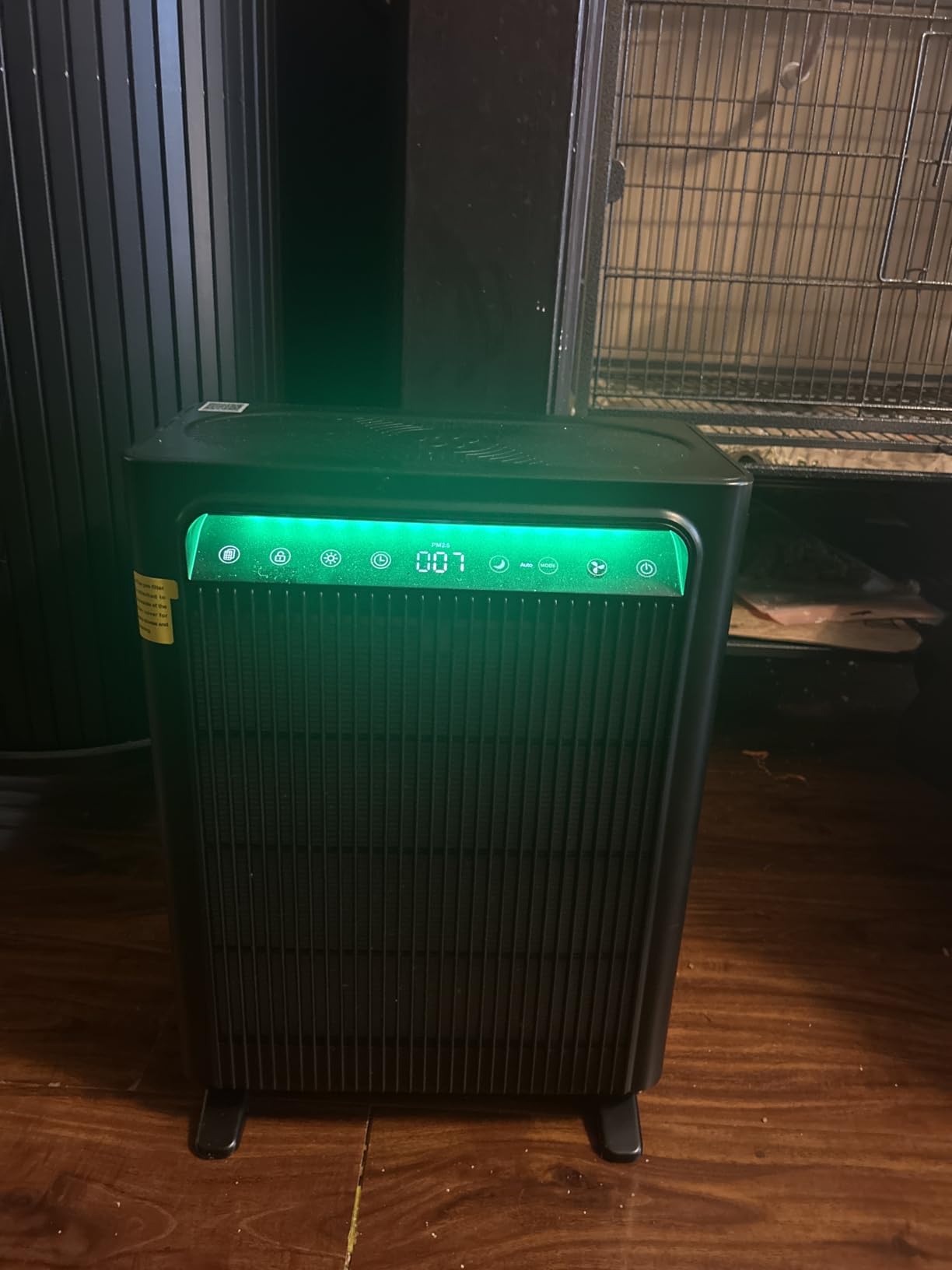
8. KNKA APH4000 – Best for Buyers Who Want No App and No WiFi
KNKA Air Purifiers for Home Bedroom Up to 1,695 Ft² in 1 Hr, APH4000, White
CADR 226-244 CFM
Dual intake design
22-24 dB sleep
9.68 lbs
Pros
- Strong 226 CFM smoke and 244 CFM pollen CADR for its size
- No app or WiFi required at all
- Accurate real-time PM2.5 readout with color panel
- Compact 9.68 pound body with built-in side handles
- Cheap widely available third-party replacement filters
Cons
- Two filter cartridges are needed per replacement cycle
- Efficiency drops to about 45% at the full 1695 sq ft claim
- Control panel is invisible until the unit is powered on
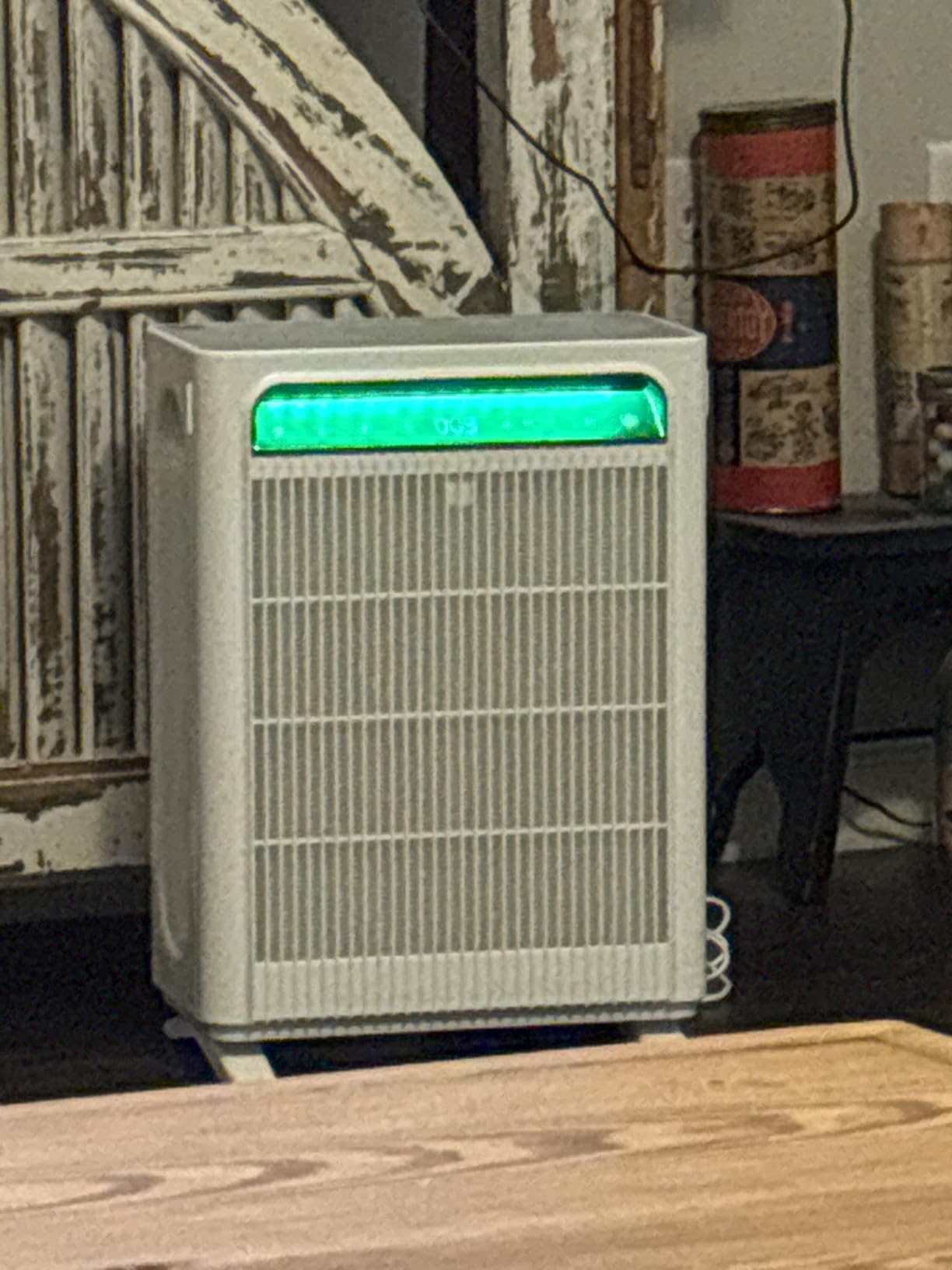
The KNKA APH4000 solves a problem most large-room purifiers ignore. It has no app and no WiFi at all, which owners consistently call out as a benefit rather than a limitation. If you would rather not grant location permissions to a device on your network, this is the cleanest option here.
AHAM verification lists CADR at 226 CFM for smoke, dust and PM2.5, and 244 CFM for pollen. The air delivery design is the interesting part: dual front-and-back intakes with dual side outlets push air through the room from more than one direction.
Verified performance is 4.8 air changes per hour in rooms up to 350 sq ft at up to 80% purification efficiency. Pet Mode boosts airflow to refresh a room in 30 minutes, and Eco Mode drops into standby when air quality is already excellent.
At 9.68 pounds with built-in side handles, it is the easiest machine here to carry between a bedroom, a home office and a living room, which matters more than specs when you are moving it twice a week.
Why the KNKA APH4000 works in a mid-size room
A 226 CFM CADR handles a 400 to 450 sq ft space at 9 ft ceilings with four or five air changes per hour, and the dual-intake layout distributes that output better than a single-inlet tower of the same size.
Filter access is unusually good. The filter panels fold down and stay attached, so swapping a cartridge does not involve awkward reassembly, and third-party filters are affordable and widely available rather than locked to one supplier.
Where the KNKA APH4000 falls short
You need two cartridges per replacement cycle, one for each side, which doubles the cost of a single change even if the per-cartridge price is low. Filter replacement intervals are rated at three to six months.
The 1,695 sq ft claim assumes roughly 45% efficiency at full volume, so a very large open space will not get the same result as a 350 sq ft room. Sleep mode runs 22 to 24 dB, which is quiet rather than silent, and the control panel stays invisible until the unit is powered on.
9. Coway Airmega 400 – Best Warranty for Whole Open Spaces
COWAY Air Purifier for Home Up to 3,120ft², Washable Pre-Filter and HEPA Filter for Smoke, Allergies, Pet Dander, Odor, AQI, Auto & Sleep Mode, Timer, 5yr Warranty, Airmega 400 White, AP-2015F
3120 sq ft coverage
Three-stage HyperCaptive
22 dB
5-year warranty
Pros
- Five-year manufacturer warranty is the longest in this group
- HyperCaptive system reduces 99.97% of 0.3 micron particles plus VOCs
- Smart Eco and Sleep modes automate operation
- Air quality monitor and filter life indicator built in
- Very quiet at 22 dB
Cons
- Highest price point of the models analyzed
- Heavy at 24.7 pounds for moving between rooms
- Touch-only controls with no app or smart home integration
The Coway Airmega 400 is the premium whole-space option in this lineup, and the number that sets it apart is the five-year manufacturer warranty. No other model here offers more than three years, and on a machine this size that coverage matters over a decade of use.
The HyperCaptive Filtration System combines a pre-filter, active carbon filter and HEPA filter to reduce 99.97% of 0.3 micron particles plus VOCs and odor. Published coverage is up to 3,120 sq ft in 60 minutes.
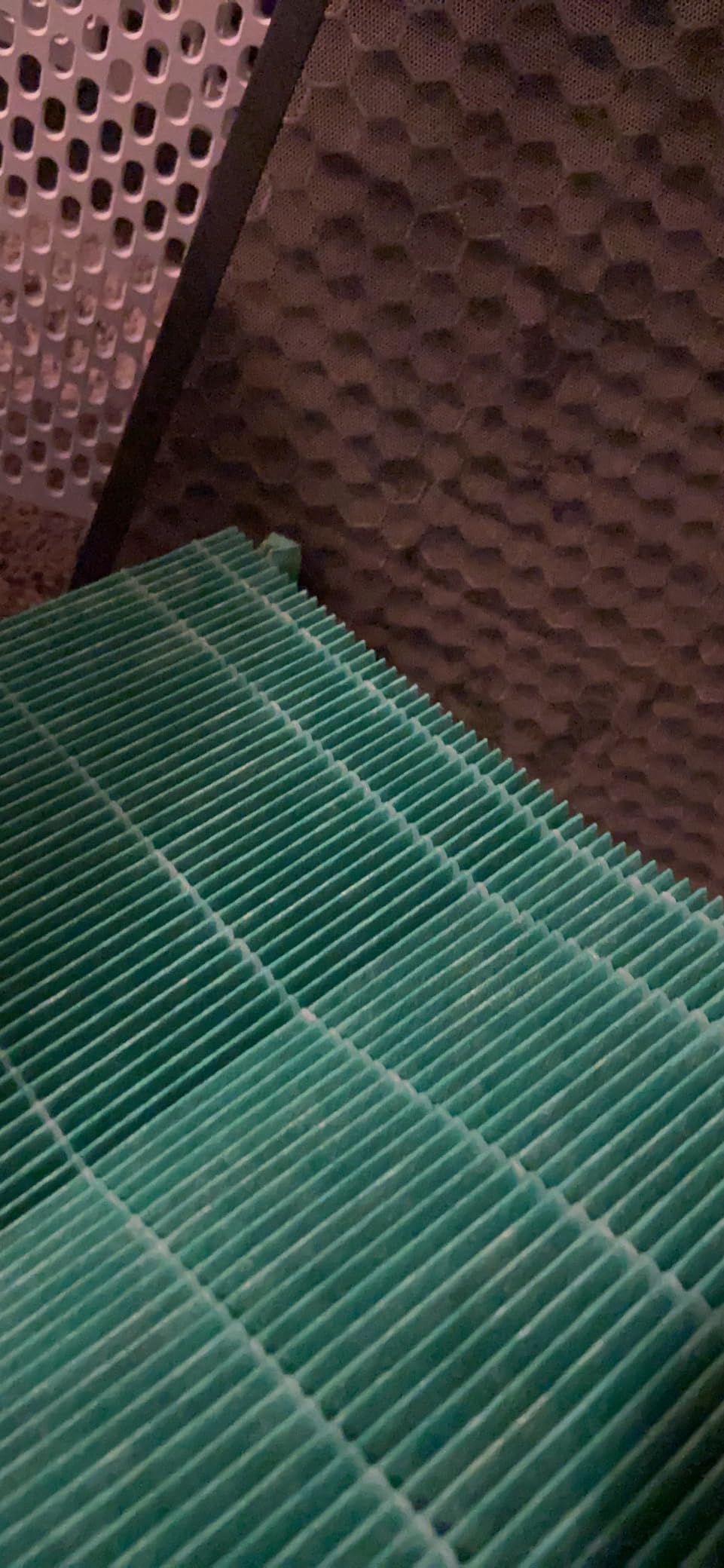
Smart Mode adapts fan speed to room air quality, Eco Mode switches the fan off after 30 minutes of purified air and restarts it when pollution appears, and Sleep Mode reduces noise and power when the room is dark and the air is clean.
It is CARB, ETL and Energy Star certified, with a built-in air quality monitor, filter life indicator and timer, drawing 66 watts at maximum.
Why the Coway Airmega 400 suits large open-concept homes
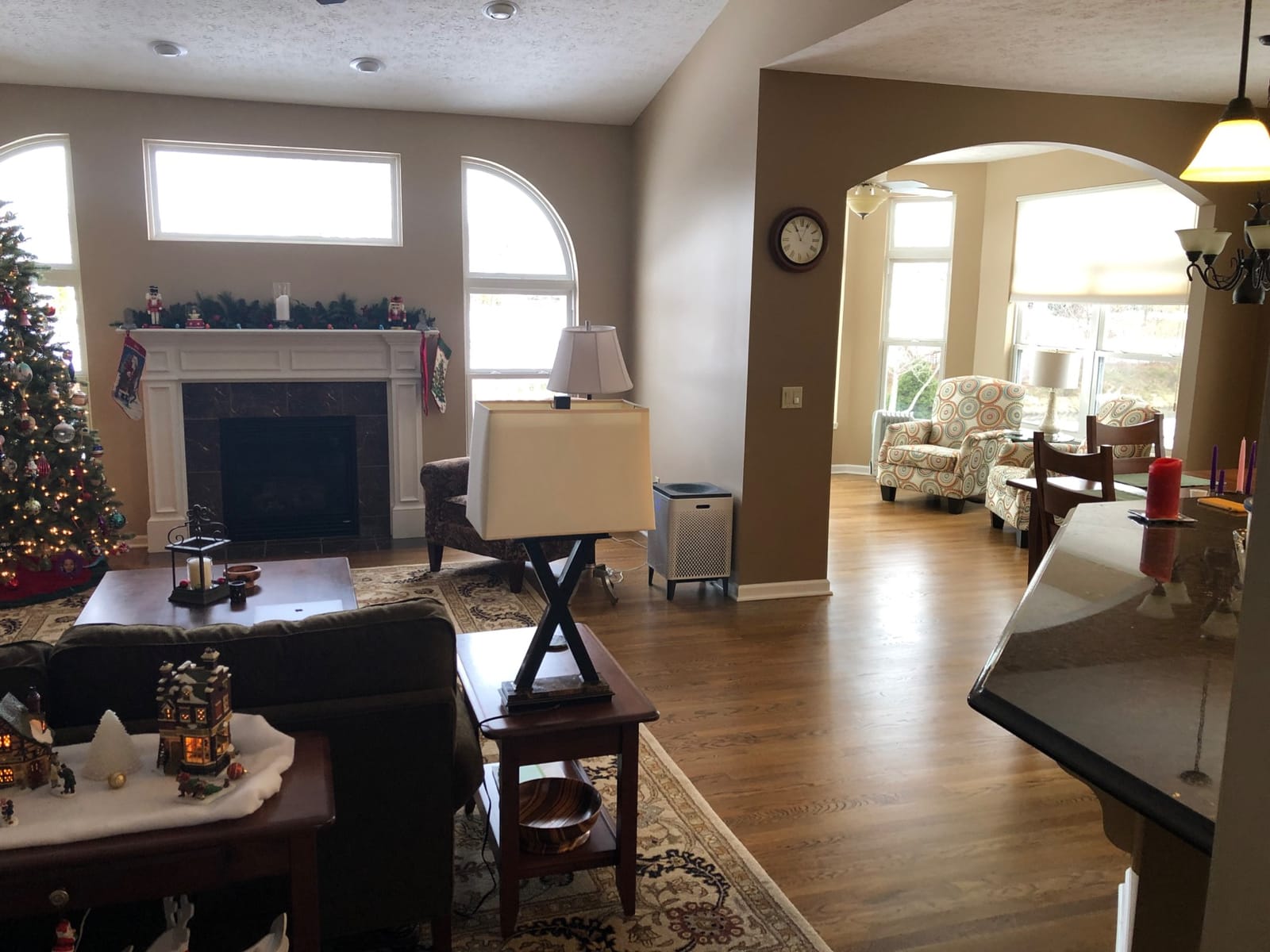
The 22 dB sleep mode means you can run it overnight in a large bedroom or loft without it becoming the dominant sound in the room. Eco Mode is the reason that works economically, since the fan actually stops when the air is already clean.
For a two-story great room with a double-height ceiling, this is the machine to try first. The warranty length and the three-stage filtration give you the most margin for a space where you are guessing at volume.
Where the Coway Airmega 400 falls short
It is the heaviest unit here at 24.7 pounds and the most expensive of the models analyzed, and both facts push it toward a permanent position rather than a movable one. Touch-only controls mean no app, no remote monitoring and no scheduling away from home.
Replacement filters for this model add substantial ongoing cost, and the 3,120 sq ft figure is a one-air-change number. For a very large open plan, two mid-range machines often cost less over five years and give you better filtration in each room.
10. Honeywell HPA5300B – Best No-Ozone Option for Asthma and Birds
Honeywell HEPA Air Purifier for Home, 2423 Ft² Rooms in 1 Hour, Air Quality Monitor, Auto Mode, Reduces Allergens, Dust, Pollen, Pet Dander, Odors, Smoke, Black, HPA5300B
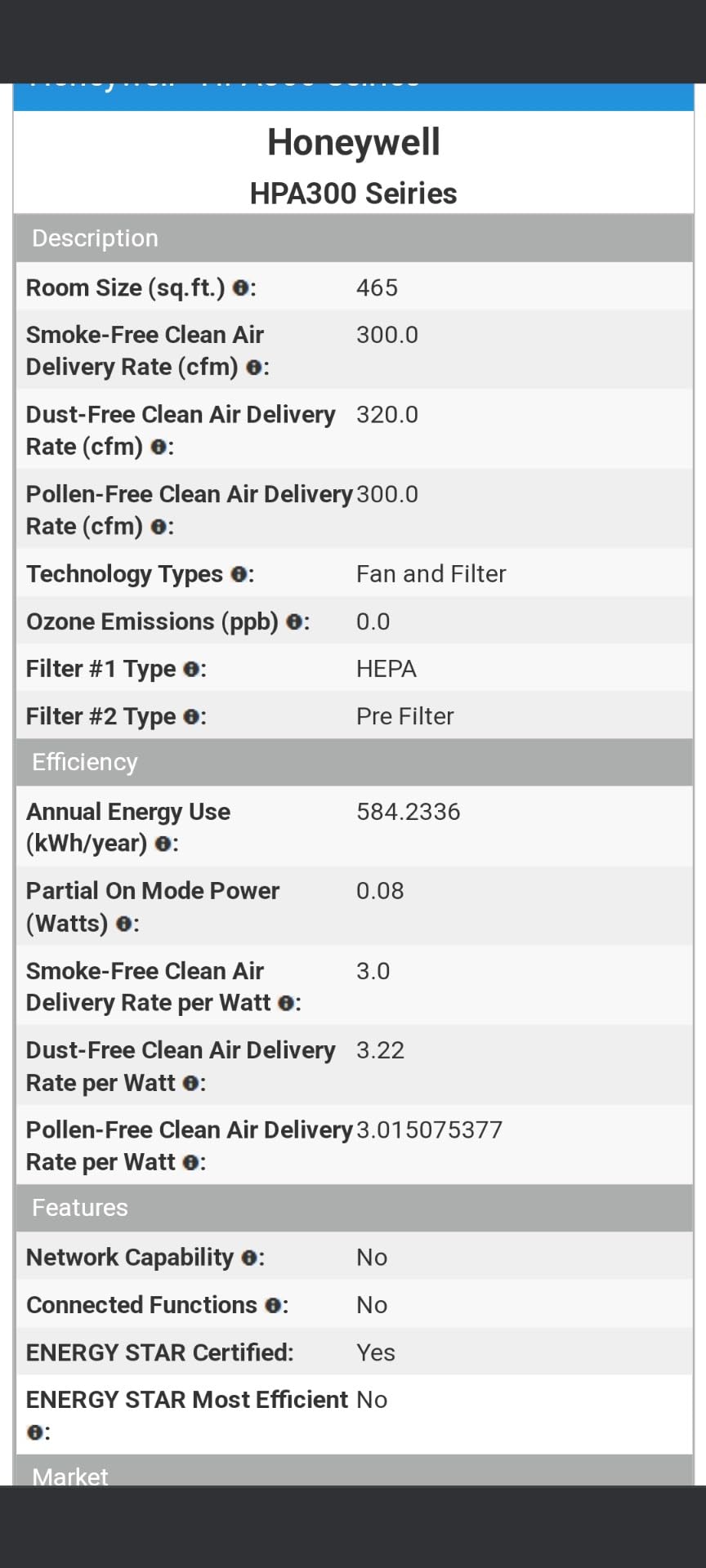
4.8 ACH to 500 sq ft
99.99% particle capture
No ozone generation
20.5 lbs
Pros
- Explicitly no ozone generation
- Owners report 12 to 15 years of service life
- Auto mode correctly escalates during smoke events
- Very quiet on the lowest setting for bedroom running
- Widely available replacement filters that outlast advertised life
Cons
- Bulky at 20.5 pounds and larger than earlier Honeywell models
- Low-level hum on the lowest setting is audible to some sleepers
- No dedicated VOC filter included as a separate purchase
The Honeywell HPA5300B is the pick when ozone is a hard no. Honeywell states no ozone generation, which matters for anyone with asthma, for households with birds, and for anyone who simply does not want an ionizer running without being able to turn it off.
AHAM Verifide testing shows the unit filters and recirculates air 4.8 times per hour in rooms up to 500 sq ft, with HEPA filtration capturing over 99.99% of airborne dust, pollen, pet dander and smoke.
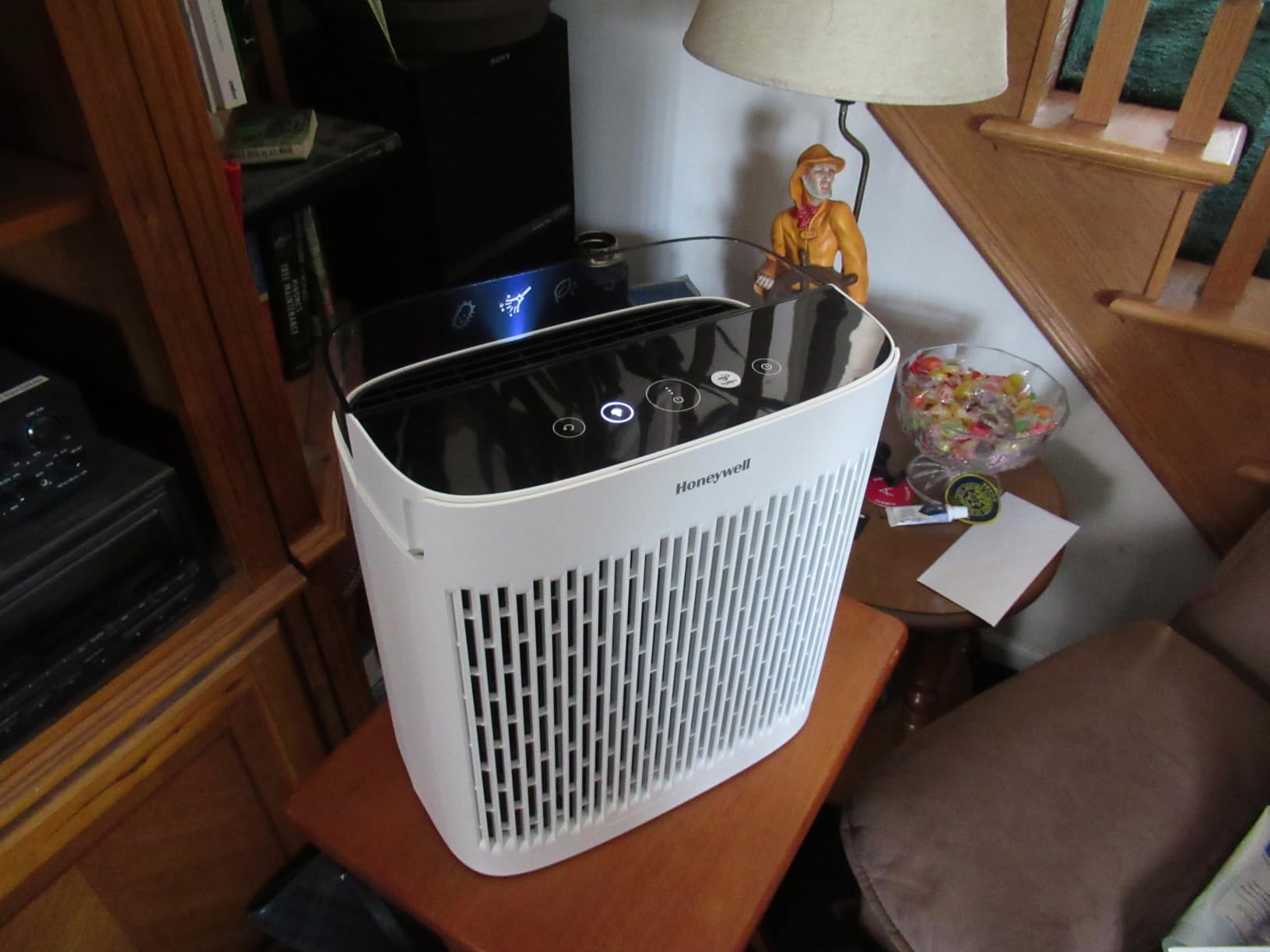
Longevity is the headline owner theme here. Multiple reviews describe machines still running after 12 to 15 years, and the auto mode is praised for correctly ramping up during wildfire smoke events, which is exactly when you need it.
Carbon pre-filters handle odor reduction and a top carry handle makes the 20.5 pound body easier to move. A clear rear surround at the top doubles as a status indicator readable from across the room.
Why the Honeywell HPA5300B works for sensitive households
Without an ionizer in the airflow path, there is no ozone byproduct to worry about during overnight runs. Owners with asthma and pet owners specifically report clear reductions in dust, cat hair and dander captured on the pre-filter.
Replacement filters are widely available and reported to outlast their advertised lifespan, which is unusual and meaningful for a machine expected to run for a decade. At-a-glance cleaning level settings keep operation simple without an app.
Where the Honeywell HPA5300B falls short
There is a persistent low-frequency hum on the lowest setting, measured by one reviewer at about 5 dB louder than the previous generation, and it was enough for that buyer to return the unit. It is also bulky at 20.5 pounds.
No dedicated VOC filter is included, so the cartridge for chemical odors is a separate purchase, and turbo has no one-hour timer option. The clear plastic top surround scratches easily, and one owner reported a burned-out motor after light use.
11. Clorox Large Room Air Purifier – Best for Dust and Virus Capture
Clorox Large Room HEPA Air Purifiers for Home With True HEPA Filter
0.1 micron retention
360 degree 3-stage
30 dB
12.7 lbs
Pros
- 99.97% particle capture down to 0.1 microns
- Claims 99.9% removal of viruses and bacteria
- Three-stage 360 degree filtration including active carbon
- Covers rooms up to 1500 sq ft
- Three-year limited manufacturer warranty
Cons
- Proprietary filters must be replaced every 6 to 12 months
- Filter light triggers on runtime rather than actual loading
- Only one filter included with the unit
- 30 dB is audible for very noise sensitive sleepers
The Clorox Large Room Air Purifier is the most straightforward machine in this group, and for a large room where dust is the main problem it does the essential job well. True HEPA filtration captures 99.97% of particles down to 0.1 microns, and it is claimed at 99.9% for viruses and bacteria.
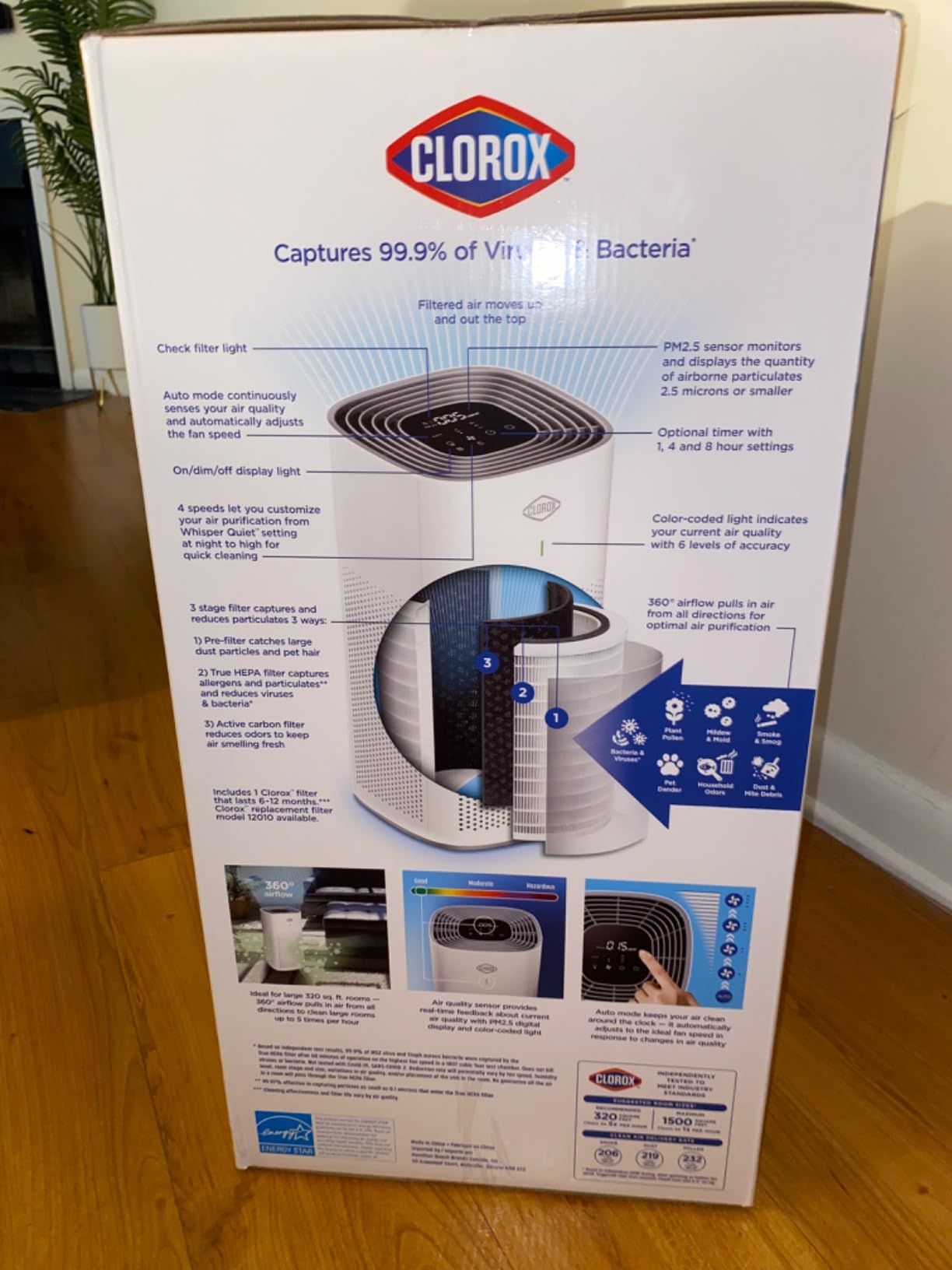
Filtration is a three-stage 360-degree arrangement of pre-filter, True HEPA filter and active carbon filter, so the carbon stage handles odors and VOCs while the HEPA stage handles particulate.
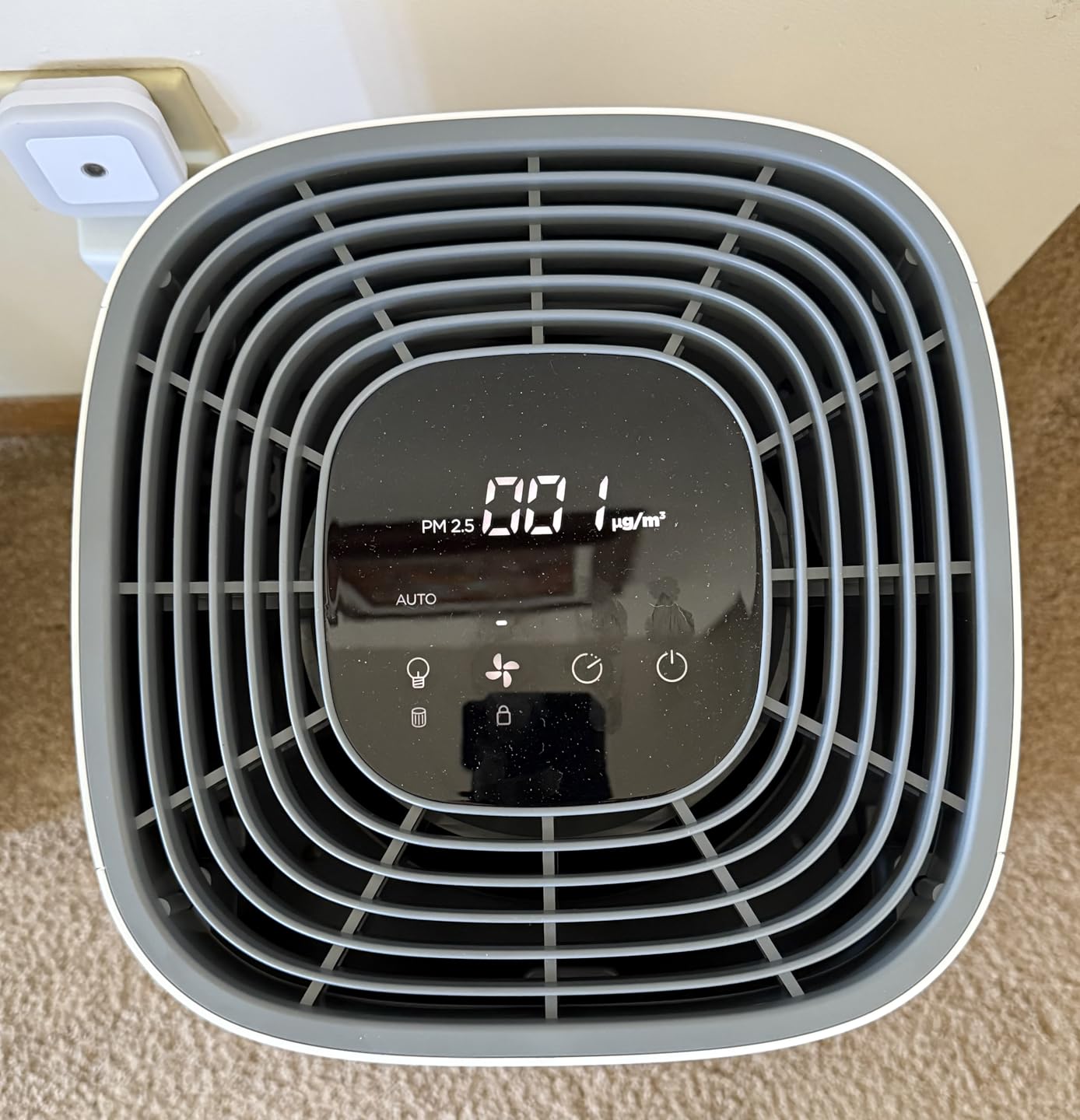
Published coverage is up to 1,500 sq ft, with five air changes per hour in 320 sq ft rooms. That second figure is the honest one, and it puts this unit squarely in the 400 to 500 sq ft effective band.
A red filter life light illuminates after 4,380 hours of use, the filter is rated for six to twelve months, and a three-year limited manufacturer warranty is included. The whole thing draws 32 watts.
Why the Clorox unit suits high-dust spaces
Reviewers consistently highlight strong allergen and dust removal, which tracks with the 0.1 micron retention specification. In a renovation-heavy space or a home with construction dust nearby, that figure is the reason to shortlist it.
Touch controls, adjustable fan speed, a timer and auto mode cover daily operation without an app, and 30 dB running noise sits in the middle of this group rather than at either extreme.
Where the Clorox unit falls short
Replacement filters are proprietary and must be swapped every six to twelve months to hold performance, and only one filter is included, so a spare has to be bought separately. That is the ownership cost to plan for.
The filter light counts runtime rather than actual filter loading, so in a dusty space it can illuminate sooner than the filter truly needs replacing. At 30 dB it is also audible at the quietest setting for sleepers, and the same line comes in 1,000, 1,500 and 2,200 sq ft variants.
12. SIESEAN AP-480 – Best Lightweight Pick for High Air Changes
Air Purifiers for Home Large Room Up to 4200 Ft², 289 CADR, 20dB Sleep Mode
CADR 271-289 CFM
20 dB sleep mode
360 degree intake
10.8 lbs
Pros
- 289 CFM pollen and 271 CFM smoke CADR for large open areas
- 20 dB sleep mode with indicator lights off
- Real-time PM2.5 sensor with color indicator
- Five fan modes plus 1/2/4/8 hour timer and child lock
- Lightest unit here at 10.8 pounds
Cons
- AP-480 replacement filters are separate and recommended every 3-6 months
- Cleans 1748 sq ft in 58 minutes so huge spaces need long runs
- Timer only
- with no scheduled on off programming
- Sleep mode hides the air quality readout at night
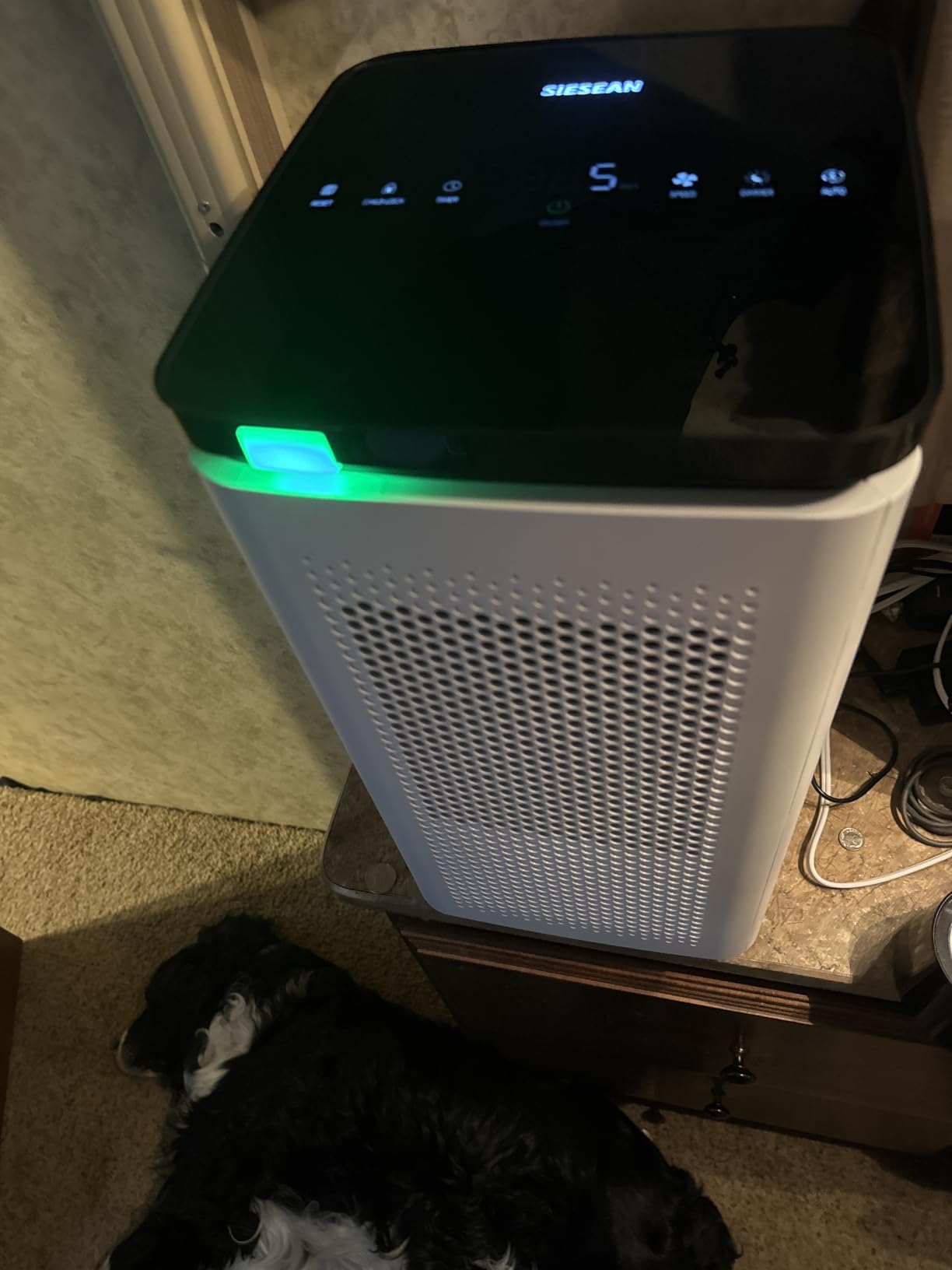
The SIESEAN AP-480 is the easiest large-airflow machine to move in this lineup, at 10.8 pounds. When you are shifting a purifier between a vaulted-ceiling loft and a basement every few weeks, that weight difference is felt more often than any spec on the sheet.
CADR is 271 CFM for smoke, dust and PM2.5 and 289 CFM for pollen, with 360 degree airflow and double-sided intake. Coverage is published as 350 sq ft in 12 minutes and 1,748 sq ft in 58 minutes.
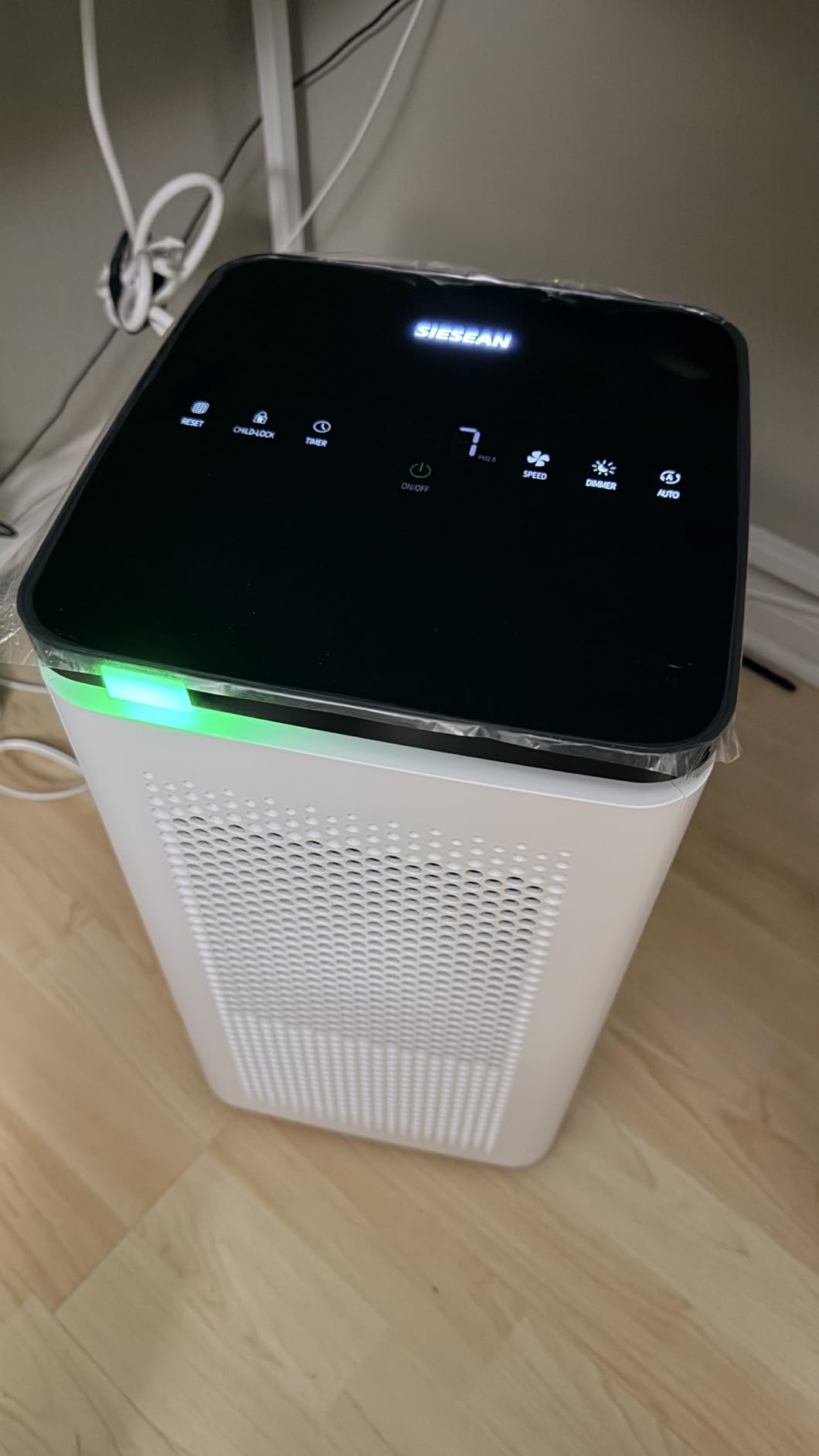
Sleep mode runs at 20 dB with the indicator lights switched off, which makes it a candidate for a large bedroom where the unit runs overnight. A built-in sensor shows real-time PM2.5 with a color indicator during the day.
There are five fan modes including Sleep and Auto, plus a 1, 2, 4 or 8 hour timer and a child lock, which is the full control set most owners actually use.
Why the SIESEAN AP-480 suits high-ceiling spaces
A 289 CFM pollen CADR in a body this light is unusual, and it lands in the 500 to 600 sq ft effective band at a 9 ft ceiling. In a loft with a 12 ft ceiling, scale the room volume rather than the floor area, because the extra cubic feet are what the fan has to move.
Auto mode with the real-time PM2.5 sensor means you can leave it running without checking on it, and the light body makes it practical for rooms where you want occasional rather than permanent placement.
Where the SIESEAN AP-480 falls short
The 4,200 sq ft maximum is a marketing ceiling. At 1,748 sq ft in 58 minutes you are seeing roughly a single air change, so very large spaces need extended run times or a second machine.
Replacement AP-480 filters are proprietary, recommended every three to six months after 2,000 hours of use, and the timer gives you fixed intervals rather than scheduled on and off programming. Sleep mode also disables the air quality readout, which removes your overnight feedback.
How to Calculate the CADR You Need (The 2/3 Rule)
The 2/3 rule is a shortcut: take the largest room size a manufacturer claims at 5 or 6 air changes per hour, and the number you can actually buy and use well is roughly two-thirds of it. It exists because the coverage printed on boxes is almost always calculated at one air change per hour, which tells you very little.
Here is the real calculation, in four steps. First, multiply floor area by ceiling height to get the room volume in cubic feet. Second, multiply that volume by your target air changes per hour, using 4 for allergy and smoke situations and 5 for heavy particulate events. Third, divide by 60 to convert to cubic feet per minute. Fourth, pick a unit whose AHAM verified CADR meets or beats that number.
Worked example: a 700 sq ft living room with a 9 ft ceiling is 6,300 cubic feet. At 5 air changes per hour you need 31,500 cubic feet per hour, which is 525 CFM. The Blueair 211i Max at 435 to 452 CFM falls short on its own, while the Levoit Core 600S-P at 391 CFM plus a second unit clears it comfortably.
For high ceilings, do the math on volume rather than square footage. A 600 sq ft room at 14 ft ceilings is 8,400 cubic feet, roughly 33% more air than the same floor at 9 ft, so the CADR target rises by the same proportion.
Why “Covers 2,000 Sq Ft” Claims Are Inflated
Almost every model here advertises a large maximum: 1,881 sq ft for the Winix 5510, 2,933 for the Levoit Core 600S-P, 3,120 for the Coway Airmega 400, 3,235 for the Blueair 211i Max and 4,200 for the SIESEAN AP-480. None of those numbers reflect 5 air changes per hour.
They are calculated at one air change per hour, which means the machine simply circulates the room volume once. Buyers who plan around those figures end up running a purifier at its quietest setting all day and see almost no measurable change in particle levels.
The verifiable number to plan around is the AHAM rate. When a manufacturer publishes both, as Winix does with 392 sq ft verified at 4.8 ACH, use the second figure. When a brand publishes only a maximum coverage number, treat it as a marketing ceiling rather than a working specification.
Watch for a second distortion too. A 3,120 sq ft claim and a 465 sq ft claim on the same product are not contradictory, they are two different speeds, and the listing will not always tell you which is which.
HEPA, H13, MERV 13 and Ionizers Explained
True HEPA is the term to look for in a large-room unit. It means the filter captures 99.97% of 0.3 micron particles, the most penetrating particle size. H13 is a European grade that performs at 0.1 micron and above the HEPA threshold, and MERV 13 is the equivalent rating on the US furnace filter scale. All three remove fine particulate effectively.
Filtration stages matter as much as the grade. A pre-filter catches hair, lint and large dust so the HEPA stage does not clog early. An activated carbon stage handles VOCs and odors, and carbon weight in pounds is the only honest way to compare odor capacity between models, since a thin carbon-impregnated fabric layer saturates quickly.
On ionizers, the concern is ozone. Charging particles to stick together is less effective than filtering them, and some ionizer modes produce ozone as a byproduct. The Honeywell HPA5300B is the clearest example of a no-ozone design here, since it states no ozone generation. If you buy a unit with an ionizer, make sure the mode can be fully disabled, and avoid running it in a room with an asthma sufferer or birds.
One structural flaw appears across many models in this category. When carbon and HEPA are bonded into one cartridge, a saturated odor layer means you replace the expensive particle filter too, which is why cartridge design belongs in your buying decision.
Noise Levels in a Large Open Room
Published noise figures are measured at roughly three feet, which flatters every unit in a large space. At three feet a 23 dB machine becomes noticeably present across a 700 sq ft open floor plan, so add several decibels of perceived loudness for your actual listening position.
Sleep mode numbers in this group range from 19 dB on the Coway Airmega Mighty2 and 20 dB on the SIESEAN AP-480 up to 24 dB on the KNKA in sleep mode and 30 dB for the Clorox at its quietest. For a large bedroom, anything under 24 dB is the realistic shortlist.
The practical problem is that many owners run the unit on low because high is loud, and low does not deliver the air changes per hour you bought it for. Look for a wide range between sleep mode and the setting that actually meets your ACH target, and check whether auto mode is sensitive enough to climb when it needs to.
One Large Purifier or Two Smaller Ones
For an open floor plan with a hallway or two connected spaces, two medium purifiers usually beat one large machine. Clean air follows air movement, and a single unit pushes a cone of filtered air outward from one point rather than mixing the whole volume, so the far end of the room stays under-purified.
Forum discussions on r/AirPurifiers and r/HomeImprovement reach the same conclusion repeatedly: users with open-concept spaces recommend running two medium machines rather than forcing one to pull air across a whole home. The second unit also gives you redundancy when one needs a filter change.
One large machine is the better answer when you have a single large room with no adjoining openings, when noise matters and you want one sleep mode for the whole space, or when moving a 25 pound unit between rooms is not realistic. A 24.7 pound Coway Airmega 400 does not get carried around.
As a rule of thumb, if the space is divided by a wall opening wider than a standard door, run two. If it is one rectangular room, one large machine works and wastes less.
Five-Year Cost of Ownership and Filter Availability
Replacement filter cost is the most common long-term regret reported by owners, and the gap between brands is wide. Winix and Coway are repeatedly described as the cheapest to maintain, while Blueair and Dyson filters are described as running well over a hundred dollars a year.
Filter availability is the second issue. Brands that sell proprietary cartridges with few third-party equivalents leave you exposed when a model is discontinued, and a filter you cannot source turns a working purifier into a very expensive box. Winix, Honeywell and Levoit have the broadest third-party availability, and the KNKA APH4000 is specifically noted for cheap, widely available third-party filters.
Electricity is the smaller number. Power draws in this group run from 32 watts on the Clorox to 66 watts on the Coway Airmega 400, with most clustering between 46 and 56 watts. Running 24/7 at 50 watts is roughly 438 kWh a year, so the electricity line item is real but predictable.
Before you buy, open the replacement filter listing for that exact model and read the price and the rated interval. Multiply by five. In several cases here the filter total over five years exceeds the cost of a different machine that includes more filter media, which is the calculation that actually changes the decision.
For smaller spaces or a different angle, see our guides to the best air purifiers for bedrooms and the best air purifiers for dust removal.
Frequently Asked Questions
What is the best air purifier for extra large rooms?
For rooms above 1,000 sq ft, no single consumer machine delivers 4 to 5 air changes per hour. The Blueair Blue Pure 211i Max has the highest published CADR in our group at 435 to 452 CFM, and most owners pair it with a second unit. For spaces over 2,000 sq ft, plan on two or three purifiers spaced through the open area.
What is the 2/3 rule for air purifiers?
The 2/3 rule says the room size a purifier can genuinely handle is about two-thirds of its maximum advertised coverage. The reason is that maximum coverage is calculated at one air change per hour, while useful purification needs four to five. If a unit claims 2,000 sq ft, plan on roughly 1,300 sq ft of real performance.
What is the number one rated air purifier for large rooms?
The Winix 5510 is our top rated pick. It is AHAM verified at 392 sq ft with 4.8 air changes per hour, carries a 4.6 average across more than 32,000 reviews, and adds app control with a washable pre-filter. The Levoit Core 600S-P scores highest on rating at 4.7 and leads on published CADR at 391 CFM.
Is one big air purifier better than two smaller ones?
For open floor plans with a hallway or wide wall opening, two medium purifiers usually work better because filtered air spreads outward from a single point rather than mixing the entire volume. One large machine is better for a single rectangular room, or when noise and ease of use matter more than raw air changes per hour.
Are ionizer air purifiers safe with ozone?
Some ionizer modes produce ozone as a byproduct, which matters for anyone with asthma and for households with birds. Ionizers are also less effective than true HEPA filtration at removing fine particles. The Honeywell HPA5300B in this group states no ozone generation. If you buy a unit with an ionizer, confirm the mode can be fully switched off.
The Best Air Purifier for Large Rooms in 2026
For most large spaces, the Winix 5510 is the safest starting point. It is AHAM verified at 392 sq ft with 4.8 air changes per hour, it runs at 23.5 dB when you need quiet, and the washable pre-filter and app control make it easy to live with for years.
Choose the Coway Airmega Mighty2 if you want the clearest view of your air with a real PM1, PM2.5 and PM10 readout, and the Levoit Core 600S-P if published CADR and smart control are your priorities. If you need truly extra large airflow, the Blueair 211i Max leads on CFM, provided you keep it off the wall and budget for its filters.
Before you click through, open the replacement filter listing for your chosen model and do the five-year filter math. That single step prevents the most common regret we see in owner reviews, and it will often point you at a different model than the one you started with.