
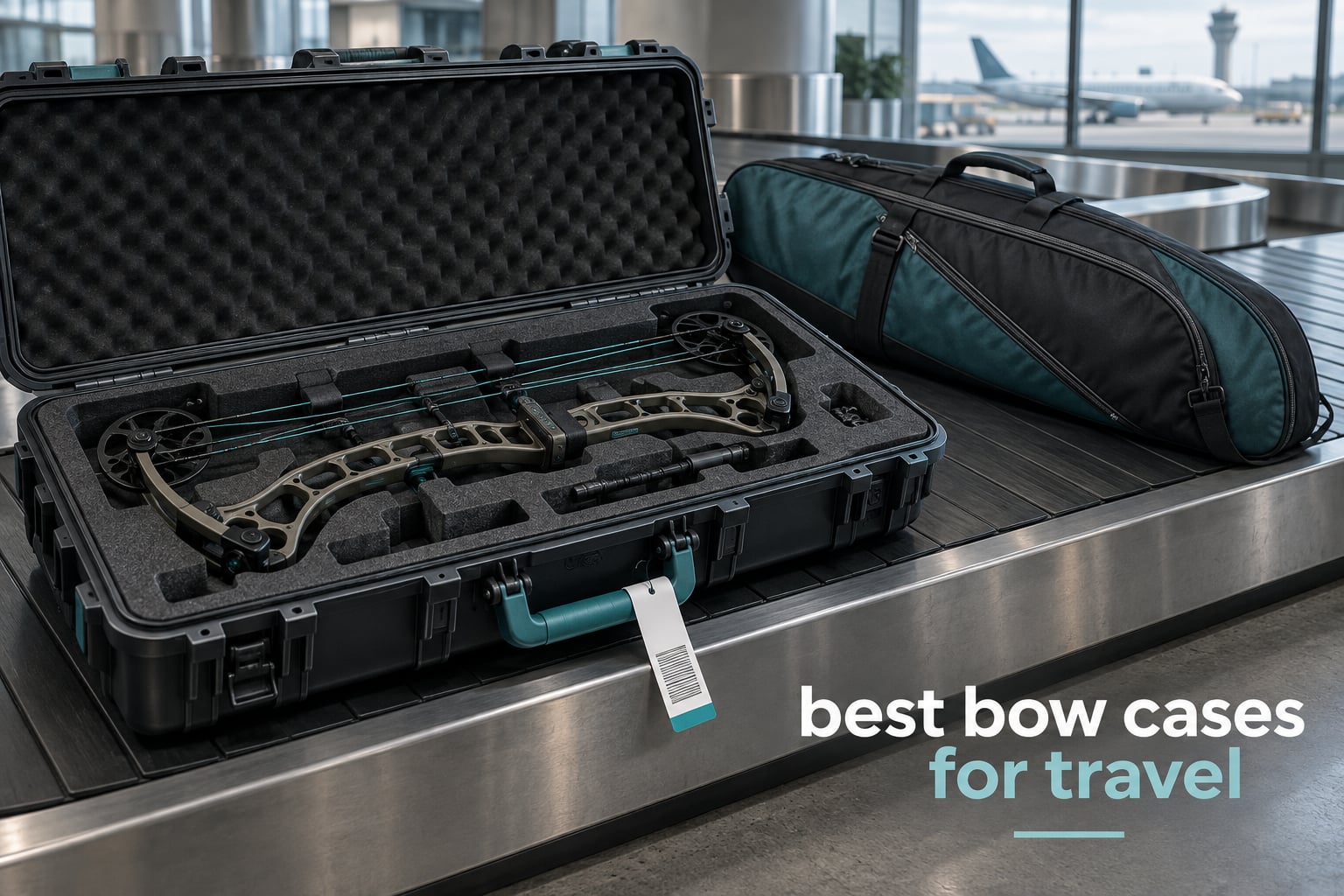
There is a specific moment before every out-of-state hunt when you realize the bow has to go in a bag, and the bag has to survive a conveyor belt. That is the whole problem this roundup solves: finding the best bow cases for travel without paying flight-grade prices for protection you will never use, or hauling 24 pounds of hard shell through a connecting airport for a weekend tournament.
Two clarifications before we start. These are archery bow cases, for compound, takedown recurve and crossbow rigs, not violin or cello cases. And the ranking below is built on published manufacturer specifications, retailer listings and owner reports in the archery community, with every case scored on the four numbers that actually decide a trip: empty weight, outside dimensions, whether it lands under the 62 linear inch oversize threshold, and how the bow is held inside.
We pulled ten cases across every format that travels well: fitted soft compound bags, a universal takedown recurve case, three crossbow cases, a foamless hard case, a pre-cut wheeled hard case, and two flight-grade molded shells. If your idea of travel is a truck bed and a gravel road, the travel jewelry cases guide covers the same principle of padding and structure at a much smaller scale.
Table of Contents
Top 3 Picks for Bow Cases That Travel (October 2026)
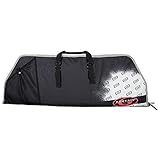
Easton Genesis 4014 Bow Case
- 16 ounce soft shell
- Custom tailored fit
- Arrow tote attachment straps
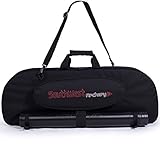
Southwest Archery Takedown Recurve Case
- Fits any 68 inch takedown bow
- Includes 12 arrow tube
- 2.5 pounds
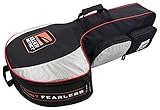
Killer Instinct SLAYER Crossbow Case
- Fits 22 by 36 inch crossbows
- Internal quiver sleeve
- 3.5 pounds
How We Chose?
Every bow case here was scored on the same four things, because those are the things that go wrong. First, empty weight, since a case that weighs 18 pounds before your bow is in it eats your checked-bag allowance before the bow even counts. Second, outside dimensions, added together length plus width plus height, because airlines charge oversize fees past 62 linear inches and that single calculation is where most expensive mistakes happen.
Third, how the bow is actually held inside the case, whether that is cut foam, an eggshell bed, a padded blanket, or a foamless chassis with tension straps. A case that merely has a compartment shaped like a bow is not protecting anything if the bow can slide. Fourth, the closure system, because a padlock gets cut off by screening agents while a TSA-approved combination lock gets opened and relocked.
We also weighted owner reports heavily. A case with a good spec sheet and a hundred reviews describing bent cams is not a good case. Cases that perform badly on one axis, such as a soft shell arriving permanently creased or an interior too narrow for a mounted stabilizer, are called out plainly in the reviews below rather than buried.
10 Best Bow Cases at a Glance (October 2026)
| Product | Specifications | Action |
|---|---|---|
| Easton Genesis 4014 Bow Case |
|
Check Latest Price |
| Southwest Archery Universal Takedown Recurve Bow Case |
|
Check Latest Price |
| Killer Instinct SLAYER Crossbow Case |
|
Check Latest Price |
 AC Allen Titan Copperhead Crossbow Case AC Allen Titan Copperhead Crossbow Case |
|
Check Latest Price |
 Legend Apollo Soft Bow Case Legend Apollo Soft Bow Case |
|
Check Latest Price |
 Wicked Ridge Ambush Bowpack Wicked Ridge Ambush Bowpack |
|
Check Latest Price |
 Flambeau Outdoors Formula Bow Case Flambeau Outdoors Formula Bow Case |
|
Check Latest Price |
 Case Club Compound Bow Case Gen 2 Case Club Compound Bow Case Gen 2 |
|
Check Latest Price |
 Ravin Hard Case Ravin Hard Case |
|
Check Latest Price |
 SKB Ultimate Watertight Double Bow Case SKB Ultimate Watertight Double Bow Case |
|
Check Latest Price |
1. Easton Genesis 4014 Bow Case: the fitted soft case that just works
Easton Genesis 4014 Bow Case, Black, Fitted
16 ounces
Soft fitted shell
2 compartments
Arrow tote attachment straps
Pros
- Custom tailored fit that zips without stretching
- Lightest case in the test at 16 ounces
- Integrated arrow tote straps
- Mesh accessory pocket
Cons
- Very snug around the cams at full draw weight
- A sight or mounted accessory can block the zipper
- Only a single snap closure and one exterior pocket
This is the case that solved the basic problem for us. A compound bow goes in, the zipper closes without any argument, and the whole thing weighs one pound. For a bow that lives in a trunk or a truck bed between the house and a range, that is the correct amount of case, and the 4.8 average across more than 1,100 ratings reflects how uneventful it is.
The construction is rugged high-denier poly with thick interior padding, and it arrives with integrated straps for an arrow tote so you are not hunting for somewhere to hang your tubes. The exterior mesh pocket is small and does not secure much, so treat it as a spot for a release or a wrench rather than for valuables.
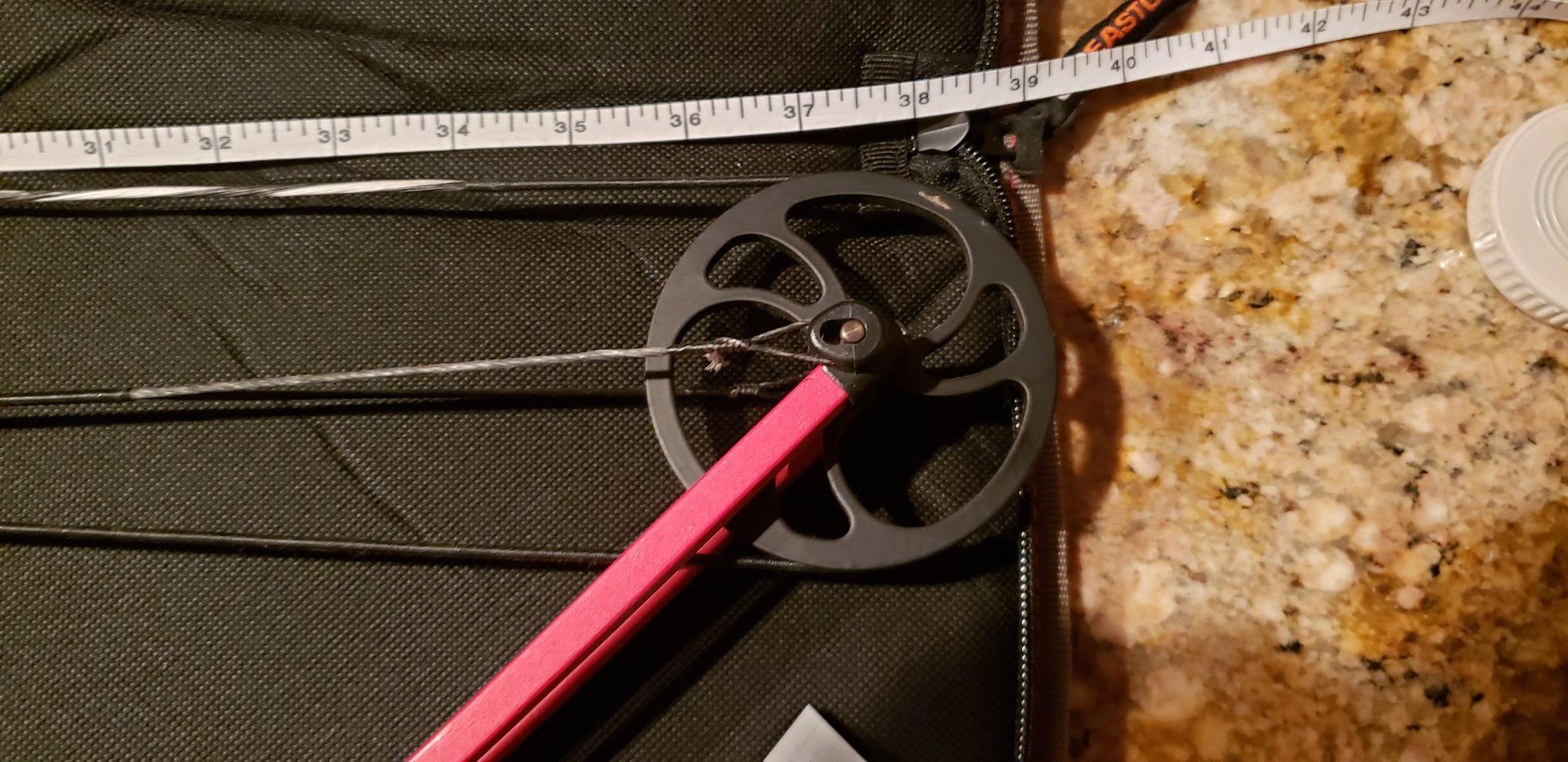
What you give up for that one-pound weight is crash protection. A soft shell cannot resist a drop onto a hard floor, and its value is scratch and weather resistance rather than abuse survival. It is also fitted, meaning it is cut for a specific bow shape rather than a general cavity.
Owners report the zipper running for years of regular use, with occasional failures replaced quickly. The material has held up better than the price suggests, and at this weight it is genuinely easy to carry through an airport on your own.
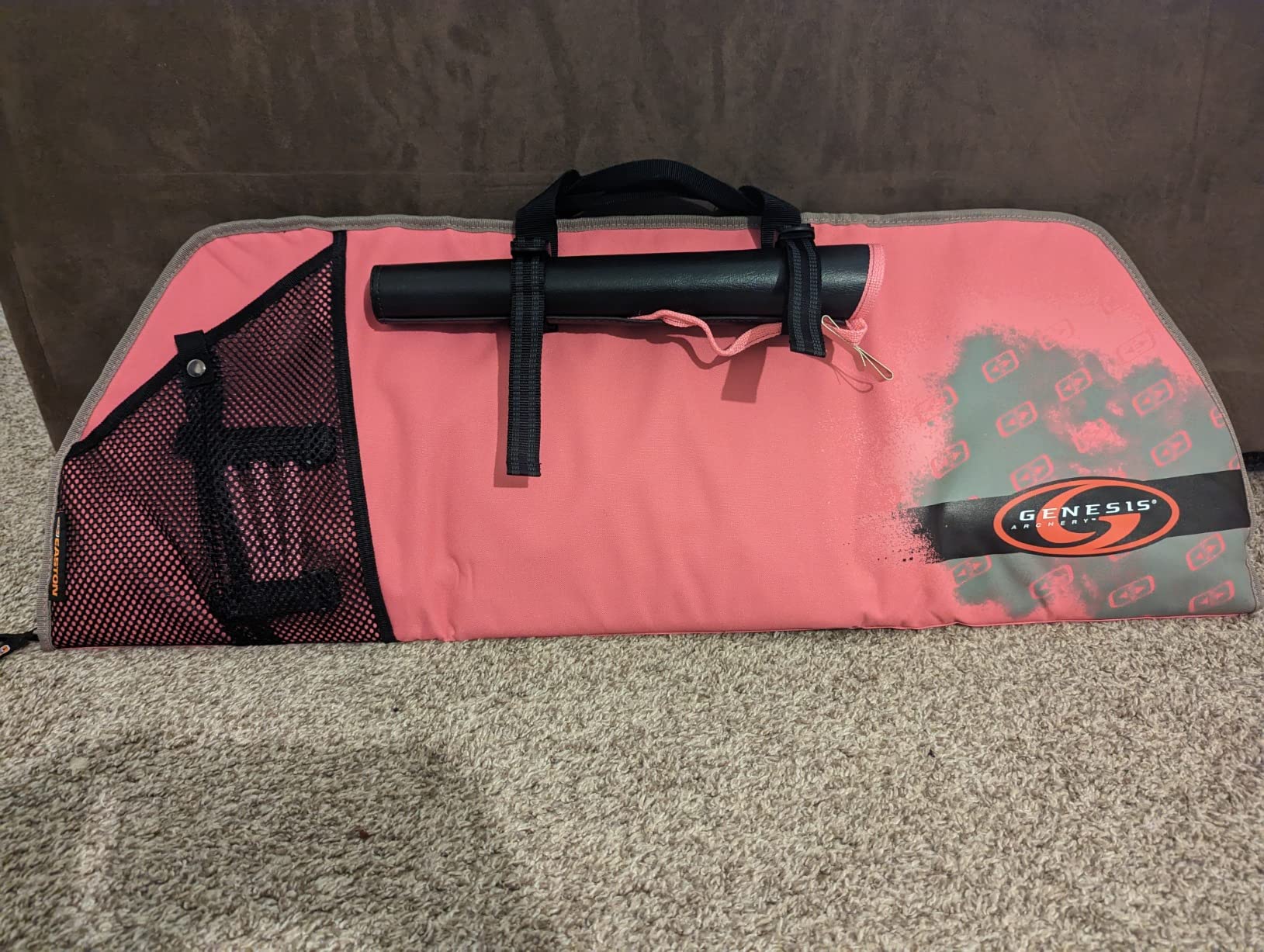
Why the close fit matters more than the padding
A fitted case holds a bow still, and a still bow is a safe bow. Loose gear inside a bag is what takes damage, because every stop and every turn becomes an impact. Padding thickness matters far less than whether the bow has anywhere to move.
The tailored shape also removes the guesswork of a general cavity, where a bow rattles against the ends on every hard stop. If your bow is one of the shapes this pattern was cut for, it is the tightest, quietest option at the bottom of the market.
Where the tight fit stops working
The fit is snug enough that owners routinely report it being tight around the cams at full draw weight, and a sight or any mounted accessory can stop the zipper closing. That is not a flaw in the design, it is a measurement requirement.
Measure your bow with everything mounted before you commit, and expect to remove a stabilizer for longer trips. The single snap closure and one open mesh pocket are also the two places to be careful about leaving valuables.
2. Southwest Archery Universal Takedown Recurve Bow Case: recurve travel made simple
Southwest Archery Universal Takedown Recurve Bow Case | Fully padded foam case includes adjustable Arrow Tube and Large Outside Pocket for Accessories – Perfect for travel
31 x 12 x 3 inches
2.5 pounds
Holds 12 arrows
3 interior slots
Pros
- Fits any 68 inch takedown bow or longbow
- Three slots separate the riser from the limbs
- Includes a hard plastic tube for 12 arrows
- Shoulder strap plus wrap handles
Cons
- Light foam handles bumps rather than drops
- Standard duty zippers and stiff wire framing
- Arrow tube is tight and awkward to load
- Limbs lay flat instead of on edge
A takedown recurve is the easy travel problem, and this case is the reason. The interior measures 31 by 12 by 3 inches and holds any takedown bow measuring 68 inches long, which covers the overwhelming majority of hunting recurves and longbows. The whole package weighs 2.5 pounds and measures 46 linear inches, comfortably under the 62 inch threshold.
Three interior slots run the length of the case, separating the riser from the limbs so the pieces do not knock against each other. The included hard plastic tube holds 12 arrows and still leaves room for a stabilizer, which is unusual at this level and saves you a second case.
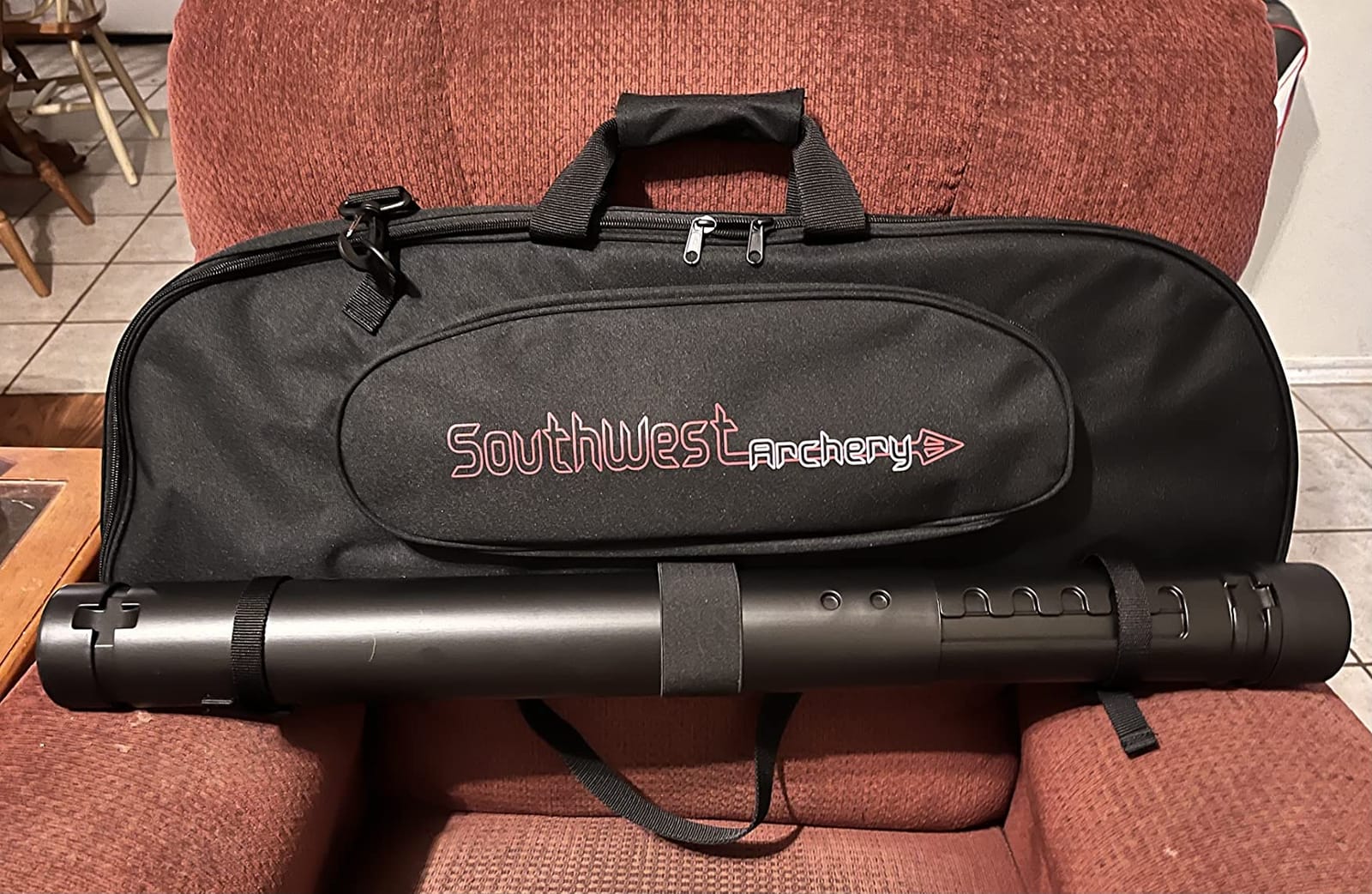
Owners buy it as a range bag, not just a travel case, and many carry it by shoulder strap or bicycle to the field. The large exterior pocket takes a stringer, arm guard, glove and tab, which covers everything you need for a day shoot plus a couple of days of clothes.
The build is tear-resistant black polyester, and the wrap handles plus quick-release shoulder strap give you two ways to move it. This is the case we would hand to someone who has never flown with a bow and does not want the first experience to involve a hard shell.
Why a takedown recurve is the easy travel problem
Because there is nothing to disassemble that matters. A compound bow has cams, cables, a sight and a stabilizer, all of which are precision parts that can bend. A takedown recurve separates into a riser and two limbs, and the limbs are the two most durable components on the bow.
That means a soft case with foam padding and separating slots is genuinely sufficient, and the entire budget on airline fees can go to something else. For most recurve archers this is the whole answer to flying with a bow.
Where light foam runs out
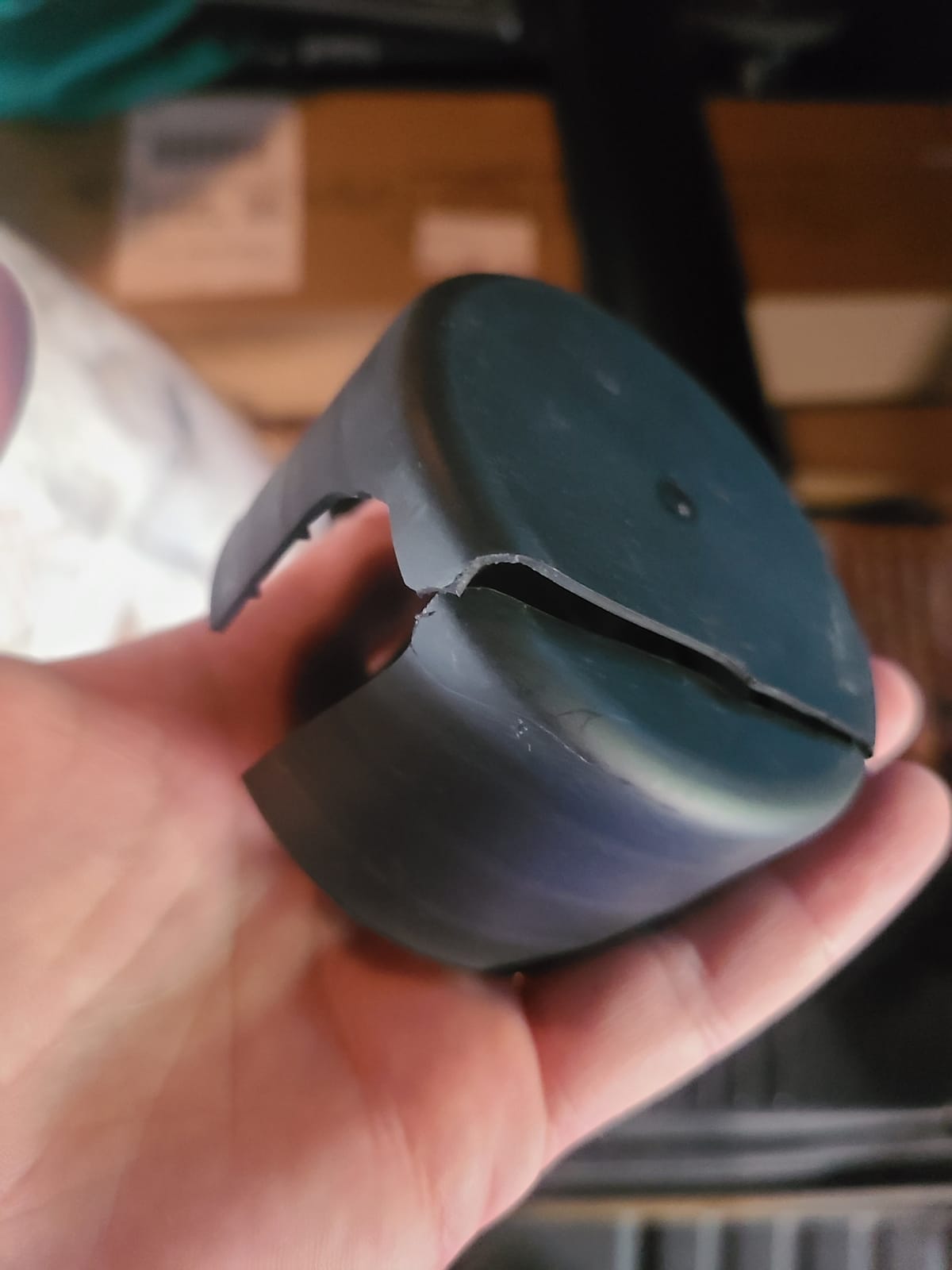
The padding protects against scuffs, abrasion and light bumps, not against a drop from height. Reviewers are candid about that, and the standard duty zippers, some of which are made harder to close by the internal wire framing, are the parts most likely to disappoint over years of use.
The arrow tube is also a tight fit that can crush broad fletching while loading. If you shoot field points with wide vanes, load carefully or carry a separate tube.
3. Killer Instinct SLAYER Crossbow Case: room without bulk
SLAYER Crossbow Case 22×36″ Black with Red Trim – Weather Repellent Shell with Internal Quiver Sleeve for Killer Instinct Crossbows
37 x 23 x 12 inches
3.5 pounds
Water repellent
4 compartments
Pros
- Fits crossbows up to 22 by 36 inches
- Internal quiver sleeve for fast setup
- Far lighter than a hard crossbow case
- Top handle plus shoulder strap
Cons
- Arrives folded and the creases never fully go away
- Soft structure gives light impact protection only
- Zipper stiff or hard to close after unrolling
Crossbow owners have historically faced a bad choice between a fabric bag that rattles and a hard case that costs more than the bow. This soft shell splits the difference for compact crossbows, holding anything up to 22 inches wide by 36 inches long with a rip-stop exterior and heavy corner trim.
At 3.5 pounds it weighs less than a hardcover book, and the layout is genuinely well thought out. A padded divider splits the interior, three internal pockets plus one external pocket hold accessories, and a dedicated internal quiver sleeve means your bolts ride in the same case as the bow rather than in a second bag.
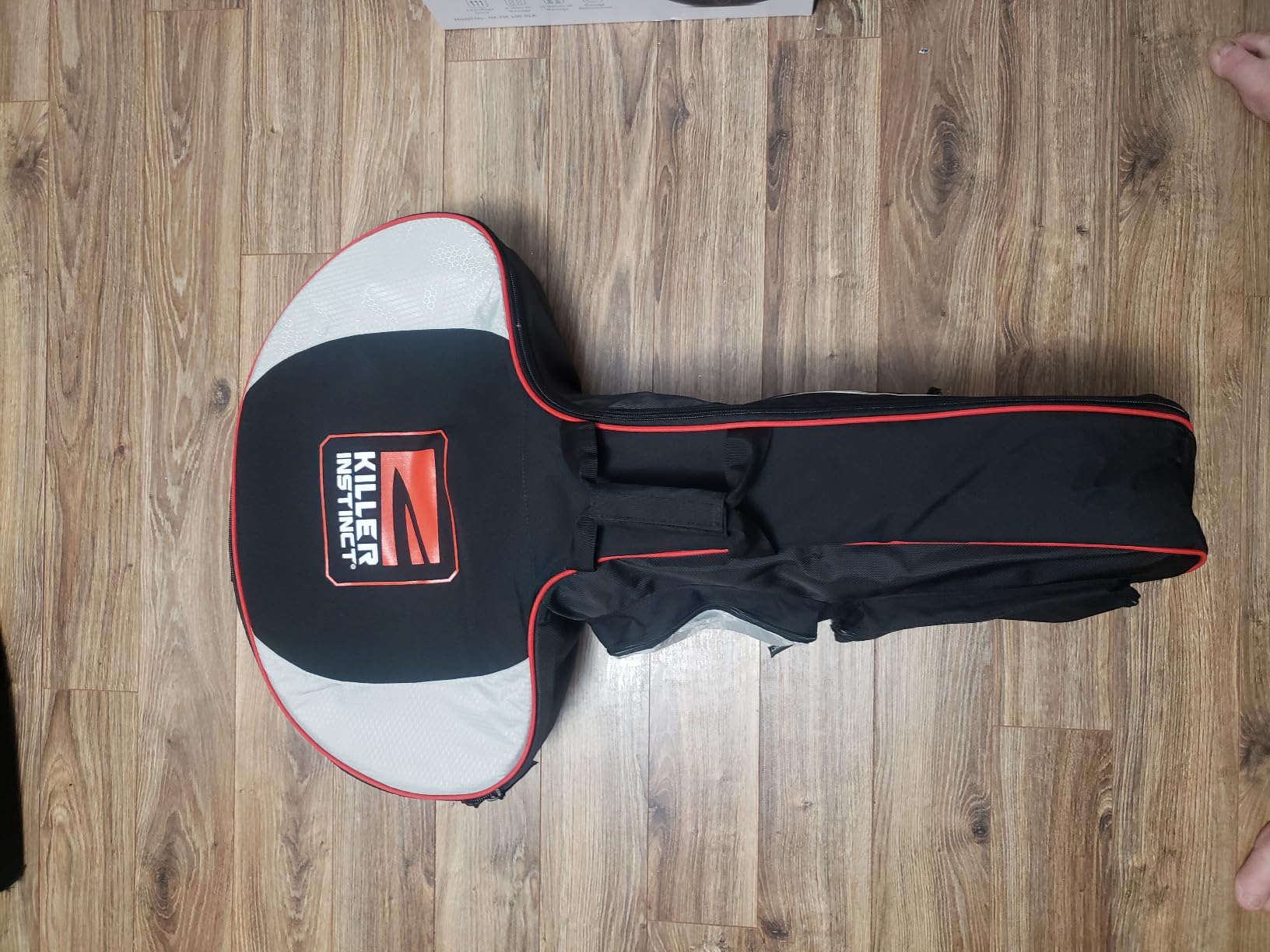
Owners report it fits crossbows from other makers whenever the dimensions are in the same neighborhood, which broadens its usefulness considerably. The top carry handle holds the crossbow horizontally and the adjustable shoulder strap handles everything else.
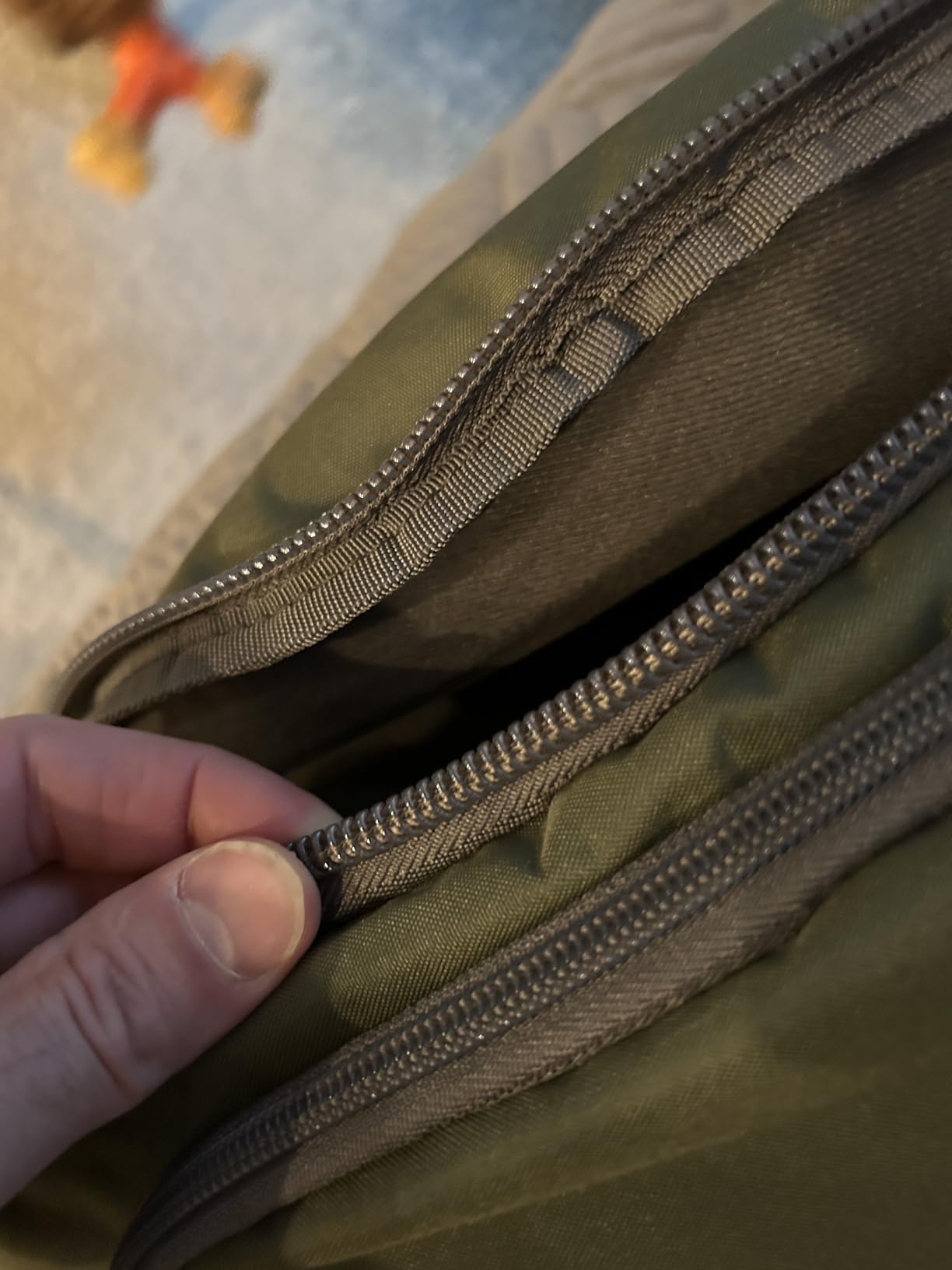
There is one honest problem that nearly every review mentions, and it is cosmetic rather than structural. The case arrives folded in half, and the creases distort both the shape and the internal padding, so it never fully recovers a clean silhouette. It does not affect protection.
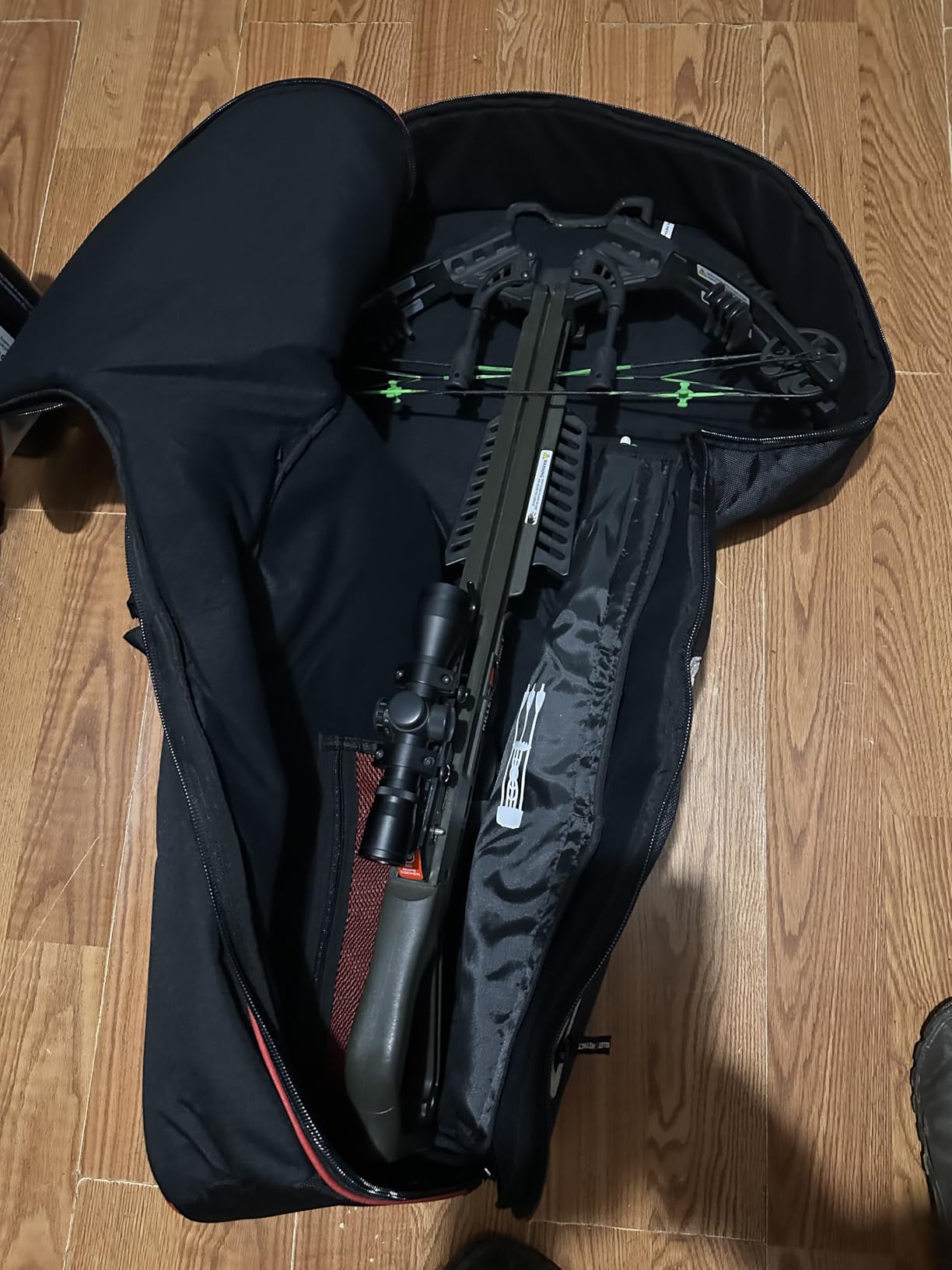
Crossbow capacity without hard case bulk
The reason hard crossbow cases feel heavy is the shell, and the reason soft ones feel dangerous is the lack of structure. A padded, rip-stop soft case with a dedicated divider and corner trim gets most of the way to a hard case for a fraction of the weight and a fraction of the bulk in a vehicle bed.
Because it weighs 3.5 pounds, packing it to a reasonable checked-bag weight is easy, which is where a 12 or 18 pound hard case forces you to make choices about what else you can bring.
The folded arrival problem
Plan for the case to look creased and misshapen out of the box. Roll it with the padding pushed back into position and let it settle, and expect the silhouette to stay a little uneven. The zipper is also reported as stiff or hard to close after the case is unrolled, which improves once the material is flexed a few times.
If appearance bothers you, this is not the case to buy. If function matters, it works well.
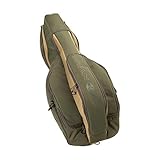
4. AC Allen Titan Copperhead Crossbow Case: the narrow limb answer
Allen Company Titan Copperhead Crossbow Case – Tricot Design – Fits 15-Inch Scoped Narrow Limb Crossbows – Pockets for Bolts, Quivers, and Other Archery Accessories – Olive/Tan – 38″ x 16″
37 x 14 x 12 inches
Tricot lining
5 external pockets
Quiver pouch
Pros
- Fits popular narrow limb crossbows including the Ravin R10 and R10X
- Five zippered pockets plus a quiver pouch
- Tricot lining shields the bow from rain and dust
- Backpack straps plus a carry handle
Cons
- Listed 14 inch width is tighter than the 15 inch claim
- Molded carry handle described as weak
- Quiver pockets really suit three bolt quivers
- Only a single carry strap
Narrow limb crossbows are a different shape problem, and this case was designed for that shape. It fits crossbows with 15 inch or less un-cocked limb width, which covers the Ravin R10 and R10X, the TenPoint Titan M1 and Venom X, and the Wicked Ridge Fury 410 and Invader M1.
Inside is a tricot lining for scratch protection, and outside are five zippered pockets plus a dedicated quiver pouch. Backpack straps and a molded carry handle give you two carrying styles, and reviewers repeatedly describe the value as strong compared with the bow manufacturer’s own case.
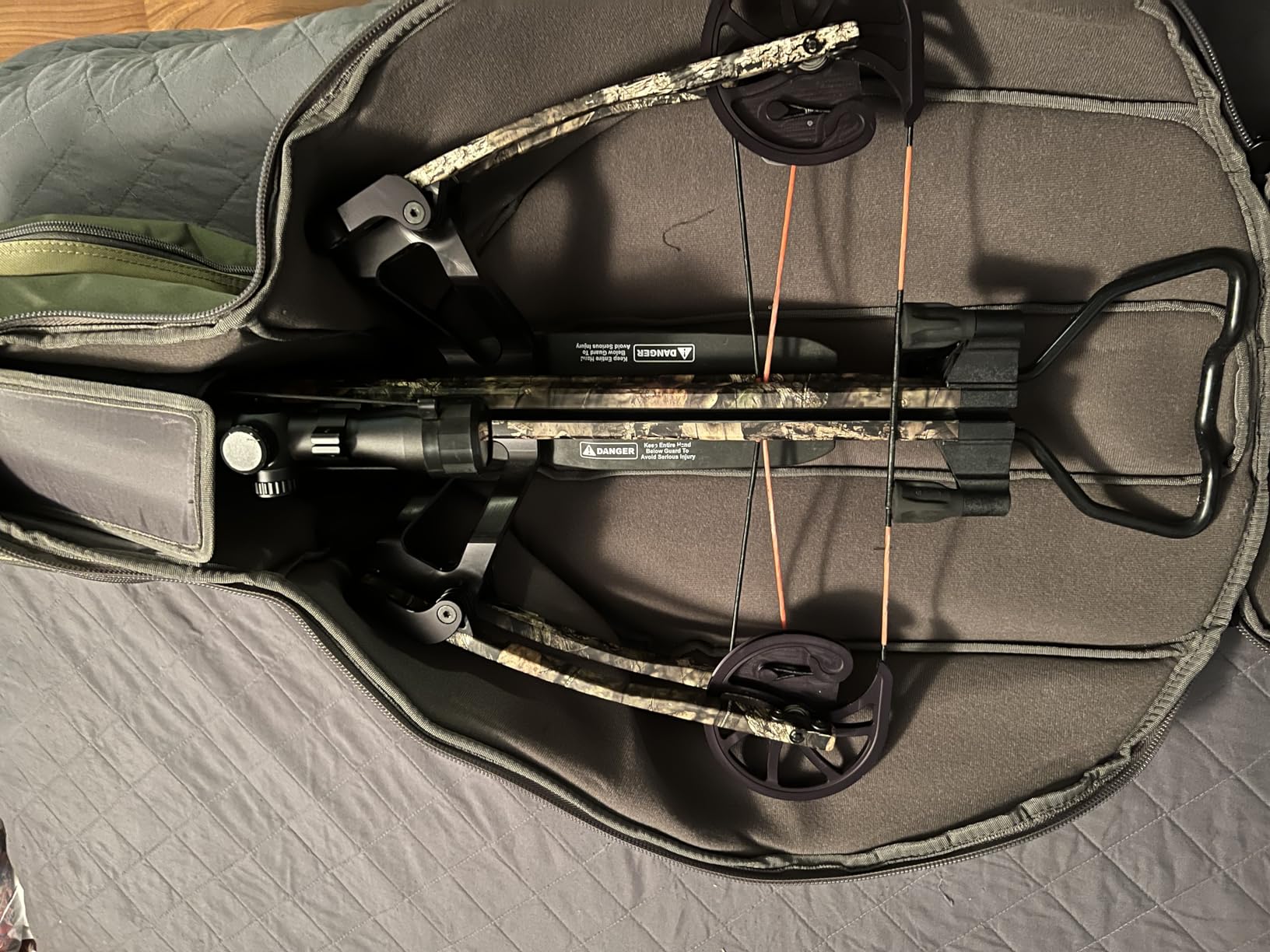
There is a specific warning here that will save you a return. The listed outside width is 14 inches while the fit claim is 15 inches, so bows at the top of that range sit crooked and the zipper closes tightly. Owners fitting a true 15 inch bow report measuring it yourself first.
External dimensions of 37 by 14 by 12 inches add up to 63 linear inches, which is one inch past the standard oversize threshold. That is worth knowing before you check it.
A written fit list beats guesswork
Most crossbow cases tell you a size range and leave you to work out compatibility. This one names the specific models it fits, which turns a purchase into a five-minute check. If your crossbow appears on that list, this is the soft case to buy.
The quilted-looking tricot exterior and water resistant construction handle mixed weather, which matters for a case that lives in a truck through hunting season rather than sitting in a closet between uses.
The width claim to read twice
Read the 14 inch listed width against the 15 inch fit claim and measure the un-cocked limb span of your own crossbow. At the top of the range the bow sits crooked and the zipper works hard, and that is a fit problem no amount of padding solves.
Two smaller notes from owners: the molded carry handle is described as weak under a full load, and the quiver pockets are sized for three bolt quivers, so four and five bolt models have to be squeezed in.
5. Legend Apollo Soft Bow Case: the tournament workhorse
Legend Apollo Travel Soft Bow Case for Compound Bow – 40″ Black/Green
41.73 x 19.69 x 3.54 inches
Soft nylon shell
Tricot lining
Arrow tube pocket
Pros
- Thick padding with soft tricot lining
- Water and rip resistant nylon shell
- Dedicated pocket for a telescopic arrow tube
- Offered in 40 and 44 inch inside lengths
Cons
- Soft shell cannot survive a hard drop
- Exterior measures about 65 linear inches
- No wheels or telescoping handle
- Single main compartment
The Apollo is the soft compound case we keep coming back to, and the reason is the choice of inside lengths. It is offered in 40 inch and 44 inch versions across eight color combinations, and that single decision resolves the most common sizing complaint in soft cases, which is a bow that fits length but not width or vice versa.
Construction is nylon with foam padding and a soft tricot lining, and the outer shell is both rip and water resistant. A front pocket is sized specifically for a telescopic arrow tube, and a padded shoulder strap with an ergonomic neoprene handle make it bearable over distance.
Owner reviews across more than 500 ratings point at the padding, the lining and the organized pocket layout as the reasons it works for tournaments and treks. Nothing about it suggests misuse; it is a good bag doing a bag’s job.
Two inside lengths solve most fit problems
Sizing is where soft compound cases usually fail, because a single length has to straddle every axle-to-axle measurement. Giving buyers a 40 inch and a 44 inch option means you can match the bow instead of hoping. Measure first, then choose.
The dedicated telescopic arrow tube pocket is the detail that separates it from a generic duffel. Your arrows ride in the case with the bow rather than as a loose second item.
What a soft shell cannot do
It will not survive a drop onto concrete, and no amount of padding changes that. If your trips are truck beds, gravel roads, boat decks and tree stands, this is more than enough. If your trips involve checked baggage and connecting flights, you are buying a different category of product.
Also note the exterior measures about 65 linear inches, which lands past the common 62 inch oversize threshold, and there are no wheels or telescoping handle to help with the weight of a full-size compound rig.
6. Wicked Ridge Ambush Bowpack: built for the tree stand
Wicked Ridge by TenPoint Ambush Bowpack, Veil Alpine/Black – Easily Transport & Protect Your Crossbow
35 x 19 x 35 inches
Soft backpack
Tricot shell
2 interior straps
Pros
- Top rubber grip handle can be hung from a tree branch
- Water resistant padded tricot shell
- Two interior hook and loop straps hold the crossbow
- Two zippered plus two elastic side pockets
Cons
- Backpack format gives up bow-shaped structure
- No rigid protection of any kind
- Does not fit brands outside its compatibility list
- External dimensions are bulky
This is not a travel case for an airport, and picking it as such would be a mistake. It is a hunting pack, and its most useful feature is the top-mounted rubber grip handle, which is designed to hang from a tree so the crossbow is in your hands the moment you are in the stand rather than on the ground below you.
The shell is padded brushed tricot with a water resistant finish, and two interior hook and loop straps hold the crossbow so it does not shift while you climb or move through brush. Two external zippered pockets plus two elastic side pockets take a water bottle and a quiver.
Wicked Ridge and TenPoint owners tend to buy it as part of a complete hunting system, which is the right frame. At a 4.8 average with 132 ratings it is well regarded, but the rating reflects a satisfied existing customer base rather than broad appeal.
A pack format built for tree stands
Backpack cases solve a different problem than flight cases. Once you are in hunting terrain, hands-free carry, a hang point and a place for a bottle matter far more than a rigid shell. A crossbow is heavy, bulky and awkward on a shoulder strap, and a pack puts the weight on your back where you can climb with it.
The two interior straps are the detail that makes it usable. A crossbow sliding in a pack is a crossbow coming apart at the limbs.
Straps and structure are the compromise
A pack gives up everything a molded shell offers: there is no crush resistance, no weather seal, no way to keep a mounted scope from taking a hit. For driving to a stand, waiting, and driving home, that is a reasonable trade. For a checked bag on a commercial flight, it is not.
Check the published compatibility list before buying. It covers a long line of Wicked Ridge models, and crossbows from other brands fall outside what the interior straps and shape are designed for.
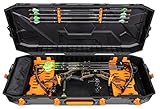
7. Flambeau Outdoors Formula Bow Case: hard protection without foam
Flambeau Outdoors Formula Bow Case Foamless ABS System Fits 43″ Bows, Black
18.25 pounds empty
Hard shell
Fits 43 inch bows
Foamless chassis
Pros
- Foamless chassis with a shock absorbing rubber membrane
- Pressure release valve and weatherproof gasket
- Sights and cams can stay mounted
- Quiver-to-go design
- Built in the USA
Cons
- 18.25 pounds with no wheels
- Arrives about 90 percent assembled needing a driver
- Shell flexes noticeably when unlatched
- Can be narrow for wide sight setups
The Formula is the most interesting design in the test. Instead of cutting foam around a bow, it uses an adjustable foamless chassis with a shock absorbing rubber membrane that grips the bow and holds it without crushing it. A manual air valve and a weatherproof gasket create an anti-crush chamber so pressure change in the hold or the cargo hold cannot load the shell.
It fits bows up to 43 inches overall, and because the chassis is tension-based rather than shape-based, sights, cams, cables and strings free-float instead of carrying load. The quiver-to-go design means the quiver stays attached to the bow inside the case, which saves a bag and removes a loose item.
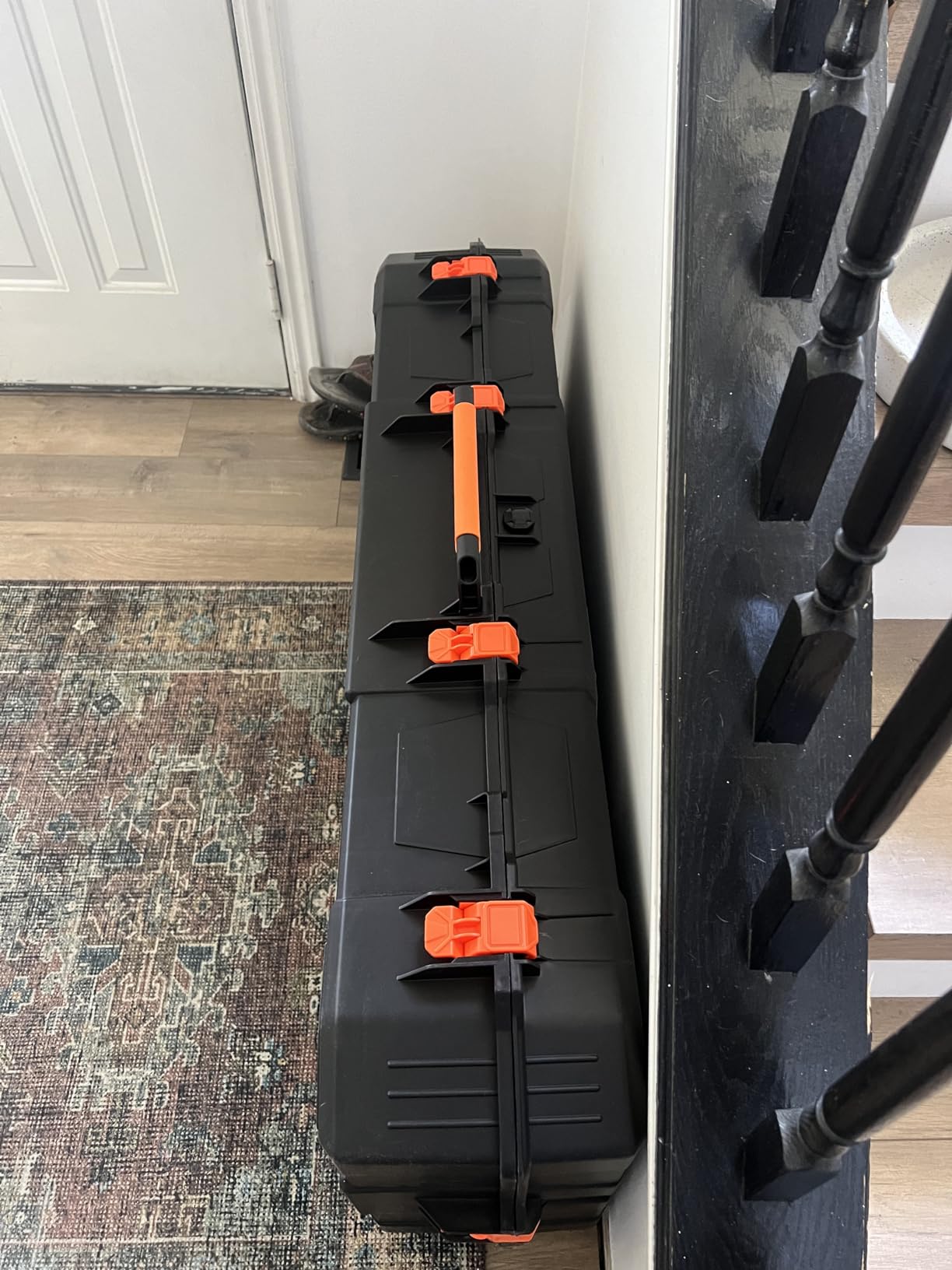
Owners moving up from soft cases value exactly those two things: the foamless retention and the ability to shoot without unbolting a sight on arrival. Several describe it as the best protection available below competition-case pricing, and it ranks third in Archery Bow Cases for a reason.
The drawback everyone repeats is weight. At 18.25 pounds unloaded, with no wheels, this is a case you carry rather than roll, and it arrives about 90 percent assembled needing a screwdriver or a low-powered driver to finish.
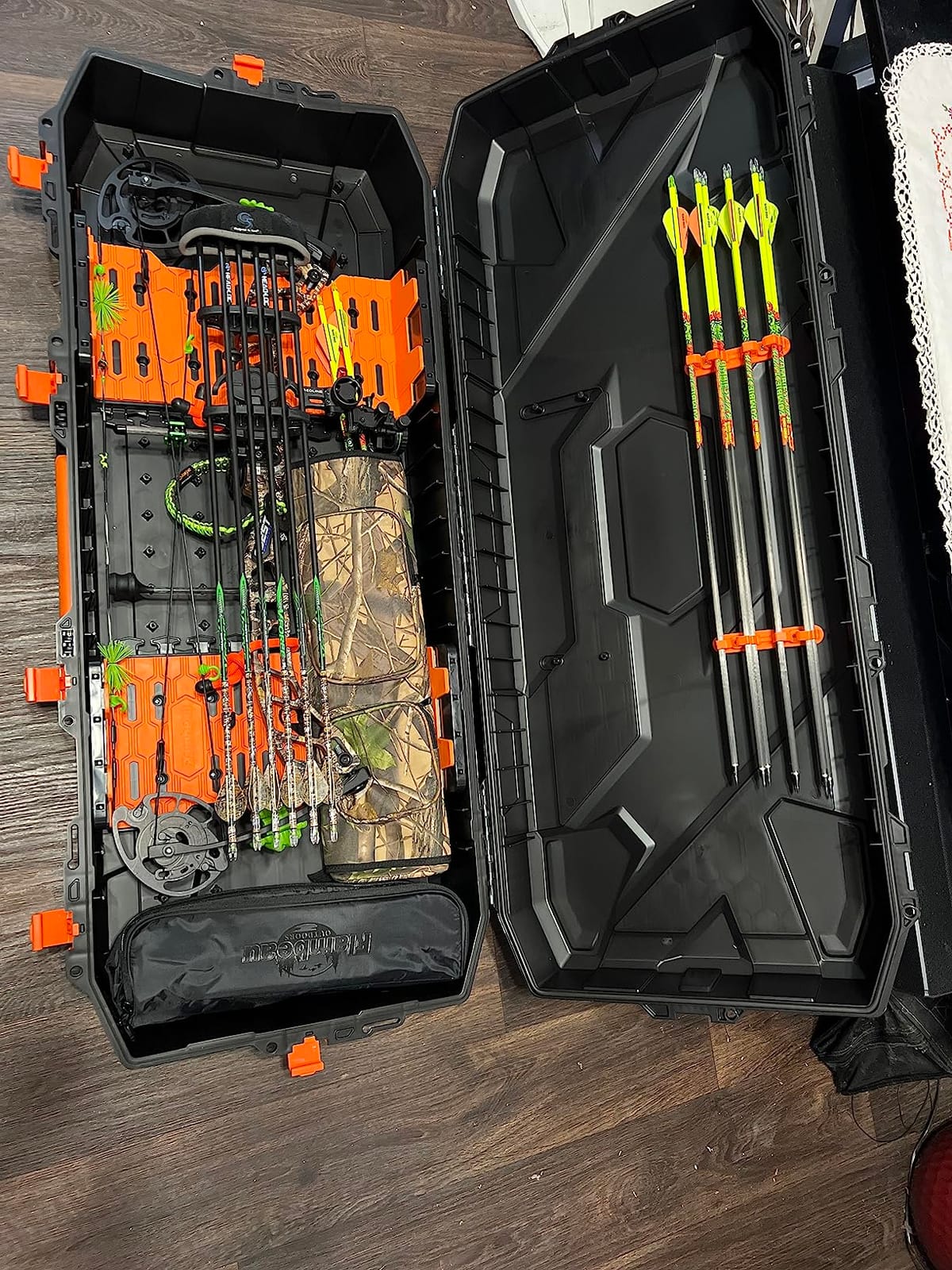
Foamless retention solves the mounted sight problem
Cut foam cases force a choice: remove the sight and stabilizer, or cut the foam yourself. The Flambeau chassis sidesteps that entirely because the bow is held by a tensioned membrane rather than a cavity, so a mounted bow with accessories stays mounted and stays unloaded.
For an archer who values walking in and shooting quickly, that matters more than the foam debate. The air valve and gasket add a second layer, since an air chamber resists the crush that a sealed case full of air would otherwise experience with altitude change.
Eighteen pounds with no wheels is a carry
Empty weight is where hard cases lose their argument, and 18.25 pounds is squarely in the range where owners report it being too heavy to move comfortably. Add a bow and it competes directly with your checked-bag allowance before you have packed a single sock.
Two more practical notes: the shell flexes noticeably while unlatched even though it feels solid once closed, and some wide sight-to-string target setups exceed the interior width. Measure the widest point of your bow with everything mounted before ordering.
8. Case Club Compound Bow Case Gen 2: the airline-ready choice
Case Club Compound Bow Case Gen 2 – Pre-Cut, Wheeled & Waterproof
46.75 x 19.5 x 9 inches exterior
Wheeled
Waterproof
TSA approved
Pros
- Arrives airline ready with pre-cut foam and TSA approval
- Tilt wheels and a swivel handle for a heavy case
- Watertight gasket and pressure relief valve
- Fits bows to 35 inch axle to axle plus 12 arrows
Cons
- Exterior measures about 75 linear inches
- Heavy and bulky in a vehicle
- Tight interior width for wide cams or long stabilizers
This is the case that ticks the airline boxes that the rest of the test does not. It is TSA approved for checked luggage, it comes on tilt wheels with a swivel handle, and the gasket seal plus pressure relief valve make it watertight, dustproof and airtight. For someone whose bow is flying on a regular basis, those are not nice-to-have features.
It also arrives ready to use. The pre-cut foam cradles the bow and a set of 12 arrows, so there is no cutting session, no saw and no glue. The fit covers a parallel limb compound bow up to 35 inches axle to axle, which is most of the current field, plus accessories in the remaining space.
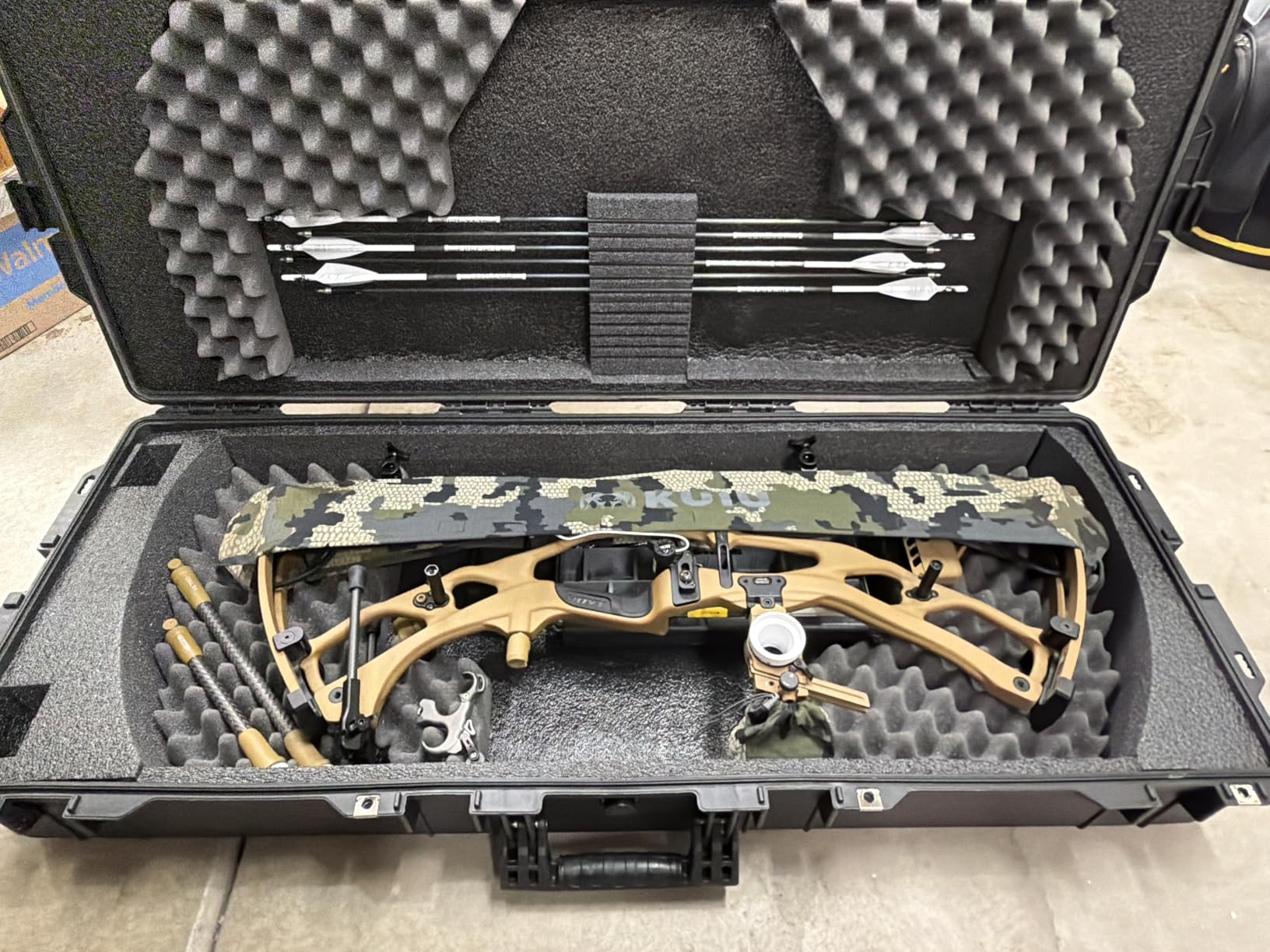
The shell is injection-molded high-strength copolymer polypropylene with reinforcing ribs, six latches, stainless steel hinge pins and a pressure relief valve. Removable spacer foam adjusts for different riser heights and separates arrows, which slows fletching deterioration over a long trip.
Owner feedback centers on exactly that combination: pre-cut foam, a watertight seal and wheels that make a heavy case manageable through an airport. The complaints that do appear are about physical limits rather than failures.
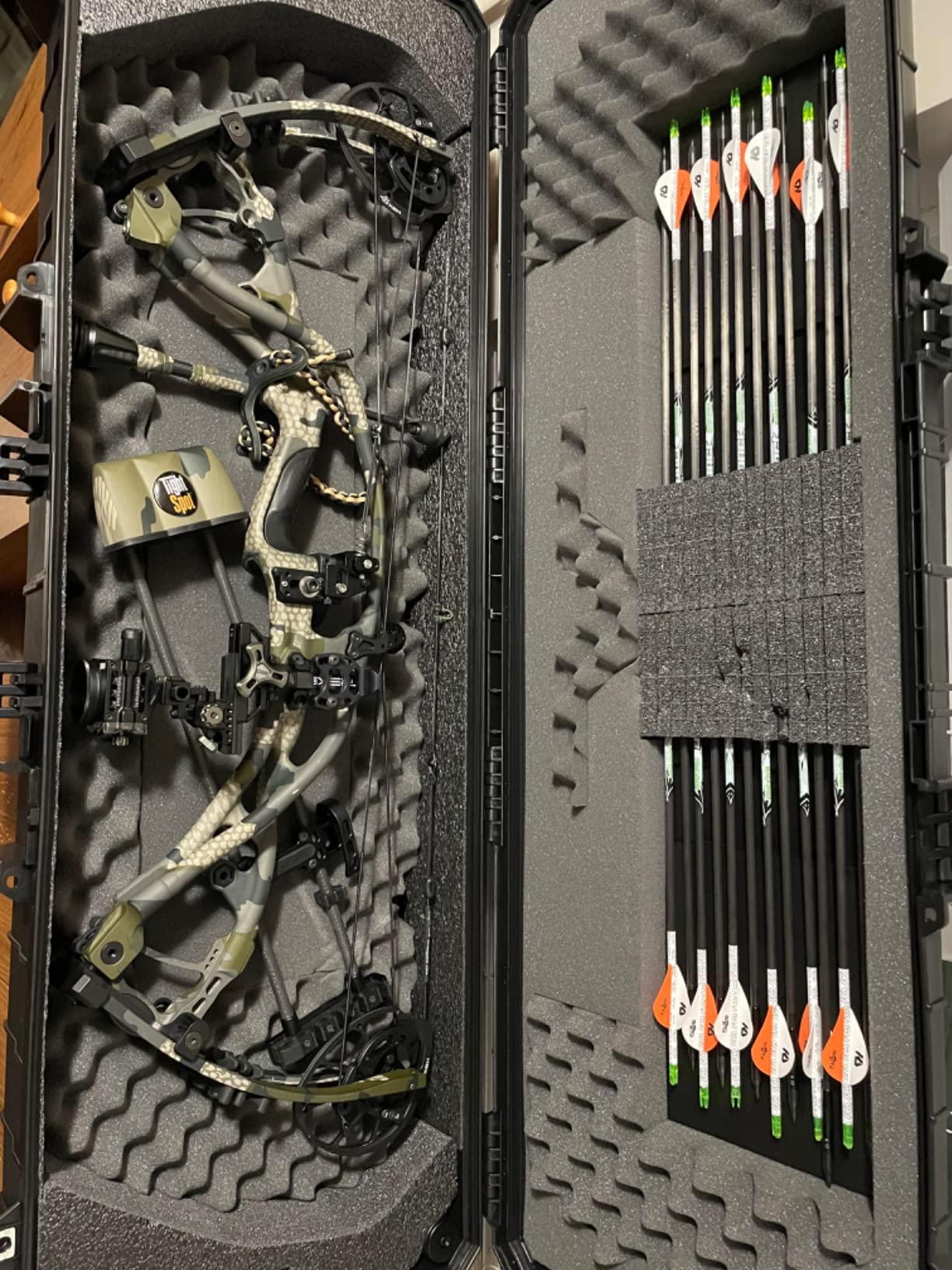
Arrives airline ready with foam already cut
Pre-cut foam removes the single most skipped step in hard case ownership. Uncut generic foam has to be marked, cut and glued, and most people either skip it or do it badly, which is exactly the situation where a bow ends up rattling against the shell wall.
TSA approval is the other thing that saves a bad morning. Screening agents open and relock an approved lock without cutting it, whereas a non-approved padlock gets severed and you find out at your destination.
Bulky outside and tight inside
Exterior dimensions of 46.75 by 19.5 by 9 inches come to roughly 75 linear inches, comfortably over the 62 inch threshold, so expect an oversize charge on most itineraries. Budget for that rather than discovering it at the counter.
Inside is tighter than most owners expect, and reports of wide cams or long stabilizers not fitting are the most common reservation. Measure the widest point of your rig including the sight, then subtract nothing.
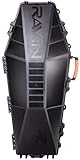
9. Ravin Hard Case: protection for an assembled crossbow
RAVIN Hard Case for R9/R15/R10/R10X/R5X/R20/LR/R470/R500 Crossbows
12 pounds
Hard shell
Fits assembled with scope
Water resistant
Pros
- Reinforced polymer shell built to take real abuse
- Fits the crossbow fully assembled with scope and quiver
- Pre-cut foam with two internal straps
- Air valve for altitude and temperature changes
- Wheels plus two carry handles
Cons
- Highest cost in the test for a single bow case
- Bow sits tight in the wider cavity with no wiggle room
- Outer clips reported broken on arrival
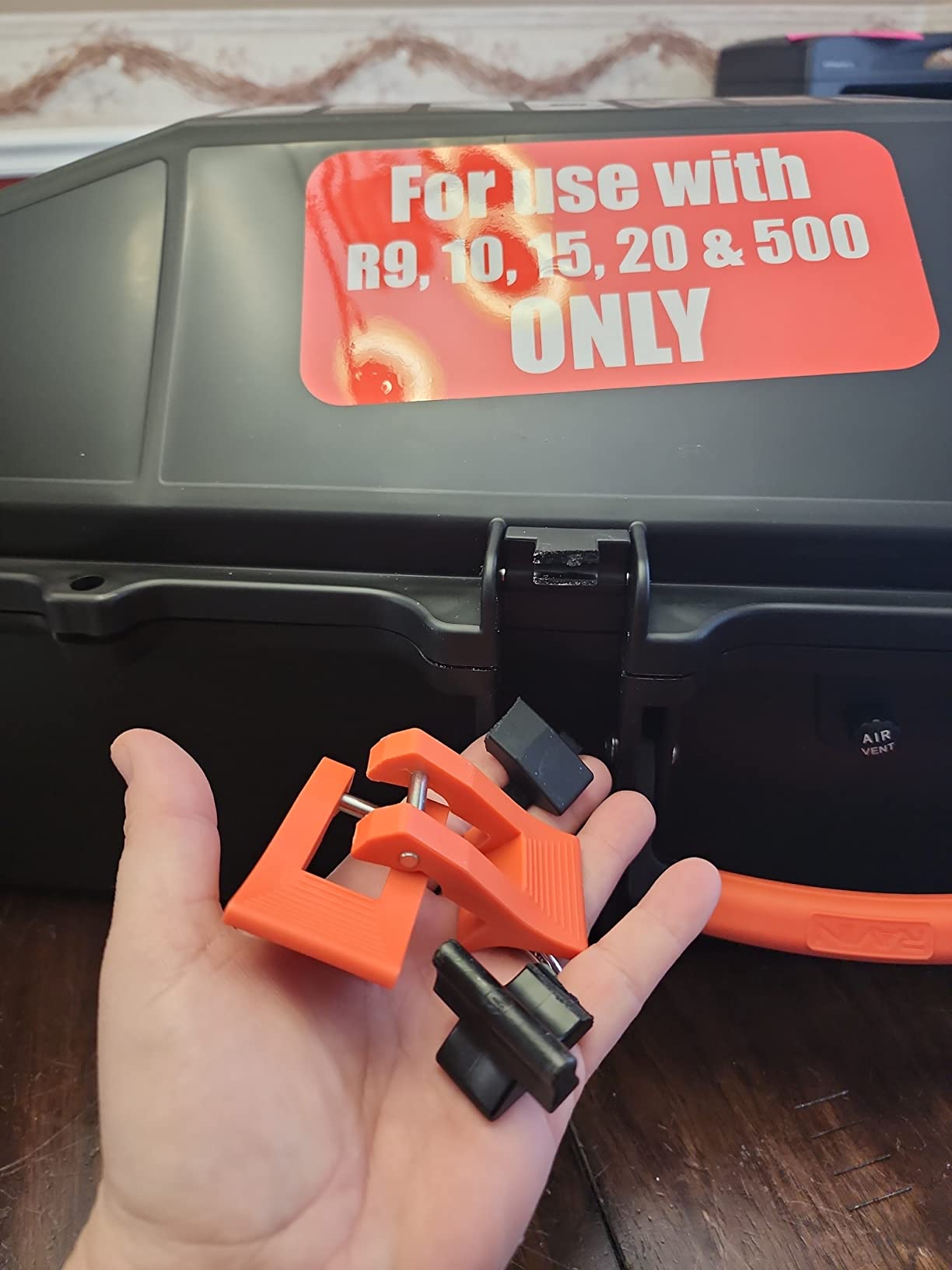
Crossbow owners spend more on the crossbow than on the bow, which is why they are the most protection-focused buyers in this category. This case fits the Ravin R9, R15, R10, R10X, R5X, R20, LR, R470 and R500 series fully assembled, with the scope mounted and the quiver attached, and still has room for arrows, a rangefinder and binoculars.
At 12 pounds it is the lighter of the two hard molded cases here, and it carries wheels on the bottom plus two wrap handles. The pre-cut foam insert cradles the crossbow and two internal straps stop anything shifting, which is the detail that separates a snug hold from a rattle.
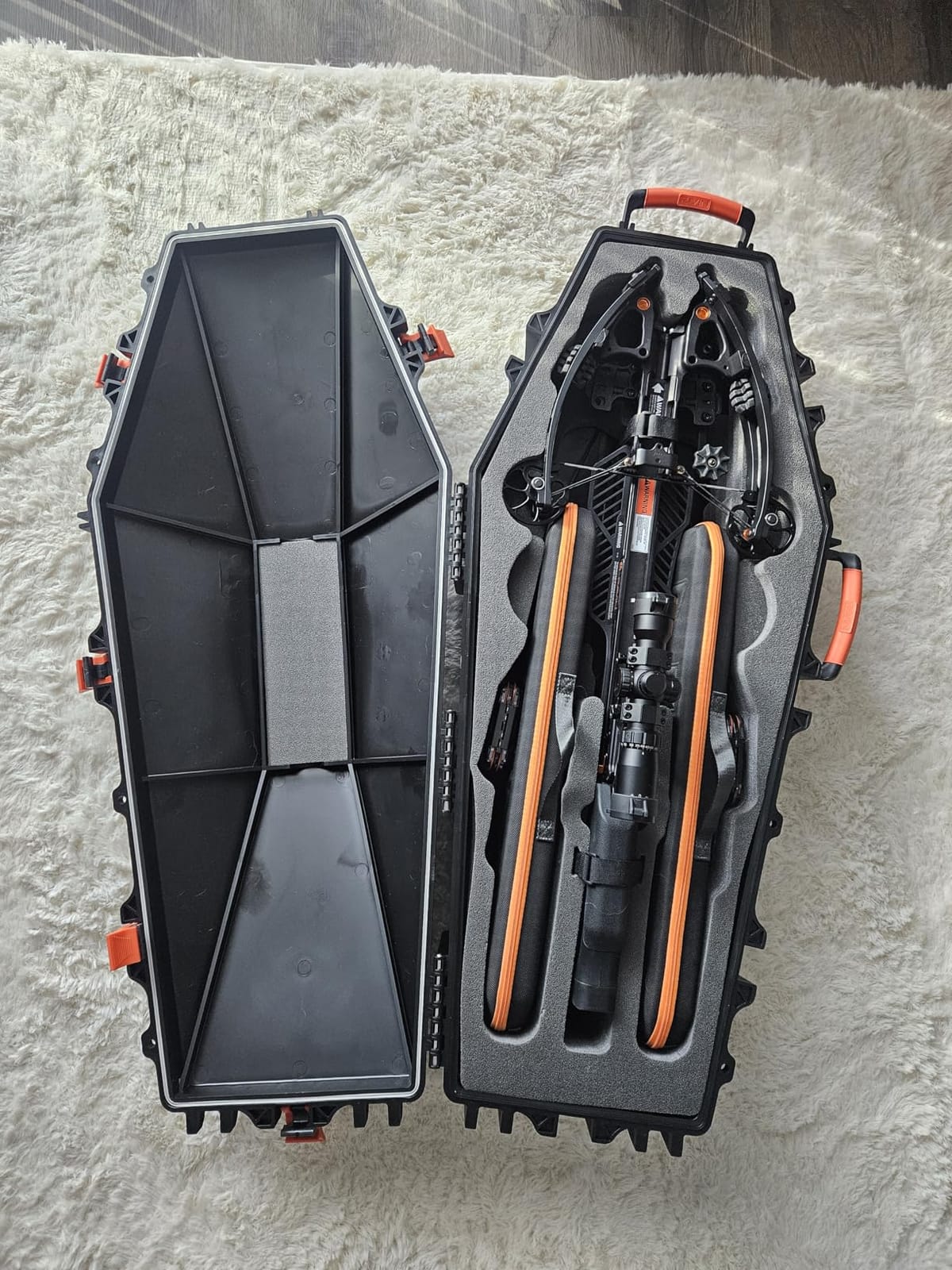
The water resistant sealed design includes a manual air valve for altitude and temperature changes, and cam-over heavy duty latches are used rather than cheap spring clips. Owners describe frequent airline check-ins, truck beds and even a rolled ATV leaving the contents undamaged, with only scratches on the outside.
Ravin has also been reported replacing broken shipping clips at no charge, which is the kind of after-sale behavior that matters when a case arrives damaged rather than failing in use.
Model specific fit is the entire point
The reason a dedicated case beats a universal hard case is that the foam is cut to the actual bow. An assembled crossbow with a scope and quiver attached is an irregular shape, and generic foam either wastes volume or presses on the scope in transit.
Here the bow goes in assembled, strapped, with accessories in the same cavity. That is a real convenience advantage for the trip from the car to the stand that has nothing to do with protection.
A snug cavity and shipping damage reports
Two reservations recur. The crossbow sits tight in the wider section with no wiggle room, which owners read as a positive in one sentence and a limitation in the next. And a small number of reports describe outer clips arriving broken, which is a handling problem on the way to you rather than a failure in the field.
For a single-bow case this is the highest cost in the test. If you own more than one crossbow, the double case below covers more ground for a similar spend.
10. SKB Ultimate Watertight Double Bow Case: two bows, or a bow and a rifle
SKB Ultimate Watertight Double Bow Rifle Case, Black
45.4 x 20 x 9 inches exterior
24.27 pounds
Waterproof
In-line skate wheels
Pros
- Rigid foam bunk bed system holds two bows or a bow and rifle
- Watertight and dust tight with TSA compatible trigger-release latches
- In-line skate wheels and cushion grip handles
- Survives conveyor belts
- changeovers and truck trails
Cons
- 24.27 pounds empty
- which is heavy against airline allowances
- Foam is not pre-cut for a bow
- Tight when rigged with two bows
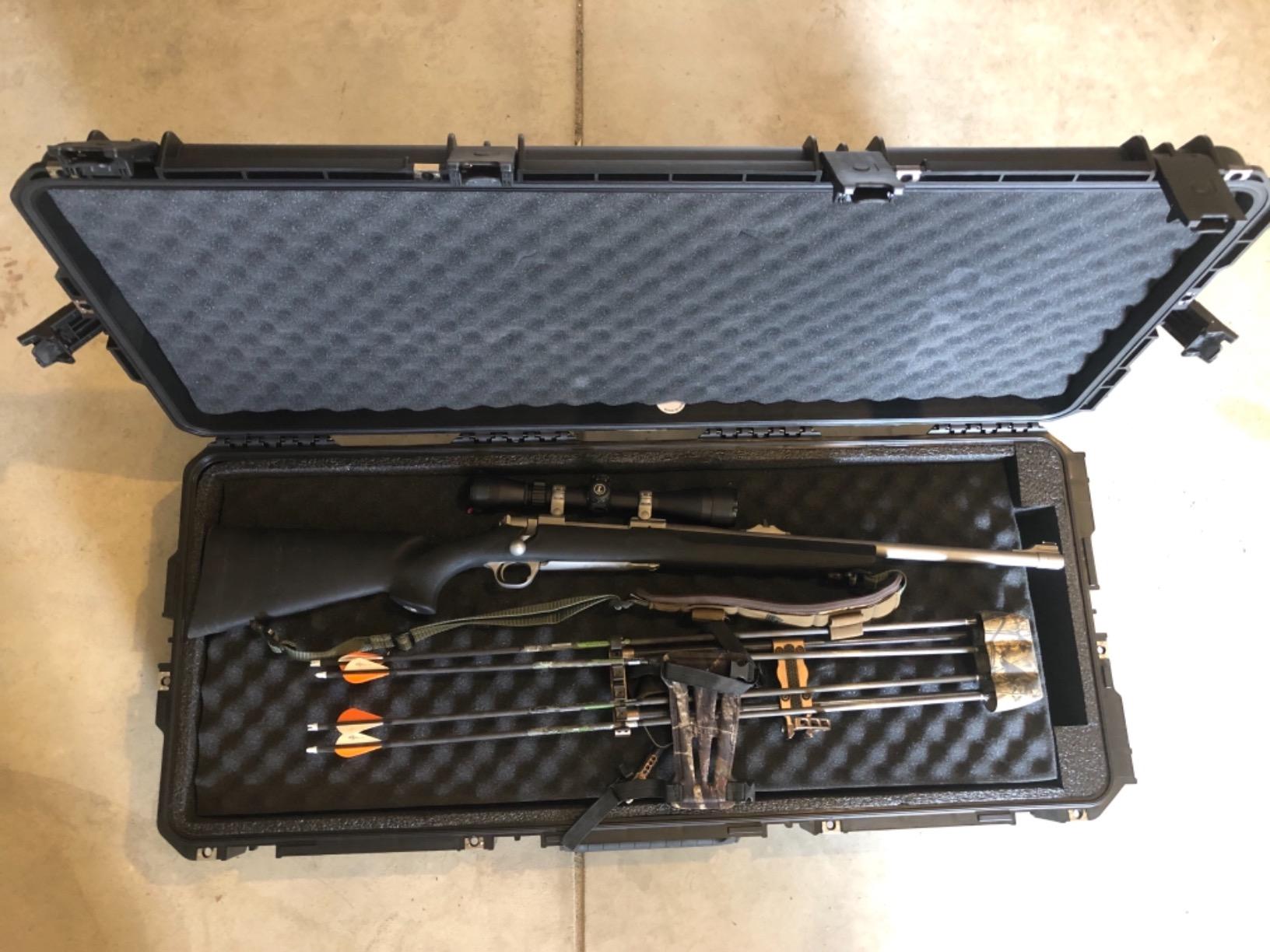
The interior measures 40 by 16 by 6.5 inches and uses a rigid foam bunk-bed system that holds two rifles, or a bow and a rifle together. For someone who owns a hunting bow and a rifle and wants one case instead of two, the logic is unbeatable. The extra volume also swallows hunting clothes and boots, which is how this case becomes your only checked bag.
The shell is waterproof and dust tight with trigger-release latches compatible with TSA locking mechanisms, heavy duty hinges and metal latches. In-line skate style wheels and cushion grip handles make a 24.27 pound case rollable rather than a lift, which matters more than the weight number at a connecting airport.
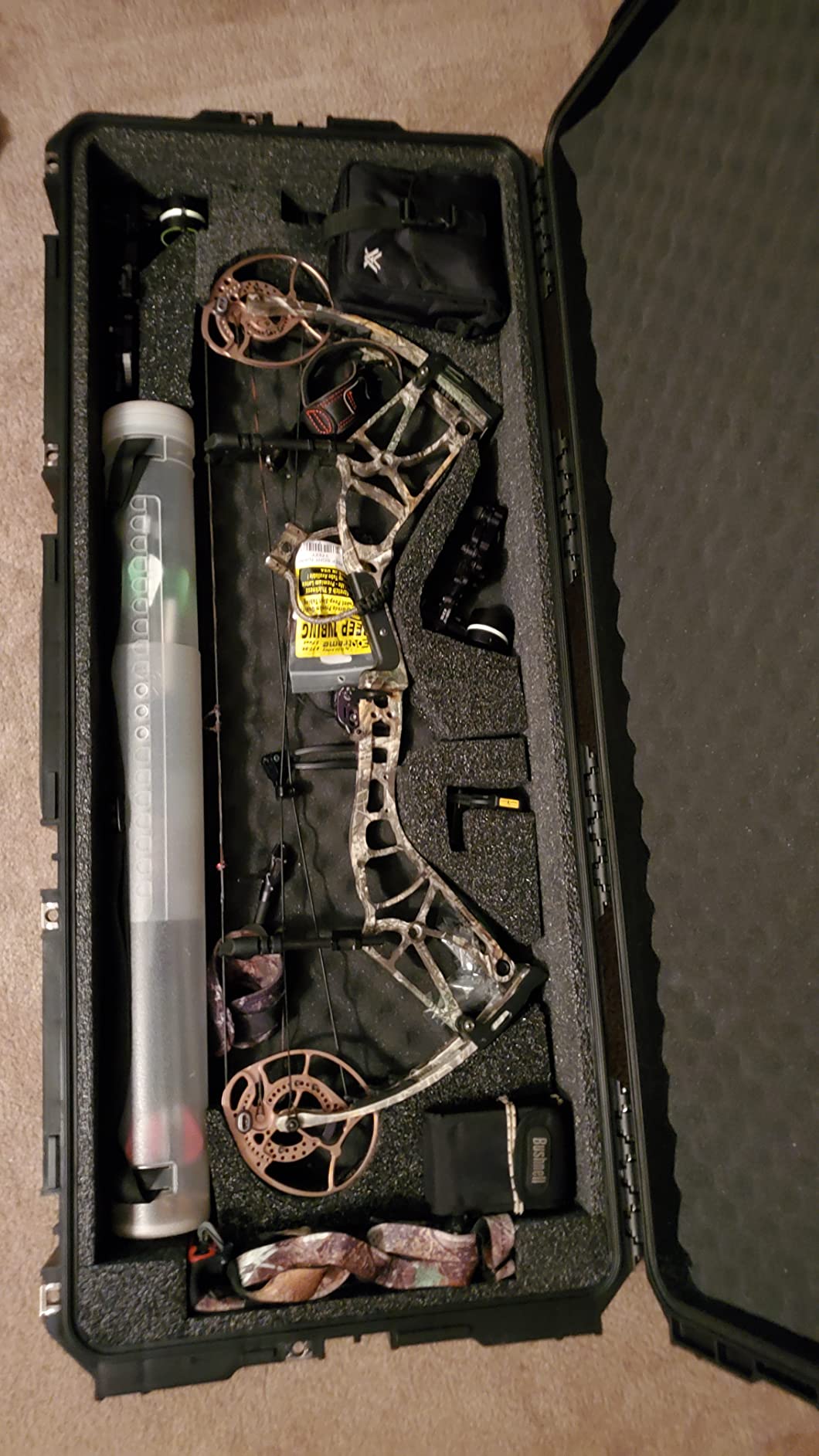
Owner reports are the most emphatic in the whole test. Bows and arrows arriving undamaged after multiple flight changeovers, conveyor belts, rough truck trails, and one case that rolled down a hill packed to a horse. Reviewers also report never once being charged as oversized baggage when flown as archery equipment.
There is genuine disagreement about this brand in the community, and it is worth being straight about it. On one Rokslide thread an SKB 4217 owner describes a case that has been around the world with no problems. On the same forum, another owner of a different iSeries model calls the design very poor and says it caused more damage than the protection provided, and a separate post recalls Alaska Air destroying the outside edge and one end of an SKB bow case in 2017.
Two bows or a bow and a rifle
The bunk-bed foam is the reason this case exists. Two bows sit in separate stacked beds, and a bow plus a rifle works equally well, which means one case covers a whole hunting kit instead of two. Riders who pack clothing around the gear also report the volume letting them check a single bag.
The catch is fitment. A tight bunk means sights may need removing when you run two rigged bows, and a bow and a rifle combination uses the length rather than the height.
Foam you will have to cut yourself
The foam is generic, not pre-cut for a bow, so it normally needs marking, cutting and gluing before the case protects anything. Budget an afternoon and a saw. This is the single largest difference between this case and the pre-cut alternative above it.
TSA locks are also not included and have to be purchased separately, so factor that into your pre-trip checklist. At 24.27 pounds empty it is the heaviest case here, and the weight is the reason it needs skate wheels.
Hard Case Vs Soft Case: both camps, and the real answer
The community is genuinely split, and no editor has resolved it, so we will not pretend to. The soft camp points to flight counts. On Rokslide, one owner reports 70 plus flights on a soft-sided case with no issues and no plans to return to a hard case, and another reports roughly 10 flights on a wheeled hard roller with enough room to pack all of their clothes and arrows so it could be checked like a regular bag.
The hard camp points to consequence. A Pelican Air Case owner on the same forum describes it as expensive but worth it, having travelled to Africa and back fully protecting the bow. Another owner flatly refuses to fly a soft case, saying he would rather be safe than sorry, and applies the same reasoning to a leading molded brand. On r/Archery the same thread opens with the observation that if you plan on flying you want a really high quality case, because luggage handlers are the concern.
Both camps are right about their own trips, which is why a single verdict does not help. Here is the decision by trip type instead.
Checked baggage, connecting flights, anything you cannot carry out the other side: hard case, no debate. The failure mode being protected against is a drop and a stack, and only a molded shell resists that.
Truck bed, gravel road, boat, tree stand: soft case. You are managing rain, abrasion and scratches, not impacts, and a soft case is lighter, cheaper and easier to store.
Recurve and takedown traditional: soft case is genuinely enough, because the limbs are the most durable parts of the bow and the case is small enough to stay under the oversize threshold.
Multi-country hunt with a long gear list: hard roller with a large interior. The extra volume lets you pack clothes around the bow and eliminate a second checked bag, which is the argument that actually moves budgets.
Crossbow under your own power, assembled: hard case with pre-cut foam, so it travels with scope and quiver mounted and nothing shifts.
One more factor sits above all of these: empty weight. A packed hard case commonly lands between 30 and 40 pounds, and pushing past the checked-bag limit triggers fees on every leg. Soft cases start at 2.5 to 3.5 pounds, which leaves room for gear. That single number explains most of the dislike aimed at hard cases.
Airline Rules That Decide Which Case You Need
Checked baggage only. A compound bow, a crossbow or a recurve does not go in the cabin. It is checked luggage, full stop, and it travels in the hold with everything else.
No weapons declaration, but the fees still apply. You do not present a firearms declaration form for a bow, yet oversize and overweight charges are entirely separate from the firearms question and are billed at the oversized-baggage counter.
62 linear inches is the number that matters. Add length, width and height of the case itself, not the bow inside it. Add up the cases in our test and the answer divides cleanly: the Southwest Archery recurve case totals 46 linear inches and stays well inside, while the Case Club wheeled case totals roughly 75 and the SKB double case roughly 74, both of which are oversize on most carriers.
The checked-bag weight limit is the second number. Aim to keep a packed bow case under the standard allowance, because the margin for error is small. Build a plan around packing clothes into the case rather than around a second bag, and a wheeled case with a wide interior makes that easy.
TSA-approved locks get relocked. Padlocks get cut. A TSA-approved combination lock is opened and re-locked by screening agents without damage. A non-approved padlock is severed, and you find that out on the far end of the journey. This is the single most avoidable travel mistake with a bow case, and it is why we weight integrated TSA latches so heavily above.
A distinctive case is a misrouting risk. A bow case looks like a bow case, and occasionally someone picks up what they assume is theirs. A name tag and contact details inside and out cost nothing.
If you are building out a travel kit for other gear too, our travel beauty kit case picks cover the same padding-versus-structure tradeoff at a different scale.
How to Measure Your Bow and Pick a Case That Fits
Most returns happen because someone measured the bow and never measured the case, or measured the bow without the accessories still mounted. The procedure is short.
Measure axle-to-axle on the unstrung bow. This is the distance between the centers of the axle pins and it is the number that drives hard case fitment. A bow with the string on is shorter, so unstring it first.
Add the sight and stabilizer protrusion. A 33 inch compound bow typically needs a case interior of roughly 40 inches once the sight and stabilizer are mounted, because the sight extends past the riser and the stabilizer sticks out in front.
Check the case interior, not the exterior. Marketing dimensions are usually outside, and outside numbers include the shell. The clearance that matters is the inside of the case.
Check width, not just length. The most common surprise is a long bow that will not zip because wide cams or a long stabilizer exceed the interior width. Measure the widest point of the rig with everything attached.
Add the arrow and accessory space. Decide whether arrows travel inside the case or in a separate tube, because cases that hold both usually have a noticeably different interior shape.
For a crossbow, the equivalent check is whether the bow fits fully assembled with the scope and quiver attached. If it only fits disassembled, you are buying a different product from the one you imagined.
Packing a Bow Case So It Survives Baggage Handling
Drop the draw weight. An unstrung or half-draw bow puts far less load on the limbs, cams and cables than one at full draw, and it is the easiest risk reduction available.
Remove stabilizers, quivers and long accessories. Anything over 8 to 10 inches will stop a soft case from zipping and presses on hard case foam. Pack them in your personal item.
Seat the bow inside the interior, not on top of it. Cut foam, an eggshell bed or a tensioned chassis only works when the bow is fully surrounded. Most in-case damage happens because the bow was never actually secured.
Pack heavy items low, near the hinge side. Weight low and forward of the wheels reduces the leverage that flips a case onto its end on a conveyor.
Use clothing as secondary padding. Rolled clothes fill the void around the bow, add crush resistance, and turn the case into your only checked bag. This is where the savings come from.
Close it and weigh it before you leave. Put the case on a scale at home. If it is over the allowance, take something out now rather than paying for it at the counter.
For a detailed look at using soft structures well, our travel case protection guide covers the same padding logic for fragile shapes.
Arrows, Bolts and Broadheads Travel Separately
Most bow cases do not handle your ammunition, and the ones that do handle it awkwardly. Arrows sitting loose in a case move, and a moving arrow is a bent arrow. Always use a tube, and pack broadheads in an enclosed hard head case rather than loose against anything.
Where a case does include arrow storage, two details are worth checking. Separated foam slots slow fletching deterioration, and an enclosed head case is a safety point rather than a convenience point. If you shoot practice heads for travel, swapping them removes the sharp components from the journey entirely.
Several cases in our test solve this elegantly: the Southwest Archery recurve case includes a hard plastic tube for 12 arrows, the Case Club case pre-cuts slots for 12 arrows, and the SLAYER and Titan Copperhead crossbow cases both have dedicated quiver storage so bolts ride with the bow.
If the Airline Damages Your Case
Airline liability for sporting equipment is real but time-limited, and the timing is the part people miss. Document and claim before you leave the airport, not the next morning.
Photograph everything before you leave the terminal. The case, the bow, each piece of equipment, and any broken latch or cracked shell. Take more photos than you think you need.
Report the damage at the baggage service desk immediately. Airlines generally cover documented sporting-equipment damage, but the report has to exist in the system while you are still there.
Keep the receipts. Repair invoices, replacement parts and temporary kit all support the claim.
File with the manufacturer as well. Manufacturer warranties cover failure that is not the airline’s fault, and several brands in this test are reported replacing broken latches, wheels or shipping clips at no charge.
Check your bow before the first shot, not the first morning. Confirm the sight is still where you left it, the peep is seated, the limb tips are uncracked, and the string is not stretched or frayed. A bow that survived the trip can still be quietly out tune.
Frequently Asked Questions
Are hard or soft bow cases better?
It depends entirely on the trip. A hard molded shell is the right answer for checked baggage, connecting flights and multi-country travel, because it resists the drop-and-stack abuse that damages cams, limbs and scopes. A soft case is the right answer for a truck bed, a boat, a tree stand or a one-bag range trip, where the risks are rain and abrasion rather than impact. Recurve archers can use a padded soft case almost everywhere, because takedown limbs are the most durable parts of the bow.
What is a TSA approved bow case?
It is a case whose integrated latches carry a TSA-approved combination lock, so screening agents can open and relock it during inspection instead of cutting it off. A non-approved padlock is severed at the checkpoint and you only discover that at your destination. Look for TSA approval stated on the latch set or the product listing, not inferred from a lock being present, because plenty of cases ship with a separate padlock hasp instead.
Can you take a compound bow on a plane?
Yes, as checked baggage only. A compound bow does not travel in the cabin, and no weapons declaration is required for archery equipment. Oversize and overweight baggage charges still apply, and 62 linear inches is the standard oversize threshold, so add the length, width and height of the outside of your case. Soft cases under about 46 linear inches stay well inside it, while large molded roller cases often land near 75.
What is the best bow case for air travel?
For a wheeled case that is ready to check without assembly, the Case Club Compound Bow Case Gen 2 is the most complete: pre-cut foam, TSA-approved latches, a watertight gasket seal, a pressure relief valve and tilt wheels. It fits parallel limb compounds to 35 inches axle to axle. Buyers who need two bows or a bow and a rifle in one case prefer the SKB double case, which is heavier at 24.27 pounds and needs its foam cut.
What are the best bow cases for flying?
Three formats work for flights. A molded hard roller with TSA locks for anything involving connections or multi-country routes. A soft wheeled roller if you want to pack clothes around the bow and check a single bag. A soft fitted case for recurve and for short, single-leg trips where the case stays under 62 linear inches. Avoid anything without a locking closure, since a case that cannot be secured is an open invitation to a claim at your destination.
What is the best hard case for a compound bow?
The Flambeau Formula is the most interesting option because its foamless chassis grips the bow with a tensioned membrane instead of cut foam, so sights, cams and cables free-float and the quiver can stay attached. It fits bows to 43 inches overall. The Case Club Gen 2 wins on arrival-readiness, with pre-cut foam and no assembly. The SKB double case wins if you carry two bows or a bow and a rifle in one shell.
How much does a bow case cost?
Prices fall into clear bands. Entry soft cases for youth and entry compounds sit at the bottom of the range. Mid-tier soft cases, including fitted compound bags and crossbow cases, sit in the middle. Hard molded cases for airline travel occupy the top band, with wheeled and pre-cut designs above plain shells. Crossbow-specific hard cases are their own category, and the two-bow molded cases are the most expensive single purchase in the category.
Final Verdict by Trip Type
If you are picking one case and nothing else, start with how the bow moves. Driving to the range, a truck bed or a tree stand means a fitted soft case is the right purchase, and the Easton Genesis 4014 is the version we would own because it weighs 16 ounces and holds the bow still. Flying a takedown recurve, the Southwest Archery universal case fits any 68 inch bow, holds 12 arrows, and stays under the oversize threshold at 46 linear inches.
Flying a compound bow, the choice is between a wheeled soft roller that lets you check one bag and a molded hard case that survives a baggage conveyor. If you want zero assembly on arrival day, the Case Club Gen 2 is the pick. If you want the bow to travel fully mounted, the Flambeau Formula’s foamless chassis does something no cut-foam case can. If you carry two bows or a rifle alongside, the SKB double case is the only one of the ten that covers that trip in a single shell.
Crossbow owners should match the case to the bow, not the other way around. The Titan Copperhead names specific narrow limb models it fits, the SLAYER handles compact crossbows with a built-in quiver sleeve, and the Ravin hard case takes an assembled rig with scope and quiver mounted.
Whichever you choose, measure your bow with everything mounted, add the three numbers that decide the trip, and check the case is a TSA-approved build before you commit. That preparation is worth more than any amount of extra padding.