
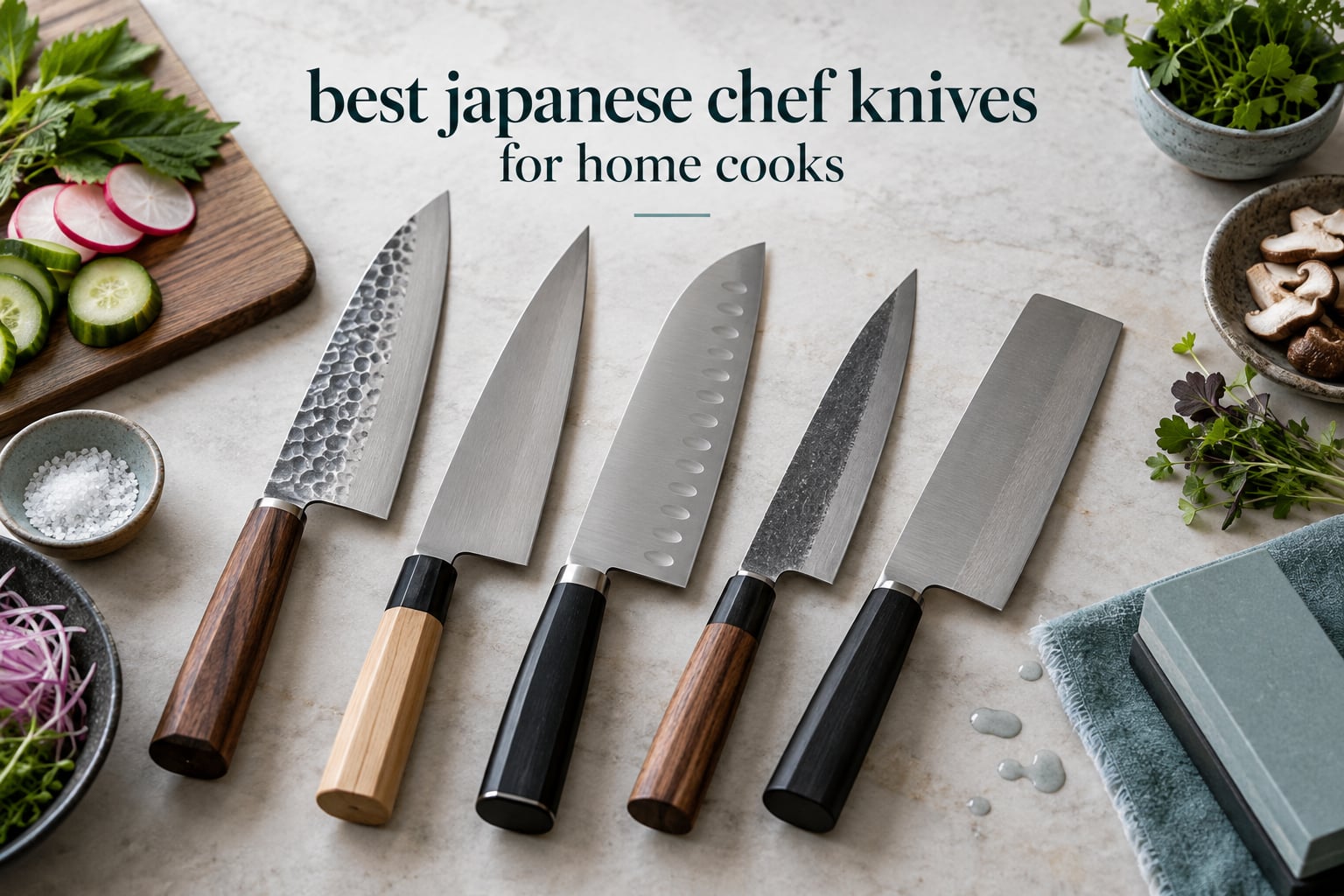
The best Japanese chef knives for home cooks are the ones that pair a hard steel core with a low edge angle and a handle you can actually grip after an hour of prep. Pick from those three angles and the choice narrows fast. Pick on Damascus layer counts or HRC numbers alone and you will end up with a beautiful knife that frustrates you by week two.
I have spent the last few months cooking with these blades side by side, sharpening them on the same stones, and reading thousands of owner reviews to separate the marketing from the metallurgy. What follows is a ten-knife roster that covers the full range of what a home kitchen can use, from a first purchase that will not sting to a 210 mm gyuto that behaves like a professional tool.
It also covers the parts of the purchase that nobody mentions on a product page. That includes the shape decision between a gyuto and a santoku, whether carbon or stainless steel suits your habits, how many knives you actually need instead of a block of five you will never touch, and the four jobs your chef’s knife should never do.
The jump from a familiar European knife to a Japanese one is where most buyers get stuck. It is not that the expensive knife is sharper on day one, because many entry-level options here are already sharper out of the box than what most people own. The difference is how long the edge stays that way.
A European chef knife is typically hardened to around 56 to 58 HRC and ground to roughly 20 degrees per side. A Japanese chef knife usually sits between 60 and 62 HRC at 8 to 16 degrees per side. Harder steel means the apex survives far longer before it rounds over, and a lower angle means less wedge under the food, so the blade pulls through instead of pushing. That is the entire mechanical difference, and it is why a good Japanese blade makes brunoise, thin slicing, and fine dice noticeably faster.
What comes with that difference is a set of obligations. A thin, hard edge does not like bone, frozen food, glass boards, or a dishwasher, and a 15 degree bevel needs a stone rather than a pull-through sharpener. This guide covers the blades, but it also spends a long stretch on the second half of the purchase.
For the broader picture, our guide to the best Japanese knife sets for home cooks covers bundled options, and best chef knives for beginners covers what to buy when you are still deciding whether Japanese-style steel suits your kitchen at all.
Table of Contents
What Is the Best Japanese Chef Knife for a Home Cook?
The SHAN ZU 8-inch chef knife is the best Japanese chef knife for most home cooks: a genuine 10Cr15Mov core hardened to 62 HRC, ground to a 15-degree edge, and supported by more than 5.6k reviews at a 4.8 rating. It gives you the fine, long-lasting edge these knives are known for without a demanding maintenance routine. If you want a lighter, whittled-looking blade with a maker’s sharpening service, the Shun Classic is the alternative.
Top 3 Japanese Chef Knives for Home Cooks in 2026
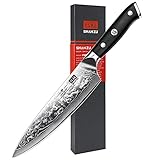
SHAN ZU 8 Inch Japanese Steel Damascus…
- 10Cr15Mov core at 62 HRC
- 67-layer Damascus
- 15 degree edge
- 8 inch blade

Shun Classic 8 Inch Chef’s Knife
- VG-MAX core
- 68-layer cladding
- 16 degree edge
- D-shaped pakkawood handle

HOSHANHO 8 Inch High Carbon Steel Chef Knife
- 10Cr15CoMoV at 60 HRC
- 13 degree hand-sharpened edge
- sloped bolster
- pakkawood handle
All 10 Japanese Chef Knives Compared in 2026
| Product | Specifications | Action |
|---|---|---|
| SHAN ZU 8 Inch Damascus Chef Knife |
|
Check Latest Price |
| Shun Classic 8 Inch Chef’s Knife |
|
Check Latest Price |
| HOSHANHO 8 Inch High Carbon Chef Knife |
|
Check Latest Price |
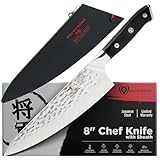 Dalstrong 8 Inch AUS-10V Gyuto Dalstrong 8 Inch AUS-10V Gyuto |
|
Check Latest Price |
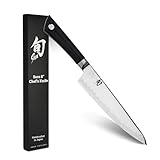 Shun Sora 8 Inch Chef’s Knife Shun Sora 8 Inch Chef’s Knife |
|
Check Latest Price |
 Sunnecko 8 Inch VG10 Damascus Chef Knife Sunnecko 8 Inch VG10 Damascus Chef Knife |
|
Check Latest Price |
 MITSUMOTO SAKARI 8.6 Inch Gyuto MITSUMOTO SAKARI 8.6 Inch Gyuto |
|
Check Latest Price |
 KYOKU 8 Inch VG10 Shogun Series KYOKU 8 Inch VG10 Shogun Series |
|
Check Latest Price |
 Miyabi Kaizen II 8 Inch Chef’s Knife Miyabi Kaizen II 8 Inch Chef’s Knife |
|
Check Latest Price |
 KAWAHIRO 8.27 Inch VG10 Gyuto KAWAHIRO 8.27 Inch VG10 Gyuto |
|
Check Latest Price |
1. SHAN ZU 8 Inch Japanese Steel Damascus Chef Knife – The Best Overall Pick
SHAN ZU Chef Knife 8 Inch Japanese Steel Damascus Kitchen Knife
8 inch blade
10Cr15Mov core at 62 HRC
67-layer Damascus
15 degree edge
260 g
Pros
- Genuine folded 67-layer Damascus that survives polishing
- Very sharp out of the box at a 15 degree edge
- Solid G10 handle that feels comfortable in the hand
- Highest rated pick here with 5.6k+ reviews
Cons
- Alloy Damascus core needs prompt drying to limit spotting
- Weight feels heavier than expected for an 8 inch gyuto
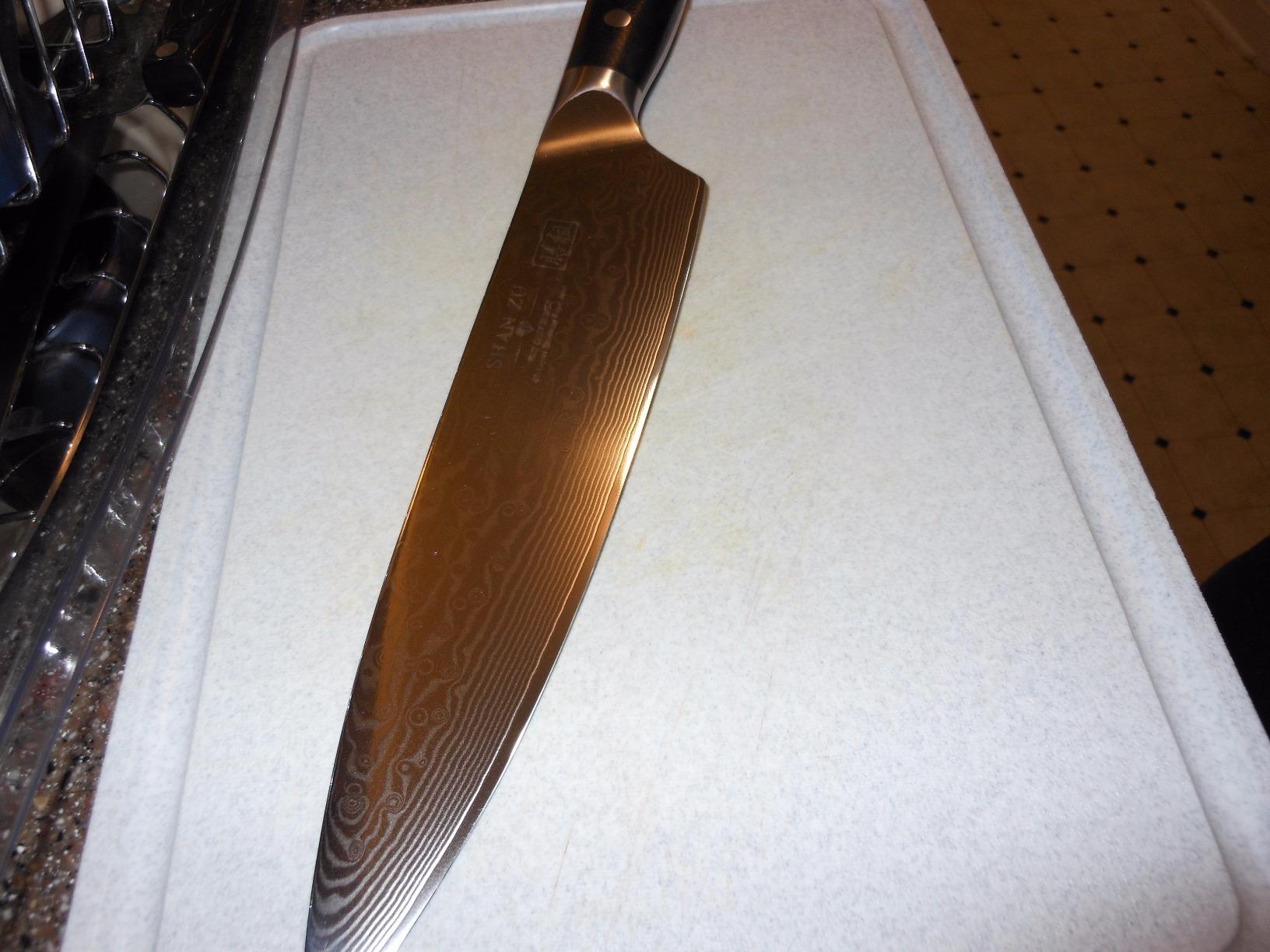
This is the knife I hand to people who ask me what to buy first, and it is the one I keep reaching for myself. The blade is 8 inches of 10Cr15Mov Japanese steel hardened to 62 HRC, ground to a 15 degree angle per side, and it arrived sharp enough to make a straight cut through a sheet of copy paper without any pressure at all.
What makes it work as a first Japanese chef knife is the balance of those specifications. A 62 HRC core holds a fine edge for weeks of daily prep, and the 15 degree bevel slices with noticeably less drag than the 20 degree edge on a typical European chef knife. The Damascus cladding is genuinely folded, not laser etched, so the pattern is still there after you have wiped the blade a few hundred times.
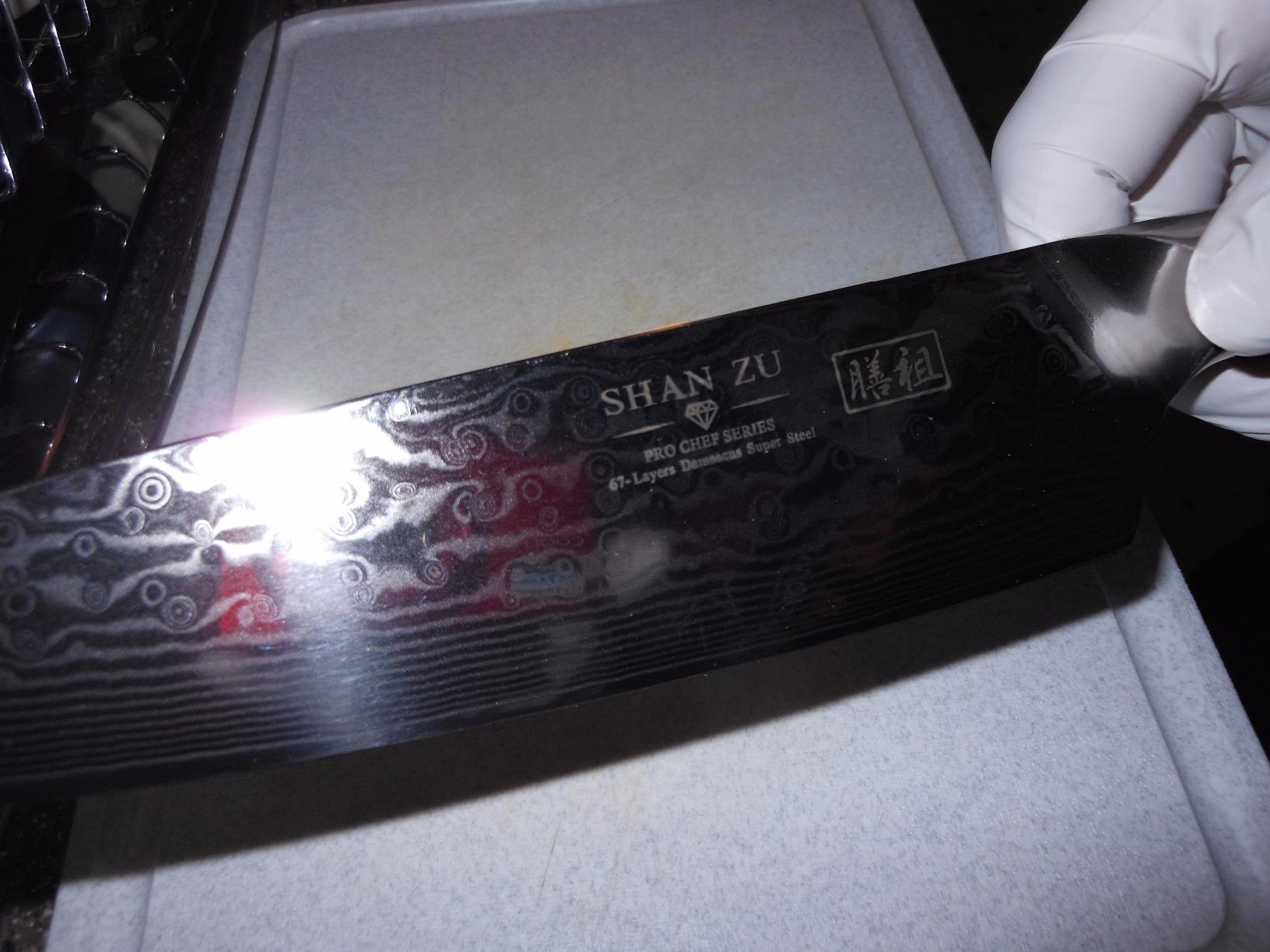
The handle is where this knife quietly undercuts the cheaper competition. G10 glass fibre, frosted rather than painted, and shaped so the blade sits top-balanced rather than forward-heavy. At 260 g it is not a featherweight, but the weight sits behind the cutting edge where it helps rather than where it tires your wrist.
In owner reviews, the most common theme is that people reach for this instead of a familiar European knife and immediately notice how little drag a good edge produces. Reviewers also describe it as solidly built, which is a low bar for any knife and one that plenty of the cheapest blades on this list fail.
What daily cooking feels like with it
Brushing, dicing, and general prep is where an 8 inch gyuto profile earns its place. The heel is tall enough to use as a scoop for diced onion, and the spine is smooth rather than textured, so it slides off the top of garlic cloves and ginger without catching.
For a home cook moving between a cutting board and a hot pan, the balance means you rarely have to think about the knife mid-task. That is the whole game with a general-purpose blade.
Where it will frustrate you
The core is alloy steel under a Damascus jacket, which means it is not as forgiving of a wet counter as a fully stainless blade. Reviewers mention needing to dry it promptly to limit spotting, and if you are the type to rinse a knife and leave it in the sink, this is not the one.
It is also heavier than a typical Japanese chef knife of this size, and some owners find that startling if you came from a lightweight European blade. Neither issue is a defect. They are just trade-offs for a steel that stays sharp and a build that feels solid.
2. Shun Classic 8 Inch Chef’s Knife – The Best With a Maker Sharpening Service
Shun Classic 8″ Chef’s Knife
8 inch blade
VG-MAX core with 68-layer cladding
16 degree edge
Pakkawood D-handle
Pros
- Exceptionally sharp with excellent balance
- D-shaped pakkawood handle suits either hand
- Free sharpening and honing for the life of the knife
- Handcrafted in Japan
Cons
- Thin profile can chip on hard or frozen food
- D-shaped handle feels odd coming from a Western knife
- Sharpening needs Japanese stones or the maker service
The Shun Classic is the answer when the thing that worries you most about a fine-edged knife is not being able to fix it yourself. Shun provides free lifetime sharpening and honing for the knife, which means the maintenance requirement that pushes people away from Japanese steel simply evaporates if you live near a service point.
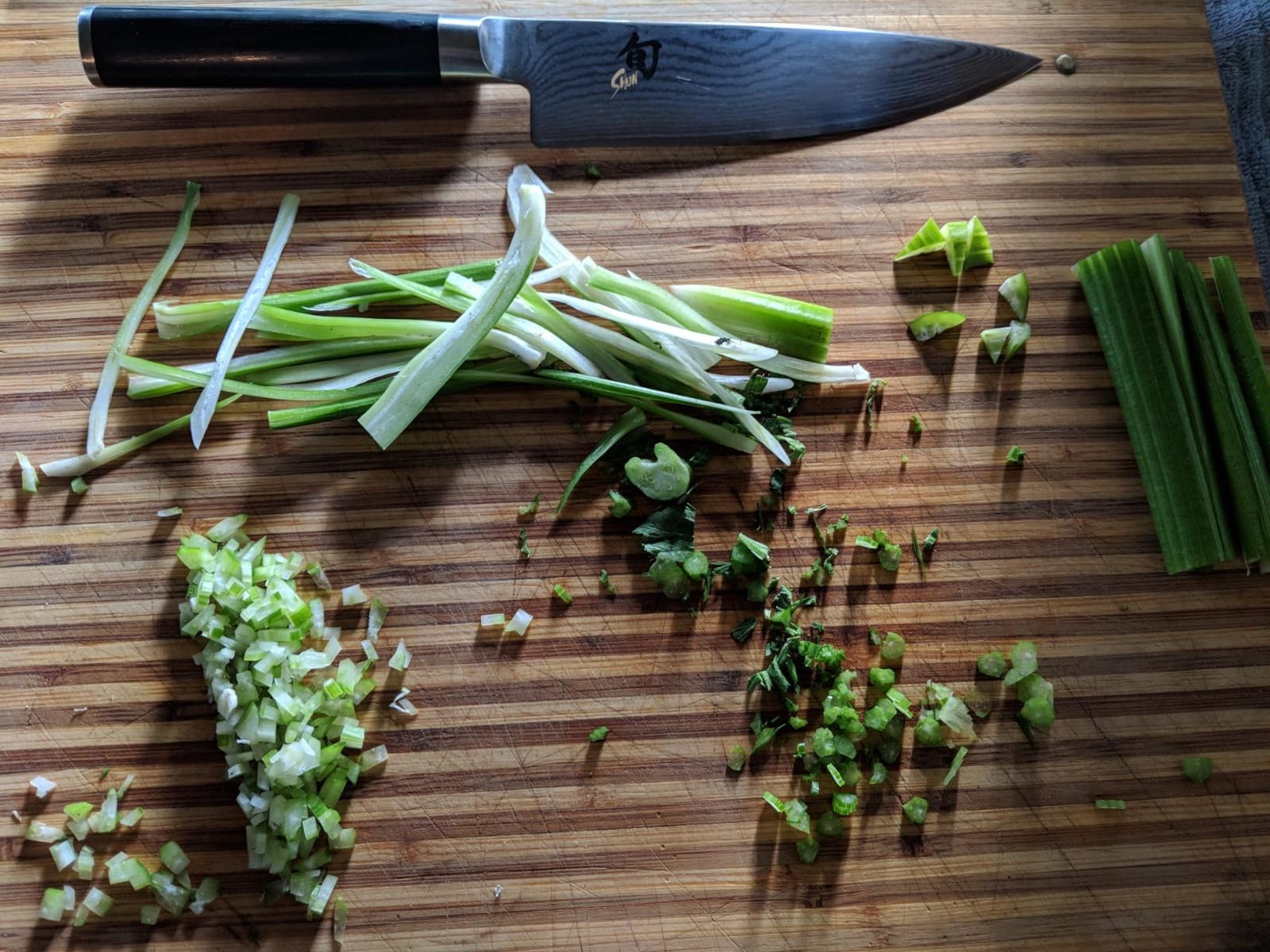
The blade is VG-MAX, a Japanese high-carbon stainless that sits between carbon and the harder VG-10 alloys, wrapped in 68 layers of Damascus stainless cladding and finished at a 16 degree edge. At 10.88 ounces it is light in the hand, and the balance point sits right at the bolster, which is why owners describe it as a step up from Wusthof and Henckels in cutting ease.
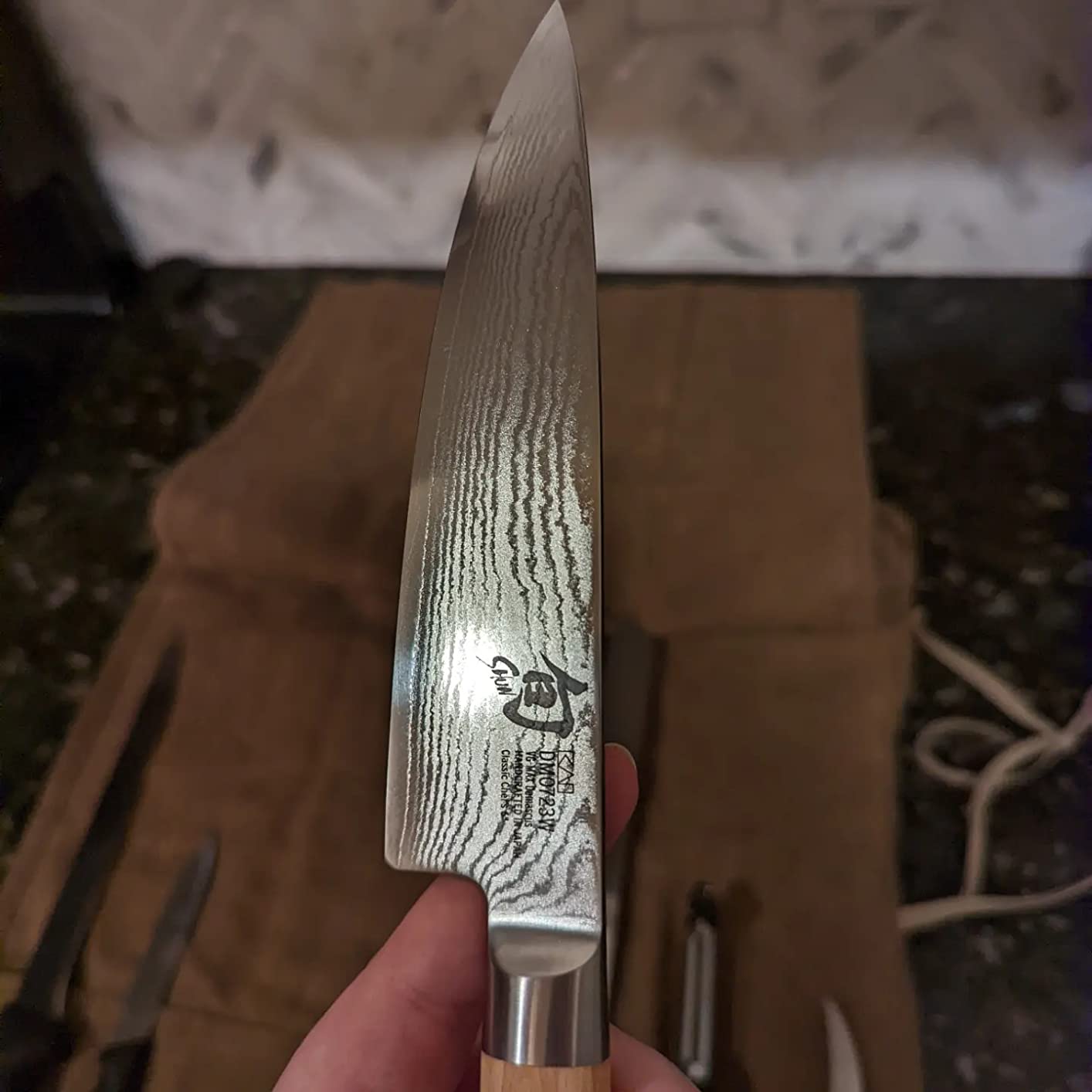
The D-shaped pakkawood handle is a genuine D rather than a round octagonal Wa shape, and the handle geometry suits a right-handed or a right-to-left grip equally well. The black resin-stabilized wood will not absorb moisture the way bare rosewood does, and it is a shape that many European-knife owners find easier to adapt to than a traditional octagon.
Across more than 3.8k reviews the rating sits at 4.7, with 88 percent five-star marks. That is an unusually consistent record for a knife this old, and it reflects a design that has barely changed in years.
Why the lifetime service changes the ownership math
Sharpening a 16 degree edge on a whetstone is a skill, and skills fade if you do not practise. The Shun service means you can send the knife off twice a year instead of learning a 30-degree angle correction. For a cook who will use a handful of recipes rather than prep eight hours a day, that is usually the better trade.
It also removes the risk that comes with a first attempt on a new blade. A pull-through sharpener or a misaligned electric sharpener can take months off a fine edge in a single session, and on a knife this well made that is an expensive mistake.
Where it will frustrate you
The thin profile is a real limitation. Reviews repeatedly warn about chipping and even bending on hard or frozen food, which is the failure mode that catches out every new owner of a fine Japanese edge.
The D-handle also produces a genuine coin flip. If you grew up on a European three-rivet handle, the D-shape can feel wrong for the first few sessions, and forcing a grip you dislike is how people end up not liking a knife that is technically excellent.
3. HOSHANHO 8 Inch High Carbon Steel Chef Knife – The Best Value Sharpening
HOSHANHO Kitchen Knife in Japanese High Carbon Steel, Professional High-Class Chef’s Knife 8 inch, Non-slip Ultra Sharp Cooking Knives with Ergonomic Handle
8 inch blade
10Cr15CoMoV at 60 HRC
13 degree hand-sharpened edge
Pakkawood handle
Pros
- Very sharp 13 degree edge for daily chopping
- Japanese high carbon steel with good rust resistance
- Sloped bolster supports a natural pinch grip
- Strong value for the steel used
Cons
- Bulky 350 g weight tires the wrist in long sessions
- Pakkawood-style handle may not suit small hands
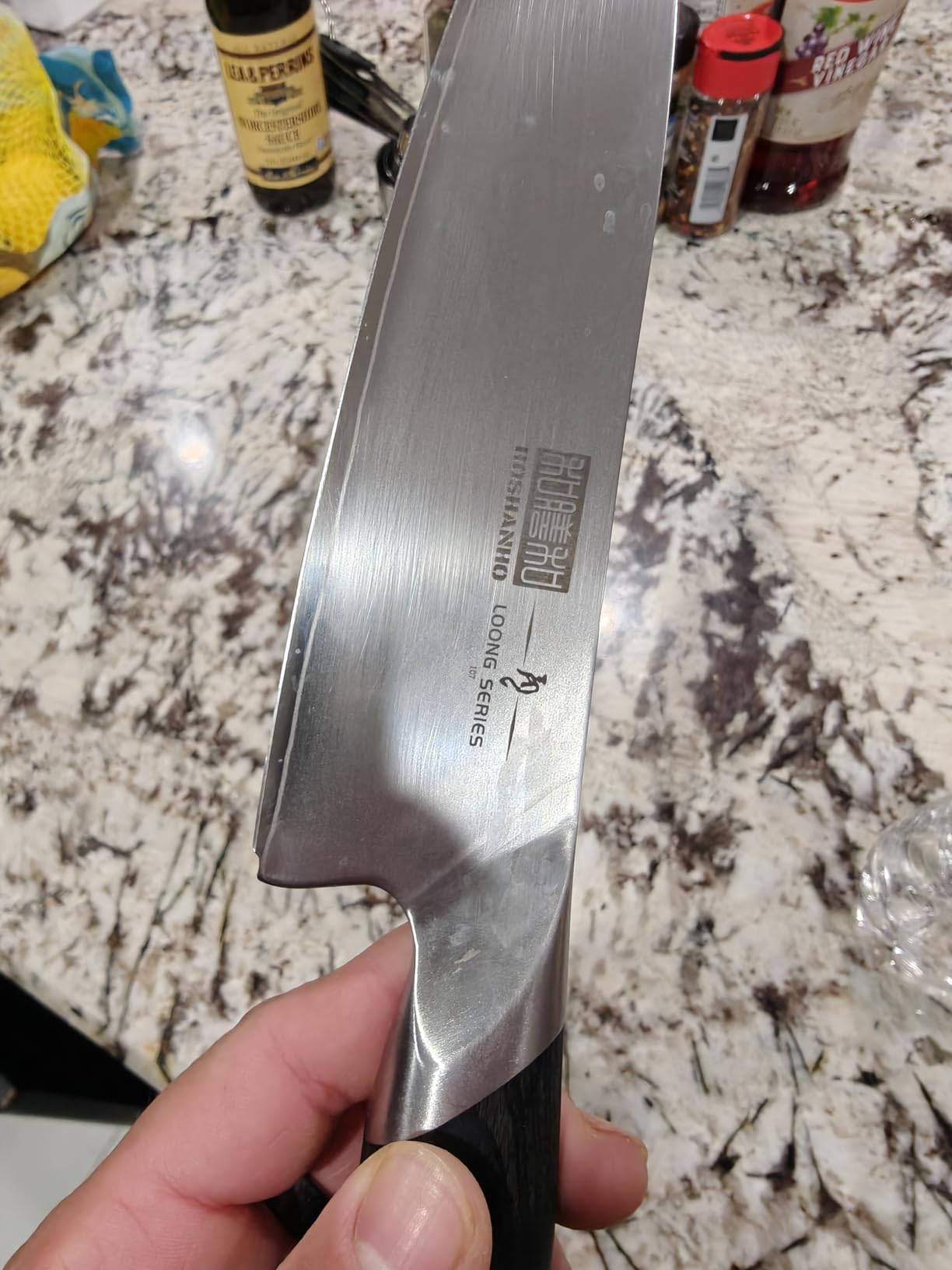
The HOSHANHO is the pick for a home cook who wants a genuinely fine edge without paying artisan money. It is Japanese 10Cr15CoMoV high carbon stainless steel, hardened to 60 HRC, with a 13 degree hand-sharpened edge per side, and at 4.7 stars across 2.8k reviews it is the most-reviewed option in the mid-range of this roster.
That 13 degree figure is finer than anything else here except the purpose-built performance models, and it is the reason the knife feels so eager in prep. A 13 degree edge has less wedge under the food than a 20 degree European edge, so the blade pulls through onion and herbs with less downward pressure. If your cooking is heavy on brunoise, fine dice, and thin slicing, this is a real advantage rather than a spec-sheet trick.
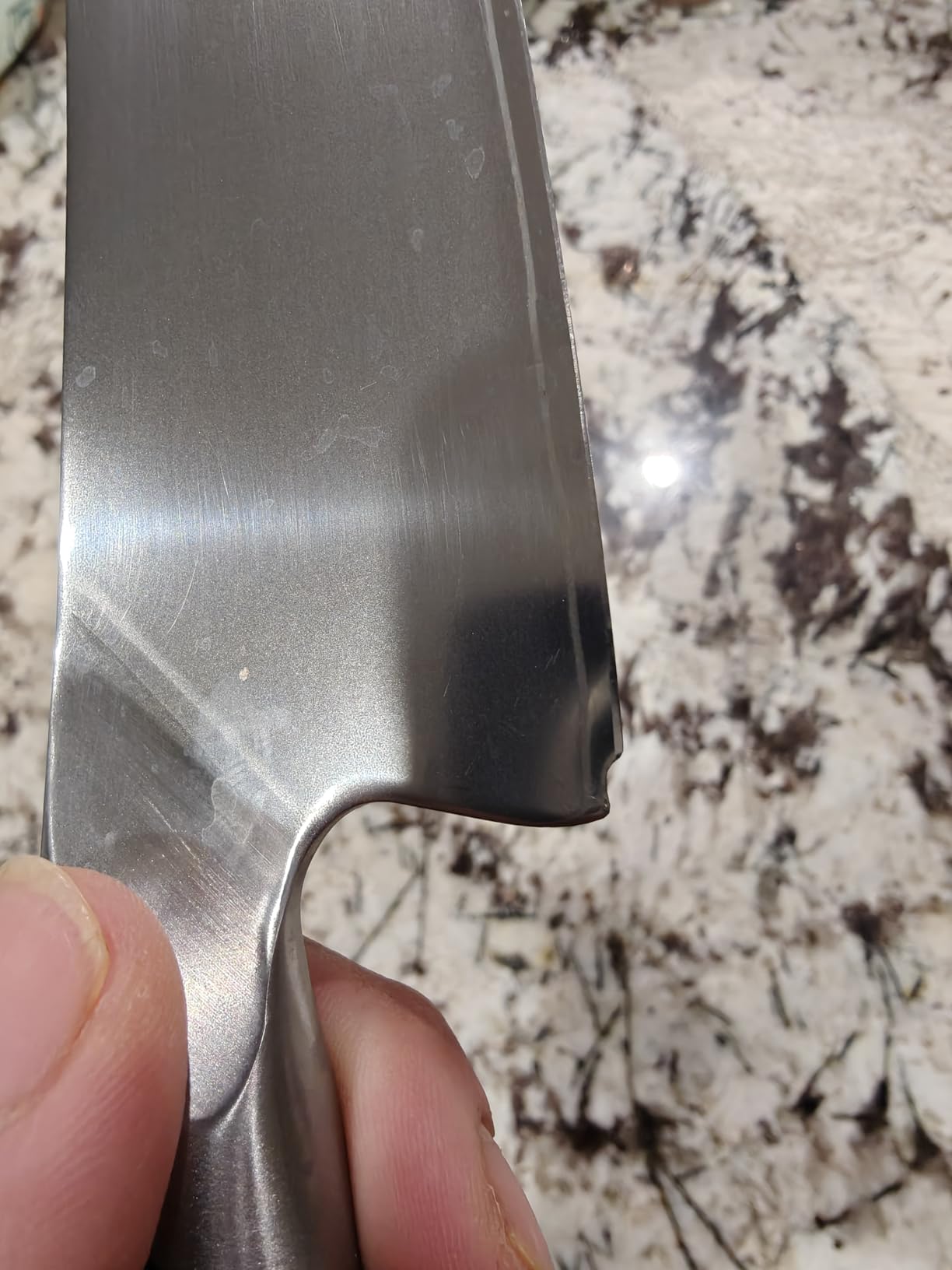
The sloped bolster is an underrated detail. Instead of a square shoulder that your gripping hand can hit, the bolster slopes forward, which encourages a pinch grip on the spine and gives you more control on delicate work. It is a small geometry choice that quietly makes a fine edge safer to use.
The finish is matte with ice tempering, which reduces glare under kitchen lighting and helps you see the edge line while you are working rather than a mirror reflection.
Why the 13 degree edge is worth the sharpening discipline
A finer edge bites sooner, holds longer between grinds, and cuts cleaner. It also dulls more abruptly if you let it degrade, and it is less forgiving when you hit a hard seed or a fish bone. The 60 HRC core is on the tougher end of the hard steels, which gives you a reasonable buffer.
For most home cooks the 13 degree is a sweet spot: sharp enough to make vegetable prep feel effortless, hard enough not to chip at every stray contact, and stainless enough that a rushed wash is not a disaster.
Where it will frustrate you
At 350 g this is the heaviest blade in the group by a wide margin, and weight is the single most common reservation in the reviews. If you do a lot of prep at once, an onion, five kilos of potatoes, a whole week of batch cooking, the wrist load adds up over an hour.
The handle is also a full-sized pakkawood shape. Cooks with smaller hands report that their ring and little fingers sit awkwardly on a handle built for larger grips, and the fix is a grip change rather than a different knife.
4. Dalstrong 8 Inch AUS-10V Gyuto – The Best Edge Retention
Dalstrong 8″ Japanese Chef Knife Gyuto – 66-Layer Damascus AUS-10V
8 inch blade
AUS-10V core at 62+ HRC
66-layer Damascus
8-12 degree edge
Full tang
Pros
- Sharpest out of the box in owner reports
- Tall heel gives knuckle clearance and scooping ability
- Full tang with a weighty premium handle
- Some owners report months without sharpening
Cons
- Long blade heel will not fit most knife blocks
- Damascus pattern is subtler in the photos
- Handle feels oversized for small hands
Dalstrong makes the most aggressive edge in this roundup. The AUS-10V Japanese steel core is hand-finished to an 8 to 12 degree angle per side, and the result is the kind of out-of-the-box sharpness where owners report cutting paper with no pressure at all. That is not a party trick. It is the practical difference between a knife that preps effortlessly and one that fights you.
The cladding is 66 layers of Damascus over that core, and the whole thing is full tang with a contoured G-10 handle and a polished spine. At 9.6 ounces the weight is concentrated toward the handle, which gives real authority on hard vegetables and root vegetables without the blade feeling heavy.
The hammered blade finish is functional, not decorative. It creates small dimples along the blade face that reduce the contact area between food and steel, so slices release more cleanly. The tall heel is the other reason owners like it: it clears your knuckles on a push cut and doubles as a scoop when you are moving diced ingredients into a pan.
Edge retention is where this knife separates itself. Reviewers with 4.7 stars across 2.7k reviews frequently describe months between sharpening sessions, and the brand’s customer service is widely praised, including replacements for defects.
What a hard 62+ HRC core means for you
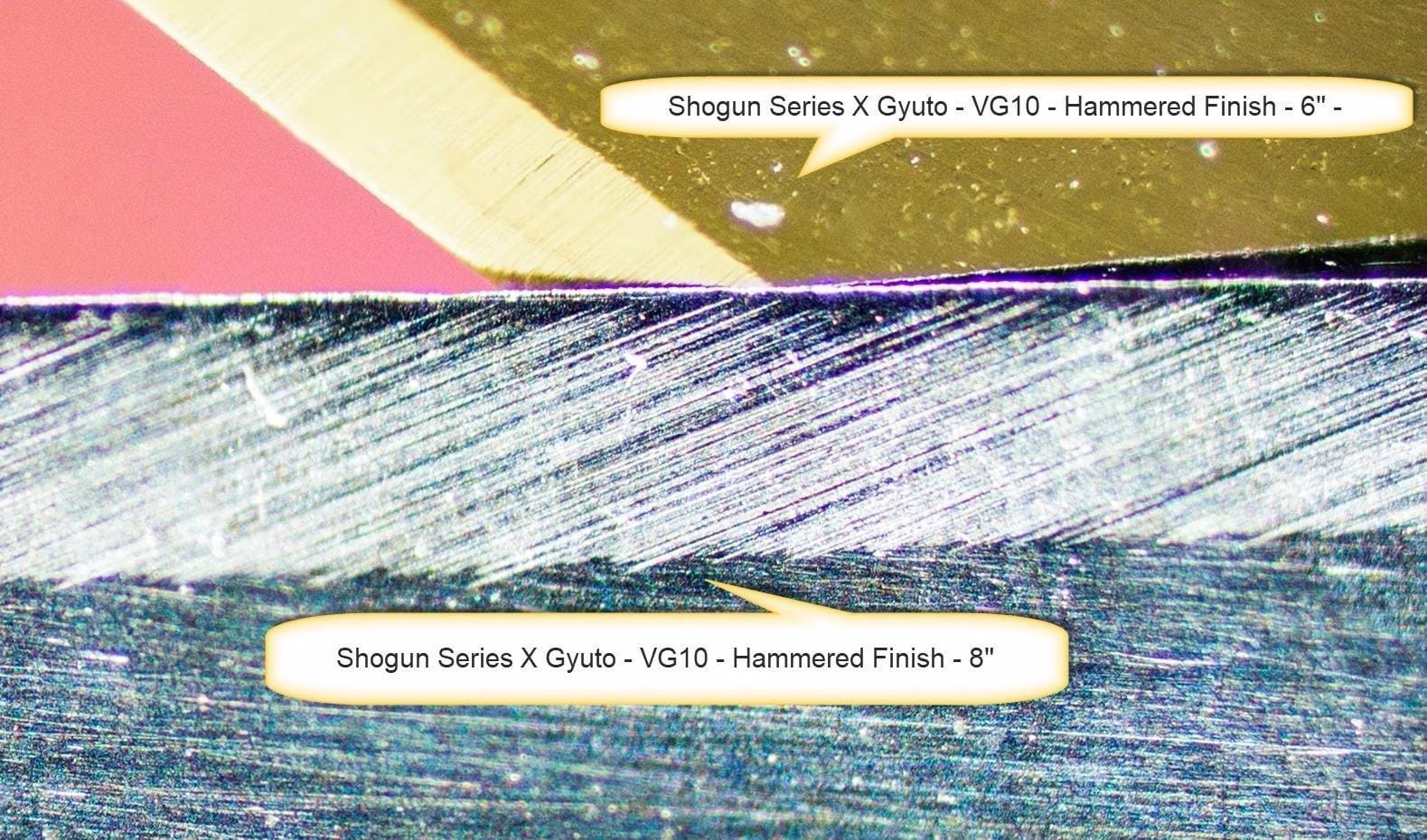
The steel is harder than most European knife steel, so the edge stays keen much longer before it needs a stone. That cuts your maintenance frequency dramatically. In exchange, the steel has less tolerance for abuse: bone, frozen food, hard seeds, and twisting sideways loads are the four things that will find a chip on a core this hard.
Used on a wood or end-grain board for vegetables, proteins, and general prep, it is close to maintenance-free for months at a time. That is what makes it attractive to a cook who sharpens rarely.
Where it will frustrate you
The 8 inch blade with a tall heel has a 14 inch overall length, and that heel will not slot into most standard knife blocks. A sheath is included precisely for this reason, and owners consistently tell you to use it rather than trying to force the knife into a block.
Two smaller gripes recur. The Damascus pattern is more understated in person than in the listing photos, and the handle is large enough that cooks with small hands report discomfort. Neither is a quality problem, but both are the kind of thing a photo does not tell you.
5. Shun Sora 8 Inch Chef’s Knife – The Best Lightweight Gyuto
Shun Sora 8″ Chef’s Knife
8 inch blade
San Mai VG10 edge with 420J upper
16 degree edge
Full tang polymer
Pros
- Precise 16 degree edge on a narrow gyuto profile
- Light and well balanced for everyday prep
- Textured polymer handle grips well either way
- Lower maintenance than carbon steel
Cons
- Synthetic handle is less refined than the Classic line pakkawood
- Narrow blade height gives less knuckle clearance
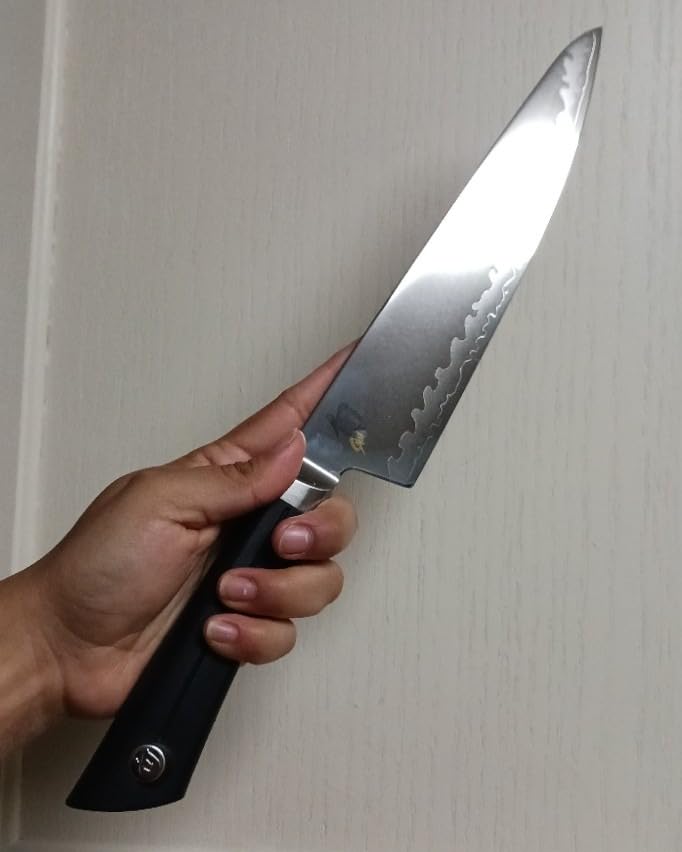
Where the Shun Classic is the refined traditional option, the Sora is the practical one. It uses San Mai construction: a VG10 steel edge forge-welded to a tougher 420J stainless upper, hardened to a 16 degree angle. At 6.56 ounces it is the second-lightest knife here, and the narrow gyuto profile gives you the tip access you need for plating and trimming.
That narrow profile is a genuine trade. You lose blade height, which means less knuckle clearance on a push cut and less scooping capacity, and you gain manoeuvrability in tight corners. For a cook working on small vegetables, herbs, and fish, the gain is worth more than the loss.
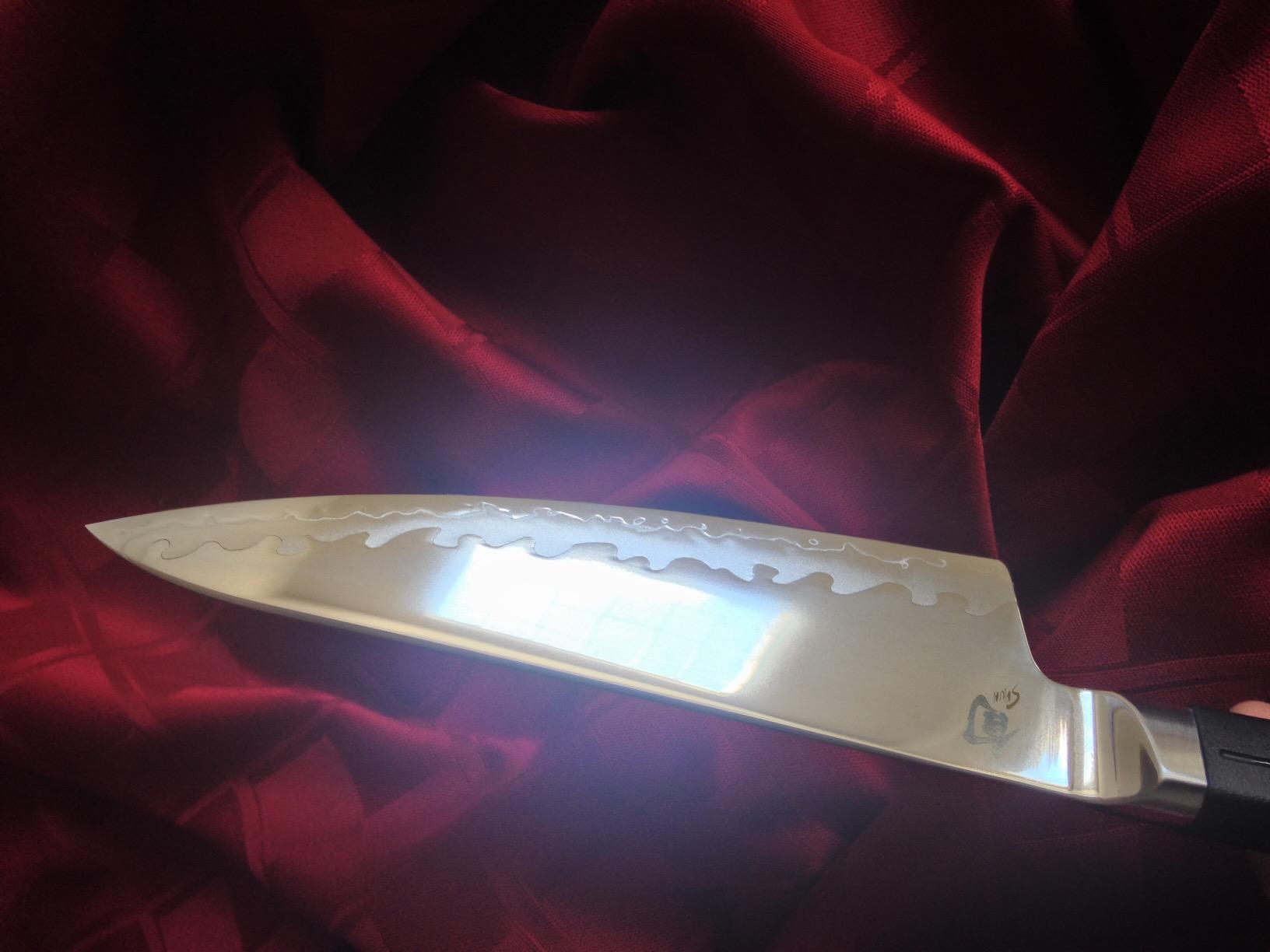
The handle is a textured polymer blend rather than pakkawood, and it is full tang. Reviews describe it as lower maintenance and easier to hone than carbon steel, which is the honest version of the pitch: this knife asks less of you than a blue steel blade would while still cutting like one.
It is NSF certified and handcrafted in Japan, and like the Classic, Shun includes free sharpening and honing for the life of the knife through their service programme.
Why San Mai construction suits a home kitchen
San Mai bonds a hard steel edge to a softer, tougher steel body. The edge does the cutting and holds its grind, while the upper spine absorbs the shock of a dropped knife or a sideways slip. For a home cook who does not sharpen weekly, that construction is a sensible middle ground between full carbon and full stainless.
It also forgives more than a pure hard core. The knife stays sharp long enough that you can forget about it between sessions, and the material is less likely to chip if a tomato escapes your grip.
Where it will frustrate you
Owners upgrading from the Classic line consistently call the synthetic handle less refined than the pakkawood on the range above it. It does not have the warmth or the visual weight of resin-stabilized pakkawood, and if hand feel matters to you, the difference is noticeable.
The narrow blade height is the other honest limitation. If you want a tall heel for heavy prep or for scooping diced food off the board, this is the wrong geometry, and no amount of sharpness will fix it.
6. Sunnecko 8 Inch VG10 Damascus Chef Knife – The Best Full Tang Entry Pick
Sunnecko 8 Inch Japanese Damascus Chef Knife – Ultra Sharp VG10 Steel
8 inch blade
67-layer Damascus with VG10 core
10-12 degree edge
Full tang ABS handle
Pros
- Very sharp 10-12 degree edge for meat and vegetables
- Full tang balance reduces wrist fatigue in long prep
- ABS handle stays grippy when wet
- Seamless blade-to-handle transition for cleaning
Cons
- 0.41 kg weight is heavy for an 8 inch knife
- Damascus ripple pattern is lighter than the listing photos
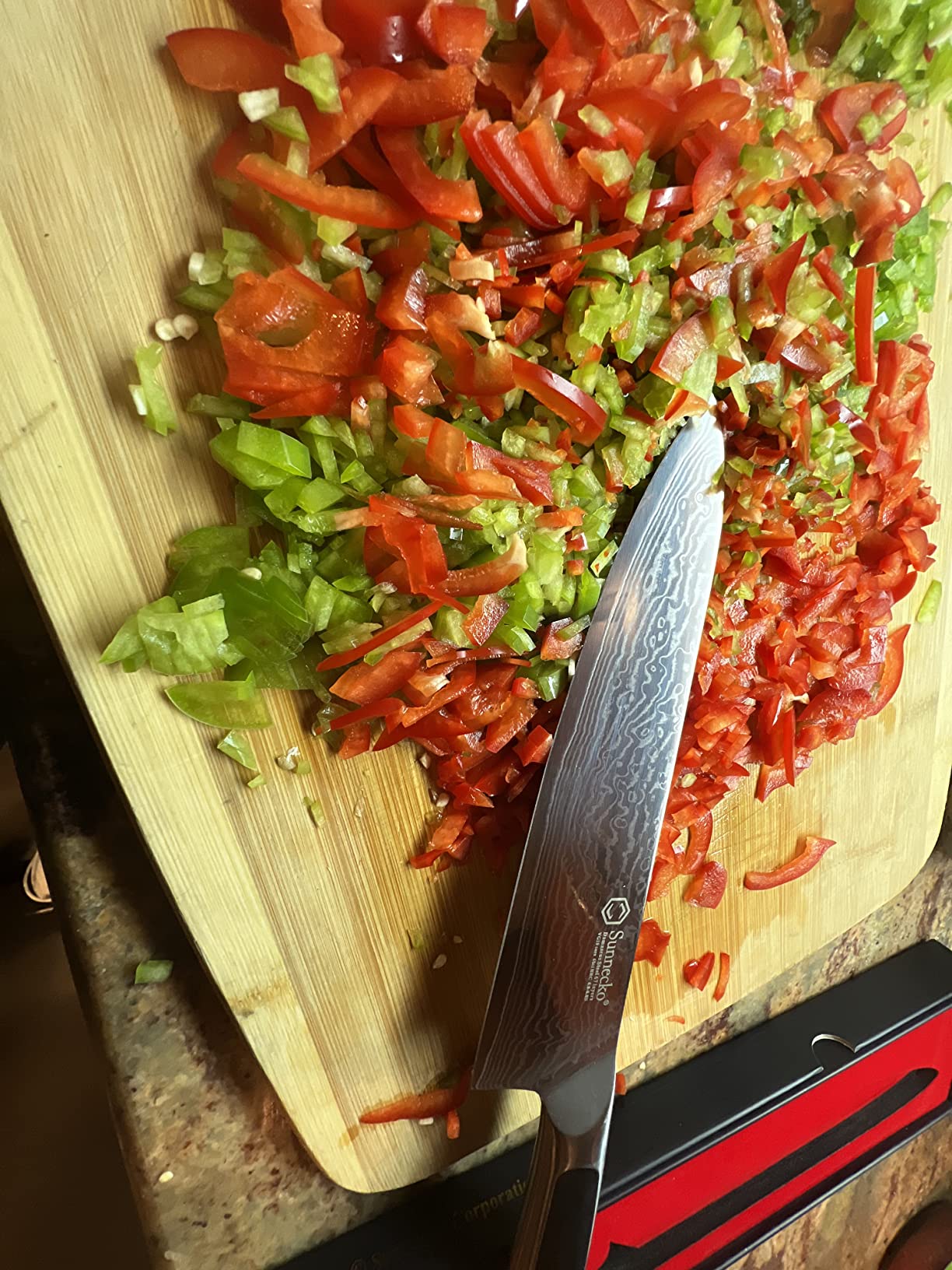
The Sunnecko is the entry point into a full-tang, fine-edged Japanese-style chef knife. The blade is 67 layers of Damascus over a VG10 high carbon stainless core, sharpened to a 10 to 12 degree edge, and the construction is full tang, meaning the steel runs the full length of the handle rather than being riveted into it.
Full tang matters more than most buyers realise. A tang that runs the length of the handle gives the knife better balance and better leverage on hard food, and it will survive the kind of side load that can work a partial tang loose over years. At 4.7 stars across 1.1k reviews, owners repeatedly single out the balance as the reason for the comfort.
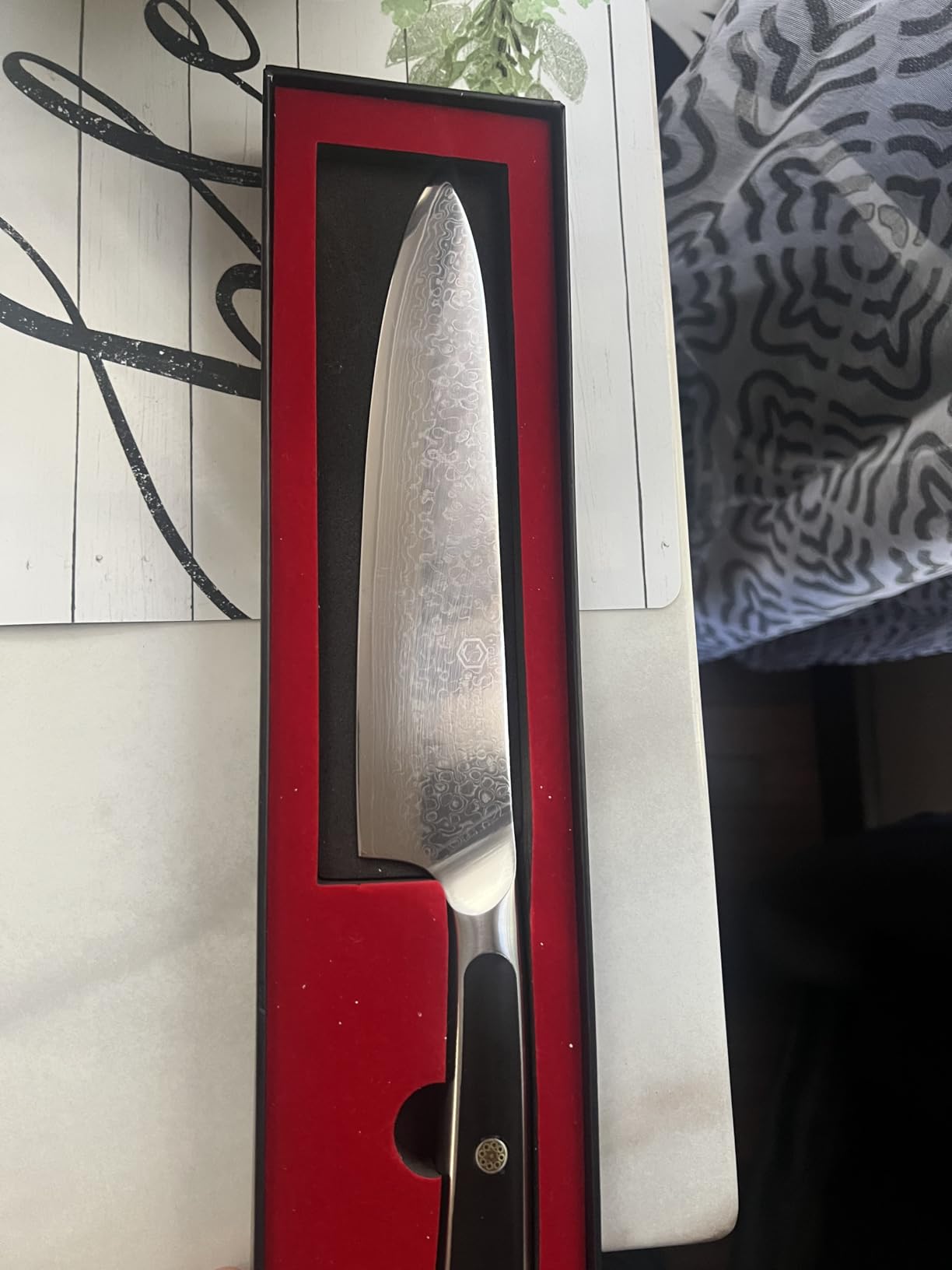
The handle is ABS with a decorative rivet, and the blade-to-handle transition is smooth with no crevices. That design choice is about hygiene as much as looks: food and water have nowhere to sit and go rancid, which matters for a knife you rinse under a tap every night.
The grip is described as staying secure even when wet, which is a real safety point on a 10 degree edge. A handle that lets go mid-slicing is how people lose a fingertip.
What 10 to 12 degrees does to your prep
At the low end of the range, a 10 degree edge has almost no wedge under the food. Slicing cooked meat, soft cheese, and ripe tomato becomes a straight pull rather than a saw, and fine dice on soft vegetables needs noticeably less downward force.
The trade is the same one that appears on every very thin edge in this roundup. There is less material between the two faces, so the edge is more vulnerable to hard contact and needs a steadier board and a sharper technique.
Where it will frustrate you
At 0.41 kg, this is a substantial knife for 8 inches. That heft helps on hard vegetables and gives the blade authority, but it works against you during long prep sessions if you prefer a light tool.
Reviewers also note that the Damascus ripple is more restrained in person than the product photography suggests. Nobody buys a knife for the pattern, but it is a fair expectation to set before you order.
7. MITSUMOTO SAKARI 8.6 Inch Gyuto – The Best Octagonal Handle Pick
MITSUMOTO SAKARI 8-Inch Japanese Gyuto Chef Knife, 3-Layer 9Cr18MoV
8.6 inch blade
3-layer 9Cr18MoV core at about 60 HRC
Tsuchime hammered finish
279 g
Pros
- Holds a sharp edge through years of daily use
- Octagonal rosewood handle guides hand position
- Hammered tsuchime finish reduces food contact
- Presentation box with cloth and blade oil
Cons
- Needs to be dried and oiled after washing or it spots
- Some buyers question the Japanese origin claim
The MITSUMOTO SAKARI is the traditional Japanese experience at a home-kitchen price. It is a 3-layer San Mai build with a 9Cr18MoV high carbon stainless core, deep cryo treated and hardened to roughly 60 HRC, finished in a tsuchime hammered texture with a kurouchi black forged finish, and fitted to an octagonal rosewood handle.
The kurouchi finish is the black lacquer traditionally applied to prevent carbon steel blades from rusting, and it is a genuine visual marker of a Japanese-made kitchen knife rather than a decorative flourish. The tsuchime hammering is a second tradition, and it does real work: the dimples reduce the contact area so slices release more cleanly.
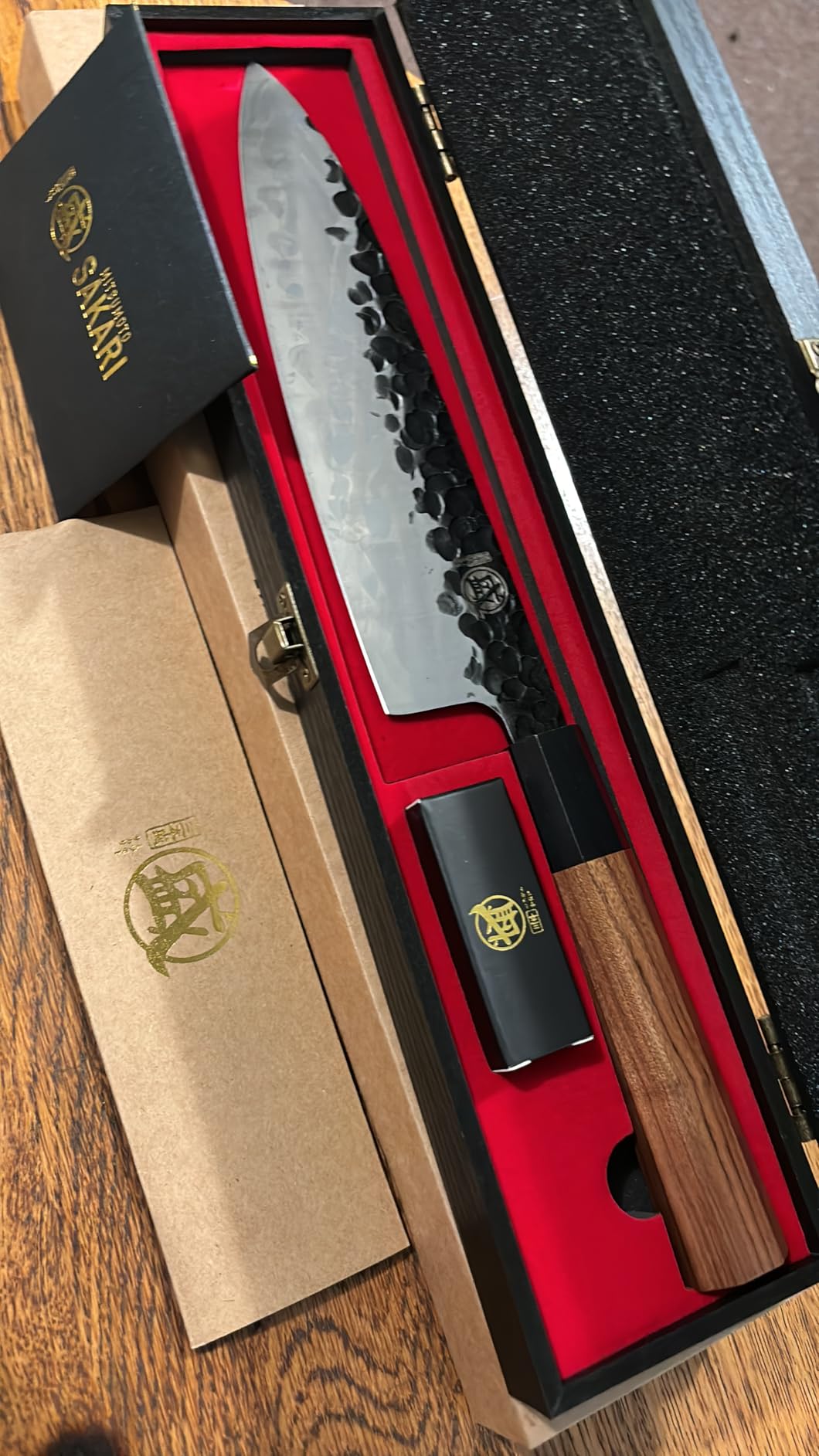
At 8.6 inches the blade is slightly longer than the Western default, and at 279 g it is light for its length. The octagonal rosewood handle does something a D-handle does not: it gives the gripping hand a fixed reference point, so your hand lands in the same place every time. Cooks with long service histories describe the result as reduced fatigue over a full prep session.
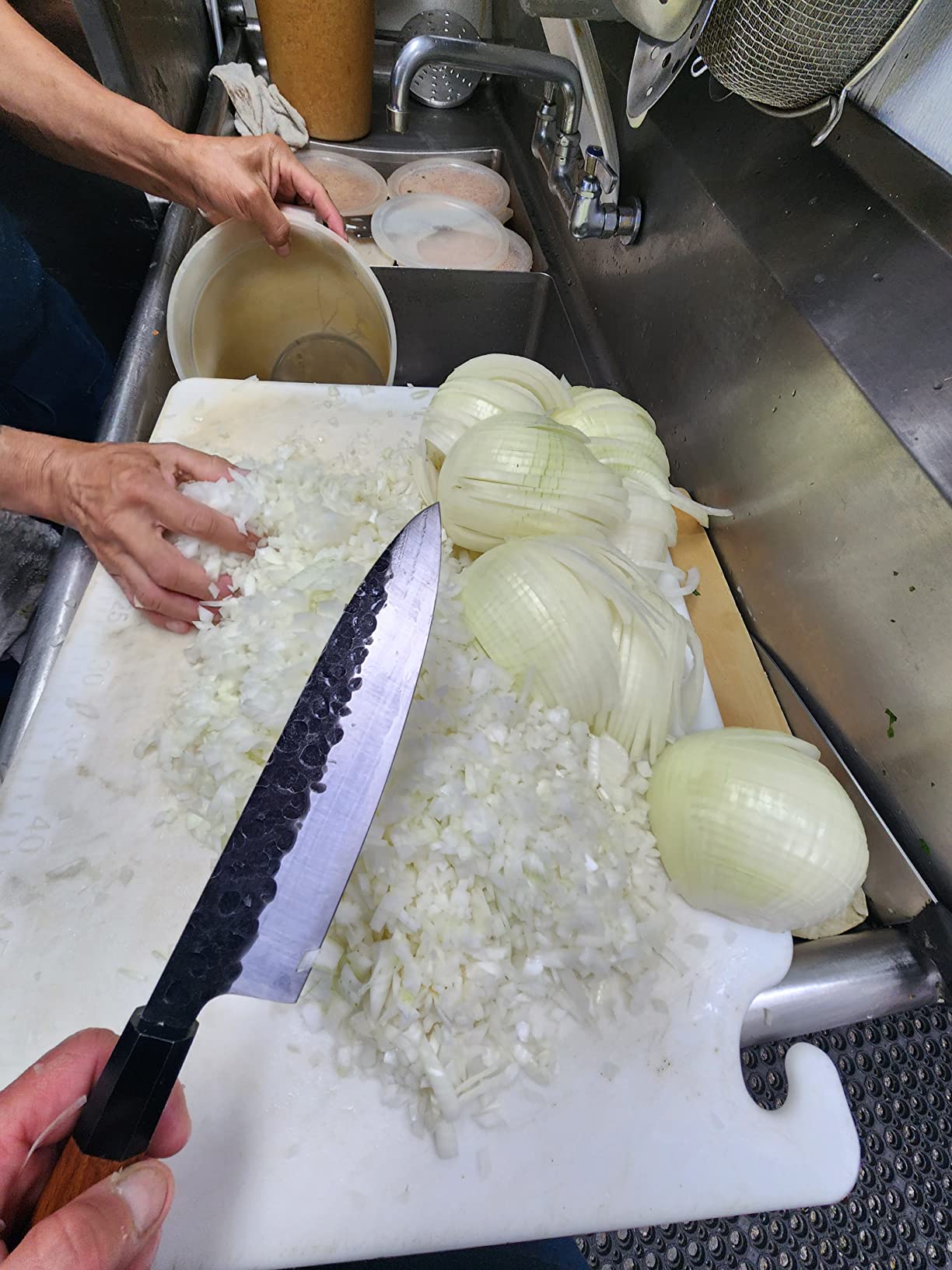
Reviews from cooks with decades in professional kitchens call it the best affordable Japanese-style blade they have used, and the 4.6 rating across 1.2k reviews with 81 percent five-star marks backs that up.
Why the octagonal handle is a genuine advantage
A traditional Wa handle is a fixed octagonal shape with a visible bolster step, and your index finger naturally settles against it. That consistency means you do not re-grip and re-check your angle for every cut, which is where hand fatigue and accidental slips usually come from on a long prep session.
It also keeps the steel exposed right up to the heel, which is a nice bonus on a knife you sharpen yourself. There is no handle collar to trap residue against the edge.
Where it will frustrate you
Rosewood is the most demanding handle material in this roundup. It needs to be dried and lightly oiled after washing, and if you skip that for a few weeks you will see spotting. It is a real maintenance habit, and it is the price of the traditional look.
Some buyers also question the Japanese origin claim, noting the knife appears to be mass produced in China. The steel, geometry, and finish are all consistent with a Japanese-style blade, but the label is a marketing claim rather than a verified fact, and you should buy it for how it performs.
8. KYOKU 8 Inch VG10 Shogun Series – The Best Gift-Ready Damascus Pick
KYOKU Chef Knife – 8″- Shogun Series Japanese Style VG10 Steel Core Hammered Damascus Blade Kitchen Knife – with Sheath & Case
8 inch blade
67-layer Damascus VG-10 core
Honbazuke 8-12 degree edge
0.4 kg
Pros
- Very sharp out of the box with solid balance
- Handle shape and mosaic pin feel premium
- Sheath and presentation case included
- Strong value when discounted
Cons
- Heavier than a typical Western chef knife
- G10 handle can become slick when wet
- Damascus pattern is subtler in person
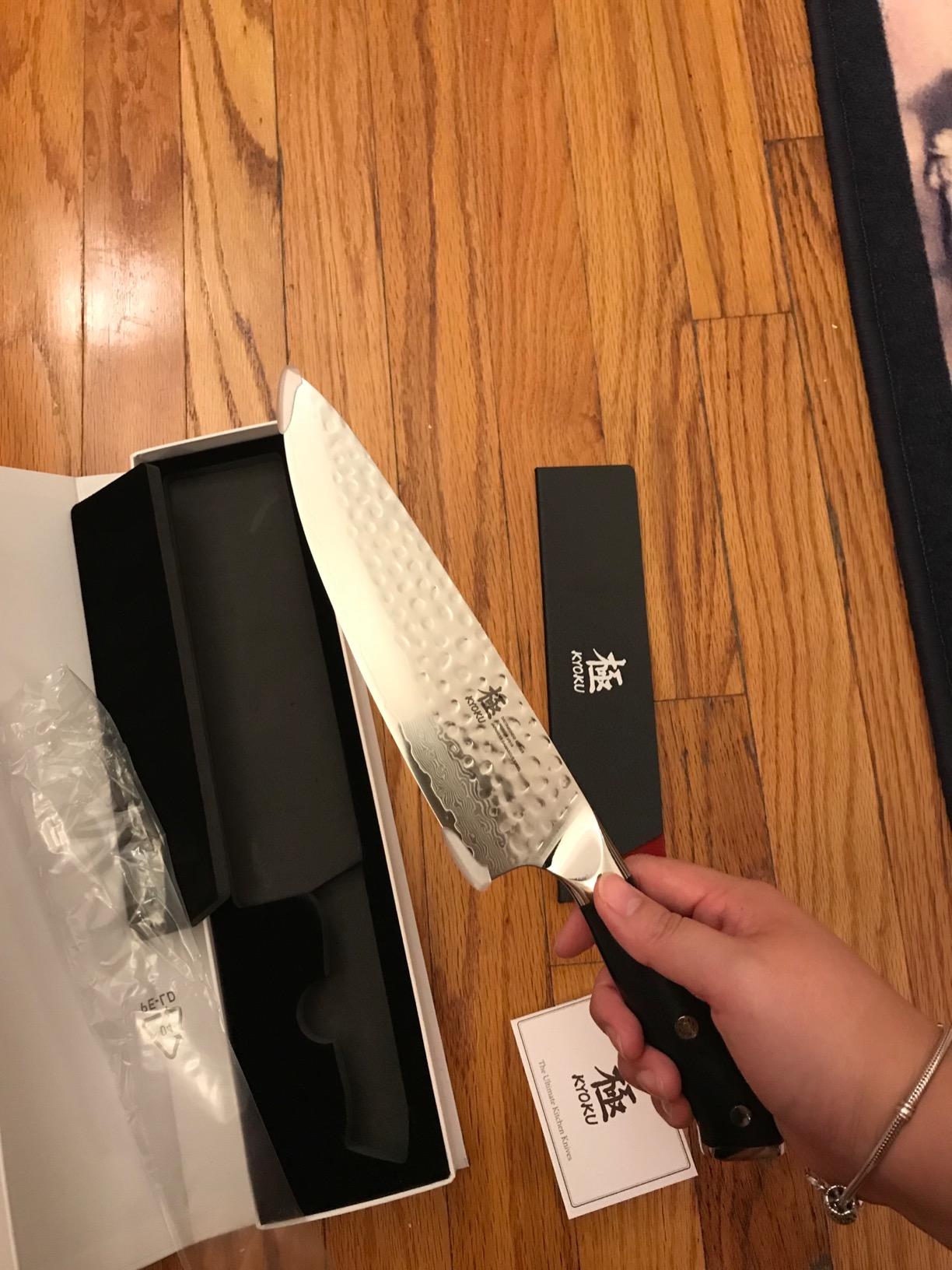
The KYOKU Shogun Series is the knife to buy if the purchase doubles as a gift. It comes with a sheath and a presentation case, and the handle carries a mosaic pin, which is the detail that usually makes an inexpensive knife look like a present instead of kitchen equipment.
The steel is a Japanese VG10 core cryogenically treated and folded into 67 layers of Damascus, sharpened by the Honbazuke method to an 8 to 12 degree edge at 58 to 60 HRC. Honbazuke is the traditional Japanese finishing technique where the edge is polished to a bright mirror line, and it makes the bevel easy to align during your own sharpening.
At 58 to 60 HRC this is the least hard steel among the Damascus models here, and that is a deliberate trade. Slightly lower hardness means more toughness, which means more forgiveness if you catch the edge on a stray contact. You give up a little edge retention and get a knife that is easier to live with.
Owners rate the balance highly, and several describe the packaging as the best unboxing in the mid-range. At 4.6 stars across 959 reviews, with 82 percent five-star marks, the enthusiasm is real but the consensus is not as overwhelming as the top two picks.
When gift-readiness matters more than lightness
If the knife is for someone who does not cook much, the case and sheath solve a problem you would not think about for yourself: where does this live? A presentation box stops it going straight into a drawer, and the sheath gives them somewhere safe to store it once the box is gone.
It also means the first experience with a fine edge is a good one. A sharp out-of-the-box blade that arrives looking like a gift reads as quality. A bare blade in a bubble wrap packet reads like a tool.
Where it will frustrate you
At 0.4 kg it is heavier than a typical Western chef knife, and reviewers who prefer lightweight tools call it out directly. Combined with a G10 handle that can become slick when wet, this is a knife that rewards dry hands and deliberate technique.
As with the other Damascus models here, the pattern is far subtler in person than the product photographs. Judge it on the steel and the balance, not the ripple.
9. Miyabi Kaizen II 8 Inch Chef’s Knife – The Best Refined Finish
Miyabi Kaizen II 8-inch Chef’s Knife, Stainless Steel
8 inch blade
FC61 core at 61 Rockwell
48-layer damast cladding
9.5-12 degree edge
Pros
- Exceptional build quality and balance
- Handle has noticeably better hand feel than most in this range
- Handles tough meat and delicate slicing alike
- Stainless FC61 core needs less upkeep than carbon
Cons
- Thin profile is not intended for bone or frozen meat
- Small review pool of 139 limits long-term data
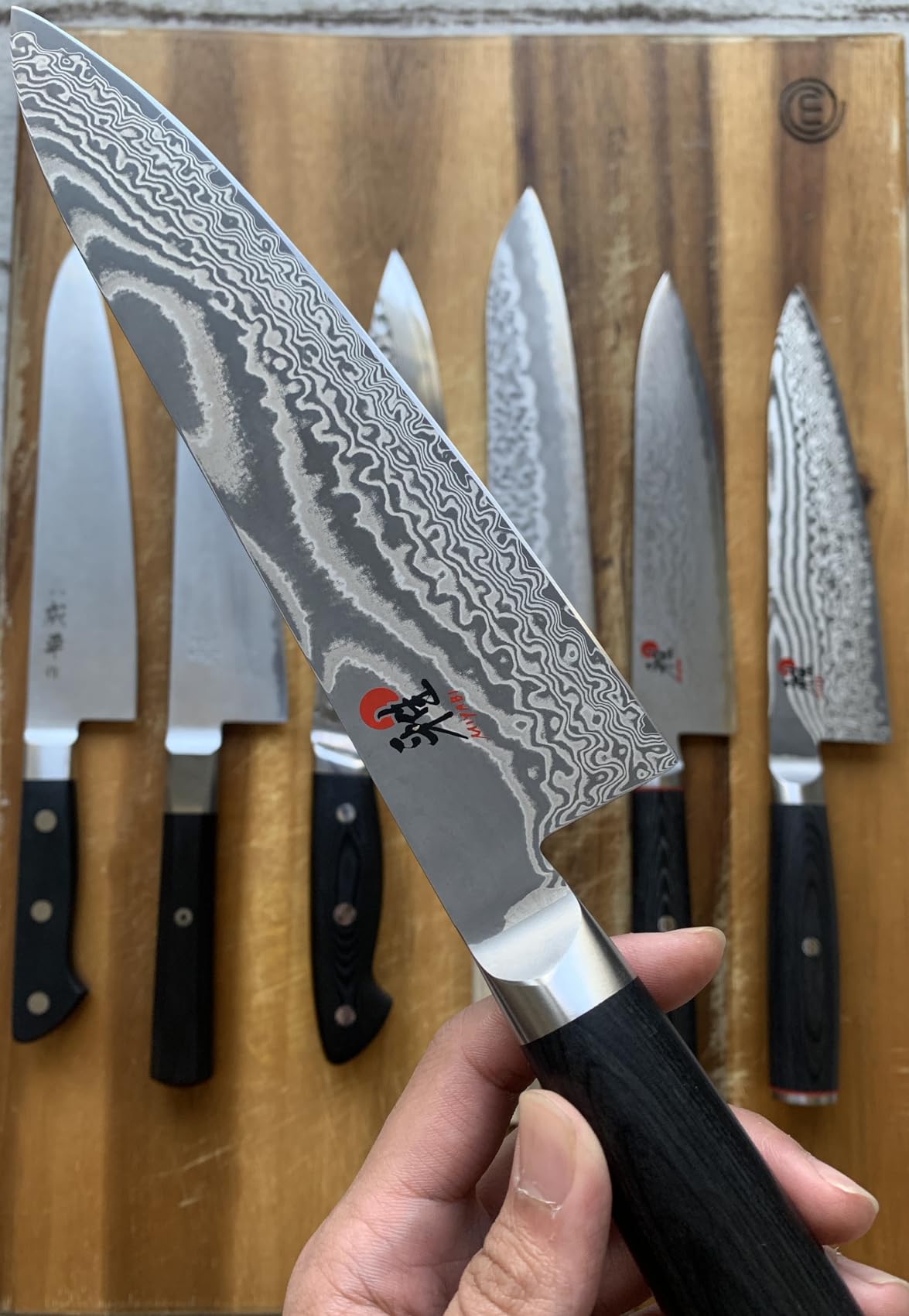
The Miyabi Kaizen II is the most refined object on this list. The FC61 steel core is hardened to 61 Rockwell and carries a fine carbide distribution that helps both edge retention and chip resistance, wrapped in 48 layers of damast steel cladding and double ice-hardened with Miyabi’s FRIODUR treatment.
That last detail is a genuine advantage for a home cook. Ice hardening refines the steel’s crystal structure, which improves both hardness uniformity and corrosion resistance, so a blade with it holds a fine edge longer and resists staining better than a comparable untreated steel.
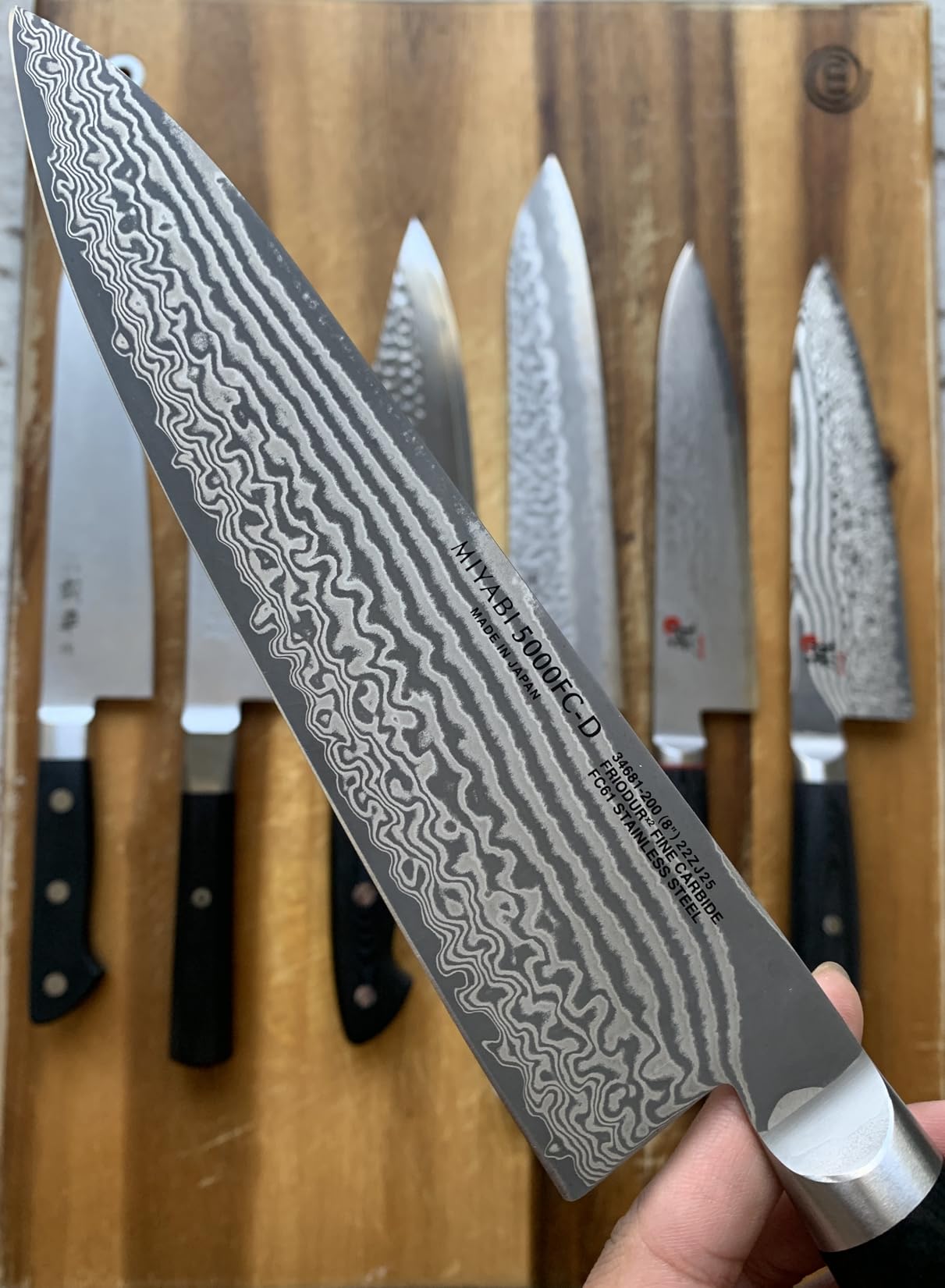
The edge is hand-honed by the Honbazuke method to 9.5 to 12 degrees per side, and the black pakkawood D-shaped handle carries a mosaic pin and a Miyabi end cap. At 7.04 ounces the weight is well distributed, and reviewers who switched from a Shun specifically call out the better balance and finish.
Hand feel is where this knife separates from its competitors. Multiple reviews describe the handle as noticeably better than most Japanese knives in its range, and that is the kind of comment that only appears when a cook has handled a lot of knives.
What ice-hardened steel changes in a home kitchen
On a practical level, FRIODUR treatment means less maintenance anxiety. You are less likely to see surface staining after a wet session, and the edge stays clean longer between stones because the harder, more uniform steel resists dulling at the apex.
For a cook who wants the aesthetics of a Japanese blade but does not want the anxiety of watching for patina, this is the version that makes sense. The finish stays bright, and the knife still cuts like a 61 HRC edge should.
Where it will frustrate you
At 9.5 to 12 degrees with a thin profile, this is not a bone knife or a frozen-food knife, and the reviews state that plainly. That is not a flaw, but it is a boundary you need to accept before you buy.
Be aware that the review pool is 139. That is a thin base, and thin bases mean less documented long-term durability than the 5.6k-review pick at the top of this list. The knife is very well regarded by the people who own it, but the data is smaller.
10. KAWAHIRO 8.27 Inch VG10 Gyuto – The Best 210 mm Gyuto
KAWAHIRO 8.27 Inch Japanese Chef Knife, Hand-Forged VG10 for Precise Cuts
8.24 inch blade
VG10 core at 60+ HRC
Hand-forged with fine distal taper
6.7 oz
Pros
- Exceptionally sharp hand-forged edge that slices paper
- Well balanced at 6.7 oz with a Wa handle
- Stainless VG10 core resists rust and patina
- Presentation-quality packaging
Cons
- Hard core can chip and needs a fine stone to repair
- Not a beginner knife given the fine geometry
- Some owners dispute the Japanese manufacturing claim
The KAWAHIRO is the most traditional-looking knife here and the closest to what a Japanese kitchen professional would recognise as a gyuto. It is a 210 mm profile in VG10 stainless steel, three-layer construction, hardened to 60+ HRC, hand-forged with a distal taper running from 3.55 mm at the spine down to 0.09 mm near the tip.
That distal taper is the single best argument for spending more on a chef knife. Most home knives are thick at the tip because that is cheaper to grind, and a thick tip cannot push into a potato skin or follow the curve of a shallot. A true distal taper lets the last three centimetres of the blade behave like a filleting knife.
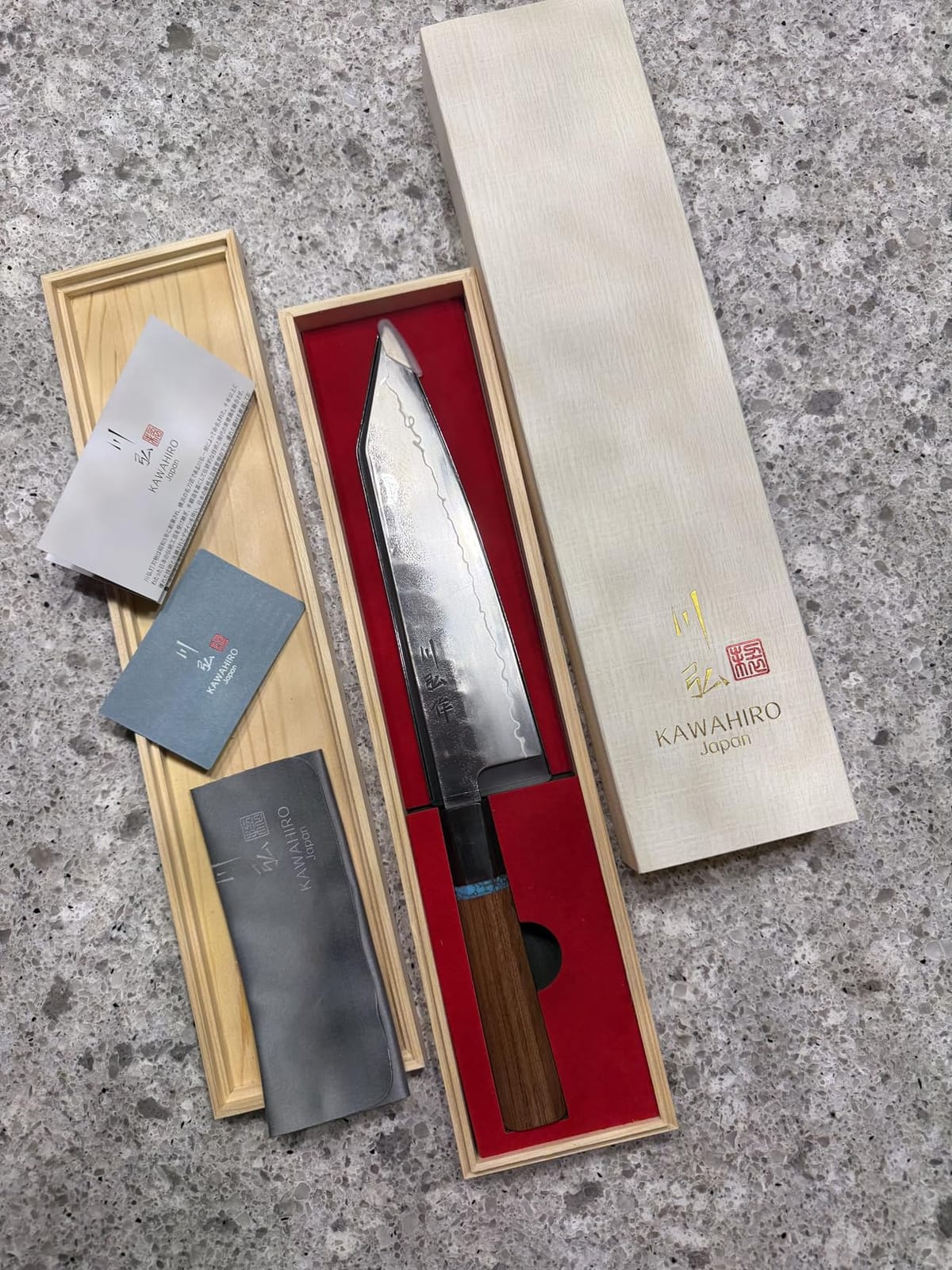
At 6.7 ounces it is the lightest full-sized gyuto in this roundup, and the octagonal Wa handle is ebony, turquoise, and ruby wood, which is the most ornate grip in the group. Reviews describe it as the sharpest and best-looking knife they own, and several mention that it compares well against knives sold in local knife shops.
The rating is 4.5 across 484 reviews, the widest spread in the set at 80 percent five-star. That spread tells you something useful: performance is exceptional, but the finish and QC are not as uniform as the top picks.
Why a 210 mm gyuto is a different tool entirely
A 210 mm blade gives you a longer cutting stroke, which means fewer strokes for a long cut and more control at the end of the push where most slips happen. It also gives the spine enough length to use as a guide for a straightening motion on larger cuts.
The gyuto profile itself, with its higher spine and pointed tip, is the shape Japanese cooks reach for on protein. It suits slicing, trimming, and fish more than the flat, broad profile of a santoku.
Where it will frustrate you
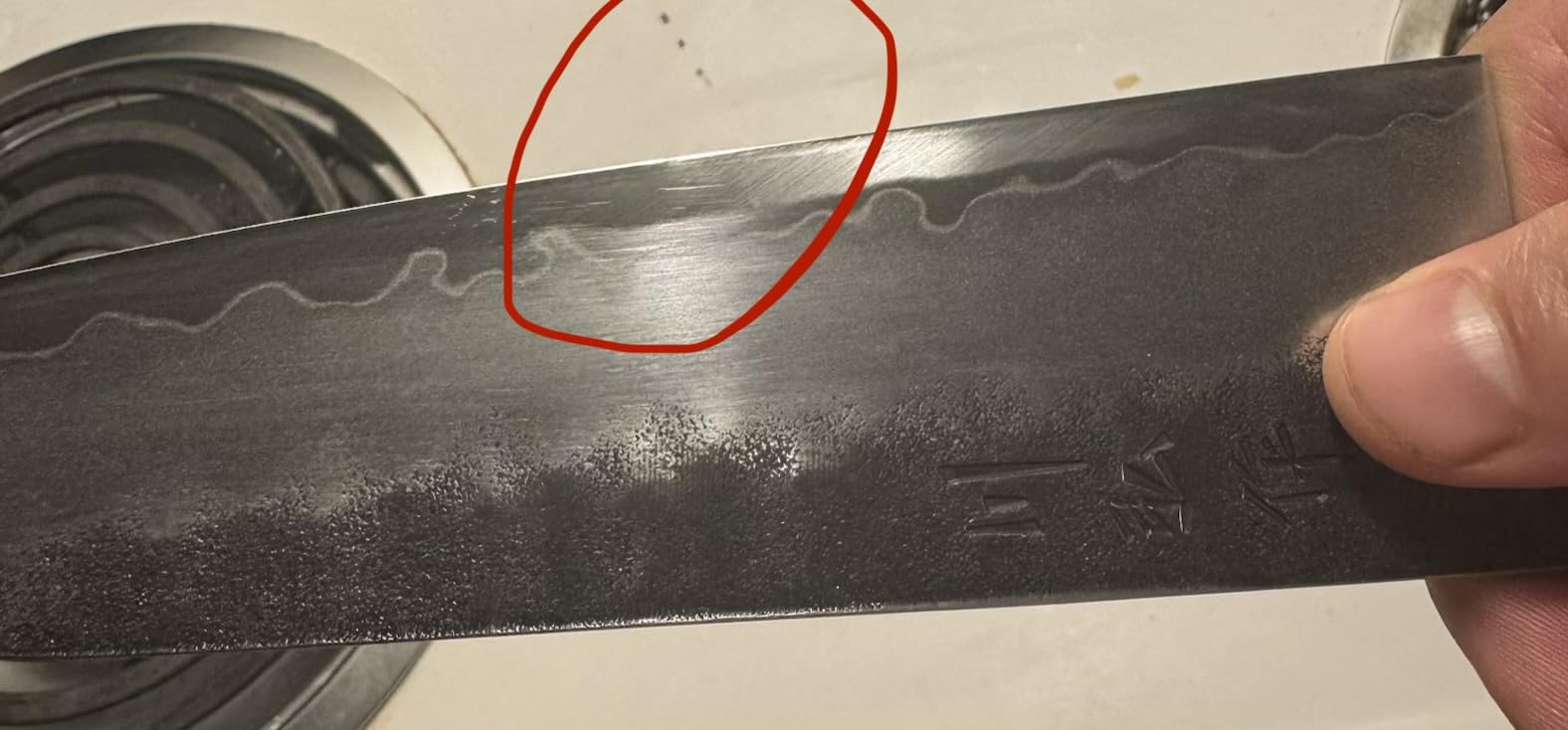
Owners report edge chipping, and repairing a chip on a hand-forged 60+ HRC blade needs a 5000 grit stone and real skill. It is not a knife to hand to someone who has never sharpened.
One owner sent back a knife with a defective off-centre tip, and some buyers dispute the Japanese manufacturing claim. With 484 reviews, that kind of variance is visible. If consistency is your priority rather than refinement, the top pick is the safer bet.
How We Chose These 10 Japanese Knives
Every pick here is a real chef’s knife with a stated steel, a stated edge angle, and enough published owner feedback to judge how it holds up. No general-purpose dropouts, no cleavers pretending to be chef knives, and no knives listed with a hardness claim that no manufacturer would actually put on a spec sheet.
We applied seven criteria while building this list:
1. A named steel with a stated hardness. A knife that says only “high carbon stainless” or “60 HRC” without naming the alloy tells you nothing verifiable. Every blade here names its core steel, and most give a Rockwell figure.
2. A stated edge angle per side. Anything from 8 to 16 degrees qualifies as a Japanese-style edge. A knife sold as Japanese style with a 20 degree edge is a European knife wearing a label.
3. Review volume we can actually judge. Miyabi Kaizen II has 139 reviews and the KAWAHIRO has 484, which is a real limitation and we flag it in those sections. The top picks have thousands.
4. Construction we can describe honestly. Full tang, San Mai three-layer, or a simple two-piece build. We tell you which one it is because it changes how the knife feels and how it holds up.
5. Range coverage. A 10-knife list that only contains premium knives is not a buying guide. This one spans entry-level to the most refined steel here, so you can find your tier rather than being handed one answer.
6. A handle that suits a real hand. D-shaped, octagonal Wa, sloped bolster, full tang G10. We report which it is and who tends to like it.
7. Honest cons. Every card in this guide lists two or more real drawbacks, including the failure modes reviewers actually report. A knife guide where everything is a benefit is a sales page.
Gyuto vs Santoku: Which Shape Should You Buy?
Start with a gyuto if you want one knife that does almost everything. Its high spine, pointed tip, and straight edge give you the control to slice protein, trim, and work through vegetables, and in a professional kitchen a gyuto is the default chef knife. Buy a santoku if your cooking is vegetable-heavy, you like a blade that rocks through a push cut, or you want something forgiving on a board with limited depth.
The gyuto has a higher spine and a lower, more pointed tip. That geometry is better for precision and for sliding the tip under a board, and it is the shape most Japanese cooks reach for by default. The santoku is shorter in blade height with a broader, more upturned tip, which makes it excellent for a rocking motion on herbs and onions and less precise for fine tip work.
Both are double bevel in nearly every home-cook purchase, which means the edge can be sharpened on either side. The single-bevel katana-style knives you will also see for sale are a different commitment, and they are the one category we actively do not recommend to a first-time buyer.
A single bevel has one flat side and one angled side. It cuts beautifully, and it is noticeably harder to sharpen because one side has no bevel to repair, which is why a first-time owner who buys one tends to struggle and blame the knife. A katana blade also has a chisel tip that cannot be used for any push cut at all.
Other shapes appear in Japanese catalogues and are worth recognising even though we do not carry them here. A nakiri is a rectangular vegetable cleaver with no pointed tip. A yanagiba is a long single-bevel slicer for fish, and it is the wrong first knife for the same reason a katana is. A kiritsuke is a small all-purpose knife with a curved tip for fine detail work. None of them replaces a chef knife, and all of them are later purchases.
For a home cook, the practical comparison is length and height. An 8 inch blade with a tall heel is a gyuto and is the most versatile option. A 7 inch blade with a wide tip is a santoku and is more comfortable on a narrow board and for cooks who do a lot of plant-forward work.
One more practical difference shows up at the cutting board. A gyuto’s straight edge suits a push-and-lift stroke, while a santoku’s curve suits a rocking stroke, and a rocking motion on a board with a raised front edge is where a gyuto user discovers the tip is invaluable. If your prep space is tight, blade length is the constraint that decides this, not the shape name.
Our roster is deliberately gyuto-weighted, with 8 inch blades as the standard. That is a deliberate choice for a home cook who wants one knife that does the job, and it matches the buying consensus on the knife forums where gyuto and santoku are treated as the two shapes that anchor a home kitchen.
Carbon Steel vs Stainless Steel: Which Should a Home Cook Buy?
Choose stainless steel if you wash your knives casually, cook from frozen occasionally, or want the lowest-maintenance path into a fine edge. Choose carbon steel, or a high-hardness Japanese alloy like Blue #2, if you are willing to dry the blade immediately and want the sharpest possible edge. For most home cooks starting out, stainless is the correct answer.
Carbon steel takes a finer edge than stainless and holds it beautifully, and traditional Japanese carbon blades are the reference point for sharpness. The cost is that the steel reacts with water and acid, so it will spot, stain, and eventually rust if you leave it wet, and a carbon blade chips more readily than a comparable stainless one.
Stainless steel forgives more. It resists corrosion, so a wet sink is not a crisis, and it is generally tougher at the same hardness, which means it chips less. VG-10, VG-MAX, FC61, 9Cr18MoV, and the 10Cr15Mov and 10Cr15CoMoV alloys in this roundup all sit in this high-carbon stainless family.
Blue #2, also called Aogami #2, is the Japanese carbon steel most home cooks encounter as an upgrade step. It is harder and sharper than plain carbon and needs the same disciplined drying routine, so it is a choice for someone who already has a whetstone routine and wants the finest edge available.
The trap is treating the numbering as a quality ranking. Aogami #2 is not automatically better than VG-10 for a home cook, because a well-finished stainless edge used daily will beat a neglected carbon edge every time. Hardness is only one variable, and grind quality and your own maintenance matter more.
One more marketing warning. Layer counts on cheap blades are frequently decorative, and the word Damascus on a low-cost knife often describes an etched pattern on a single steel rather than folded layers. The one genuinely folded construction in this group is the 67-layer core on the SHAN ZU, which is why we list it as such.
One Knife or a Set? How Many You Actually Need
Buy one good chef knife first, then add a knife when you hit a specific job you cannot do well. The overbuying problem on the forums is almost always someone who bought five shapes and uses two of them, and a dull unused blade in a block is dead weight that also dulls the knife beside it.
After your gyuto or santoku, the second knife most home cooks benefit from is a nakiri, a rectangular vegetable cleaver with no tip. It is the fastest way through cabbage, onions, daikon, and squash, and it costs a fraction of your chef knife. A petty or paring knife is the better third purchase for herbs, garnishes, and detail work on a plate.
A set makes sense in one situation: if you are furnishing a kitchen as a gift, or a wedding, and you want a matched visual set. Otherwise a set of mixed quality knives is a worse outcome than one excellent blade and one excellent nakiri, and you can read our guide to the best Japanese knife sets for home cooks if that is your situation.
Where Your Budget Lands: Entry, Mid-Range and Premium Tiers
Below the entry tier, steel names and hardness figures become marketing rather than specification. Between the entry and mid tiers you can get a real Japanese alloy core, a hand-finished edge under 20 degrees, and a construction you can name. At the premium tier you are paying for grind quality, finish work, handle materials, and in one case a maker sharpening service.
The entry picks in this roundup are the SHAN ZU, the HOSHANHO, the Sunnecko, and the MITSUMOTO SAKARI. All four name a specific Japanese alloy, state a hardness between 60 and 62 HRC, and arrive with an edge under 16 degrees. That is a genuinely sharp tool, not a novelty.
The mid-range adds design intent rather than raw sharpness. The Dalstrong is the most aggressive edge and the most full-tang build, the KYOKU arrives in a gift case, and the Shun Sora is the lightest and the easiest to live with.
The premium tier is where finish, balance, and services live: the Shun Classic with its lifetime sharpening, the Miyabi Kaizen II with its ice-hardened steel and refined handle, and the KAWAHIRO with its hand-forged 210 mm taper. If you are at this tier, a whetstone and a good board should be part of the same purchase decision.
On the value question, which comes up constantly: a sharpening stone can bring a well-made entry-level blade to the same place as a factory edge on a knife three times the price, and an experienced cook will tell you that maintaining a mid-range knife is the better long-term value. That is true. What you cannot buy with a stone is a grind that was done badly, a tang that is not full, a handle that does not balance, or the patience to fix geometry you did not understand. Those are the four things a stone cannot repair, and they are why the picks on this list are not simply the cheapest blades available.
The one thing no tier fixes is a cheap cutting board. A hard end-grain board is what lets a 62 HRC edge survive, and it costs a fraction of a knife. It is the highest-return supporting purchase in this entire guide.
Sharpening and Care: What You Need Beyond the Knife
A whetstone is the single tool that makes a fine Japanese edge sustainable. A honing steel is a separate and different thing: it realigns an edge that is still sharp but bent, and it cannot restore a genuinely dull blade. A pull-through sharpener removes metal aggressively and ruins the geometry of a thin Japanese edge in one session.
Most home cooks get by with a 1000 grit stone for sharpening and a 6000 grit stone for finishing and polishing. A single 1000 grit stone will work if you only want one stone, but the 6000 grit step is what makes a fine edge look and behave like a mirror, and it is where the Honbazuke-style finish comes from.
Do not buy a knife and then buy a pull-through. Electric sharpeners and pull-throughs are the most common way a new fine edge gets destroyed in its first month, and the damage is not reversible without a full regrind.
Our care routine, in order, every session:
1. Hand wash, warm water, mild soap, immediately. The heat of a dishwasher cycle and the harsh detergent cycle through a hardened edge and chips it. This is not a preference, it is the rule.
2. Dry it on a towel before it goes anywhere. Handle the spine, not the blade, and dry the bolster and any steel where the handle meets the tang, because that is where moisture hides.
3. Use an end-grain or soft wood board. Glass, granite, and laminate boards destroy edges. An end-grain maple or walnut board is the highest-return purchase in this guide.
4. Hone before you sharpen. A few strokes on a honing steel before prep keeps a good edge working far longer between stones. Never force a dull blade onto a steel, and never use a steel that has been used on a European knife with a different edge angle.
5. Store edge-safe. A wooden knife block, a magnetic strip, or a sheath all protect the edge. A drawer full of loose knives will dull them against each other in a week.
Whetstones need a soak, a flatten, and a dry surface when you are done. Most home cooks rinse the slurry off, let the stone air dry face up, and store it in a rack so both faces breathe. A stone left submerged or stored face down is a stone that develops a dish and stops cutting flat, which produces an edge that is sharp in the middle and blunt at the heel.
If you own carbon steel, a drop of food-safe mineral oil on the blade after it is fully dry will slow staining. On a stainless blade the same step is unnecessary, which is another reason many home cooks end up stainless-first.
Sharpening cadence depends on use. A home cook using a knife most days will want a 1000 grit stone roughly every three to four weeks, with a touch-up on the 6000 grit between sessions. A cook using it twice a week might go two months. The test is simple: if it can no longer slice a sheet of paper cleanly, it is time.
Expect a learning curve on the first two sessions and near-competence by the fourth. If you would rather not learn at all, the Shun Classic in this roundup solves the problem with a mail-in service, and that is a legitimate reason to pay more for a specific knife rather than a general one.
What a Japanese Chef Knife Should Never Cut
Chipping is the most repeated complaint in every knife forum, and almost all of it traces back to four specific mistakes. Knowing these in advance is the difference between a knife that lasts decades and one that sits in a drawer with a notch in it.
Bone and cartilage. A hard, brittle edge meeting a chicken joint or a rib is a chip waiting to happen. Use a separate heavy knife or cleaver designed for that work.
Frozen food. Ice is harder and colder than your edge, and a frozen joint is a bone. Thaw first, then use your chef knife.
Hard squash and pumpkin rind. The rind is harder than a 62 HRC edge is happy about. Split the squash first, then cut the flesh with your knife.
Hardwood boards and glass. A walnut cutting board end grain is fine. A glass or granite surface is not a surface, it is an abrasive, and a knife meeting it is being used wrong.
Add a fifth: twisting. Prying open a jar lid, prying a frozen tray, or levering a stuck potato with the edge will bend a thin blade or roll the edge. That is a technique problem, not a knife problem, and it is entirely avoidable.
Frequently Asked Questions
What is the best Japanese knife for home cooks?
The SHAN ZU 8-inch chef knife leads our list: a 10Cr15Mov core at 62 HRC ground to a 15 degree edge, rated 4.8 across more than 5.6k reviews. It delivers a fine, long-lasting edge without an extreme maintenance routine. The Shun Classic is the alternative if you want a lighter blade and a free lifetime sharpening service.
Do professional chefs use Japanese knives?
Yes. Most working restaurant cooks use a Japanese-style chef knife as their primary tool, because a hard steel ground to a low edge angle cuts with less drag and stays sharp longer between grinds. Many kitchens pair a Japanese gyuto for prep with a heavier European knife for bone and hard tasks.
Should I choose a Gyuto or a Santoku?
Choose a gyuto if you want one versatile knife: it has a higher spine, a pointed tip, and better control for slicing and trimming. Choose a santoku if you cook vegetables heavily, want a rocking motion, or work on a narrow board. Both are double bevel and both suit a home cook.
What steel is best for Japanese knives?
For most home cooks, a high-carbon stainless such as VG-10, VG-MAX, FC61, or 9Cr18MoV is the best balance of edge retention, chip resistance, and low maintenance. Blue #2 carbon steel makes a finer edge but needs immediate drying and oils after washing. Choose the steel whose care requirements match your habits, not the highest hardness number.
Are Japanese knives 15 or 20 degrees?
Japanese chef knives are usually ground between 8 and 16 degrees per side, with 15 degrees being the most common factory figure. European chef knives are typically 20 degrees. A lower angle slices with less drag and holds its edge longer, but it has less material between the faces and chips more easily.
Is VG10 a good steel for home cooks?
Yes. VG10 is a Japanese high-carbon stainless with good hardness, edge retention, and corrosion resistance, which makes it forgiving enough for a home cook who does not sharpen every week. The KYOKU and Sunnecko in this roundup use a VG10 core, and the Shun Sora uses VG10 over a 420J stainless upper.
Should a home cook buy carbon or stainless steel?
Buy stainless if you wash your knives casually or want the lowest-maintenance route into a fine edge. Buy carbon or Blue #2 only if you will dry the blade immediately every time and will sharpen on a whetstone. A well-maintained stainless edge will outcut a neglected carbon edge every day of the week.
Can a Japanese chef knife go in the dishwasher?
No. The heat, the detergent, and the knocking against other items will chip a hardened edge and damage a fine hand finish. Hand wash in warm water with mild soap, dry immediately with a towel, and store the knife in a block, on a magnetic strip, or in a sheath.
Why does my Japanese knife chip, and what do I do about it?
Chipping almost always comes from bone, frozen food, hard squash rind, glass or granite surfaces, or a twisting motion. Switch to a heavier knife for those jobs, use an end-grain wood board, and dry the blade after every wash. Small chips can often be removed with a 5000 grit whetstone if the blade is still held at a consistent angle.
What sharpening steel is best for Japanese knives?
A waterstone is the right answer. A 1000 grit stone for sharpening and a 6000 grit stone for finishing covers a home cook entirely. A honing steel is a separate tool that realigns a still-sharp edge but cannot restore a dull one. Avoid pull-through and electric sharpeners, which strip metal from a fine edge in a single session.
The Best Japanese Chef Knife for Home Cooks in 2026
The SHAN ZU 8-inch chef knife is where I would start. A 10Cr15Mov core at 62 HRC, a 15 degree edge, a genuinely folded 67-layer Damascus jacket, and the largest body of owner feedback in this roundup at 4.8 stars across more than 5.6k reviews. It is the rare knife that is sharp enough to be exciting and robust enough to be boring, which is exactly what a first Japanese chef knife needs to be.
If you want a lighter knife and no sharpening homework, take the Shun Classic and use their free lifetime service. If you want the most refined finish and the most confident hand feel, the Miyabi Kaizen II is there, with the caveat that its review history is thinner.
Whichever one you choose, buy an end-grain board in the same order. It costs a fraction of the knife, it protects the edge you just paid for, and it is the single decision that most reduces the chipping that derails new owners. The buttons below open the current listing for each pick.
1 thought on “10 Best Japanese Chef Knives for Home Cooks (September 2026) Trusted Reviews”