
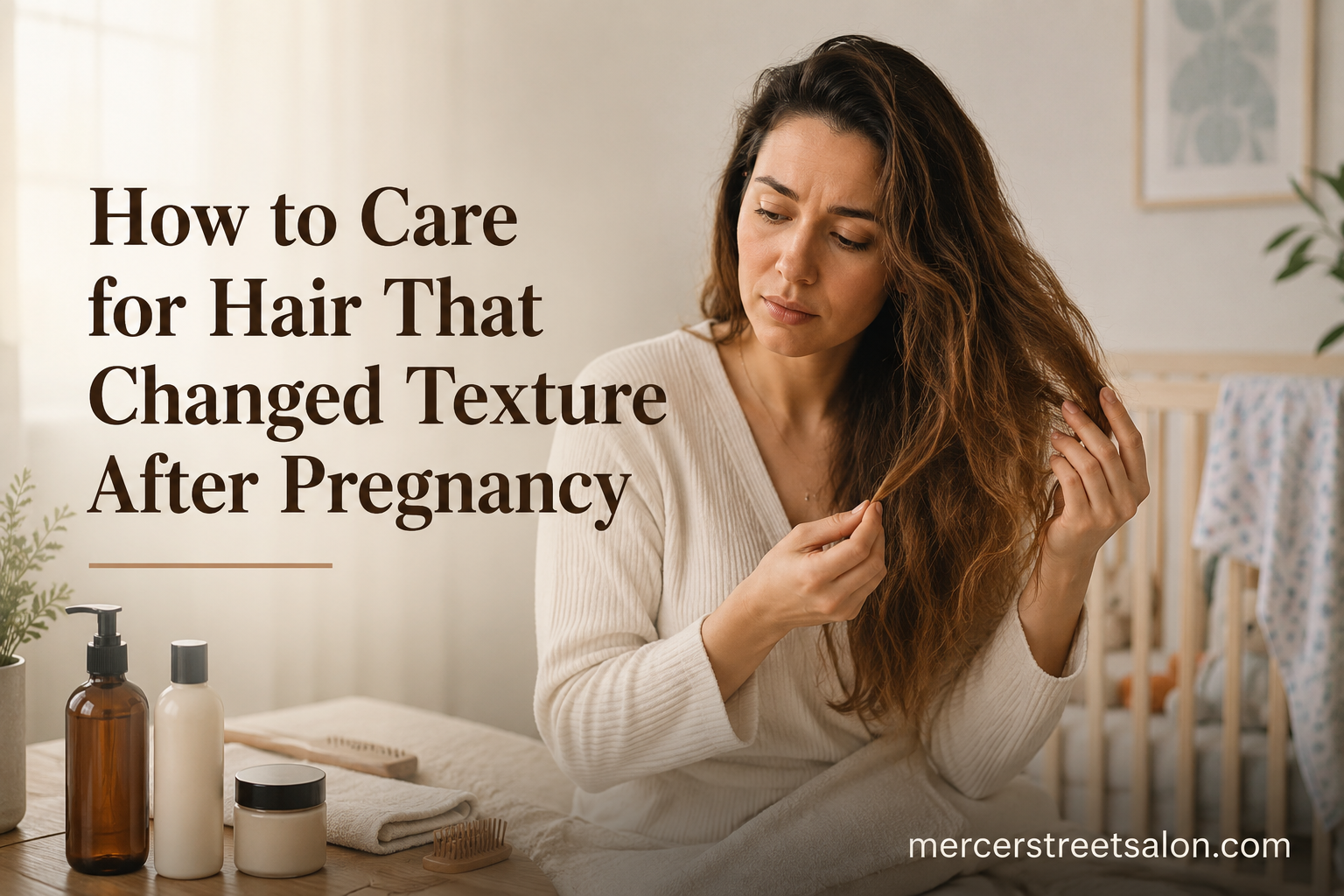
Yes, pregnancy can fundamentally change your hair texture. One morning you might wake up and realize your stick-straight hair has developed a wave, or your once-manageable curls have gone flat and lifeless. I have spoken to hundreds of new mothers who describe this exact moment of shock when they look in the mirror and no longer recognize their own hair.
The science behind this is straightforward, even if the experience feels anything but. During pregnancy, your body produces elevated levels of estrogen and progesterone, which keep hair in a prolonged growth phase and alter how each strand sits on your head. After delivery, those hormone levels drop sharply, pushing hair into a shedding cycle while simultaneously changing follicle shape, sebum production, and moisture retention. The result can be a completely different hair type than what you had before pregnancy.
How to care for hair that changed texture after pregnancy is one of the most common questions new mothers ask during the postpartum period. The answer depends entirely on what kind of texture shift you are experiencing, because a woman whose hair went from straight to curly needs an entirely different routine from someone whose hair went from curly to limp and flat. Our team at Mercer Street Salon has worked with dozens of postpartum clients navigating these changes, and we have seen how the right approach can make this transition far less stressful.
In this guide, I will walk you through exactly why your hair is behaving differently, what types of texture changes are most common, and how to build a care routine that works with your new hair rather than against it. Whether you are three months postpartum or a full year in, there are actionable steps you can take right now. This guide covers everything from the science behind follicle changes to step-by-step routines for each texture type, plus answers to the most common questions from new mothers on forums and social media.
Table of Contents
Key Takeaways
Before diving into the details, here is what you need to know most:
1. Hair texture changes after pregnancy are completely normal and driven by hormonal shifts, not anything you did wrong. Understanding the cause reduces anxiety and helps you take the right action.
2. Most texture changes begin within 2 to 4 months after delivery as estrogen levels drop and the hair growth cycle resets. This is the most common timeline reported by postpartum women.
3. Straight-to-curly is the most commonly reported transition, and it requires a shift from lightweight products to moisturizing, curl-supporting routines. The straight-to-wavy transition is the number one topic in postpartum hair forums.
4. Texture changes typically resolve within 6 to 12 months, though some women experience permanent shifts, especially after multiple pregnancies. Patience and consistent care make a real difference.
5. The same products you used before pregnancy will likely not work after, because your hair’s moisture needs and porosity have shifted. Product switching is not optional, it is essential.
6. You can manage almost every type of postpartum texture change with the right routine, patience, and a few targeted adjustments to how you care for your hair. The goal is to work with your new texture, not fight it.
Why Hair Texture Changes After Pregnancy
Understanding why your hair is changing is the first step toward feeling less frustrated with it. During pregnancy, your estrogen levels rise significantly, which extends the growth phase of hair follicles. Most women notice their hair feels thicker and fuller during pregnancy because fewer strands are entering the shedding phase. Estrogen also influences the shape of the hair follicle itself.
Round follicles produce straight hair, oval follicles create wavy hair, and flatter or more elliptical follicles generate coily or curly hair. When estrogen surges during pregnancy, it can subtly shift follicle shape over time, which is why some women wake up postpartum with a completely new curl pattern. This shift in follicle shape is the primary reason straight hair can become wavy or curly after pregnancy.
Progesterone and prolactin play supporting roles as well. Progesterone can affect sebum production on the scalp, which changes how moisturized your hair feels. Higher sebum production during pregnancy often leaves hair looking shinier and smoother, while the drop after delivery can leave strands feeling dry and rough. Prolactin, the hormone responsible for milk production, has been linked to changes in hair diameter and growth rate during breastfeeding.
The hair growth cycle itself undergoes a dramatic reset after birth. During pregnancy, elevated hormones keep most hair in the anagen, or growth, phase. After delivery, the sudden hormone withdrawal causes a large number of follicles to enter the telogen, or shedding, phase all at once. This is called telogen effluvium, and it typically begins 2 to 4 months postpartum. While telogen effluvium is primarily about hair loss, the hairs that regrow during the recovery period may come back with a different texture. This is because the follicles have been through a hormonal shock, and new growth can reflect that shift in follicle shape and behavior.
Androgens, the so-called male hormones that all women produce in smaller amounts, can also influence hair texture after pregnancy. Some research indicates that shifts in the estrogen-to-androgen ratio after delivery may make hair appear coarser or thicker, especially at the temples and crown. This is part of why postpartum hair can feel so different from what you had before. The combined effect of changing estrogen, progesterone, prolactin, and androgens creates a hormonal environment that reshapes not just how much hair you have, but how each individual strand grows, curves, and behaves. Your hair is literally growing under new hormonal instructions.
Types of Postpartum Hair Texture Changes
Every woman’s experience is different, but there are several texture changes that show up repeatedly in new mothers. The most common shift is straight hair becoming wavy or curly. I have heard this described so many times in our salon that it barely surprises me anymore. Women who used to need only a blow dryer suddenly find their hair forming ringlets or loose waves without any product.
This happens because the follicle shape has changed during pregnancy, and the new growth carries that altered shape. The hairs that were already on your head before pregnancy may still be straight, which creates an awkward mix of textures until the old hair sheds out and the new hair grows in fully. Many women describe seeing a visible line in their hair where the old straight growth ends and the new wavy or curly growth begins.
The reverse transition also happens. Some women with naturally curly or coily hair find that their new postpartum growth comes in straighter and flatter. This can be just as disorienting, especially if you have built an entire hair care routine around enhancing curl. Dry, rough, or coarse hair is another frequent complaint. The drop in scalp sebum production after delivery leaves many women with hair that feels straw-like and unmanageable, even if the curl pattern has not changed significantly.
Frizzy hair often accompanies dryness, because the hair shaft lacks the moisture it needs to lie flat against the head. Women who never had frizz issues before pregnancy may find themselves fighting a halo of flyaways that no amount of product seems to control. Thinning or loss of volume is closely related to texture change, though it is technically a separate issue. When hair sheds heavily during the telogen effluvium phase, the overall density drops, which can make hair feel and look thinner.
This is usually temporary, but the combination of shedding and a changed curl pattern can make hair feel dramatically different from what you were used to. Finally, hair color changes often accompany texture shifts. Many women notice their hair gets darker during pregnancy and lighter after delivery, sometimes with a visible line separating the two shades. This is caused by shifts in melanin production and is usually temporary as well. Hair texture and color changes often happen together, which makes the transition feel even more dramatic.
Postpartum Hair Loss vs. Texture Change: What Is the Difference?
It is important to understand that postpartum hair loss and postpartum texture change are related but distinct phenomena. Hair loss, or telogen effluvium, is about the quantity of hair on your head. It happens when a large number of follicles enter the shedding phase simultaneously, which typically begins 2 to 4 months after delivery. The average person sheds 50 to 100 hairs per day, but postpartum women can shed up to 400 hairs per day during the peak period. This is alarming to see in the shower drain or on your hairbrush, but it is almost always temporary.
Texture change is about the quality and behavior of each individual strand. Even if you are not shedding significantly, your hair may feel drier, curlier, straighter, frizzier, or coarser than it did before pregnancy. The two can absolutely happen at the same time, and many women experience both during the postpartum period. Some women find that their new curl pattern or hair texture never fully returns to what it was before pregnancy, especially after multiple births. Understanding this difference helps you set realistic expectations and choose the right response for what you are experiencing.
Timeline: When Changes Start and When They End
Knowing the typical timeline of postpartum hair changes can reduce a lot of anxiety. During pregnancy itself, many women report that their hair feels thicker, shinier, and more manageable. This is the estrogen effect at work, keeping hair in a prolonged growth phase and boosting sebum production. Some women even notice curl pattern changes during pregnancy, though these are less common than postpartum shifts.
The real transformation usually begins 2 to 4 months after delivery, when estrogen levels drop sharply and the hair growth cycle resets. This is when most women first notice shedding, new texture, or both. By the 6-month mark, many women see noticeable improvement. The worst of the shedding is usually over, and the new growth that has come in since delivery is fully visible. If the texture change is temporary, this is often when the hair begins returning to its pre-pregnancy behavior.
However, it can take up to 12 months for hair to fully return to normal. Patience is genuinely important here, because the regrowth process is slow and uneven. You may have straight hair at the roots and wavy hair at the ends for several months, which can be frustrating. The good news is that most texture changes do resolve within a year, though some women are left with a permanent shift in curl pattern or thickness, particularly after multiple pregnancies. If your hair has not started improving by the 9-month mark, it is worth consulting a dermatologist to discuss your options and rule out underlying conditions.
How to Care for Hair That Changed Texture After Pregnancy
Caring for hair that has changed texture after pregnancy requires a completely fresh approach to your routine. The products and techniques that worked before pregnancy are likely failing you now because your hair’s moisture needs, porosity, and texture have shifted. I have seen this play out countless times in our salon. A woman comes in with hair that used to be straight and silky, now frizzy and undefined, still using the same lightweight shampoo and conditioner she has used for years. The fix is not a miracle product. It is a systematic adjustment to how she washes, conditions, and styles her hair.
Step 1 is identifying your new hair type. Before you can choose the right products, you need to understand what your hair is asking for now. Wash your hair with a gentle, sulfate-free shampoo and let it air dry without any product. Observe the shape of the curls or waves, how much shrinkage occurs, how dry or oily your scalp feels, and how easily your hair tangles. If your straight hair has developed a wave, you now have wavy hair and need products designed for that texture. If your curls have gone limp, you may need volumizing products instead of heavy curl creams. This self-assessment takes five minutes and saves you weeks of product returns.
Step 2 is switching your shampoo and conditioner. If your hair has become drier, curlier, or frizzier, you need to move toward more moisturizing formulas. Look for sulfate-free shampoos that cleanse without stripping natural oils, and follow with a rich conditioner that contains ingredients like shea butter, argan oil, coconut oil, or glycerin. If your hair has gone from curly to straight or thin, you may need a volumizing shampoo that adds body without weighing hair down. The key is matching your products to your current hair needs, not the needs you had six months ago.
Step 3 is adjusting your washing frequency. Postpartum hair tends to be drier and more fragile, which means washing too often can worsen the problem. If you were washing every day before pregnancy, try stretching to every other day or every third day. On non-wash days, use a dry shampoo at the roots to absorb excess oil and refresh your scalp. Between washes, your scalp has time to produce the natural oils that keep your hair moisturized and manageable. For women with new curls, washing less frequently also helps preserve the natural oils that define and enhance curl patterns.
Step 4 is adding deep conditioning treatments. A weekly deep conditioning mask is one of the most effective things you can do for postpartum hair, regardless of what texture change you are experiencing. Deep conditioning restores moisture, reduces frizz, improves elasticity, and helps repair damage that may have accumulated during pregnancy and early postpartum days. Look for masks with ingredients like shea butter, avocado oil, hydrolyzed wheat protein, or honey. Apply the mask to clean, damp hair, leave it on for at least 15 to 20 minutes, and rinse with cool water. For women with new curls or coily hair, you can add a plastic shower cap to create gentle heat and help the product penetrate deeper. This simple step can transform dry, rough postpartum hair into something soft and manageable within a few weeks.
Step 5 is protecting your hair from heat and friction. Postpartum hair is more fragile than usual because the hair growth cycle has been disrupted. Heat styling tools like flat irons, curling wands, and blow dryers can cause breakage and make texture changes worse. If you must use heat, always apply a heat protectant first and keep the temperature as low as possible. Friction is another enemy of changing hair. Sleeping on cotton pillowcases creates friction that worsens frizz and tangles. Switch to a silk or satin pillowcase, which reduces friction dramatically and helps your hair retain moisture overnight. You can also wrap your hair in a silk scarf or bonnet before bed for extra protection.
Step 6 is being gentle when detangling. Tangling is one of the most common complaints I hear from postpartum women, especially those with new curls or coily hair. The change in texture makes strands more prone to knotting, and rough detangling causes breakage that worsens the problem. Always detangle on wet, conditioned hair using a wide-tooth comb or your fingers, starting from the ends and working your way up to the roots. Never brush dry hair, especially if it has become curlier or coiler. A detangling spray or leave-in conditioner makes the process much smoother. For women with long hair, consider sleeping with your hair in a loose braid or pineapple style to minimize overnight tangling.
Step 7 is moisturizing appropriately for your new texture. Moisture needs change dramatically when your hair texture shifts. If your hair has gone from straight to curly, it likely needs more moisture than ever before. Curly and coily hair types are naturally drier because the natural oils from the scalp have a harder time traveling down the curved shaft. Use a leave-in conditioner or curl cream on damp hair to lock in moisture, and seal with a lightweight oil like argan or jojoba oil. If your hair has gone from curly to straight or fine, you may need lighter products that add moisture without weighing hair down. A light leave-in conditioner or a hydrating hair milk can provide moisture without making flat hair look greasy or limp.
Step 8 is getting regular trims to remove split ends and damaged strands. Postpartum hair is more prone to breakage, and split ends can travel up the hair shaft, making texture changes feel worse. A trim every 10 to 12 weeks keeps ends healthy and prevents breakage from worsening frizz or coarseness. If you are in an awkward growing-out phase with two different textures, ask your stylist for a blended cut that layers the two textures together more seamlessly. A well-executed cut can make the transition period far more manageable than any product ever could.
Step 9 is using protective styles that keep hair safe while you sleep and during busy days. Loose braids, low buns, and pineapple updos keep hair from rubbing against clothing and pillowcases, which reduces friction and breakage. Silk or satin hair wraps are an excellent investment for overnight protection. During the day, avoid tight elastic bands that pull at the roots, especially around the hairline where postpartum thinning is most common. Soft scrunchies and spiral hair ties are gentler alternatives that still hold hair securely without causing tension or breakage at the follicles.
Caring for Specific Texture Transitions
Every texture transition requires a slightly different strategy, and I want to address the most common ones directly. If your hair went from straight to wavy or curly, congratulations: you now have a texture that many women spend years trying to achieve. The catch is that new curls require a completely different product and styling routine. You need sulfate-free shampoo, a rich conditioner, a curl-defining cream or gel applied to soaking wet hair, and a diffuser or air-drying method.
Scrunching rather than brushing is key, and you should avoid towel-drying with a rough cotton towel. A microfiber towel or a cotton T-shirt works much better for preserving curl definition. The transition period can last several months as your old straight hair sheds and the new curly hair grows in, so be patient with the awkward in-between stage. During this phase, you may need to use different products on the new growth versus the old growth until the textures blend naturally.
If your hair went from curly to straight, you may feel like you have lost the texture you knew how to care for. The shift is often caused by hormonal changes that make hair finer and less porous, which means curls cannot form as easily. You may need to switch from heavy curl creams to lighter volumizing products. A volumizing mousse applied to roots before blow-drying can help restore some body, and a light leave-in conditioner provides moisture without weighing hair down. If you miss your curls, you can use a curling wand on the new growth to create waves, but be gentle with heat and always use a protectant.
For women experiencing dry, rough, or coarse hair, hydration is your primary goal. A weekly deep conditioning mask is non-negotiable, and you should use a hydrating shampoo and conditioner pair daily. Oils like coconut oil, argan oil, and shea butter can be applied as a pre-shampoo treatment or a leave-in serum. A weekly hot oil treatment using warm coconut or olive oil left on the hair for 30 minutes before washing can dramatically improve softness. If your hair feels like straw, avoid clarifying shampoos until the moisture balance is restored. You may also want to use a hair oil or serum on the ends after washing to lock in moisture and reduce the rough feeling.
If thinning or loss of volume is your main concern, focus on gentle volumizing techniques. A volumizing shampoo at the roots, a lightweight mousse applied to damp roots, and root-lifting sprays can create the illusion of fuller hair. Avoid heavy oils and butters that weigh hair down at the roots. Get regular trims to remove any damaged ends that make hair look thinner, and avoid tight hairstyles like ponytails or braids that pull on fragile follicles. Most importantly, give it time. Thinning from telogen effluvium is almost always temporary, and volume typically returns as the shedding phase ends and new growth fills in. If your temple areas are noticeably thinning, a side part or layered cut can help camouflage the thinning while you wait for regrowth.
Nutrition and Supplements for Hair Recovery
Your hair does not grow in a vacuum. It reflects what is happening inside your body, and the postpartum period is a time of significant nutritional depletion. During pregnancy, your body diverts nutrients to the baby, which can leave your own stores depleted after delivery. This nutrient gap often shows up first in your hair, because hair is a non-essential tissue from the body’s perspective. Prioritizing nutrition is one of the most impactful things you can do for postpartum hair recovery, and it also supports your overall health as a new mother.
Postnatal vitamins are a good starting point, but not all prenatal vitamins continue after delivery. Look for a postnatal supplement that includes biotin, iron, zinc, vitamin D, and omega-3 fatty acids. Biotin supports keratin production, which is the protein hair is made from. Iron deficiency is extremely common after pregnancy, especially if you had a heavy bleed during delivery, and low iron is directly linked to hair thinning and slow regrowth. A blood test can confirm whether you are low, and your doctor can recommend the right dosage.
Zinc and vitamin D support the hair growth cycle, while omega-3s nourish the scalp and reduce inflammation that can disrupt follicle function. Beyond supplements, focus on eating a balanced diet rich in protein, healthy fats, and fresh vegetables. Hair is primarily made of protein, so inadequate protein intake will show up as weak, slow-growing strands. Aim for at least 60 to 80 grams of protein per day from sources like lean meat, fish, eggs, legumes, and dairy. Healthy fats from avocados, nuts, seeds, and olive oil support scalp health and sebum production.
Hydration matters too. Dehydration affects every system in your body, including hair growth, so drink plenty of water throughout the day. If you are breastfeeding, your fluid needs are even higher, so keep a water bottle nearby at all times. Eating small, frequent meals throughout the day helps maintain steady nutrient supply to your hair follicles, which is especially important when you are running on limited sleep and busy caring for a newborn. Snacks like nuts, seeds, Greek yogurt, and fresh fruit provide quick nutrition that supports both your energy levels and your hair health.
Scalp Care Routine
Your scalp is the foundation of healthy hair, and postpartum hormonal shifts can throw scalp health out of balance. Many women experience increased scalp sensitivity, dryness, or excess oil production after pregnancy, which directly affects how hair grows and feels. A dedicated scalp care routine can address these issues and support healthier hair regrowth. Start with a gentle scalp massage two to three times per week. Using the pads of your fingers, massage your scalp in circular motions for 5 to 10 minutes. This increases blood flow to the follicles, which delivers more oxygen and nutrients to support the hair growth cycle. You can do this while watching television or before bed.
For women with dry or tight scalps, a warm oil treatment before shampooing can make a significant difference. Coconut oil, jojoba oil, and almond oil are all excellent choices. Warm the oil slightly, apply it to your scalp and hair, leave it on for 30 minutes to an hour, then wash it out with a gentle shampoo. The oil penetrates the scalp, reduces dryness and tightness, and adds moisture to the hair shaft. If you have an oily scalp, focus the oil on the hair strands rather than the scalp, or use a lighter oil like jojoba that does not clog pores. Consistency is more important than intensity. A simple 10-minute scalp massage twice a week will do more good than an elaborate monthly treatment that you forget to repeat.
Scalp exfoliation is another technique that many women overlook. Just like the skin on your face, your scalp can accumulate dead skin cells, product buildup, and excess oil that block follicles and slow regrowth. A gentle scalp scrub used once a week can remove this buildup and create a healthier environment for new hair growth. You can use a commercial scalp scrub or make your own by mixing sugar or sea salt with a carrier oil like coconut or jojoba oil. Apply it to the scalp with your fingertips, massage gently in circular motions, and rinse thoroughly with a gentle shampoo. Be careful not to scrub too hard, as postpartum scalps can be more sensitive than usual. If you have an itchy or flaky scalp, a scalp scrub with tea tree oil or salicylic acid can help reduce flakes and restore balance.
Breastfeeding and Hair Texture: What You Need to Know
If you are breastfeeding, your hair texture changes may persist longer than they would otherwise. Prolactin, the hormone that stimulates milk production, remains elevated throughout the breastfeeding period, and it can continue to influence hair growth rate, thickness, and even follicle shape. Some women notice that their hair texture does not begin to normalize until after they wean, while others see gradual improvement during breastfeeding.
The connection between prolactin and hair texture is still being studied, but the anecdotal evidence from mothers is consistent: breastfeeding mothers often report more persistent or more dramatic texture changes than non-breastfeeding mothers. This does not mean you should stop breastfeeding to fix your hair. The benefits of breastfeeding for both you and your baby are well-documented, and hair texture changes are almost always manageable with the right routine.
What it does mean is that you may need to be more patient and more intentional about your hair care while you are nursing. Focus on the basics: gentle cleansing, regular deep conditioning, scalp care, and a nutrient-dense diet that supports both milk production and hair health. Some breastfeeding mothers find that their hair becomes even curlier or coiler over the first six months of nursing, and then begins to soften as prolactin levels gradually decline. Every body is different, so track your own patterns rather than comparing your timeline to someone else’s.
If you are breastfeeding and noticing that your hair is not just changing texture but also shedding heavily, this is likely a combination of normal postpartum telogen effluvium and the ongoing effects of prolactin. The shedding usually peaks around 4 months postpartum and begins to subside after that, but the texture changes may linger. Be especially gentle with your hair during this time. Avoid tight hairstyles, minimize heat styling, and use products that support your new texture rather than fighting it. The combination of hormonal shifts, sleep deprivation, and the physical demands of caring for a newborn makes this a challenging time, so be kind to yourself as you figure out what works.
Hair Color Changes After Pregnancy
Texture is not the only thing that changes. Many women notice their hair color shifts during and after pregnancy as well. The most common pattern is hair getting darker during pregnancy and lighter after delivery. This happens because hormonal fluctuations affect melanin production in the hair follicle. During pregnancy, elevated hormones can cause the body to produce more melanin, which darkens hair color. After delivery, as hormone levels drop, melanin production may decrease, causing hair to lighten.
Some women also report their hair getting grayer during pregnancy, which is thought to be related to stress hormones temporarily affecting melanin-producing cells. The good news is that hair color changes are almost always temporary, just like texture changes. As your hormones stabilize and your hair completes its regrowth cycle, your natural color typically returns within 6 to 12 months. You may notice a visible line where the darker pregnancy hair ends and the lighter postpartum growth begins, which can be startling.
If this bothers you, a demi-permanent color or gloss can blend the two shades without using harsh chemicals on fragile postpartum hair. Always consult with a colorist who understands postpartum hair before making any major color decisions, because your hair is more fragile than usual and may react differently to chemical treatments. A gloss is a gentler alternative to full color, as it adds shine and blends tones without lifting the cuticle as aggressively as permanent color. Many colorists recommend waiting until at least 6 months postpartum before doing any major color work, to give your hair time to stabilize.
Styling Tips for Your New Hair Texture
Styling hair that has changed texture requires letting go of old habits and learning to work with what you have now. If your hair went from straight to wavy or curly, you will need to relearn how to style it entirely. The blow dryer routine you relied on for straight hair will likely create frizz and fight against your new texture rather than enhancing it. Consider using a diffuser attachment on low heat, or let your hair air dry and scrunch with a curl cream or gel. Plopping, which involves laying damp hair on a T-shirt or microfiber cloth and wrapping it up for 20 to 30 minutes, is a popular technique that enhances curls without heat. For women with new coily hair, a twist-out or braid-out on damp hair can create beautiful definition without any heat at all.
If your hair went from curly to straight or fine, you may need to add volume through styling. A round brush and blow dryer can lift roots and create body, while a volumizing mousse adds thickness at the roots. Be careful not to overload fine hair with heavy products, because this will weigh it down and make it look flatter. A light texturizing spray can add separation and movement without heaviness. Regardless of your new texture, avoid tight hairstyles that pull on fragile follicles. Loose braids, low buns, and half-up styles are gentler than tight ponytails or sleeked-back looks.
If you wear your hair up often, use soft elastic bands rather than tight rubber bands, and avoid styles that cause pain or tension at the temples, where postpartum thinning is most noticeable. For women dealing with the awkward in-between stage where old straight hair and new curly hair coexist, strategic haircuts can make a huge difference. Layers that blend the two textures together are far more forgiving than blunt cuts that highlight the contrast. Ask your stylist for a cut that works with both textures, or consider getting a trim that removes some of the old, straight growth while leaving enough length to tie the two textures together.
When to See a Professional
Most postpartum hair texture changes resolve with time and the right home care routine, but there are situations where professional help is needed. If your hair shedding is extreme, with more than a few hundred hairs coming out per day and lasting beyond six months, it is worth visiting a dermatologist. While telogen effluvium is almost always temporary, there are other conditions that can cause hair loss, including thyroid disorders, autoimmune conditions, and iron deficiency anemia. A dermatologist can run tests to rule out underlying issues and may recommend prescription treatments if needed.
A licensed hair stylist can also be incredibly helpful during this transition. A good stylist who understands postpartum hair can assess your new texture, recommend appropriate products, and give you a haircut that works with your changed hair rather than fighting it. Many women find that a strategic trim or even a slightly shorter style makes their new texture much more manageable. If you are struggling with an awkward growing-out phase where half your hair is straight and half is curly, a stylist can suggest layered cuts or textured styles that blend the two textures more seamlessly.
At Mercer Street Salon, we have seen how a single well-planned haircut can transform a new mother’s confidence during the postpartum period. A stylist who understands the science behind postpartum hair changes can be an invaluable partner in your recovery. Do not hesitate to seek professional guidance if you are feeling stuck or overwhelmed by your new hair. Sometimes an outside perspective is exactly what you need to see a path forward.
The Emotional Side of Postpartum Hair Changes
I want to address something that most articles about postpartum hair skip entirely: the emotional impact. Hair is deeply tied to identity, and not recognizing your own reflection can be genuinely distressing. I have had clients sit in my chair and cry because their hair no longer feels like theirs. They describe a sense of loss, as if a small but important part of their pre-motherhood self has disappeared. This reaction is completely valid, and it deserves more attention than it typically receives in hair care guides.
The early postpartum period is already a time of enormous physical and emotional adjustment. Your body has changed in visible and invisible ways, your sleep is fragmented, and your entire daily routine has been upended. Hair texture changes add one more layer of disruption to an already overwhelming experience. It is normal to grieve the hair you had before pregnancy, even while you are grateful for the baby you now have. These feelings do not make you vain or ungrateful. They make you human.
Be patient with yourself during this transition. Your hair will continue to evolve over the coming months, and it may not return exactly to what it was before. Some women discover that they actually prefer their new texture once they learn how to care for it. Others choose to embrace the change with a new cut, new color, or new style that reflects who they are now rather than who they were before pregnancy. There is no right or wrong way to feel.
If the emotional impact of your hair changes feels heavy, talk about it with your partner, friends, or a postpartum support group. Online communities on Reddit and WhatToExpect are filled with women who understand exactly what you are going through, and sharing your experience with them can be incredibly validating. You are not alone in this experience, and you do not have to navigate it by yourself.
Before vs. After: Hair Care Routine Adjustments
One of the most practical things you can do is compare your old routine side by side with what your hair needs now. This helps you see exactly where adjustments are needed. Below is a breakdown of typical pre-pregnancy and postpartum hair care adjustments across every major category.
Shampoo: Before pregnancy, sulfate shampoo was likely fine for your hair type. After pregnancy, sulfate-free formulas are essential to prevent stripping the extra moisture your hair now needs. If your hair has become curlier or coarser, you may also want to try a co-wash, which uses only conditioner to cleanse without foaming agents. Co-washing preserves the natural oils that your new curls desperately need to stay defined and moisturized.
Conditioner: Before pregnancy, you may have applied conditioner only to the ends. After pregnancy, apply conditioner from root to tip if your scalp is dry, or focus on the ends if your roots are oily. The key is matching the application to your scalp’s current oil production, not what it was before. Many postpartum women find that their scalps are drier than before, so conditioning the roots becomes necessary even if you never did it before.
Washing frequency: Before pregnancy, daily or every-other-day washing may have been normal. After pregnancy, extend to every other day or every third day to preserve natural scalp oils. Use dry shampoo on non-wash days to keep roots fresh. Between washes, your scalp has time to produce the natural oils that keep your hair moisturized and manageable. For women with new curls, washing less frequently also helps preserve the natural oils that define and enhance curl patterns.
Styling products: Before pregnancy, you may have used gel, mousse, or nothing at all. After pregnancy, your products should match your new texture: curl creams and gels for new curls, volumizing mousses for thinning hair, hydrating milks for dry hair. The product you used before pregnancy is likely the wrong weight for your new hair. Do not be afraid to buy sample sizes first and test products over a few weeks before committing to full-size bottles.
Heat tools: Before pregnancy, daily flat iron or curling wand use may have been normal. After pregnancy, limit heat styling to once or twice per week, always use a heat protectant, and keep temperatures below 350 degrees. Air drying or diffusing on low heat is gentler and preserves your new texture better. High heat can permanently alter the protein structure of fragile postpartum hair, making texture changes feel irreversible.
Sleep protection: Before pregnancy, a cotton pillowcase was probably fine. After pregnancy, switch to silk or satin to reduce friction and frizz overnight. Wrap your hair in a silk scarf or use a silk bonnet for extra protection while you sleep. This single change can reduce morning frizz by a noticeable amount within the first week. Many women report that their hair is significantly more manageable after making this switch.
Detangling tools: Before pregnancy, a brush may have worked fine. After pregnancy, use a wide-tooth comb or your fingers on wet, conditioned hair only. Start at the ends and work upward to avoid breakage. A detangling spray makes the process smoother and faster. Rough brushing of dry hair is one of the fastest ways to worsen texture changes and cause unnecessary breakage during an already fragile period.
Deep conditioning: Before pregnancy, an occasional deep conditioning mask may have been enough. After pregnancy, a weekly deep conditioning treatment is essential for restoring moisture and repairing damage. Leave the mask on for at least 15 to 20 minutes and use a shower cap to enhance penetration. Think of deep conditioning as a non-negotiable appointment in your calendar, not an optional luxury.
Frequently Asked Questions
Here are answers to the most common questions about postpartum hair texture changes.
Does hair texture go back to normal after pregnancy?
Hair texture often returns to its pre-pregnancy state within 6 to 12 months after delivery as hormone levels stabilize. However, some women experience permanent changes, especially after multiple pregnancies. The curl pattern, thickness, and overall texture can shift due to hormonal fluctuations, aging, and genetics. Patience and gentle hair care during the recovery period help support healthy regrowth. If your hair has not shown signs of improvement after a full year, a dermatologist can help determine whether the changes are likely permanent or if there is an underlying condition that needs treatment.
How to fix damaged hair after pregnancy?
Use gentle sulfate-free shampoos and conditioners to reduce breakage. Add weekly deep conditioning or bond-repair treatments. Incorporate scalp massages with natural oils like coconut or argan oil to nourish roots. Minimize heat styling, avoid tight hairstyles, and use a wide-tooth comb on wet hair. Consider postpartum vitamins after consulting your doctor. Damaged postpartum hair responds well to consistent, gentle care over time, so stick with your routine even if you do not see immediate results.
How to manage postpartum frizzy hair?
Use sulfate-free shampoos with silicone-based conditioners to lock in moisture. Apply leave-in conditioner or curl cream to damp hair. Try a hydrating hair mask once a week. Sleep on a silk pillowcase to reduce friction. Avoid towel-drying with rough cotton; use a microfiber towel or cotton T-shirt instead. Limit heat styling and get regular trims to reduce split ends. Frizz is almost always a sign that your hair needs more moisture, so prioritize hydrating products and treatments over smoothing products that rely on silicones alone.
Can pregnancy make your hair texture change?
Yes, pregnancy hormones can significantly change hair texture. Elevated estrogen and progesterone during pregnancy can alter follicle shape, causing straight hair to become wavy or curly, or vice versa. Hair may also become drier, coarser, or thicker. These changes typically begin during pregnancy or within 2 to 4 months after delivery as hormone levels shift. The change is driven by biology, not by anything you did or did not do, so try not to blame yourself for the shift.
Is postpartum hair texture change permanent?
Most postpartum hair texture changes are temporary and resolve within 6 to 12 months as hormones stabilize. However, some women do experience permanent changes, particularly after multiple pregnancies. If your hair texture has not returned to normal after a full year, consult a dermatologist to rule out other causes and discuss your options. Permanent changes are more likely if the texture shift was gradual and progressive over multiple pregnancies, rather than sudden after a single delivery.
Can breastfeeding cause hair texture changes?
Yes, breastfeeding can prolong or intensify hair texture changes. Prolactin, the hormone that drives milk production, remains elevated during breastfeeding and may continue to affect hair follicle shape, growth rate, and strand thickness. Many breastfeeding mothers find that their hair texture does not begin normalizing until after weaning, though this varies from person to person. The prolactin effect is not a reason to stop breastfeeding, but it is useful information for setting realistic expectations about your hair timeline.
Why did my straight hair turn wavy after pregnancy?
Your straight hair likely turned wavy because pregnancy hormones altered the shape of your hair follicles. Round follicles produce straight hair, while more oval follicles create waves or curls. Elevated estrogen and progesterone during pregnancy can shift follicle shape over time, so the new hair that grows in carries the altered shape. As your old straight hair sheds and the new wavy hair grows in fully, you will see the full extent of the change over several months. This is the single most commonly reported texture transition in postpartum hair forums, and it is well-documented by dermatologists and hair scientists.
How long does postpartum hair texture change last?
Postpartum hair texture changes typically last between 6 and 12 months. The shedding and texture shifts usually begin 2 to 4 months after delivery, with improvement visible by the 6-month mark. Most women see their hair return to normal within a year. However, some experience longer-lasting or even permanent changes, especially after multiple pregnancies. The timeline varies based on individual hormone levels, genetics, and overall health. The best thing you can do is focus on consistent, gentle care and give your body the time it needs to recover.
Conclusion
Postpartum hair texture changes can feel like one of the most personal and frustrating parts of the recovery period, but they are also one of the most manageable with the right approach. Your hair is responding to a massive hormonal event, and it will continue to evolve over the coming months. The most important thing you can do is stop fighting your new texture and start working with it. Switch to products that match your current hair needs, build a gentle care routine centered on moisture and protection, and give your body the nutrients it needs to support healthy regrowth.
If you are struggling with the emotional side of these changes, know that you are not alone and that support is available. Talk to other mothers who have been through the same thing, seek out a stylist or dermatologist who understands postpartum hair, and be patient with yourself as your body continues to recover from pregnancy and childbirth. How to care for hair that changed texture after pregnancy is not a question with a single answer, but with patience, observation, and a few targeted adjustments, you can absolutely find a routine that makes your hair feel like yours again.