
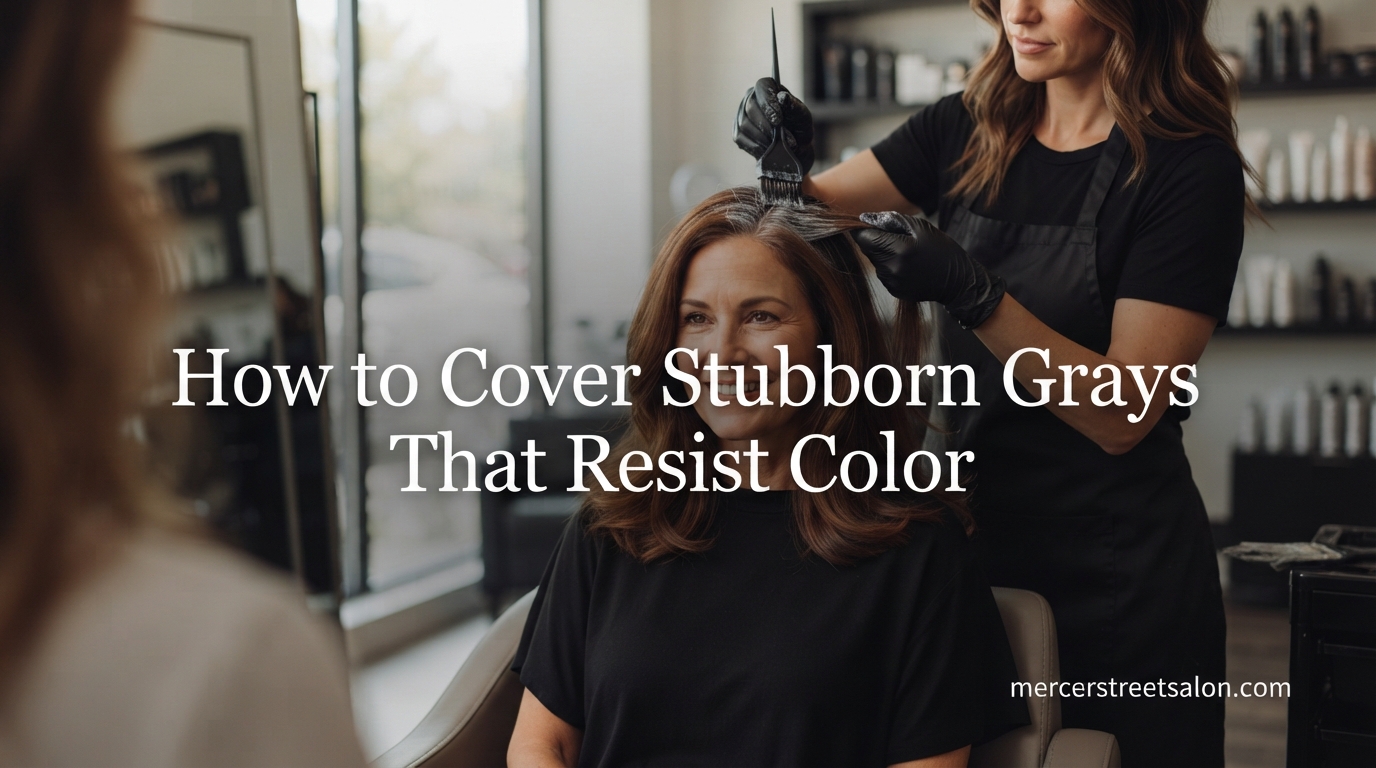
If you have ever colored your hair only to find silver strands peeking back through a few days later, you are not imagining things. Some gray hairs genuinely resist color, bouncing back no matter what dye you throw at them. Learning how to cover stubborn grays that resist color comes down to understanding why those strands behave differently and using techniques that actually work with their texture.
At our salon, we see clients every week who have tried three or four box dyes at home with disappointing results. The problem is rarely the product itself. It is almost always the approach. Covering resistant gray hair requires a different strategy than coloring pigmented hair, and once you understand the difference, the results improve dramatically.
In this guide, we walk you through the science behind resistant grays, the products that deliver real coverage, and a step-by-step application method you can use at home or share with your colorist.
Table of Contents
Why Gray Hair Resists Color in the First Place
Gray hair is not just missing color. It is structurally different from pigmented hair, and that structural difference is exactly why it fights back against dye.
When hair loses its melanin, the pigment that gives it natural color, the strand also changes texture. Gray hair tends to be coarser, wirier, and more porous in some areas while being resistant in others. The cuticle layer, which is the outermost shield of the hair shaft, becomes thicker and more tightly compacted on gray strands. This makes it harder for color molecules to penetrate into the cortex where they need to bond.
Think of pigmented hair like an open window that lets dye flow through easily. Gray hair is more like a window with the shutters closed. You need more force, more time, and sometimes a different tool to pry those shutters open and get the pigment inside.
There is also a density issue. Gray hair strands are often finer in diameter but packed more densely at the scalp, particularly around the temples and hairline. This means even when color does penetrate, the coverage can look uneven because the hair is packed so tightly that saturation is incomplete.
One concept that comes up frequently in gray hair discussions is the 50-50-50 rule. This informal guideline suggests that by age 50, approximately 50 percent of the population will have 50 percent gray hair. It is not a hard scientific law, but it does help explain why so many people in their late forties and fifties suddenly notice their gray coverage becoming more difficult. At that level of gray density, spot coverage no longer works. You need a full-coverage strategy.
How to Cover Stubborn Grays That Resist Color: Choose the Right Products
The single most important product decision you will make is choosing between permanent and demi-permanent color. For resistant gray hair, this choice makes or breaks your results.
Permanent color is the only type that reliably delivers full gray coverage on stubborn strands. It uses oxidative dye technology, meaning it relies on hydrogen peroxide to both lift the natural pigment and deposit new color molecules deep inside the cortex. This dual action is what allows permanent color to grip onto gray hair that refuses to hold other formulas.
Demi-permanent color is gentler. It uses a lower concentration of developer and deposits color without significantly lifting your natural shade. It is excellent for blending, glossing, and refreshing faded color. However, demi-permanent color will not fully cover resistant grays. It stains them temporarily, which means the silver will resurface within a week or two of washing.
If your goal is 100 percent gray coverage, permanent color is your starting point. If you are comfortable with a softer blend that lets some silver show through, demi-permanent can work as a lower-maintenance option between full color sessions.
Another factor to consider is the depth of your target shade. Lighter colors, particularly ash tones, struggle more with gray coverage because they contain less pigment overall. Warm and neutral shades with gold or copper undertones tend to cover gray hair more effectively because those warm molecules fill in porous gray strands better than cool tones. If you want an ash result, your colorist may need to use a two-step process: first apply a warm filler shade, then tone it down to your desired cool finish.
Step-by-Step Application Technique for Resistant Grays
Getting color onto resistant gray hair is about more than just picking the right dye. How you apply it matters just as much. Here is the method we use and recommend for maximum gray coverage.
Step 1: Pre-Soften the Most Resistant Spots
Before you apply your color mixture, take a small amount of your color formula without any developer and paint it directly onto the most stubborn gray patches. Focus on the temples, hairline, and any wiry silver strands at the crown. This technique, sometimes called dead color application, primes the cuticle and starts opening it up before the activated formula even touches the hair.
Let the pre-application sit for about 5 minutes. Then apply your full color-and-developer mixture right over the top of it.
Step 2: Section Your Hair Systematically
Divide your hair into clean, manageable sections using clips. Work in quadrants: split the hair down the center from forehead to nape, then ear to ear across the back. This gives you four workable zones. Within each zone, take subsections no wider than half an inch.
Thin sections are critical for resistant grays. If your sections are too thick, the color will sit on the surface and never reach the hair closest to the scalp, which is exactly where grays are most visible.
Step 3: Start With the Most Resistant Areas
Always begin application at the temples and hairline. These areas need the longest processing time because they are the most resistant. By the time you finish applying color to the rest of your head, the temples will have had several extra minutes of processing.
Work from the front hairline back toward the crown, then finish with the nape and ends. The ends of your hair are typically the most porous, so they process faster and need the least amount of time.
Step 4: Saturate Completely
Resistant grays need full saturation, not a light coating. Apply enough product that every strand is visibly coated from root to tip. Use a bowl-and-brush application rather than a squeeze bottle for better control and coverage. The brush lets you press the color into the hair and work it through the cuticle rather than just laying it on top.
If you can see hair through the color, you have not applied enough. Add more.
Step 5: Use a Processing Cap
Once your color is fully applied, cover your hair with a plastic processing cap. This traps body heat and creates a controlled environment that helps the cuticle stay open and the pigment penetrate deeper. For maximum effect, sit under a hooded dryer or use a thermal heat cap for 15 to 20 minutes of your total processing time.
This step is a favorite trick from professional colorists. The combination of moisture and consistent heat can mean the difference between grays that stay covered for four weeks versus six weeks.
Step 6: Let It Process Fully
Follow the manufacturer’s recommended processing time, but do not rush it. For resistant gray coverage, the full processing window is typically 30 to 45 minutes. Cutting it short is one of the most common reasons color fails to take.
Check a small section near the temple after 30 minutes. If the gray is still visible, give it another 10 to 15 minutes before rinsing.
Developer Volume Guide: Which Strength to Use
Developer is the activator that makes hair color work. It contains hydrogen peroxide in varying concentrations, and choosing the right volume directly impacts your gray coverage results.
Here is how each developer strength performs on resistant gray hair.
10 Volume Developer contains 3 percent hydrogen peroxide. It is the gentlest option and works well for depositing color without lifting your natural shade. However, 10 volume is rarely strong enough to open tightly compacted gray cuticles. Use it only if your gray hair is fine and minimally resistant, or if you are doing a demi-permanent gloss.
20 Volume Developer contains 6 percent hydrogen peroxide. This is the industry standard for gray coverage and the volume we recommend for most at-home users and professionals alike. It opens the cuticle sufficiently for permanent color to penetrate the cortex while lifting natural pigment by about one to two levels. If you are coloring stubborn grays for the first time, start here.
30 Volume Developer contains 9 percent hydrogen peroxide. It lifts up to three levels and is used when you want significantly lighter results. It can work for extremely resistant grays, but it also causes more damage and dryness. Use 30 volume only if you have experience with hair color or are working with a professional.
40 Volume Developer contains 12 percent hydrogen peroxide and is intended for high-lift applications only. We do not recommend 40 volume for home use on gray hair. The risk of breakage, scalp irritation, and uneven results is too high without professional supervision.
For most people dealing with resistant grays, 20 volume with a permanent color formula is the sweet spot. It provides enough lifting power without excessive damage.
Advanced Techniques for Extremely Resistant Grays
Sometimes standard application is not enough. If you have been coloring your gray hair for months or years and certain patches still will not take, these advanced methods can help.
The Double Application Method
For grays that absolutely refuse to cover, apply your color, process it for the full recommended time, rinse, and then apply a fresh batch of color to the same stubborn areas. Process for an additional 15 to 20 minutes. This two-pass approach gives the cuticle two chances to absorb pigment, and it works particularly well on the wiry silver strands at the temples.
Be aware that double processing increases dryness, so follow up with a deep conditioning treatment.
Adding Gold to Your Formula
Gold-based color molecules are larger and fill porous gray hair more effectively than cool-toned pigments. If you are mixing a custom formula, ask your colorist to add a quarter inch of a gold-based shade to your target color. This acts as a filler that gives the rest of the pigment something to grip onto. You will not see a noticeable gold tint in the final result, but you will see noticeably better gray coverage.
Heat Processing With a Thermal Cap
We mentioned the processing cap method earlier, but it deserves emphasis here. Heat is one of the most effective tools for forcing color into resistant strands. Professional salons use heat processors like a Climazon, but you can replicate the effect at home with a thermal heat cap or by sitting under a hooded dryer.
Apply your color, cover with a plastic cap, and apply medium heat for 20 minutes. Then remove the heat and let the color continue processing at room temperature for the remaining time. This heat-then-rest method gives the cuticle time to close back down and lock the pigment inside.
Natural Pre-Treatment Options
Some people report success using natural pre-treatments before coloring. A baking soda paste applied to resistant gray patches for 5 to 10 minutes before coloring can help slightly rough up the cuticle surface, making it more receptive to color. Mix one tablespoon of baking soda with enough water to form a paste, apply it to dry hair, rinse thoroughly, and then proceed with your color application.
Apple cider vinegar rinses are another option, though they work differently. Vinegar helps balance the pH of the hair and scalp, which can improve how evenly color takes. Use a diluted vinegar rinse (one part vinegar to three parts water) the day before coloring, not immediately before, as vinegar can temporarily close the cuticle.
These natural methods are not backed by extensive clinical research, but many users in hair coloring communities report measurable improvements. If you try them, always do a strand test first.
Target Areas: Temples, Hairline, and Crown
Not all gray hair is equally stubborn. Certain areas of the head are notoriously resistant, and knowing where to focus your effort saves time and frustration.
The temples are the number one trouble zone for gray coverage. The hair here is often the first to go gray, the coarsest in texture, and the most tightly packed at the scalp. Always start your color application at the temples and give them the longest processing time.
The hairline around the forehead and ears is the second most problematic area. These hairs are fine but numerous, and they sit right at the edge of your face where any missed coverage is instantly visible. Use a detailing brush to paint color along the hairline precisely, and apply a second coat if needed.
The crown can also be tricky because hair grows in a spiral pattern there, creating multiple directions and layers. Take extra-thin sections at the crown and make sure the color reaches every layer, not just the surface.
For root touch-ups between full color sessions, focus on these three areas. You can stretch the time between full applications by touching up just the temples, hairline, and crown every two weeks. Most people find they need a full root retouch every three to four weeks and a complete color refresh every six to eight weeks.
Post-Color Care for Long-Lasting Gray Coverage
Getting color onto resistant grays is only half the battle. Keeping it there requires the right aftercare routine.
Wait at least 48 hours after coloring before washing your hair. This gives the color molecules time to fully oxidize and lock into the cortex. Washing too soon can strip away pigment that has not yet set, which is especially damaging on resistant grays that barely took the color in the first place.
Switch to a sulfate-free, color-safe shampoo. Sulfates are harsh detergents that accelerate color fading by stripping the cuticle. Look for products labeled as safe for color-treated hair, and wash no more than two or three times per week.
Use cool or lukewarm water when you wash. Hot water opens the cuticle and lets pigment escape. A cool rinse at the end of your shower helps seal the cuticle and lock in color.
Apply a deep conditioning mask once a week. Gray hair tends to be drier than pigmented hair, and coloring makes it even more so. A weekly moisture mask keeps the hair flexible and less prone to the brittleness that makes color flake off.
Protect your hair from the sun and heat styling. UV rays break down color molecules, and hot tools can damage the cuticle and cause premature fading. Use a heat protectant before styling, and consider wearing a hat if you will be in direct sunlight for extended periods.
Common Mistakes to Avoid When Covering Resistant Grays
Avoiding these frequent errors will immediately improve your gray coverage results.
Rushing the processing time. Taking the color off after 20 minutes because you are impatient is the most common cause of failed gray coverage. Let it process for the full recommended duration.
Using the wrong developer volume. Using 10 volume on extremely resistant grays will not open the cuticle enough. Conversely, jumping to 30 or 40 volume unnecessarily causes damage without improving coverage.
Applying color in thick sections. Thick sections mean uneven saturation. Color needs to touch every strand, especially at the scalp where grays are most visible.
Skipping the pre-treatment step. Applying color without pre-softening the most resistant spots means those areas start at a disadvantage. Take five extra minutes to prime the temples and hairline.
Washing too frequently after coloring. Daily washing strips color fast, and on resistant grays, the pigment is already hanging on by a thread. Extend the time between washes.
FAQs
What do you do when grey hair won’t hold color?
Switch to a permanent color formula with 20 volume developer, pre-soften the most resistant spots by applying color without developer first, and use a processing cap with heat for 20 minutes. Let the color process for the full recommended time without rushing. If coverage still fails, try a double application or consult a professional colorist.
What hair dye covers stubborn greys?
Permanent oxidative hair color is the most effective type for covering stubborn grays. Look for formulas specifically labeled for 100 percent gray coverage, and use 20 volume developer. Warm and neutral shades with gold undertones tend to cover gray more effectively than ash tones because the gold molecules fill porous gray strands better.
What is the 50 50 50 rule for gray hair?
The 50-50-50 rule is an informal guideline suggesting that by age 50, approximately 50 percent of the population will have 50 percent gray hair. It is not a scientific law but helps explain why gray coverage becomes more challenging in your late forties and fifties, when gray density increases and spot coverage no longer works.
What happens when you sprinkle baking soda on gray hair?
Baking soda acts as a mild alkaline cleanser that can slightly rough up the cuticle surface of gray hair, making it more receptive to color. Some people apply a baking soda paste to resistant gray patches for 5 to 10 minutes before coloring. However, baking soda can also be drying, so always follow with a conditioning treatment and do a strand test first.
How to cover resistant grays?
Use permanent color with 20 volume developer, start application at the temples and hairline, take thin sections for full saturation, use a processing cap with heat for 20 minutes, and process for the full recommended time. Pre-softening the most resistant spots by applying color without developer first also dramatically improves coverage.
What does vinegar do to gray hair?
Apple cider vinegar helps balance the pH of the hair and scalp, which can improve how evenly color takes on resistant grays. A diluted vinegar rinse used the day before coloring may help the cuticle respond better to color application. However, vinegar can temporarily close the cuticle, so it should not be used immediately before coloring.
Conclusion
Covering resistant gray hair is not about finding a magic product. It is about using the right technique with the right product at the right time. When you understand why gray hair resists color, choose permanent oxidative color with the appropriate developer volume, pre-soften your most stubborn patches, and process under heat for the full recommended time, the difference is immediate and lasting.
Whether you color at home or visit a professional, the principles in this guide will help you cover stubborn grays that resist color and keep them covered longer. Start with the basics, be patient with processing time, and adjust your approach based on how your specific hair responds. Every head of gray hair is a little different, but the science and techniques outlined here give you a reliable foundation for consistent, full coverage.