
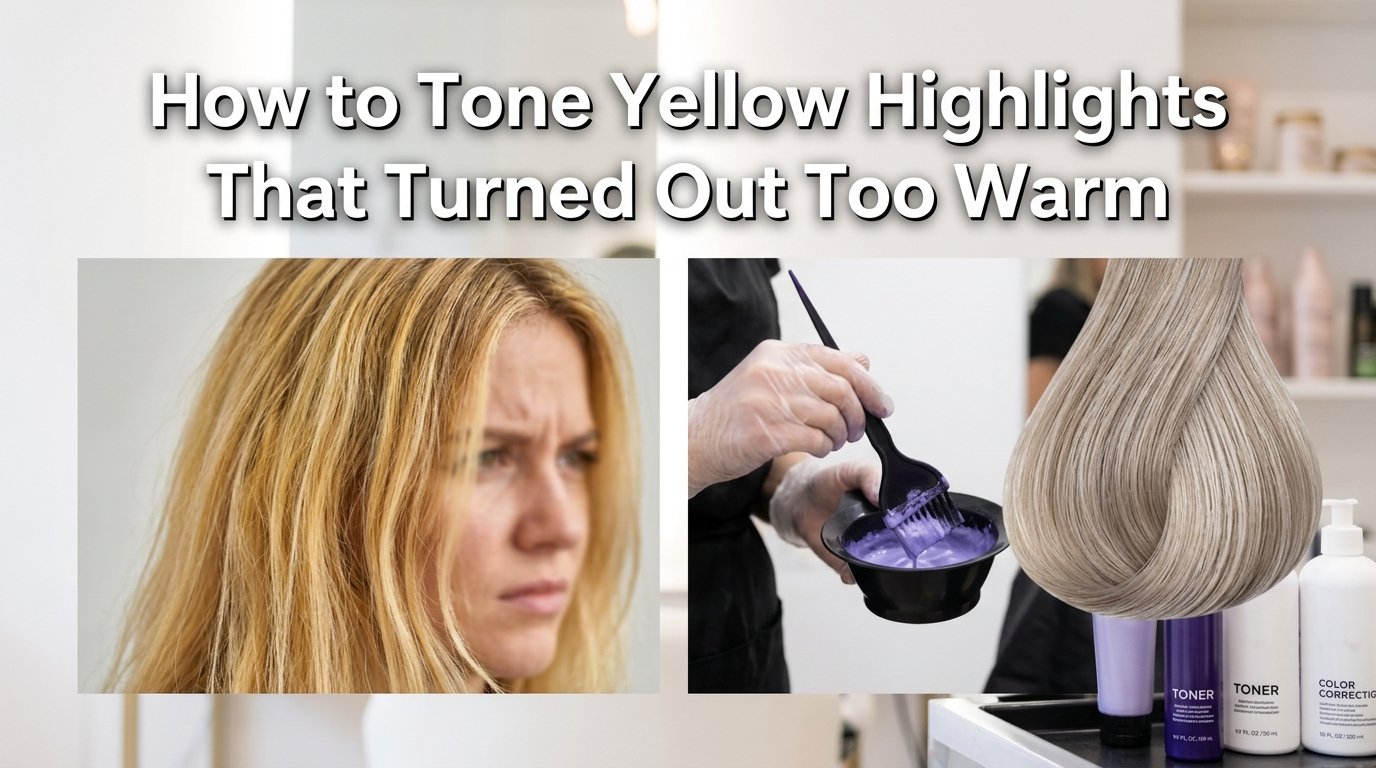
You left the salon feeling amazing, and two weeks later your highlights look straight-up yellow. I have been there, and so has almost every blonde I know. Learning how to tone yellow highlights that turned out too warm changed my entire hair routine, and it can change yours too.
Warm yellow brassiness is the most common complaint after a highlighting service. The good news is you do not need another salon appointment to fix it. With the right products and a little color theory knowledge, you can cool things down at home.
In this guide, I will walk you through exactly why your highlights turned yellow, which toning method fits your situation, and how to keep that cool blonde looking fresh for weeks. Whether your highlights are barely warm or full-on golden, you will find a fix here.
Table of Contents
Quick Answer: How to Tone Yellow Highlights That Turned Out Too Warm
The fastest way to tone yellow highlights that turned out too warm is to use a purple shampoo or violet toner. Purple sits directly opposite yellow on the color wheel, so it neutralizes brassy yellow tones on contact. For mild warmth, use purple shampoo once or twice a week. For stronger brassiness, apply a violet toner mixed with 10-volume developer and leave it on for 20 to 30 minutes.
Why Your Highlights Turned Yellow in the First Place
Understanding the cause makes the fix a lot easier. Yellow highlights happen because bleaching lifts your natural pigment in stages, and the final stage before pale blonde is yellow.
When your stylist applies bleach, it strips away the dark melanin first, then moves through red, orange, gold, and finally yellow. If your hair does not lift past the yellow stage, or if your salon toner fades, that underlying warmth shows through.
Here are the most common reasons your highlights turned too warm:
The toner faded. Salon toners are semi-permanent and typically last 2 to 6 weeks. Once they wash out, the yellow undertones reappear.
Your hair did not lift light enough. If bleach was removed before reaching a pale yellow or level 9 to 10 stage, warm pigments remain visible.
Hard water deposits. Iron and copper minerals in your shower water attach to lightened hair and create a yellowish cast over time.
Heat styling without protection. Hot tools above 400 degrees Fahrenheit open the cuticle and accelerate color fade, exposing warmth faster.
Sun and UV exposure. UV rays break down toner molecules and oxidize the hair, bringing out brassy undertones.
Sulfate shampoos. Harsh detergents strip toner pigment from the hair cuticle with every wash.
If any of these sound familiar, you are dealing with the same cycle most highlighted blondes face. The fix is not complicated once you know what is causing the warmth.
The Color Theory Behind Toning Yellow Hair
Here is the part most guides skip or overcomplicate. Toning yellow hair comes down to one simple rule from the color wheel: opposite colors cancel each other out.
Purple is directly opposite yellow. When you apply purple pigment to yellow hair, the two colors neutralize and you are left with a cooler, more neutral blonde. This is why every purple shampoo, toner, and color-depositing mask on the market leans violet.
For orange brassiness, the same rule applies but with blue. Blue sits opposite orange on the color wheel. If your highlights are more orange than yellow, you need a blue-based product instead of a purple one.
This matters because using the wrong tone color is a common mistake. Purple shampoo on orange hair will do almost nothing, and blue shampoo on yellow hair will leave a muddy residue. Match the toning color to the brassiness color for real results.
How to Choose the Right Toner Shade for Your Hair
Picking the right toner shade confuses more people than any other part of this process. I see the same questions on every hair forum, so let me break it down simply.
First, identify what color your brassiness actually is. Look at your highlights in natural daylight. If the warmth is pale yellow, lemony, or golden, you need a violet or purple-based toner. If it leans orange, coppery, or reddish-gold, you need a blue-based toner.
Next, consider your hair color level. The hair color scale runs from 1 (black) to 10 (palest blonde). Most highlighted hair sits between levels 7 and 10. Here is a quick reference:
Level 10 (palest yellow): Use a high-lift violet toner like Wella T18 for maximum cooling.
Level 8 to 9 (light golden yellow): A violet toner or strong purple shampoo will neutralize warmth effectively.
Level 7 (gold to light orange): You need a blue-violet toner to address both yellow and orange tones.
Level 6 and below (orange to red-orange): Blue toner is necessary. Purple alone will not cut it.
For dark hair with blonde highlights, be careful. Toner only affects the lightened pieces, not your natural base. Apply toner to the highlighted sections only to avoid muddying your natural color.
How to Tone Yellow Highlights That Turned Out Too Warm: At-Home Method 1, Purple Shampoo
Purple shampoo is the easiest and lowest-risk method for toning yellow highlights at home. It is where I recommend everyone starts, especially if your brassiness is mild to moderate.
The key is using it correctly. Most people either use too little or leave it on way too long. Here is the step-by-step method I have refined over years of trial and error.
Step 1: Start with wet hair. Use warm water to open the cuticle slightly so the purple pigments can grab on.
Step 2: Apply a generous amount of purple shampoo, focusing on the highlighted sections. Massage it in evenly from root to ends.
Step 3: Leave it on for 3 to 5 minutes for mild warmth, or up to 10 minutes for stronger brassiness. Do not exceed 10 minutes or you risk a lavender tint.
Step 4: Rinse thoroughly with cool water. Cool water seals the cuticle and locks in the toning effect.
Step 5: Follow with a hydrating conditioner. Purple shampoo can be drying, so replenish moisture every time.
Use this method once or twice a week. If you use it daily, you will over-tone and end up with a grey or purple cast. Less is more with purple shampoo.
For an extra boost, some people pair purple shampoo with a purple conditioner. This double-toning approach works well for stubborn brassiness, but I recommend trying the shampoo alone first to see how your hair responds.
At-Home Method 2: Violet Toner and Developer
When purple shampoo is not strong enough, a violet toner mixed with developer is your next step. This is the method that produces the most dramatic before-and-after results.
A toner is a semi-permanent or demi-permanent color deposit that actively shifts the tone of your hair. Mixed with a low-volume developer, it opens the cuticle just enough to deposit pigment and lasts longer than shampoo alone.
Here is the complete step-by-step process for toning yellow highlights with a violet toner.
Step 1: Determine your hair level. Use a hair color chart to figure out whether your highlights are at a level 8, 9, or 10. This tells you which toner shade to buy.
Step 2: Choose your toner. For pale yellow highlights at level 9 or 10, a violet-based toner like Wella T18 or Color Charm T14 works well. For level 7 to 8 with golden warmth, try T11 or a blue-violet blend.
Step 3: Get a 10-volume developer. Never use 20-volume or higher for toning. Ten volume is enough to deposit color without lifting your base, and it minimizes damage.
Step 4: Mix the toner and developer. The standard ratio is 2 parts developer to 1 part toner. Use a plastic bowl and a tint brush for even mixing.
Step 5: Apply to dry, unwashed hair. Section your hair and apply the mixture to the highlighted pieces only. Use the tint brush to coat each section evenly.
Step 6: Set a timer for 20 to 30 minutes. Check your hair at the 15-minute mark. If it looks cool enough, rinse early. If not, let it process the full time.
Step 7: Rinse with cool water. Do not shampoo. Apply a deep conditioning mask and let it sit for 5 minutes to restore moisture.
Results from this method typically last 3 to 6 weeks depending on your wash frequency, water quality, and hair porosity.
One warning from personal experience: always do a strand test first. Apply the toner mixture to a small hidden section of hair and wait 15 minutes. This tells you exactly how your hair will react before you commit your whole head.
At-Home Method 3: Color-Depositing Masks and Conditioners
If toner sounds too intense and purple shampoo is not cutting it, color-depositing masks sit right in the middle. They deliver a moderate dose of purple pigment while also conditioning your hair.
These products are ideal for maintaining your tone between toner applications. Use them once a week in place of your regular conditioner.
Apply the mask to clean, damp hair after shampooing. Distribute it evenly with a wide-tooth comb, leave it on for 5 to 10 minutes, and rinse with cool water. The pigment builds up gradually, so you will notice cooler tone after two or three uses.
This is my favorite method for people who are nervous about over-toning. The pigment is gentle and builds slowly, which makes it very forgiving.
How Often Should You Tone Yellow Highlights
This is the question I see asked most often on hair forums, and almost no guide answers it clearly. Here is a straightforward toning schedule based on your method.
Purple shampoo: Use 1 to 2 times per week. If your water is hard or you wash daily, you may need it 2 to 3 times.
Violet toner with developer: Apply every 4 to 6 weeks. Toning more frequently than this risks over-depositing pigment and stressing your hair.
Color-depositing mask: Use weekly as a maintenance step between toner applications.
The brassiness cycle typically runs like this: your tone looks great for 1 to 2 weeks, warmth starts creeping in around week 3, and by week 5 to 6 you need to re-tone. Plan your schedule around this timeline.
If you swim, spend time in the sun, or wash your hair daily, your toner will fade faster. Adjust your frequency accordingly.
What to Do If You Over-Tone and Hair Turns Grey or Blue
Over-toning happens when you leave purple products on too long or use them too frequently. Your hair takes on a grey, silver, or blueish cast that looks just as unwanted as the original yellow.
Do not panic. Over-toning is temporary and fixable.
The fastest fix is to wash your hair with a clarifying shampoo. Clarifying shampoo strips product buildup and pigment faster than regular shampoo. Use it 2 to 3 times over a couple of days and the grey tone will fade.
If clarifying shampoo does not do enough, mix a small amount of baking soda with your regular shampoo. This creates a gentle scrub that lifts pigment. Use this method only once or twice to avoid drying out your hair.
For minor over-toning, simply wait. Each wash removes a little pigment, and within 3 to 4 washes the grey cast will disappear and your natural blonde tone will return.
To prevent over-toning in the future, always set a timer when using purple shampoo or toner. Never wing it. And never use purple products on consecutive days.
Prevention Tips to Keep Brassiness Away
Toning fixes the problem, but prevention keeps it from coming back. These habits will extend the life of your cool blonde tone significantly.
Switch to sulfate-free, color-safe shampoo. Sulfates are detergents that strip toner pigment from your cuticle. A sulfate-free formula preserves color up to 40 percent longer.
Install a shower filter. If you have hard water, iron and copper deposits are contributing to your brassiness. A shower filter removes these minerals and makes a visible difference within weeks.
Always use heat protectant. Never use a flat iron, curling iron, or blow dryer on high heat without protection. Keep your tools below 400 degrees Fahrenheit and apply a heat protectant spray or cream before styling.
Use UV protection for your hair. Just like skin, your hair needs sun protection. Wear a hat in direct sunlight or use a UV-protective leave-in spray.
Pre-wet hair before swimming. Chlorine and pool chemicals strip toner and cause rapid brassiness. Saturate your hair with clean water before jumping in so it absorbs less chlorine.
Wash less frequently. Every wash fades your toner a little. Aim for 2 to 3 washes per week using dry shampoo in between.
Deep condition weekly. Healthy, well-moisturized hair holds toner longer. Dry, porous hair releases pigment faster. Use a deep conditioning mask every week.
When to Visit a Salon Instead of Toning at Home
At-home toning works for most situations, but sometimes a professional is the better call. Here is how to decide.
Visit a salon if your highlights are severely uneven, patchy, or have bands of different colors. A colorist can correct the issue without creating more problems.
If your hair is already damaged from repeated bleaching, adding more chemicals at home can cause breakage. A professional can assess your hair condition and use gentler, bond-building toning formulas.
Schedule a salon visit if you want a gloss treatment. Professional glosses use acidic glazes that smooth the cuticle and deposit sheer tone simultaneously. The result is shinier and longer-lasting than anything you can replicate at home.
Finally, if you have attempted at-home toning twice and the brassiness is not improving, stop. A colorist can identify underlying issues like oxidation or mineral buildup that home products cannot fix.
FAQs
How to cool down yellow highlights?
Use a purple shampoo or violet toner to cool down yellow highlights. Purple sits opposite yellow on the color wheel and neutralizes brassy tones. Apply purple shampoo to damp hair, leave on for 3 to 5 minutes, then rinse with cool water. For stronger correction, use a violet toner mixed with 10-volume developer and leave on for 20 to 30 minutes.
How to tone down yellow highlights?
Tone down yellow highlights by using purple shampoo once or twice a week. Apply to wet hair, massage in, and leave on for 3 to 5 minutes before rinsing with cool water. For more intense results, apply a violet toner mixed with 10-volume developer to the highlighted sections only and process for 20 to 30 minutes.
How to tone down warm highlights?
Tone down warm highlights by using a color-depositing treatment opposite to the warmth on the color wheel. For yellow brassiness, use purple or violet products. For orange tones, use blue-based products. Apply a purple shampoo or toning mask, leave on for 5 to 15 minutes depending on intensity, and rinse thoroughly.
What color cancels out yellow hair dye?
Purple cancels out yellow hair dye. On the color wheel, purple is directly opposite yellow, so purple pigments neutralize yellow tones on contact. This is why purple shampoo and violet toners are the standard products for fixing yellow or brassy highlights.
Conclusion
Fixing yellow highlights at home is completely doable once you understand the basics. The key is matching your toning method to the severity of your brassiness and sticking to a consistent schedule.
Start with purple shampoo for mild warmth, move to a violet toner with 10-volume developer for stronger brassiness, and use color-depositing masks for maintenance. Knowing how to tone yellow highlights that turned out too warm gives you control over your color between salon visits.
Remember to prevent brassiness from returning by switching to sulfate-free products, protecting your hair from heat and sun, and washing less frequently. Your cool blonde will last longer, and you will spend less time and money fixing unwanted warmth.