
Walking into a salon without knowing your face shape is like ordering a suit without knowing your measurements. You might get lucky, but chances are the fit will be off. If you have ever left a haircut appointment feeling like something was not quite right, your face shape probably had a lot to do with it.
At Mercer Street Salon, our stylists hear the same question almost every day: “How do I figure out what face shape I have so I can pick the right haircut?” We decided to write this guide because most of the information online is either too vague, too academic, or years out of date.
Here is the truth that nobody tells you: your face shape is the single most important factor in whether a haircut flatters you. The same bob that looks stunning on your friend might widen your face. The curtain bangs you saved on Instagram could either soften your jawline or make your forehead look enormous. It all comes down to proportions.
Learning how to figure out what face shape you have for choosing a haircut does not require an app, a paid consultation, or a cosmetology degree. All you need is a tape measure, a mirror, and about ten minutes.
In this guide, we will walk you through the exact measurement method our stylists use during consultations, the six main face shapes with real identification tips, the haircut measurement rules nobody else is talking about (the 2-inch rule, the 2.25 rule, and the 3:2:1 rule), and the specific cuts that work best for each face shape.
Table of Contents
How to Figure Out What Face Shape You Actually Have for Choosing a Cut
The first step in choosing a haircut that flatters you is knowing exactly what face shape you have. Your face shape determines which angles, lengths, and textures will enhance your natural features and which ones will work against you. Once you have identified your shape from oval, round, square, heart, diamond, or oblong, you will have a clear roadmap for every haircut decision going forward.
How to Figure Out What Face Shape You Have: The Quick Mirror Method
If you want a fast answer before breaking out the tape measure, the mirror method gives you a solid starting point in under two minutes. Pull your hair completely back, stand facing a mirror straight on, and grab a tube of lipstick or a dry-erase marker.
Trace the outline of your face on the mirror, starting at your hairline, moving down along your temples, across your cheekbones, past your jaw, and around your chin. Step back and look at the shape you drew. The outline will roughly match one of six shapes: oval, round, square, heart, diamond, or oblong.
An oval outline looks like an egg gently tapered at the chin. A round outline is roughly as wide as it is long with soft curves. A square outline shows a strong, angular jaw with a similarly wide forehead. A heart shape is wider at the forehead and cheekbones but narrows sharply to a pointed chin. A diamond is narrow at the forehead and chin but widest at the cheekbones. An oblong shape is noticeably longer than it is wide.
This method is quick but not always reliable. Lighting, angles, and the way you hold your head can distort the outline. That is why we always recommend following up with actual measurements for a confident answer.
One common frustration we hear from clients is that they cannot tell the difference between similar face shapes. Round and oval are the most commonly confused. The key difference is the length-to-width ratio, which brings us to the measurement method.
How to Measure Your Face Shape (Step by Step)
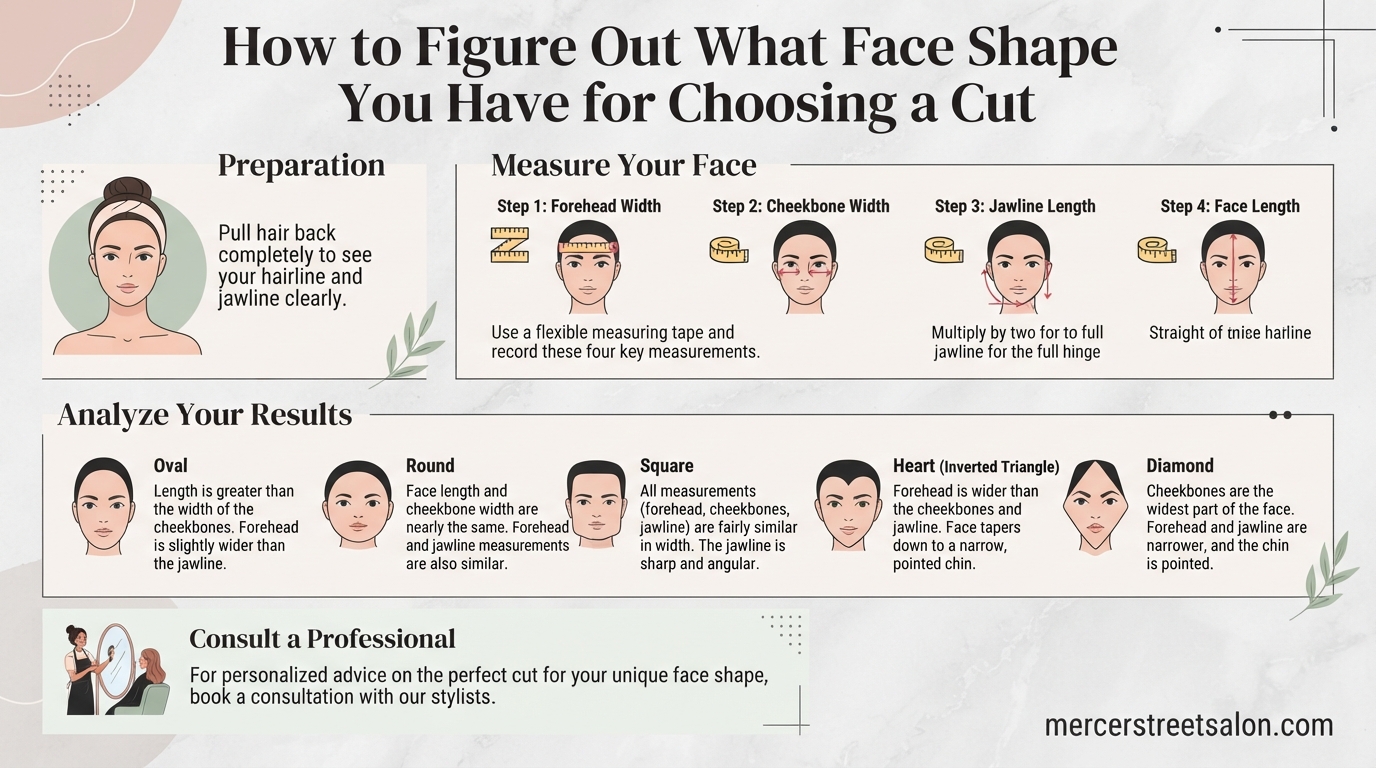
Measuring your face is the most reliable way to determine your shape objectively. You will need a flexible tape measure, a small notebook or phone to record numbers, and a mirror. Stand in good, natural lighting and pull your hair off your face.
You are going to take four measurements. Write each one down as you go.
Step 1: Measure your forehead width. Place the tape across the widest part of your forehead, usually halfway between your eyebrows and your hairline. Measure from one side to the other where the forehead begins to curve into the temples.
Step 2: Measure your cheekbone width. Find the most prominent points of your cheekbones, typically just below the outer corners of your eyes. Measure straight across from one cheekbone peak to the other.
Step 3: Measure your jawline width. Find the widest points of your jaw, which are usually at the angles where your jaw turns upward toward your ears. Measure straight across from one side to the other.
Step 4: Measure your face length. Place the tape at the center of your hairline and measure straight down to the lowest point of your chin. Keep the tape vertical and do not follow the curve of your face.
Now compare your numbers. Here is what each pattern tells you.
If your face length is noticeably longer than your cheekbone width, and your forehead is slightly wider than your jaw, you likely have an oval face. If your face length and cheekbone width are nearly equal, and your jaw is soft and rounded, you likely have a round face. If your forehead, cheekbones, and jaw are all roughly the same width, and your jaw is angular, you likely have a square face.
If your forehead and cheekbones are wide but your chin is pointed and narrow, you likely have a heart face. If your cheekbones are the widest measurement by far, with a narrow forehead and narrow chin, you likely have a diamond face. If your face length is significantly greater than your width across all measurements, you likely have an oblong face.
A quick note: many people do not fit perfectly into one category. You might be somewhere between oval and oblong, or square and round. That is completely normal. Use the shape that matches the majority of your measurements, and choose haircuts accordingly.
The 6 Face Shape Types Explained
Let us break down each face shape in detail so you can confirm what your measurements told you. For each shape, we cover the key features, the shapes it is most commonly confused with, and a celebrity example for reference.
Oval Face Shape
The oval face is considered the most versatile shape because its balanced proportions work with nearly any haircut. Your face is gently curved, slightly longer than it is wide, with a forehead that is a touch wider than your rounded chin.
People with oval faces often confuse themselves with oblong. The difference is that an oval face’s length is only slightly greater than its width, while an oblong face is noticeably elongated. Celebrity examples include Beyonce, Rihanna, and George Clooney.
Round Face Shape
A round face is roughly equal in length and width, with full cheeks, a soft jawline, and a rounded chin. The overall silhouette is circular rather than angular. Round faces tend to look youthful and approachable.
This is the shape most commonly confused with oval. The giveaway is the length-to-width ratio. If your face is as wide as it is long, you are round. If it is noticeably longer than wide, you are oval. Celebrity examples include Selena Gomez, Mila Kunis, and Leonardo DiCaprio.
Square Face Shape
A square face has a strong, defined jawline with a forehead, cheekbones, and jaw that are all roughly the same width. The jaw is angular rather than curved, giving the face a structured, bold appearance.
Square faces are sometimes confused with round faces because both have similar width-to-length ratios. The difference is the jaw. A round face has a soft, curved jaw. A square face has a sharp, angular one. Celebrity examples include Angelina Jolie, Olivia Wilde, and Brad Pitt.
Heart Face Shape
A heart-shaped face is wide at the forehead and cheekbones but narrows significantly to a small, pointed chin. The chin is the defining feature here. It is noticeably narrower than the rest of the face.
Heart shapes are often confused with diamond shapes because both have narrow chins. The difference is the forehead. A heart face has a wide forehead, while a diamond face has a narrow one. Celebrity examples include Reese Witherspoon, Scarlett Johansson, and Ryan Gosling.
Diamond Face Shape
A diamond face is narrow at both the forehead and the chin, with the cheekbones being the widest and most prominent part of the face. The overall shape is angular and striking, with a sculpted appearance.
This is the rarest of the six face shapes, which is why people struggle to identify it. It is most often confused with heart or oval. The giveaway is that the forehead is narrow, unlike a heart shape. Celebrity examples include Vanessa Hudgens, Megan Fox, and Johnny Depp.
Oblong Face Shape
An oblong face is significantly longer than it is wide, with a fairly consistent width from forehead to jaw. The shape is elongated and rectangular, sometimes called rectangular when the jaw is more angular.
Oblong is most commonly confused with oval. The test is simple. If your face length is significantly greater than your cheekbone width, you are oblong. If only slightly greater, you are oval. Celebrity examples include Sarah Jessica Parker, Liv Tyler, and Adam Levine.
Quick Reference: Face Shape Comparison Chart
Here is a side-by-side comparison of all six face shapes so you can quickly identify yours and see the best and worst haircut options at a glance.
- Oval: Key features: balanced, slightly longer than wide. Best cuts: almost anything. Avoid: heavy forward fringe that shortens the face. Celebrity: Rihanna.
- Round: Key features: equal length and width, soft jaw. Best cuts: long layers, side-swept bangs, height on top. Avoid: chin-length bobs, blunt cuts. Celebrity: Selena Gomez.
- Square: Key features: angular jaw, equal width. Best cuts: soft layers, wavy textures, side parts. Avoid: blunt straight bangs, boxy cuts. Celebrity: Angelina Jolie.
- Heart: Key features: wide forehead, pointed chin. Best cuts: chin-length bobs, curtain bangs, side parts. Avoid: heavy top volume, short layers. Celebrity: Reese Witherspoon.
- Diamond: Key features: prominent cheekbones, narrow forehead and chin. Best cuts: forehead-framing bangs, chin-length cuts, width at temples. Avoid: pin-straight long hair, volume only at cheekbones. Celebrity: Megan Fox.
- Oblong: Key features: long face, consistent width. Best cuts: bangs, chin-length cuts, waves for width. Avoid: long flat hair, excessive height on top. Celebrity: Sarah Jessica Parker.
Best Haircuts for Each Face Shape
Now that you know your face shape, here are the specific cuts our stylists recommend most often at Mercer Street Salon. We cover options for both men and women, plus what to avoid.
Best Haircuts for Oval Faces
Oval faces can pull off nearly any haircut, which is both a blessing and a curse. The freedom of choice can feel paralyzing. Our recommendation is to choose cuts that do not disrupt the natural balance of your proportions.
For women, long layers, bobs, lobs, pixies, and curtain bangs all work beautifully. For men, almost any style from a textured crop to a slick back will flatter an oval face. The one thing to avoid is a heavy, blunt fringe that covers the forehead entirely, as it can make the face look shorter and rounder than it is.
Best Haircuts for Round Faces
The goal with a round face is to create the illusion of length and angles. Cuts that add height on top and definition at the sides work best.
For women, long face-framing layers, side-swept bangs, and asymmetrical bobs are excellent choices. Avoid chin-length blunt cuts, which emphasize the width of the face. For men, pompadours, quiffs, and high fades with volume on top create the elongation that round faces need. Avoid buzz cuts and close-cropped styles that remove all height.
Best Haircuts for Square Faces
Square faces benefit from haircuts that soften the strong jawline and add movement. The goal is to break up the angular structure with texture and waves.
For women, soft layered cuts, beach waves, and side parts work well. Curtain bangs are particularly flattering because they draw the eye outward rather than down. Avoid blunt straight bangs and boxy one-length cuts. For men, textured crops with soft fringe, side parts, and medium-length styles soften the jaw. Avoid sharp, geometric cuts that emphasize the angles.
Best Haircuts for Heart Faces
Heart-shaped faces need balance between the wide forehead and the narrow chin. The right cut adds width at the jawline while softening the forehead.
For women, chin-length bobs are ideal because they add fullness right at the narrowest point of the face. Curtain bangs and side-swept fringe balance the forehead beautifully. Avoid heavy top volume and very short layers that widen the upper face further. For men, medium-length styles with fringe or textured forward fringe work well. Avoid high fades that strip width from the sides.
Best Haircuts for Diamond Faces
Diamond faces need width at the forehead and chin to balance the prominent cheekbones. The right cut fills in the narrow areas.
For women, forehead-framing bangs, chin-length cuts, and styles with width at the temples are perfect. Avoid pin-straight long hair that clings to the cheekbones and highlights the narrow forehead. For men, textured fringes and side-swept styles add width where needed. Avoid very short sides that make the cheekbones look even more prominent.
Best Haircuts for Oblong Faces
Oblong faces need width and fullness to balance the length. The right cut adds horizontal volume and shortens the appearance of the face.
For women, bangs of any kind are your best friend because they cover the forehead and visually shorten the face. Chin-length cuts, waves, and curls add the width you need. Avoid long flat iron-straight hair and excessive height on top. For men, fringes, textured crops with forward direction, and medium-length styles work best. Avoid high fades with tall pompadours that elongate the face further.
Haircut Measurement Rules: The 2-Inch, 2.25, and 3:2:1 Rules
These three measurement rules come up constantly in PAA questions and forum discussions, yet almost no guide covers all three. Our stylists use them as quick reference tools during consultations, and they are surprisingly accurate.
The 2-Inch Rule
The 2-inch rule helps you decide whether you can pull off short hair. Take a pencil and place it horizontally under your chin. Hold a ruler vertically from the bottom of your earlobe downward. Measure the distance from your earlobe to your eyebrow line, and then from your earlobe to the pencil under your chin.
If the distance from your earlobe to your chin is less than 2.25 inches, short hair will flatter you. If it is more than 2.25 inches, longer styles tend to be more flattering. Yes, this is actually called the 2-inch rule even though the cutoff is 2.25 inches. The rule originates from hairstylist John Frieda’s facial mapping technique.
The 2.25 Rule
The 2.25 rule is essentially the same measurement described more precisely. It refers to the exact cutoff point in the 2-inch rule. Measure from the bottom of your earlobe to the tip of your chin. If that measurement is under 2.25 inches, your facial proportions favor short cuts like pixies, crops, and bobs.
If the measurement is over 2.25 inches, short hair may elongate your face in an unflattering way. Longer styles that fall below the chin will create better balance. This rule is a guideline, not a law. Styling, hair texture, and personal preference all play roles in the final result.
The 3:2:1 Rule
The 3:2:1 rule is a proportion guideline for face shape measurement that helps you determine your face’s ratio. The three numbers correspond to three measurements: your face length (3), your cheekbone width (2), and your jawline or forehead width (1).
If your measurements roughly follow a 3:2:1 ratio, your face is well-proportioned and likely falls into the oval or balanced category. This means you have significant flexibility in haircut choices. If your ratios deviate significantly from 3:2:1, your face leans toward round, square, oblong, heart, or diamond, and you should follow the specific recommendations for those shapes.
Here is how to apply it. Divide your face length by your cheekbone width. If the result is around 1.5, your proportions are balanced. Then check whether your forehead, cheekbones, and jaw follow a gradual narrowing or widening pattern. Use that pattern to confirm your face shape from the six categories above.
Face Shape Mistakes to Avoid
Even after identifying your face shape, it is easy to make choices that work against you. Here are the most common mistakes our stylists see and how to avoid them.
Mistake 1: Ignoring your hair type. Face shape is only half the equation. A haircut that suits your face shape on paper might fail if your hair texture cannot support it. Fine hair cannot hold the volume that thick hair can. Curly hair behaves differently than straight hair at the same length. Always factor in hair type when choosing a cut.
Mistake 2: Copying a celebrity haircut without checking their face shape. That wolf cut looks amazing on the celebrity you saw, but if your face shape is different, the same cut could look entirely wrong on you. Always verify that the reference photo matches your proportions.
Mistake 3: Choosing a cut that fights your natural features. If you have a strong square jaw and you choose a blunt, geometric bob, you are amplifying the angles rather than softening them. Work with your features, not against them.
Mistake 4: Forgetting about facial hair. For men, a beard completely changes your face shape. A full beard can make a round face look longer or add weight to a pointed chin. Factor facial hair into your face shape assessment before choosing a haircut.
Mistake 5: Not consulting your stylist. Online guides are a great starting point, but nothing replaces a professional who can assess your face shape, hair type, and lifestyle in person. Bring reference photos and be honest about how much time you are willing to spend styling.
FAQs
How do I find my face shape for a haircut?
To find your face shape, pull your hair back, measure four areas (forehead width, cheekbone width, jawline width, and face length from hairline to chin), then compare the ratios. If your face is slightly longer than wide with a rounded chin, you are oval. Equal length and width means round. Angular jaw with equal width means square. Wide forehead with a pointed chin means heart. Narrow forehead and chin with wide cheekbones means diamond. Significantly longer than wide means oblong.
What is the 3:2:1 rule for haircuts?
The 3:2:1 rule is a proportion guideline for face shape measurement. The numbers represent your face length (3), cheekbone width (2), and jawline or forehead width (1). If your measurements roughly follow this ratio, your face is well-proportioned and likely oval, giving you flexibility in haircut choices. Deviations from this ratio indicate other face shapes like round, square, heart, diamond, or oblong.
What is the 2.25 rule for hair?
The 2.25 rule helps determine if short hair will suit you. Measure the distance from the bottom of your earlobe to the tip of your chin. If the measurement is under 2.25 inches, short haircuts like pixies, crops, and bobs will flatter your face. If it is over 2.25 inches, longer styles that fall below the chin create better balance.
Are side parts coming back in 2026?
Yes, side parts are making a strong comeback in 2026. After several years of middle parts dominating social media, side parts and side-swept styles are returning across both men’s and women’s hair trends. Side parts are particularly flattering for square, round, and heart face shapes because they add asymmetry and soften strong features.
Wrapping It Up
Figuring out how to choose a haircut that actually flatters you starts with knowing your face shape. Once you can identify whether you are oval, round, square, heart, diamond, or oblong, every haircut decision becomes easier and more intentional.
The measurement method takes about ten minutes and gives you a clear, objective answer. The comparison chart helps you reference your shape at a glance. The three haircut rules give you quick decision-making tools for short hair, proportions, and balance. And the per-shape recommendations point you toward the cuts that will genuinely work for your features.
Remember that face shape is one piece of the puzzle. Hair type, texture, lifestyle, and personal style all matter just as much. Bring what you have learned here to your next salon appointment, share your measurements and reference photos with your stylist, and have an honest conversation about what you want.
At Mercer Street Salon, we love when clients come in knowing their face shape. It makes the consultation smoother, the result better, and the experience more collaborative. Book a consultation with one of our stylists, and we will help you translate your face shape into a haircut you will love.