
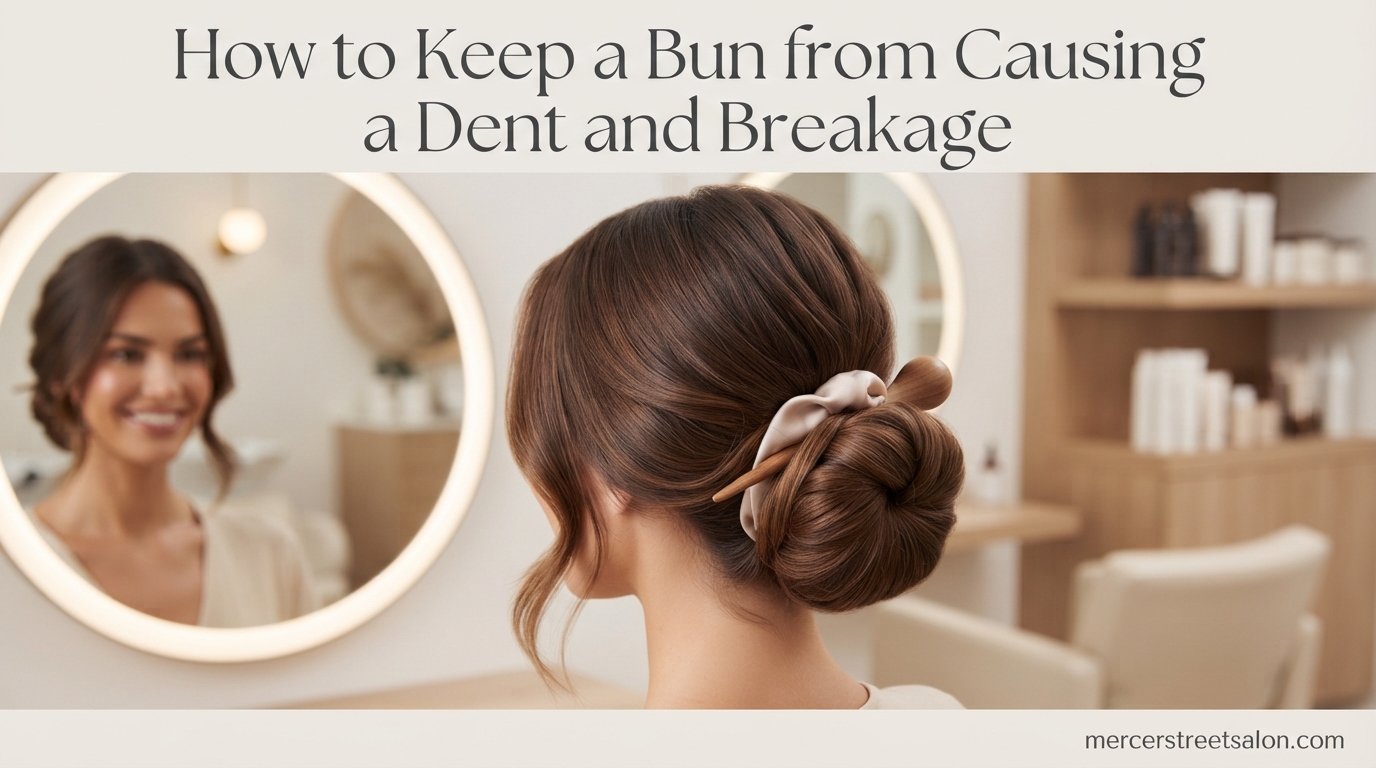
Learning how to keep a bun from causing a dent and breakage where the tie sits can save you from constant bad hair days and protect the long-term health of your hair. If you wear buns regularly, you have probably noticed that telltale ridge of compressed hair right where the elastic cinches down. Over time, that same spot can develop into real breakage, split ends, and even thinning at the hairline. The good news is that a few changes to how you tie your bun, what kind of tie you use, and where you position it can make a dramatic difference. I have helped clients at Mercer Street Salon address this exact problem for years, and the solution almost always comes down to reducing pressure and friction at that single contact point.
The key to preventing bun dents lies in understanding what causes them in the first place. Every time you pull a section of hair into a bun and wrap an elastic around it, you create three forces working against your hair shaft: tension from pulling, friction from the tie material, and concentrated pressure at one small point on your scalp. Those three forces combine to compress the hair cuticle where the elastic sits. The result is a dent that can last for hours or even into the next day. Add breakage to the mix, especially if you tie your hair while it is wet or pull it tighter than needed, and you are gradually weakening those strands.
Table of Contents
What Causes Dents and Breakage at the Bun Tie
A hair tie dent forms when the elastic band compresses the hair shaft at a specific point, flattening it against your scalp. Think of it like folding a piece of paper repeatedly along the same crease line. Eventually, that fold becomes a permanent feature. Hair works similarly. Each time you tie a bun in the same spot, you reinforce that indentation. The cuticle layer, which is the outer protective shell of each strand, gets lifted and roughened by friction from the elastic. Once the cuticle is damaged, the inner cortex of the hair is exposed, leading to breakage at exactly that point.
Tension plays a major role too. Pulling hair into a tight bun increases the force applied at the tie point by a significant margin. This is why people in professions that require strict neatness, such as the military, healthcare, and food service, often report severe breakage along their hairline. A military member on the r/Haircare subreddit described having to wear a tight bun five days a week and watching the hairline break down despite using edge control and a silk pillowcase at night. The damage comes from the repeated daily pressure in one location, not from a single bad day.
Wet hair is especially vulnerable to this kind of damage. When hair is wet, the cuticle layer swells and becomes more fragile. Tying wet hair into a bun creates a double problem: the elastic presses on already-compromised strands, and as the hair dries it shrinks back, tightening the tie further and intensifying the pressure. This is the single most agreed-upon tip in the haircare community. Always let your hair dry completely before tying it up, no matter how rushed you are in the morning.
How Hair Tie Placement Determines Dent Severity
Where you place the bun tie on your head matters more than most people realize. A tie positioned at the crown of your head sits on the thickest part of your hair, where more strands can distribute the pressure across a wider area. A tie placed lower, near the nape of your neck or at the back of the head, concentrates the force on fewer strands, which means each strand takes more of the compression. This is why low buns tend to leave more visible and lasting dents than high buns or top knots.
The direction of the tie wrap also changes where the damage shows up. If you wrap the elastic in a single continuous spiral from top to bottom, the pressure is distributed more evenly because each loop of the elastic shares the load. If you bunch all the hair into a single concentrated area and cinch it down hard, the elastic digs into that one point and creates a sharp, deep indentation. I have found that teaching clients to spread the hair into a wider, looser bundle before wrapping the tie significantly reduces dent depth on its own, even before switching to a better material.
Tie height also affects how visible the dent remains after you take the bun down. A tie at the crown leaves a dent that is usually hidden by the volume of hair around it. A tie at the hairline, especially a tight side bun, leaves an indentation that is immediately obvious. For people who wear buns to work and cannot control the placement, this is a frustrating reality. The trick is to position the tie just high enough to be hidden by surrounding hair while still keeping the bun secure. If your job requires a specific bun placement, the material of the tie and the wrapping technique become even more important.
Best Hair Tie Materials for Preventing Bun Damage
Not all hair ties are equally damaging, and the material makes a real difference in both dent formation and breakage. Silk hair ties, especially those made from mulberry silk, have a smooth surface that creates far less friction against the hair shaft. Silk fibers glide over the cuticle instead of catching and lifting it. This is why silk scrunchies have become a staple recommendation among stylists. The smooth surface means the hair slides slightly under the elastic rather than being pinched flat, which reduces both the depth of the dent and the amount of breakage at the tie point.
Satin is often confused with silk, but it behaves differently. Satin is a weave structure, not a fiber type. Most satin hair ties are made from polyester or nylon, and while they are smoother than cotton or standard elastic, they do not match the natural protein structure of real silk. Satin ties still create some friction and can still leave dents, especially on fine hair. For clients with thick or curly hair, satin is a reasonable middle ground. For those with fine, straight hair that dents easily, mulberry silk is worth the extra cost.
Spiral hair ties, often called coil ties or phone cord ties, are another popular option. These use a spring-like plastic coil that wraps around the hair bundle. Because the coil distributes pressure across multiple contact points along the hair rather than a single band, the pressure per unit area is much lower. Many users on the r/longhair subreddit report that spiral ties cause noticeably less breakage than traditional elastics. The tradeoff is that they can leave a slight mark on fine hair, and they do not hold very thick buns as securely. They work best for medium to thick hair where the coil can grip enough strands to stay put.
Fabric-covered elastics sit somewhere between regular elastics and silk ties. The outer fabric layer reduces direct friction on the hair, but most fabric ties still have a standard rubber or elastic core inside. That core is what actually creates the pressure, and it can still compress the hair shaft enough to leave a dent. Many scrunchies on the market follow this design. They look and feel softer than plain elastics, which helps, but they are not as dent-free as genuine silk ties. If you are buying a scrunchie specifically to prevent bun dents, look for one labeled as pure silk rather than satin or fabric-covered.
Proper Bun Technique That Distributes Pressure Evenly
The way you tie your bun matters just as much as the tie itself. A well-executed bun with a decent tie will cause less damage than a poorly executed one with an expensive silk tie. The first rule is to keep the bun loose enough to allow some give in the hair. A bun that feels uncomfortably tight on your scalp is applying too much tension, and that tension translates directly into breakage at the tie point. Aim for a bun that feels secure but not strained. If you need to adjust your bun throughout the day because it feels too tight, you tied it too tight to begin with.
Start with dry hair whenever possible. Run a brush or comb through your hair to remove any tangles before beginning. Gather the hair at your desired height and hold it with one hand. With your other hand, take the hair tie and stretch it wide before sliding it over the hair bundle. Do not stretch it only around the hair, because that concentrates the pressure. Stretch the tie first, then place it over the hair so it lands with less force. This small change alone reduces the initial compression on the hair shaft by a meaningful amount.
The wrapping pattern you use also affects dent depth. A single spiral wrap from one end of the tie to the other distributes the elastic more evenly across the hair bundle. To do this, stretch the tie, place it over the hair, then pull one side of the tie around the bundle and back through the loop, repeating two or three times before tightening. Each pass of the tie around the bundle spreads the pressure across more surface area rather than concentrating it at one point. For clients with fine hair, I recommend wrapping only twice before securing the tie. For thick hair, three wraps usually provide enough hold without cinching too hard.
Padding is a technique that almost no one talks about, and it is one of the most effective ways to eliminate dents. Before you wrap the tie around your hair, pull a thin section of hair from the top layer of your bun and lay it over the hair tie like a cushion. Then wrap the tie over that section of hair. The hair acts as a buffer between the elastic and the rest of the bundle, absorbing the pressure so it does not compress the hair shaft directly. It sounds simple, but the difference in dent depth is immediately noticeable. I have clients who swear by this method for mandatory work buns where they cannot change the tie type.
For people who need extra hold without extra damage, the two-elastic method can help. First, pull all your hair into a low ponytail and secure it with one tie. Then, gather that ponytail into a bun and wrap a second tie around the bun itself. Because the first tie holds the weight of all the hair at the nape, the second tie only has to secure the bun shape rather than hold the full weight. This reduces the tension at the bun tie point significantly. Users on the r/longhair community have reported that this method causes far less breakage than tying the entire hair mass into a bun with a single elastic.
Alternative Styling Methods That Avoid Ties Entirely
If you are open to moving away from elastics entirely, there are several styling methods that create a secure bun without any compression on the hair shaft. Spin pins, which are long twisted metal rods with a threaded texture, are the most popular alternative. You insert two or three spin pins into a bun, and the threads grip the hair from the inside to hold it in place. Because the pins distribute their grip across the entire bun rather than concentrating pressure at one point, they cause no dents at all. The main limitation is that they work best on medium to thick hair where the pins have enough material to grip. Fine hair can sometimes slip out, especially with high buns.
Bobby pins offer another tie-free option, though they require a bit more technique. To bun your hair with bobby pins, twist your hair into a rope and wrap it around the base, then insert bobby pins through the wrapped hair and into the scalp to secure it. Use at least six to eight pins for a thick bun, spacing them evenly around the base. The pins hold the hair in place by friction against your scalp rather than by compressing the hair shaft. This method works well for fine hair where spin pins might slip, and it is also useful for workplace settings where spiral ties or scrunchies might not meet dress code requirements.
Hair forks are a less common but effective alternative. A hair fork is a two- or three-pronged tool made from wood, metal, or plastic that you stab into a bun to hold it together. You gather the hair, twist it, and then insert the fork through the center of the bun so the prongs spread inside the hair and hold it from within. Like spin pins, hair forks distribute grip across the interior of the bun rather than pinching the outside. They are particularly popular with people who have long, thick hair and who want a zero-waste styling tool that lasts for years. The only real downside is that they take some practice to use quickly.
The braid-and-tuck method is one of the gentlest options available. Instead of gathering all your hair into one section and tying it, you divide your hair into two or three sections, braid each section loosely, and then coil the braids around the base of your head. Tuck the ends under the coiled braids and secure with a few bobby pins. Because the braids add structural integrity, you barely need any pins at all. The braiding process itself takes longer than a simple bun, but the result is a secure style with zero dent and minimal breakage. Many people on the r/femalefashionadvice subreddit use this method for events where they need the bun to last all day without leaving a mark.
Recovering From Tie Damage You Already Have
If you have been tying your hair tightly for months or years, the existing damage will not disappear overnight. But you can take steps to repair your hair and prevent the situation from getting worse. Start by giving your hair a break from tight buns entirely for at least two weeks. Wear your hair down, in a loose braid, or in a low, loose ponytail with a silk scrunchie during this recovery period. Letting the hair grow out and avoiding pressure at the damaged spots allows the cuticle layer to smooth back down and the hair shaft to recover its natural shape.
During recovery, focus on products that strengthen the hair shaft and seal the cuticle. A weekly hair mask with ingredients like argan oil, shea butter, or keratin helps rebuild the protective layer around each strand. Leave-in conditioner applied to the ends and along the area where breakage has occurred adds slip and reduces tangling, which prevents further mechanical damage when you brush. I have seen significant improvement in clients who commit to a mask twice a week for six weeks, especially when paired with a switch to a silk pillowcase at night.
A silk pillowcase reduces friction while you sleep, which matters because many people unconsciously pull their hair into a loose bun or wrap it on the pillow during the night. Even this low-level friction adds up over time. Microfiber towels are another simple swap. If you wrap your hair in a standard cotton towel after washing it, the cotton fibers create friction that can rough up the cuticle before you even tie your hair up. Switching to a microfiber towel or an old cotton t-shirt for drying reduces this friction significantly. The towel drying step is something most people overlook, but it sets the stage for how much damage the rest of your styling routine can cause.
Daily Prevention Tips for Long-Term Hair Health
Preventing bun dents and breakage is easier than repairing damage after the fact. Start by varying your bun placement day to day. If you tie your hair at the crown on Monday, move it to the side or lower on Tuesday. This prevents the same spot on your scalp from absorbing repeated pressure, which is the main cause of cumulative damage over time. Rotating positions is a zero-cost change that requires only a small adjustment to your routine.
Choose your hair tie material deliberately. If you wear buns daily, invest in a set of mulberry silk scrunchies and keep them in your bag, car, and desk drawer so you never have to fall back on a standard elastic. Spiral ties are a good backup for days when you need extra hold. Keep one or two in your rotation and test them on days when your bun needs to stay put through physical activity or a long shift.
Give your hair a rest day whenever possible. Even if you wear buns for work five days a week, letting your hair down on weekends gives the follicles and the hair shaft time to recover. On rest days, avoid tight styles entirely. A loose braid or simply wearing your hair down is ideal. If your hair feels sore along the hairline at the end of the work week, that soreness is a signal that the tension has been too high. Use that signal to adjust the tightness of your bun and to check whether you need a softer tie.
Protect your hair at night with a silk bonnet or a silk pillowcase. Hair that is loosely secured while you sleep experiences far less friction than hair that is left loose on a cotton pillowcase. This small habit prevents both dents from overnight positioning and breakage from tossing and turning against rough fabric. Over time, the difference in hair texture and split-end count is noticeable.
FAQs
How to avoid hair tie dent?
Use a mulberry silk hair tie or spiral tie instead of a standard elastic. Position the tie at the crown of your head rather than the hairline. Add a padding technique by laying a small section of hair over the tie before wrapping. Avoid tying wet hair, and keep the bun loose enough to release pressure at the contact point.
How to tie a bun without damaging hair?
Start with completely dry, detangled hair. Stretch the tie wide before placing it over the hair bundle to reduce initial compression. Wrap the tie in a spiral pattern around the hair rather than bunching it into one spot. Use a padding technique with a small section of hair over the tie. Keep the bun secure but not tight enough to cause scalp discomfort.
Does twisting hair in a bun cause breakage?
Yes, twisting hair into a bun can cause breakage, especially when the hair is wet or the bun is pulled too tight. Twisting creates tension along each strand, and when the elastic cinches the twisted hair down, the pressure is concentrated at the tie point. Repeated daily twisting and tying in the same spot leads to cumulative breakage at the hairline. Looser wrapping patterns and avoiding wet hair reduce this risk significantly.
What hair ties don’t cause dents?
Mulberry silk scrunchies are the least likely to cause dents because their smooth surface glides over the hair cuticle instead of compressing it. Spiral coil ties distribute pressure across multiple contact points and also minimize dents. Bobby pins, spin pins, and hair forks avoid dents entirely because they do not compress the hair shaft at all. Traditional elastics and rubber bands cause the deepest dents and should be avoided for daily bun styling.
Preventing a dent and breakage at the bun tie comes down to three things: choosing the right tie material, positioning the tie strategically, and using a wrapping technique that spreads pressure instead of concentrating it. Small changes to how you style your hair each morning can add up to much healthier hair over the course of weeks and months. If you have been dealing with persistent breakage at your tie point, try the padding technique and switch to a silk scrunchie this week. Your hair will feel the difference within a few days.