
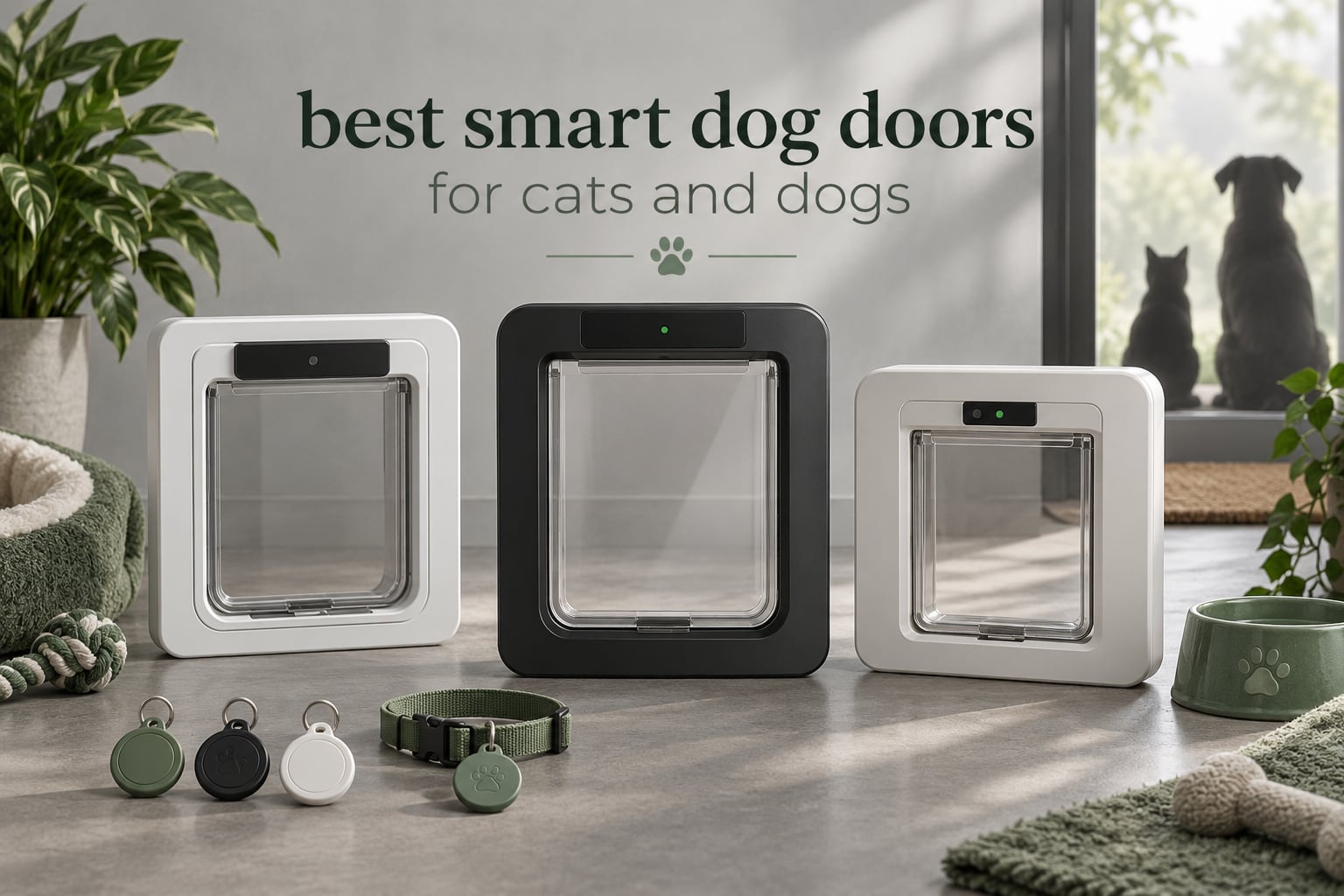
Two dogs, one cat, and a dog door that will not stop letting the cat out into the yard at 6am. That is the problem almost every buyer of a smart dog door is actually trying to solve, and it is why searching for the best smart dog doors for cats and dogs is trickier than it looks. A flap door is not selective. A microchip or collar-key door is selective, but only in the directions the hardware allows, and most people do not realise until the cat is gone that a door which controls entry does not control exit.
We compared all seven doors in this roundup on the things that decide whether a smart pet door survives daily life: recognition reliability, how the door behaves when power or signal fails, weather sealing, security hardware, install difficulty, and whether the app earns its place. The PetSafe Electronic Pet Door came out on top for mixed cat-and-dog homes because it programmes selective entry, exit and auto-locking, holds up to five keys, and has more owner history behind it than anything else here.
Below, each pick gets real drawbacks, a clear line on who it is not for, and the flap dimensions and control method that determine whether your animals will actually use it. If you also want a broader look at the non-connected options, our guide to the best electronic dog doors for cats is worth a read. For homes where size, not electronics, is the deciding factor, we cover sizing separately in best pet doors for large dogs.
Table of Contents
Top 3 Picks: Best Smart Dog Doors for Cats and Dogs in 2026
PetSafe Electronic Pet Door
- Collar key selective entry
- exit and auto-lock
- Up to 5 programmed keys
- Weatherized rigid panel for large dogs

SureFlap Microchip Pet Door
- Reads implanted microchip via RFID
- Learns up to 32 identities
- 6 11/16 inch by 7 inch opening
- Up to 12 months battery life

High Tech Pet Power Pet PX-2
- Motorized panel with steel dead bolt
- Hermetically sealed
- 4-way access control
- AC powered with battery backup
What a Smart Dog Door Actually Does
A smart dog door is an electronically controlled pet door that unlocks only for your specific animals and locks again by itself, so strays, wildlife and unwanted pets cannot pass. That is the whole promise, and it is a bigger promise than most flap doors can keep.
Three control methods cover everything in this roundup. Microchip recognition uses an RFID antenna to read the ID chip already implanted in your cat or dog, so nothing has to hang off the collar. Collar-key control uses a battery tag on the collar, read either by radio frequency or by an ultrasonic signal. App and WiFi control adds scheduling, remote locking and entry or exit notifications on top of one of the other two methods.
Two other terms matter when you read the specs. Selective entry means the door unlocks for programmed animals only. Four-way access control means the door can be set to enter only, exit only, both, or fully locked, and the ability to set exit only is what separates a door that keeps a cat in at night from one that does not.
Flap count is the other lever. A single flap is cheapest and easiest to push through. A double or triple flap holds back cold air and wind far better but is heavier, and some nervous dogs will not push through the weight. Cat doors are physically smaller than dog doors, so a cat can usually squeeze through a large dog flap if the flap is flexible enough, which is exactly why size alone does not keep a determined cat inside.
All 7 Smart Dog Doors Compared in 2026
| Product | Specifications | Action |
|---|---|---|
| PetSafe Electronic Pet Door |
|
Check Latest Price |
| SureFlap Microchip Pet Door |
|
Check Latest Price |
| High Tech Pet Power Pet PX-2 |
|
Check Latest Price |
 SureFlap Microchip Pet Door Connect SureFlap Microchip Pet Door Connect |
|
Check Latest Price |
 nolonly Automatic Dog Door nolonly Automatic Dog Door |
|
Check Latest Price |
 Power Pet WiFi PX2-WIFI Power Pet WiFi PX2-WIFI |
|
Check Latest Price |
 PetSafe Electronic SmartDoor PetSafe Electronic SmartDoor |
|
Check Latest Price |
1. PetSafe Electronic Pet Door – Best Overall for Mixed Cat and Dog Homes
PetSafe Electronic Pet Door, Collar Key Sensor, Dogs Up to 100 lb, Large
Collar key control
Up to 5 keys
4 D-cell powered
Interior or exterior door mount
Pros
- Programmable selective entry
- exit and auto-locking
- Weatherized body holds back wind
- Rigid panel rather than a rubber flap
- Works for cats and dogs together
- Quiet except for the unlock pop
Cons
- Collar key is bulky on small pets
- Unlock pop can startle timid animals
- D-cell batteries consumed every few months
- Battery only with no power adapter option
This is the door we recommend first, and the reason is the programming rather than the hardware. It offers entry, exit and auto-lock modes, and the ability to set exit-only is what lets a dog out in the morning and keeps a cat from following it out the door at night. That one feature is why this door tops our list for a mixed household.
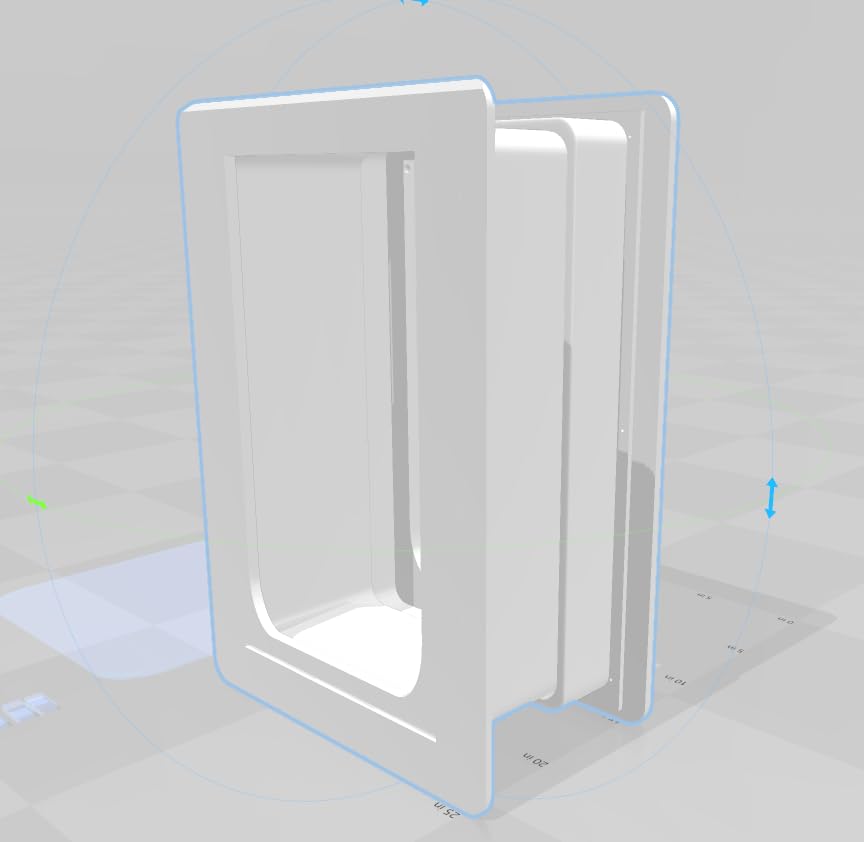
The build is more substantial than it looks in photos. The panel is rigid rather than a rubberized flap, and owners report that this is exactly what stops a strong dog from tearing it and what keeps heavy wind and driving rain out. The rigid panel also will not bind the way some soft flaps do once they age. It is designed for interior or exterior doors, with a wall install kit sold separately.
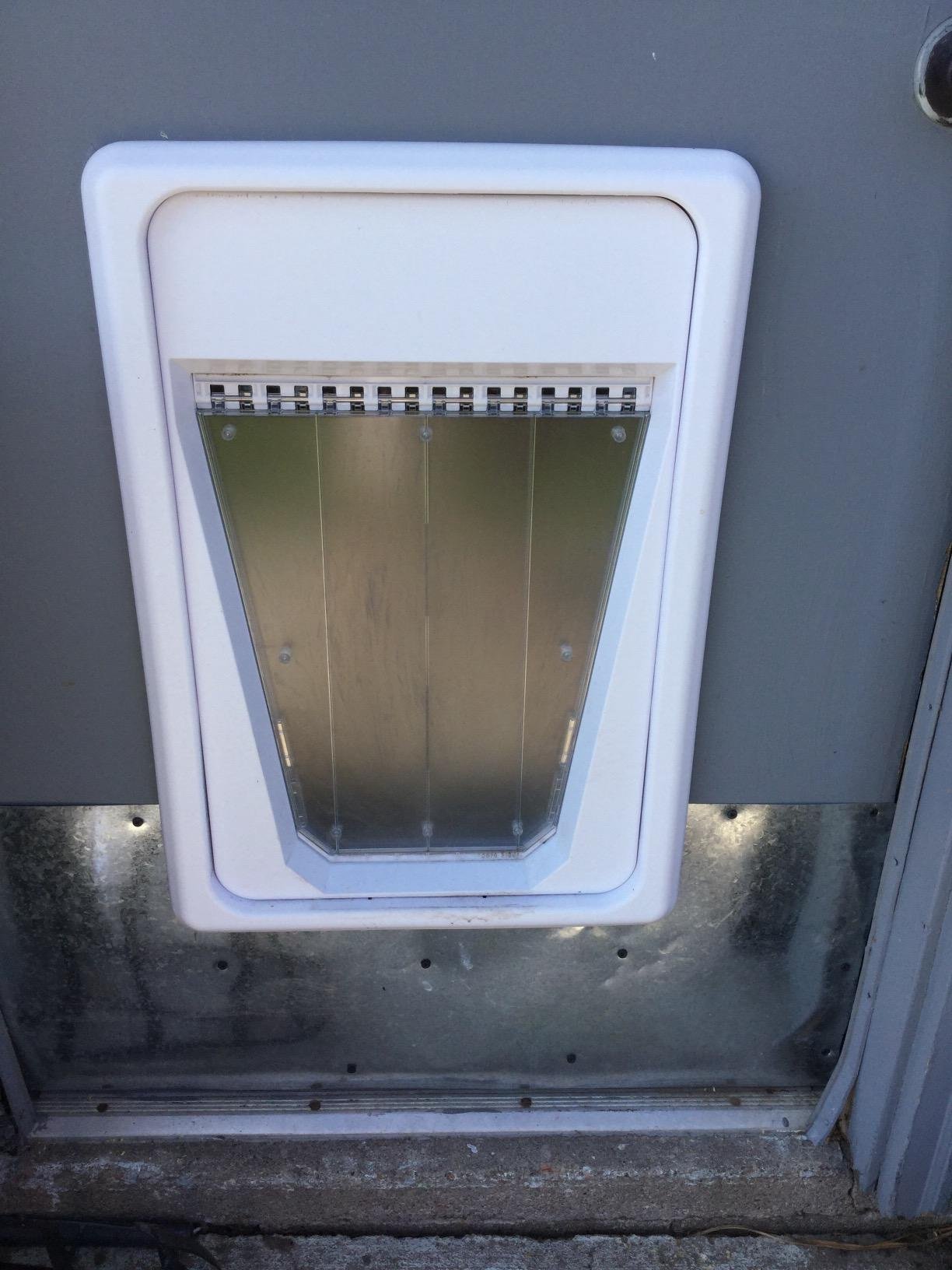
Recognition has been reliable in the long run, which matters more than any spec. It programmes up to five keys, so a two-dog, one-cat, plus-a-spare setup is comfortable, and sensitivity can be adjusted when a pet is hesitating at the threshold. Installation precision matters more than usual here, because a panel that is not squared up in the cutout will sit unevenly and eventually bind.
Power is the real weakness. It runs on four D-cell batteries and owners typically replace them every one to three months depending on traffic through the door, and there is no power adapter option, so you cannot wire it to mains power to stop thinking about it. The collar key is also a genuinely bulky accessory for a small dog or a cat, and it hangs off the collar permanently, which is a fair objection for short-haired cats that dislike anything on the collar.
Who this door suits
It suits homes with a dog that needs outdoor time and a cat that must stay inside, especially where several animals share the same door. It also suits anyone who wants exit control rather than just entry control, and anyone who prefers not to run an app or hub at all.
Who should skip it
Skip it if your animals are all under ten pounds and collar tags bother them, since the SmartKey is the largest collar accessory in this roundup. Skip it if you are not willing to check and change D-cell batteries on a schedule, and treat the low 3.8 rating as the visible cost of that tradeoff.
2. SureFlap Microchip Pet Door – Best for Cats That Must Stay Indoors
SureFlap Microchip Pet Door (Brown)
RFID microchip reading
Up to 32 identities
6 11/16 x 7 inch opening
4 C batteries
Pros
- No collar needed for chipped pets
- Learns up to 32 identities
- Up to 12 months battery life
- One-button programming
- Three year warranty
- Installs in doors
- windows or walls
Cons
- Flap is small for large dogs
- Collar tags sold separately for unchipped pets
- Opening suits cats and small dogs only
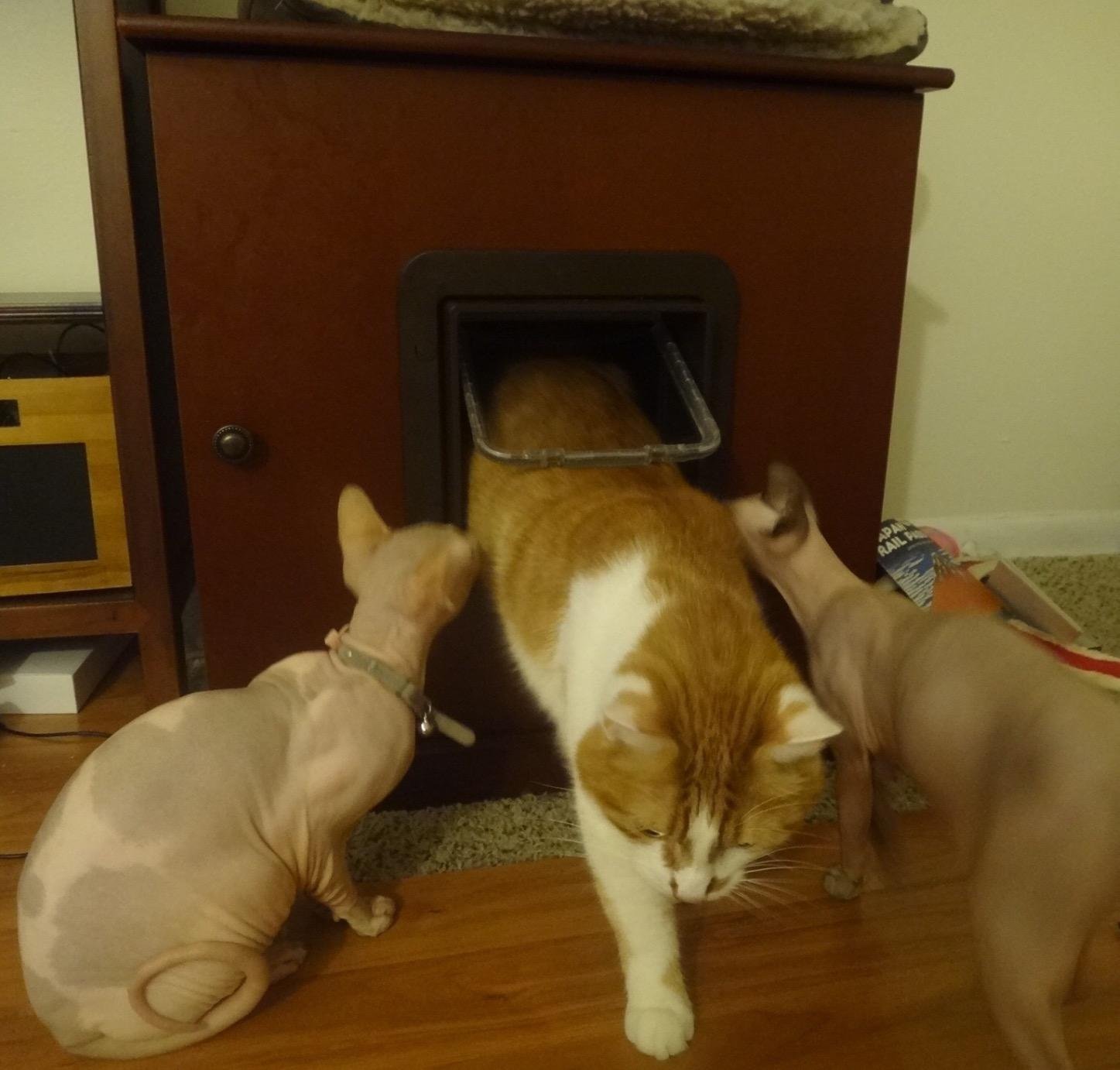
This is the cleanest answer to the question we get asked most often, which is how to let a dog out while the cat stays inside. If your animals are already chipped, the door reads the implanted ID and nothing else unlocks it. No collar key, no tag to lose, and the cat simply has no identifier the door recognises.
Battery life is the standout number here. Four C batteries run up to twelve months, and a low battery indicator flashes red when they need changing, which removes the single biggest reliability complaint we see with collar-key doors. The head-in activation design is also deliberate: the door does not unlock every time a pet walks past, it only reacts when a head is presented, and owners consistently report that this cuts down on the door triggering for no reason.

Programming is genuinely one button, and the door can hold up to 32 identities, so it scales from a single cat to a full boarding kennel. It installs in doors, windows or walls. If a pet is not chipped, programmable collar tags are sold separately, which reintroduces the same bulky tag problem the microchip version was meant to avoid.
Size is the constraint. The flap opening is 6 11/16 inches high by 7 inches wide, which suits cats and small dogs comfortably and will not suit a medium or large breed. This is a cat-scale door, and buying it for a Labrador is a mistake people make because the listing photo does not convey the scale.
Who this door suits
It suits indoor cats that need monitored access to a catio or sunroom while a dog uses a separate door, and any household where all animals are already microchipped. It also suits cold and mild climates equally, since twelve months between battery changes means less to forget.
Who should skip it
Skip it if you have dogs above small breed size, and skip it if none of your pets are chipped and you do not want to chip them. If you need remote control and schedules rather than simple presence-based entry, the Connect version below is the one to look at instead.
3. High Tech Pet Power Pet PX-2 – Best for Security and Weather Sealing
Genuine Power Pet Fully Automatic Pet Door from High Tech Pet Brand. Pet Collar Operated, 4 Way Access, Directional Sensing, Dead Bolt Lock, Air Tight, Quick, Quiet Operation, USA Customer Service
Motorized panel
Steel dead bolt
Hermetically sealed
4-way access control
Pros
- No flap to push
- so nothing to tear
- Steel dead bolt automatic lock
- Hermetically sealed against wind and drafts
- Directional collar signal cuts false triggers
- AC adapter included with battery backup option
Cons
- Requires proprietary MS-5 ultrasonic collars
- Wall mounting may need professional help
- Proprietary collar system limits compatibility
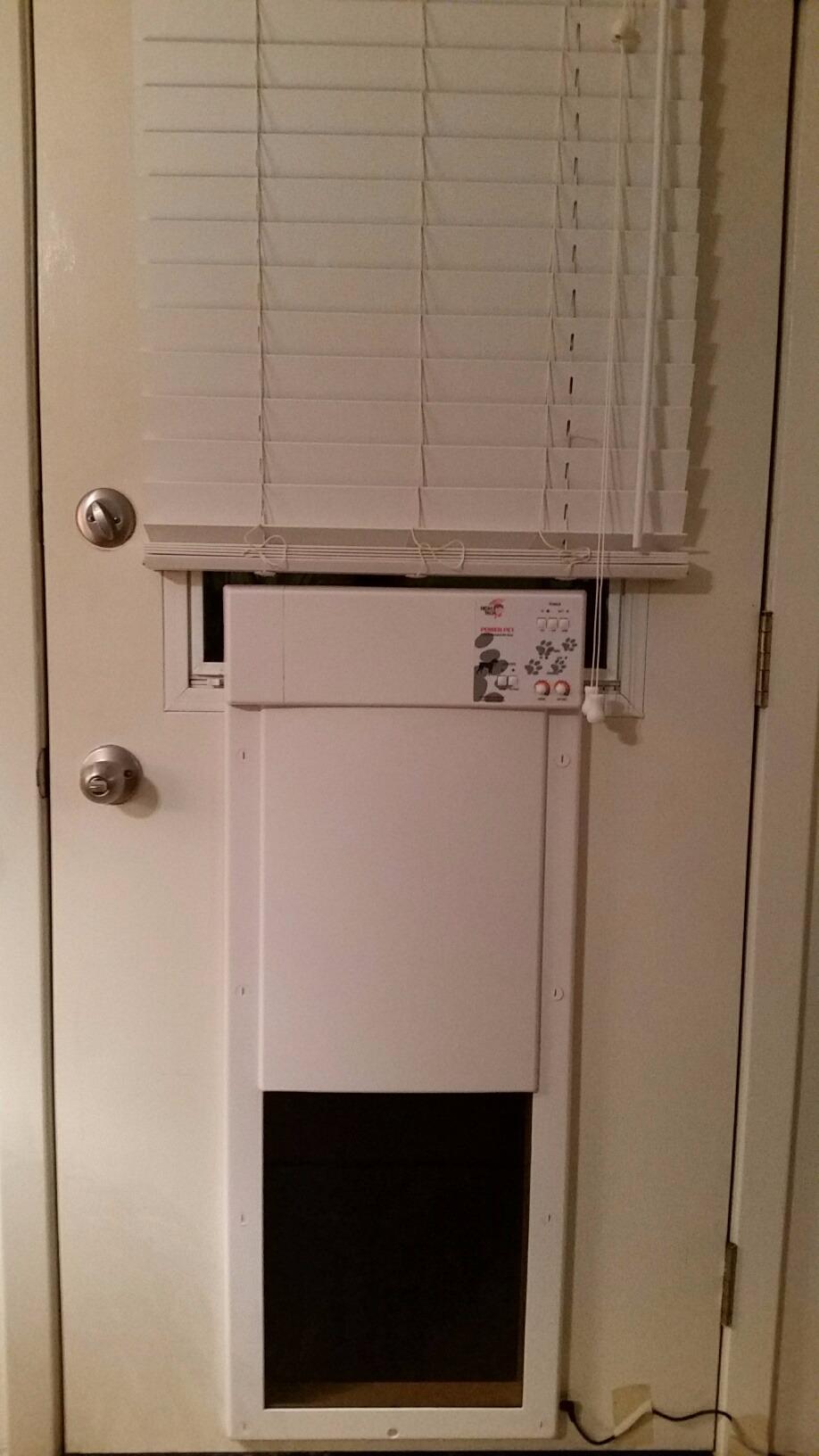
This is the most secure door in the roundup and the best answer to anyone who worries about what a hole in their exterior door means for home security. There is no flap at all. A motorised panel rises when your pet approaches with a High Tech Pet MS-5 ultrasonic collar and drops behind it, and an automatic steel dead bolt throws as the panel closes.
The sealing is the other headline. The panel is hermetically sealed, and owners describe it as airtight and free of draughts, which makes it the best option for cold-climate installs where a double-flap door would still be letting warm indoor air escape. Four-way access control gives you enter only, exit only, both, and locked, and the same directional sensing that reads the collar also stops the door opening when a pet passes by without approaching.
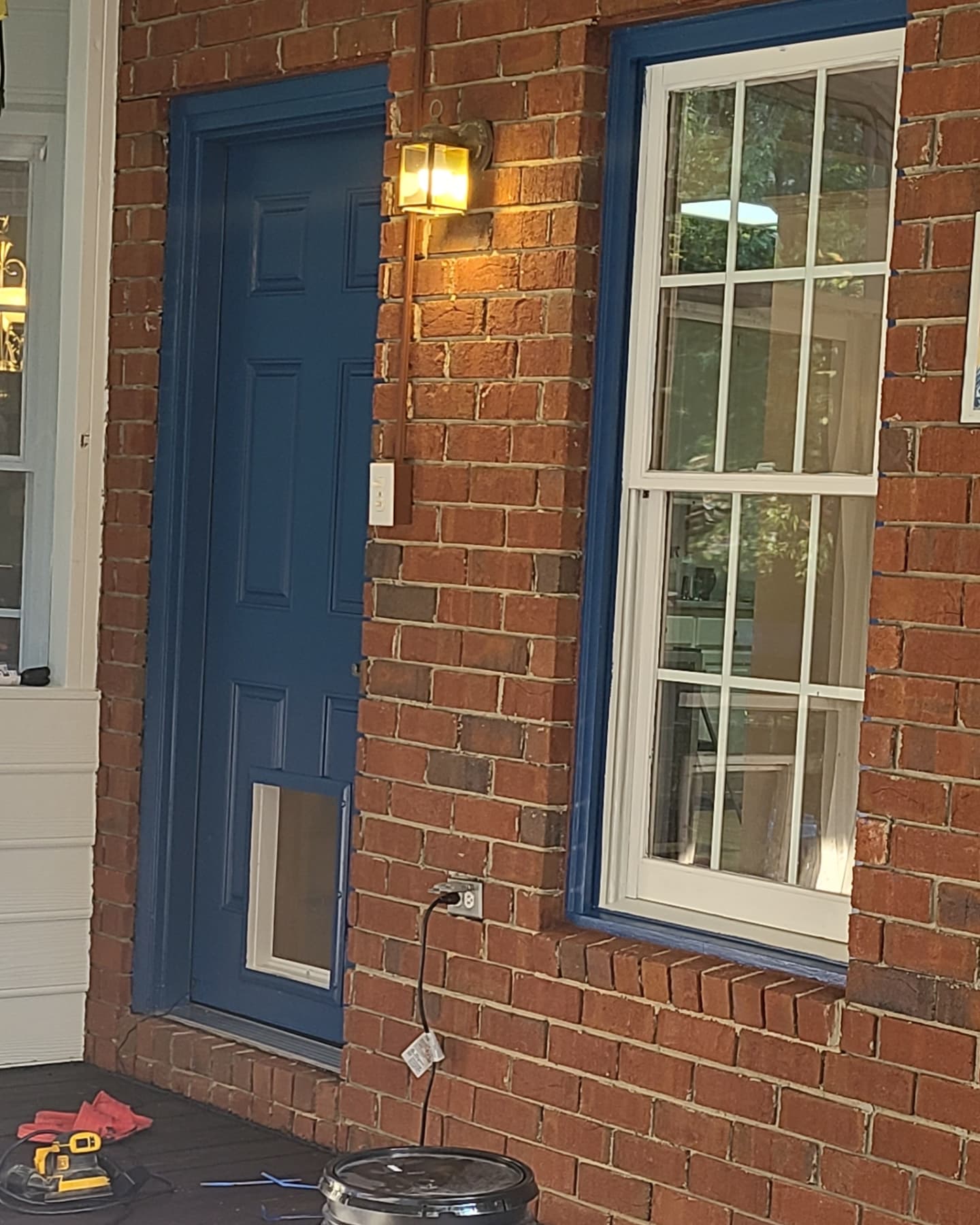
There is a safety layer too, an automatic retract system that detects an obstruction and stops the panel. For a household that worries about a tail or a paw caught in a moving part, that is a meaningful difference from flap doors, where there is no moving part at all. The door is 18 by 6 by 47 inches, which is a substantial unit and one you will feel when you close the exterior door.
The compromise is the collar system. The door only reads genuine MS-5 ultrasonic transmitters, and the performance warranty applies only with authentic transmitters, so third-party collars will not work and the door is locked into one ecosystem. Wall mounting is also a bigger job than a door cut, and some homes will want a professional for it.
Who this door suits
It suits homes in cold climates that want the tightest seal available, and homes where security is a genuine worry rather than a passing thought. It also suits owners with nervous or slow-learning dogs, since owners report success training pets when the panel slides up rather than requiring a push through a flap.
Who should skip it
Skip it if you need a large opening for a giant breed, since this unit is not sized for the biggest dogs. Skip it if you are not ready to use one brand of collar for every pet that needs access, because the ultrasonic signal is proprietary.
4. SureFlap Microchip Pet Door Connect – Best for App Control and Curfews
SureFlap Microchip Pet Door Connect Without Hub – Flap Opening is 6 3/4 inches by 7 inches
App control with separate hub
Remote lock and unlock
Curfew scheduling
6 11/16 x 7 inch opening
Pros
- Lock or unlock the door from anywhere
- Change curfew times from the app
- Activity history shows long-term pet patterns
- Microchip entry with no collar needed
Cons
- SureFlap Hub sold separately for app features
- Flap limited to cats and small dogs
- Hub dependency for every smart feature
- 4 C batteries not included
This is the version to buy if you work long shifts away from home and want to know what your pet is doing rather than guess. Through the app you can lock or unlock the door remotely, change curfew windows, and review the activity history, which lets you spot changes in your pet’s routine over weeks rather than minutes.
Under the bonnet the recognition is the same RFID microchip reading as the standard SureFlap, and the opening stays at 6 11/16 inches by 7 inches. That means it inherits the same strengths, a one-button programming routine, support for many identities, and no collar key, and it inherits the same size limitation, which is cats and small dogs only.
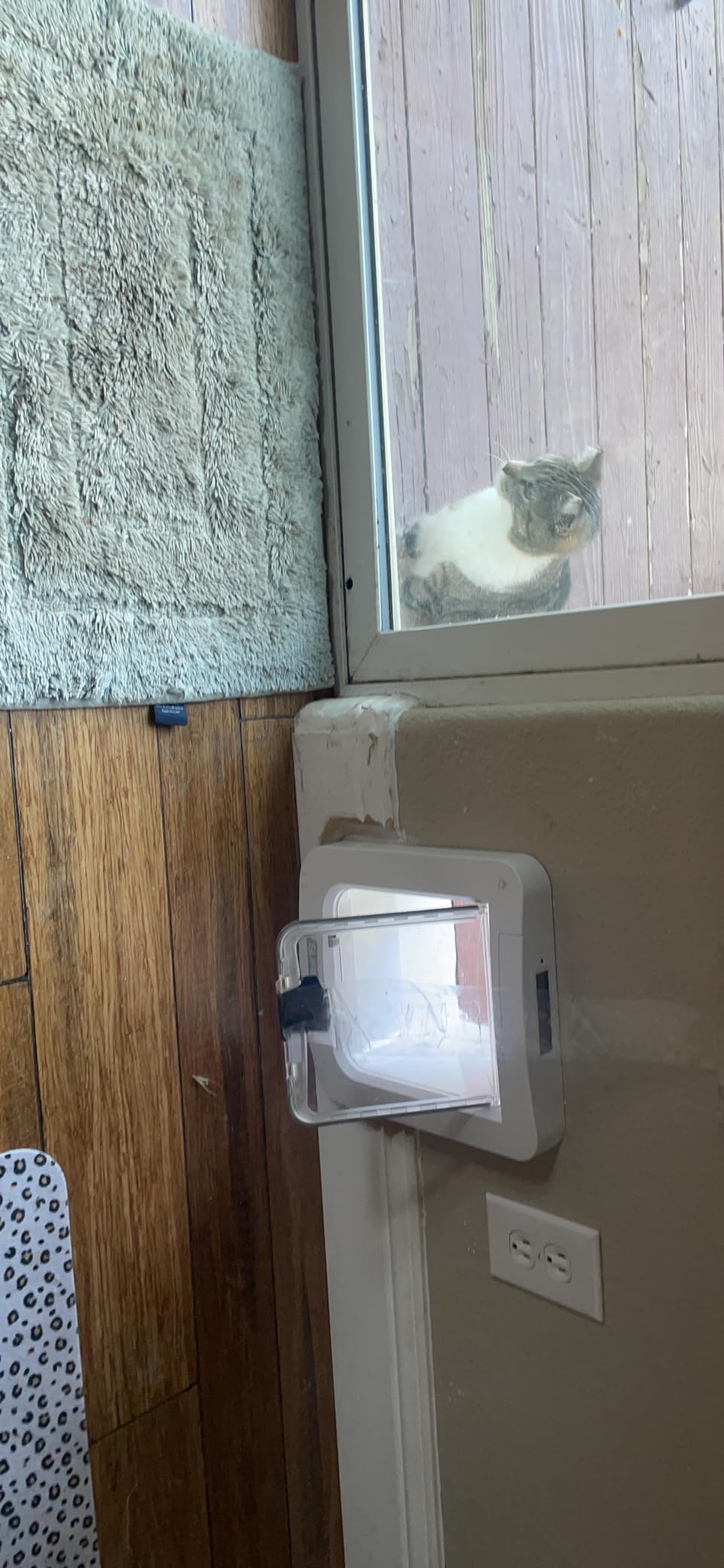
What changes is the dependency. This unit is the door without a hub, and the hub is sold separately, so the smart features do nothing until you add it. That is the main reason for the 3.8 rating here. You are buying the connectivity layer on the assumption that you will also buy the piece that makes it work.
It is also worth being clear-eyed about app lock-in. Remote locking, schedules and history all run through the manufacturer’s app, so the practical value depends on the phone app continuing to be maintained and on your home internet working. For a pet door, we would still keep a physical backup plan rather than assume the app is always reachable.
Who this door suits
It suits cat households and small-dog households where the owner is away for long periods and wants remote control and a record of movements. It also suits anyone who wants a curfew window, such as locking the door after dark on a patio.
Who should skip it
Skip it if you are not prepared to buy the hub, and skip it if you do not want a connected device in an exterior door. For plain microchip entry with no cloud dependency, the non-Connect SureFlap in this roundup does the same job for less.
5. nolonly Automatic Dog Door – Budget Pick with a Timer
Automatic Dog Door with Timer, Smart Electric Pet Door Anti-Pinch Sensor
Anti-pinch sensor
Plug-in or 4000mAh battery
LCD timer panel
Aluminum alloy frame
Pros
- Anti-pinch sensor stops and reverses for a pet
- Two power modes including a rechargeable battery
- 30 days per charge on battery mode
- Aluminum alloy body resists weather
- Lifetime warranty
- Works for cats
- dogs and small animals
Cons
- Newer brand with a shorter track record
- Plug-in adapter not included
- One size listed
- Aluminum panel is louder than plastic
This is the highest rated door in the roundup at 4.7 across 435 reviews, and the reason is that it solves a problem the premium doors do not: it has no collar or microchip at all. It is a scheduled automatic door, so you set when it opens on the LCD panel and the motorised panel rises and falls on that schedule. Every pet can use it, which is useful for a house where the dog is not chipped.
The anti-pinch sensor is the safety story here. If a pet is detected in the way, the door stops and reverses automatically, which is a meaningful safeguard with a moving panel. The opening measures 13.78 by 9.06 inches, so it accommodates a wider range of pet sizes than the microchip doors here, and the unit is listed for cats, dogs and small animals.
Power flexibility is genuinely useful. It runs on a plug-in adapter or on a built-in 4000mAh rechargeable battery that runs about 30 days per charge, so a power cut does not lock your pet out. The battery indicator is on the LCD screen, which answers the single most common complaint about battery-only doors.
The caveats are straightforward. This is a newer brand without years of owner history, and 435 reviews is a shorter track record than the doors above it. The plug-in adapter is not included, the aluminum alloy panel is noisier than plastic, and only one size is listed, so check your measurements carefully before committing.
Who this door suits
It suits homes where you want everyone out on a schedule, including cats and dogs together, and renters or owners who want a three-minute install with the accessories supplied. It also suits anyone nervous about a moving panel, because of the anti-pinch sensor and the two power options.
Who should skip it
Skip it if you need selective access, since anyone can use this door on its schedule, including a stray or a raccoon. Skip it if you cannot accept a brand with limited long-term reliability data, and note the lifetime warranty is a meaningful offset to that concern.
6. Power Pet WiFi PX2-WIFI – Best for Scheduled Large-Dog Access
Power Pet WiFi Automatic Electronic Pet Door by High Tech Pet – Pet Operated Dog Door, App Control, 24/7 Scheduling, Secure, Air Tight, for Large Dogs (30-100 lbs.) Door Mount, Easy Install – PX2-WIFI
WiFi app scheduling
Motorized panel
Steel dead bolt
For dogs 30 to 100 lbs
Pros
- Weekly scheduling for entry and exit
- Motorised panel with no flap to push
- Steel dead bolt security lock
- Hermetically sealed against drafts
- Real-time notifications and low battery alerts
- Directional collar signal
Cons
- Requires proprietary MS-5 collars
- Door mount only
- Least review history in this roundup
This is the only door here built specifically around a large dog’s schedule, and it is the one to consider if your dog needs structured access, such as a garden in the morning and a locked door overnight. It is rated for dogs from 30 to 100 pounds and adds WiFi control with 24/7 weekly timers, so you can set entry and exit windows for each day rather than relying on a presence sensor alone.
The mechanical side is the same proven PX-2 platform: a fully automatic motorised panel, an automatic safety retract system for obstruction detection, a steel dead bolt lock, and a hermetically sealed panel. Owners get real-time notifications for entries and exits plus low battery alerts, which is where the app earns its place for an owner who is not at home.
Directional sensing is inherited too, so the door opens on a direct approach from the MS-5 collar rather than every time a dog passes. The collar is waterproof and rugged, and the door itself is quiet in operation, which matters for a household with a light sleeper.
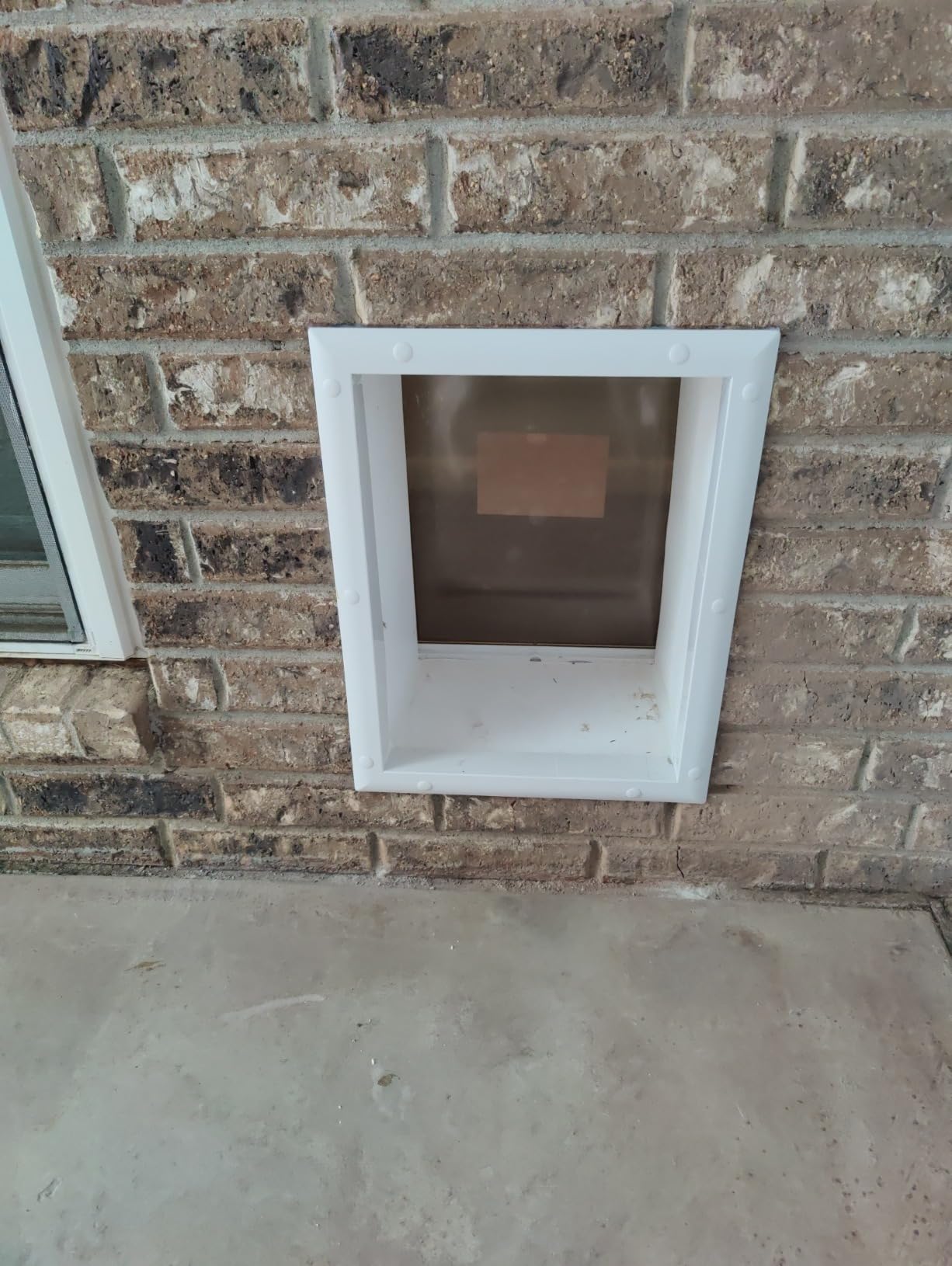
Two practical limits. It is a door mount with a maximum compatible thickness of 0.5 inches, so a thicker exterior door or a wall install is out of scope without a tunnel kit. And at 151 reviews it has the smallest owner history in this roundup, which is worth factoring in when you are buying the most connected and most committed door on the list.
Who this door suits
It suits large-dog households that want a rigid schedule and real-time notifications, and owners who are away for long stretches and want to confirm the dog came back in. It also suits anyone who wants the tightest seal plus the strongest lock in the category.
Who should skip it
Skip it if you want a wall mount or a thick door, and skip it if you need a large opening for a giant breed, since 100 pounds is the ceiling here. If you want the same mechanical door without the app, the PX-2 in position three is the lower-commitment route.
7. PetSafe Electronic SmartDoor – Best Budget Collar-Key Door
PetSafe Electronic SmartDoor – White, Large with Extra SmartKey
RF SmartKey collar key
Entry, exit and auto-lock modes
Up to 5 SmartKeys
LED indicators
Pros
- Entry
- exit and auto-locking modes
- Extra SmartKey included in the box
- LED status indicators show door state
- Sensitivity control for hesitant pets
- Cutting template and instructions included
Cons
- SmartKey is bulky for small pets
- Battery powered with no AC option
- Plastic frame less durable than metal
- Smaller owner history than the original PetSafe
This is the entry point into collar-key doors, and the reason to pick it over a plain plastic flap is the same as the original PetSafe: real selective access with entry, exit and auto-locking modes. It uses radio-frequency identification on a battery SmartKey worn on the collar, and the LED indicators show the door state so you are not guessing in the dark.
Sensitivity control is a genuinely useful addition. A door that is too eager to unlock wastes battery and defeats the point, and a door that is not eager enough teaches a hesitant pet to give up. Being able to adjust it is the difference between a door a nervous dog learns to use quickly and one that takes months.
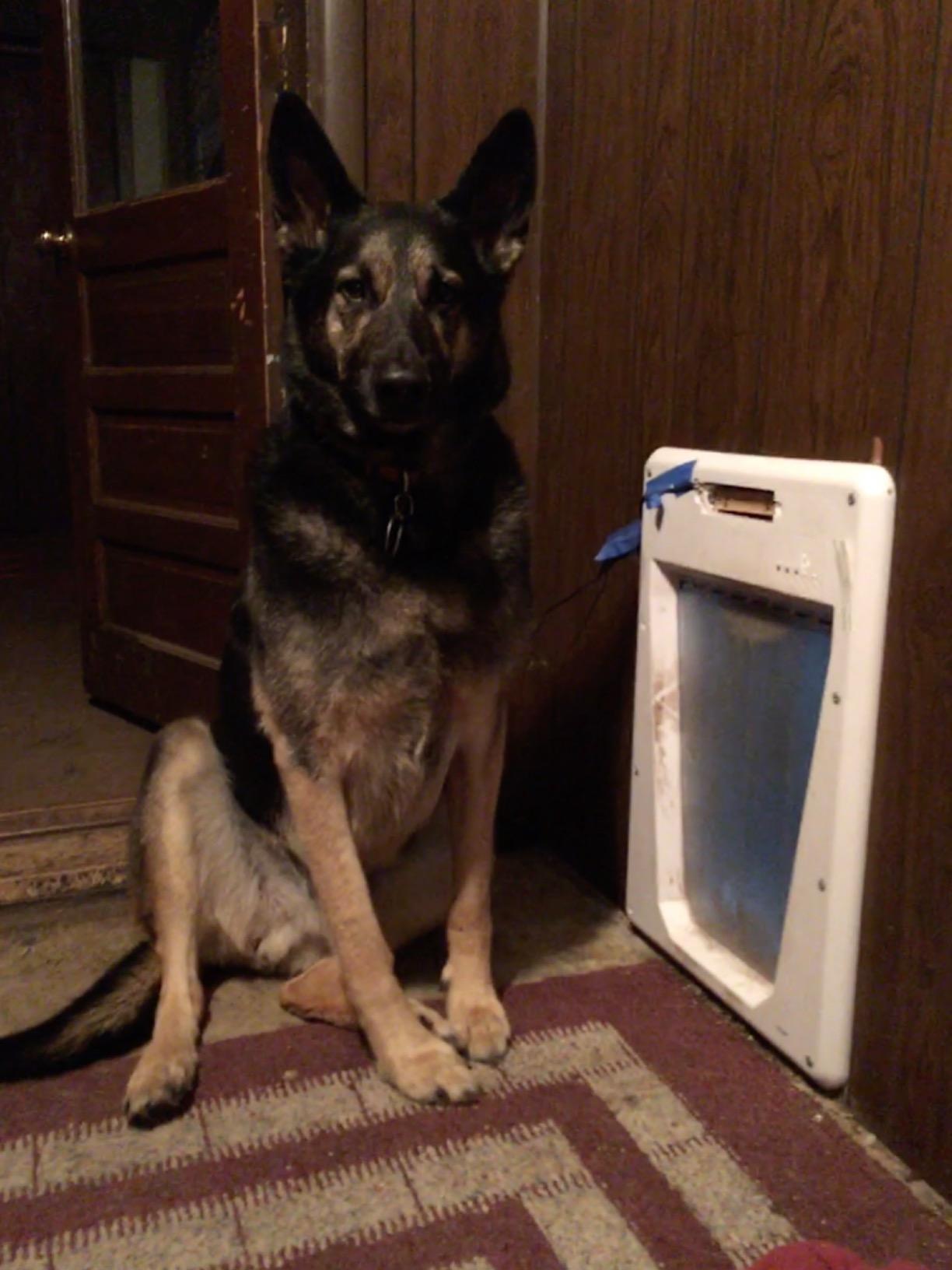
Two SmartKeys are included, one in the battery compartment and one extra, and the door programs up to five, so a multi-pet home is covered. Installation is straightforward with the supplied cutting template and instructions.
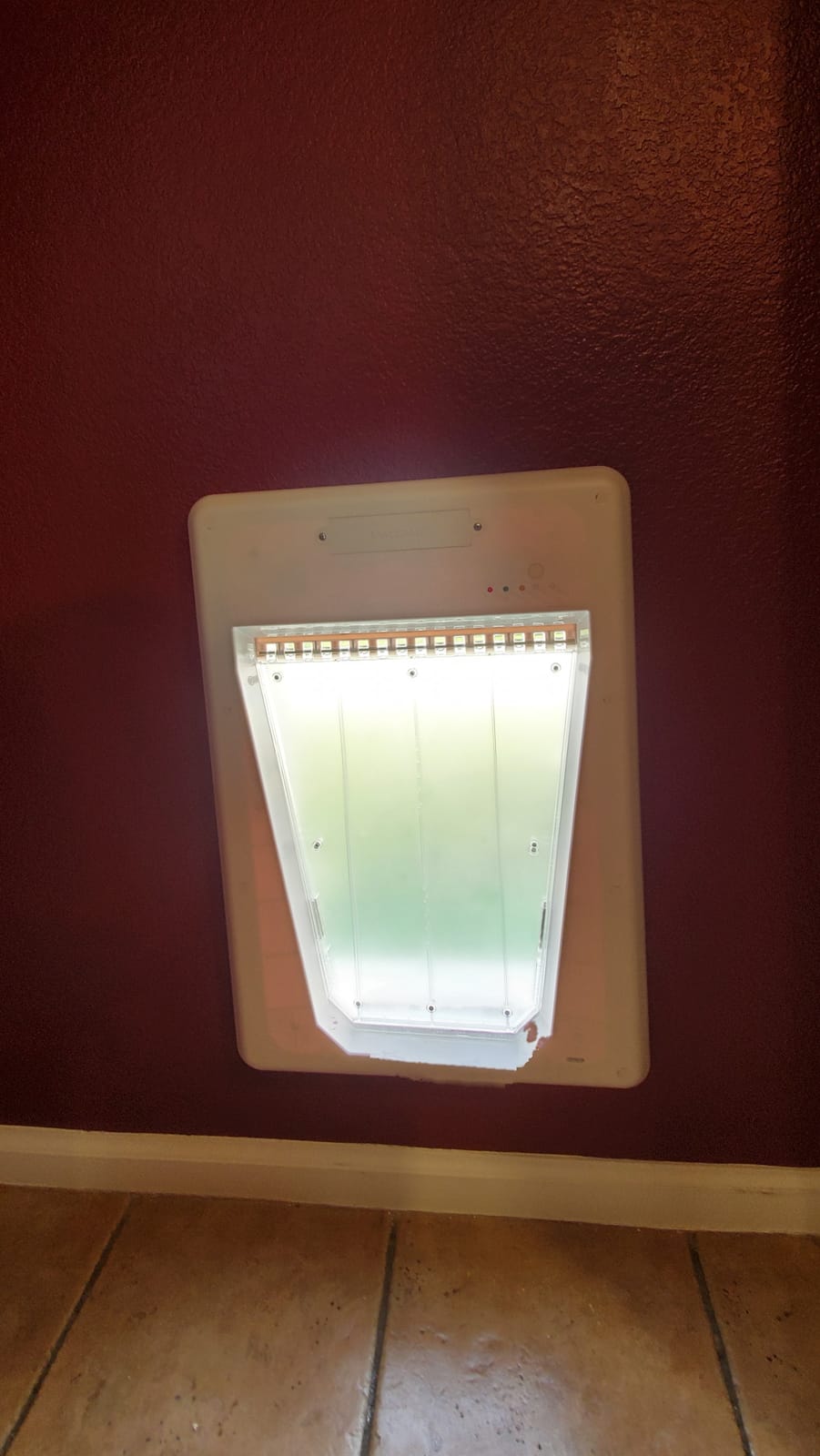
It shares the collar-key drawbacks. The SmartKey is the bulky accessory problem again, worst on small dogs and on cats that object to anything on the collar, and the key battery is a second consumable that can die without warning. The plastic frame is less durable than a metal-bodied door if you have a dog that treats doors as something to lean on, and with 158 reviews it has far less owner history than the original PetSafe in position one.
Who this door suits
It suits first-time smart door buyers who want selective access without an app, a hub, or a proprietary collar ecosystem. It also suits smaller multi-pet homes, since two keys are included and five can be programmed.
Who should skip it
Skip it if your animals are chipped and can use a microchip door instead, which removes the collar entirely. Skip it if you have a powerful chewer or a large dog that will stress a plastic frame, and consider the original PetSafe for its longer record of owner feedback.
How to Choose a Smart Dog Door
Start with the direction you need to control, because this is the decision most people get wrong. A door that controls entry only stops strays and wildlife coming in, but your cat can still walk out. A door with exit-only or four-way control can keep a cat in while a dog goes out, which is the whole point of a mixed-pet home. If that is your situation, cross off the entry-only options first, no matter how good they are otherwise.
Next, match the opening to the largest animal that will use it, and measure rather than guess. The cat-scale doors in this roundup, with a 6 11/16 inch by 7 inch opening, suit cats and small dogs only. The collar-key and motorised doors here take noticeably larger animals, with the widest opening here measuring 13.78 by 9.06 inches. Measure your animal at the shoulder and add clearance, and measure the actual opening rather than the outside frame.
Think about where it goes. A door mount is the simplest install and the cheapest, but a 0.5 inch thickness limit on some models will rule out a thick exterior door, and the tunnel is short so you lose some insulation benefit. A wall mount needs a tunnel through the wall and is more work, but it gives you a proper insulated passage. Sliding glass patio door inserts avoid cutting anything at all, which matters for renters.
Check power and failure behaviour honestly. A door that locks a pet outside when a battery dies is a genuine risk, particularly for owners whose dogs cannot wait. Battery-only doors give you a low battery warning in some cases and none in others, and doors that run on mains power with a battery backup, like the High Tech Pet units, remove the problem. Whichever you choose, decide now where your manual override is.
On insulation, flap count is what matters. A single flap is cheapest but a constant draught. Double and triple flaps hold back cold air and wind far better at the cost of a heavier flap that some dogs will not push through. A hermetically sealed motorised panel such as the PX-2 removes the draught question entirely.
On app-controlled doors, weigh lock-in honestly. Remote lock, schedules and activity history are genuinely useful when you work long hours, and our smart pet feeder guide covers the same trade-off in feeding devices. Just do not let an app be the only way your pet gets outside, and do not assume it works when your internet does not.
Finally, total cost goes beyond the door. Add spare collar keys, batteries, a tunnel extender for a deeper wall, and professional installation if you are cutting brick or a thick exterior door. Microchip doors have almost no consumables, collar-key doors have a per-pet consumable, and app doors have a hub or subscription-shaped dependency. That difference matters over a ten-year life.
Keeping Cats In While Dogs Go Out
The mixed cat-and-dog question has a short answer: use a door that controls both directions, and program it. Any door with a lock mode that includes exit-only or a four-way setting can hold a cat in while still letting a dog out, and that single setting is the whole framework.
Work in this order. First, choose a door with exit control, which rules out the simplest flap-style products entirely. Second, pick recognition that suits your animals: microchip doors need no collar and are the cleanest answer for cats, while collar-key doors work for animals you cannot or do not want to chip. Third, set the lock to exit-only during daylight hours when the dog needs out, and locked overnight. Fourth, train the exit control, because a door that opens inward for a dog but not outward for a cat needs the cat to understand the difference.
Two refinements. If you have a cat that is a persistent escape artist, put the microchip door at a height and location where the cat is not motivated to try, since no door keeps a determined cat in if the cat treats it as a challenge. And if you also need wildlife control, microchip and collar-key doors both block raccoons, possums and stray animals, which a scheduled timer door like the nolonly does not, since anything can enter on its schedule.
When a Smart Dog Door Locks a Pet Out
Lock-out is the fear that stops people buying these doors, and it is worth planning for rather than hoping against. The most common causes are a dead collar-key battery, a door set to the wrong lock mode, a programming error, or a motorised panel that lost power mid-cycle.
Collar-key batteries are the leading cause because they have no warning. A small routine prevents most incidents: check each key on a calendar reminder rather than waiting, and keep one spare key programmed and accessible. For microchip doors, the far more common cause is a lock mode set to fully locked rather than the automatic mode, so check the mode first.
Power loss matters most for motorised doors. A door on mains power with a battery backup keeps working, and a door with a rechargeable battery, such as the nolonly unit, keeps working for weeks. A battery-only door will simply stop unlocking, which is a failure that leaves a dog outside rather than trapped inside.
Two habits reduce the risk. Keep a physical key, latch or manual override for every motorised door and know where it is before you need it, and give any pet that must not be locked out, such as a puppy or an anxious dog, a second exit route such as a window pet door or a person on standby. Owners of large breeds that should not be out unsupervised tell us the redundancy matters more than the electronics.
Training is the other half. Dogs that are wary of flaps learn faster when the panel moves out of the way visibly, which is one reason the motorised doors get good reports with skittish dogs. Start by propping the flap or holding the panel open, reward the pet for going through, then close it partway and increase over several days. Repeating the session twice a day for a week is usually enough.
Frequently Asked Questions
What is the best dog door to keep cats inside?
The best door for keeping cats inside is one that locks both directions, not just entry. A microchip-reading door such as the SureFlap Microchip Pet Door is the cleanest option because it recognises your cat’s implanted chip and no other animal, and the collar-key PetSafe Electronic Pet Door adds an exit-only mode so a dog can leave while the cat cannot follow. Program the lock mode, not just the keys.
Is there a dog door that cats can’t get out of?
Yes, a smart dog door that controls exit as well as entry will keep cats in. Look for a four-way lock system with an exit-only or fully locked setting, or a programmable selective entry, exit and auto-lock mode. A door that only controls entry will still let your cat walk out, so check the direction of control before you buy.
Can cats get through doggy doors?
Yes, most cats can squeeze through a dog door if the flap is flexible and the opening is wide enough for their body. A rigid or motorised panel is harder for a cat to push than a soft flap, and a large opening invites passage rather than blocking it. If keeping a cat in is the goal, control the door with recognition rather than relying on size alone.
Which brand of smart dog door is the best?
PetSafe offers the widest door in this roundup for mixed cat-and-dog homes because it programmes selective entry, exit and auto-locking for up to five keys. SureFlap is the strongest choice when all your pets are microchipped, because it needs no collar. High Tech Pet Power Pet leads on security, with a motorised panel, a steel dead bolt and a hermetically sealed frame.
What are people saying about the SureFlap microchip cat door?
Owners consistently praise the microchip reading, the one-button programming, the head-in activation that stops the door opening every time a pet walks past, and battery life of up to twelve months on four C batteries with a low battery indicator. The common criticism is size, since the 6 11/16 inch by 7 inch opening suits cats and small dogs but not larger breeds.
Conclusion: Our Final Smart Dog Door Picks for 2026
The best smart dog doors for cats and dogs in 2026 come down to one question: do you need the door to control exit, not just entry? If yes, the PetSafe Electronic Pet Door is our overall pick, with programmable selective entry, exit and auto-locking for up to five keys. If all your animals are chipped and the door serves cats and small dogs, the SureFlap Microchip Pet Door does the job with no collar and a year between battery changes. For cold climates and home security, the High Tech Pet Power Pet PX-2 seals and locks better than anything else here, and the PX2-WIFI adds scheduling on top of the same mechanics. Budget buyers who want a scheduled door without chips or collars will find the timer-driven nolonly unit easy to live with. If you need a second piece of gear alongside the door, our guide to dog strollers for senior dogs covers getting an older dog out safely. Measure your largest pet, confirm the lock modes include the direction you need, and keep a manual override plan before the first cut.