
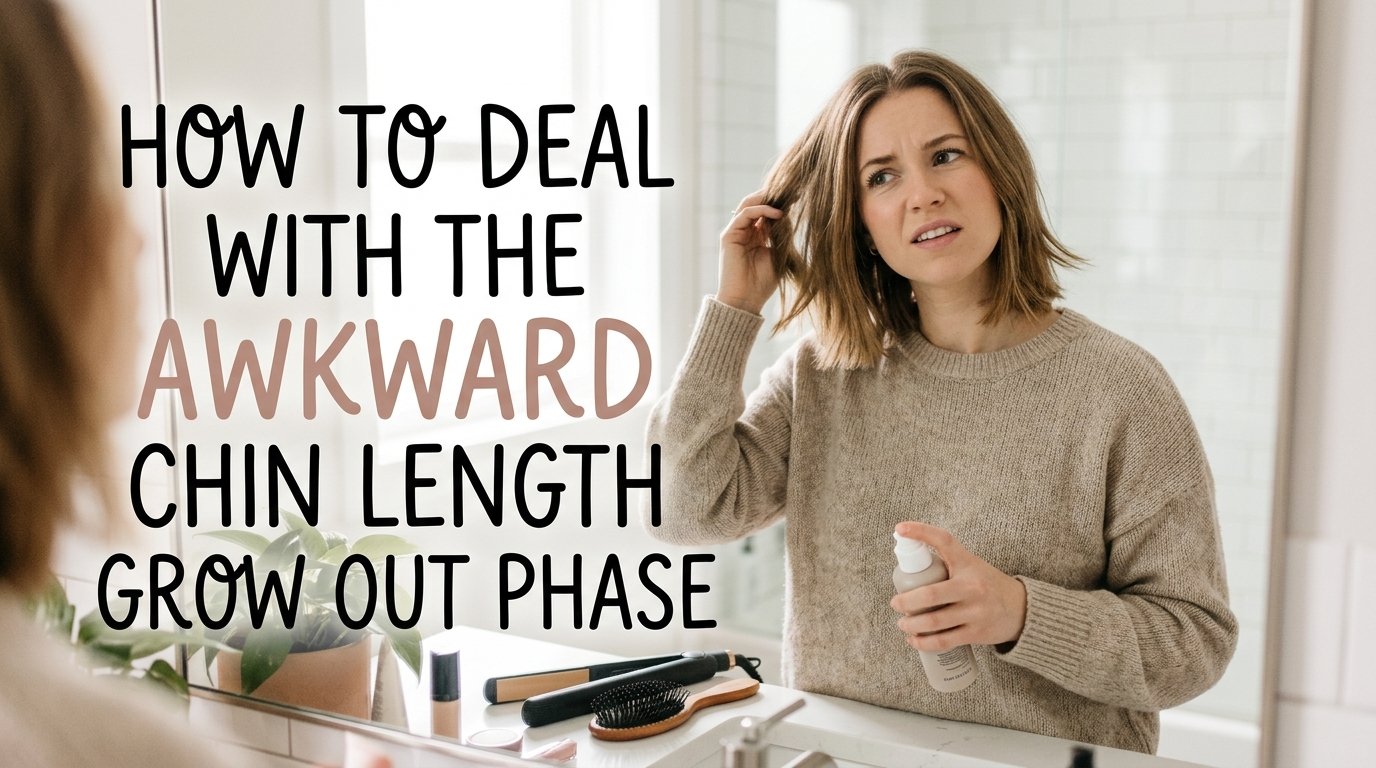
If you are reading this, you are probably standing in front of your mirror right now wondering what happened to your hair. You cut it short, you decided to grow it out, and somewhere around chin length everything went wrong. One day it looked intentional and chic, and the next day it looked like a bunch of dead worms sitting on your head. If that sounds familiar, you have found the right guide.
I am going to walk you through everything you need to know about the awkward chin length grow out phase, including why it happens, what to expect, and exactly what to do with your hair until it grows past this miserable stage. You will learn styling techniques that work, the right kinds of products to use, the hairstyles that actually flatter this length, and how to protect your sanity while you wait. I have had personal experience with this phase, and I have talked dozens of clients at Mercer Street Salon through it. This is the guide I wish someone had handed me the last time I went through it.
Table of Contents
What Exactly Is the Awkward Stage?
The awkward stage is the transitional period when your hair is too long to be considered short but too short to be styled like long hair. It typically starts around chin length, which means your hair is roughly three to four inches past whatever short style you originally had. At this length, your hair does not lay flat against your head, it does not tuck behind your ears, and it does not have enough weight to cascade down your back. It just sort of sits there, sticking out in random directions and refusing to cooperate with any styling routine you throw at it.
Here is the part nobody tells you upfront: the awkward stage lasts for months, not weeks. Hair grows at about half an inch per month, which means it takes roughly eight to twelve weeks just to move from chin length to one inch beyond your jawline. The full awkward phase, from the moment your short haircut starts misbehaving until you reach shoulder length where you can finally pull it back, can take anywhere from three to nine months depending on your starting point and your growth rate. That is a long time to spend feeling frustrated with your reflection every single morning.
The chin-length phase specifically is usually the worst two to four months of that entire timeline. You are past the point where a short haircut looks intentional, but you are nowhere near the point where you can throw it up in a bun and call it a day. Every morning you look in the mirror and ask yourself the same question: what do I even do with this? One Reddit user described their chin-length phase as looking like a bunch of dead worms on their head. Another said almost four months into their grow-out, they had no clue how to tame their hair anymore because it was too long for the original style and too short for anything else. If those descriptions hit close to home, know that you are not alone and there is a way through it.
Why the Chin-Length Phase Is Especially Tricky
Chin length sounds like it should be a perfectly normal hair length. The problem is that it is a perfectly normal hair length that happens to be positioned right at the most awkward spot on your head. Your hair ends right around your jawline and chin, which means every cowlick, every growth pattern, and every strand of flyaway hair is framed directly against your face. There is nowhere for the hair to fall naturally.
Bangs add an entirely separate layer of frustration during this phase. If you grew out bangs along with the rest of your hair, you know the struggle personally. They are too long to keep straight down without curling up or sticking out, but they are too short to tuck behind your ears without looking patchy and uneven. Many people resort to clipping them back with bobby pins or pushing them to the side, which works in a pinch but rarely looks polished. The bang situation is so common that it shows up in almost every forum discussion about growing out hair. People ask what they are supposed to do with bangs that are too long to keep down but too short to style. It is one of the most frequent complaints during the chin-length phase.
There is also the problem of mismatched lengths. Hair does not grow evenly across your head. The back often grows faster than the sides, and certain spots have growth patterns that push hair outward instead of downward. At chin length, these mismatches are impossible to ignore. Your hair might look fine from the front and completely wild from the side. You might have one section that lays flat and another that poofs out like a mushroom. This inconsistency is what makes chin length feel so unmanageable. Your friends might not notice, but you see it every time you glance in a window or a mirror.
Short hair has rules. It has a shape, a line, and a style. Long hair has weight, length, and options. Chin-length hair has none of those things. It is all transition and no destination, which is exactly why it drives so many people to the salon asking for a cut. But before you pick up the scissors, know that there are better ways to handle this phase.
Quick-Fix Solutions for Today
Before we get into the longer-term strategies, you need something that works right now. These are the tricks that will get you through today, tomorrow, and the rest of this week without losing your mind. I recommend keeping these tools in your arsenal from day one of the awkward phase.
Hats are your best friend during this phase. A well-fitted baseball cap, a floppy sun hat, or even a beanie in cooler weather can hide a bad hair day instantly. I am not suggesting you wear a hat every single day, but having a few reliable options in your rotation takes enormous pressure off the morning styling routine. On days when your hair simply will not cooperate, when it is poofing in three different directions and the weather is against you, a hat is not a cop-out. It is a survival strategy.
Bobby pins and small hair clips deserve a lot more credit than they get. A single bobby pin placed behind one ear can tame a strand that sticks out at a weird angle. Two clips can pull back just enough hair to change the entire silhouette of your style. I keep a small tin of bobby pins in my bag, my car, and my desk drawer. You never know when you will need to pin back a section of hair that refuses to lay flat. The key is to be strategic about placement rather than just jamming pins everywhere. A clip placed at the right angle can make a messy section look like you meant to do that.
Headbands and bandanas work similarly by controlling the hair around your face. A thin, padded headband can smooth down the hair at your temples and keep flyaways in place without creating a bulky look. A silk or satin headband has the added benefit of reducing friction against your hair, which helps prevent breakage during the grow-out process. Bandanas tied around the forehead or hairline can cover up uneven bangs and add a stylish touch to an otherwise messy look. The bandana look has become surprisingly trendy, which means you can pull it off as a fashion choice rather than a desperation move.
Dry shampoo and root powder are not just for extending time between washes. During the awkward phase, they add texture and grip at the roots, which helps your hair hold a style longer. A light dusting of dry shampoo at the crown and along the part creates enough tension to prevent that flat, lifeless look that chin-length hair gets by midday. Root powder works the same way but with more precision and less mess. Both are lifesavers on busy mornings when you do not have time to wash and style your hair from scratch.
Finally, give yourself permission to have easy hair days. Not every day requires a perfect hairstyle. Some days, the goal is simply to have your hair off your face and not look like you rolled out of bed. That is a perfectly acceptable standard on difficult days. You do not have to perform effortless style for an audience every single morning.
Practical Styling Tips for Chin-Length Hair
The styling tips in this section are the core of getting through the awkward phase with some level of dignity. These are techniques I have used myself and recommended to clients at Mercer Street Salon who are going through the exact same thing. Most of these take five minutes or less, which matters when you are already frustrated before your day has started.
Blow-dry your hair backward instead of forward. This is the single most impactful change you can make to your styling routine at chin length. When you dry your hair forward, it falls flat against your face and creates that helmet look that makes the awkward phase feel ten times worse. Drying it backward, with your head tilted down, pushes the hair away from your face and creates volume at the roots. The result is lift, movement, and a shape that actually looks intentional. Use a round brush to add bend at the ends if you want a softer finish. This one change alone will make your hair look noticeably different on days when you have time to blow-dry it.
Straighten your hair to create the illusion of more length. I know this sounds counterintuitive if you are trying to embrace your natural texture, but straightening chin-length hair smooths out the kinks, reduces the poof, and creates clean lines that look polished. Flat-ironed hair at chin length reads as sleek and intentional rather than messy and transitional. The key is to use a heat protectant before you start and keep the iron moving so you do not damage your ends while you are trying to grow them out. You want every inch of growth to be healthy, so protecting your ends from heat damage is non-negotiable.
Half-up, half-down styles are your greatest asset during this phase. You do not need enough hair for a full ponytail, but you probably have enough to pull back the top section and secure it with a small clip or elastic. This gets the hair off your face, which is usually the biggest source of frustration, while still showing that you have length growing underneath. Twist the top section before securing it for a more polished look, or use a decorative clip for something more playful. Half-up styles work for almost every hair type and every occasion, from the office to date night.
Low buns work at chin length, and most people do not realize this until they try it. You do not need long hair for a bun. Gather whatever hair you can at the nape of your neck, twist it loosely, and secure it with a few bobby pins or a small elastic. The loose, low bun at chin length has a deliberately undone quality that looks stylish rather than like you could not fit all your hair up. Use a few face-framing strands to soften the look, and keep a few bobby pins handy for any pieces that fall out. I have seen clients walk into the salon with messy chin-length hair and leave with a low bun that looks completely intentional and elegant.
Strategic side parts can completely change how your hair lays. If your hair has a natural part, experiment with moving it slightly to one side or the other. A deep side part creates asymmetry that distracts from the fact that your hair is at an awkward length. It also shifts how the hair falls across your forehead, which can help with the bang situation. Parting on the opposite side from your usual part creates extra volume and makes your hair look like you styled it deliberately. Try a middle part for a few days if you normally part on the side. The change in perspective, both yours and other people’s, can be surprising.
Textured cuts are worth discussing with your stylist if your hair feels bulky or boxy at chin length. Instead of growing everything out uniformly, a textured cut removes some bulk, softens harsh lines, and adds movement. Face-framing layers can soften the jawline area and make the length feel more intentional. A texturizing technique at the ends prevents that triangle shape that makes chin-length hair look so boxy and unflattering. The goal is not to cut off length but to shape the hair you already have into something that works with your growth pattern rather than against it.
Sea salt spray and lightweight mousse can give chin-length hair the body and texture it needs to look styled with minimal effort. A quick spritz of sea salt spray on damp hair followed by a rough blow-dry creates natural-looking waves and grit that make the hair look like you spent time on it. Light mousse worked through the roots adds volume without weighing the hair down, which is exactly what fine or straight hair needs at this length. The key word here is lightweight. Heavy products will make chin-length hair look greasy and flat within hours, which is the last thing you need when you are already self-conscious about your hair.
When to Get a Strategic Trim (and When Not To)
One of the hardest decisions during the awkward phase is whether to get a trim. The instinct is to cut it all off and start over, but that approach guarantees you will be stuck in this phase forever. Strategic trimming, on the other hand, can actually help you move through it faster and with more confidence.
A strategic trim, sometimes called a micro-trim, is not the same as a haircut. It involves removing only the split ends and damaged sections while leaving the overall length completely intact. Your stylist trims the stray hairs that stick out at odd angles, cleans up the neckline, and removes any split ends that are causing your hair to look frizzy or unhealthy. The result is the same length of hair, but it looks cleaner, healthier, and more intentional. Clients often leave a micro-trim feeling like they got a whole haircut, even though nothing was actually cut off in terms of overall length.
I recommend scheduling a strategic trim every eight to ten weeks during the grow-out process. This frequency keeps split ends in check without slowing your overall progress. Split ends, if left untrimmed, travel up the hair shaft and cause breakage, which means you lose length over time even though you are not cutting it. Regular micro-trims prevent that breakage and keep your hair looking healthy as it grows. Many people do not realize that skipping trims actually makes their hair shorter over time because of breakage.
When you book the appointment, be very specific with your stylist about what you want. Tell them you are growing your hair out and you need a shape cleanup, not a haircut. Ask them to remove only what is absolutely necessary to maintain a clean line. A good stylist will understand your goal immediately and will work with it. If your stylist pushes back or suggests cutting more than you are comfortable with, that is a sign you might want to find someone who respects your growth goals. The right stylist will be your partner in this process, not an obstacle.
Do not skip trims entirely in an effort to grow faster. This is one of the most common mistakes I see in the salon. People think that if they never cut their hair, it will grow faster. But untrimmed split ends cause breakage, which means your hair actually gets shorter over time. A small trim every two months keeps your ends healthy and helps your hair look better at every stage of growth. The difference between a trim and a haircut is everything in this context.
Recommended Products for the Awkward Phase
I want to be clear that the right products do not fix a bad haircut or make the awkward stage disappear overnight. What they do is give you more control over how your hair looks and behaves on any given day. These are the product categories worth investing in during the grow-out process. You do not need to buy every product on this list, but having two or three of these in your routine will make a noticeable difference.
A lightweight shaping cream is the most versatile tool in your arsenal during the awkward phase. Unlike gel, which hardens and creates that crunchy hair look, shaping cream provides flexible hold that keeps your hair in place without making it look stiff or greasy. Work a small amount through damp hair before blow-drying for all-day control, or apply a tiny bit to dry hair to tame flyaways and define ends. Shaping cream is forgiving, which matters when you are still figuring out what works with your hair type. It washes out easily, so you are not committing to a style that lasts for days.
A lightweight hairspray adds hold without weight. Look for a flexible-finish formula rather than a super-strong hold, because rigid hairspray makes chin-length hair look helmeted and unnatural. A few quick sprays after styling keep your hair in place through wind, humidity, and a full day of activity. I always recommend keeping a travel-size can in your bag for midday touch-ups when your hair starts to fall apart after lunch.
A smoothing hair serum or oil fights frizz and adds shine, which makes even the messiest hair look more polished. Serum works best on the mid-lengths and ends, avoiding the roots so you do not weigh your hair down. If you have curly or coily hair, look for a curl-specific serum that adds moisture without making your curls crunchy or stiff. A small drop is all you need. Less is more with serum, especially at chin length where excess product makes hair look greasy within hours.
A heat protectant spray is non-negotiable if you use hot tools regularly. Flat irons, curling wands, and blow dryers all expose your hair to high temperatures that cause damage over time. During the grow-out process, protecting your ends from heat damage is critical because you want every inch of growth to be healthy. A good heat protectant creates a barrier between your hair and the heat source while also adding a bit of shine and smoothness. Spritz it on before you start styling, not after.
Sea salt spray creates texture, body, and that desirable beach-wave look that makes chin-length hair look deliberately styled rather than accidentally messy. Spritz it on damp hair, scrunch with your fingers, and let it air-dry for a natural wave. If you blow-dry, use a diffuser to enhance the texture without creating frizz. Sea salt spray works particularly well on straight and wavy hair that tends to look flat and lifeless at chin length. A little goes a long way with this product, so start with one spray and add more if needed.
Dry shampoo extends the life of your hairstyle between washes and adds grip at the roots. At chin length, second-day hair often looks better than freshly washed hair because the natural oils add weight and texture. A quick spritz of dry shampoo on day two or three revives the roots, absorbs excess oil, and gives your hair enough body to hold a style. Look for a translucent formula that does not leave white residue on darker hair. Dry shampoo is also handy for adding texture to fine hair that tends to look limp at chin length.
Protective and Versatile Hairstyles That Actually Work
The right hairstyle can make the difference between feeling put-together and feeling like you are having a bad hair year. These styles are designed specifically for chin-length hair during the grow-out process. Each one works because it embraces the length you have rather than fighting it. I recommend mastering two or three of these so you have reliable options for different occasions.
The half-up twist is one of the easiest styles to master and one of the most flattering at chin length. Take the top section of your hair, twist it gently away from your face, and secure it at the back with a small clip or a single bobby pin. Leave the rest of your hair down. The twist pulls the hair away from your face, which solves the framing problem, while the remaining down hair shows that you have length growing underneath. This style works on straight, wavy, and curly hair, and it is appropriate for work, casual outings, and everything in between. Add a decorative clip at the twist point for a polished finish.
The low twisted bun uses the hair you have to create a style that looks deliberate and polished. Gather your hair at the nape of your neck, twist it loosely, and wrap it around the base. Secure it with two or three bobby pins rather than a tight elastic for a softer look. Leave a few face-framing strands loose to soften the style. The low bun at chin length has an elegant, undone quality that reads as intentional rather than desperate. It works well for professional settings and formal occasions, and it keeps your hair completely off your neck on humid days.
Pinned-back styles use small clips or decorative pins to pull just the sides of your hair back while leaving the rest down. This is an excellent option if you have pieces around your ears that stick out or if your bangs are too long to keep down but too short to style. Choose clips that match your aesthetic, from simple matte bobby pins to decorative barrettes. The pinned-back look is versatile enough for the office and polished enough for dinner out. Try pinning one side back and leaving the other down for an asymmetrical look that feels modern and intentional.
The side braid is a practical option that works surprisingly well at chin length. A single braid over one shoulder keeps your hair contained, looks intentional, and eliminates the styling question entirely. A loose, messy braid looks casual and effortless, while a tighter, smoother braid looks more polished. Side braids work for every hair type, though curly and coily hair may need a bit of serum to control frizz along the braid. This is also a great overnight style because it protects your hair while you sleep and gives you a decent-looking style when you wake up.
The low ponytail with a face-framing twist is another simple option. Gather your hair at the nape of your neck using a soft elastic, twist the tail once or twice, and secure it. Pull out a few strands around your face to soften the look. This style is quick, functional, and appropriate for almost any setting. The key is to keep the elastic soft and loose so it does not create a harsh line at the nape of your neck. A low ponytail with a silk or velvet ribbon tied around the elastic adds a touch of elegance that makes the style feel more put-together.
Hair Type Considerations for Chin-Length Growth
Not all hair behaves the same way at chin length, and generic advice often misses the nuances that make the difference between a good hair day and a bad one. Here is what you need to know based on your specific hair type. I have included practical product and styling recommendations for each type because the right approach for fine straight hair is completely different from what works for thick curly hair.
Straight hair at chin length tends to look flat and lifeless. Without natural wave or curl to create body, straight hair can cling to the head and create a helmet effect that highlights every cowlick and growth pattern. The fix is volume at the roots. Blow-dry your hair upside down or use a round brush to lift at the crown. A volumizing mousse applied to damp roots before drying gives straight hair the lift it needs. Avoid heavy oils and serums on straight hair during the awkward phase, because they will weigh it down further and make it look greasy within hours. A light texturizing spray at the ends adds separation and movement without weight.
Wavy hair is actually in the best position during the awkward phase, even though it does not feel that way. Waves add natural texture and movement that make chin-length hair look intentionally styled rather than accidentally messy. The challenge with wavy hair is humidity, which can turn defined waves into a frizzy explosion by midday. A lightweight sea salt spray enhances your natural wave pattern, while a small amount of curl cream keeps frizz under control. If your waves tend to fall flat on humid days, a quick refresh with a spray bottle of water and a scrunch can revive the texture without adding product buildup.
Curly hair faces a unique challenge at chin length: shrinkage. Your hair is probably longer than it looks, but the curl pattern pulls it up and inward, making it appear shorter and creating a rounded shape that can look bulky around the jawline. The key for curly hair during the awkward phase is moisture and definition. A sulfate-free shampoo, a rich conditioner, and a leave-in curl cream keep your curls hydrated and defined. Wash-and-go styles work well because they embrace the natural curl pattern rather than fighting it. If your curls feel too dense at chin length, ask your stylist about thinning shears or strategic layers to reduce bulk without losing length. Finger-coiling small sections can also create more defined, bouncier curls that look intentional.
Coily hair experiences even more shrinkage than curly hair, and the bulk at chin length can feel overwhelming. Protective styles are not optional for coily hair during the awkward phase, they are essential. Braids, twists, and low buns protect your ends from breakage while keeping your hair neat and manageable. Moisturize daily with a leave-in conditioner or hair oil, because coily hair dries out faster than any other type. A satin or silk pillowcase reduces friction while you sleep, which prevents breakage and helps your hair retain moisture overnight. Protective styles like two-strand twists or flat twists can be worn for weeks at a time, which means less daily styling and less daily frustration during the grow-out process.
Fine hair at chin length often looks thin and limp because it lacks the weight and body to create a strong silhouette. Fine hair needs products that add volume without weight. A volumizing mousse at the roots, a light styling cream on the mid-lengths, and a texturizing spray on the ends create the illusion of thicker, fuller hair. Avoid heavy conditioners on the roots, because they will weigh fine hair down and make it look greasy quickly. Fine hair also benefits from more frequent micro-trims during the grow-out process, because split ends are more visible and make the hair look even thinner than it is.
Thick hair has the opposite problem at chin length: too much bulk. Thick hair at chin length creates a triangular silhouette that widens at the jawline and can make your head look larger than it is. The solution is removing bulk through texturizing and layering. Ask your stylist for internal texturizing and long layers that remove weight without sacrificing length. Thick hair also benefits from smoothing products like hair serum and light hair oil, which keep the hair controlled and reduce the poof factor. A blowout with a round brush creates a sleek finish that makes thick chin-length hair look polished and intentional rather than bulky.
Mindset Tips: How to Stick With It
The styling tips and products will only take you so far. The real challenge of the awkward phase is mental. Every morning when you look in the mirror and your hair does not do what you want, you will think about cutting it. Every time someone says “you should just cut it,” you will question your decision to grow it out. This is normal, and almost everyone who has ever grown their hair out has experienced it. Here is how to handle it.
Set your expectations based on months, not weeks. The biggest source of frustration during the grow-out process is unrealistic timelines. Hair grows at roughly half an inch per month. If you are starting from a pixie cut and want to reach shoulder length, that is a six to twelve month journey. Knowing this upfront prevents you from feeling like your hair is not growing fast enough at the two-month mark. It is growing exactly on schedule. You just need to give it time. Write your target length on a calendar and mark off each month. Seeing the progress in black and white is reassuring.
Take progress photos every two to four weeks. You will not notice day-to-day changes, and you will probably not notice week-to-week changes either. But when you compare a photo from two months ago to one you take today, the difference is often remarkable. Progress photos are tangible proof that your hair is growing, even when it does not feel like it. Keep them in a folder on your phone and look at them on the days when you need a reminder that this phase is temporary. Many of my clients who have successfully grown their hair out say the photos were the only thing that kept them from cutting it during the worst weeks.
The two-weekend rule is a strategy that works for everyone. The idea is simple: if you are thinking about cutting your hair, wait two full weekends. Do not make a hair decision on a weekday evening when you are tired and your hair looks bad from a long day. Wait until you have had two full weekends of social interaction. If you still want to cut it after two weekends, have that conversation with your stylist. Most of the time, the urge passes. The two-weekend rule works because it removes the emotional reaction to a single bad hair day from the decision-making process.
Ignore unsolicited advice from well-meaning friends and family members. Everyone will have an opinion about your hair. Your mom will tell you to cut it. Your coworkers will ask when you are going to do something about it. Your best friend will suggest a completely different style. Their intentions are good, but their perspective is not your perspective. You made a decision to grow your hair out for a reason. Hold onto that reason on the days when the comments get to you. One Reddit user put it perfectly: people will keep saying “you should just cut it,” but that is their discomfort with the awkward phase, not a reflection of how your hair actually looks.
Finally, try to find something to appreciate about your hair at every stage. Chin-length hair has its advantages. It is low-maintenance compared to long hair. It shows off your face and your jewelry. It is a great length for experimenting with accessories like clips and headbands. Focusing on what your hair can do, rather than what it cannot do, changes the entire experience of the grow-out process. This phase will end. Your hair will reach the length you want. And when it does, you will look back and realize that the awkward stage was just a temporary chapter, not the whole story.
When to Book a Professional Consultation
There comes a point during the awkward phase when you might benefit from a professional opinion. I am not talking about getting a haircut. I am talking about a consultation where a stylist looks at your hair, understands your growth goals, and recommends a strategy for making the chin-length phase more manageable without sacrificing your progress.
A professional consultation is worth booking if you are more than three months into your grow-out and still struggling to find styles that work. A good stylist can assess your hair’s growth pattern, identify any problem areas like cowlicks or uneven growth, and recommend specific texturizing or layering techniques that will make your chin-length hair look more intentional. They can also suggest product types that match your hair type and show you how to use them correctly. At Mercer Street Salon, we have helped dozens of clients navigate the awkward phase without cutting off the length they have worked so hard to grow.
During a consultation, be honest about your frustrations and your goals. Tell your stylist exactly what you are struggling with, whether it is bangs that will not cooperate, bulk at the jawline, or hair that poofs out at the ears. The more specific you are, the better your stylist can tailor their recommendations to your situation. A good consultation leaves you with a clear plan of action, not pressure to book a haircut you do not want.
What to Expect Next: Chin-Length to Shoulder-Length
Once your hair moves past chin length and starts approaching jaw length and then collarbone length, things genuinely get easier. Shoulder-length hair can be pulled back, tucked behind your ears, styled up or down, and accessorized in ways that chin-length hair simply cannot. The styling options multiply as your hair gets longer, and the daily frustration level drops significantly. Most people find the chin-length phase to be the hardest part of the entire grow-out journey, and things only get better from there.
The transition from chin length to shoulder length usually takes another three to five months, depending on your starting point. During that time, you will notice gradual improvements. Your hair will start to tuck behind your ears. You will be able to gather it in a small ponytail. Half-up styles will look fuller and more intentional. Each small milestone feels like a victory because it represents another month you did not cut your hair off. I encourage my clients to celebrate these milestones, because they are proof that patience pays off.
Seasonal changes also affect how your hair behaves during this phase. Summer humidity can make chin-length hair frizzier and more unmanageable, while winter dryness can cause static and flyaways. Adjust your products and styling routine accordingly. In summer, focus on frizz control with serums and anti-humidity products. In winter, add a leave-in conditioner or hair oil for extra moisture, and consider using a silk pillowcase to reduce static and breakage while you sleep. The better you care for your hair during each season, the healthier it will be when it finally reaches your target length.
Keep taking care of your hair as it grows. Regular trims, deep conditioning treatments, and a consistent hair care routine will ensure that the hair reaching shoulder length is healthy and vibrant rather than dry and damaged. The goal is not just to grow your hair out, but to grow it out in good condition. Hair that is well-maintained through the awkward phase will look better and be easier to style at every length. When you finally reach shoulder length, you will be glad you stuck with it and took care of the hair you had along the way.
FAQ
How do you get past the awkward stage of growing your hair out?
Work with your hair’s natural growth pattern instead of fighting it. Get strategic trims every eight to ten weeks to remove split ends without sacrificing length. Use protective styles like low buns, half-up looks, and braids to keep your hair looking intentional. Switch to lightweight products like shaping cream and light hairspray for control without stiffness. Stay consistent with your routine and remember that the phase typically lasts three to nine months depending on your starting length and growth rate.
How long does the awkward stage of growing hair last?
The awkward stage typically lasts three to nine months, depending on your starting length, hair growth rate, and target length. Most people experience the worst of it at chin length, which usually lasts two to four months as hair transitions from a short style to something longer. Since hair grows at about half an inch per month, moving through each growth phase takes consistent time. The phase ends naturally once your hair reaches shoulder length, where it can be pulled back and styled with more flexibility.
What is the 2.25 rule for hair length?
The 2.25 rule is a guideline used by stylists to determine whether you have moved past the most awkward stage of hair growth. Measure the distance from your chin to your earlobe, then multiply that number by 2.25. If your current hair length is longer than that result, you have likely reached a more manageable and stylable length. This rule gives you a rough benchmark for estimating how much longer you need to grow your hair before the styling challenges ease up significantly.
How can I make my chin-length hair look good while growing it out?
Focus on styles that embrace the length you have rather than fighting it. Blow-dry your hair backward for volume, use half-up and low bun styles to keep hair off your face, and invest in lightweight shaping cream and texturizing products. Schedule micro-trims every eight to ten weeks to keep your ends healthy. Accessories like headbands, bobby pins, and decorative clips can transform a bad hair day instantly. Above all, be patient, as chin length is a transitional stage that will pass with time and consistent care.
What should I tell my stylist when growing out chin-length hair?
Be clear that you are growing your hair out and want to preserve length. Ask for a shape cleanup rather than a haircut, and request that only split ends and uneven sections be removed. Mention any problem areas like cowlicks, uneven growth, or bulk at the jawline so your stylist can address them strategically. Ask about face-framing layers or texturizing to make the chin-length shape look more intentional. A good stylist will work with your growth goals rather than pushing you toward a cut.
Is the awkward stage of hair growth different for curly or coily hair?
Yes, curly and coily hair experience the awkward stage differently than straight hair. The main difference is shrinkage, which makes hair appear shorter than it actually is and creates more bulk around the jawline. Curly and coily hair also tends to dry out faster, so moisture-focused products like curl creams, leave-in conditioners, and deep conditioning treatments are essential. Protective styles like braids, twists, and low buns are particularly effective for coily hair because they keep the hair neat while protecting ends from breakage. Regular trims are still important, but focus on removing split ends rather than reducing volume.
Can you skip the awkward stage of growing hair out?
You cannot completely skip the awkward stage if you are growing from a short style to a longer one, because your hair must pass through every length between your starting point and your goal. However, you can significantly reduce how noticeable and difficult the phase feels. A strategic textured cut at the beginning of your grow-out can create a more flattering shape at chin length. Protective styles, the right products, and regular micro-trims all make the phase more manageable. Some people choose an intermediate length, like a longer bob, as a compromise that avoids the most awkward stage entirely.
How do I stay motivated when growing out chin-length hair?
Take progress photos every two to four weeks so you can see the growth over time, even when it does not feel like much is happening. Set small, achievable goals, like reaching the point where your hair tucks behind your ears or where you can do a half-up style. Use the two-weekend rule: if you are tempted to cut your hair, wait two full weekends before making any decisions. Most of the time, the urge passes. Focus on the health and appearance of your hair at its current length rather than fixating on how far it has to go. Remind yourself regularly why you started the grow-out process in the first place.
Dealing with the awkward chin length grow out phase is mostly about strategy, patience, and the right tools. The phase will not last forever, and the hair you are waiting for is worth the frustration of getting there. Focus on the styling techniques that work for your hair type, invest in a few key products, schedule regular micro-trims, and be kind to yourself on the hard days. If you ever feel stuck, a professional consultation can help you find a shape that makes the most of your current length without sacrificing your growth goals. Your hair will reach shoulder length eventually, and when it does, you will wonder why you worried so much. The awkward chin length grow out phase is just one chapter in your hair story, not the whole book.