
If you are reading this, you have probably stared at your hair in the mirror and thought: my crown looks like 3B ringlets, my sides look like loose 2C waves, and the nape of my neck looks almost straight. You are not broken, and your hair is not defective. You are simply part of the majority of people with textured hair who have more than one curl pattern living on the same head. Learning how to figure out your curl type when you seem to have three of them is one of the most common and most frustrating challenges in the curly hair world.
Here is the good news: having multiple curl patterns is completely normal. In fact, it is so common that single-pattern heads are the exception, not the rule. The curl typing system was designed as a guideline, not a cage. Once you understand why your hair behaves differently in different zones and how to work with those differences instead of against them, everything about your routine gets easier.
In this guide, we will walk through the full curl type chart (2A through 4C), show you a step-by-step method for identifying your dominant pattern, explain why your crown, nape, and sides all look different, and help you build one routine that works for all of them. By the end, you will have a clear map of your own head and a practical plan for managing it.
Table of Contents
The Truth About Having Multiple Curl Types on One Head
Yes, you can absolutely have multiple curl types on one head. Mixed curl patterns are not a fluke or a sign of damage. They are the natural result of how hair follicles are distributed across your scalp. Most people with wavy, curly, or coily hair have at least two distinct patterns, and many have three or more living in different zones.
Your curl pattern is determined by the shape of your individual hair follicles. Round follicles produce straight hair, oval follicles produce wavy or curly hair, and elliptical or asymmetrical follicles produce tight coils. The key thing to understand is that your scalp does not have a single uniform follicle shape. The follicles on your crown may be more oval, the ones at your nape may be rounder, and the ones at your temples may fall somewhere in between. This is why one head can produce 3B corkscrews on top and 2A loose waves underneath.
Hormones play a role too. Puberty, pregnancy, menopause, thyroid changes, and even stress can shift your curl pattern over time. Some people who had stick-straight hair as children develop waves or curls in their teens and twenties. Others notice their pattern loosening or tightening after having a baby. These shifts can happen unevenly across your scalp, which adds to the mixed-pattern effect.
If you have spent hours scrolling through Reddit threads and curly hair forums looking for someone who understands the frustration, you are in good company. The most common sentiment in those communities is relief: relief that other people also have wiry ringlets at the crown, loose waves on the sides, and something completely different at the front hairline. Your hair is not misbehaving. It is just being honest about its follicular diversity.
Your Curl Type Chart Reference: All 9 Types Explained
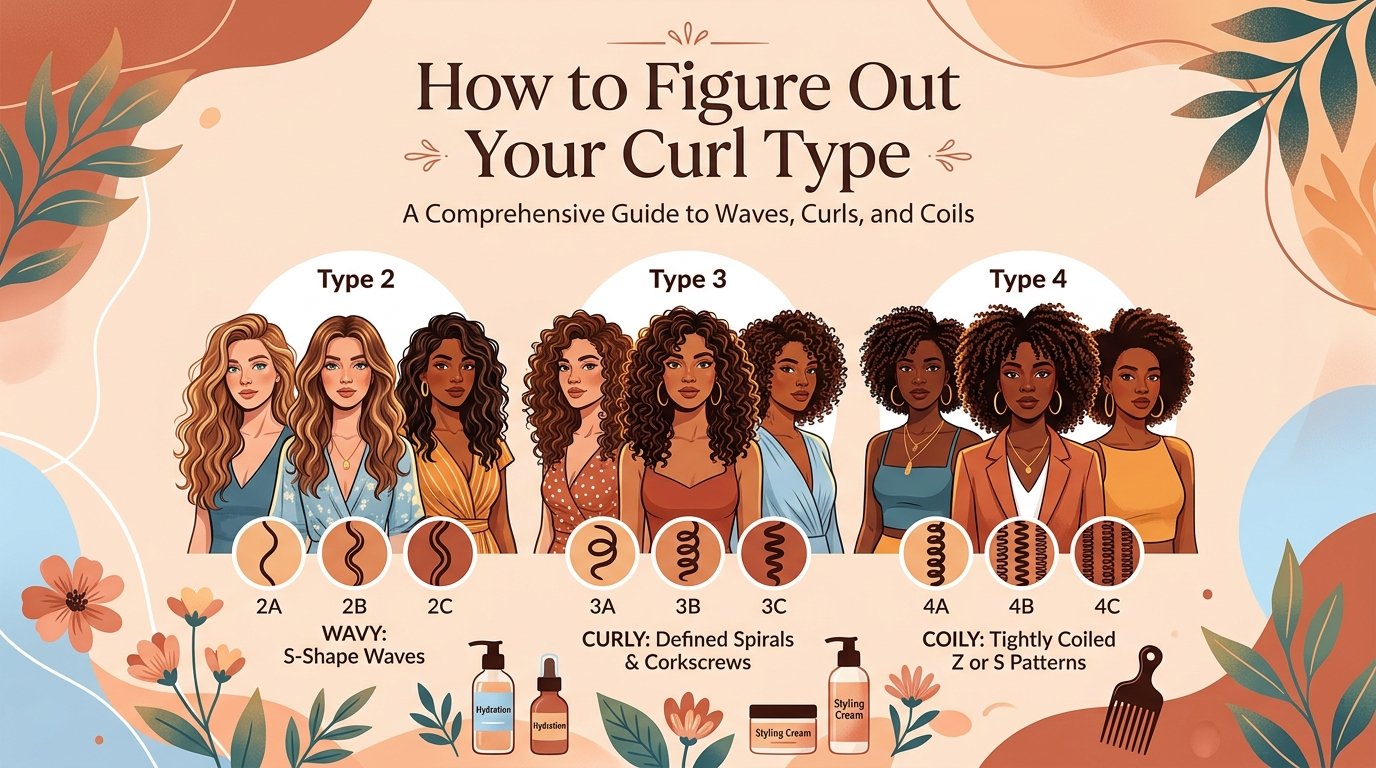
Before you can map your zones, you need to know what you are looking at. The Andre Walker hair typing system divides textured hair into three main categories (Type 2 wavy, Type 3 curly, Type 4 coily), each with three subcategories. Here is a quick reference for each.
Type 2: Wavy Hair
Type 2 hair forms an S-shape rather than a full spiral. It tends to be closer to the head and can range from barely-there bends to thick, defined waves.
Type 2A: Loose, gentle S-waves that are nearly straight at the root and bend subtly toward the ends. This type is easy to straighten and often responds well to lightweight mousse. Think of the wave you get from a loose braid, but natural.
Type 2B: Medium S-waves that are more defined starting closer to the root. The bends are clearly visible and the hair has more body and volume than 2A. It can frizz easily in humidity.
Type 2C: Thick, coarse S-waves that are deep and well-defined. This is the strongest wave pattern and can include some loose spiral curls mixed in. 2C hair has significant volume and often struggles with frizz at the crown.
Type 3: Curly Hair
Type 3 hair forms actual spirals and ringlets. The curl is visible from the root or near it, and the hair has a noticeable spring factor when stretched and released.
Type 3A: Large, loose curls about the circumference of a piece of sidewalk chalk. The spirals are well-defined, springy, and shiny when healthy. 3A curls are easy to straighten but bounce back with moisture.
Type 3B: Medium curls about the circumference of a marker or Sharpie. The ringlets are tighter and more springy than 3A, with more volume and texture. 3B hair tends to be drier because natural oils have a harder time traveling down the spiral.
Type 3C: Tight corkscrew curls about the circumference of a pencil or straw. These curls are dense, springy, and full of volume. 3C hair has significant shrinkage and needs consistent moisture to stay defined.
Type 4: Coily Hair
Type 4 hair forms tight coils, zig-zags, or Z-shaped patterns. It has the most shrinkage of all types and requires the most moisture and gentle handling.
Type 4A: Tight coils about the circumference of a crochet needle. The S-shaped coils are defined and springy with visible curl pattern when stretched or wet.
Type 4B: Z-shaped coils with less defined curl pattern. The hair bends at sharp angles rather than forming smooth spirals. 4B hair has significant shrinkage and a cotton-like texture.
Type 4C: Tight Z-pattern coils with little to no visible curl definition. The hair is densely packed and shrinks up to 75 percent of its stretched length. 4C hair is delicate and requires protective styling and deep moisture.
How to Figure Out Your Curl Type: Step-by-Step Method
The most reliable way to identify your curl type is to observe your hair in its natural state, without product, heat, or manipulation. Here is the method we recommend.
Step 1: Clarify Your Hair
Start with a clean slate. Wash your hair with a clarifying shampoo to remove all product buildup, oils, and residue. This ensures you are seeing your true natural pattern, not a pattern shaped by yesterday’s leave-in conditioner or styling cream. If your hair is very dry, you can skip the clarifier and use a gentle sulfate-free shampoo instead.
Step 2: Condition and Detangle Gently
Apply conditioner and detangle with your fingers or a wide-tooth comb. This separates your natural curl clumps so they can form properly. Rinse out most of the conditioner, leaving just a small amount for slip. Do not apply any styling product yet.
Step 3: Air Dry Without Manipulation
Let your hair air dry completely without touching it, scrunching it, or applying product. You can also use the plopping method: lay a cotton T-shirt flat, flip your head forward, and lower your wet hair onto the fabric, then wrap it gently. Plopping helps curls form without frizz. Leave it for 15 to 20 minutes, then remove and let your hair finish air drying.
Step 4: Photograph Each Zone Separately
This is where most people go wrong. They look at their whole head and feel overwhelmed. Instead, photograph each zone individually: the crown, the nape, the left side, the right side, and the front hairline. Take close-up photos of clean, dry hair sections. These photos will become your zone map.
Step 5: Compare Each Zone to the Reference Chart
Now compare each zone photo to the curl type chart above. Write down what you see in each area. You might discover your crown is 3B, your sides are 2C, my nape is 2A, and your front hairline has a few 3A ringlets mixed in. This is your personal curl map, and it is the foundation for building a routine that works for your whole head.
Zone Mapping: Why Your Crown, Nape, and Sides All Behave Differently
Zone mapping is the process of identifying what curl pattern lives in each area of your scalp. If you feel like you have three different curl types on one head, this section will explain why.
The Crown Zone
The crown is often the curliest zone on the head. This area has the highest density of hair follicles, and the hair grows in a circular or spiral pattern radiating outward from a central point. The combination of dense follicle packing and the radial growth direction encourages tighter curl formation. If your crown forms defined 3B ringlets while everything else looks looser, you are experiencing the most common mixed-pattern scenario.
The crown is also the most exposed part of your head, which means it absorbs the most sunlight, humidity, and friction. This can make it frizzier and more unpredictable than other zones. Many people find their crown needs heavier products and more moisture than the rest of their hair.
The Nape Zone
The nape of the neck is frequently the loosest or straightest zone. The hair here tends to be finer, the follicles are often rounder, and the area experiences constant friction from collars, scarves, and sleeping surfaces. If your nape looks almost straight or only has gentle waves while your crown has full ringlets, that is entirely normal.
Nape hair also tends to be more fragile and prone to breakage because of the constant friction. If you wear tight styles, the nape is often where thinning and damage show up first. Treat this zone gently and use lighter products to avoid weighing down the finer texture.
The Sides and Temples
The sides of your head often fall somewhere between the crown and the nape in terms of curl pattern. Many people find their sides are wavy (2B or 2C) even when their crown is clearly curly (3A or 3B). The temple area, in particular, can be finer and more prone to frizz.
The sides also experience asymmetric wear. If you sleep on one side more than the other, that side may look looser and flatter because of nighttime friction. This is why your hair can look different on the left versus the right even when the underlying follicle pattern is the same.
The Front Hairline
The front hairline is often its own ecosystem. The baby hairs and edges here can be coily even when the rest of your head is wavy, or they can be nearly straight when your crown is curly. The front hairline also produces the face-framing pieces that often have a mind of their own. Do not be surprised if this zone does not match anything else on your head.
Why Zones Happen: Friction, Follicles, and Habits
The three main reasons for zone differences are follicle shape variation, friction patterns, and styling habits. Follicle shape is genetic and fixed. Friction from sleeping, collars, and ponytails physically loosens curl patterns over time. And styling habits like always pulling your hair back in the same spot can permanently alter the curl pattern in that area. Understanding which factors are at play helps you adjust your routine accordingly.
Borderline Battles: How to Tell 2C from 3A, and 3A from 3B
The most common source of curl type confusion is the borderline between categories. The line between a strong wave and a loose curl can be blurry, and people spend months going back and forth trying to decide. Here is how to tell the difference.
2C vs 3A: The Wave-to-Curl Boundary
The key test is the spring factor. Take a clean, dry strand and stretch it gently, then release. If it springs back immediately and forms a spiral, you are in Type 3 territory. If it forms an S-shape but does not spring back into a coil, you are looking at 2C.
Another test: look at the shape. 2C waves are S-shaped, meaning they curve in one direction, then the other. 3A curls form actual loops or spirals, even if they are large and loose. If your hair forms round, loop-like shapes, it is 3A. If it forms flattened S-bends, it is 2C.
The circumference comparison helps too. A 2C wave does not wrap around any object neatly because it is not a full loop. A 3A curl is roughly the circumference of sidewalk chalk. If you can trace your hair pattern into a circle that size, it is 3A.
3A vs 3B: Diameter and Spring
The difference between 3A and 3B comes down to curl diameter and tightness. 3A curls are large and loose, about the size of sidewalk chalk. 3B curls are noticeably tighter, about the size of a Sharpie marker. If your ringlets are bouncy and loose with lots of shine, that is 3A. If they are springy, tighter, and have more volume with a slightly drier feel, that is 3B.
The shrinkage test also helps. Stretch a dry curl down to its full length and release. 3A curls have less shrinkage, maybe 20 to 30 percent. 3B curls shrink more, around 30 to 40 percent. The more your hair bounces up when released, the tighter the curl pattern.
2A vs 2B vs 2C: The Wavy Spectrum
Within the wavy category, the differences come down to how deep the S-bend is and where the wave starts. 2A waves are subtle and mostly visible toward the ends. 2B waves are defined from the mid-shaft down. 2C waves are deep, thick, and start close to the root, with some loose spiral curls mixed in. If your hair has mostly S-bends with an occasional loose spiral, you are 2C. If the bends are gentle and the hair stays close to the head, you are 2A or 2B.
Remember that borderline types are the most common scenario for people with mixed patterns. If you cannot decide between two types, you probably sit right on the border, and that is fine. Your routine should account for both patterns.
Building One Routine for Conflicting Curl Patterns
Having three different curl patterns does not mean you need three different routines. It means you need one smart routine with zone-specific adjustments. Here is how to build one.
Find Your Dominant Type
Your dominant type is the pattern that covers the largest area of your head. If 60 percent of your hair is 2C and the rest is split between 3A at the crown and 2A at the nape, your dominant type is 2C. Build your base routine around 2C needs: medium-hold products, frizz control, and moisture without heaviness.
Apply Products Strategically by Zone
This is the single most important technique for managing mixed patterns. Apply heavier, richer products to the curliest zones first (usually the crown), then use whatever is left on your hands for the wavier or looser zones. This gives your tightest curls the moisture and definition they need without weighing down your looser areas.
For the nape, where hair is finer and looser, use almost no product. A tiny amount of lightweight mousse or a leave-in spray is usually enough. Over-producting the nape is the number one reason it falls flat and looks greasy.
Use Styling Techniques That Unify Patterns
Several techniques help blend different curl patterns into a more cohesive look. Finger coiling involves taking individual curl clumps and wrapping them around your finger to encourage a uniform spiral shape. This works especially well for taming frizz at the crown and encouraging looser sections to curl more.
Diffusing with a low-heat, low-speed setting can also help unify patterns. Cup sections of hair in the diffuser bowl and hold them close to the scalp to encourage curl formation, then move to the next section. Diffusing adds definition and bounce to looser zones while helping tighter zones dry without frizz.
Plopping, which we covered in the identification method, also helps set a uniform pattern. By letting your hair dry slightly in a scrunched, lifted position, you encourage curl formation across all zones before gravity and friction start pulling them apart.
The Product Cocktail Strategy
For mixed patterns, a single product is rarely enough. A basic cocktail might include a leave-in conditioner for moisture, a curl cream for definition, and a light gel for hold. Apply the leave-in everywhere, use the curl cream primarily on your curliest zones, and use the gel to seal everything in. Adjust the ratio of cream to gel based on what each zone needs.
If your hair changes dramatically between zones, you may benefit from two styling products: a richer cream for the crown and a lighter mousse for the nape and sides. This is not overcomplicating things. It is giving each zone what it actually needs.
Beyond Curl Type: Porosity, Density, and Texture Matter Too
Curl type gets all the attention, but three other characteristics have a bigger impact on which products work for you. If you have been frustrated that products recommended for your curl type do not work, these factors are likely why.
Porosity
Porosity is your hair’s ability to absorb and retain moisture. Low porosity hair has a tightly sealed cuticle that resists water and product, needing heat or humectants to absorb moisture. High porosity hair has gaps and holes in the cuticle (often from damage or chemical processing) that absorb moisture quickly but lose it just as fast. Medium porosity sits in between and is the easiest to manage.
Test your porosity by placing a clean strand of shed hair in a glass of water. If it floats, you have low porosity. If it sinks slowly, you have medium porosity. If it sinks immediately, you have high porosity. Your porosity determines whether you need lightweight liquid-based products (low porosity) or rich creams and butters (high porosity).
Density
Density refers to how many individual hair strands you have per square inch of scalp. You can have thick curls with low density, or fine curls with high density. To check yours, hold a section of your hair and look at your scalp. If you can see your scalp easily, you have low to medium density. If your hair completely blocks the view of your scalp, you have high density.
Density affects how much product you need and how heavy a product you can use without weighing your hair down. Low-density hair needs lightweight volumizing products. High-density hair can handle richer, heavier formulations.
Texture (Strand Diameter)
Texture refers to the thickness of each individual hair strand, not how many you have. Fine strands are barely visible between your fingers. Medium strands feel like a piece of thread. Coarse strands feel substantial, almost like sewing thread or fishing line.
Fine hair gets weighed down easily and needs lightweight products and gentle hold. Coarse hair is strong and can handle heavier products, stronger hold, and more manipulation. If your curl type says gel but your fine texture says it will fall flat, trust your texture.
FAQs
How do I identify my curl type?
Wash your hair with a clarifying shampoo, condition and detangle, then let it air dry without any product. Once fully dry, photograph each zone of your head separately (crown, sides, nape, front) and compare the patterns to a curl type chart. Most people find they have at least two different patterns across different zones.
How do I tell if my hair is 2C or 3A?
The key difference is the spring factor and curl shape. 2C hair forms deep S-shaped waves that do not spring back into a spiral when stretched and released. 3A hair forms actual loop-shaped curls about the circumference of sidewalk chalk that spring back when stretched. If your pattern is a flat S-bend, it is 2C. If it forms a round loop, it is 3A.
Is it normal to have different curl patterns on one head?
Yes, having different curl patterns on one head is completely normal and extremely common. Your scalp contains hair follicles of varying shapes, and each shape produces a different curl pattern. Most people with textured hair have at least two patterns, and many have three or more across different zones.
Can you have a mix of wavy and curly hair?
Yes, having a mix of wavy and curly hair is very common. Many people have curly hair at the crown and wavy hair at the nape or sides. This happens because hair follicle shapes vary across different areas of the scalp, producing different curl patterns in each zone.
What is the rarest curl type?
Type 1 (perfectly straight hair) is the rarest natural hair type globally. Among textured hair types, Type 4C tight coils and Type 3C corkscrew curls are less common than 2A waves or 3A loose curls. However, rarity depends heavily on genetics and ethnic background.
Why is my hair curlier at the crown than the nape?
The crown typically has denser hair follicles and a radial growth pattern that encourages tighter curl formation. The nape has finer hair, rounder follicles, and experiences constant friction from collars and sleeping surfaces, which loosens the curl pattern. This crown-versus-nape difference is one of the most common mixed-pattern scenarios.
The Bottom Line on Mixed Curl Patterns
If there is one thing to take away from this guide, it is this: learning how to figure out your curl type when you seem to have three of them starts with accepting that multiple patterns are your normal. Map your zones, find your dominant type, and build a routine with strategic, zone-specific adjustments rather than trying to force your whole head into one category. Your crown, nape, sides, and front hairline each have their own needs, and giving each zone what it actually wants is the fastest path to a good hair day. Grab your phone, take those zone photos, and start building your personal curl map today.