
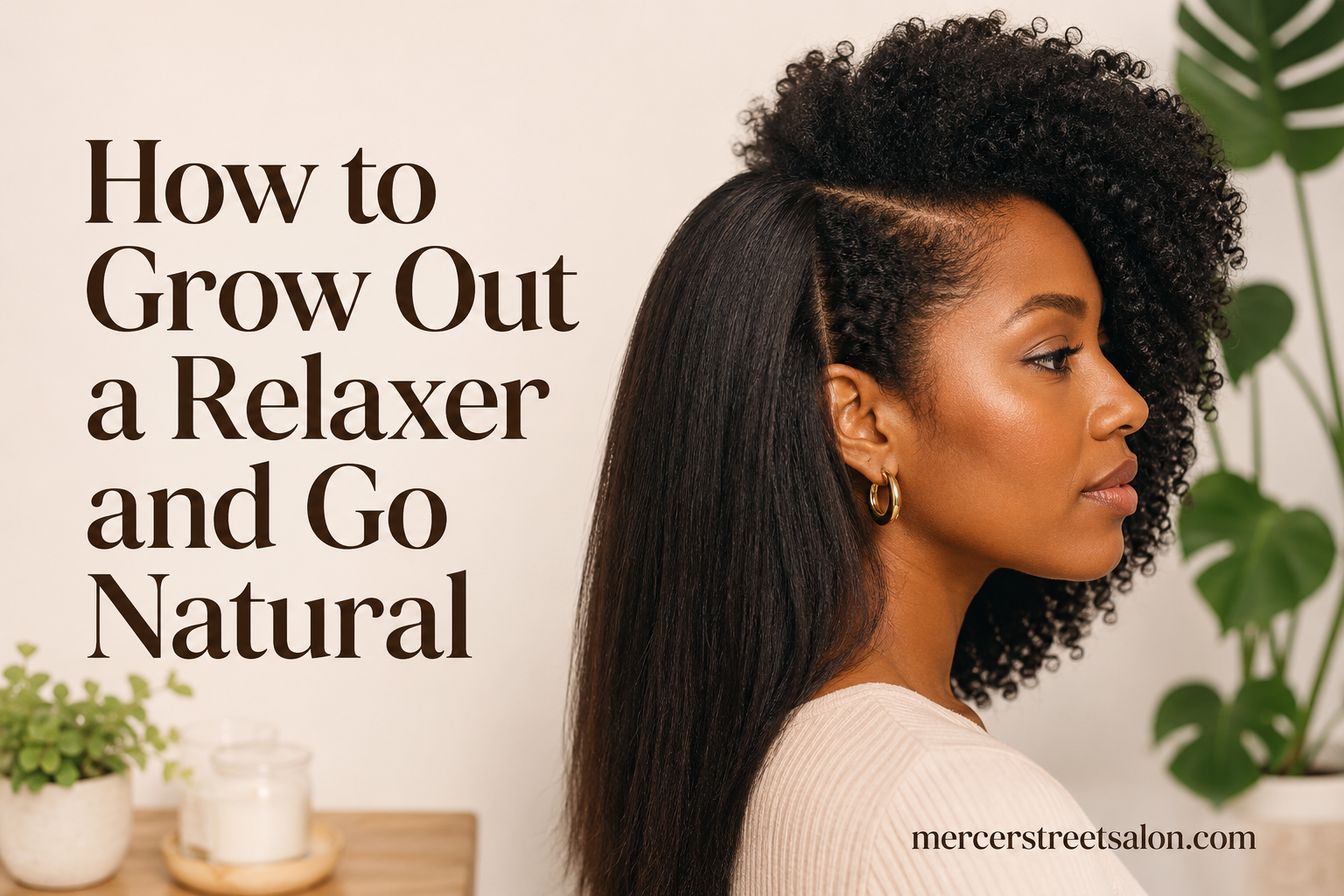
Learning how to grow out a relaxer and go natural without the two textures snapping is one of the most common challenges people face on their natural hair journey. When you stop relaxing your hair, new growth begins growing in with your natural curl pattern while the previously relaxed ends remain straight. This creates a fragile meeting point called the line of demarcation, and that is where most breakage happens.
The good news is that breakage is not inevitable. With the right combination of moisture, gentle handling, protective styling, and a consistent trim schedule, you can transition from relaxed to natural hair while keeping your length intact. This guide walks through every step of the process, from understanding why breakage occurs to building a routine that works for two-texture hair.
I have spent years working with clients at our salon who are navigating this exact transition. The most important thing I tell everyone is that patience and consistency matter more than any single product. Let us break down exactly how to do this right.
Table of Contents
Why Your Hair Breaks at the Line of Demarcation
The line of demarcation is the point where your new natural growth meets your previously relaxed hair. This junction is the weakest part of your strand during the entire transitioning journey. Understanding why it breaks is the first step in preventing it.
Relaxers work by breaking the disulfide bonds inside your hair shaft. These bonds are what give hair its natural shape and structural strength. When a relaxer breaks them, the hair permanently changes from curly to straight, but it also becomes weaker and more porous than your natural growth.
Your new growth, on the other hand, has intact disulfide bonds and a full structural backbone. So now you have strong curly roots growing next to weakened straight ends. The spot where these two different textures meet takes all the stress every time you comb, style, wash, or manipulate your hair.
Think of it like taping two different materials together at a single point. Every time you bend that joint, stress concentrates right at the seam. That is exactly what happens at the line of demarcation, and that is why transitioning hair needs special care to survive.
Your Two Main Paths: Big Chop vs. Slow Transition
Before diving into technique, you need to understand the two routes for going natural. Neither is better than the other, and the right choice depends on your lifestyle, comfort level, and emotional readiness.
The Big Chop
The big chop means cutting off all your relaxed ends at once, leaving only your natural new growth. Some people do this after a few months of growth, while others do it immediately after their last relaxer. The advantage is that you eliminate the line of demarcation entirely, which means no two-texture problem to manage.
The trade-off is that you will have very short hair for a while. For some people this is liberating. For others, especially those who feel pressure to maintain a certain look at work or in social settings, it can feel overwhelming. One Reddit user in the r/Naturalhair community described the big chop as like coming out, a positive and life-changing affirmation. But it is a personal decision that nobody should rush into.
The Slow Transition
The slow transition means you stop getting relaxers but keep your existing length, gradually trimming away relaxed ends over several months or years. This lets you keep more length throughout the process. The challenge is that you must manage two textures for the entire duration.
Many people in hair forums describe this route as emotionally taxing. One person shared that growing out a relaxer is not for the weak, and that their relaxed ends kept breaking no matter what they did. The key to making the slow transition work is having a solid routine and being willing to trim regularly, even when you want to hold onto length.
Some people even do a hybrid approach. They transition for several months, build confidence with their natural texture, and then do a big chop once they have enough new growth to feel comfortable. There is no wrong answer here as long as you choose what feels right for you.
Month-by-Month Timeline: What to Expect
Having realistic expectations about your transitioning timeline keeps you motivated and prevents frustration. Hair grows an average of half an inch per month, which means visible progress takes time. Here is what you can expect as you grow out your relaxer.
Months 1 to 3
In the first three months, your new growth is minimal. You might notice slight texture differences at your roots, but styling is still fairly straightforward. This is the time to build your moisturizing and deep conditioning routine. Focus on establishing habits now, because the real challenge starts when more new growth comes in.
Months 4 to 6
By month four to six, you will have two to three inches of new growth. This is when the two-texture period really begins. You will start noticing the line of demarcation more clearly, and some styles that used to work may no longer hold. This is also when breakage risk increases significantly.
This is the phase where protective styles become essential. Braid-outs, twist-outs, and roller sets become your best friends for blending the two textures. Many transitioners find months four through six the most frustrating, so remind yourself that this phase is temporary.
Months 7 to 9
By months seven through nine, your natural growth is becoming the dominant texture. You may have four to five inches of natural hair at your roots. The contrast between textures is now very pronounced, and your relaxed ends are carrying more weight and stress than ever.
This is an ideal time to increase your trim frequency. Many stylists recommend trimming a half inch every six to eight weeks during this phase. You are gradually removing relaxed hair while retaining as much natural length as possible.
Months 10 to 12 and Beyond
By the one-year mark, you have approximately six inches of natural growth. Many people choose this point to do a final chop and remove all remaining relaxed ends. Others continue transitioning for another six to twelve months if they started with longer hair. Either way, the hardest part is behind you.
Remember that your transition may take more or less time depending on your starting length, growth rate, and how aggressively you trim. Some people complete their transition in eight months. Others take two years. Both timelines are completely normal.
How to Grow Out a Relaxer Without Breakage: Step-by-Step
If you want to learn how to grow out a relaxer without the two textures snapping, this step-by-step routine covers everything you need. Follow these steps consistently and your hair will thank you.
Step 1: Deep Condition Every Week
Deep conditioning is the single most important thing you can do during your transition. Your relaxed ends are porous and hungry for moisture, and your natural roots need hydration to stay elastic and strong. A weekly deep conditioning session with heat for twenty to thirty minutes gives both textures what they need.
Look for deep conditioners with moisturizing ingredients like shea butter, glycerin, and aloe vera. Alternate between moisture-focused and protein-focused treatments every other week to keep your hair balanced. One forum user put it perfectly when they said deep conditioning is the key to dealing with coarse and unmanageable new growth.
Step 2: Moisturize Daily or Every Other Day
Two-texture hair loses moisture faster than fully natural or fully relaxed hair. The relaxed ends cannot hold onto moisture well because their cuticle layer has been altered. Apply a water-based leave-in conditioner followed by a sealant oil or cream every one to two days.
Focus extra product on your ends, since they are the oldest, driest, and most fragile part of your hair. Pay special attention to the line of demarcation, where dryness leads directly to snapping.
Step 3: Detangle Gently and Only When Wet
Never detangle two-texture hair when it is dry. Dry detangling is the number one cause of breakage at the demarcation line. Always saturate your hair with conditioner and water first, then work through tangles slowly with your fingers or a wide-tooth comb.
Start from the ends and work your way up to the roots. This prevents knots from tightening as you pull through. Take your time, because rushing this step will cost you length.
Step 4: Follow a Consistent Trim Schedule
Trimming is what eventually removes all your relaxed hair. Without a trim schedule, you will hold onto damaged ends that continue to split and break higher up the strand. Most stylists recommend trimming a quarter to half inch every six to eight weeks during transition.
If your relaxed ends are severely damaged, you may need to trim more aggressively. It feels counterintuitive to cut hair you are trying to grow, but damaged ends will break off anyway. Trimming on your terms is always better than losing hair to breakage.
Step 5: Use Protective Styles Between Wash Days
Protective styling reduces daily manipulation, which directly reduces breakage. Styles like braids, twists, buns, and updos tuck away fragile ends and keep the line of demarcation from being stressed. Aim to keep your hair in a protective style at least three to four days per week.
Step 6: Avoid Direct Heat
Blow dryers, flat irons, and hot combs put concentrated stress on the line of demarcation. The relaxed portion of your hair is already weakened, and adding heat makes it even more brittle. If you must use heat, always apply a heat protectant first and keep temperatures below 350 degrees Fahrenheit.
Better yet, explore heat-free styling options like flexi rods, roller sets, and air-dried twist-outs. These styles give you polished results without compromising your transition.
Protective Styles That Blend Two Textures
Protective styling is your secret weapon during the two-texture period. The right styles can camouflage the contrast between your natural roots and relaxed ends while keeping fragile hair tucked safely away.
Braid-Outs and Twist-Outs
Braid-outs and twist-outs are arguably the most popular protective styles for transitioners. You braid or twist damp, product-loaded hair, let it dry completely, then unravel for a defined curly look. The resulting texture helps bridge the gap between your curly roots and straight ends.
For best results, use a styling cream or gel with hold. Smaller braids or twists give you tighter, more uniform curls that do a better job of hiding the texture difference.
Bantu Knots
Bantu knots are a fantastic option for blending textures. You twist small sections of hair into tight coils secured against your scalp, then unravel them once dry for beautiful spiral curls. One Reddit transitioner shared that they did bantu knots in their relaxed hair successfully for the first time and realized natural hair is actually not that hard to care for.
Flexi Rod and Roller Sets
Roller sets and flexi rods create uniform curls from root to tip, which visually unifies your two textures. This is one of the few styles that makes relaxed and natural hair look like they belong together. Set your hair on rollers while damp, sit under a hooded dryer or air dry overnight, and remove for a smooth, curly finish.
Wigs, Weaves, and Braided Extensions
If you want a break from daily styling, wigs, sew-ins, and box braids give you a polished look while completely protecting your natural hair. These styles let you go weeks without manipulating your hair at all. Just make sure your natural hair is well moisturized before installation and that extensions are not installed too tightly.
Low Buns and Tucked Styles
Sometimes the simplest option works best. A low bun or tucked updo hides your ends entirely, which means zero stress on the line of demarcation. Pair with a headband or scarf to smooth your edges and you have an effortless, professional look that works anywhere.
Detangling Two-Texture Hair Without Snapping
Detangling is where most breakage happens during a relaxer transition. The key is to be methodical, patient, and gentle. Rushing through this step will undo weeks of progress.
Start with Saturated, Conditioner-Loaded Hair
Apply a generous amount of conditioner to soaking wet hair. The conditioner provides slip, which means your comb or fingers glide through tangles instead of ripping through them. If you feel any resistance, add more water and conditioner before continuing.
Use Your Fingers First
Finger detangling is gentler than any tool. Work through large knots with your fingers before reaching for a comb. You will feel where the line of demarcation is because that is where the hair feels most fragile and where tangles tend to cluster.
Switch to a Wide-Tooth Comb
Once major tangles are out, use a wide-tooth comb to refine. Start at the very ends of your hair and work upward in small sections. Never comb from roots to ends in one stroke, because that pushes tangles down into the demarcation zone and causes snapping.
Work in Small Sections
Divide your hair into six to eight sections and detangle one at a time. Clip each finished section out of the way. This keeps you organized and prevents already-detangled hair from tangling again.
Products and Ingredients That Help During Transition
You do not need a massive product collection to transition successfully. Focus on a few categories that directly address the needs of two-texture hair.
Water-based leave-in conditioners provide daily moisture without weighing hair down. Look for ingredients like glycerin, aloe vera, and panthenol. A good leave-in bridges the gap between your wash-day deep conditioning sessions.
Bond-building treatments help strengthen the compromised relaxed ends by temporarily reconnecting broken bonds. These are especially valuable in the first few months when your relaxed hair still makes up the majority of your length.
Protein treatments, used once every two to four weeks, reinforce the structural integrity of your strands. Alternate between light protein and strong protein depending on how much damage you are dealing with. If your hair feels stiff or brittle after a protein treatment, back off and focus on moisture instead.
Sealing oils like jojoba, sweet almond, or argan oil lock in the moisture you have applied. Use them sparingly on your ends, where dryness and breakage are worst.
Warning Signs You Need a Trim Now
Sometimes you cannot wait for your scheduled trim. Watch for these signs that your relaxed ends need to go sooner rather than later.
If you see visible splits traveling up the hair shaft, it is time to trim. If your ends feel rough and crispy no matter how much you moisturize, they are beyond saving. If you notice excessive shedding of short broken pieces in your comb or on the floor after styling, your breakage has reached a level that trimming will actually help you retain more length.
Trust your instincts. If your hair feels thinner at the ends than it did a month ago, schedule a trim. Holding onto damaged hair always costs you more length in the long run.
FAQs
How to grow out a relaxer without breakage?
To grow out a relaxer without breakage, deep condition weekly, moisturize every one to two days with a water-based leave-in, detangle only when hair is saturated with conditioner, avoid direct heat, and trim relaxed ends every six to eight weeks. Protective styles like braid-outs, twist-outs, and roller sets reduce daily manipulation and protect the fragile line of demarcation.
How to stop breakage from relaxer?
Stop relaxer breakage by keeping both textures deeply moisturized, using protein treatments every two to four weeks, applying a sealant oil to your ends, and handling hair gently. Never detangle dry hair, always use a wide-tooth comb on wet conditioned hair, and sleep on a satin or silk pillowcase to reduce friction overnight.
How to transition from a relaxer to natural?
You can transition from a relaxer to natural hair by either doing a big chop to remove all relaxed ends at once, or slowly transitioning by growing out your natural texture while gradually trimming relaxed ends. The slow route requires weekly deep conditioning, daily moisturizing, gentle detangling, protective styling, and consistent trims to manage the two-texture period successfully.
How long does it take to grow out a relaxer naturally?
Growing out a relaxer takes anywhere from eight months to two years depending on your starting length, growth rate, and trim schedule. Hair grows about half an inch per month, so expect roughly six inches of natural growth after one year. Most people complete their full transition within twelve to eighteen months.
What is the best way to transition from relaxed hair to natural hair?
The best way to transition is the method that fits your lifestyle and comfort level. The big chop is fastest and eliminates two-texture breakage entirely, while slow transitioning preserves length but requires more maintenance. Both paths succeed with consistent deep conditioning, gentle detangling, protective styling, and regular trimming of relaxed ends.
Can relaxed hair go back to natural?
Relaxed hair cannot revert to its natural texture because the chemical process permanently breaks disulfide bonds in the hair shaft. However, your new growth will come in with your natural curl pattern. You grow out the relaxer by allowing natural hair to grow in while gradually trimming away the permanently relaxed ends.
Final Thoughts on Going Natural
Figuring out how to grow out a relaxer and go natural without the two textures snapping takes patience, consistency, and the right routine. The process revolves around protecting the line of demarcation through weekly deep conditioning, daily moisturizing, gentle detangling, regular trims, and protective styling.
The journey is emotional for many people. Some days your hair will cooperate and other days it will not. What matters is that you keep showing up for your hair with the same care and attention each week. The breakage you prevent today becomes the length you celebrate six months from now.
Whether you choose the big chop or a slow transition, you are moving toward your natural texture on your own terms. Stay consistent, trust the process, and remember that every transitioner before you has made it through the same two-texture phase you are navigating right now.