
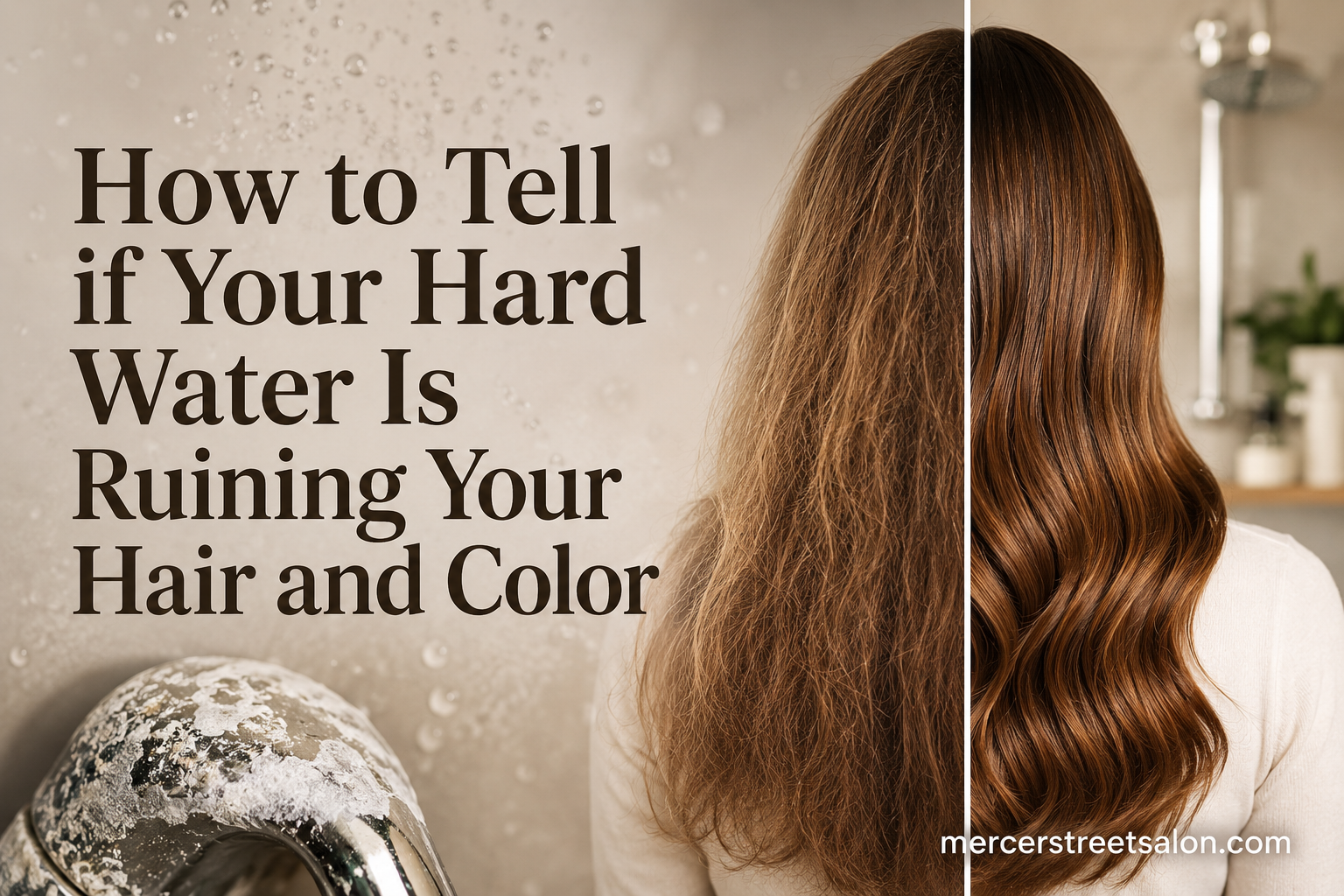
You shampoo, condition, and buy the same quality products your stylist swears by, yet your hair still feels wrong. It looks dull, breaks when you brush it, and that salon color you paid good money for is fading before your next appointment. If this sounds familiar, the culprit might not be your products. It could be the water coming out of your shower head.
In this guide, we will walk you through exactly how to tell if your hard water is ruining your hair and color. You will learn the seven clearest warning signs, the science behind mineral buildup on hair, how different hair types react, and practical steps to test and treat the problem at home.
At our salon, we see hard water damage almost every week. Clients walk in frustrated, convinced their hair has changed overnight. The truth is that hard water damage builds slowly, strand by strand, wash by wash. Catching it early can save your hair and your color investment.
Table of Contents
What Is Hard Water and Why Does It Matter for Your Hair
Hard water is simply water that contains high concentrations of dissolved minerals, primarily calcium and magnesium ions. These minerals dissolve into groundwater as it passes through limestone, chalk, and other mineral-rich rock deposits underground. The more minerals the water picks up, the harder it becomes.
According to the United States Geological Survey, approximately 85 percent of American homes receive hard water. If you live in states like Texas, Florida, Arizona, Nevada, or throughout the Midwest, your water hardness likely falls into the moderate to very hard range. Even if your city treats the water supply, treatment plants rarely remove calcium and magnesium because those minerals are not harmful to drink.
The problem is that what is harmless to your body can be brutal to your hair. Every time you wash, those calcium and magnesium ions cling to your hair shaft. They form a microscopic mineral film that blocks moisture, prevents your conditioner from working, and slowly degrades both your natural hair and any color treatment sitting on it.
Water hardness is measured in grains per gallon (gpg). Anything above 7 gpg is considered hard, and levels above 10 gpg are classified as very hard. You can check your local water hardness report through your municipal water utility or use a home test kit.
How to Tell if Your Hard Water Is Ruining Your Hair and Color: 7 Clear Signs
Wondering how to tell if your hard water is ruining your hair and color? These seven signs are the most common and reliable indicators we look for in the salon chair. If you notice three or more of these symptoms, hard water is almost certainly part of the problem.
1. Your Hair Feels Dry and Brittle No Matter How Much You Condition
Hard water minerals coat each strand with a film that blocks moisture from entering the hair shaft. Your conditioner sits on top of that film instead of penetrating the cuticle. The result is hair that feels parched, stiff, and straw-like even immediately after washing and conditioning.
Clients often describe this feeling as though their hair has been “fried” or “crispy.” If your deep conditioning masks are no longer working and you cannot figure out why, mineral buildup is a likely suspect.
2. You See Persistent Brassiness or Unwanted Color Tones
Blonde, silver, and lightened hair is especially vulnerable to hard water. The minerals in hard water, particularly iron and copper trace metals, deposit onto lightened hair and oxidize. This oxidation process produces those dreaded orange, yellow, and brassy tones that seem to appear within weeks of a fresh color service.
As stylists, we frequently see clients return with brassiness far sooner than expected. When we ask about their home water situation, the connection is almost always clear. Hard water is one of the top reasons cool-toned color does not last.
3. Your Hair Color Fades Faster Than It Should
Hard water does not just shift your color. It actively strips it. The mineral film that builds up on your hair raises the cuticle layer, which loosens the grip color molecules have on the hair shaft. Each wash rinses more color down the drain.
If your color used to last eight weeks and now barely survives four, hard water is a prime suspect. This accelerated fading is one of the most frustrating signs for clients who invest in professional color services.
4. Your Hair Feels Coated, Heavy, or Waxy
Hard water prevents shampoo from lathering properly. The minerals react with soap to form a sticky residue called soap scum, which clings to your hair and scalp. This residue makes hair feel weighed down, coated, or even greasy right after washing.
Many clients tell us their hair “never feels truly clean.” They wash it repeatedly, switch shampoos, and still feel that heavy coating. The cause is not the shampoo. It is the mineral and soap scum combination that no regular shampoo can fully remove.
5. You Notice Increased Breakage, Split Ends, and Tangling
As the mineral film builds and the cuticle layer lifts, your hair becomes more porous and fragile. Strands catch on each other, tangle easily, and snap under tension that healthy hair would handle without issue. You may notice more hair in your brush, in the shower drain, or on the bathroom floor.
Split ends multiply rapidly under these conditions. The breakage tends to be worst in the mid-lengths and ends of the hair, where the oldest mineral accumulation sits.
6. Your Hair Looks Frizzy, Dull, and Limp
Healthy hair reflects light because the cuticle layer lies flat and smooth. Hard water lifts and roughens that cuticle, scattering light instead of reflecting it. The result is hair that looks cloudy, dull, and lifeless no matter how you style it.
Frizz often accompanies this dullness because the lifted cuticle allows moisture from the air to penetrate unevenly, causing strands to swell and frizz unpredictably.
7. Your Scalp Is Dry, Itchy, or Irritated
Hard water does not just affect the hair shaft. The same mineral buildup accumulates on your scalp, clogging follicles and irritating the skin. Many people develop flaky scalp conditions, itchiness, or a tight, dry sensation that no amount of scalp serum seems to fix.
In more severe cases, this buildup can contribute to folliculitis, an inflammation of the hair follicles. If your scalp has been bothering you and nothing provides lasting relief, hard water is worth investigating.
How Hard Water Damages Hair: The Science Explained
To understand how to tell if your hard water is ruining your hair and color, it helps to understand what is actually happening at the microscopic level. Each hair strand has an outer layer called the cuticle, which functions like shingles on a roof. When those shingles lie flat, hair looks smooth, shiny, and holds color well.
Calcium and magnesium ions carry a positive electrical charge. Hair protein carries a negative charge. Opposites attract, which means those mineral ions bind tightly to your hair every single time you wash. Over weeks and months, they create a stubborn mineral film that wraps around each strand.
This mineral film does three things. First, it physically lifts the cuticle layer, leaving hair rough and porous. Second, it blocks water-soluble conditioning ingredients from penetrating the shaft, so your products cannot do their job. Third, it increases hair porosity, which means color molecules slip out more easily and humidity gets in more readily.
The damage is cumulative. Each wash adds another thin layer of mineral deposit. After months or years of washing with hard water, the buildup becomes so dense that hair loses its natural elasticity, shine, and color retention. This is why people often notice a sudden decline after moving to a new home with harder water, even though the change builds gradually.
Hard Water Effects on Color-Treated Hair
Color-treated hair is the most vulnerable hair type when it comes to hard water. The chemical processing required to lift or deposit color already raises the cuticle and increases porosity. Add mineral buildup on top of that, and you have hair that is essentially an open sponge for both stains and color loss.
Hard water causes color to fade faster through a two-step process. First, the mineral film raises the cuticle even further, loosening the bond between color molecules and the hair cortex. Second, each wash rinses those loosened molecules away. The combination means your color literally washes down the drain with every shower.
Brunettes are not immune. Hard water can cause brown and red tones to oxidize, creating muddy, flat, or orange-shifted color. Reds fade fastest of all because red color molecules are the largest and least stable, making them the easiest to dislodge.
If your color looks great leaving the salon but dulls dramatically within two to three weeks, hard water is one of the first things to investigate. At our salon, we always ask new clients about their home water situation when diagnosing premature color fade.
How Different Hair Types React to Hard Water
Not all hair responds to hard water the same way. Your hair type, texture, and porosity level all influence how quickly and severely you will notice damage.
Curly and Coily Hair
Curly and coily hair is naturally drier because scalp oils have a harder time traveling down the spiral hair shaft. When hard water adds mineral buildup on top of that existing dryness, curls lose definition, become frizzy, and tangle more easily. Many clients with textured hair report that their curl pattern seems to “disappear” after months of hard water exposure.
Fine and Straight Hair
Fine hair has a smaller diameter, which means the same mineral coating takes up a larger percentage of the strand. Fine hair tends to look limp, flat, and greasy very quickly under hard water conditions. The weight of the mineral film crushes volume and makes fine hair feel dirty almost immediately after washing.
Coarse and Thick Hair
Coarse hair has a thicker cuticle layer, which offers some natural protection. However, once minerals penetrate that thicker cuticle, removal becomes more difficult. Coarse hair tends to feel rough, wiry, and unmanageable rather than limp.
Color-Treated and Chemically Processed Hair
As we covered earlier, any chemical process that lifts the cuticle makes hair more vulnerable to mineral buildup. If you color, bleach, perm, or chemically relax your hair, hard water will accelerate damage and shorten the life of your treatment significantly.
How to Test if You Have Hard Water at Home
Before you commit to any treatment plan, confirm that hard water is actually your problem. Here are four ways to test your water hardness at home, ranging from free to affordable.
Method 1: The Soap Shake Test
Fill a clear plastic bottle halfway with your tap water. Add a few drops of pure liquid soap, ideally one without detergents or fragrances. Shake vigorously for about 15 seconds. If the water turns cloudy, milky, and produces very little foam, you likely have hard water. Soft water produces clear, bubbly suds quickly.
Method 2: Purchase a Home Water Hardness Test Kit
You can buy a water hardness test strip kit online or at a hardware store for under 15 dollars. Dip the strip into a glass of your tap water for a few seconds, then compare the color change to the included chart. This gives you a specific hardness reading in grains per gallon.
Method 3: The Glass Sight Test
Look at your shower head, glass shower door, and faucets. If you see white, chalky residue or scale buildup, that is calcium and magnesium depositing on surfaces. What you see on your fixtures is the same mineral film forming on your hair.
Method 4: Check Your Municipal Water Report
Most cities and water utilities publish annual water quality reports online. Search for your local water utility plus the words “water quality report” and look for the hardness measurement. Anything above 7 grains per gallon confirms hard water.
How to Remove Hard Water Buildup and Protect Your Hair
Once you confirm that hard water is affecting your hair, the good news is that you have several effective treatment options. The best approach usually combines a removal strategy with an ongoing prevention method.
Use a Chelating or Clarifying Treatment
Chelating shampoos and treatments contain ingredients specifically designed to bind to mineral ions and pull them off the hair shaft. This is different from a regular clarifying shampoo, which removes product buildup but does not target mineral deposits. Popular chelating options include Malibu C Hard Water Wellness packets and similar professional-grade treatments.
Use a chelating treatment once every one to two weeks depending on your water hardness. Overuse can dry out your hair, so follow each treatment with a deep conditioning mask.
Install a Shower Filter
A shower head filter sits between your water pipe and shower head, filtering out chlorine and some minerals before water reaches your hair. Shower filters vary in effectiveness. Look for filters that specifically list calcium and magnesium reduction, not just chlorine removal. Filters need replacement every three to six months to remain effective.
Keep in mind that shower filters reduce minerals but do not eliminate them entirely. They are a good first line of defense for moderate hardness.
Consider a Whole-Home Water Softener
For very hard water, a whole-home water softening system is the most complete solution. These systems use an ion exchange process to replace calcium and magnesium ions with sodium or potassium ions, delivering soft water throughout your home. They require professional installation and ongoing salt refills, but they protect your hair, skin, plumbing, and appliances simultaneously.
Try Natural Remedies as a Complement
Apple cider vinegar rinses are a popular DIY option. Mix one to two tablespoons of raw apple cider vinegar with a cup of water and pour it over your hair after shampooing. The mild acidity helps dissolve some mineral residue and smooths the cuticle. This is not a replacement for chelating treatments, but it can help between deeper treatments.
Ask Your Salon About Professional Treatments
Many salons offer professional chelating and demineralizing treatments that are stronger than at-home options. These treatments can strip months of mineral buildup in a single session, often using the same Malibu C technology. Schedule one before your next color service so you are coloring clean, mineral-free hair.
Some stylists also recommend a clear gloss or bonding treatment after chelating to reseal the cuticle that hard water has lifted. This combination can dramatically restore shine and manageability.
Is Hard Water Hair Damage Reversible?
The short answer is yes, in most cases, hard water damage is reversible. Once you remove the mineral buildup with chelating treatments and stop adding new deposits with a filter or softener, your hair will gradually recover its natural texture and shine.
However, there is a catch. If hard water has caused significant cuticle damage, breakage, or split ends, those physical breaks cannot be repaired. You can improve the look and feel of the remaining hair, but broken strands need to grow out. This is why catching hard water damage early matters so much.
Most clients see visible improvement within two to four weeks of starting a chelating treatment routine. Full recovery, including new growth replacing broken strands, takes three to six months depending on hair length and the severity of the original damage.
FAQs
How do I tell if my hair is affected by hard water?
Look for seven key signs: dry brittle hair that resists conditioner, persistent brassiness or unwanted tones, color fading faster than expected, hair that feels coated or waxy, increased breakage and split ends, frizz and dullness, and scalp irritation. If you notice three or more of these symptoms, hard water is likely a factor.
Can you reverse hair damage from hard water?
Yes, most hard water damage is reversible. Chelating treatments remove mineral buildup from the hair shaft, and installing a shower filter or water softener prevents new deposits. Visible improvement typically appears within two to four weeks, though severely broken strands will need to grow out over several months.
Can hard water cause folliculitis?
Yes, hard water can contribute to folliculitis. Mineral buildup on the scalp clogs hair follicles and irritates the skin, creating conditions where inflammation and infection can develop. If you have persistent scalp bumps, itchiness, or redness alongside other hard water signs, mineral buildup may be the underlying trigger.
How to protect colored hair from hard water?
Use a chelating treatment every one to two weeks to remove mineral deposits, install a shower filter that reduces calcium and magnesium, wash less frequently to minimize mineral exposure, and schedule a professional demineralizing treatment before each color service. A clear gloss treatment can also help reseal the cuticle that hard water lifts.
What does hard water buildup look like on hair?
Hard water buildup makes hair look dull, cloudy, and lifeless rather than shiny and reflective. It often feels coated, heavy, or waxy to the touch. You may notice a white or chalky residue similar to what appears on your shower fixtures. Lightened hair frequently develops orange, yellow, or brassy tones from oxidizing iron and copper deposits.
Does hard water ruin hair color?
Yes, hard water accelerates color fading and causes unwanted tone shifts. The mineral film lifts the cuticle layer, loosening color molecules so they wash out faster. Iron and copper trace metals also oxidize on lightened hair, creating brassy or orange tones. Color that should last eight weeks can fade in four under hard water conditions.
How long does it take to reverse hard water damage on hair?
Most people see visible improvement within two to four weeks of starting chelating treatments and using filtered water. Full recovery, including new growth replacing any broken strands, typically takes three to six months. Hair that has suffered severe cuticle damage or breakage will need to grow out, as those physical breaks cannot be repaired.
Conclusion
Hard water is one of the most overlooked causes of hair and color problems, yet it affects roughly 85 percent of homes across the country. Knowing how to tell if your hard water is ruining your hair and color comes down to watching for those seven clear signs: dryness, brassiness, fading, coating, breakage, dullness, and scalp irritation.
The damage is real, but it is also treatable. Start with a simple home water test, add a chelating treatment to your routine, and consider a shower filter or water softener for long-term protection. Your hair and your color investment will thank you.
If you are still unsure whether hard water is the problem, schedule a consultation at our salon. We can assess your hair in person, perform a professional demineralizing treatment, and help you build a routine that keeps your color vibrant no matter what comes out of your shower head.